SEO for Locksmith Companies:
Someone standing outside a locked car at 11 at night types 4 words into a phone and calls whoever appears first. They do not compare, they do not read, and they will never search for you again. Visibility decides who gets that call.









Why Locksmith Companies Need SEO
More than 29,000 locksmith businesses compete in the US, and Google treats the whole category as high-risk after years of lead-generation scams. Getting found is now a trust problem.
Emergency lockouts, house rekeys, transponder key programming and commercial master-key systems are 4 markets with 4 separate SERPs. Most locksmith sites cover all 4 in a list on one page. The customer hunting for a key fob cut at 8am never finds you, and you never learn they looked.
Search 24 hour locksmith near me in a US city and Yelp, the Better Business Bureau and Angi sit above every real shop, selling your competitors placement on the page that buried you. Below them sit call-center listings with invented names and no van, dispatching whoever bids highest.
Emergency locksmith clicks run $30 to $35 in most US metros, and Local Services Ads charge $25 to $75 per lead on top. Operators on r/SEO report quotes above $1,200 a month just to manage it. Pause any of it and the phone goes quiet the same evening, because nothing was ever built.
How SEO Works for Locksmith Companies
Search Engine Optimization projects are long-term investments for locksmiths, where each task supplements the others and creates compound results over time.
01
Keywords, page structure, and the signals Google reads directly
On-page work is awkward for locksmiths because the trade’s own vocabulary and the customer’s vocabulary barely overlap. Nobody types cylinder rekey or restricted keyway; they type locked out of my car, key snapped in the lock, or how much to change a house lock. A site organised around Residential, Commercial and Automotive matches almost nothing anyone searches. The pages that actually earn calls are one job per page, written the way a panicked person describes the problem, plus a pricing page and a license and insurance page that proves you are not a call-center.
What holds value is anything tied to a lock, a vehicle or a price rather than to a date. A page on what a transponder key costs against dealer pricing, or which Kwikset SmartKey cylinders can be rekeyed in place, keeps pulling calls for years because the hardware outlives the search trend. What rots is the seasonal post: the holiday break-in warning, the new van announcement, the winter frozen-lock tip republished every November. Most locksmith sites have 30 of those and no page at all for the 5 jobs that pay the bills. Write fewer pages and revisit the prices annually.
1
Split the services page into a page per job: car lockout, key fob programming, house rekey, ignition repair, safe opening.
2
Unpublish last year’s flat-rate pages and discontinued lock lines in Search Console, redirecting each into the current service page that replaced it.
3
Use schema.org Locksmith rather than plain LocalBusiness, with areaServed, hasOfferCatalog and 24/7 OpeningHoursSpecification, then validate in the Rich Results Test.
4
Publish evergreen answers to what a locksmith costs per hour, call-out fees, and whether a locksmith can cut a key without the original.
02
Map Pack visibility, citations, and proximity signals
Nobody drives across a state for a locksmith. Demand is decided by who can be there in 20 minutes, which makes the 3-result map pack and the Local Services Ads card above it the entire game. Blue-link rankings mostly feed those two. A single van operation can outrank Yelp inside that pack, and it is the only surface in this trade where that is realistically possible.
Set the primary category to Locksmith, add Auto Locksmith or Emergency Locksmith only if you genuinely run them, and list every service you ship. Expect video verification: Google puts locksmiths in the same advanced-verification bracket as garage door companies and will ask you to film your van, tools and signage. Post real job photos weekly. Claiming 24 hours when the phone diverts to voicemail at 6 is the fastest route to suspension.
The citation layer that moves locksmith rankings is a trust layer. ALOA, your state licensing board register, the Better Business Bureau and your Safe and Vault Technicians Association listing all confirm you are a licensed human being, which is exactly what Google is filtering for here. Yelp, Angi, Thumbtack, Bing Places, Apple Maps and Nextdoor carry the general weight. One mismatched suite number across 40 listings reads as another fake shop rather than a typo.
1
Set Locksmith as primary, load your state license number into the profile, and complete Google’s video verification before touching anything else.
2
Give each shop its own profile and its own page; for mobile-only vans, pick the 20 zip codes Google allows using real job history.
3
Run BrightLocal or Yext across ALOA, BBB, Yelp, Angi and your state licensing register, fixing every name, suite and phone variant.
4
Post one Google Business Profile update a week from the field: a rekey finished, a fob programmed, a security tip after a neighbourhood break-in.
03
Topic authority, inbound links, and content that earns traffic
Almost every locksmith search starts with a price fear and a legality question. Can someone open my car without the key? Will they damage the door? What does a call-out cost at midnight versus at noon? Answer those plainly, with real ranges and the reason the night rate differs, and you convert readers who would otherwise keep dialling until somebody quotes a number over the phone.
The reader who already knows what they need is now checking whether you are real. They want your state license number on the page, proof of insurance, the name of the technician who will arrive, a photo of a branded van, and a flat price rather than a starting-at figure. In a trade with a documented bait-and-switch reputation, publishing the number you will actually charge is the strongest conversion lever available.
Links in this trade come from the people who already call you. Property managers, apartment leasing offices, car dealerships, fleet operators and self-storage sites all publish approved-supplier pages. ALOA and your state association list members. Locksmith Ledger and Security Systems News take contributed pieces from working technicians. Local press want a quote every time a car theft ring turns up, and relay-attack season gives you something genuinely newsworthy to say.
1
Publish an annual car key replacement comparison: dealership price, locksmith price and turnaround, broken out by the vehicle makes you actually program.
2
Build one page per year, make and model you cut keys for, since drivers search their exact car before they search locksmith.
3
Cluster every pricing question into one hub: call-out fees, after-hours rates, rekey per cylinder, car key programming, and whether insurance covers it.
4
Write a page for each brand you install and service, such as Schlage Encode, Kwikset SmartKey, Medeco M3, Mul-T-Lock and Yale Assure.
04
Site speed, crawlability, Core Web Vitals, and mobile health
The failure nobody catches is the phone number. Locksmiths bolt call-tracking onto the site, and the swap script rewrites the number client-side, so the digits Google crawls in the HTML no longer match the Google Business Profile or 200 old citations. Mobile operators compound it by hiding the address on the profile while the footer and the LocalBusiness schema still publish it. That contradiction is precisely the pattern the locksmith spam filter hunts for.
Every high-value locksmith search happens one-handed, outdoors, on a phone with one bar and a dying battery, by someone who is cold and already annoyed. They are not reading. They want a tappable number and a line telling them how long you will be. If a chat widget, a cookie banner or a hero video loads before the phone number does, they have already hit back and called the next result.
1
Crawl the site with Screaming Frog for every phone number in the HTML, and make CallRail swap only a secondary number, never the NAP one.
2
Run PageSpeed Insights on your lockout page over a throttled 4G profile and get the click-to-call button painted under 2 seconds.
3
Serve genuine van, team and job photos as WebP at display size with width and height set, because stock key images signal nothing.
4
Keep service, vehicle and city pages in a sitemap separate from the blog, and resubmit whenever call-out pricing or coverage changes.
05
Star ratings, review volume, and response strategy that builds trust
Reviews carry more weight here than in any comparable trade, because the customer is handing a stranger the ability to open their door and the star rating is all they have. Two things make it hard. The job is done in 10 minutes at the roadside and the customer drives off before anyone thinks to ask, and the whole category is so saturated with bought reviews that a sudden burst of 5-star ratings can trip the spam filter and suppress the entire profile.
Ask at the vehicle, before the technician packs up. The relief is at its peak the second the door opens, and it is gone by the time an email arrives 2 days later. A card with a QR code in every van, handed over with the invoice, beats any sequence. If you automate, fire the text 15 minutes after the job is closed in Workiz or Jobber, from the technician’s name rather than the company’s.
1
Wire Workiz, Jobber or Housecall Pro to text the review link 15 minutes after the technician marks the job complete.
2
Reply inside 24 hours to every pricing complaint by restating the quoted call-out and parts cost, because that is the accusation this trade attracts.
3
Pull car lockout reviews onto the automotive page and rekey reviews onto the residential page, instead of one site-wide testimonial slider.
4
Ask property managers and facilities leads for reviews after master-key rekeys, since B2B reviewers describe reliability in the words commercial buyers search.
Google is No Longer the Only Place Your customers are Searching
Customers are using AI to find answers, and they trust what it tells them. Invest in GEO to get recommended in those answers.
1 Billion
Questions ChatGPT receives every single day
38%
Your #1 top ranking page on Google would be cited by AI
14%
of locksmiths optimise for GEO. The rest are invisible in AI answers


You can rank #1 for “locksmith near me” and still not exist in ChatGPT’s answer. Run a free GEO audit to see where your brand actually stands.
GEO vs SEO: Same Goal, Different Methods
GEO is wider than SEO. AI recommends the brands that show up across the sources it reads, so your presence in forums, social platforms and locksmith blogs decides your odds. AIclicks measures the three metrics below so you know which to work on first.
AI Assistant
Which locksmith near me can cut a car key?
Your Lock Shop
Citation Rate
Shows how many AI answers about locksmith companies name your brand, out of every 100. Models pull from the same trusted pages over and over, so citations compound: once you are in, staying in gets easier. Find the competitor pages AI cites most, then publish your own version of each.
Your Lock Shop
82% positive
Competitor A
54% positive
Competitor B
38% positive
Brand Sentiment
Shows how AI describes you when your brand comes up: positive, neutral or negative. Tone is what separates being mentioned from being recommended, and models repeat whatever framing they find. Track the negative mentions back to the reviews and threads behind them, then publish content that answers those directly.
Others 52%
You 24%
— 24%
Your Lock Shop
AI mention share of voice — locksmith category
Competitors
Not Cited
Share of Voice in AI
Shows how much of the locksmith conversation belongs to you rather than your competitors. This is the metric that matters most, the GEO version of a Google ranking. With only 1–5 brands named per answer, the market is winner-takes-more and every point is taken from someone.
The Dashboard Your Dedicated AI Search Team Works In
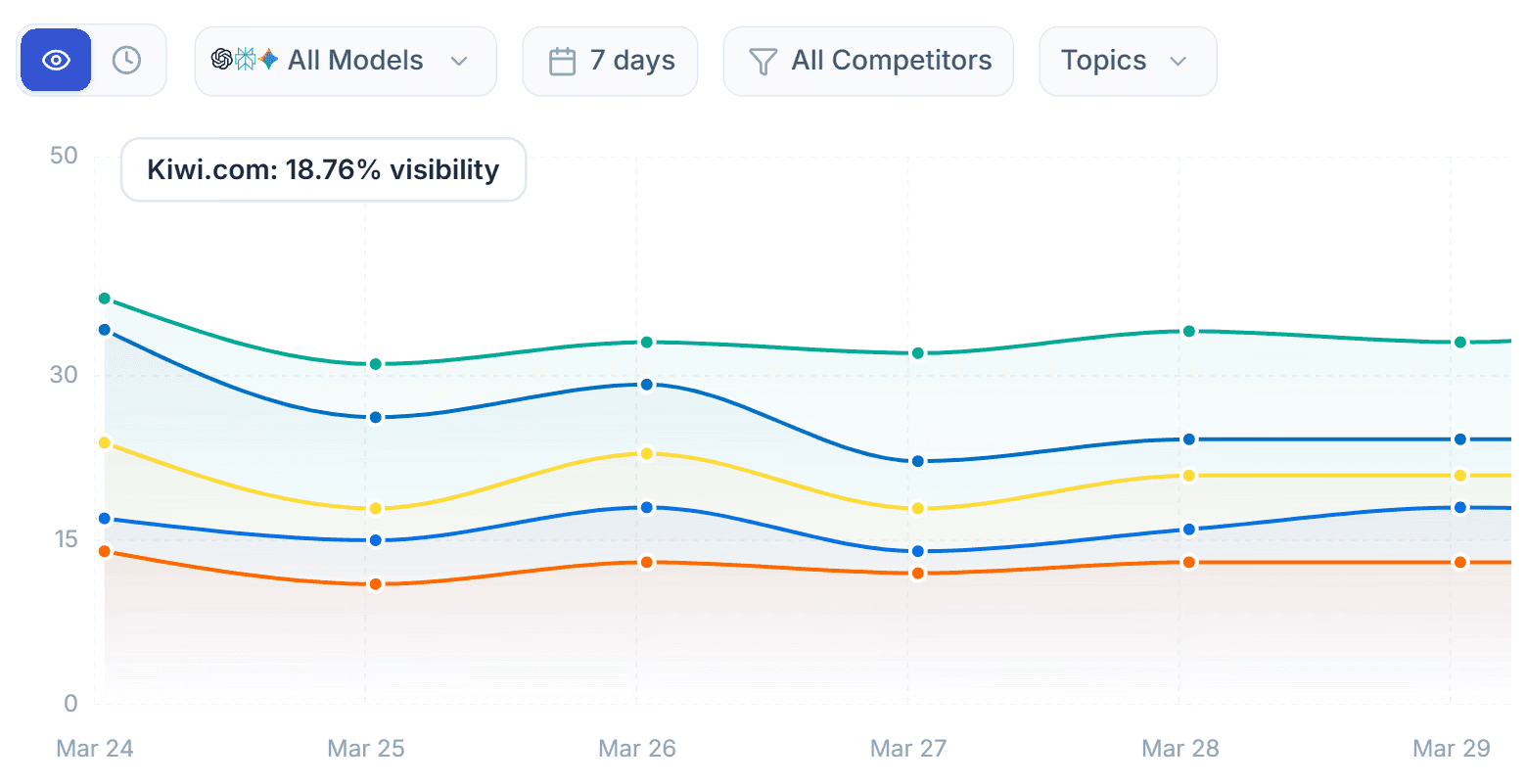
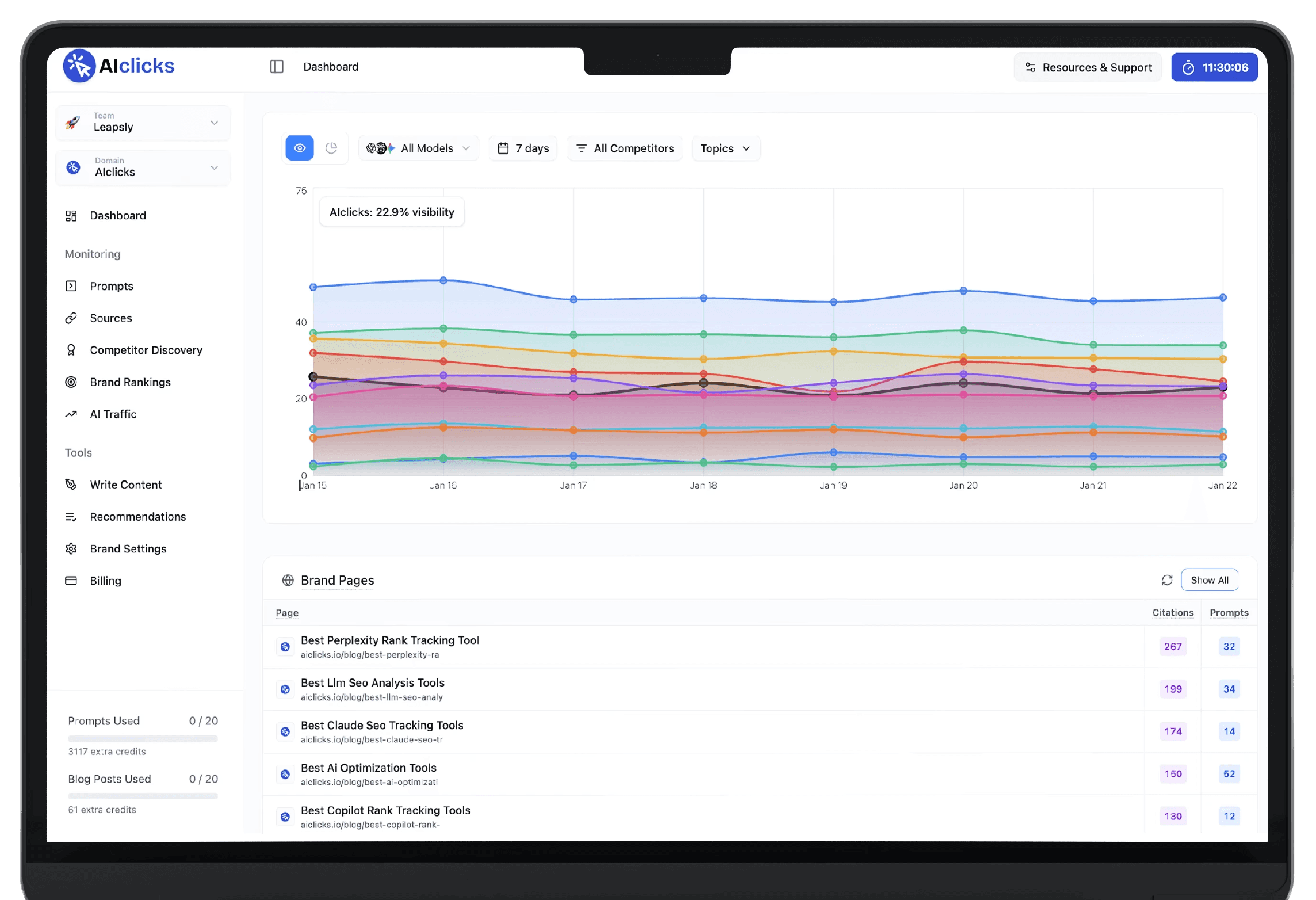
AIclicks gives you a live dashboard with daily ChatGPT mention rate, citation rate, sentiment, and share-of-voice across your tracked prompts, plus GA4 referral attribution for the traffic ChatGPT does send back.
Choose Your Plan
Flexible pricing that grows with your team. Upgrade or downgrade at any time.
Monthly
Yearly
-20%
Starter
Perfect for individuals & small teams
$49
/ month
Billed annually — you save $142
Choose 3 from:
Daily

" height="16px" id="fvSweaOBo" transform="translate(1 0)" width="14px"/></svg>)
" width="14px"><path d="M 13.864 5.629 L 13.3 5.629 L 13.3 5.6 L 7 5.6 L 7 8.4 L 10.956 8.4 C 10.379 10.03 8.828 11.2 7 11.2 C 4.681 11.2 2.8 9.319 2.8 7 C 2.8 4.681 4.681 2.8 7 2.8 C 8.071 2.8 9.045 3.204 9.786 3.864 L 11.766 1.884 C 10.516 0.719 8.844 0 7 0 C 3.134 0 0 3.134 0 7 C 0 10.866 3.134 14 7 14 C 10.866 14 14 10.866 14 7 C 14 6.531 13.952 6.073 13.864 5.629 Z" fill="rgb(255, 193, 7)" height="14px" id="H_YjfTNpn" width="14px"/><path d="M 0 3.742 L 2.3 5.429 C 2.922 3.888 4.429 2.8 6.193 2.8 C 7.264 2.8 8.238 3.204 8.979 3.864 L 10.959 1.884 C 9.709 0.719 8.037 0 6.193 0 C 3.504 0 1.172 1.518 0 3.742 Z" fill="rgb(255, 61, 0)" height="5.428500000000002px" id="PlkthQDhg" transform="translate(0.875 0)" width="10.959199999999996px"/><path d="M 6.232 5.581 C 8.04 5.581 9.683 4.889 10.925 3.764 L 8.758 1.931 C 8.032 2.483 7.144 2.782 6.232 2.781 C 4.411 2.781 2.865 1.62 2.283 0 L 0 1.759 C 1.159 4.026 3.511 5.581 6.232 5.581 Z" fill="rgb(76, 175, 80)" height="5.581099999999999px" id="WlnJ5gngE" transform="translate(0.7 8.4)" width="10.924899999999994px"/><path d="M 6.864 0.029 L 6.3 0.029 L 6.3 0 L 0 0 L 0 2.8 L 3.956 2.8 C 3.68 3.576 3.183 4.254 2.526 4.75 L 2.527 4.749 L 4.693 6.582 C 4.54 6.722 7 4.9 7 1.4 C 7 0.931 6.952 0.473 6.864 0.029 Z" fill="rgb(25, 118, 210)" height="6.589883930775992px" id="x_rSW275p" transform="translate(7 5.6)" width="7px"/></g></svg>)
" height="16px" id="hHS98fTxZ" width="16px"/></svg>)
 scale(1 1) translate(-1.861736945942159, -1.1170155383302638)" id="P20NzAvj0-699428820-radial-gradient" r="0.9935228066204626"><stop offset="0" stop-color="rgb(0, 174, 255)"/><stop offset="1" stop-color="rgb(7, 54, 196)"/></radialGradient><radialGradient cx="0.48250042504016705" cy="1.8366934653567062" gradient-transform="translate(0.48250042504016705, 1.8366934653567062) scale(1 1) translate(-0.48250042504016705, -1.8366934653567062)" id="UEWZqVjij-699428820-radial-gradient" r="0.9176890228114506"><stop offset="0" stop-color="rgb(255, 182, 87)"/><stop offset="1" stop-color="rgb(192, 43, 60)"/></radialGradient><linearGradient id="jyMN3TmKx-699428820-linear-gradient" x1="0.4594862532842614" x2="0.5405137467157386" y1="0" y2="1"><stop offset="0" stop-color="rgb(13, 145, 225)"/><stop offset="1" stop-color="rgb(255, 200, 0)"/></linearGradient><linearGradient id="xhMNwDFG0-699428820-linear-gradient" x1="0.4784828731548295" x2="0.5215171268451705" y1="5.551115123125783e-17" y2="1"><stop offset="0" stop-color="rgb(61, 203, 255)"/><stop offset="1" stop-color="rgba(5, 136, 247, 0)"/></linearGradient><radialGradient cx="1.4305090871482182" cy="0.34866158048251783" gradient-transform="translate(1.4305090871482182, 0.34866158048251783) scale(1 1) translate(-1.4305090871482182, -0.34866158048251783)" id="i79kAqaS4-699428820-radial-gradient" r="1.3362743412697924"><stop offset="0" stop-color="rgb(140, 72, 255)"/><stop offset="1" stop-color="rgb(255, 177, 82)"/></radialGradient><linearGradient id="mcxvno3tX-699428820-linear-gradient" x1="0.49844355920154226" x2="0.5015564407984577" y1="0" y2="1"><stop offset="0" stop-color="rgb(248, 173, 250)"/><stop offset="1" stop-color="rgba(168, 110, 221, 0)"/></linearGradient></defs><g d="M 11.605 1.219 C 11.397 0.499 10.739 0.002 9.989 0 L 9.498 0 C 8.682 0.002 7.985 0.588 7.842 1.391 L 7 6.016 L 7.209 5.296 C 7.416 4.574 8.075 4.076 8.825 4.074 L 11.681 4.074 L 12.879 4.545 L 14.033 4.074 L 13.697 4.074 C 12.947 4.072 12.289 3.575 12.081 2.855 Z M 4.413 13.387 C 4.618 14.111 5.278 14.611 6.031 14.613 L 7.075 14.613 C 7.988 14.613 8.735 13.88 8.758 12.96 L 8.871 8.5 L 8.633 9.319 C 8.426 10.039 7.768 10.537 7.018 10.539 L 4.138 10.539 L 3.111 9.977 L 2 10.539 L 2.331 10.539 C 3.084 10.542 3.743 11.042 3.949 11.766 L 4.413 13.387 Z M 9.999 0 L 4.167 0 C 2.501 0 1.501 2.221 0.834 4.441 C 0.045 7.073 -0.989 10.591 2.001 10.591 L 4.519 10.591 C 5.273 10.591 5.933 10.089 6.139 9.36 C 6.577 7.815 7.345 5.121 7.948 3.069 C 8.255 2.027 8.509 1.132 8.901 0.575 C 9.148 0.212 9.56 -0.004 9.999 0 M 9.999 0 L 4.167 0 C 2.501 0 1.501 2.221 0.834 4.441 C 0.045 7.073 -0.989 10.591 2.001 10.591 L 4.519 10.591 C 5.273 10.591 5.933 10.089 6.139 9.36 C 6.577 7.815 7.345 5.121 7.948 3.069 C 8.255 2.027 8.509 1.132 8.901 0.575 C 9.148 0.212 9.56 -0.004 9.999 0 M 6 14.593 L 11.833 14.593 C 13.499 14.593 14.499 12.372 15.166 10.151 C 15.955 7.519 16.989 4 13.999 4 L 11.48 4 C 10.725 4.002 10.063 4.505 9.86 5.232 C 9.266 7.332 8.663 9.429 8.051 11.523 C 7.745 12.566 7.49 13.461 7.098 14.019 C 6.851 14.382 6.439 14.597 6 14.593 M 6 14.593 L 11.833 14.593 C 13.499 14.593 14.499 12.372 15.166 10.151 C 15.955 7.519 16.989 4 13.999 4 L 11.48 4 C 10.725 4.002 10.063 4.505 9.86 5.232 C 9.266 7.332 8.663 9.429 8.051 11.523 C 7.745 12.566 7.49 13.461 7.098 14.019 C 6.851 14.382 6.439 14.597 6 14.593" fill="transparent" height="14.613333333333333px" id="QzkBy4Ibc" transform="translate(0 1)" width="16.00011071294081px"><path d="M 4.605 1.219 C 4.397 0.499 3.739 0.002 2.989 0 L 2.498 0 C 1.682 0.002 0.985 0.588 0.842 1.391 L 0 6.016 L 0.209 5.296 C 0.416 4.574 1.075 4.076 1.825 4.074 L 4.681 4.074 L 5.879 4.545 L 7.033 4.074 L 6.697 4.074 C 5.947 4.072 5.289 3.575 5.081 2.855 Z" fill="url(%23P20NzAvj0-699428820-radial-gradient)" height="6.016px" id="P20NzAvj0" transform="translate(7 0)" width="7.0333333333333385px"/><path d="M 2.413 4.887 C 2.618 5.611 3.278 6.111 4.031 6.113 L 5.075 6.113 C 5.988 6.113 6.735 5.38 6.758 4.46 L 6.871 0 L 6.633 0.819 C 6.426 1.539 5.768 2.037 5.018 2.039 L 2.138 2.039 L 1.111 1.477 L 0 2.039 L 0.331 2.039 C 1.084 2.042 1.743 2.542 1.949 3.266 L 2.413 4.887 Z" fill="url(%23UEWZqVjij-699428820-radial-gradient)" height="6.113333333333333px" id="UEWZqVjij" transform="translate(2 8.5)" width="6.871333333333332px"/><path d="M 9.999 0 L 4.167 0 C 2.501 0 1.501 2.221 0.834 4.441 C 0.045 7.073 -0.989 10.591 2.001 10.591 L 4.519 10.591 C 5.273 10.591 5.933 10.089 6.139 9.36 C 6.577 7.815 7.345 5.121 7.948 3.069 C 8.255 2.027 8.509 1.132 8.901 0.575 C 9.148 0.212 9.56 -0.004 9.999 0" fill="url(%23jyMN3TmKx-699428820-linear-gradient)" height="10.591388755215167px" id="jyMN3TmKx" width="9.999444046274142px"/><path d="M 9.999 0 L 4.167 0 C 2.501 0 1.501 2.221 0.834 4.441 C 0.045 7.073 -0.989 10.591 2.001 10.591 L 4.519 10.591 C 5.273 10.591 5.933 10.089 6.139 9.36 C 6.577 7.815 7.345 5.121 7.948 3.069 C 8.255 2.027 8.509 1.132 8.901 0.575 C 9.148 0.212 9.56 -0.004 9.999 0" fill="url(%23xhMNwDFG0-699428820-linear-gradient)" height="10.591388755215167px" id="xhMNwDFG0" width="9.999444046274142px"/><path d="M 0 10.593 L 5.833 10.593 C 7.499 10.593 8.499 8.372 9.166 6.151 C 9.955 3.519 10.989 0 7.999 0 L 5.48 0 C 4.725 0.002 4.063 0.505 3.86 1.232 C 3.266 3.332 2.663 5.429 2.051 7.523 C 1.745 8.566 1.49 9.461 1.098 10.019 C 0.851 10.382 0.439 10.597 0 10.593" fill="url(%23i79kAqaS4-699428820-radial-gradient)" height="10.593388755215164px" id="i79kAqaS4" transform="translate(6 4)" width="10.000110712940803px"/><path d="M 0 10.593 L 5.833 10.593 C 7.499 10.593 8.499 8.372 9.166 6.151 C 9.955 3.519 10.989 0 7.999 0 L 5.48 0 C 4.725 0.002 4.063 0.505 3.86 1.232 C 3.266 3.332 2.663 5.429 2.051 7.523 C 1.745 8.566 1.49 9.461 1.098 10.019 C 0.851 10.382 0.439 10.597 0 10.593" fill="url(%23mcxvno3tX-699428820-linear-gradient)" height="10.593388755215164px" id="mcxvno3tX" transform="translate(6 4)" width="10.000110712940803px"/></g></svg>)
" height="15.360666565427872px" id="HZPvvPBv7" transform="translate(0 0.5)" width="16px"/></svg>)
Tracked prompts
30
Websites you can add
3
LLMs you can track
3
Countries per project
1
LLM responses / mo
4,650
AI-optimized articles per month
10
Integrations
-
Support
Pro
For growing teams for more power
$140
/ month
Billed annually — you save $454
Choose 4 from:
Daily
Tracked prompts
150
Websites you can add
Unlimited
LLMs you can track
4
Countries per project
Unlimited
LLM responses / mo
18,600
AI-optimized articles per month
20
Integrations
Google Analytics
Support
BUSINESS
Best for medium-sized organizations
$357
/ month
Billed annually — you save $1198
Choose 6 from:
Daily
Tracked prompts
300
Websites you can add
Unlimited
LLMs you can track
6
Countries per project
Unlimited
LLM responses / mo
55,800
AI-optimized articles per month
30
Integrations
Google Analytics, API
Support
Dedicated account specialist
Become the #1 Answer in AI
Succeed in GEO yourself, or let us do all the work.
Do it yourself
Use AIclicks to see exactly where you appear across 10+ AI platforms, spot the gaps competitors are filling, and act on clear weekly recommendations.
From $59/month · Cancel anytime
Done for you
We Do All the Work for You
Our team manages your complete search presence: traditional SEO and GEO strategy, content, implementation, and reporting. You focus on customers.
Custom pricing · Minimum 3-month engagement
The AI SEO agency trusted by 1,000+ brands worldwide
From solo founders to multi-client agencies, AIclicks runs the full AI SEO agency program for organizations of every shape and size that want to be cited across every AI surface.
4.9/5 stars on G2







FAQ
How long does locksmith SEO take to bring calls?
Map pack movement usually shows in 4 to 8 weeks, and steady call volume around 3 to 6 months. Local Services Ads verification adds another 2 to 6 weeks before the badge appears. Commercial and master-key terms compound more slowly, often 6 to 12 months, because those buyers research longer. Keyword difficulty in this trade sits near 25%, so smaller markets move faster than large metros.
Should we bother with ChatGPT or just Google?
Both, and locksmiths are unusually exposed on the AI side. Ahrefs analysed 863,000 keywords and found only 38% of pages cited in AI Overviews also ranked in the top 10, down from 76% a year earlier. Worse, assistants asked for a locksmith hedge hard because of the trade’s scam history, and they lean on BBB, ALOA and review text rather than your site. Being verifiable is what gets you named.
How is locksmith SEO different from normal local SEO?
Google treats locksmiths as a high-risk category, alongside garage door companies, and that changes everything. New profiles face advanced video verification, reinstatement after a suspension is genuinely difficult, and legitimate shops get caught in filters built for fake listings. Local Services Ads sit above the map pack and demand license, insurance and background checks. Generic local SEO advice assumes none of this and leaves operators stranded when a profile disappears.
What should a locksmith budget for SEO?
Practitioners on r/SEO report quotes from roughly $1,000 to $1,200 a month for a single-market locksmith, with multi-van and multi-city operations running higher. Judge it against what you already spend: emergency locksmith clicks run $30 to $35, and Local Services Ads charge $25 to $75 per lead. A retainer that steadily lowers your cost per billable job is the cheaper line within a year.
Do we still need LSA and Google Ads?
Yes, and they stack rather than compete. Local Services Ads sit above the map pack and charge per lead, so they cover emergency demand while organic authority builds. Google Ads fills the gaps you cannot rank for yet. The discipline is attribution: put dynamic number insertion on every source so you can see which channel produced a billable job rather than a price-shopping call, then shift budget accordingly.
Which pages should a locksmith build first?
Google Business Profile first, verified properly, because nothing else matters while it is unverified or suspended. Then your emergency lockout page, which captures the highest-intent searches in the trade. Then car key replacement, house rekey and commercial master-key as separate pages. Then a pricing page and a license and insurance page. City pages after that. The blog is last, and only for questions customers genuinely ask.
How do we know the SEO is actually working?
Count billable jobs from organic search, not rankings. Almost every locksmith lead is a phone call, so without call tracking it never appears in analytics at all. Use CallRail or CallTrackingMetrics with a separate number per source, and record calls so you can separate real jobs from price shoppers. Watch Google Business Profile calls and direction requests, which move first, and Search Console impressions on job terms.
Should we do this ourselves or hire someone?
Split it. Review requests, job photos, profile posts and honest pricing answers are better done by whoever is in the van, because nobody outside knows the work. Hand out the technical layer: schema, site speed, citation cleanup and call-tracking setup. When hiring, ask directly how they handle a suspended profile and whether they have taken a locksmith through advanced verification. Anyone selling you 200 directory links is selling the old problem.
Further Reading
Go deeper on GEO, AI search, and visibility tracking.