SEO for Law Firms:
Someone with a legal problem searches before they call anyone. They read 3 or 4 firms’ pages, check reviews, and ask ChatGPT who to trust, usually before your intake team hears the phone ring. Search visibility decides which firms make that shortlist.









Why Law Firms Need SEO
Legal keywords are among the most expensive in paid search. Ahrefs found 17.52% of the priciest terms in its 28.7-billion-keyword database are legal. Organic visibility is the only version that compounds.
Most firms build one page per practice area and stop. A prospect searching a specific situation, a rear-end collision or a contested custody modification, lands on a competitor who wrote about exactly that. You lose the case before intake and never know it existed.
Search personal injury lawyer near me in a US city and you will usually find a directory above the first firm. Super Lawyers and Justia rank on aggregate authority no single firm can match, then sell your competitors placement on the listing that outranked you.
Firms routinely pay over $100 a click for competitive legal terms, and some personal injury keywords clear $200. Agency retainers run $2,500 to $10,000 a month on top. Stop the ad spend and the pipeline stops that afternoon. You have bought traffic, not an asset.
How SEO Works for Law Firms
Search Engine Optimization projects are long-term investments for lawyers, where each task supplements the others and creates compound results over time.
01
Keywords, page structure, and the signals Google reads directly
On-page work is harder for law firms than for almost any other local business, because Google files legal content under YMYL, Your Money or Your Life, and applies its strictest quality bar before ranking it. A page that would rank fine for a landscaper gets held back for a lawyer unless it shows who wrote it, what they are admitted to practise, and why they are qualified to say it. The pages that carry this weight are your practice area pages, your attorney bios, and your case result pages, not the blog.
The durable assets are the ones tied to a situation rather than a season. A page explaining how comparative fault works in your state, or what happens at a first custody hearing, keeps earning enquiries for years because the law changes slowly and the questions do not. Firm news, award announcements, and commentary on this month’s verdict churn out of the index within weeks. Most firms have the ratio backwards: a thin practice area page that never gets touched, and a blog updated weekly with content nobody actually searches for.
1
Rebuild each practice area page around one specific situation, with the attorney who handles it named and credentialed on the page.
2
Audit old case results and outdated statute pages quarterly in Search Console; update the law, or 301 them into the practice area page.
3
Mark up every attorney bio with Attorney schema and each practice area with LegalService, then validate in Google’s Rich Results Test.
4
Publish state-specific explainers on deadlines, fault rules and fee structures, the questions clients ask on every call, answered once.
02
Map Pack visibility, citations, and proximity signals
Legal demand is overwhelmingly local: an injured client hires a firm in their own city, and Google knows it. That is why the map pack sits above every organic result for lawyer near me queries, and why 3 firms capture the calls while everyone below fights for what is left. For most firms the local pack delivers more signed cases than the rest of the site combined, and it costs nothing to claim.
A complete legal profile picks the narrowest accurate primary category, Personal Injury Attorney rather than Lawyer, then lists each practice area as its own service with a description. Add real office photos rather than stock, genuine hours including after-hours availability if you offer it, and pre-answered questions in the Q&A covering fees, consultations and languages spoken. Post weekly. Google visibly favours profiles someone is actually maintaining.
Legal has its own citation layer that general local SEO advice misses. Avvo, Martindale-Hubbell, Justia, Super Lawyers and FindLaw carry weight with Google precisely because they verify bar admission. Your state and county bar association listings matter for the same reason. Every one of those needs the identical firm name, suite number and phone, because a single mismatched address across 40 listings quietly dilutes the signal all of them were meant to send.
1
Set the primary category to your highest-value practice area, then add every other area as a separate service entry with its own description.
2
Give every office its own profile and its own page listing the attorneys who actually sit there, never one page with 3 addresses.
3
Run BrightLocal or Yext across Avvo, Justia, Martindale-Hubbell and your state bar listing, and fix every name or suite-number variant.
4
Post one Google Business Profile update a week: a case result, a new attorney, a plain-language answer to a question clients keep asking.
03
Topic authority, inbound links, and content that earns traffic
Before anyone calls a firm they are trying to work out whether they even have a case, what it might be worth, and what it will cost them to find out. Content that answers those 3 questions honestly outperforms anything written to rank. A page explaining how contingency fees actually work, or what the filing deadline is in your state, earns trust at exactly the moment the reader is deciding who to call.
The reader who has decided they need a lawyer is now comparing firms, and they are looking for evidence rather than adjectives. Case results with the facts and the number, attorney bios that name the courts you appear in, and straight answers about who pays what and when will do more than any amount of experienced and compassionate. This is also where reviews stop being a local ranking factor and start being the deciding one.
Legal link building is unusually tractable because the legitimate sources are all institutional. Bar associations publish member directories and committee pages. Law schools list adjuncts and alumni. Local news needs a lawyer to explain a ruling on deadline, and services like Qwoted and Featured exist to broker exactly that. Legal aid organisations, chambers of commerce and the charities you already sponsor will link if asked. None of it requires buying anything.
1
Publish an annual guide to what a case in your practice area costs in your state, using real fee structures rather than ranges.
2
Build one page per case type per city you serve, such as rear-end collision lawyer plus the town name, using genuinely local detail.
3
Cluster every how much does a lawyer cost variant into one hub covering contingency, hourly, retainers and costs advanced, then interlink the spokes.
4
Create a page for each court and county you practise in, covering local filing rules and judges, the specialism competitors never document.
04
Site speed, crawlability, Core Web Vitals, and mobile health
The failure almost every firm shares is duplication at scale. The city-page template gets cloned 40 times with the town name swapped, and Google quietly indexes 3 of them. Meanwhile the site runs on a WordPress theme built in 2018, carrying attorney photos at full camera resolution and a page-builder plugin that ships 40 kilobytes of unused CSS to every visitor. Nobody notices, because the homepage still ranks for the firm’s own name.
Legal searches spike in the worst moments of someone’s life, and they happen on a phone, often at a roadside, in a hospital corridor, or the night before a hearing. That reader has no patience and no second attempt. If the page takes more than a couple of seconds, or the call button sits below a cookie banner they cannot dismiss one-handed, they are back in the results calling the next firm.
1
Crawl the site with Screaming Frog, flag city pages sharing more than 70% of their text, and rewrite or consolidate them.
2
Run PageSpeed Insights on your heaviest attorney bio, usually the photo-led ones, and target Largest Contentful Paint under 2.5 seconds.
3
Serve attorney headshots and courtroom photos as WebP at display size, with explicit width and height to stop layout shift.
4
Split the sitemap so practice areas and locations sit apart from blog archives, and resubmit whenever a case result page is published.
05
Star ratings, review volume, and response strategy that builds trust
Reviews decide legal searches more than almost any other trade, because the reader is handing a stranger something they cannot afford to lose. They are also the hardest reviews in any industry to collect. Confidentiality makes some clients unwilling to be named at all, bar advertising rules restrict what a firm may solicit or republish, and the outcome that would earn 5 stars often lands 18 months after the client last thought about you.
The moment to ask is the day the matter resolves in the client’s favour, not at case closure weeks later, when the paperwork has flattened the relief. Build the request into your case management workflow so it fires automatically on status change, with the attorney’s name on it rather than the firm’s. One link, one sentence, no forms and no login. Ask every client, every time, and the volume problem solves itself.
1
Wire Clio or MyCase to send the review link the moment a matter is marked resolved, signed by the handling attorney.
2
Respond within 24 hours without confirming the person was ever a client, because confidentiality binds you even when the reviewer volunteers everything.
3
Pull reviews mentioning a specific case type onto that practice area page, not into a single site-wide testimonials carousel.
4
Ask referring attorneys and co-counsel for reviews too, because professional endorsements read differently to prospects than client testimonials do.
Google is No Longer the Only Place Your clients are Searching
Clients are using AI to find answers, and they trust what it tells them. Invest in GEO to get recommended in those answers.
1 Billion
Questions ChatGPT receives every single day
38%
Your #1 top ranking page on Google would be cited by AI
14%
of lawyers optimise for GEO. The rest are invisible in AI answers


You can rank #1 for “lawyer near me” and still not exist in ChatGPT’s answer. Run a free GEO audit to see where your brand actually stands.
GEO vs SEO: Same Goal, Different Methods
GEO is wider than SEO. AI recommends the brands that show up across the sources it reads, so your presence in forums, social platforms and legal blogs decides your odds. AIclicks measures the three metrics below so you know which to work on first.
AI Assistant
Which law firm should I call after a crash?
Your Firm
Citation Rate
Shows how many AI answers about law firms name your brand, out of every 100. Models pull from the same trusted pages over and over, so citations compound: once you are in, staying in gets easier. Find the competitor pages AI cites most, then publish your own version of each.
Your Firm
82% positive
Competitor A
54% positive
Competitor B
38% positive
Brand Sentiment
Shows how AI describes you when your brand comes up: positive, neutral or negative. Tone is what separates being mentioned from being recommended, and models repeat whatever framing they find. Track the negative mentions back to the reviews and threads behind them, then publish content that answers those directly.
Others 52%
You 24%
— 24%
Your Firm
AI mention share of voice — legal category
Competitors
Not Cited
Share of Voice in AI
Shows how much of the legal conversation belongs to you rather than your competitors. This is the metric that matters most, the GEO version of a Google ranking. With only 1–5 brands named per answer, the market is winner-takes-more and every point is taken from someone.
The Dashboard Your Dedicated AI Search Team Works In
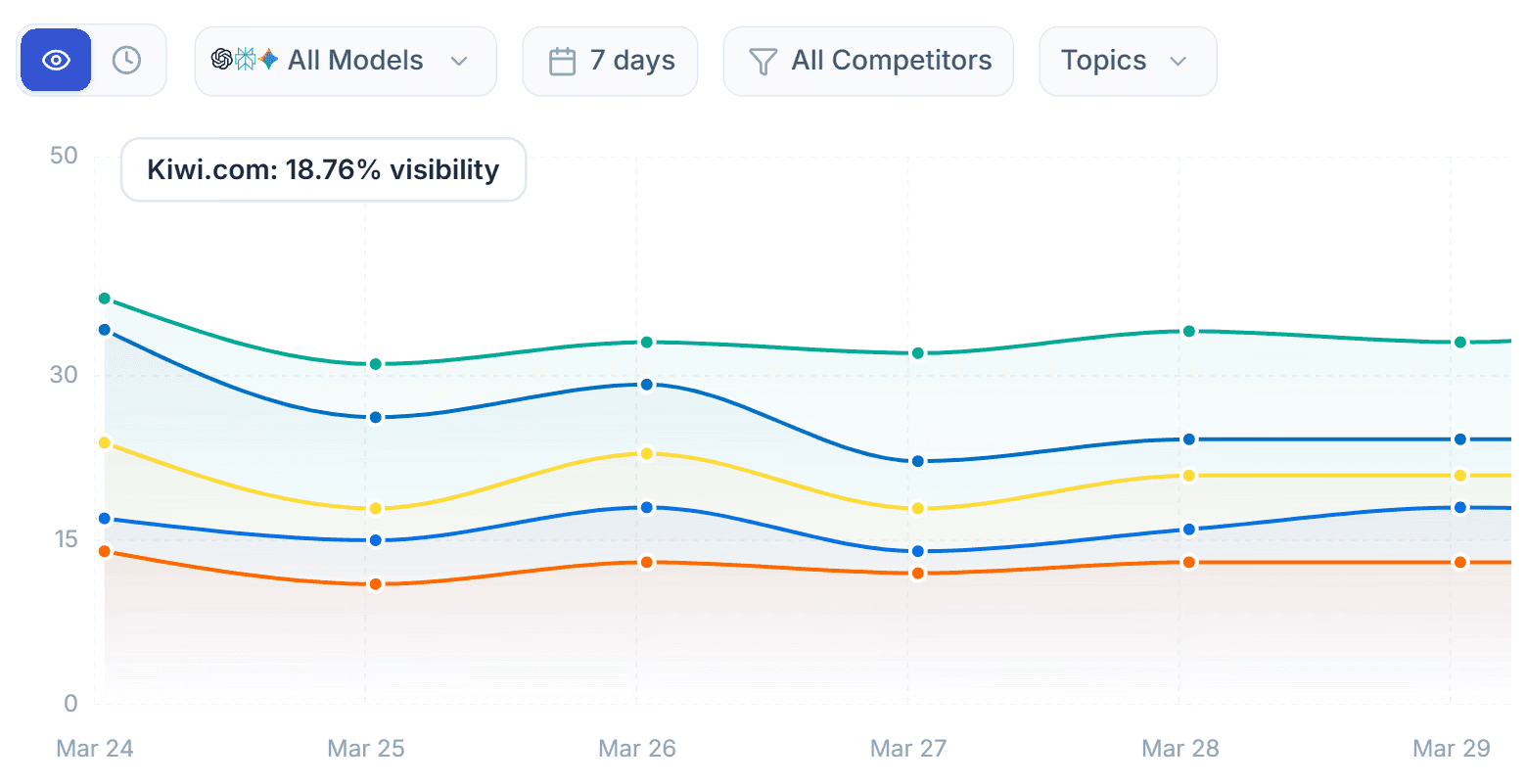
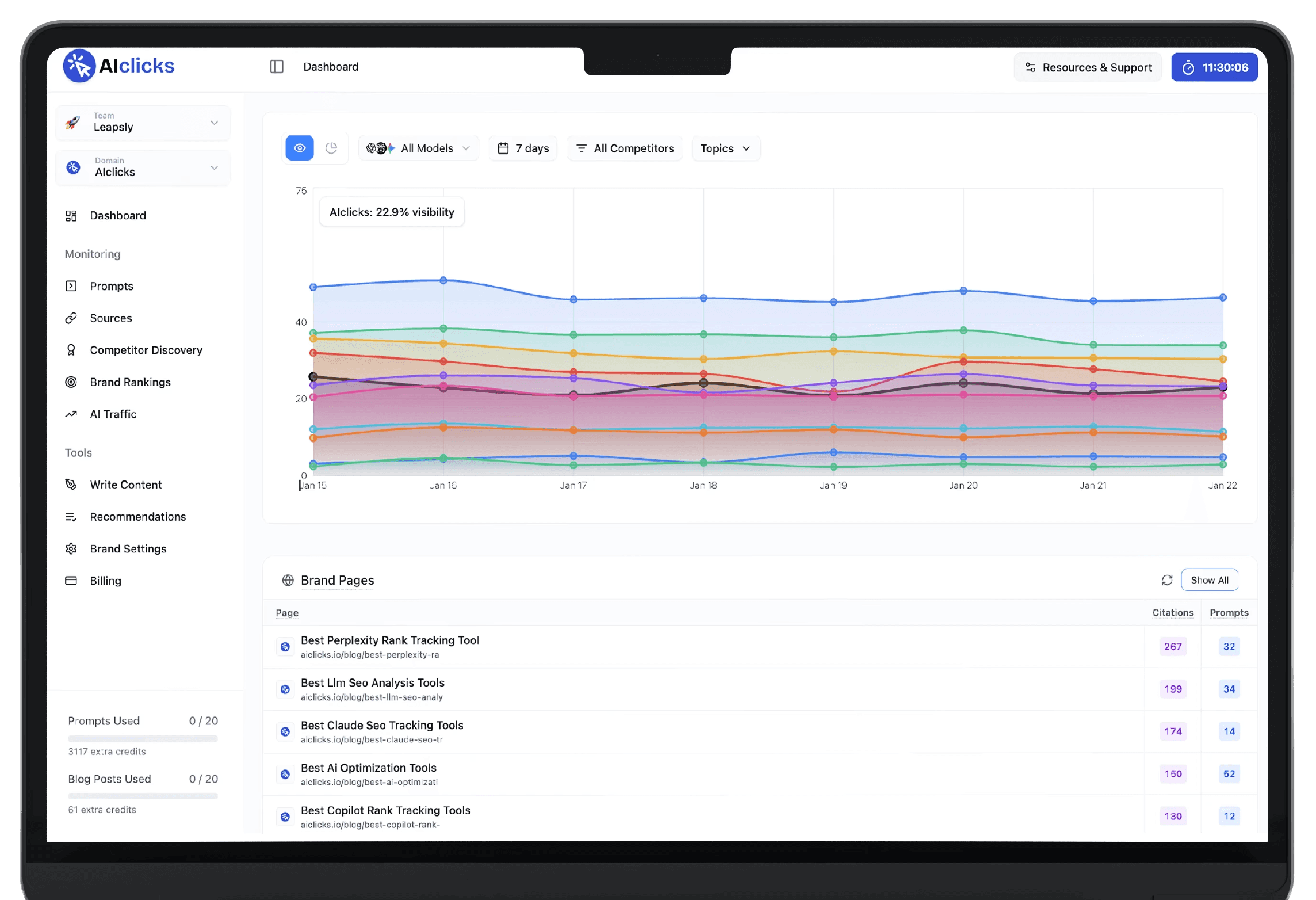
AIclicks gives you a live dashboard with daily ChatGPT mention rate, citation rate, sentiment, and share-of-voice across your tracked prompts, plus GA4 referral attribution for the traffic ChatGPT does send back.
Choose Your Plan
Flexible pricing that grows with your team. Upgrade or downgrade at any time.
Monthly
Yearly
-20%
Starter
Perfect for individuals & small teams
$49
/ month
Billed annually — you save $142
Choose 3 from:
Daily

" height="16px" id="fvSweaOBo" transform="translate(1 0)" width="14px"/></svg>)
" width="14px"><path d="M 13.864 5.629 L 13.3 5.629 L 13.3 5.6 L 7 5.6 L 7 8.4 L 10.956 8.4 C 10.379 10.03 8.828 11.2 7 11.2 C 4.681 11.2 2.8 9.319 2.8 7 C 2.8 4.681 4.681 2.8 7 2.8 C 8.071 2.8 9.045 3.204 9.786 3.864 L 11.766 1.884 C 10.516 0.719 8.844 0 7 0 C 3.134 0 0 3.134 0 7 C 0 10.866 3.134 14 7 14 C 10.866 14 14 10.866 14 7 C 14 6.531 13.952 6.073 13.864 5.629 Z" fill="rgb(255, 193, 7)" height="14px" id="H_YjfTNpn" width="14px"/><path d="M 0 3.742 L 2.3 5.429 C 2.922 3.888 4.429 2.8 6.193 2.8 C 7.264 2.8 8.238 3.204 8.979 3.864 L 10.959 1.884 C 9.709 0.719 8.037 0 6.193 0 C 3.504 0 1.172 1.518 0 3.742 Z" fill="rgb(255, 61, 0)" height="5.428500000000002px" id="PlkthQDhg" transform="translate(0.875 0)" width="10.959199999999996px"/><path d="M 6.232 5.581 C 8.04 5.581 9.683 4.889 10.925 3.764 L 8.758 1.931 C 8.032 2.483 7.144 2.782 6.232 2.781 C 4.411 2.781 2.865 1.62 2.283 0 L 0 1.759 C 1.159 4.026 3.511 5.581 6.232 5.581 Z" fill="rgb(76, 175, 80)" height="5.581099999999999px" id="WlnJ5gngE" transform="translate(0.7 8.4)" width="10.924899999999994px"/><path d="M 6.864 0.029 L 6.3 0.029 L 6.3 0 L 0 0 L 0 2.8 L 3.956 2.8 C 3.68 3.576 3.183 4.254 2.526 4.75 L 2.527 4.749 L 4.693 6.582 C 4.54 6.722 7 4.9 7 1.4 C 7 0.931 6.952 0.473 6.864 0.029 Z" fill="rgb(25, 118, 210)" height="6.589883930775992px" id="x_rSW275p" transform="translate(7 5.6)" width="7px"/></g></svg>)
" height="16px" id="hHS98fTxZ" width="16px"/></svg>)
 scale(1 1) translate(-1.861736945942159, -1.1170155383302638)" id="P20NzAvj0-699428820-radial-gradient" r="0.9935228066204626"><stop offset="0" stop-color="rgb(0, 174, 255)"/><stop offset="1" stop-color="rgb(7, 54, 196)"/></radialGradient><radialGradient cx="0.48250042504016705" cy="1.8366934653567062" gradient-transform="translate(0.48250042504016705, 1.8366934653567062) scale(1 1) translate(-0.48250042504016705, -1.8366934653567062)" id="UEWZqVjij-699428820-radial-gradient" r="0.9176890228114506"><stop offset="0" stop-color="rgb(255, 182, 87)"/><stop offset="1" stop-color="rgb(192, 43, 60)"/></radialGradient><linearGradient id="jyMN3TmKx-699428820-linear-gradient" x1="0.4594862532842614" x2="0.5405137467157386" y1="0" y2="1"><stop offset="0" stop-color="rgb(13, 145, 225)"/><stop offset="1" stop-color="rgb(255, 200, 0)"/></linearGradient><linearGradient id="xhMNwDFG0-699428820-linear-gradient" x1="0.4784828731548295" x2="0.5215171268451705" y1="5.551115123125783e-17" y2="1"><stop offset="0" stop-color="rgb(61, 203, 255)"/><stop offset="1" stop-color="rgba(5, 136, 247, 0)"/></linearGradient><radialGradient cx="1.4305090871482182" cy="0.34866158048251783" gradient-transform="translate(1.4305090871482182, 0.34866158048251783) scale(1 1) translate(-1.4305090871482182, -0.34866158048251783)" id="i79kAqaS4-699428820-radial-gradient" r="1.3362743412697924"><stop offset="0" stop-color="rgb(140, 72, 255)"/><stop offset="1" stop-color="rgb(255, 177, 82)"/></radialGradient><linearGradient id="mcxvno3tX-699428820-linear-gradient" x1="0.49844355920154226" x2="0.5015564407984577" y1="0" y2="1"><stop offset="0" stop-color="rgb(248, 173, 250)"/><stop offset="1" stop-color="rgba(168, 110, 221, 0)"/></linearGradient></defs><g d="M 11.605 1.219 C 11.397 0.499 10.739 0.002 9.989 0 L 9.498 0 C 8.682 0.002 7.985 0.588 7.842 1.391 L 7 6.016 L 7.209 5.296 C 7.416 4.574 8.075 4.076 8.825 4.074 L 11.681 4.074 L 12.879 4.545 L 14.033 4.074 L 13.697 4.074 C 12.947 4.072 12.289 3.575 12.081 2.855 Z M 4.413 13.387 C 4.618 14.111 5.278 14.611 6.031 14.613 L 7.075 14.613 C 7.988 14.613 8.735 13.88 8.758 12.96 L 8.871 8.5 L 8.633 9.319 C 8.426 10.039 7.768 10.537 7.018 10.539 L 4.138 10.539 L 3.111 9.977 L 2 10.539 L 2.331 10.539 C 3.084 10.542 3.743 11.042 3.949 11.766 L 4.413 13.387 Z M 9.999 0 L 4.167 0 C 2.501 0 1.501 2.221 0.834 4.441 C 0.045 7.073 -0.989 10.591 2.001 10.591 L 4.519 10.591 C 5.273 10.591 5.933 10.089 6.139 9.36 C 6.577 7.815 7.345 5.121 7.948 3.069 C 8.255 2.027 8.509 1.132 8.901 0.575 C 9.148 0.212 9.56 -0.004 9.999 0 M 9.999 0 L 4.167 0 C 2.501 0 1.501 2.221 0.834 4.441 C 0.045 7.073 -0.989 10.591 2.001 10.591 L 4.519 10.591 C 5.273 10.591 5.933 10.089 6.139 9.36 C 6.577 7.815 7.345 5.121 7.948 3.069 C 8.255 2.027 8.509 1.132 8.901 0.575 C 9.148 0.212 9.56 -0.004 9.999 0 M 6 14.593 L 11.833 14.593 C 13.499 14.593 14.499 12.372 15.166 10.151 C 15.955 7.519 16.989 4 13.999 4 L 11.48 4 C 10.725 4.002 10.063 4.505 9.86 5.232 C 9.266 7.332 8.663 9.429 8.051 11.523 C 7.745 12.566 7.49 13.461 7.098 14.019 C 6.851 14.382 6.439 14.597 6 14.593 M 6 14.593 L 11.833 14.593 C 13.499 14.593 14.499 12.372 15.166 10.151 C 15.955 7.519 16.989 4 13.999 4 L 11.48 4 C 10.725 4.002 10.063 4.505 9.86 5.232 C 9.266 7.332 8.663 9.429 8.051 11.523 C 7.745 12.566 7.49 13.461 7.098 14.019 C 6.851 14.382 6.439 14.597 6 14.593" fill="transparent" height="14.613333333333333px" id="QzkBy4Ibc" transform="translate(0 1)" width="16.00011071294081px"><path d="M 4.605 1.219 C 4.397 0.499 3.739 0.002 2.989 0 L 2.498 0 C 1.682 0.002 0.985 0.588 0.842 1.391 L 0 6.016 L 0.209 5.296 C 0.416 4.574 1.075 4.076 1.825 4.074 L 4.681 4.074 L 5.879 4.545 L 7.033 4.074 L 6.697 4.074 C 5.947 4.072 5.289 3.575 5.081 2.855 Z" fill="url(%23P20NzAvj0-699428820-radial-gradient)" height="6.016px" id="P20NzAvj0" transform="translate(7 0)" width="7.0333333333333385px"/><path d="M 2.413 4.887 C 2.618 5.611 3.278 6.111 4.031 6.113 L 5.075 6.113 C 5.988 6.113 6.735 5.38 6.758 4.46 L 6.871 0 L 6.633 0.819 C 6.426 1.539 5.768 2.037 5.018 2.039 L 2.138 2.039 L 1.111 1.477 L 0 2.039 L 0.331 2.039 C 1.084 2.042 1.743 2.542 1.949 3.266 L 2.413 4.887 Z" fill="url(%23UEWZqVjij-699428820-radial-gradient)" height="6.113333333333333px" id="UEWZqVjij" transform="translate(2 8.5)" width="6.871333333333332px"/><path d="M 9.999 0 L 4.167 0 C 2.501 0 1.501 2.221 0.834 4.441 C 0.045 7.073 -0.989 10.591 2.001 10.591 L 4.519 10.591 C 5.273 10.591 5.933 10.089 6.139 9.36 C 6.577 7.815 7.345 5.121 7.948 3.069 C 8.255 2.027 8.509 1.132 8.901 0.575 C 9.148 0.212 9.56 -0.004 9.999 0" fill="url(%23jyMN3TmKx-699428820-linear-gradient)" height="10.591388755215167px" id="jyMN3TmKx" width="9.999444046274142px"/><path d="M 9.999 0 L 4.167 0 C 2.501 0 1.501 2.221 0.834 4.441 C 0.045 7.073 -0.989 10.591 2.001 10.591 L 4.519 10.591 C 5.273 10.591 5.933 10.089 6.139 9.36 C 6.577 7.815 7.345 5.121 7.948 3.069 C 8.255 2.027 8.509 1.132 8.901 0.575 C 9.148 0.212 9.56 -0.004 9.999 0" fill="url(%23xhMNwDFG0-699428820-linear-gradient)" height="10.591388755215167px" id="xhMNwDFG0" width="9.999444046274142px"/><path d="M 0 10.593 L 5.833 10.593 C 7.499 10.593 8.499 8.372 9.166 6.151 C 9.955 3.519 10.989 0 7.999 0 L 5.48 0 C 4.725 0.002 4.063 0.505 3.86 1.232 C 3.266 3.332 2.663 5.429 2.051 7.523 C 1.745 8.566 1.49 9.461 1.098 10.019 C 0.851 10.382 0.439 10.597 0 10.593" fill="url(%23i79kAqaS4-699428820-radial-gradient)" height="10.593388755215164px" id="i79kAqaS4" transform="translate(6 4)" width="10.000110712940803px"/><path d="M 0 10.593 L 5.833 10.593 C 7.499 10.593 8.499 8.372 9.166 6.151 C 9.955 3.519 10.989 0 7.999 0 L 5.48 0 C 4.725 0.002 4.063 0.505 3.86 1.232 C 3.266 3.332 2.663 5.429 2.051 7.523 C 1.745 8.566 1.49 9.461 1.098 10.019 C 0.851 10.382 0.439 10.597 0 10.593" fill="url(%23mcxvno3tX-699428820-linear-gradient)" height="10.593388755215164px" id="mcxvno3tX" transform="translate(6 4)" width="10.000110712940803px"/></g></svg>)
" height="15.360666565427872px" id="HZPvvPBv7" transform="translate(0 0.5)" width="16px"/></svg>)
Tracked prompts
30
Websites you can add
3
LLMs you can track
3
Countries per project
1
LLM responses / mo
4,650
AI-optimized articles per month
10
Integrations
-
Support
Pro
For growing teams for more power
$140
/ month
Billed annually — you save $454
Choose 4 from:
Daily
Tracked prompts
150
Websites you can add
Unlimited
LLMs you can track
4
Countries per project
Unlimited
LLM responses / mo
18,600
AI-optimized articles per month
20
Integrations
Google Analytics
Support
BUSINESS
Best for medium-sized organizations
$357
/ month
Billed annually — you save $1198
Choose 6 from:
Daily
Tracked prompts
300
Websites you can add
Unlimited
LLMs you can track
6
Countries per project
Unlimited
LLM responses / mo
55,800
AI-optimized articles per month
30
Integrations
Google Analytics, API
Support
Dedicated account specialist
Become the #1 Answer in AI
Succeed in GEO yourself, or let us do all the work.
Do it yourself
Use AIclicks to see exactly where you appear across 10+ AI platforms, spot the gaps competitors are filling, and act on clear weekly recommendations.
From $59/month · Cancel anytime
Done for you
We Do All the Work for You
Our team manages your complete search presence: traditional SEO and GEO strategy, content, implementation, and reporting. You focus on clients.
Custom pricing · Minimum 3-month engagement
The AI SEO agency trusted by 1,000+ brands worldwide
From solo founders to multi-client agencies, AIclicks runs the full AI SEO agency program for organizations of every shape and size that want to be cited across every AI surface.
4.9/5 stars on G2







FAQ
How long does SEO take to work for a law firm?
Expect early local movement in 3 to 4 months and meaningful case flow around 6. Competitive personal injury terms in a major metro realistically take 9 to 18 months, because you are building the authority signals Google requires for YMYL content, not just adding pages. Firms in smaller markets or narrower practice areas often see results faster. Anyone promising page one in 30 days is selling something else.
Should we focus on Google or AI search?
Both, but they are not the same job. Ahrefs analysed 863,000 keywords and found only 38% of pages cited in AI Overviews also ranked in the top 10 for that query, down from 76% a year earlier. Your Google position no longer carries you into the answer. Ranking wins the click; being quotable, credentialed and structured wins the citation. Legal queries trigger AI answers constantly, so both matter.
How is law firm SEO different from normal local SEO?
Two things change everything. Google classifies legal content as YMYL, Your Money or Your Life, and applies stricter E-E-A-T standards, so unattributed pages that would rank for a plumber will not rank for you. Second, you are regulated: state bar advertising rules govern what you can claim, how you describe results, and what disclaimers a page needs. Generic local SEO advice ignores both and gets firms into trouble.
What should a law firm budget for SEO?
Published agency rates cluster around $2,000 to $6,000 a month for a single practice area in one market, $6,000 to $12,000 to genuinely compete in that market, and beyond $12,000 for multi-market or multi-practice firms. Compare it against legal CPCs rather than against nothing: when competitive terms run over $100 a click and some personal injury keywords clear $200, a retainer that eventually reduces your cost per case is the cheaper line.
How does SEO fit with the Google Ads we run?
They solve different problems. Ads buy visibility today and stop the afternoon you pause them; SEO compounds and lowers cost per case over time. Most firms run both, using ads to cover the terms they cannot yet rank for and to test which case types actually convert before committing content budget. The useful discipline is measuring them on cost per signed case, not cost per click or ranking position.
Which pages should a law firm build first?
Start with the Google Business Profile, because it is free and it sits above every organic result. Then rebuild your highest-value practice area page properly: one situation, named attorney, real credentials. Then the attorney bios, which carry your E-E-A-T signals. Then location pages for the cities you actually serve. The blog comes last, and only for questions clients genuinely ask. Most firms do this in exactly the wrong order.
How do we know if our SEO is actually working?
Track signed cases from organic search, not rankings. Put call tracking on the site so phone enquiries attribute properly, tag form submissions by landing page, and review Search Console for impressions on practice area terms, because impressions rise before positions do and that is your earliest real signal. Watch local pack visibility separately from organic. If an agency reports traffic without tying it to matters opened, ask why.
Should we do SEO in-house or hire an agency?
Split it. Google Business Profile upkeep, review requests and answering client questions in writing are all better done in-house, because nobody outside the firm knows the practice or the local courts. Technical work, schema, site speed and link building generally need a specialist. If you hire out, pick someone who can talk fluently about bar advertising rules and YMYL; a generalist agency will produce content your compliance partner has to unwind.
Further Reading
Go deeper on GEO, AI search, and visibility tracking.