SEO for Landscaping Companies:
A homeowner staring at a dead lawn or a cracked patio does not call 3 companies. They search, scroll the map pack, read every review, then ask ChatGPT which contractor is worth trusting with a five-figure backyard and 2 weeks of disruption.









Why Landscaping Companies Need SEO
Landscapers near me draws roughly 56,000 US searches a month, and the answer increasingly arrives as an AI summary naming 3 companies. Demand is seasonal; the shortlist is not.
Snow removal and holiday lighting pages go up in November, get deleted in April, and rebuild from zero the next season at a new URL. Meanwhile spring cleanup demand spikes in a 3-week window while your site is still dormant. Rankings need months to warm up; your calendar needs them ready on day one.
Search landscapers near me in a US city and Thumbtack sits above every contractor on the page, with Angi, Yelp and the BBB filling the rest. They aggregate thousands of crews and outrank all of them. You appear inside their listings, paying per lead for a homeowner who was already searching for you.
Shared leads from home-services marketplaces run $30 to $100 each and land in 4 different inboxes at once. Agency retainers on top range from around $1,200 to $8,300 a month, and one operator was quoted $30,000 a year with pressure toward $50,000. Stop paying and the pipeline stops the same week.
How SEO Works for Landscaping Companies
Search Engine Optimization projects are long-term investments for landscapers, where each task supplements the others and creates compound results over time.
01
Keywords, page structure, and the signals Google reads directly
On-page work is unusually awkward for landscapers because the business is visual and search is textual. The pages that matter most, the project galleries, carry almost no words for Google to read, while the pages carrying the words are a generic About and a Services list. There is also a vocabulary gap: crews say hardscape, design-build and softscape, homeowners type paver patio cost, fix soggy backyard and who cuts grass near me. The pages that earn work are one page per service written in homeowner language, plus a costs page and a service-area page, not the blog.
The durable assets are the ones tied to a material or a problem rather than a month. A page on what a paver patio costs per square foot, or why a lawn floods after rain, keeps pulling quotes for years because concrete and drainage do not change. What churns is everything dated: the spring promotion, the new mower announcement, the truck-wrap photos. Landscapers make this worse by unpublishing seasonal pages instead of leaving them live and dated. Keep the snow removal page online in July with a note about booking early, and it ranks the moment the forecast turns.
1
Break the services list into one page each for paver patios, retaining walls, irrigation repair, drainage and landscape lighting.
2
Never delete snow removal or holiday lighting pages in the off-season; keep the URL, update the dates, and add a booking waitlist form.
3
Mark the site up as HomeAndConstructionBusiness with areaServed and hasOfferCatalog, then add Service schema per service page and validate in Rich Results Test.
4
Publish a cost page per install type, priced per square foot or linear foot, since homeowners search prices long before contractors.
02
Map Pack visibility, citations, and proximity signals
Almost nobody hires a landscaper from 40 miles away, because the crew has to drive a truck and trailer there every week and still make money on the route. Demand is therefore almost entirely local, and the 3-result map pack sits above Thumbtack, Angi and everyone else. It is the one position a 2-crew operation can take from a national marketplace, and claiming it costs nothing but a Saturday morning.
Set the primary category to Landscaper if you design and install, or Lawn Care Service if maintenance pays the bills, then add Landscape Designer, Irrigation System Supplier, Paving Contractor and Snow Removal Service as secondaries. Most landscapers are service-area businesses, so hide the address and draw the service radius honestly. Upload finished-project photos weekly with the crew in them, list every service with a description, and pre-answer questions about minimum job size and design fees.
General citations get you to parity: Yelp, Bing Places, Apple Maps, Nextdoor, the Better Business Bureau. The layer that actually separates landscapers is trade verification. Houzz doubles as a portfolio and a link source, and the National Association of Landscape Professionals, the Irrigation Association certified-professional register, ISA Certified Arborist lookup and your state nursery and landscape association all list members Google can corroborate. Service-area businesses get this wrong constantly, and a single name variant is enough to split the signal.
1
Pick Landscaper or Lawn Care Service as primary, add hardscaping and irrigation as secondaries, and set a service radius you actually drive.
2
Give each yard, shop or branch its own profile and its own page naming the crew leads who dispatch from it.
3
Push a single NAP record through Whitespark or Moz Local to Houzz, Angi, Thumbtack, Nextdoor and your state landscape association.
4
Post one finished job a week with the plant list, the paver brand and the neighbourhood type, shot on the crew’s phone.
03
Topic authority, inbound links, and content that earns traffic
Before a homeowner calls anyone they are trying to work out 3 things: what the job costs, how long their yard will be a construction site, and whether the plants will survive. Content that answers those honestly beats anything written to rank. A page comparing pavers against stamped concrete, or explaining why a French drain is not always the fix, converts browsers into quote requests better than any gallery.
A homeowner who has already decided on an outdoor kitchen is now choosing a builder, and they want evidence. Show completed projects at a similar budget, name the certified installer on the crew, state whether you carry a written plant warranty, and say what a design deposit costs and whether it credits against the build. Put that on the service page rather than 3 clicks deep. The deal is usually lost on the page that refuses to name a price.
Landscaping links come from the supply chain and the neighbourhood. Wholesale nurseries, stone yards and irrigation distributors publish contractor locators. Paver manufacturers such as Belgard, Unilock and Techo-Bloc run authorised-installer directories that pass real authority and real leads. Garden clubs, master gardener programmes, HOA newsletters and the extension service all publish. So do the youth sports fields you mow for free. Architects and pool builders you already subcontract with should be linking both ways.
1
Publish an annual pavers versus concrete versus natural stone comparison with real per-square-foot ranges, lifespan and maintenance, updated each spring.
2
Build one page per service per town you actually drive to, carrying local soil type, HOA rules and 2 finished projects from that area.
3
Answer the money questions on one hub page: deposits, phased builds, maintenance contracts, Wisetack or GreenSky financing, and what design alone costs.
4
Write a page for every system you are certified on, such as Belgard pavers, Hunter irrigation, FX Luminaire lighting or SYNLawn turf.
04
Site speed, crawlability, Core Web Vitals, and mobile health
The failure nearly every landscaping site shares is weight. Portfolio galleries load 60 unresized camera JPEGs at 8 megabytes each, the homepage autoplays a drone flyover, and a lightbox plugin renders the whole thing in JavaScript so Google sees a page with 40 pictures and 60 words of text. Nobody notices, because the site still ranks for the company name and the owner only ever opens it on office wifi from a desktop.
The homeowner searching for you is standing in the yard on a phone, usually after a storm knocked a limb down or a sprinkler line burst. They want a photo that loads and a number to tap. If the gallery stalls, or the quote form asks for a lot size before it asks for a phone number, they go back and tap the next result. Mobile bounce rates above 70% are normal on landscaping sites, and load time is almost always the reason.
1
Crawl the site in Screaming Frog with JavaScript rendering on, and flag every project page holding fewer than 150 words of text.
2
Test your heaviest project gallery in PageSpeed Insights on throttled 4G, and push Largest Contentful Paint below 2.5 seconds.
3
Resize before-and-after photos to display width, serve them as WebP through Cloudflare Images or ShortPixel, and lazy-load everything below the fold.
4
Keep service and town pages in a sitemap separate from the blog, and resubmit whenever seasonal pages flip from waitlist to booking.
05
Star ratings, review volume, and response strategy that builds trust
Reviews decide landscaping searches because the homeowner is letting strangers with excavators onto the only asset they own. The trouble is volume and timing. A maintenance client sees the crew 30 times a year and never thinks to write anything; an install client is thrilled for a week and then forgets. The people who reliably post are the ones disputing a change order, which is how a good company drifts to 4.1 stars.
For installs, ask 10 to 14 days after the crew leaves, once the plants have settled and a neighbour has said something. For maintenance accounts, ask at the 3-month mark when the client can speak to showing up on time. Fire it from Jobber, Aspire or LMN on job-status change, as a text rather than an email, signed by the foreman who did the work. One company went from 45 reviews to 125 in 9 months doing only this.
1
Wire Jobber, Aspire or ServiceTitan to text the review link 10 days after an install closes, signed by the foreman.
2
Answer inside 24 hours naming the specific line item disputed, since most landscaping complaints are about scope creep rather than workmanship.
3
Place irrigation reviews on the irrigation page and patio reviews under the patio gallery, so the proof sits next to the photograph.
4
Ask HOA boards and property managers for reviews at contract renewal, because commercial testimonials pull the bigger maintenance accounts your competitors ignore.
Google is No Longer the Only Place Your homeowners are Searching
Homeowners are using AI to find answers, and they trust what it tells them. Invest in GEO to get recommended in those answers.
1 Billion
Questions ChatGPT receives every single day
38%
Your #1 top ranking page on Google would be cited by AI
14%
of landscapers optimise for GEO. The rest are invisible in AI answers


You can rank #1 for “landscaper near me” and still not exist in ChatGPT’s answer. Run a free GEO audit to see where your brand actually stands.
GEO vs SEO: Same Goal, Different Methods
GEO is wider than SEO. AI recommends the brands that show up across the sources it reads, so your presence in forums, social platforms and landscaping blogs decides your odds. AIclicks measures the three metrics below so you know which to work on first.
AI Assistant
Which landscaping company should I hire for backyard drainage?
Your Company
Citation Rate
Shows how many AI answers about landscaping companies name your brand, out of every 100. Models pull from the same trusted pages over and over, so citations compound: once you are in, staying in gets easier. Find the competitor pages AI cites most, then publish your own version of each.
Your Company
82% positive
Competitor A
54% positive
Competitor B
38% positive
Brand Sentiment
Shows how AI describes you when your brand comes up: positive, neutral or negative. Tone is what separates being mentioned from being recommended, and models repeat whatever framing they find. Track the negative mentions back to the reviews and threads behind them, then publish content that answers those directly.
Others 52%
You 24%
— 24%
Your Company
AI mention share of voice — landscaping category
Competitors
Not Cited
Share of Voice in AI
Shows how much of the landscaping conversation belongs to you rather than your competitors. This is the metric that matters most, the GEO version of a Google ranking. With only 1–5 brands named per answer, the market is winner-takes-more and every point is taken from someone.
The Dashboard Your Dedicated AI Search Team Works In
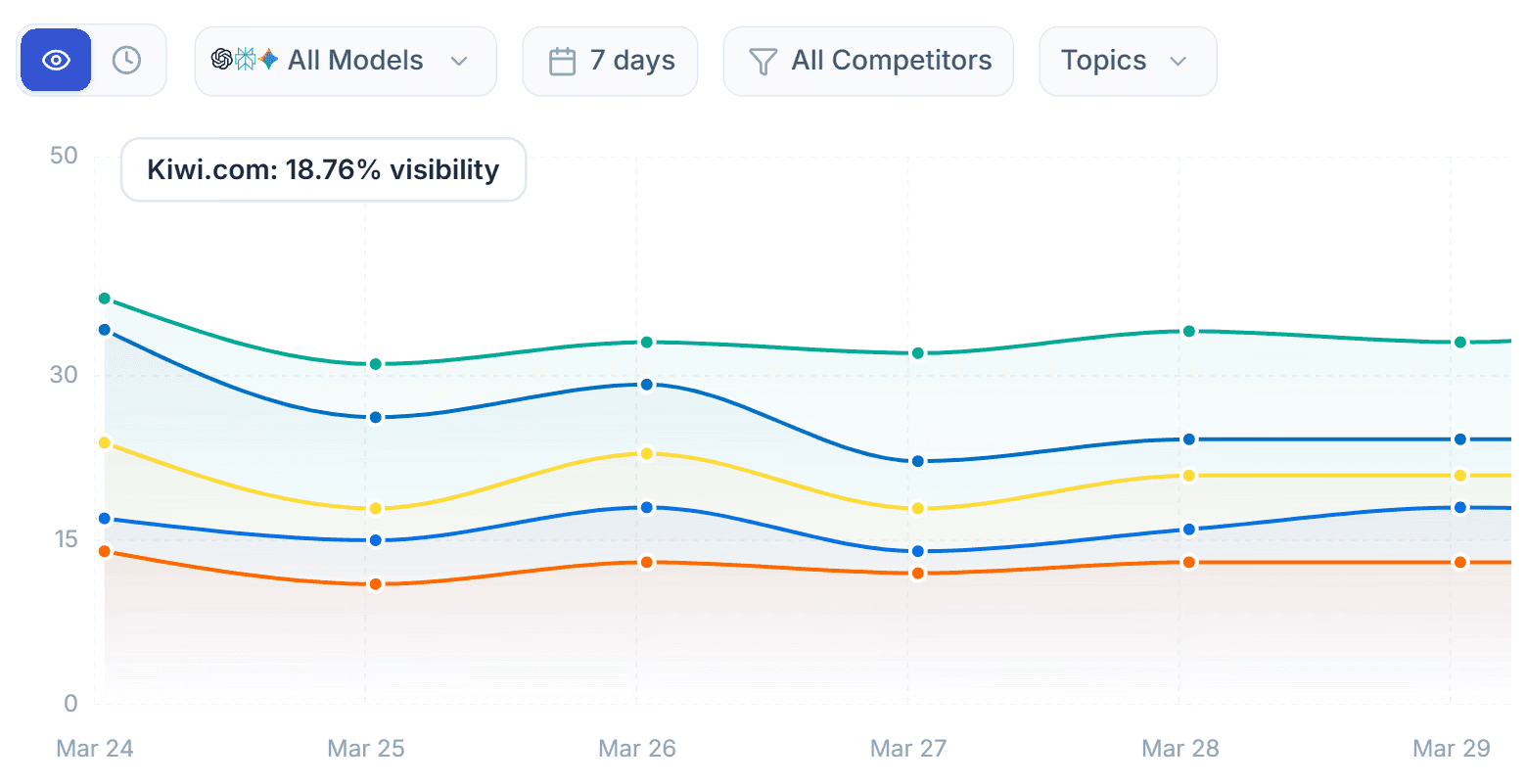
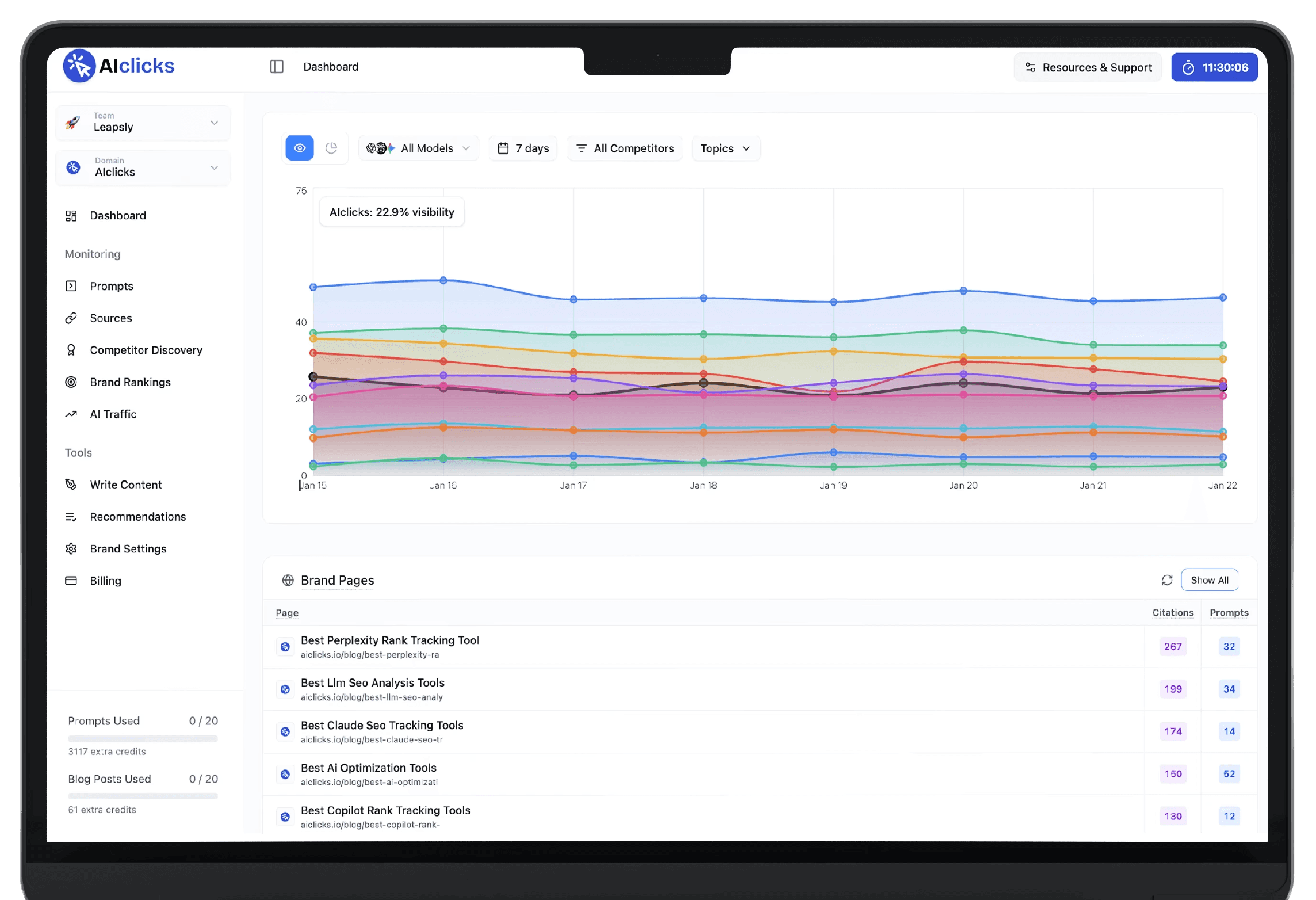
AIclicks gives you a live dashboard with daily ChatGPT mention rate, citation rate, sentiment, and share-of-voice across your tracked prompts, plus GA4 referral attribution for the traffic ChatGPT does send back.
Choose Your Plan
Flexible pricing that grows with your team. Upgrade or downgrade at any time.
Monthly
Yearly
-20%
Starter
Perfect for individuals & small teams
$49
/ month
Billed annually — you save $142
Choose 3 from:
Daily

" height="16px" id="fvSweaOBo" transform="translate(1 0)" width="14px"/></svg>)
" width="14px"><path d="M 13.864 5.629 L 13.3 5.629 L 13.3 5.6 L 7 5.6 L 7 8.4 L 10.956 8.4 C 10.379 10.03 8.828 11.2 7 11.2 C 4.681 11.2 2.8 9.319 2.8 7 C 2.8 4.681 4.681 2.8 7 2.8 C 8.071 2.8 9.045 3.204 9.786 3.864 L 11.766 1.884 C 10.516 0.719 8.844 0 7 0 C 3.134 0 0 3.134 0 7 C 0 10.866 3.134 14 7 14 C 10.866 14 14 10.866 14 7 C 14 6.531 13.952 6.073 13.864 5.629 Z" fill="rgb(255, 193, 7)" height="14px" id="H_YjfTNpn" width="14px"/><path d="M 0 3.742 L 2.3 5.429 C 2.922 3.888 4.429 2.8 6.193 2.8 C 7.264 2.8 8.238 3.204 8.979 3.864 L 10.959 1.884 C 9.709 0.719 8.037 0 6.193 0 C 3.504 0 1.172 1.518 0 3.742 Z" fill="rgb(255, 61, 0)" height="5.428500000000002px" id="PlkthQDhg" transform="translate(0.875 0)" width="10.959199999999996px"/><path d="M 6.232 5.581 C 8.04 5.581 9.683 4.889 10.925 3.764 L 8.758 1.931 C 8.032 2.483 7.144 2.782 6.232 2.781 C 4.411 2.781 2.865 1.62 2.283 0 L 0 1.759 C 1.159 4.026 3.511 5.581 6.232 5.581 Z" fill="rgb(76, 175, 80)" height="5.581099999999999px" id="WlnJ5gngE" transform="translate(0.7 8.4)" width="10.924899999999994px"/><path d="M 6.864 0.029 L 6.3 0.029 L 6.3 0 L 0 0 L 0 2.8 L 3.956 2.8 C 3.68 3.576 3.183 4.254 2.526 4.75 L 2.527 4.749 L 4.693 6.582 C 4.54 6.722 7 4.9 7 1.4 C 7 0.931 6.952 0.473 6.864 0.029 Z" fill="rgb(25, 118, 210)" height="6.589883930775992px" id="x_rSW275p" transform="translate(7 5.6)" width="7px"/></g></svg>)
" height="16px" id="hHS98fTxZ" width="16px"/></svg>)
 scale(1 1) translate(-1.861736945942159, -1.1170155383302638)" id="P20NzAvj0-699428820-radial-gradient" r="0.9935228066204626"><stop offset="0" stop-color="rgb(0, 174, 255)"/><stop offset="1" stop-color="rgb(7, 54, 196)"/></radialGradient><radialGradient cx="0.48250042504016705" cy="1.8366934653567062" gradient-transform="translate(0.48250042504016705, 1.8366934653567062) scale(1 1) translate(-0.48250042504016705, -1.8366934653567062)" id="UEWZqVjij-699428820-radial-gradient" r="0.9176890228114506"><stop offset="0" stop-color="rgb(255, 182, 87)"/><stop offset="1" stop-color="rgb(192, 43, 60)"/></radialGradient><linearGradient id="jyMN3TmKx-699428820-linear-gradient" x1="0.4594862532842614" x2="0.5405137467157386" y1="0" y2="1"><stop offset="0" stop-color="rgb(13, 145, 225)"/><stop offset="1" stop-color="rgb(255, 200, 0)"/></linearGradient><linearGradient id="xhMNwDFG0-699428820-linear-gradient" x1="0.4784828731548295" x2="0.5215171268451705" y1="5.551115123125783e-17" y2="1"><stop offset="0" stop-color="rgb(61, 203, 255)"/><stop offset="1" stop-color="rgba(5, 136, 247, 0)"/></linearGradient><radialGradient cx="1.4305090871482182" cy="0.34866158048251783" gradient-transform="translate(1.4305090871482182, 0.34866158048251783) scale(1 1) translate(-1.4305090871482182, -0.34866158048251783)" id="i79kAqaS4-699428820-radial-gradient" r="1.3362743412697924"><stop offset="0" stop-color="rgb(140, 72, 255)"/><stop offset="1" stop-color="rgb(255, 177, 82)"/></radialGradient><linearGradient id="mcxvno3tX-699428820-linear-gradient" x1="0.49844355920154226" x2="0.5015564407984577" y1="0" y2="1"><stop offset="0" stop-color="rgb(248, 173, 250)"/><stop offset="1" stop-color="rgba(168, 110, 221, 0)"/></linearGradient></defs><g d="M 11.605 1.219 C 11.397 0.499 10.739 0.002 9.989 0 L 9.498 0 C 8.682 0.002 7.985 0.588 7.842 1.391 L 7 6.016 L 7.209 5.296 C 7.416 4.574 8.075 4.076 8.825 4.074 L 11.681 4.074 L 12.879 4.545 L 14.033 4.074 L 13.697 4.074 C 12.947 4.072 12.289 3.575 12.081 2.855 Z M 4.413 13.387 C 4.618 14.111 5.278 14.611 6.031 14.613 L 7.075 14.613 C 7.988 14.613 8.735 13.88 8.758 12.96 L 8.871 8.5 L 8.633 9.319 C 8.426 10.039 7.768 10.537 7.018 10.539 L 4.138 10.539 L 3.111 9.977 L 2 10.539 L 2.331 10.539 C 3.084 10.542 3.743 11.042 3.949 11.766 L 4.413 13.387 Z M 9.999 0 L 4.167 0 C 2.501 0 1.501 2.221 0.834 4.441 C 0.045 7.073 -0.989 10.591 2.001 10.591 L 4.519 10.591 C 5.273 10.591 5.933 10.089 6.139 9.36 C 6.577 7.815 7.345 5.121 7.948 3.069 C 8.255 2.027 8.509 1.132 8.901 0.575 C 9.148 0.212 9.56 -0.004 9.999 0 M 9.999 0 L 4.167 0 C 2.501 0 1.501 2.221 0.834 4.441 C 0.045 7.073 -0.989 10.591 2.001 10.591 L 4.519 10.591 C 5.273 10.591 5.933 10.089 6.139 9.36 C 6.577 7.815 7.345 5.121 7.948 3.069 C 8.255 2.027 8.509 1.132 8.901 0.575 C 9.148 0.212 9.56 -0.004 9.999 0 M 6 14.593 L 11.833 14.593 C 13.499 14.593 14.499 12.372 15.166 10.151 C 15.955 7.519 16.989 4 13.999 4 L 11.48 4 C 10.725 4.002 10.063 4.505 9.86 5.232 C 9.266 7.332 8.663 9.429 8.051 11.523 C 7.745 12.566 7.49 13.461 7.098 14.019 C 6.851 14.382 6.439 14.597 6 14.593 M 6 14.593 L 11.833 14.593 C 13.499 14.593 14.499 12.372 15.166 10.151 C 15.955 7.519 16.989 4 13.999 4 L 11.48 4 C 10.725 4.002 10.063 4.505 9.86 5.232 C 9.266 7.332 8.663 9.429 8.051 11.523 C 7.745 12.566 7.49 13.461 7.098 14.019 C 6.851 14.382 6.439 14.597 6 14.593" fill="transparent" height="14.613333333333333px" id="QzkBy4Ibc" transform="translate(0 1)" width="16.00011071294081px"><path d="M 4.605 1.219 C 4.397 0.499 3.739 0.002 2.989 0 L 2.498 0 C 1.682 0.002 0.985 0.588 0.842 1.391 L 0 6.016 L 0.209 5.296 C 0.416 4.574 1.075 4.076 1.825 4.074 L 4.681 4.074 L 5.879 4.545 L 7.033 4.074 L 6.697 4.074 C 5.947 4.072 5.289 3.575 5.081 2.855 Z" fill="url(%23P20NzAvj0-699428820-radial-gradient)" height="6.016px" id="P20NzAvj0" transform="translate(7 0)" width="7.0333333333333385px"/><path d="M 2.413 4.887 C 2.618 5.611 3.278 6.111 4.031 6.113 L 5.075 6.113 C 5.988 6.113 6.735 5.38 6.758 4.46 L 6.871 0 L 6.633 0.819 C 6.426 1.539 5.768 2.037 5.018 2.039 L 2.138 2.039 L 1.111 1.477 L 0 2.039 L 0.331 2.039 C 1.084 2.042 1.743 2.542 1.949 3.266 L 2.413 4.887 Z" fill="url(%23UEWZqVjij-699428820-radial-gradient)" height="6.113333333333333px" id="UEWZqVjij" transform="translate(2 8.5)" width="6.871333333333332px"/><path d="M 9.999 0 L 4.167 0 C 2.501 0 1.501 2.221 0.834 4.441 C 0.045 7.073 -0.989 10.591 2.001 10.591 L 4.519 10.591 C 5.273 10.591 5.933 10.089 6.139 9.36 C 6.577 7.815 7.345 5.121 7.948 3.069 C 8.255 2.027 8.509 1.132 8.901 0.575 C 9.148 0.212 9.56 -0.004 9.999 0" fill="url(%23jyMN3TmKx-699428820-linear-gradient)" height="10.591388755215167px" id="jyMN3TmKx" width="9.999444046274142px"/><path d="M 9.999 0 L 4.167 0 C 2.501 0 1.501 2.221 0.834 4.441 C 0.045 7.073 -0.989 10.591 2.001 10.591 L 4.519 10.591 C 5.273 10.591 5.933 10.089 6.139 9.36 C 6.577 7.815 7.345 5.121 7.948 3.069 C 8.255 2.027 8.509 1.132 8.901 0.575 C 9.148 0.212 9.56 -0.004 9.999 0" fill="url(%23xhMNwDFG0-699428820-linear-gradient)" height="10.591388755215167px" id="xhMNwDFG0" width="9.999444046274142px"/><path d="M 0 10.593 L 5.833 10.593 C 7.499 10.593 8.499 8.372 9.166 6.151 C 9.955 3.519 10.989 0 7.999 0 L 5.48 0 C 4.725 0.002 4.063 0.505 3.86 1.232 C 3.266 3.332 2.663 5.429 2.051 7.523 C 1.745 8.566 1.49 9.461 1.098 10.019 C 0.851 10.382 0.439 10.597 0 10.593" fill="url(%23i79kAqaS4-699428820-radial-gradient)" height="10.593388755215164px" id="i79kAqaS4" transform="translate(6 4)" width="10.000110712940803px"/><path d="M 0 10.593 L 5.833 10.593 C 7.499 10.593 8.499 8.372 9.166 6.151 C 9.955 3.519 10.989 0 7.999 0 L 5.48 0 C 4.725 0.002 4.063 0.505 3.86 1.232 C 3.266 3.332 2.663 5.429 2.051 7.523 C 1.745 8.566 1.49 9.461 1.098 10.019 C 0.851 10.382 0.439 10.597 0 10.593" fill="url(%23mcxvno3tX-699428820-linear-gradient)" height="10.593388755215164px" id="mcxvno3tX" transform="translate(6 4)" width="10.000110712940803px"/></g></svg>)
" height="15.360666565427872px" id="HZPvvPBv7" transform="translate(0 0.5)" width="16px"/></svg>)
Tracked prompts
30
Websites you can add
3
LLMs you can track
3
Countries per project
1
LLM responses / mo
4,650
AI-optimized articles per month
10
Integrations
-
Support
Pro
For growing teams for more power
$140
/ month
Billed annually — you save $454
Choose 4 from:
Daily
Tracked prompts
150
Websites you can add
Unlimited
LLMs you can track
4
Countries per project
Unlimited
LLM responses / mo
18,600
AI-optimized articles per month
20
Integrations
Google Analytics
Support
BUSINESS
Best for medium-sized organizations
$357
/ month
Billed annually — you save $1198
Choose 6 from:
Daily
Tracked prompts
300
Websites you can add
Unlimited
LLMs you can track
6
Countries per project
Unlimited
LLM responses / mo
55,800
AI-optimized articles per month
30
Integrations
Google Analytics, API
Support
Dedicated account specialist
Become the #1 Answer in AI
Succeed in GEO yourself, or let us do all the work.
Do it yourself
Use AIclicks to see exactly where you appear across 10+ AI platforms, spot the gaps competitors are filling, and act on clear weekly recommendations.
From $59/month · Cancel anytime
Done for you
We Do All the Work for You
Our team manages your complete search presence: traditional SEO and GEO strategy, content, implementation, and reporting. You focus on homeowners.
Custom pricing · Minimum 3-month engagement
The AI SEO agency trusted by 1,000+ brands worldwide
From solo founders to multi-client agencies, AIclicks runs the full AI SEO agency program for organizations of every shape and size that want to be cited across every AI surface.
4.9/5 stars on G2







FAQ
How long before landscaping SEO actually brings in jobs?
Expect local movement in 3 to 6 months and reliable job flow around 9. Competitive metro markets take 6 to 12 months for top-page positions on install terms. Landscaping has a wrinkle nobody warns you about: seasonality. Work started in November lands right as spring demand arrives, while work started in March misses the season entirely. Map pack impressions rise first, well before booked estimates do.
Should we bother with ChatGPT or just Google?
Both, and they reward different work. Ahrefs analysed 863,000 keywords and found only 38% of pages cited in AI Overviews also ranked in the top 10, down from 76% a year earlier. Ranking no longer carries you into the answer. Homeowners now ask assistants who to hire for a patio or a drainage problem, and the assistant names 3 companies. Almost no landscaper is tracking whether they are one of them.
What makes landscaping SEO different from regular local SEO?
Three things. Demand is violently seasonal, so the work has to be published months ahead of the spike rather than during it. The money sits in install and hardscape keywords while the search volume sits in mowing keywords, and generic advice chases the volume. And your competition is not other crews but Thumbtack, Angi and Yelp, which own the head terms outright and sell your leads back to you.
What should a landscaping company budget for SEO?
Published rates run from about $1,200 a month at the low end to $8,300 for a competitive metro, with most established companies landing between $2,000 and $5,000. Agencies bill $100 to $200 an hour, so a $1,000 retainer buys 5 hours of actual work. Owners on Reddit report being quoted $30,000 a year and pushed toward $50,000. Judge it on cost per booked install, not on the retainer.
How does SEO fit with the lead services we pay for?
They solve different problems. Angi, Thumbtack and Google Ads buy jobs this week and stop the day you pause them, and the lead is shared with 3 competitors. Organic and map pack leads arrive exclusive and cost nothing per click once earned. Most companies run both, using paid to fill the shoulder seasons and organic to own spring. Track cost per booked job by source, not cost per lead.
Which pages should a landscaping company build first?
Google Business Profile first, because it is free and it sits above Thumbtack. Then a page for your highest-margin service, usually hardscape or design-build, written in homeowner language with a real price range. Then a costs hub, because pricing is the question every enquiry starts with. Then town pages for the places you actually drive to. Project pages with genuine text come next. The blog is last, and optional.
How do we know the SEO is actually working?
Count booked estimates from organic search, not rankings. Landscaping enquiries are overwhelmingly phone calls, so put call tracking on the site or they vanish from analytics. Watch Google Business Profile insights for calls and direction requests, which move months before revenue does. In Search Console, track impressions on install terms rather than position. Then reconcile against Jobber or Aspire: signed contracts are the only number that pays a crew.
Should we do this ourselves or hire someone?
Split it. The crew already carries a phone, so job photos, profile posts and review requests belong in-house and nobody outside can fake them. Hand out the technical layer: schema, gallery performance, citation cleanup and link work. If you hire, avoid anyone selling a template site to 200 other landscapers, and ask what they will do in January, because an agency that only works in spring is selling you the wrong season.
Further Reading
Go deeper on GEO, AI search, and visibility tracking.