SEO for IT Companies:
A business owner does not shop for IT support until something breaks or a cyber insurance renewal forces the question. Then they search once, shortlist 3 providers from Google and ChatGPT in an afternoon, and never look at the fourth.









Why IT Companies Need SEO
Gartner found B2B buyers spend just 17% of the purchase cycle meeting suppliers. The rest is self-directed research, and most of it now happens somewhere you cannot see.
Your site says managed IT, cloud and cybersecurity. Nobody types that. They type Microsoft 365 migration help, CMMC compliance consultant, or co-managed IT for a 40-person office. Each is a distinct query needing its own page, and you wrote none, so the enquiry lands with a provider who did.
Type managed IT services near me anywhere in the US and Clutch, Cloudtango, UpCity and Yelp sit above most of the providers actually doing the work. They rank on aggregate review volume no single MSP can match, then charge your competitors to appear higher inside the listing that beat you.
MSP marketing packages typically run $1,500 to $8,000 a month, and much of it buys a leased website plus blog posts syndicated to 200 other providers. Cancel and the pages leave with the vendor, not you. Meanwhile managed IT clicks in Google Ads clear $30 and they stop the day you pause.
How SEO Works for IT Companies
Search Engine Optimization projects are long-term investments for IT providers, where each task supplements the others and creates compound results over time.
01
Keywords, page structure, and the signals Google reads directly
On-page SEO breaks down at IT companies for an unusual reason: the people writing the site are engineers, and engineers describe capability rather than outcome. A page headed Infrastructure Solutions or Digital Transformation matches nothing a business owner types. The buyer types help desk for 30 users, Microsoft 365 tenant migration, or IT support for a dental office. Worse, the same vendor stack sits on every competitor’s site, so 40 MSPs in one state publish near-identical Cybersecurity and Cloud Services pages. The pages that actually earn enquiries are one per service line, one per compliance framework, and one per vertical you genuinely serve.
What holds value is anything tied to a decision rather than a product release. A page comparing what co-managed IT costs against hiring a second in-house sysadmin, or explaining what a CMMC Level 2 assessment actually involves, keeps pulling enquiries long after publication, because the question outlives the technology. What churns is whatever your vendor feeds you: the reaction post about last week’s Microsoft outage, the syndicated piece on a threat nobody remembers, the announcement that you renewed a partner tier. Those age out within weeks and quietly become most of an MSP blog. Publish less, about decisions, and revisit the pricing annually.
1
Break the single services page into one URL per line: co-managed IT, Microsoft 365 migration, help desk, vCISO, backup and disaster recovery.
2
Unpublish syndicated posts about retired products such as Windows Server 2012 or Datto legacy hardware, and 301 each one into whichever service page superseded it.
3
Mark the company up as ProfessionalService, add a Service entry per offering, and use hasCredential for Microsoft Solutions Partner and CompTIA certifications.
4
Publish one evergreen page per framework you support, HIPAA, PCI DSS, CMMC and SOC 2, explaining what an audit actually demands of a small business.
02
Map Pack visibility, citations, and proximity signals
Nearly half of all Google searches carry local intent, and IT support is not a business owners want handled entirely from another time zone. They want someone who can be onsite the morning a switch dies. That is why the 3-result map pack takes the top of the page for IT support near me, and why a 12-person MSP can outrank Clutch there and nowhere else. Proximity is fixed; profile depth and review volume are not.
The category choice matters more than owners expect. Computer Support and Services beats Computer Store, and every service line should exist as its own entry with a description. List genuine service areas rather than a 200-mile radius, publish real hours including after-hours and 24/7 monitoring cover, and load photos of the actual operations floor, the team and a van at a client site. Pre-answer what decides the deal in Q&A: contract length, per-user pricing, onboarding time, line-of-business app support.
IT carries 2 citation layers, and generic local checklists only cover one. The first is Yelp, Bing Places and Apple Maps. The second is where buyers actually shortlist: Clutch, UpCity, Cloudtango, G2, Expertise.com, and the partner locators run by Microsoft, Datto, Pax8 and your security vendors. Those partner directories carry weight because the vendor verifies the relationship before listing you. Every one needs the identical company name, suite and direct phone; one stray variant across 30 listings dilutes the lot.
1
Pick Computer Support and Services over Computer Store as your main category, add each service line, and list only counties you truly dispatch technicians to.
2
Every staffed office needs a separate profile plus a location page naming the engineers who sit there; a mailbox address earns a suspension.
3
Run BrightLocal across Clutch, UpCity, Cloudtango and Yelp, then hand-check your Microsoft Partner Center and Pax8 marketplace listings, which no aggregator syncs.
4
Publish one Google Business Profile post a week: a patch advisory in plain English, a phishing wave hitting local firms, a new certification.
03
Topic authority, inbound links, and content that earns traffic
An owner considering a change is trying to settle 3 things first: whether the current setup is genuinely a risk, what outsourcing costs per head, and what happens to the person who handles IT today. Content answering those plainly beats anything written about your stack. A straight page on what a co-managed model means for an existing internal admin removes the objection that quietly kills most MSP deals.
Once the decision to outsource is made, the owner shortlists 3 providers and hunts for evidence. Publish response-time commitments with the real SLA numbers, the account manager structure, per-user pricing tiers, and case studies stating the industry, the headcount and what changed. Put your Clutch and G2 ratings on the page instead of a testimonial slider. Most MSPs lose here by refusing to show a price, which reads as something to hide.
Link building here runs through the channel, not the open web. Distributors and vendors publish partner spotlights and joint case studies, and Pax8, Datto, Huntress, SentinelOne and Microsoft all link out from them. Peer groups list member firms. Trade press including Channel Futures, CRN and MSSP Alert needs operators who will comment on deadline. Chambers, the associations you belong to, and the nonprofits you donate decommissioned hardware to will link if asked.
1
Publish an annual buyer guide comparing break-fix, co-managed and fully managed IT with real per-user numbers, the format buyers search before every renewal.
2
Give each industry you genuinely serve its own page, IT support for law firms, for manufacturers, for medical practices, each naming that sector’s compliance burden.
3
Group every pricing question into a single hub: managed IT cost per user, break-fix hourly rates, onboarding fees, and what a vCISO retainer includes.
4
Build a page for every platform you deploy, Microsoft 365, Azure, Datto, NinjaOne or Huntress, because buyers search vendor names before they search providers.
04
Site speed, crawlability, Core Web Vitals, and mobile health
The failure unique to IT companies is self-inflicted: you secure your own site the way you secure a client network. Cloudflare Bot Fight Mode, a WAF rule blocking non-browser user agents, and geo-blocking everything outside the country all sound sensible, and all of them quietly serve challenges to Googlebot, Bingbot and GPTBot. Nobody notices, because staff reach the site fine from the office. Search Console reports crawl anomalies that get filed as noise.
The buyer is often a non-technical owner checking providers on a phone between meetings, or an office manager comparing 3 sites while the network is down and the laptop is useless. Self-hosted WordPress on a spare VM in your own rack is a point of pride and a performance liability: no CDN, an unpatched page builder, and a chat widget loading before anything renders. If the contact number is not tappable in 2 seconds they call the next provider.
1
Run URL Inspection live tests in Search Console, then curl the homepage using Googlebot and GPTBot user agents to expose WAF challenges.
2
Test the vendor logo wall and partner badge grid in WebPageTest; those image stacks usually push a service page past 3 seconds.
3
Export network diagrams and certification badges as SVG rather than screenshots, and compress team headshots to WebP under 80 kilobytes each.
4
Give service, vertical and pricing URLs their own sitemap file away from the blog, and ping Bing IndexNow whenever SLA or pricing details change.
05
Star ratings, review volume, and response strategy that builds trust
Reviews matter more here than in most trades, because a buyer is about to hand a stranger domain admin and a key to the server room. Sterling Sky found that crossing 10 Google reviews produces a measurable lift in Maps visibility, so volume matters. Collecting them is the hard part: your best quarters are invisible, since nothing broke. The ones who reach for the keyboard are the clients whose ticket sat open across a weekend, so unmanaged profiles drift below what the service deserves.
Ask on the day a ticket closes while the relief is still fresh, not at the quarterly business review when the memory has faded. Wire the request into the PSA so it fires on resolution, signed by the engineer who fixed it rather than by the company. Then ask the decision maker separately after a project lands, because a completed migration or a passed audit is the story a buyer wants to read on Clutch.
1
Fire the review link automatically from ConnectWise PSA, Autotask or HaloPSA when a ticket closes, sent under the resolving engineer’s name.
2
Answer inside 24 hours naming the ticket number but never the client’s systems or vulnerabilities, since a public postmortem hands attackers a reconnaissance gift.
3
Pull Clutch and Google reviews that mention a specific service onto that service page, and embed your G2 rating on the pricing page.
4
Ask after project work too, not just support tickets, since a finished Microsoft 365 migration produces a more detailed review than a reset password.
Google is No Longer the Only Place Your buyers are Searching
Buyers are using AI to find answers, and they trust what it tells them. Invest in GEO to get recommended in those answers.
1 Billion
Questions ChatGPT receives every single day
38%
Your #1 top ranking page on Google would be cited by AI
14%
of IT providers optimise for GEO. The rest are invisible in AI answers


You can rank #1 for “IT provider near me” and still not exist in ChatGPT’s answer. Run a free GEO audit to see where your brand actually stands.
GEO vs SEO: Same Goal, Different Methods
GEO is wider than SEO. AI recommends the brands that show up across the sources it reads, so your presence in forums, social platforms and IT blogs decides your odds. AIclicks measures the three metrics below so you know which to work on first.
AI Assistant
Which IT support company is best for small businesses?
Your Company
Citation Rate
Shows how many AI answers about IT companies name your brand, out of every 100. Models pull from the same trusted pages over and over, so citations compound: once you are in, staying in gets easier. Find the competitor pages AI cites most, then publish your own version of each.
Your Company
82% positive
Competitor A
54% positive
Competitor B
38% positive
Brand Sentiment
Shows how AI describes you when your brand comes up: positive, neutral or negative. Tone is what separates being mentioned from being recommended, and models repeat whatever framing they find. Track the negative mentions back to the reviews and threads behind them, then publish content that answers those directly.
Others 52%
You 24%
— 24%
Your Company
AI mention share of voice — IT category
Competitors
Not Cited
Share of Voice in AI
Shows how much of the IT conversation belongs to you rather than your competitors. This is the metric that matters most, the GEO version of a Google ranking. With only 1–5 brands named per answer, the market is winner-takes-more and every point is taken from someone.
The Dashboard Your Dedicated AI Search Team Works In
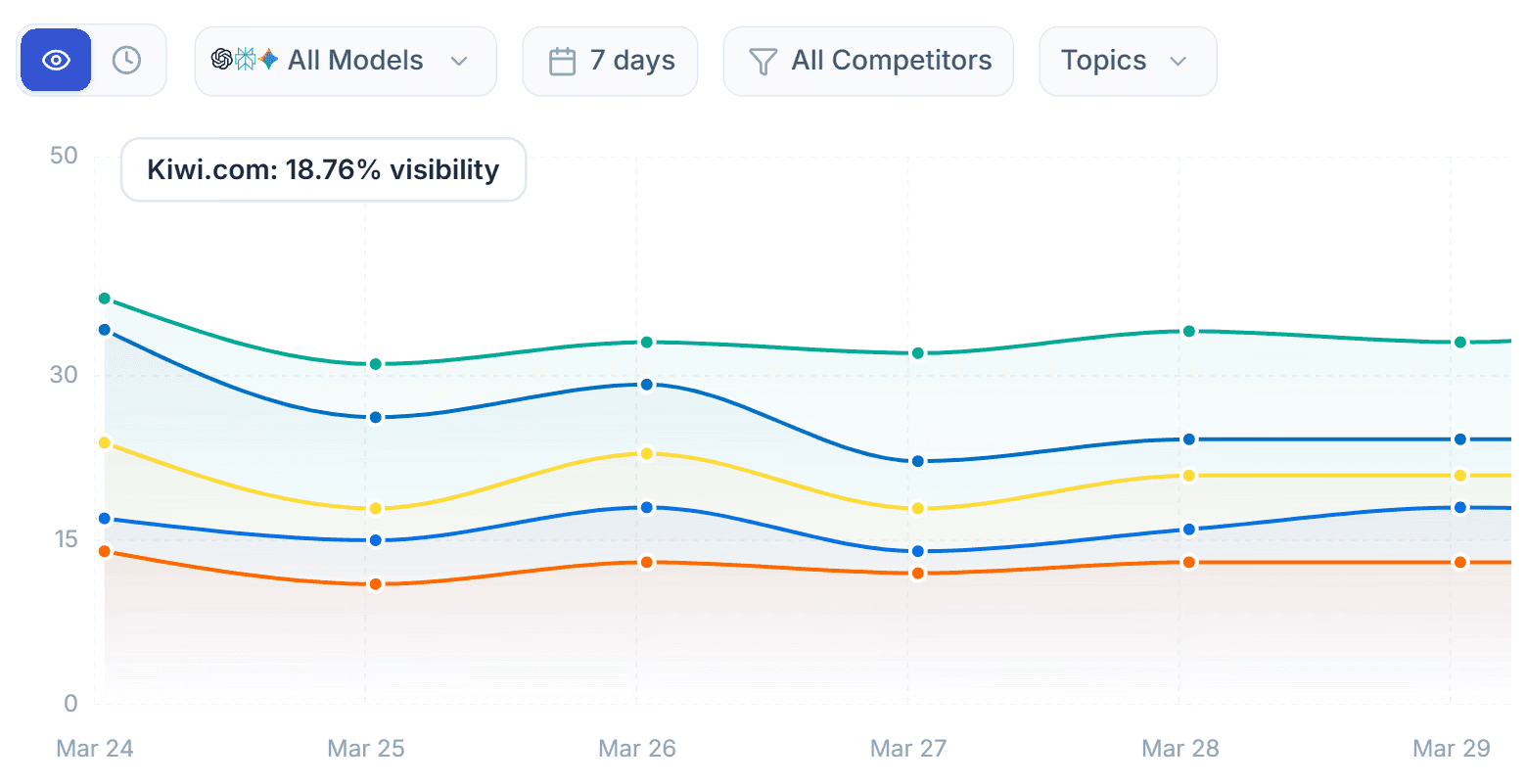
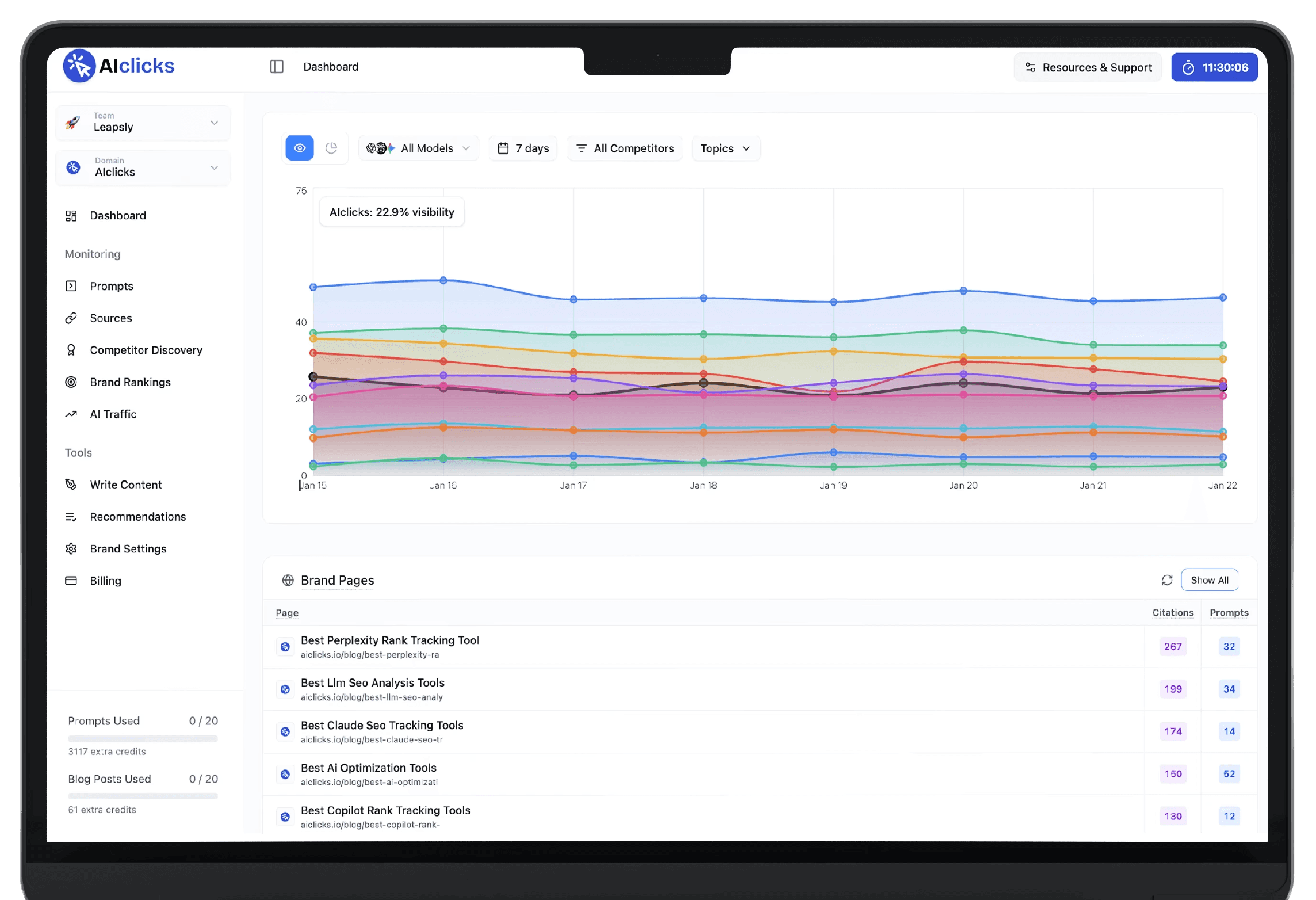
AIclicks gives you a live dashboard with daily ChatGPT mention rate, citation rate, sentiment, and share-of-voice across your tracked prompts, plus GA4 referral attribution for the traffic ChatGPT does send back.
Choose Your Plan
Flexible pricing that grows with your team. Upgrade or downgrade at any time.
Monthly
Yearly
-20%
Starter
Perfect for individuals & small teams
$49
/ month
Billed annually — you save $142
Choose 3 from:
Daily

" height="16px" id="fvSweaOBo" transform="translate(1 0)" width="14px"/></svg>)
" width="14px"><path d="M 13.864 5.629 L 13.3 5.629 L 13.3 5.6 L 7 5.6 L 7 8.4 L 10.956 8.4 C 10.379 10.03 8.828 11.2 7 11.2 C 4.681 11.2 2.8 9.319 2.8 7 C 2.8 4.681 4.681 2.8 7 2.8 C 8.071 2.8 9.045 3.204 9.786 3.864 L 11.766 1.884 C 10.516 0.719 8.844 0 7 0 C 3.134 0 0 3.134 0 7 C 0 10.866 3.134 14 7 14 C 10.866 14 14 10.866 14 7 C 14 6.531 13.952 6.073 13.864 5.629 Z" fill="rgb(255, 193, 7)" height="14px" id="H_YjfTNpn" width="14px"/><path d="M 0 3.742 L 2.3 5.429 C 2.922 3.888 4.429 2.8 6.193 2.8 C 7.264 2.8 8.238 3.204 8.979 3.864 L 10.959 1.884 C 9.709 0.719 8.037 0 6.193 0 C 3.504 0 1.172 1.518 0 3.742 Z" fill="rgb(255, 61, 0)" height="5.428500000000002px" id="PlkthQDhg" transform="translate(0.875 0)" width="10.959199999999996px"/><path d="M 6.232 5.581 C 8.04 5.581 9.683 4.889 10.925 3.764 L 8.758 1.931 C 8.032 2.483 7.144 2.782 6.232 2.781 C 4.411 2.781 2.865 1.62 2.283 0 L 0 1.759 C 1.159 4.026 3.511 5.581 6.232 5.581 Z" fill="rgb(76, 175, 80)" height="5.581099999999999px" id="WlnJ5gngE" transform="translate(0.7 8.4)" width="10.924899999999994px"/><path d="M 6.864 0.029 L 6.3 0.029 L 6.3 0 L 0 0 L 0 2.8 L 3.956 2.8 C 3.68 3.576 3.183 4.254 2.526 4.75 L 2.527 4.749 L 4.693 6.582 C 4.54 6.722 7 4.9 7 1.4 C 7 0.931 6.952 0.473 6.864 0.029 Z" fill="rgb(25, 118, 210)" height="6.589883930775992px" id="x_rSW275p" transform="translate(7 5.6)" width="7px"/></g></svg>)
" height="16px" id="hHS98fTxZ" width="16px"/></svg>)
 scale(1 1) translate(-1.861736945942159, -1.1170155383302638)" id="P20NzAvj0-699428820-radial-gradient" r="0.9935228066204626"><stop offset="0" stop-color="rgb(0, 174, 255)"/><stop offset="1" stop-color="rgb(7, 54, 196)"/></radialGradient><radialGradient cx="0.48250042504016705" cy="1.8366934653567062" gradient-transform="translate(0.48250042504016705, 1.8366934653567062) scale(1 1) translate(-0.48250042504016705, -1.8366934653567062)" id="UEWZqVjij-699428820-radial-gradient" r="0.9176890228114506"><stop offset="0" stop-color="rgb(255, 182, 87)"/><stop offset="1" stop-color="rgb(192, 43, 60)"/></radialGradient><linearGradient id="jyMN3TmKx-699428820-linear-gradient" x1="0.4594862532842614" x2="0.5405137467157386" y1="0" y2="1"><stop offset="0" stop-color="rgb(13, 145, 225)"/><stop offset="1" stop-color="rgb(255, 200, 0)"/></linearGradient><linearGradient id="xhMNwDFG0-699428820-linear-gradient" x1="0.4784828731548295" x2="0.5215171268451705" y1="5.551115123125783e-17" y2="1"><stop offset="0" stop-color="rgb(61, 203, 255)"/><stop offset="1" stop-color="rgba(5, 136, 247, 0)"/></linearGradient><radialGradient cx="1.4305090871482182" cy="0.34866158048251783" gradient-transform="translate(1.4305090871482182, 0.34866158048251783) scale(1 1) translate(-1.4305090871482182, -0.34866158048251783)" id="i79kAqaS4-699428820-radial-gradient" r="1.3362743412697924"><stop offset="0" stop-color="rgb(140, 72, 255)"/><stop offset="1" stop-color="rgb(255, 177, 82)"/></radialGradient><linearGradient id="mcxvno3tX-699428820-linear-gradient" x1="0.49844355920154226" x2="0.5015564407984577" y1="0" y2="1"><stop offset="0" stop-color="rgb(248, 173, 250)"/><stop offset="1" stop-color="rgba(168, 110, 221, 0)"/></linearGradient></defs><g d="M 11.605 1.219 C 11.397 0.499 10.739 0.002 9.989 0 L 9.498 0 C 8.682 0.002 7.985 0.588 7.842 1.391 L 7 6.016 L 7.209 5.296 C 7.416 4.574 8.075 4.076 8.825 4.074 L 11.681 4.074 L 12.879 4.545 L 14.033 4.074 L 13.697 4.074 C 12.947 4.072 12.289 3.575 12.081 2.855 Z M 4.413 13.387 C 4.618 14.111 5.278 14.611 6.031 14.613 L 7.075 14.613 C 7.988 14.613 8.735 13.88 8.758 12.96 L 8.871 8.5 L 8.633 9.319 C 8.426 10.039 7.768 10.537 7.018 10.539 L 4.138 10.539 L 3.111 9.977 L 2 10.539 L 2.331 10.539 C 3.084 10.542 3.743 11.042 3.949 11.766 L 4.413 13.387 Z M 9.999 0 L 4.167 0 C 2.501 0 1.501 2.221 0.834 4.441 C 0.045 7.073 -0.989 10.591 2.001 10.591 L 4.519 10.591 C 5.273 10.591 5.933 10.089 6.139 9.36 C 6.577 7.815 7.345 5.121 7.948 3.069 C 8.255 2.027 8.509 1.132 8.901 0.575 C 9.148 0.212 9.56 -0.004 9.999 0 M 9.999 0 L 4.167 0 C 2.501 0 1.501 2.221 0.834 4.441 C 0.045 7.073 -0.989 10.591 2.001 10.591 L 4.519 10.591 C 5.273 10.591 5.933 10.089 6.139 9.36 C 6.577 7.815 7.345 5.121 7.948 3.069 C 8.255 2.027 8.509 1.132 8.901 0.575 C 9.148 0.212 9.56 -0.004 9.999 0 M 6 14.593 L 11.833 14.593 C 13.499 14.593 14.499 12.372 15.166 10.151 C 15.955 7.519 16.989 4 13.999 4 L 11.48 4 C 10.725 4.002 10.063 4.505 9.86 5.232 C 9.266 7.332 8.663 9.429 8.051 11.523 C 7.745 12.566 7.49 13.461 7.098 14.019 C 6.851 14.382 6.439 14.597 6 14.593 M 6 14.593 L 11.833 14.593 C 13.499 14.593 14.499 12.372 15.166 10.151 C 15.955 7.519 16.989 4 13.999 4 L 11.48 4 C 10.725 4.002 10.063 4.505 9.86 5.232 C 9.266 7.332 8.663 9.429 8.051 11.523 C 7.745 12.566 7.49 13.461 7.098 14.019 C 6.851 14.382 6.439 14.597 6 14.593" fill="transparent" height="14.613333333333333px" id="QzkBy4Ibc" transform="translate(0 1)" width="16.00011071294081px"><path d="M 4.605 1.219 C 4.397 0.499 3.739 0.002 2.989 0 L 2.498 0 C 1.682 0.002 0.985 0.588 0.842 1.391 L 0 6.016 L 0.209 5.296 C 0.416 4.574 1.075 4.076 1.825 4.074 L 4.681 4.074 L 5.879 4.545 L 7.033 4.074 L 6.697 4.074 C 5.947 4.072 5.289 3.575 5.081 2.855 Z" fill="url(%23P20NzAvj0-699428820-radial-gradient)" height="6.016px" id="P20NzAvj0" transform="translate(7 0)" width="7.0333333333333385px"/><path d="M 2.413 4.887 C 2.618 5.611 3.278 6.111 4.031 6.113 L 5.075 6.113 C 5.988 6.113 6.735 5.38 6.758 4.46 L 6.871 0 L 6.633 0.819 C 6.426 1.539 5.768 2.037 5.018 2.039 L 2.138 2.039 L 1.111 1.477 L 0 2.039 L 0.331 2.039 C 1.084 2.042 1.743 2.542 1.949 3.266 L 2.413 4.887 Z" fill="url(%23UEWZqVjij-699428820-radial-gradient)" height="6.113333333333333px" id="UEWZqVjij" transform="translate(2 8.5)" width="6.871333333333332px"/><path d="M 9.999 0 L 4.167 0 C 2.501 0 1.501 2.221 0.834 4.441 C 0.045 7.073 -0.989 10.591 2.001 10.591 L 4.519 10.591 C 5.273 10.591 5.933 10.089 6.139 9.36 C 6.577 7.815 7.345 5.121 7.948 3.069 C 8.255 2.027 8.509 1.132 8.901 0.575 C 9.148 0.212 9.56 -0.004 9.999 0" fill="url(%23jyMN3TmKx-699428820-linear-gradient)" height="10.591388755215167px" id="jyMN3TmKx" width="9.999444046274142px"/><path d="M 9.999 0 L 4.167 0 C 2.501 0 1.501 2.221 0.834 4.441 C 0.045 7.073 -0.989 10.591 2.001 10.591 L 4.519 10.591 C 5.273 10.591 5.933 10.089 6.139 9.36 C 6.577 7.815 7.345 5.121 7.948 3.069 C 8.255 2.027 8.509 1.132 8.901 0.575 C 9.148 0.212 9.56 -0.004 9.999 0" fill="url(%23xhMNwDFG0-699428820-linear-gradient)" height="10.591388755215167px" id="xhMNwDFG0" width="9.999444046274142px"/><path d="M 0 10.593 L 5.833 10.593 C 7.499 10.593 8.499 8.372 9.166 6.151 C 9.955 3.519 10.989 0 7.999 0 L 5.48 0 C 4.725 0.002 4.063 0.505 3.86 1.232 C 3.266 3.332 2.663 5.429 2.051 7.523 C 1.745 8.566 1.49 9.461 1.098 10.019 C 0.851 10.382 0.439 10.597 0 10.593" fill="url(%23i79kAqaS4-699428820-radial-gradient)" height="10.593388755215164px" id="i79kAqaS4" transform="translate(6 4)" width="10.000110712940803px"/><path d="M 0 10.593 L 5.833 10.593 C 7.499 10.593 8.499 8.372 9.166 6.151 C 9.955 3.519 10.989 0 7.999 0 L 5.48 0 C 4.725 0.002 4.063 0.505 3.86 1.232 C 3.266 3.332 2.663 5.429 2.051 7.523 C 1.745 8.566 1.49 9.461 1.098 10.019 C 0.851 10.382 0.439 10.597 0 10.593" fill="url(%23mcxvno3tX-699428820-linear-gradient)" height="10.593388755215164px" id="mcxvno3tX" transform="translate(6 4)" width="10.000110712940803px"/></g></svg>)
" height="15.360666565427872px" id="HZPvvPBv7" transform="translate(0 0.5)" width="16px"/></svg>)
Tracked prompts
30
Websites you can add
3
LLMs you can track
3
Countries per project
1
LLM responses / mo
4,650
AI-optimized articles per month
10
Integrations
-
Support
Pro
For growing teams for more power
$140
/ month
Billed annually — you save $454
Choose 4 from:
Daily
Tracked prompts
150
Websites you can add
Unlimited
LLMs you can track
4
Countries per project
Unlimited
LLM responses / mo
18,600
AI-optimized articles per month
20
Integrations
Google Analytics
Support
BUSINESS
Best for medium-sized organizations
$357
/ month
Billed annually — you save $1198
Choose 6 from:
Daily
Tracked prompts
300
Websites you can add
Unlimited
LLMs you can track
6
Countries per project
Unlimited
LLM responses / mo
55,800
AI-optimized articles per month
30
Integrations
Google Analytics, API
Support
Dedicated account specialist
Become the #1 Answer in AI
Succeed in GEO yourself, or let us do all the work.
Do it yourself
Use AIclicks to see exactly where you appear across 10+ AI platforms, spot the gaps competitors are filling, and act on clear weekly recommendations.
From $59/month · Cancel anytime
Done for you
We Do All the Work for You
Our team manages your complete search presence: traditional SEO and GEO strategy, content, implementation, and reporting. You focus on buyers.
Custom pricing · Minimum 3-month engagement
The AI SEO agency trusted by 1,000+ brands worldwide
From solo founders to multi-client agencies, AIclicks runs the full AI SEO agency program for organizations of every shape and size that want to be cited across every AI surface.
4.9/5 stars on G2







FAQ
How soon does SEO produce leads for an MSP?
Local movement shows in 3 to 6 months; consistent pipeline takes closer to 12 to 18. Operators on r/msp put it in exactly that range, and the reason is the sales cycle rather than the rankings: a business under contract with another provider cannot switch until renewal. Watch map pack impressions and service page impressions first, because both rise months before anyone fills in a form.
Do we need to show up in ChatGPT answers?
Yes, and it is now a separate job from ranking. Ahrefs analysed 863,000 keywords and found only 38% of pages cited in AI Overviews also ranked in the top 10, down from 76% a year earlier. Ranking well no longer guarantees a place in the answer. IT buyers ask assistants to shortlist providers, so what wins is being structured, credentialed and quotable across the sources those models actually pull from.
What makes IT company SEO different from local SEO?
Three things, and generic local SEO covers none of them. The buyer is a committee rather than a person, so the owner, the office manager and the person who currently handles IT each need something to read. The sales cycle turns on contract renewal dates you cannot influence. And your real competition includes Clutch and Cloudtango, which hold the head terms and sell placement to whoever pays.
What should an IT company budget for SEO?
MSP-focused marketing retainers generally run $1,500 to $4,000 monthly for a single-market provider, $4,000 to $10,000 to compete properly across several metros. Judge it against your own numbers rather than against zero: if average contract value sits near $3,000 a month and clients stay 4 years, one signed agreement covers a year of the work. Ask what you keep if you leave.
Where does SEO sit next to the ads we run?
They cover different parts of the same funnel. Google Ads and LinkedIn rent attention that vanishes the day you pause; organic accumulates and drives down the cost of a booked assessment. Most providers run ads on managed IT and cybersecurity head terms while building organic on compliance, pricing and vertical queries with far less competition. Use the ad data to decide which pages to write first.
Which pages should an MSP build first?
Claim and finish the Google Business Profile before anything else; it costs nothing and it outranks your own homepage locally. Then build a real pricing page, since refusing to publish numbers loses more deals than any ranking does. Then a page apiece for your 3 largest service lines, in the buyer’s words. Then vertical pages for the industries you already serve. Blog last.
What should we measure to prove this is working?
Count booked assessments that originate in organic search, not rankings. Tag every form and call by landing page, and run call tracking, because a first contact in this trade is still usually a phone call. In Search Console watch impressions on service and vertical terms, which move months before positions do. Then reconcile against the PSA: agreements signed and monthly recurring revenue added are the only figures that justify the spend.
Can our own engineers handle this, or outsource?
Your engineers can handle the technical layer better than most agencies can, and they should. Crawl access, schema, page speed and IndexNow are all things a competent systems team will get right. What they will not do is write the pricing page, ask clients for reviews, or keep publishing when a major incident eats the week. Outsource the content and the discipline; keep the infrastructure.
Further Reading
Go deeper on GEO, AI search, and visibility tracking.