SEO for Insurance Companies:
Nobody calls an agent first any more. They price a policy on a comparison site, read a handful of reviews, ask an AI assistant whether a broker is even worth using, and only then pick up the phone. Search decides who gets that call.









Why Insurance Companies Need SEO
Almost every policy purchase now starts with a search, and increasingly with a question typed into ChatGPT. Comparison sites and carriers answer it. Independent agencies are rarely in the room.
Most agency sites collapse auto, home, life, umbrella, workers’ compensation and commercial property into one services page with 6 bullets. Every one of those lines carries its own demand, its own buyer question, and a rival already ranking for it. A contractor hunting general liability never finds you.
Type insurance agent near me anywhere in the US and the top results are agent locators, not agencies. Trusted Choice and Progressive Agent rank on national authority, then hand the prospect to whichever appointed agency sits closest. You are a row in somebody else’s directory, competing on proximity alone.
Agencies buy shared leads at $15 to $60 apiece, resold to 3 rivals before your producer dials. Owners on agency forums describe spending $15,000 a year across the website, retainer and Google Ads for personal lines alone. Stop paying and the pipeline empties the same week, because nothing was ever owned.
How SEO Works for Insurance Companies
Search Engine Optimization projects are long-term investments for insurance agents, where each task supplements the others and creates compound results over time.
01
Keywords, page structure, and the signals Google reads directly
On-page work is awkward in insurance because the words carriers use and the words buyers type barely overlap. Nobody searches personal lines or E&S placement; they search cheap renters insurance, does my policy cover a leaking pipe, or SR-22 after a DUI. Google also files insurance under YMYL, so a page with no named, licensed producer behind it gets held back regardless of how well it reads. The pages that carry the weight are one page per coverage line, one per industry you write commercial business for, and the quote page. The blog is not where the money is.
Coverage explainers hold their value. What workers’ compensation actually costs a small employer, or what a home policy will not pay for after a flood, still earns quote requests years later because the coverage question does not change. What churns is everything dated: the rate-increase announcement, the open enrollment reminder, the storm-season checklist republished every fall from a carrier’s content library. Those decay within weeks and quietly become most of an agency blog. Write fewer pages, build them around a coverage decision rather than a calendar, and revisit the numbers on each one once a year.
1
Break the services page apart, one URL per coverage line, titled the way buyers search: general liability insurance, SR-22 filing, umbrella policy.
2
When an appointment ends or a product is withdrawn, 301 that carrier page into the coverage page rather than leaving it live.
3
Mark the agency up as InsuranceAgency schema, each producer as Person with licence number, and coverage FAQs as FAQPage.
4
Publish a cost page for every line you write, with real premium ranges by risk profile, updated once a year.
02
Map Pack visibility, citations, and proximity signals
Personal lines demand is almost entirely local, because most buyers still want somebody in their own state who can be reached by phone when a claim goes wrong. Above the carrier locators and the comparison sites, a 3-result map pack takes the near me calls. It is the one position where a 4-person independent agency can outrank a national brand, and claiming it costs nothing but time.
Pick Insurance Agency as the primary category rather than Insurance Company, then add each line you actually write as a separate service with its own description. List the carriers you are appointed with, real office hours including whether anyone answers after a storm, and photos of the actual office and producers instead of stock handshakes. Use the Q&A to pre-answer the things that decide the call: walk-ins, languages spoken, whether you handle commercial.
Insurance carries a citation layer general local SEO never mentions. Trusted Choice, the agency locators of every carrier you are appointed with, your state Department of Insurance producer lookup and the NIPR record all publish your name and address, and prospects use them to verify a licence before they call. Add the BBB, Yelp, Bing Places and Apple Business Connect. One stale suite number or a tracking phone number across 30 listings quietly undoes the lot.
1
Set Insurance Agency as your primary category, list every coverage line as a service, and name the carriers you are appointed with.
2
Give each branch its own profile and page listing the producers who sit there; never point 3 offices at one contact page.
3
Run BrightLocal across Trusted Choice, your carrier locators, the state producer lookup and the BBB, and fix every legacy address variant.
4
Publish a profile update every week: a carrier rate change, a renewal deadline, a plain answer to a coverage question.
03
Topic authority, inbound links, and content that earns traffic
Before anyone contacts an agency they want to know what coverage they legally need, what it will cost, and whether using a broker adds anything to the price. That last question comes up constantly and almost no agency answers it. Content that explains state minimums honestly, shows what a policy will not pay for, and says plainly that the premium is the same whether they buy direct or through you earns the call.
Someone who has decided they want an independent agent is now choosing which one, and they want evidence rather than adjectives. Show the carriers you can actually quote, the licences and designations your producers hold, how fast a certificate of insurance gets issued, and what happens the day they file a claim. Say it on the coverage page itself, not buried on an about page. Claims service is what they are really buying.
Insurance links come from the risks you already touch. The contractors, restaurants and trucking firms you write commercial policies for publish partner pages. Chambers of commerce, trade associations and the Big I state affiliate list member agencies. Insurance Journal and PropertyCasualty360 quote practitioners on market conditions, and reporters find them through Qwoted. Sponsor the safety training, the youth league, the community fair, and claim the sponsor page nobody remembers to ask for.
1
Publish a yearly what it costs guide per line, using real quoted premium bands by age, vehicle or payroll rather than averages.
2
Build one page per trade you insure, such as roofer or food truck general liability, with the real exposures and certificate requirements.
3
Cluster every how do I lower my premium question into one hub covering deductibles, bundling, telematics and non-renewal, linking each spoke to the quote form.
4
Give each carrier you represent and each specialism you place its own page, because buyers search carrier names long before agency names.
04
Site speed, crawlability, Core Web Vitals, and mobile health
The failure specific to insurance is that the money page lives on somebody else’s domain. Appointed agents get a carrier-hosted microsite that duplicates their own site and collects the links, while the quote path is an EZLynx or TurboRater rater dropped into an iframe, so the highest-intent page on the site has almost no indexable text. Meanwhile the coverage copy came from a carrier content library and is running verbatim on hundreds of other agency sites.
The searches that convert happen on a phone in a dealership finance office, at the curb after a fender bender, or the morning a landlord demands proof of coverage before handing over keys. That reader needs a number and a certificate, not a chat widget and a cookie banner. Agency sites are heavy: rater scripts, live chat, a tracking pixel per carrier. Every one of those delays the tap-to-call button they came for.
1
Crawl with Screaming Frog, list every carrier microsite and rater iframe carrying your name, then rebuild the quote path on your own domain.
2
Test the quote-request page in PageSpeed Insights, usually the heaviest on the site, and defer the rater script until the visitor taps Start.
3
Convert scanned policy PDFs and producer headshots to compressed WebP or text pages, since PDFs rank badly and rarely carry your contact details.
4
Split coverage, trade and location URLs into their own sitemap away from the blog, and resubmit whenever an appointment or state filing changes.
05
Star ratings, review volume, and response strategy that builds trust
Reviews decide insurance searches because the product is a promise, and a stranger has nothing to weigh it against except the star count. They are also brutal to collect. A satisfied client thinks about you twice a year, at renewal and at billing, and the person most driven to write is the one whose claim was denied by a carrier you did not choose. Left alone, an agency’s rating drifts to the angriest month it ever had.
Ask the day a claim is paid, not at renewal. That is the only moment the value of an agent is obvious, and it is the moment nobody thinks to use. Wire the request into the agency management system so it fires on claim closure with the account manager’s name on it, a single link and no form. Ask again after a certificate is issued same-day for a commercial client, since that is a small favour people remember.
1
Set Applied Epic, EZLynx or HawkSoft to fire the review link when a claim is marked closed and paid.
2
Answer inside 24 hours without naming the carrier, the policy or the claim, because publishing client detail breaches your state privacy rules.
3
Pull reviews that mention a paid claim onto the matching coverage page, placing the proof right beside the quote button.
4
Ask commercial accounts and referral partners like mortgage brokers and realtors for reviews, since a business testimonial answers a different worry.
Google is No Longer the Only Place Your policyholders are Searching
Policyholders are using AI to find answers, and they trust what it tells them. Invest in GEO to get recommended in those answers.
1 Billion
Questions ChatGPT receives every single day
38%
Your #1 top ranking page on Google would be cited by AI
14%
of insurance agents optimise for GEO. The rest are invisible in AI answers


You can rank #1 for “insurance agent near me” and still not exist in ChatGPT’s answer. Run a free GEO audit to see where your brand actually stands.
GEO vs SEO: Same Goal, Different Methods
GEO is wider than SEO. AI recommends the brands that show up across the sources it reads, so your presence in forums, social platforms and insurance blogs decides your odds. AIclicks measures the three metrics below so you know which to work on first.
AI Assistant
Which insurance agency near me can quote several carriers?
Your Agency
Citation Rate
Shows how many AI answers about insurance companies name your brand, out of every 100. Models pull from the same trusted pages over and over, so citations compound: once you are in, staying in gets easier. Find the competitor pages AI cites most, then publish your own version of each.
Your Agency
82% positive
Competitor A
54% positive
Competitor B
38% positive
Brand Sentiment
Shows how AI describes you when your brand comes up: positive, neutral or negative. Tone is what separates being mentioned from being recommended, and models repeat whatever framing they find. Track the negative mentions back to the reviews and threads behind them, then publish content that answers those directly.
Others 52%
You 24%
— 24%
Your Agency
AI mention share of voice — insurance category
Competitors
Not Cited
Share of Voice in AI
Shows how much of the insurance conversation belongs to you rather than your competitors. This is the metric that matters most, the GEO version of a Google ranking. With only 1–5 brands named per answer, the market is winner-takes-more and every point is taken from someone.
The Dashboard Your Dedicated AI Search Team Works In
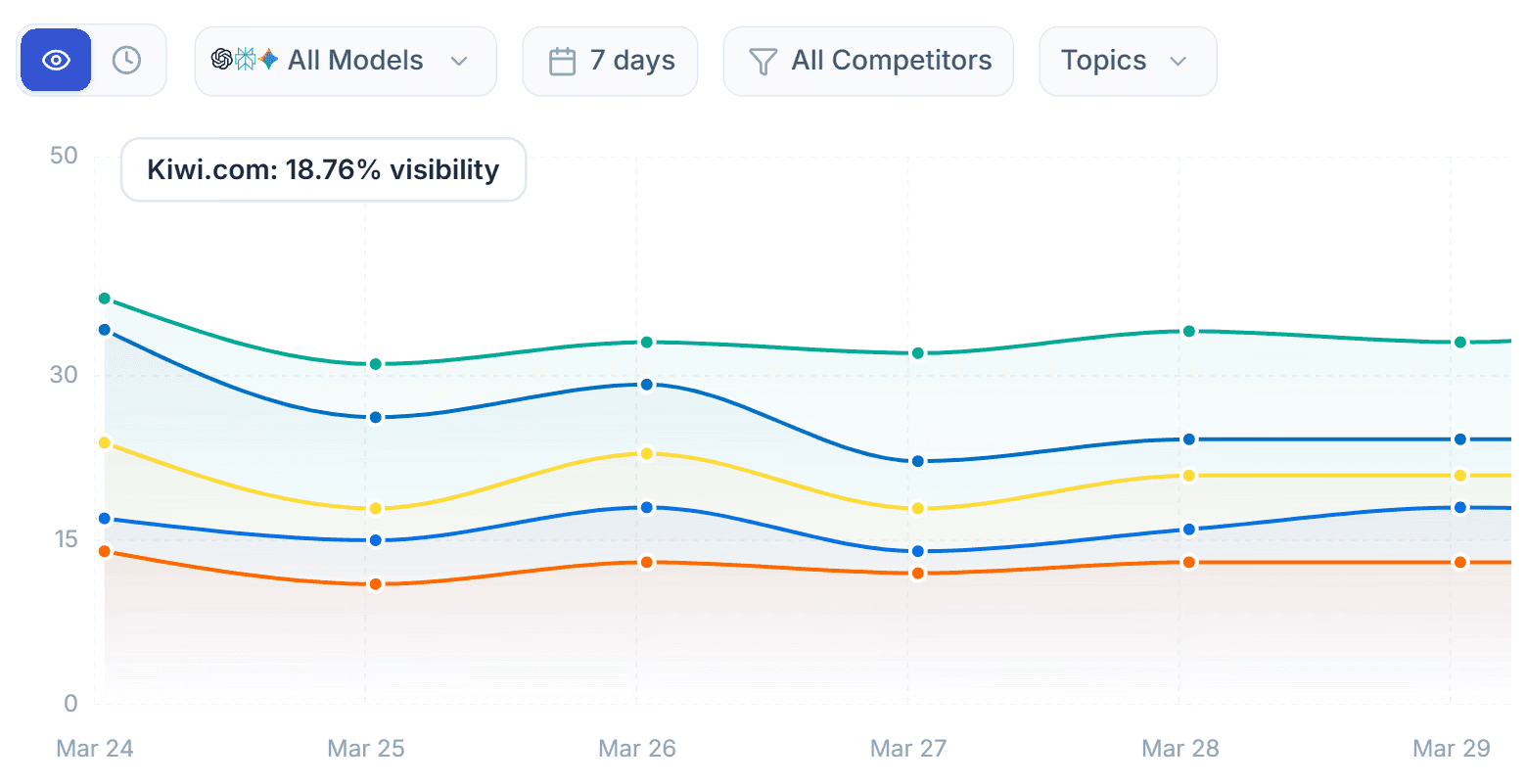
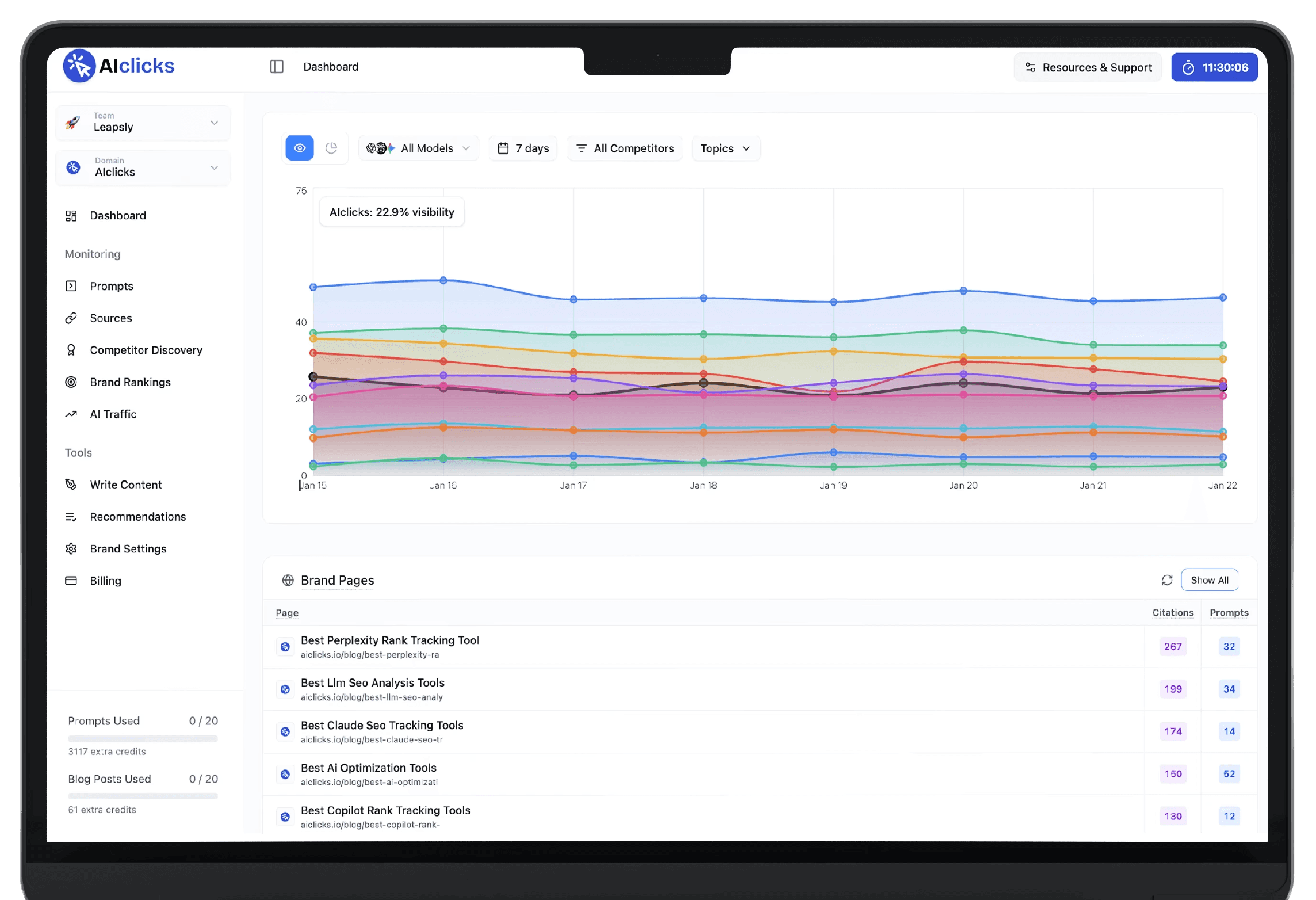
AIclicks gives you a live dashboard with daily ChatGPT mention rate, citation rate, sentiment, and share-of-voice across your tracked prompts, plus GA4 referral attribution for the traffic ChatGPT does send back.
Choose Your Plan
Flexible pricing that grows with your team. Upgrade or downgrade at any time.
Monthly
Yearly
-20%
Starter
Perfect for individuals & small teams
$49
/ month
Billed annually — you save $142
Choose 3 from:
Daily

" height="16px" id="fvSweaOBo" transform="translate(1 0)" width="14px"/></svg>)
" width="14px"><path d="M 13.864 5.629 L 13.3 5.629 L 13.3 5.6 L 7 5.6 L 7 8.4 L 10.956 8.4 C 10.379 10.03 8.828 11.2 7 11.2 C 4.681 11.2 2.8 9.319 2.8 7 C 2.8 4.681 4.681 2.8 7 2.8 C 8.071 2.8 9.045 3.204 9.786 3.864 L 11.766 1.884 C 10.516 0.719 8.844 0 7 0 C 3.134 0 0 3.134 0 7 C 0 10.866 3.134 14 7 14 C 10.866 14 14 10.866 14 7 C 14 6.531 13.952 6.073 13.864 5.629 Z" fill="rgb(255, 193, 7)" height="14px" id="H_YjfTNpn" width="14px"/><path d="M 0 3.742 L 2.3 5.429 C 2.922 3.888 4.429 2.8 6.193 2.8 C 7.264 2.8 8.238 3.204 8.979 3.864 L 10.959 1.884 C 9.709 0.719 8.037 0 6.193 0 C 3.504 0 1.172 1.518 0 3.742 Z" fill="rgb(255, 61, 0)" height="5.428500000000002px" id="PlkthQDhg" transform="translate(0.875 0)" width="10.959199999999996px"/><path d="M 6.232 5.581 C 8.04 5.581 9.683 4.889 10.925 3.764 L 8.758 1.931 C 8.032 2.483 7.144 2.782 6.232 2.781 C 4.411 2.781 2.865 1.62 2.283 0 L 0 1.759 C 1.159 4.026 3.511 5.581 6.232 5.581 Z" fill="rgb(76, 175, 80)" height="5.581099999999999px" id="WlnJ5gngE" transform="translate(0.7 8.4)" width="10.924899999999994px"/><path d="M 6.864 0.029 L 6.3 0.029 L 6.3 0 L 0 0 L 0 2.8 L 3.956 2.8 C 3.68 3.576 3.183 4.254 2.526 4.75 L 2.527 4.749 L 4.693 6.582 C 4.54 6.722 7 4.9 7 1.4 C 7 0.931 6.952 0.473 6.864 0.029 Z" fill="rgb(25, 118, 210)" height="6.589883930775992px" id="x_rSW275p" transform="translate(7 5.6)" width="7px"/></g></svg>)
" height="16px" id="hHS98fTxZ" width="16px"/></svg>)
 scale(1 1) translate(-1.861736945942159, -1.1170155383302638)" id="P20NzAvj0-699428820-radial-gradient" r="0.9935228066204626"><stop offset="0" stop-color="rgb(0, 174, 255)"/><stop offset="1" stop-color="rgb(7, 54, 196)"/></radialGradient><radialGradient cx="0.48250042504016705" cy="1.8366934653567062" gradient-transform="translate(0.48250042504016705, 1.8366934653567062) scale(1 1) translate(-0.48250042504016705, -1.8366934653567062)" id="UEWZqVjij-699428820-radial-gradient" r="0.9176890228114506"><stop offset="0" stop-color="rgb(255, 182, 87)"/><stop offset="1" stop-color="rgb(192, 43, 60)"/></radialGradient><linearGradient id="jyMN3TmKx-699428820-linear-gradient" x1="0.4594862532842614" x2="0.5405137467157386" y1="0" y2="1"><stop offset="0" stop-color="rgb(13, 145, 225)"/><stop offset="1" stop-color="rgb(255, 200, 0)"/></linearGradient><linearGradient id="xhMNwDFG0-699428820-linear-gradient" x1="0.4784828731548295" x2="0.5215171268451705" y1="5.551115123125783e-17" y2="1"><stop offset="0" stop-color="rgb(61, 203, 255)"/><stop offset="1" stop-color="rgba(5, 136, 247, 0)"/></linearGradient><radialGradient cx="1.4305090871482182" cy="0.34866158048251783" gradient-transform="translate(1.4305090871482182, 0.34866158048251783) scale(1 1) translate(-1.4305090871482182, -0.34866158048251783)" id="i79kAqaS4-699428820-radial-gradient" r="1.3362743412697924"><stop offset="0" stop-color="rgb(140, 72, 255)"/><stop offset="1" stop-color="rgb(255, 177, 82)"/></radialGradient><linearGradient id="mcxvno3tX-699428820-linear-gradient" x1="0.49844355920154226" x2="0.5015564407984577" y1="0" y2="1"><stop offset="0" stop-color="rgb(248, 173, 250)"/><stop offset="1" stop-color="rgba(168, 110, 221, 0)"/></linearGradient></defs><g d="M 11.605 1.219 C 11.397 0.499 10.739 0.002 9.989 0 L 9.498 0 C 8.682 0.002 7.985 0.588 7.842 1.391 L 7 6.016 L 7.209 5.296 C 7.416 4.574 8.075 4.076 8.825 4.074 L 11.681 4.074 L 12.879 4.545 L 14.033 4.074 L 13.697 4.074 C 12.947 4.072 12.289 3.575 12.081 2.855 Z M 4.413 13.387 C 4.618 14.111 5.278 14.611 6.031 14.613 L 7.075 14.613 C 7.988 14.613 8.735 13.88 8.758 12.96 L 8.871 8.5 L 8.633 9.319 C 8.426 10.039 7.768 10.537 7.018 10.539 L 4.138 10.539 L 3.111 9.977 L 2 10.539 L 2.331 10.539 C 3.084 10.542 3.743 11.042 3.949 11.766 L 4.413 13.387 Z M 9.999 0 L 4.167 0 C 2.501 0 1.501 2.221 0.834 4.441 C 0.045 7.073 -0.989 10.591 2.001 10.591 L 4.519 10.591 C 5.273 10.591 5.933 10.089 6.139 9.36 C 6.577 7.815 7.345 5.121 7.948 3.069 C 8.255 2.027 8.509 1.132 8.901 0.575 C 9.148 0.212 9.56 -0.004 9.999 0 M 9.999 0 L 4.167 0 C 2.501 0 1.501 2.221 0.834 4.441 C 0.045 7.073 -0.989 10.591 2.001 10.591 L 4.519 10.591 C 5.273 10.591 5.933 10.089 6.139 9.36 C 6.577 7.815 7.345 5.121 7.948 3.069 C 8.255 2.027 8.509 1.132 8.901 0.575 C 9.148 0.212 9.56 -0.004 9.999 0 M 6 14.593 L 11.833 14.593 C 13.499 14.593 14.499 12.372 15.166 10.151 C 15.955 7.519 16.989 4 13.999 4 L 11.48 4 C 10.725 4.002 10.063 4.505 9.86 5.232 C 9.266 7.332 8.663 9.429 8.051 11.523 C 7.745 12.566 7.49 13.461 7.098 14.019 C 6.851 14.382 6.439 14.597 6 14.593 M 6 14.593 L 11.833 14.593 C 13.499 14.593 14.499 12.372 15.166 10.151 C 15.955 7.519 16.989 4 13.999 4 L 11.48 4 C 10.725 4.002 10.063 4.505 9.86 5.232 C 9.266 7.332 8.663 9.429 8.051 11.523 C 7.745 12.566 7.49 13.461 7.098 14.019 C 6.851 14.382 6.439 14.597 6 14.593" fill="transparent" height="14.613333333333333px" id="QzkBy4Ibc" transform="translate(0 1)" width="16.00011071294081px"><path d="M 4.605 1.219 C 4.397 0.499 3.739 0.002 2.989 0 L 2.498 0 C 1.682 0.002 0.985 0.588 0.842 1.391 L 0 6.016 L 0.209 5.296 C 0.416 4.574 1.075 4.076 1.825 4.074 L 4.681 4.074 L 5.879 4.545 L 7.033 4.074 L 6.697 4.074 C 5.947 4.072 5.289 3.575 5.081 2.855 Z" fill="url(%23P20NzAvj0-699428820-radial-gradient)" height="6.016px" id="P20NzAvj0" transform="translate(7 0)" width="7.0333333333333385px"/><path d="M 2.413 4.887 C 2.618 5.611 3.278 6.111 4.031 6.113 L 5.075 6.113 C 5.988 6.113 6.735 5.38 6.758 4.46 L 6.871 0 L 6.633 0.819 C 6.426 1.539 5.768 2.037 5.018 2.039 L 2.138 2.039 L 1.111 1.477 L 0 2.039 L 0.331 2.039 C 1.084 2.042 1.743 2.542 1.949 3.266 L 2.413 4.887 Z" fill="url(%23UEWZqVjij-699428820-radial-gradient)" height="6.113333333333333px" id="UEWZqVjij" transform="translate(2 8.5)" width="6.871333333333332px"/><path d="M 9.999 0 L 4.167 0 C 2.501 0 1.501 2.221 0.834 4.441 C 0.045 7.073 -0.989 10.591 2.001 10.591 L 4.519 10.591 C 5.273 10.591 5.933 10.089 6.139 9.36 C 6.577 7.815 7.345 5.121 7.948 3.069 C 8.255 2.027 8.509 1.132 8.901 0.575 C 9.148 0.212 9.56 -0.004 9.999 0" fill="url(%23jyMN3TmKx-699428820-linear-gradient)" height="10.591388755215167px" id="jyMN3TmKx" width="9.999444046274142px"/><path d="M 9.999 0 L 4.167 0 C 2.501 0 1.501 2.221 0.834 4.441 C 0.045 7.073 -0.989 10.591 2.001 10.591 L 4.519 10.591 C 5.273 10.591 5.933 10.089 6.139 9.36 C 6.577 7.815 7.345 5.121 7.948 3.069 C 8.255 2.027 8.509 1.132 8.901 0.575 C 9.148 0.212 9.56 -0.004 9.999 0" fill="url(%23xhMNwDFG0-699428820-linear-gradient)" height="10.591388755215167px" id="xhMNwDFG0" width="9.999444046274142px"/><path d="M 0 10.593 L 5.833 10.593 C 7.499 10.593 8.499 8.372 9.166 6.151 C 9.955 3.519 10.989 0 7.999 0 L 5.48 0 C 4.725 0.002 4.063 0.505 3.86 1.232 C 3.266 3.332 2.663 5.429 2.051 7.523 C 1.745 8.566 1.49 9.461 1.098 10.019 C 0.851 10.382 0.439 10.597 0 10.593" fill="url(%23i79kAqaS4-699428820-radial-gradient)" height="10.593388755215164px" id="i79kAqaS4" transform="translate(6 4)" width="10.000110712940803px"/><path d="M 0 10.593 L 5.833 10.593 C 7.499 10.593 8.499 8.372 9.166 6.151 C 9.955 3.519 10.989 0 7.999 0 L 5.48 0 C 4.725 0.002 4.063 0.505 3.86 1.232 C 3.266 3.332 2.663 5.429 2.051 7.523 C 1.745 8.566 1.49 9.461 1.098 10.019 C 0.851 10.382 0.439 10.597 0 10.593" fill="url(%23mcxvno3tX-699428820-linear-gradient)" height="10.593388755215164px" id="mcxvno3tX" transform="translate(6 4)" width="10.000110712940803px"/></g></svg>)
" height="15.360666565427872px" id="HZPvvPBv7" transform="translate(0 0.5)" width="16px"/></svg>)
Tracked prompts
30
Websites you can add
3
LLMs you can track
3
Countries per project
1
LLM responses / mo
4,650
AI-optimized articles per month
10
Integrations
-
Support
Pro
For growing teams for more power
$140
/ month
Billed annually — you save $454
Choose 4 from:
Daily
Tracked prompts
150
Websites you can add
Unlimited
LLMs you can track
4
Countries per project
Unlimited
LLM responses / mo
18,600
AI-optimized articles per month
20
Integrations
Google Analytics
Support
BUSINESS
Best for medium-sized organizations
$357
/ month
Billed annually — you save $1198
Choose 6 from:
Daily
Tracked prompts
300
Websites you can add
Unlimited
LLMs you can track
6
Countries per project
Unlimited
LLM responses / mo
55,800
AI-optimized articles per month
30
Integrations
Google Analytics, API
Support
Dedicated account specialist
Become the #1 Answer in AI
Succeed in GEO yourself, or let us do all the work.
Do it yourself
Use AIclicks to see exactly where you appear across 10+ AI platforms, spot the gaps competitors are filling, and act on clear weekly recommendations.
From $59/month · Cancel anytime
Done for you
We Do All the Work for You
Our team manages your complete search presence: traditional SEO and GEO strategy, content, implementation, and reporting. You focus on policyholders.
Custom pricing · Minimum 3-month engagement
The AI SEO agency trusted by 1,000+ brands worldwide
From solo founders to multi-client agencies, AIclicks runs the full AI SEO agency program for organizations of every shape and size that want to be cited across every AI surface.
4.9/5 stars on G2







FAQ
How fast can an insurance agency expect SEO results?
Expect measurable movement in 3 to 6 months and real quote volume between 6 and 12. Local pack visibility and review growth come first, because those compound fastest. Coverage-line rankings against carriers and comparison sites take longer, and commercial niches with low search volume can move quicker than crowded personal lines. Anyone promising page one inside 90 days is selling you a lead list with a different label.
Do we need to show up in ChatGPT too?
Yes, and it is a different job from ranking. Ahrefs analysed 863,000 keywords and found only 38% of pages cited in AI Overviews also ranked in the top 10, down from 76% a year earlier. Insurance questions trigger AI answers constantly, and assistants hedge on financial advice by naming criteria and national brands. Being quotable, licensed and clearly structured is what gets an agency named instead.
How is insurance SEO different from generic local SEO?
Three things. Insurance is YMYL, so Google wants a named licensed producer behind every coverage claim before it ranks the page. Your competition is not other agencies but carriers, comparison sites and the carrier agent locators that sit above you for your own market. And a lot of your best content and your quote form live on somebody else’s domain, which generic local SEO advice never even looks at.
What should an insurance agency budget for SEO?
Published rates for insurance SEO cluster between $750 and $5,000 a month, with most US agencies quoted $3,000 to $7,500 for a serious program and hourly work at $100 to $250. Agency owners often describe spending around $15,000 a year across website, retainer and Google Ads for personal lines alone. Judge it against your current cost per bound policy, not against the retainer on its own.
Where does SEO sit next to the leads we buy?
Bought leads and ads fill this month; SEO lowers what next year costs. Shared internet leads arrive already sold to several agencies, so your close rate is set before you dial. Organic enquiries come to you by name and convert far better. Most agencies keep Google Ads running while the organic pages mature, then cut spend line by line as specific coverage pages start producing quote requests. Measure both on cost per bound policy.
Which pages should an insurance agency build first?
The Google Business Profile comes first, since it costs nothing and outranks your website for near me searches. Then one page for each coverage line you actually want more of, written in buyer language with real premium ranges. Then producer bios carrying licences and designations, because those are your credibility signals. Then trade pages for the commercial classes you specialise in. Location pages after that, and the blog last.
How do we know the SEO work is paying off?
Count bound policies attributable to organic, not ranking positions. Most insurance enquiries arrive as phone calls, so add call tracking or they never appear in analytics at all. Tag quote-form submissions by landing page so you know which coverage line produced them. Watch Google Business Profile calls and direction requests, which move first, and Search Console impressions on coverage terms. Then reconcile against your management system: quoted, bound, and premium written.
Should we hire an SEO agency or do it ourselves?
Split it. Nobody outside the agency knows which carriers you can place, which classes you want, or what a claim actually felt like for a client, so profile posts, review requests and coverage answers should stay in-house. Hand out the technical layer: schema, site speed, citation cleanup and the carrier microsite mess. If you hire, ask for cost per bound policy in the reporting and walk if they only show rankings.
Further Reading
Go deeper on GEO, AI search, and visibility tracking.