SEO for HVAC Companies:
Nobody shops around when the house hits 90 degrees. A homeowner grabs a phone, taps whichever heating and cooling company looks closest, open and well rated, and stops looking after the second call connects. That shortlist is decided entirely by search.









Why HVAC Companies Need SEO
Homeowners looking for a contractor start online almost every time, and now many ask an assistant first. HVAC demand arrives in spikes, so 3 map pack slots decide an entire week of dispatch.
You service 5 counties, but Google ranks you from a single pin on the map. A homeowner 20 minutes away searching AC repair near me sees the 3 companies closer to them and never sees you at all. Nothing of this shows up as a lost job, because the enquiry never happened in the first place.
Run the query from any zip code. Yelp, Angi and Better Business Bureau listings all sit above working contractors. So does the manufacturer whose badge is on your van: Trane, Lennox and Carrier operate dealer locators that rank on national authority, then file you inside a page they own.
Blended cost per lead on HVAC Google Ads runs around $104, and $150 is normal in a competitive market. Retainers stack another $1,500 to $4,000 monthly on that. Published packages for a growing shop sit near $2,100. Pause any of it in the shoulder season and the phones go quiet that week.
How SEO Works for HVAC Companies
Search Engine Optimization projects are long-term investments for HVAC contractors, where each task supplements the others and creates compound results over time.
01
Keywords, page structure, and the signals Google reads directly
The vocabulary mismatch is what kills HVAC on-page work. Your site is structured the way you write quotes: residential, commercial, installation, maintenance. No homeowner types any of those. They type AC blowing warm air, furnace keeps shutting off, how much is a new heat pump, mini split installation cost. Every single one of those needs a page of its own, and somebody else already wrote it. What actually books jobs is a page per symptom, a page per system type, a page per service you dispatch, alongside the emergency page and the maintenance agreement page.
Value sits in whatever a homeowner reads before spending real money. What a full system replacement costs, how long a heat pump lasts, whether an old unit deserves one more repair bill: those keep pulling calls 4 years later, since equipment lifecycles barely move. What rots is everything with a date on it: the spring tune-up special, the refrigerant phase-out post written 3 years ago, the announcement that you added a truck. Those quietly become most of the site. Write fewer, write them about equipment and money, and revisit the prices each year.
1
Explode the services page into a page per symptom and system: AC not cooling, furnace short cycling, heat pump replacement cost.
2
Redirect expired tune-up promotions and discontinued equipment pages into the live service page, rather than leaving them to 404 each season.
3
Deploy HVACBusiness schema across the site, with Service and areaServed entries per trade, then confirm output in Schema Markup Validator.
4
Publish a cost page for every system you install and a lifespan page for every brand you service, both searched year-round.
02
Map Pack visibility, citations, and proximity signals
Nobody drives past 40 contractors to reach yours. HVAC demand is almost entirely proximity-bound, which is why the 3 result map pack outranks every organic listing on the page, the BBB and the dealer locators included. A service-area business has nowhere else it can outrank a national name. Distance from the caller is fixed. Profile depth and the rate reviews arrive are not, and that is where the ranking turns.
Your primary category should name the work that pays the bills: HVAC Contractor, or Air Conditioning Repair Service if that is most of the dispatch board. Furnace repair, heat pump installation and duct cleaning each get their own service entry, described properly. Draw the service area from zip codes you genuinely reach, not the whole state. Upload photos of real trucks, real crews and real installs. Claim 24 hour cover only if somebody answers.
Citations in this trade come in 3 layers. The general one covers Yelp, Facebook, Apple Business Connect and Bing. Home services listings cover Angi, HomeAdvisor, Thumbtack, Nextdoor, Porch and the BBB. The layer that actually separates you is trade credentialing: your Trane, Lennox, Carrier or Bryant dealer listing, the NATE certified contractor lookup, your ACCA membership page, and the approved contractor roster of every utility rebate program you file through. Every one of them needs the same name, the same suite, the same phone.
1
Set the primary category as narrowly as the work allows, give every trade a separate service entry, and cap the radius at real zip codes.
2
Each shop needs its own listing, its own dedicated line, and a page naming which technicians roll out of that building.
3
Audit Angi, HomeAdvisor, BBB and your manufacturer dealer profile in BrightLocal or Yext, then fix every name and suite variant.
4
Turn a finished job into a weekly profile post: the system installed, the fault diagnosed, the area the crew covered.
03
Topic authority, inbound links, and content that earns traffic
Every enquiry starts as the same private argument: repair it or replace it. The homeowner wants to know what a compressor swap costs against a whole new system, whether a 14-year-old unit deserves another bill, and what a heat pump rebate is genuinely worth this year. Answer that with numbers and you have won the job before a rival has even quoted. Most sites answer it with a contact form.
Once the replacement decision is made, the homeowner is picking a crew, and adjectives stop working. Show the brands you hold certification on, the NATE credentials your technicians carry, photographs of installs your own people did rather than the manufacturer’s stock library, financing terms in writing, and exactly what the labour warranty covers. All of that belongs on the system page itself, not buried on an about page nobody opens.
HVAC links are mostly relationships you already have. Your distributor and your manufacturer publish dealer and certified installer pages. Utility companies list approved contractors for their rebate programs. Home builders, property managers and realtors you already work with have vendor pages. Trade bodies like ACCA and your state mechanical contractors association publish member directories. Local news wants a contractor to explain heat wave load or a refrigerant rule change. None of that costs money.
1
Publish an annual repair-or-replace guide using the $5,000 rule, real part prices and the current federal heat pump credit.
2
Give each town you dispatch to its own service pages, carrying real drive times, local housing stock and the systems your crews keep finding.
3
Group every money question onto one hub page: install cost, financing, maintenance agreements, utility rebates and the federal heat pump tax credit.
4
Give every equipment line you are certified on its own page, Trane, Lennox, Mitsubishi ductless, because homeowners research the brand first.
04
Site speed, crawlability, Core Web Vitals, and mobile health
Most HVAC sites quietly demolish themselves twice a year. Come spring the AC pages get pushed into the navigation and the furnace pages get pulled, unpublished or shifted to a new URL. Come autumn it runs backwards. Internal links snap, redirects never get written, and the heating page that spent 6 months building authority is orphaned in the week its season opens. Google relearns the site every 6 months, so nothing accumulates.
The search that decides everything is made from inside a house at 90 degrees, on a phone, by somebody who has already given up on the thermostat. All they need is a tap-to-call button and confirmation you are open. HVAC sites bury both beneath a ServiceTitan or Housecall Pro booking widget, a chat bot and a review carousel, every one of them loading ahead of the header. Roughly 47% of people expect a page inside 2 seconds.
1
Each shoulder season, run a Screaming Frog crawl against last year’s sitemap and restore or redirect every heating page that fell out.
2
Score your AC repair page in PageSpeed Insights, then hold the Housecall Pro or Schedule Engine booking embed back until a visitor taps it.
3
Convert install galleries and equipment shots to WebP, lazy-load anything under the fold, and hard-code dimensions so the layout stops jumping.
4
Keep service and service-area URLs in a dedicated sitemap file, well away from blog archives, and ping a resubmit when pricing or equipment shifts.
05
Star ratings, review volume, and response strategy that builds trust
Nothing lifts a map pack in the trades like reviews, because a homeowner is about to let a stranger into the house and quote them $12,000. HVAC makes them awkward to collect. The technician who earned the review is already back in the van and on to the next call. The customer feels relief, not delight. And whoever sits down to write unprompted is usually somebody who got a replacement quote they did not expect.
The window is while the technician is still standing there and cold air is coming out of the vent. Relief peaks then and never returns. Fire the request out of ServiceTitan, Housecall Pro or Jobber on ticket closure, with the technician’s name attached rather than the company’s. Hand out a QR card too, for the customers who ignore texts. Ask on every call, not only the big installs, and the rating stops depending on who complains loudest.
1
Set ServiceTitan, Housecall Pro or Jobber to text the review request when a technician closes the ticket, with that technician named.
2
Answer the same day, citing the invoice date and what was diagnosed, since almost every negative HVAC review is really a pricing dispute.
3
Pull heat pump reviews onto the heat pump page and furnace reviews onto the furnace page, where the buying decision actually happens.
4
Ask at every maintenance agreement visit as well, because tune-ups are your highest-volume, lowest-stress touchpoint and the customer is not being billed.
Google is No Longer the Only Place Your homeowners are Searching
Homeowners are using AI to find answers, and they trust what it tells them. Invest in GEO to get recommended in those answers.
1 Billion
Questions ChatGPT receives every single day
38%
Your #1 top ranking page on Google would be cited by AI
14%
of HVAC contractors optimise for GEO. The rest are invisible in AI answers


You can rank #1 for “HVAC contractor near me” and still not exist in ChatGPT’s answer. Run a free GEO audit to see where your brand actually stands.
GEO vs SEO: Same Goal, Different Methods
GEO is wider than SEO. AI recommends the brands that show up across the sources it reads, so your presence in forums, social platforms and HVAC blogs decides your odds. AIclicks measures the three metrics below so you know which to work on first.
AI Assistant
My furnace stopped working, who can come tonight?
Your Company
Citation Rate
Shows how many AI answers about HVAC companies name your brand, out of every 100. Models pull from the same trusted pages over and over, so citations compound: once you are in, staying in gets easier. Find the competitor pages AI cites most, then publish your own version of each.
Your Company
82% positive
Competitor A
54% positive
Competitor B
38% positive
Brand Sentiment
Shows how AI describes you when your brand comes up: positive, neutral or negative. Tone is what separates being mentioned from being recommended, and models repeat whatever framing they find. Track the negative mentions back to the reviews and threads behind them, then publish content that answers those directly.
Others 52%
You 24%
— 24%
Your Company
AI mention share of voice — HVAC category
Competitors
Not Cited
Share of Voice in AI
Shows how much of the HVAC conversation belongs to you rather than your competitors. This is the metric that matters most, the GEO version of a Google ranking. With only 1–5 brands named per answer, the market is winner-takes-more and every point is taken from someone.
The Dashboard Your Dedicated AI Search Team Works In
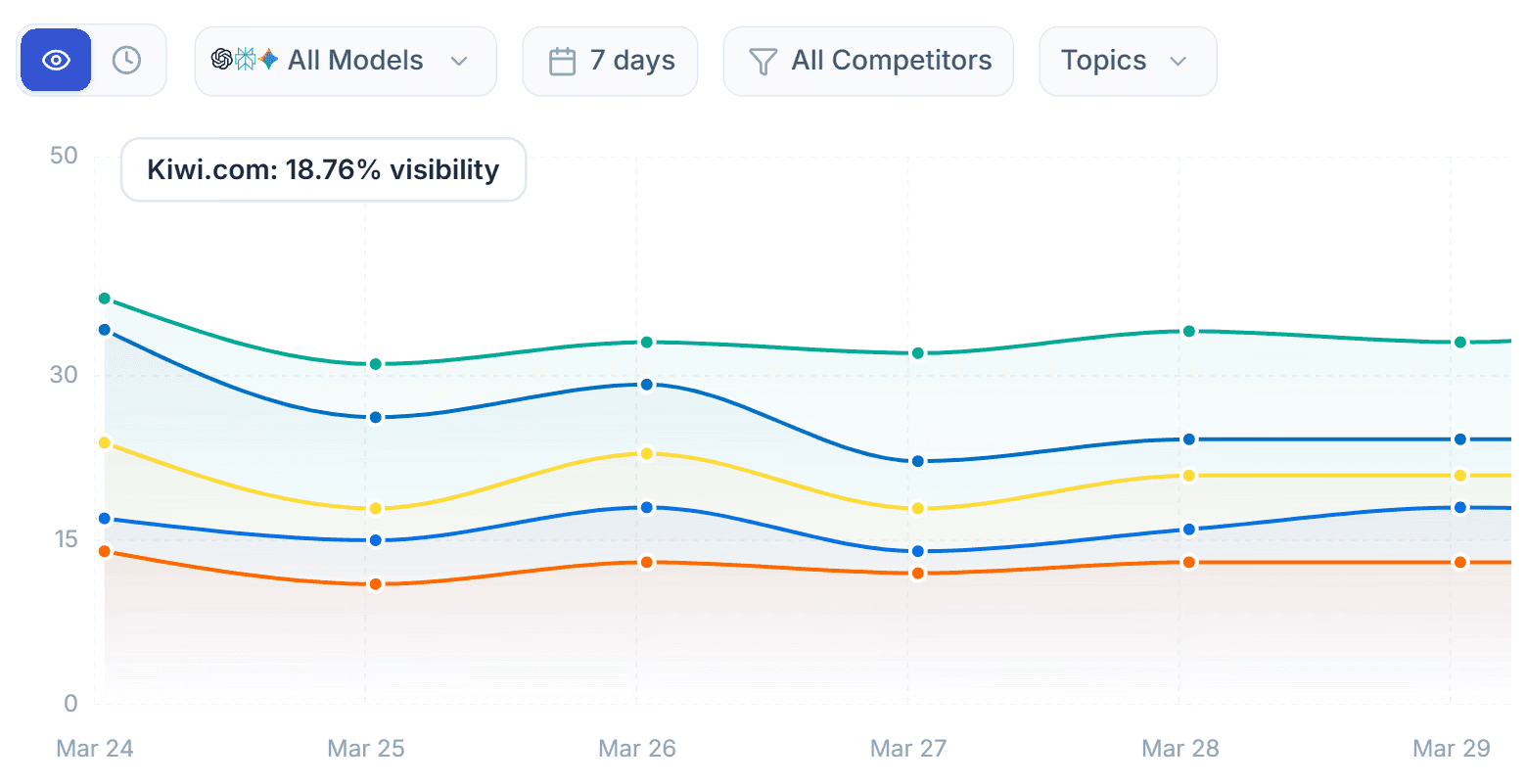
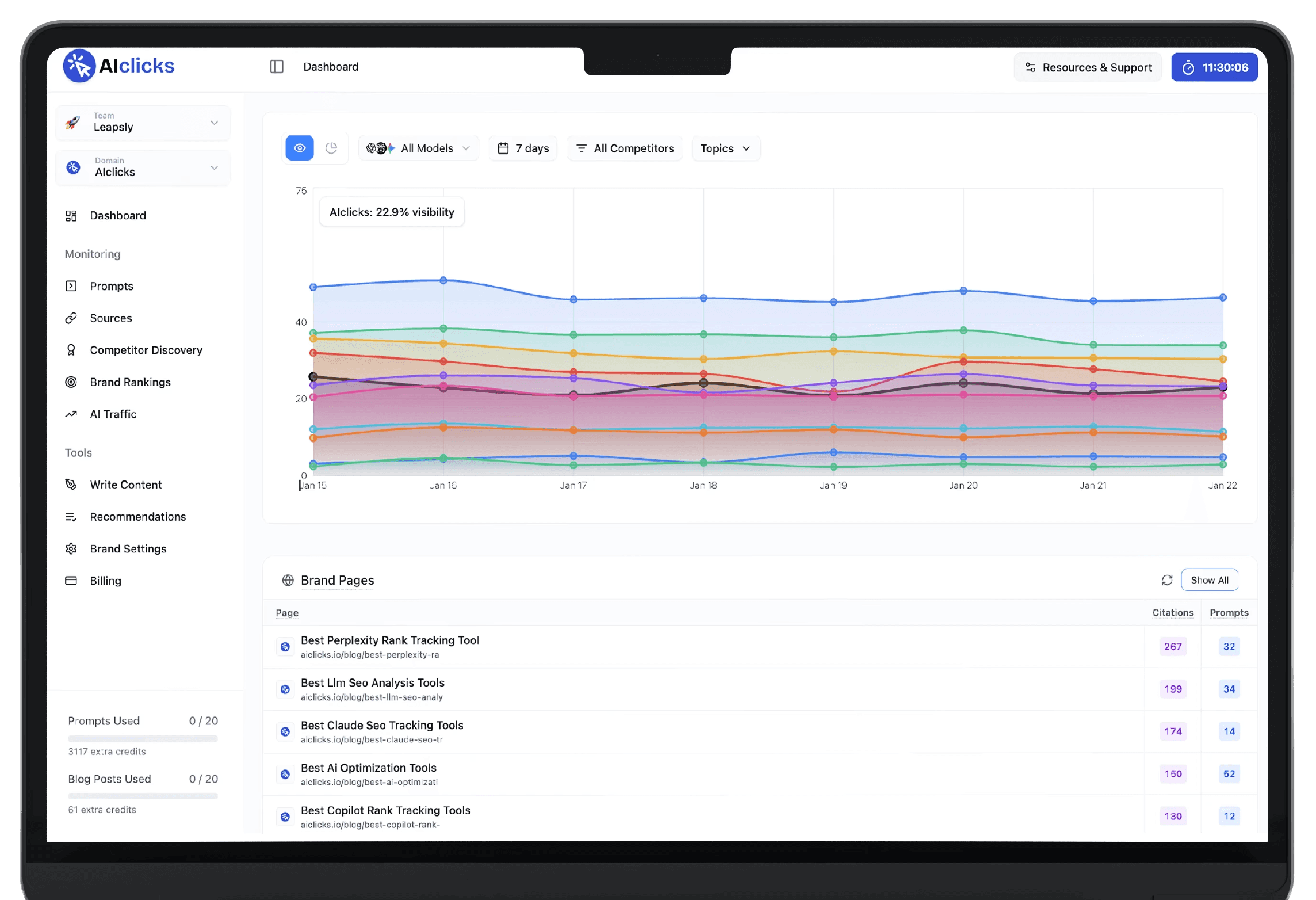
AIclicks gives you a live dashboard with daily ChatGPT mention rate, citation rate, sentiment, and share-of-voice across your tracked prompts, plus GA4 referral attribution for the traffic ChatGPT does send back.
Choose Your Plan
Flexible pricing that grows with your team. Upgrade or downgrade at any time.
Monthly
Yearly
-20%
Starter
Perfect for individuals & small teams
$49
/ month
Billed annually — you save $142
Choose 3 from:
Daily

" height="16px" id="fvSweaOBo" transform="translate(1 0)" width="14px"/></svg>)
" width="14px"><path d="M 13.864 5.629 L 13.3 5.629 L 13.3 5.6 L 7 5.6 L 7 8.4 L 10.956 8.4 C 10.379 10.03 8.828 11.2 7 11.2 C 4.681 11.2 2.8 9.319 2.8 7 C 2.8 4.681 4.681 2.8 7 2.8 C 8.071 2.8 9.045 3.204 9.786 3.864 L 11.766 1.884 C 10.516 0.719 8.844 0 7 0 C 3.134 0 0 3.134 0 7 C 0 10.866 3.134 14 7 14 C 10.866 14 14 10.866 14 7 C 14 6.531 13.952 6.073 13.864 5.629 Z" fill="rgb(255, 193, 7)" height="14px" id="H_YjfTNpn" width="14px"/><path d="M 0 3.742 L 2.3 5.429 C 2.922 3.888 4.429 2.8 6.193 2.8 C 7.264 2.8 8.238 3.204 8.979 3.864 L 10.959 1.884 C 9.709 0.719 8.037 0 6.193 0 C 3.504 0 1.172 1.518 0 3.742 Z" fill="rgb(255, 61, 0)" height="5.428500000000002px" id="PlkthQDhg" transform="translate(0.875 0)" width="10.959199999999996px"/><path d="M 6.232 5.581 C 8.04 5.581 9.683 4.889 10.925 3.764 L 8.758 1.931 C 8.032 2.483 7.144 2.782 6.232 2.781 C 4.411 2.781 2.865 1.62 2.283 0 L 0 1.759 C 1.159 4.026 3.511 5.581 6.232 5.581 Z" fill="rgb(76, 175, 80)" height="5.581099999999999px" id="WlnJ5gngE" transform="translate(0.7 8.4)" width="10.924899999999994px"/><path d="M 6.864 0.029 L 6.3 0.029 L 6.3 0 L 0 0 L 0 2.8 L 3.956 2.8 C 3.68 3.576 3.183 4.254 2.526 4.75 L 2.527 4.749 L 4.693 6.582 C 4.54 6.722 7 4.9 7 1.4 C 7 0.931 6.952 0.473 6.864 0.029 Z" fill="rgb(25, 118, 210)" height="6.589883930775992px" id="x_rSW275p" transform="translate(7 5.6)" width="7px"/></g></svg>)
" height="16px" id="hHS98fTxZ" width="16px"/></svg>)
 scale(1 1) translate(-1.861736945942159, -1.1170155383302638)" id="P20NzAvj0-699428820-radial-gradient" r="0.9935228066204626"><stop offset="0" stop-color="rgb(0, 174, 255)"/><stop offset="1" stop-color="rgb(7, 54, 196)"/></radialGradient><radialGradient cx="0.48250042504016705" cy="1.8366934653567062" gradient-transform="translate(0.48250042504016705, 1.8366934653567062) scale(1 1) translate(-0.48250042504016705, -1.8366934653567062)" id="UEWZqVjij-699428820-radial-gradient" r="0.9176890228114506"><stop offset="0" stop-color="rgb(255, 182, 87)"/><stop offset="1" stop-color="rgb(192, 43, 60)"/></radialGradient><linearGradient id="jyMN3TmKx-699428820-linear-gradient" x1="0.4594862532842614" x2="0.5405137467157386" y1="0" y2="1"><stop offset="0" stop-color="rgb(13, 145, 225)"/><stop offset="1" stop-color="rgb(255, 200, 0)"/></linearGradient><linearGradient id="xhMNwDFG0-699428820-linear-gradient" x1="0.4784828731548295" x2="0.5215171268451705" y1="5.551115123125783e-17" y2="1"><stop offset="0" stop-color="rgb(61, 203, 255)"/><stop offset="1" stop-color="rgba(5, 136, 247, 0)"/></linearGradient><radialGradient cx="1.4305090871482182" cy="0.34866158048251783" gradient-transform="translate(1.4305090871482182, 0.34866158048251783) scale(1 1) translate(-1.4305090871482182, -0.34866158048251783)" id="i79kAqaS4-699428820-radial-gradient" r="1.3362743412697924"><stop offset="0" stop-color="rgb(140, 72, 255)"/><stop offset="1" stop-color="rgb(255, 177, 82)"/></radialGradient><linearGradient id="mcxvno3tX-699428820-linear-gradient" x1="0.49844355920154226" x2="0.5015564407984577" y1="0" y2="1"><stop offset="0" stop-color="rgb(248, 173, 250)"/><stop offset="1" stop-color="rgba(168, 110, 221, 0)"/></linearGradient></defs><g d="M 11.605 1.219 C 11.397 0.499 10.739 0.002 9.989 0 L 9.498 0 C 8.682 0.002 7.985 0.588 7.842 1.391 L 7 6.016 L 7.209 5.296 C 7.416 4.574 8.075 4.076 8.825 4.074 L 11.681 4.074 L 12.879 4.545 L 14.033 4.074 L 13.697 4.074 C 12.947 4.072 12.289 3.575 12.081 2.855 Z M 4.413 13.387 C 4.618 14.111 5.278 14.611 6.031 14.613 L 7.075 14.613 C 7.988 14.613 8.735 13.88 8.758 12.96 L 8.871 8.5 L 8.633 9.319 C 8.426 10.039 7.768 10.537 7.018 10.539 L 4.138 10.539 L 3.111 9.977 L 2 10.539 L 2.331 10.539 C 3.084 10.542 3.743 11.042 3.949 11.766 L 4.413 13.387 Z M 9.999 0 L 4.167 0 C 2.501 0 1.501 2.221 0.834 4.441 C 0.045 7.073 -0.989 10.591 2.001 10.591 L 4.519 10.591 C 5.273 10.591 5.933 10.089 6.139 9.36 C 6.577 7.815 7.345 5.121 7.948 3.069 C 8.255 2.027 8.509 1.132 8.901 0.575 C 9.148 0.212 9.56 -0.004 9.999 0 M 9.999 0 L 4.167 0 C 2.501 0 1.501 2.221 0.834 4.441 C 0.045 7.073 -0.989 10.591 2.001 10.591 L 4.519 10.591 C 5.273 10.591 5.933 10.089 6.139 9.36 C 6.577 7.815 7.345 5.121 7.948 3.069 C 8.255 2.027 8.509 1.132 8.901 0.575 C 9.148 0.212 9.56 -0.004 9.999 0 M 6 14.593 L 11.833 14.593 C 13.499 14.593 14.499 12.372 15.166 10.151 C 15.955 7.519 16.989 4 13.999 4 L 11.48 4 C 10.725 4.002 10.063 4.505 9.86 5.232 C 9.266 7.332 8.663 9.429 8.051 11.523 C 7.745 12.566 7.49 13.461 7.098 14.019 C 6.851 14.382 6.439 14.597 6 14.593 M 6 14.593 L 11.833 14.593 C 13.499 14.593 14.499 12.372 15.166 10.151 C 15.955 7.519 16.989 4 13.999 4 L 11.48 4 C 10.725 4.002 10.063 4.505 9.86 5.232 C 9.266 7.332 8.663 9.429 8.051 11.523 C 7.745 12.566 7.49 13.461 7.098 14.019 C 6.851 14.382 6.439 14.597 6 14.593" fill="transparent" height="14.613333333333333px" id="QzkBy4Ibc" transform="translate(0 1)" width="16.00011071294081px"><path d="M 4.605 1.219 C 4.397 0.499 3.739 0.002 2.989 0 L 2.498 0 C 1.682 0.002 0.985 0.588 0.842 1.391 L 0 6.016 L 0.209 5.296 C 0.416 4.574 1.075 4.076 1.825 4.074 L 4.681 4.074 L 5.879 4.545 L 7.033 4.074 L 6.697 4.074 C 5.947 4.072 5.289 3.575 5.081 2.855 Z" fill="url(%23P20NzAvj0-699428820-radial-gradient)" height="6.016px" id="P20NzAvj0" transform="translate(7 0)" width="7.0333333333333385px"/><path d="M 2.413 4.887 C 2.618 5.611 3.278 6.111 4.031 6.113 L 5.075 6.113 C 5.988 6.113 6.735 5.38 6.758 4.46 L 6.871 0 L 6.633 0.819 C 6.426 1.539 5.768 2.037 5.018 2.039 L 2.138 2.039 L 1.111 1.477 L 0 2.039 L 0.331 2.039 C 1.084 2.042 1.743 2.542 1.949 3.266 L 2.413 4.887 Z" fill="url(%23UEWZqVjij-699428820-radial-gradient)" height="6.113333333333333px" id="UEWZqVjij" transform="translate(2 8.5)" width="6.871333333333332px"/><path d="M 9.999 0 L 4.167 0 C 2.501 0 1.501 2.221 0.834 4.441 C 0.045 7.073 -0.989 10.591 2.001 10.591 L 4.519 10.591 C 5.273 10.591 5.933 10.089 6.139 9.36 C 6.577 7.815 7.345 5.121 7.948 3.069 C 8.255 2.027 8.509 1.132 8.901 0.575 C 9.148 0.212 9.56 -0.004 9.999 0" fill="url(%23jyMN3TmKx-699428820-linear-gradient)" height="10.591388755215167px" id="jyMN3TmKx" width="9.999444046274142px"/><path d="M 9.999 0 L 4.167 0 C 2.501 0 1.501 2.221 0.834 4.441 C 0.045 7.073 -0.989 10.591 2.001 10.591 L 4.519 10.591 C 5.273 10.591 5.933 10.089 6.139 9.36 C 6.577 7.815 7.345 5.121 7.948 3.069 C 8.255 2.027 8.509 1.132 8.901 0.575 C 9.148 0.212 9.56 -0.004 9.999 0" fill="url(%23xhMNwDFG0-699428820-linear-gradient)" height="10.591388755215167px" id="xhMNwDFG0" width="9.999444046274142px"/><path d="M 0 10.593 L 5.833 10.593 C 7.499 10.593 8.499 8.372 9.166 6.151 C 9.955 3.519 10.989 0 7.999 0 L 5.48 0 C 4.725 0.002 4.063 0.505 3.86 1.232 C 3.266 3.332 2.663 5.429 2.051 7.523 C 1.745 8.566 1.49 9.461 1.098 10.019 C 0.851 10.382 0.439 10.597 0 10.593" fill="url(%23i79kAqaS4-699428820-radial-gradient)" height="10.593388755215164px" id="i79kAqaS4" transform="translate(6 4)" width="10.000110712940803px"/><path d="M 0 10.593 L 5.833 10.593 C 7.499 10.593 8.499 8.372 9.166 6.151 C 9.955 3.519 10.989 0 7.999 0 L 5.48 0 C 4.725 0.002 4.063 0.505 3.86 1.232 C 3.266 3.332 2.663 5.429 2.051 7.523 C 1.745 8.566 1.49 9.461 1.098 10.019 C 0.851 10.382 0.439 10.597 0 10.593" fill="url(%23mcxvno3tX-699428820-linear-gradient)" height="10.593388755215164px" id="mcxvno3tX" transform="translate(6 4)" width="10.000110712940803px"/></g></svg>)
" height="15.360666565427872px" id="HZPvvPBv7" transform="translate(0 0.5)" width="16px"/></svg>)
Tracked prompts
30
Websites you can add
3
LLMs you can track
3
Countries per project
1
LLM responses / mo
4,650
AI-optimized articles per month
10
Integrations
-
Support
Pro
For growing teams for more power
$140
/ month
Billed annually — you save $454
Choose 4 from:
Daily
Tracked prompts
150
Websites you can add
Unlimited
LLMs you can track
4
Countries per project
Unlimited
LLM responses / mo
18,600
AI-optimized articles per month
20
Integrations
Google Analytics
Support
BUSINESS
Best for medium-sized organizations
$357
/ month
Billed annually — you save $1198
Choose 6 from:
Daily
Tracked prompts
300
Websites you can add
Unlimited
LLMs you can track
6
Countries per project
Unlimited
LLM responses / mo
55,800
AI-optimized articles per month
30
Integrations
Google Analytics, API
Support
Dedicated account specialist
Become the #1 Answer in AI
Succeed in GEO yourself, or let us do all the work.
Do it yourself
Use AIclicks to see exactly where you appear across 10+ AI platforms, spot the gaps competitors are filling, and act on clear weekly recommendations.
From $59/month · Cancel anytime
Done for you
We Do All the Work for You
Our team manages your complete search presence: traditional SEO and GEO strategy, content, implementation, and reporting. You focus on homeowners.
Custom pricing · Minimum 3-month engagement
The AI SEO agency trusted by 1,000+ brands worldwide
From solo founders to multi-client agencies, AIclicks runs the full AI SEO agency program for organizations of every shape and size that want to be cited across every AI surface.
4.9/5 stars on G2







FAQ
How soon will HVAC SEO start producing phone calls?
Map pack gains usually land first, somewhere around month 3, with organic service terms following between months 6 and 12. Agencies in this trade quote page one within 3 to 6 months, which assumes nobody tears the site apart every season. Smaller markets move quicker. Long before rankings shift, profile calls rise and impressions climb on furnace and AC queries; those are the 2 signals worth watching.
Should we chase Google rankings or AI answers now?
Both, and they no longer come as a pair. Ahrefs analysed 863,000 keywords and found only 38% of pages cited in AI Overviews also ranked in the top 10 for that query, down from 76% a year earlier. Assistants assemble HVAC recommendations from review text, directory data and dealer network pages rather than from your homepage. A ranking earns the click. Getting named in the answer needs credentials, clear structure and a consistent description.
What makes HVAC search different from any local business?
Three things. Demand swings with the weather, so the site must hold heating and cooling rankings simultaneously instead of trading one for the other. You have no storefront customers walk into, which means Google’s proximity filter caps your reach long before content quality does. And the manufacturer whose equipment you install competes with you, because dealer locators outrank the dealers listed on them. None of that shows up in generic local search advice.
What should an HVAC company budget for SEO?
Published rates for this trade cluster between $1,500 and $4,000 a month, with entry packages near $1,200 and multi-location programs running far higher. Judge it against paid, not against zero: blended cost per lead on HVAC Google Ads sits around $104 and reaches $150 in tight markets. A retainer that eventually drops your cost per booked job below that is the cheaper line.
Do we still need paid ads if SEO works?
Yes, because they cover different halves of the same result page. Paid placements sit on top of the emergency search and disappear the moment you stop funding them. What compounds through shoulder seasons, precisely when ad budgets get cut, is map pack and organic strength. Run both, let ad data tell you which services deserve a page, and hold every channel to the same number: cost per booked job.
Which pages should an HVAC company build first?
Before a single website change, finish the Google Business Profile. It is the only asset here that ranks without a budget. Emergency repair page next, since that captures the sharpest intent in the trade. After that, dedicated pages for AC repair, furnace repair and system replacement, phrased the way a homeowner describes the fault. Then the cost and rebate hub. Service-area pages last, only for towns your crews actually reach.
Which numbers actually prove HVAC SEO is working?
Booked jobs traced back to organic search, and nothing softer than that. HVAC enquiries arrive by phone, so a site without call tracking will always look like it underperforms. Inside the profile, direction requests and calls shift earliest. In Search Console, impressions on furnace and AC queries rise well ahead of position. Then reconcile the lot against closed tickets in ServiceTitan or Housecall Pro, because revenue settles the argument.
Is HVAC SEO something our office staff can run?
Partly, and the split follows who holds the knowledge. Profile posts, job photos, review requests and honest replies to homeowner questions all sit better inside the company, because nobody outside it knows what your crews installed last week. Schema, page speed, crawl issues and link acquisition belong with a specialist. Before signing anyone, check they can discuss seasonal demand, service radius and manufacturer co-op rules unprompted.
Further Reading
Go deeper on GEO, AI search, and visibility tracking.