SEO for Hotels:
A traveller compares 5 properties, reads the reviews, checks the map, then asks an assistant which one is worth it, and books whichever name keeps appearing. Most of that happens on Booking.com and Google, before your own site ever loads.









Why Hotels Need SEO
Travellers now ask an assistant where to stay before they open a browser tab, and the answer is assembled from OTA and review data. Cloudbeds found OTAs already captured 63.4% of independent hotel bookings.
A hotel site is usually a photo carousel, a paragraph about the location, and a big Book Now button. The suite with the balcony, the pet policy, the airport shuttle, the meeting room: all of them real searches, and none of them a page. Guests searching for exactly that find it on an OTA instead.
Type hotels near me anywhere in the US and Booking.com, Tripadvisor, Expedia and Hotels.com fill the page above every individual property. They rank on inventory no single hotel can match, then charge you 15% to 30% commission on the guest they intercepted with a listing built from your own photos.
A 40-room independent with 70% OTA share pays 20% of that revenue away every month, plus metasearch bids on Google Hotels and Trivago to win back guests who already found it. Hotel SEO retainers start near $1,500 a month and climb past $6,000. Only one of those lines is worth something next season.
How SEO Works for Hotels
Search Engine Optimization projects are long-term investments for hoteliers, where each task supplements the others and creates compound results over time.
01
Keywords, page structure, and the signals Google reads directly
On-page work is awkward for hotels because the thing you sell is not on your website. Rates, availability and room inventory live in the property management system and surface through a booking engine like SynXis, Cloudbeds or ThinkReservations, often on a separate domain. What Google can read is whatever sits around that widget, and on most hotel sites that is a homepage, a gallery and a contact form. The pages that earn rankings have to be built by hand: one per room type, one per amenity, one per package, and a location page for the guest who has not picked a neighbourhood yet.
The durable pages answer a question instead of announcing a date. A page on parking and airport transfers, a page on what the resort fee covers, a page on which rooms take dogs and what it costs: those still rank in 3 years because the answer barely changes and every guest asks. What churns is the offer. The summer rate page, the New Year package, the press release about the lobby refurbishment go stale in weeks and become most of a hotel’s index. Hotels have this backwards, with 40 expired offer pages live and no page for the suite that sells out first.
1
Give every room type its own indexable page with square footage, bed configuration, view, occupancy and a direct rate, not just a booking-engine modal.
2
Redirect last season’s rate and package URLs into the room or amenity page that replaced them, and unpublish event pages once the event has passed.
3
Nest HotelRoom and Offer inside LodgingBusiness schema so Google reads star rating, check-in hours, amenities and price range; validate in the Rich Results Test.
4
Publish standing pages for parking, resort fees, pet policy, early check-in and airport transfers, the questions your front desk answers on every call.
02
Map Pack visibility, citations, and proximity signals
Almost every hotel query carries a place in it, and Google answers those with a hotel pack rather than the usual 3-result map pack: a date-aware carousel of rates, ratings and Book buttons, and the rates in it come from whichever channels feed Google, usually the OTAs, not you. That unit outranks every organic listing on the page. It is the one surface where a 40-room independent can appear beside a chain, and claiming it costs nothing.
A hotel profile is not a normal listing. Set the primary category precisely, then fill the hotel attributes Google actually filters on: free breakfast, parking, pool, pet policy, accessibility, check-in and check-out times, star class. Connect your booking engine to Google’s free booking links through SiteMinder, Cloudbeds or Mews so your direct rate appears next to the OTA rates instead of being missing. Load real photographs of every room type, and answer the Q&A yourself before a guest guesses.
Hotels have a citation layer general local SEO never mentions. Tripadvisor, Booking.com, Expedia, Trivago and Kayak hold your name, address and phone whether you maintain them or not. Above those sit the ones that actually confer trust: your destination marketing organisation and convention bureau listing, your state lodging association, AAA and Forbes Travel Guide ratings, and the Cvent Supplier Network if you sell meeting space. One wrong suite number or an old phone across 30 profiles dilutes every signal.
1
Complete every hotel attribute, set check-in and check-out times, and enable Google free booking links through your channel manager so the direct rate shows.
2
Give each property a separate profile and a dedicated site section; never point 4 properties at one shared About Us and phone number.
3
Audit Tripadvisor, Expedia, Trivago, your tourism board listing and Apple Business Connect with Yext or BrightLocal, fixing every legal-name and suite variant.
4
Publish a Google Business Profile post each week tied to what is happening nearby that weekend, festivals, games, conferences, with the direct booking link attached.
03
Topic authority, inbound links, and content that earns traffic
Guests research a destination long before they research a hotel. They are working out which neighbourhood to stay in, how far the airport really is, whether a car is needed, and what a fair nightly rate looks like that week. A property that answers those honestly, including where not to stay, gets read at the top of the funnel and remembered at the bottom. This is also the content travel editors and AI assistants quote.
The guest who has chosen the city is now choosing between 4 properties and one OTA tab. They want the real photograph of the actual room, the total with taxes and resort fee, the cancellation terms in plain words, and a reason to book direct rather than through Booking.com. Publish the direct-booking benefit as a page, not a banner: late checkout, free upgrade, best rate guarantee, whatever you genuinely honour.
Hotel links come from the destination, not from the hospitality trade. Your destination marketing organisation and convention bureau publish member directories. Wedding and event venues, tour operators, festivals and conference organisers all list recommended accommodation. Local restaurants and attractions will swap a where to stay mention for a where to eat one. Travel writers and guidebook editors need a room and a story, and a press stay is still the most reliable link a hotel can earn.
1
Publish an annual where to stay guide comparing each neighbourhood by price, noise and walking distance, naming the trade-offs rather than only your own street.
2
Build one landing page per nearby venue, stadium, campus or convention centre, following the hotels near X pattern with real walking times and shuttle detail.
3
Pull the how much does it cost questions into one hub: nightly rates by season, resort fees, parking, taxes and direct-booking savings.
4
Give the restaurant, spa, rooftop bar and meeting rooms their own pages with menus, treatment lists and capacity charts, since guests search those names separately.
04
Site speed, crawlability, Core Web Vitals, and mobile health
The failure nobody sees is the date picker. Every check-in and check-out combination a guest can select generates a URL, and Googlebot will happily crawl hundreds of thousands of near-identical availability pages while the room and amenity pages it should be indexing sit undiscovered. Meanwhile the booking flow itself runs on a vendor subdomain, so the pages that convert are on a different hostname and pass no authority back at all. Search Console calls it crawled, not indexed, and nobody looks.
Hotel sites are the slowest in local search. Industry page speed audits routinely score properties below 50 on mobile, wrecked by full-resolution gallery images, a video header and 3 chat widgets. The guest who is deciding is standing in an airport with one bar of signal and an OTA app already installed. Google’s travel data found a 0.1 second improvement in load time lifted conversions by 10%, and a hotel gallery is exactly where that 0.1 second is hiding.
1
Check the Crawl Stats report in Search Console for booking parameter URLs, then block checkin and checkout parameters in robots.txt and canonical the room pages.
2
Run PageSpeed Insights on the photo gallery, serve images at display size, and get Largest Contentful Paint below 2.5 seconds on 4G.
3
Convert room and property photography to AVIF or WebP, lazy-load everything below the fold, and keep the hero image under 200 kilobytes.
4
Split room, amenity and location URLs into their own sitemap away from blog and offers, and resubmit whenever a package or rate page changes.
05
Star ratings, review volume, and response strategy that builds trust
No industry is judged on reviews as ruthlessly as this one. A guest will not book a 3.9 property when a 4.4 sits 2 blocks away at the same rate, and the score is visible in the hotel pack before your name is. The difficulty is that the reviews live in 5 places at once: Google, Tripadvisor, Booking.com, Expedia and Yelp, each with its own scale, its own guest and its own verified-stay rule.
Ask on the morning of checkout, not 3 days later. The guest is still in the room, still holding the key card, and has not yet had the flight home to reframe the stay. Trigger it from the property management system on checkout status so it fires automatically, and send it from the person who checked them in. Route OTA guests to the OTA review they are eligible for and everyone else to Google.
1
Fire the review request from Revinate, TrustYou or your PMS on checkout status, timed for the morning of departure rather than 3 days later.
2
Reply to every 1 and 2 star review within 24 hours, name the specific fix, and never blame the rate the guest paid an OTA.
3
Surface the reviews that name a room type or the restaurant on that page, marked with Review schema, instead of one site-wide testimonial slider.
4
Ask wedding parties, conference organisers and restaurant diners for reviews too; they rate the venue rather than the bed and lift different queries.
Google is No Longer the Only Place Your guests are Searching
Guests are using AI to find answers, and they trust what it tells them. Invest in GEO to get recommended in those answers.
1 Billion
Questions ChatGPT receives every single day
38%
Your #1 top ranking page on Google would be cited by AI
14%
of hoteliers optimise for GEO. The rest are invisible in AI answers


You can rank #1 for “hotelier near me” and still not exist in ChatGPT’s answer. Run a free GEO audit to see where your brand actually stands.
GEO vs SEO: Same Goal, Different Methods
GEO is wider than SEO. AI recommends the brands that show up across the sources it reads, so your presence in forums, social platforms and hotel blogs decides your odds. AIclicks measures the three metrics below so you know which to work on first.
AI Assistant
What hotel nearby works best for a family of 4?
Your Hotel
Citation Rate
Shows how many AI answers about hotels name your brand, out of every 100. Models pull from the same trusted pages over and over, so citations compound: once you are in, staying in gets easier. Find the competitor pages AI cites most, then publish your own version of each.
Your Hotel
82% positive
Competitor A
54% positive
Competitor B
38% positive
Brand Sentiment
Shows how AI describes you when your brand comes up: positive, neutral or negative. Tone is what separates being mentioned from being recommended, and models repeat whatever framing they find. Track the negative mentions back to the reviews and threads behind them, then publish content that answers those directly.
Others 52%
You 24%
— 24%
Your Hotel
AI mention share of voice — hotel category
Competitors
Not Cited
Share of Voice in AI
Shows how much of the hotel conversation belongs to you rather than your competitors. This is the metric that matters most, the GEO version of a Google ranking. With only 1–5 brands named per answer, the market is winner-takes-more and every point is taken from someone.
The Dashboard Your Dedicated AI Search Team Works In
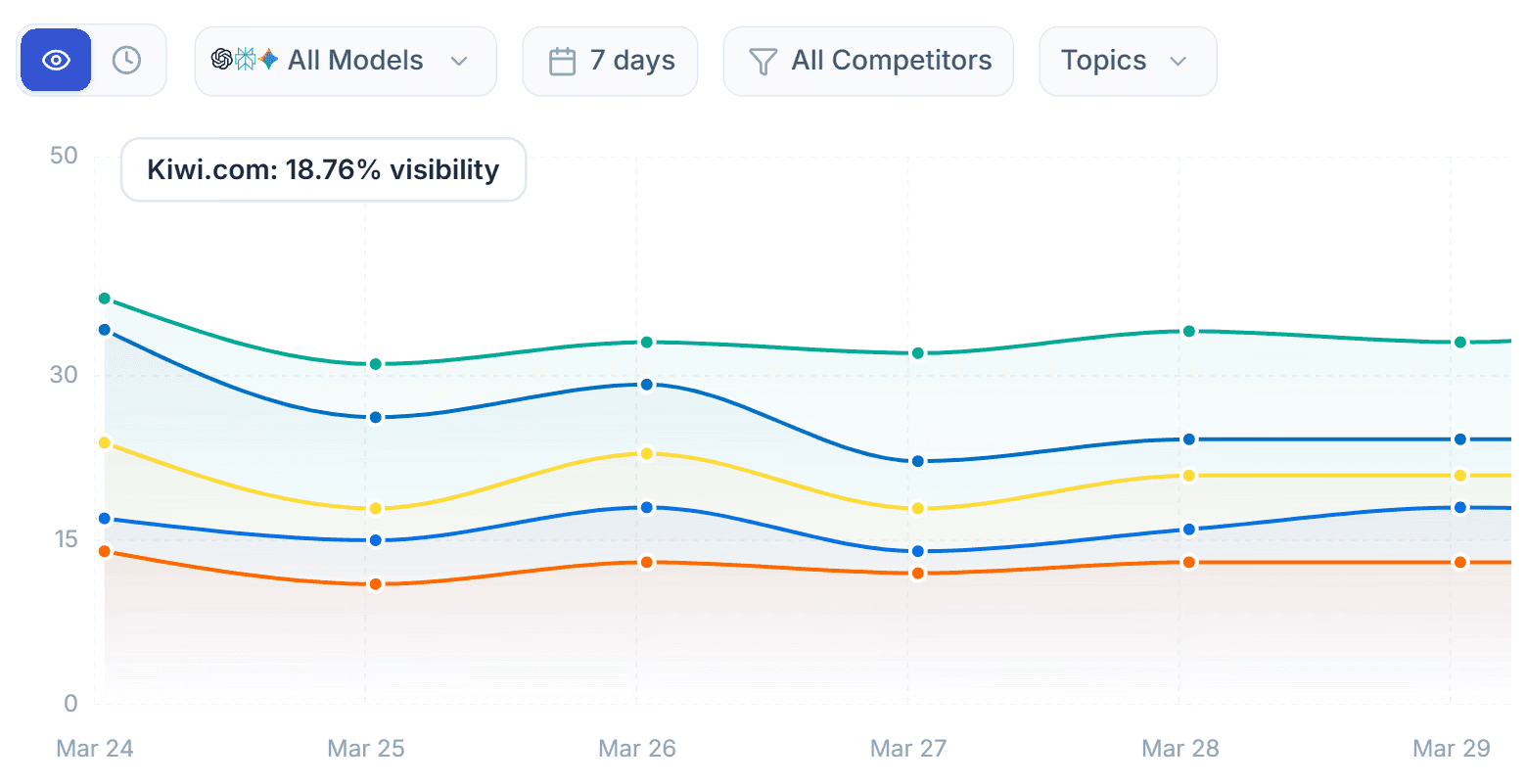
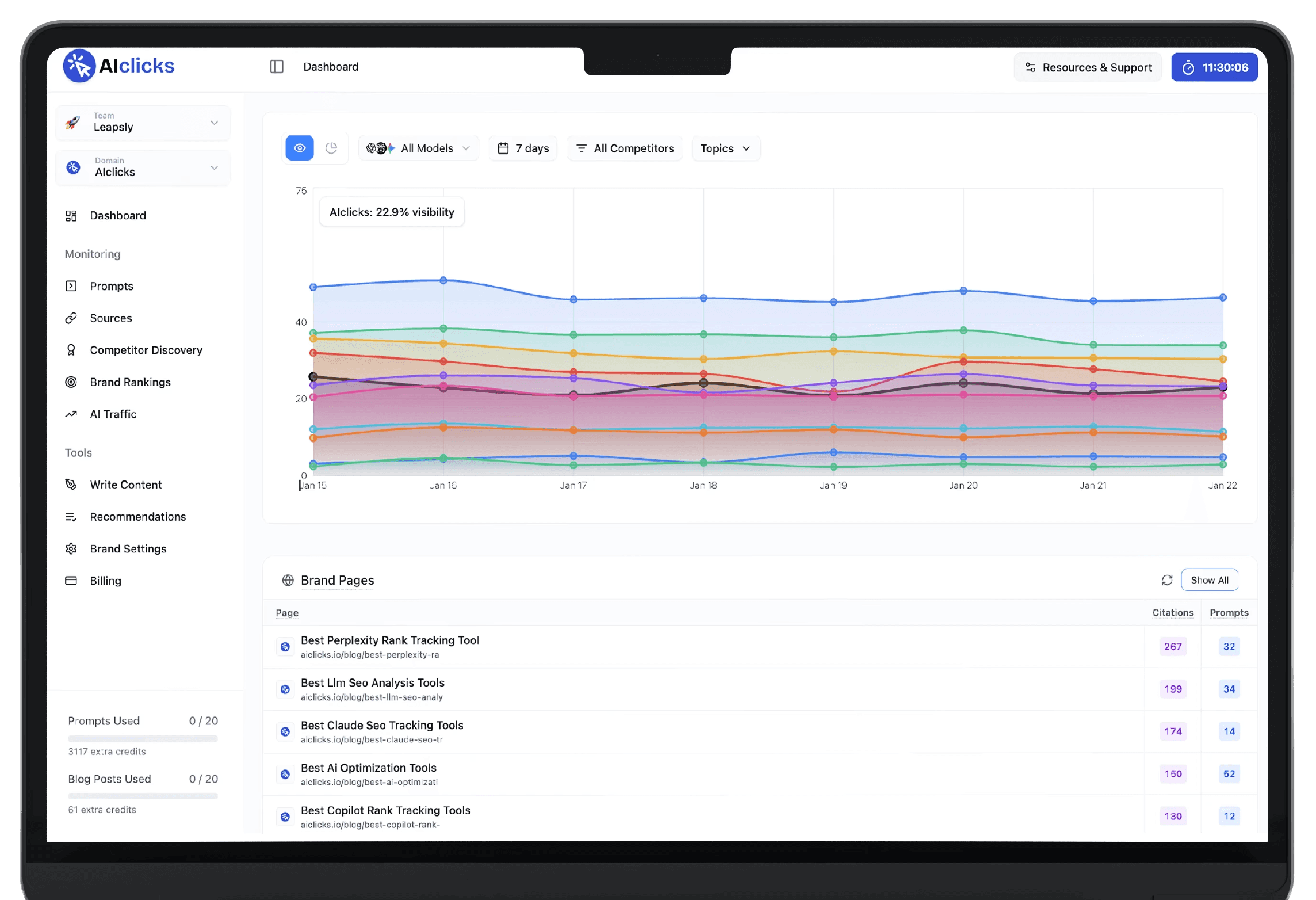
AIclicks gives you a live dashboard with daily ChatGPT mention rate, citation rate, sentiment, and share-of-voice across your tracked prompts, plus GA4 referral attribution for the traffic ChatGPT does send back.
Choose Your Plan
Flexible pricing that grows with your team. Upgrade or downgrade at any time.
Monthly
Yearly
-20%
Starter
Perfect for individuals & small teams
$49
/ month
Billed annually — you save $142
Choose 3 from:
Daily
" height="16px" id="fvSweaOBo" transform="translate(1 0)" width="14px"/></svg>)
" width="14px"><path d="M 13.864 5.629 L 13.3 5.629 L 13.3 5.6 L 7 5.6 L 7 8.4 L 10.956 8.4 C 10.379 10.03 8.828 11.2 7 11.2 C 4.681 11.2 2.8 9.319 2.8 7 C 2.8 4.681 4.681 2.8 7 2.8 C 8.071 2.8 9.045 3.204 9.786 3.864 L 11.766 1.884 C 10.516 0.719 8.844 0 7 0 C 3.134 0 0 3.134 0 7 C 0 10.866 3.134 14 7 14 C 10.866 14 14 10.866 14 7 C 14 6.531 13.952 6.073 13.864 5.629 Z" fill="rgb(255, 193, 7)" height="14px" id="H_YjfTNpn" width="14px"/><path d="M 0 3.742 L 2.3 5.429 C 2.922 3.888 4.429 2.8 6.193 2.8 C 7.264 2.8 8.238 3.204 8.979 3.864 L 10.959 1.884 C 9.709 0.719 8.037 0 6.193 0 C 3.504 0 1.172 1.518 0 3.742 Z" fill="rgb(255, 61, 0)" height="5.428500000000002px" id="PlkthQDhg" transform="translate(0.875 0)" width="10.959199999999996px"/><path d="M 6.232 5.581 C 8.04 5.581 9.683 4.889 10.925 3.764 L 8.758 1.931 C 8.032 2.483 7.144 2.782 6.232 2.781 C 4.411 2.781 2.865 1.62 2.283 0 L 0 1.759 C 1.159 4.026 3.511 5.581 6.232 5.581 Z" fill="rgb(76, 175, 80)" height="5.581099999999999px" id="WlnJ5gngE" transform="translate(0.7 8.4)" width="10.924899999999994px"/><path d="M 6.864 0.029 L 6.3 0.029 L 6.3 0 L 0 0 L 0 2.8 L 3.956 2.8 C 3.68 3.576 3.183 4.254 2.526 4.75 L 2.527 4.749 L 4.693 6.582 C 4.54 6.722 7 4.9 7 1.4 C 7 0.931 6.952 0.473 6.864 0.029 Z" fill="rgb(25, 118, 210)" height="6.589883930775992px" id="x_rSW275p" transform="translate(7 5.6)" width="7px"/></g></svg>)
" height="16px" id="hHS98fTxZ" width="16px"/></svg>)
 scale(1 1) translate(-1.861736945942159, -1.1170155383302638)" id="P20NzAvj0-699428820-radial-gradient" r="0.9935228066204626"><stop offset="0" stop-color="rgb(0, 174, 255)"/><stop offset="1" stop-color="rgb(7, 54, 196)"/></radialGradient><radialGradient cx="0.48250042504016705" cy="1.8366934653567062" gradient-transform="translate(0.48250042504016705, 1.8366934653567062) scale(1 1) translate(-0.48250042504016705, -1.8366934653567062)" id="UEWZqVjij-699428820-radial-gradient" r="0.9176890228114506"><stop offset="0" stop-color="rgb(255, 182, 87)"/><stop offset="1" stop-color="rgb(192, 43, 60)"/></radialGradient><linearGradient id="jyMN3TmKx-699428820-linear-gradient" x1="0.4594862532842614" x2="0.5405137467157386" y1="0" y2="1"><stop offset="0" stop-color="rgb(13, 145, 225)"/><stop offset="1" stop-color="rgb(255, 200, 0)"/></linearGradient><linearGradient id="xhMNwDFG0-699428820-linear-gradient" x1="0.4784828731548295" x2="0.5215171268451705" y1="5.551115123125783e-17" y2="1"><stop offset="0" stop-color="rgb(61, 203, 255)"/><stop offset="1" stop-color="rgba(5, 136, 247, 0)"/></linearGradient><radialGradient cx="1.4305090871482182" cy="0.34866158048251783" gradient-transform="translate(1.4305090871482182, 0.34866158048251783) scale(1 1) translate(-1.4305090871482182, -0.34866158048251783)" id="i79kAqaS4-699428820-radial-gradient" r="1.3362743412697924"><stop offset="0" stop-color="rgb(140, 72, 255)"/><stop offset="1" stop-color="rgb(255, 177, 82)"/></radialGradient><linearGradient id="mcxvno3tX-699428820-linear-gradient" x1="0.49844355920154226" x2="0.5015564407984577" y1="0" y2="1"><stop offset="0" stop-color="rgb(248, 173, 250)"/><stop offset="1" stop-color="rgba(168, 110, 221, 0)"/></linearGradient></defs><g d="M 11.605 1.219 C 11.397 0.499 10.739 0.002 9.989 0 L 9.498 0 C 8.682 0.002 7.985 0.588 7.842 1.391 L 7 6.016 L 7.209 5.296 C 7.416 4.574 8.075 4.076 8.825 4.074 L 11.681 4.074 L 12.879 4.545 L 14.033 4.074 L 13.697 4.074 C 12.947 4.072 12.289 3.575 12.081 2.855 Z M 4.413 13.387 C 4.618 14.111 5.278 14.611 6.031 14.613 L 7.075 14.613 C 7.988 14.613 8.735 13.88 8.758 12.96 L 8.871 8.5 L 8.633 9.319 C 8.426 10.039 7.768 10.537 7.018 10.539 L 4.138 10.539 L 3.111 9.977 L 2 10.539 L 2.331 10.539 C 3.084 10.542 3.743 11.042 3.949 11.766 L 4.413 13.387 Z M 9.999 0 L 4.167 0 C 2.501 0 1.501 2.221 0.834 4.441 C 0.045 7.073 -0.989 10.591 2.001 10.591 L 4.519 10.591 C 5.273 10.591 5.933 10.089 6.139 9.36 C 6.577 7.815 7.345 5.121 7.948 3.069 C 8.255 2.027 8.509 1.132 8.901 0.575 C 9.148 0.212 9.56 -0.004 9.999 0 M 9.999 0 L 4.167 0 C 2.501 0 1.501 2.221 0.834 4.441 C 0.045 7.073 -0.989 10.591 2.001 10.591 L 4.519 10.591 C 5.273 10.591 5.933 10.089 6.139 9.36 C 6.577 7.815 7.345 5.121 7.948 3.069 C 8.255 2.027 8.509 1.132 8.901 0.575 C 9.148 0.212 9.56 -0.004 9.999 0 M 6 14.593 L 11.833 14.593 C 13.499 14.593 14.499 12.372 15.166 10.151 C 15.955 7.519 16.989 4 13.999 4 L 11.48 4 C 10.725 4.002 10.063 4.505 9.86 5.232 C 9.266 7.332 8.663 9.429 8.051 11.523 C 7.745 12.566 7.49 13.461 7.098 14.019 C 6.851 14.382 6.439 14.597 6 14.593 M 6 14.593 L 11.833 14.593 C 13.499 14.593 14.499 12.372 15.166 10.151 C 15.955 7.519 16.989 4 13.999 4 L 11.48 4 C 10.725 4.002 10.063 4.505 9.86 5.232 C 9.266 7.332 8.663 9.429 8.051 11.523 C 7.745 12.566 7.49 13.461 7.098 14.019 C 6.851 14.382 6.439 14.597 6 14.593" fill="transparent" height="14.613333333333333px" id="QzkBy4Ibc" transform="translate(0 1)" width="16.00011071294081px"><path d="M 4.605 1.219 C 4.397 0.499 3.739 0.002 2.989 0 L 2.498 0 C 1.682 0.002 0.985 0.588 0.842 1.391 L 0 6.016 L 0.209 5.296 C 0.416 4.574 1.075 4.076 1.825 4.074 L 4.681 4.074 L 5.879 4.545 L 7.033 4.074 L 6.697 4.074 C 5.947 4.072 5.289 3.575 5.081 2.855 Z" fill="url(%23P20NzAvj0-699428820-radial-gradient)" height="6.016px" id="P20NzAvj0" transform="translate(7 0)" width="7.0333333333333385px"/><path d="M 2.413 4.887 C 2.618 5.611 3.278 6.111 4.031 6.113 L 5.075 6.113 C 5.988 6.113 6.735 5.38 6.758 4.46 L 6.871 0 L 6.633 0.819 C 6.426 1.539 5.768 2.037 5.018 2.039 L 2.138 2.039 L 1.111 1.477 L 0 2.039 L 0.331 2.039 C 1.084 2.042 1.743 2.542 1.949 3.266 L 2.413 4.887 Z" fill="url(%23UEWZqVjij-699428820-radial-gradient)" height="6.113333333333333px" id="UEWZqVjij" transform="translate(2 8.5)" width="6.871333333333332px"/><path d="M 9.999 0 L 4.167 0 C 2.501 0 1.501 2.221 0.834 4.441 C 0.045 7.073 -0.989 10.591 2.001 10.591 L 4.519 10.591 C 5.273 10.591 5.933 10.089 6.139 9.36 C 6.577 7.815 7.345 5.121 7.948 3.069 C 8.255 2.027 8.509 1.132 8.901 0.575 C 9.148 0.212 9.56 -0.004 9.999 0" fill="url(%23jyMN3TmKx-699428820-linear-gradient)" height="10.591388755215167px" id="jyMN3TmKx" width="9.999444046274142px"/><path d="M 9.999 0 L 4.167 0 C 2.501 0 1.501 2.221 0.834 4.441 C 0.045 7.073 -0.989 10.591 2.001 10.591 L 4.519 10.591 C 5.273 10.591 5.933 10.089 6.139 9.36 C 6.577 7.815 7.345 5.121 7.948 3.069 C 8.255 2.027 8.509 1.132 8.901 0.575 C 9.148 0.212 9.56 -0.004 9.999 0" fill="url(%23xhMNwDFG0-699428820-linear-gradient)" height="10.591388755215167px" id="xhMNwDFG0" width="9.999444046274142px"/><path d="M 0 10.593 L 5.833 10.593 C 7.499 10.593 8.499 8.372 9.166 6.151 C 9.955 3.519 10.989 0 7.999 0 L 5.48 0 C 4.725 0.002 4.063 0.505 3.86 1.232 C 3.266 3.332 2.663 5.429 2.051 7.523 C 1.745 8.566 1.49 9.461 1.098 10.019 C 0.851 10.382 0.439 10.597 0 10.593" fill="url(%23i79kAqaS4-699428820-radial-gradient)" height="10.593388755215164px" id="i79kAqaS4" transform="translate(6 4)" width="10.000110712940803px"/><path d="M 0 10.593 L 5.833 10.593 C 7.499 10.593 8.499 8.372 9.166 6.151 C 9.955 3.519 10.989 0 7.999 0 L 5.48 0 C 4.725 0.002 4.063 0.505 3.86 1.232 C 3.266 3.332 2.663 5.429 2.051 7.523 C 1.745 8.566 1.49 9.461 1.098 10.019 C 0.851 10.382 0.439 10.597 0 10.593" fill="url(%23mcxvno3tX-699428820-linear-gradient)" height="10.593388755215164px" id="mcxvno3tX" transform="translate(6 4)" width="10.000110712940803px"/></g></svg>)
" height="15.360666565427872px" id="HZPvvPBv7" transform="translate(0 0.5)" width="16px"/></svg>)
Tracked prompts
30
Websites you can add
3
LLMs you can track
3
Countries per project
1
LLM responses / mo
4,650
AI-optimized articles per month
10
Integrations
-
Support
Pro
For growing teams for more power
$140
/ month
Billed annually — you save $454
Choose 4 from:
Daily
Tracked prompts
150
Websites you can add
Unlimited
LLMs you can track
4
Countries per project
Unlimited
LLM responses / mo
18,600
AI-optimized articles per month
20
Integrations
Google Analytics
Support
BUSINESS
Best for medium-sized organizations
$357
/ month
Billed annually — you save $1198
Choose 6 from:
Daily
Tracked prompts
300
Websites you can add
Unlimited
LLMs you can track
6
Countries per project
Unlimited
LLM responses / mo
55,800
AI-optimized articles per month
30
Integrations
Google Analytics, API
Support
Dedicated account specialist
Become the #1 Answer in AI
Succeed in GEO yourself, or let us do all the work.
Do it yourself
Use AIclicks to see exactly where you appear across 10+ AI platforms, spot the gaps competitors are filling, and act on clear weekly recommendations.
From $59/month · Cancel anytime
Done for you
We Do All the Work for You
Our team manages your complete search presence: traditional SEO and GEO strategy, content, implementation, and reporting. You focus on guests.
Custom pricing · Minimum 3-month engagement
The AI SEO agency trusted by 1,000+ brands worldwide
From solo founders to multi-client agencies, AIclicks runs the full AI SEO agency program for organizations of every shape and size that want to be cited across every AI surface.
4.9/5 stars on G2






FAQ
How long does hotel SEO take to show results?
Expect the hotel pack and branded terms to move inside 2 to 4 months, with non-branded booking volume arriving nearer 6 to 9. Competitive destination terms in a major market can run 12 to 18 months, since you are up against Booking.com and Tripadvisor on the same query. Properties in secondary markets move faster. The earliest honest signal is impressions on room and amenity terms in Search Console.
Do we chase Google rankings or AI assistant mentions?
Both, and hotels have an extra problem. Ahrefs analysed 863,000 keywords and found only 38% of pages cited in AI Overviews also ranked in the top 10, down from 76% a year earlier. Ranking no longer carries you into the answer. Worse, when an assistant builds a shortlist of where to stay it reads OTA and review pages, so the channel you pay commission to also decides whether you get named. Track that separately.
What makes hotel SEO different from standard local SEO?
Hotel SEO differs in 3 ways. Your Google listing is a hotel entity, not a standard business profile, so it carries rates, dates and booking links most local advice never mentions. Your rankings compete with OTAs that resell your own inventory, not just with the property down the road. And your conversion page sits inside a booking engine you may not control. Generic local SEO checklists skip all 3 and leave the biggest levers untouched.
What should a hotel budget for SEO?
Hospitality SEO retainers typically sit at $1,500 to $3,000 monthly for one independent property in a quiet market, $3,000 to $6,000 to compete in a busy destination, and higher for groups and resorts. Judge it against commission, not against zero. If OTAs take 15% to 30% of a booking and your average stay is $600, a retainer that converts 20 stays a month to direct has already paid for itself.
Where does SEO sit next to metasearch and Google Ads?
They cover different parts of the same page. Metasearch bids on Google Hotels, Trivago and Kayak buy the rate comparison at the moment of choice and stop the day you pause them. SEO earns the destination and amenity queries that happen weeks earlier, where nobody is bidding. Most properties run both, and use metasearch data to decide which room types and amenities deserve a page. Measure both on cost per direct booking.
Which pages should a hotel build first?
Google Business Profile first, with every hotel attribute filled and free booking links connected, since nothing else outranks it and it is free. Then one page per room type with a real rate. Then your top 3 amenity pages, usually parking, breakfast and the pool or spa. Then a hotels near the venue page for whatever draws people to your area. Destination guides come after that, and the blog last.
How can we tell whether hotel SEO is working?
Watch the direct share of your channel mix, not rankings. Split branded from non-branded organic in Search Console, because branded traffic only proves you already had demand. Tag your booking engine so organic sessions attribute to confirmed reservations rather than to button clicks, and reconcile against the property management system monthly. Then compare room nights and average daily rate from direct against OTA. If a report shows traffic without room nights, ask why.
Do we run hotel SEO in-house or bring someone in?
Split it. Nobody outside the property can write the neighbourhood guide, answer the Q&A or ask for reviews at checkout, and those are the parts that move fastest. Outsource the technical layer: crawl traps, schema, page speed and listing cleanup across the OTAs. Be careful with agencies reselling the same hotel SEO package your booking engine vendor already sells, and ask any candidate how they would stop the date picker eating your crawl budget.
Further Reading
Go deeper on GEO, AI search, and visibility tracking.