SEO for Colleges and Universities:
A student picks a shortlist of 6 schools long before anyone opens an application. They compare program pages, read student reviews on Niche, scroll Reddit threads, and ask ChatGPT which programs are worth the tuition. Search decides who makes that list.









Why Colleges and Universities Need SEO
About a third of an institution’s website traffic arrives through organic search, and 67% of prospective students use Reddit while choosing. Your .edu authority does not follow them into either place.
Departments name programs the way accreditors do: Master of Science in Applied Behavioral Analytics. Students type online data analytics masters or is a business degree worth it. The catalog entry ranks for the exact program title nobody uses, and the page a student would convert on was never written.
Type best colleges near me from anywhere in the country and Niche, U.S. News, Princeton Review and BigFuture fill the page before a single .edu appears. They rank on the aggregate data that you supplied to IPEDS, then sell your competitors featured placement inside the listing that just outranked you.
Institutions routinely run $3,000 to $10,000 a month with an agency, plus paid search on degree terms and lead-buy contracts with rankings portals that resell the same student to 4 schools. Organic leads typically cost 60% to 70% less. Pause the spend and the inquiry queue empties inside a few weeks.
How SEO Works for Colleges and Universities
Search Engine Optimization projects are long-term investments for institutions, where each task supplements the others and creates compound results over time.
01
Keywords, page structure, and the signals Google reads directly
The obstacle to on-page work at an institution is that nobody owns the page. The same degree exists 4 times over: a catalog entry generated by CourseLeaf or Acalog, a department page in Drupal, an admissions landing page, and an online-division version built by a partner. Each was written by a different office, each targets the same query, and Google picks whichever it likes least. The pages that matter are program pages, cost and financial aid pages, and admissions requirements, not the news feed the communications team updates daily. Google also weighs tuition and outcome claims as decisions with money attached.
What holds value are pages tied to a decision, not to a term. A page on what a nursing degree actually costs after aid, or on what a philosophy major does for a living, still pulls inquiries 5 years later because every cohort asks it again. Dated material churns: commencement recaps, faculty grant announcements, the reminder that classes start soon. That makes up most of an institution’s blog and almost none of its organic traffic. Worse, the catalog rolls over each academic year and mints a second copy of every program page, so last year’s URL quietly competes with this year’s.
1
Pick one canonical program page per degree, 301 the department and catalog duplicates into it, and write it in student language.
2
When CourseLeaf or Acalog publishes the new academic year, canonical the archived catalog to the live program page instead of leaving both indexed.
3
Mark every degree with EducationalOccupationalProgram schema, filling timeToComplete, educationalCredentialAwarded and offers, then validate in Google’s Rich Results Test.
4
Publish a what can I do with a degree page per major, with salary bands and job titles pulled from your own graduate outcomes survey.
02
Map Pack visibility, citations, and proximity signals
Local matters more than most institutions admit. Nearly half of transfer students enroll within 50 miles of home, and community college demand is almost entirely commuter-radius. That is why a map pack sits above every organic result for colleges near me, and why a regional campus can outrank a national brand for the searches that actually convert. Adult learners and degree completers search this way too, usually on a phone at night.
Category choice matters more here than most fields. Pick College or University rather than the vaguer Educational Institution, then give the admissions office, library and athletic facility their own listings where each has a public front door. Load real photos of classrooms, residence halls and labs, publish genuine term dates and admissions hours, and pre-answer what decides a visit: parking, whether tours run at weekends, deadlines, and who handles transfer credit.
Higher ed runs on a citation layer nobody outside the sector knows about. Google’s college panel is built from what you reported to IPEDS, not from your website, so a stale enrollment figure there propagates everywhere. Beyond that sit Niche, U.S. News, BigFuture, Peterson’s, College Scorecard, CHEA’s accreditation database and your programmatic accreditors: AACSB, ABET, CCNE. All of them need the identical legal name, campus address and admissions phone, because AI answers are assembled from exactly these sources.
1
Set the primary category to College or University, add the admissions office and library as their own profiles, and upload current campus photos.
2
Give every satellite campus and teaching site a separate profile plus a landing page listing the degrees genuinely taught there, never one shared address.
3
Reconcile your IPEDS and College Scorecard records against Niche, BigFuture and Peterson’s each fall, since Google’s college panel inherits the federal figures.
4
Publish one profile update weekly and add every open house, info session and deadline as a Google Business Profile event with Event schema.
03
Topic authority, inbound links, and content that earns traffic
Before a student shortlists anything they are working out whether the degree is worth the debt. They search what a major leads to, what aid actually reduces the sticker price, whether an online option is respected by employers, and how one program differs from another. Content that answers those honestly, including the transfer-credit and prior-learning questions adult learners ask first, outperforms anything the brand team writes about campus spirit.
By now the field is settled and the choice is between schools, which means the reader wants evidence rather than atmosphere. Put the full curriculum with course titles, cost per credit hour, the accreditation body, the application deadline, the faculty who actually teach the core, and the placement rate on the program page itself rather than 3 clicks into the catalog. Most institutions bury the price, and that is exactly where the inquiry is lost.
Institutions have link sources nobody else does and rarely use them. Faculty research gets covered by trade press and journalists who need a source on deadline. Alumni employers, school district partners and clinical placement sites publish partnership pages. Scholarship listings, athletic conference sites and library research guides all link out. Your own faculty are cited by other universities. The job is not outreach; it is finding the mentions that already exist and asking for the link.
1
Publish an annual MBA versus MS or BSN versus RN-to-BSN comparison covering cost, length and licensure, updated when the curriculum changes.
2
Template one landing page per program per format: on campus, online, hybrid, accelerated and part-time, with genuinely different schedules and costs on each.
3
Build one hub covering net price, FAFSA steps, scholarships, employer tuition reimbursement and what a credit hour costs, then link every program page into it.
4
Give every core faculty member a bio page with Person schema, publications, courses taught and media contact details, since AI answers cite named experts.
04
Site speed, crawlability, Core Web Vitals, and mobile health
The failure hiding in plain sight is the PDF. Program sheets, viewbooks, course syllabi and financial aid worksheets get uploaded by the hundred, indexed by Google, and served to students instead of the HTML page you optimised. They carry no navigation, no CTA and no analytics, and half of them are last year’s. Meanwhile department subdomains run on separate CMS installs that nobody has crawled since launch, quietly duplicating admissions copy across the estate.
Around 46% of graduate and adult prospects reach a university site from a phone, and the moment that matters is a student comparing 3 programs in bed at 11 at night with the deadline days away. If the program page loads a video hero before the tuition table, or the request-information form breaks the keyboard on a small screen, they close the tab. Students typically leave after 3 seconds, and the next school is one tap away.
1
Run a filetype:pdf site search and a Screaming Frog crawl, then noindex or replace every program sheet that duplicates a live HTML page.
2
Test your highest-enrollment program page in PageSpeed Insights on mobile, and get Largest Contentful Paint under 2.5 seconds by deferring the video hero.
3
Convert campus photography and drone footage to WebP at display size, and lazy-load virtual tour embeds so they never block first paint.
4
Keep programs, admissions and cost pages in their own sitemap away from news and events, and resubmit whenever the catalog or tuition changes.
05
Star ratings, review volume, and response strategy that builds trust
Reviews decide this category in a way rankings tables cannot, because a student is committing 4 years and six figures on the word of strangers their own age. The difficulty is that the reviews live in places you do not control: Niche, RateMyProfessors, Unigo, Reddit threads and Google. Most institutions have never asked a single student for one, so the review profile is written entirely by the aggrieved and the graduating.
Ask at the end of the first term, not at commencement. A student 4 months in is still surprised by what they like, and the answer reads specific rather than nostalgic. Wire the request into Slate so it fires after grades post, and send students to a Niche profile as often as to Google, because Niche student surveys feed the rankings that AI assistants quote back. Ask alumni again 6 months after they land the job.
1
Fire the review request from Slate or Salesforce Education Cloud when first-term grades post, signed by the student’s academic adviser rather than marketing.
2
Respond inside 2 days without confirming enrollment status, because FERPA bars you from acknowledging a student record even when the reviewer names themselves.
3
Put nursing testimonials on the nursing program page and MBA testimonials on the MBA page, marked up with Review schema, never one campus-wide highlight reel.
4
Collect employer testimonials about your graduates through the career services office, since hiring partners carry more weight with adult learners than student reviews.
Google is No Longer the Only Place Your prospective students are Searching
Prospective Students are using AI to find answers, and they trust what it tells them. Invest in GEO to get recommended in those answers.
1 Billion
Questions ChatGPT receives every single day
38%
Your #1 top ranking page on Google would be cited by AI
14%
of institutions optimise for GEO. The rest are invisible in AI answers


You can rank #1 for “institution near me” and still not exist in ChatGPT’s answer. Run a free GEO audit to see where your brand actually stands.
GEO vs SEO: Same Goal, Different Methods
GEO is wider than SEO. AI recommends the brands that show up across the sources it reads, so your presence in forums, social platforms and higher-ed blogs decides your odds. AIclicks measures the three metrics below so you know which to work on first.
AI Assistant
Where should I study nursing without leaving my area?
Your University
Citation Rate
Shows how many AI answers about colleges and universities name your brand, out of every 100. Models pull from the same trusted pages over and over, so citations compound: once you are in, staying in gets easier. Find the competitor pages AI cites most, then publish your own version of each.
Your University
82% positive
Competitor A
54% positive
Competitor B
38% positive
Brand Sentiment
Shows how AI describes you when your brand comes up: positive, neutral or negative. Tone is what separates being mentioned from being recommended, and models repeat whatever framing they find. Track the negative mentions back to the reviews and threads behind them, then publish content that answers those directly.
Others 52%
You 24%
— 24%
Your University
AI mention share of voice — higher-ed category
Competitors
Not Cited
Share of Voice in AI
Shows how much of the higher-ed conversation belongs to you rather than your competitors. This is the metric that matters most, the GEO version of a Google ranking. With only 1–5 brands named per answer, the market is winner-takes-more and every point is taken from someone.
The Dashboard Your Dedicated AI Search Team Works In
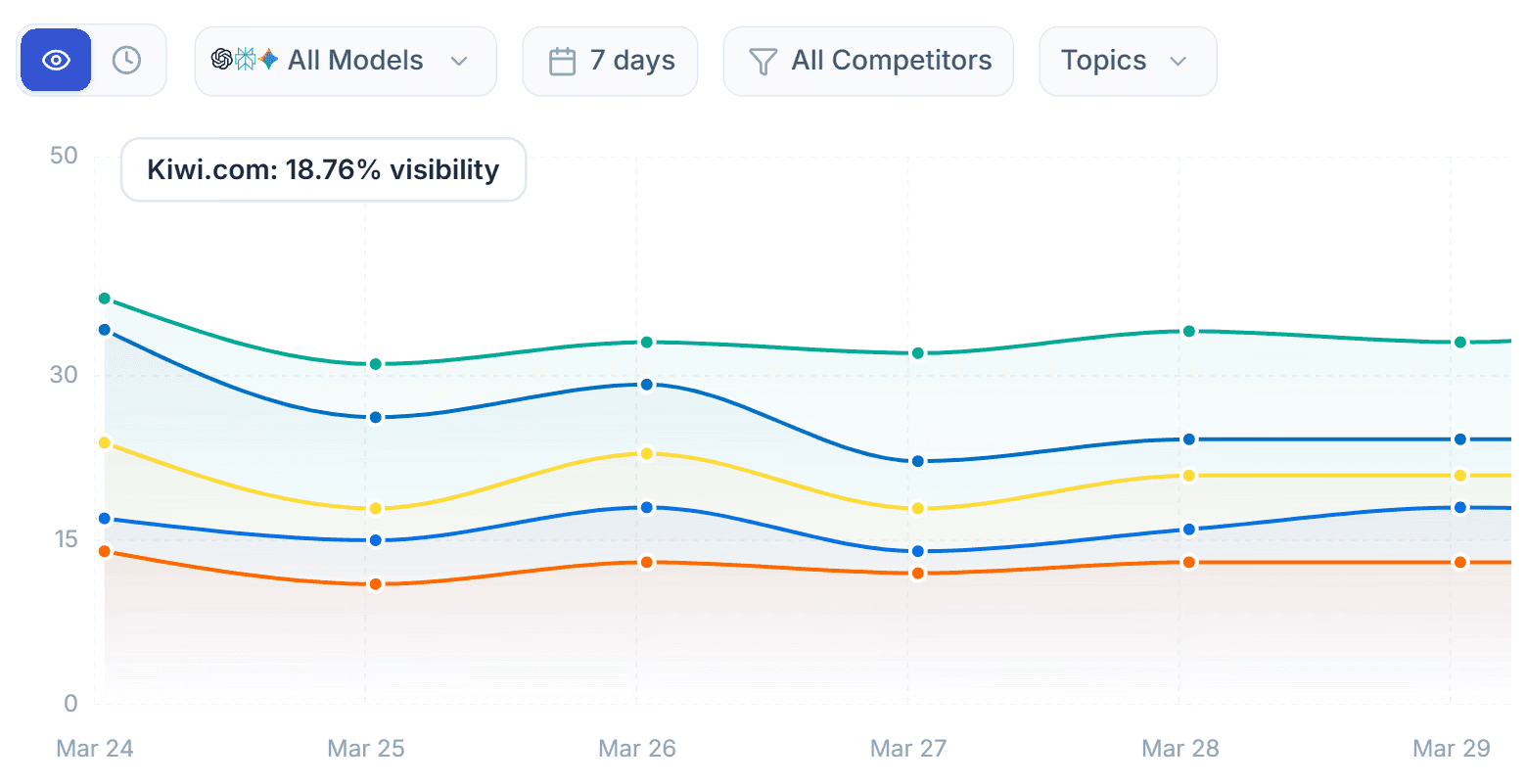
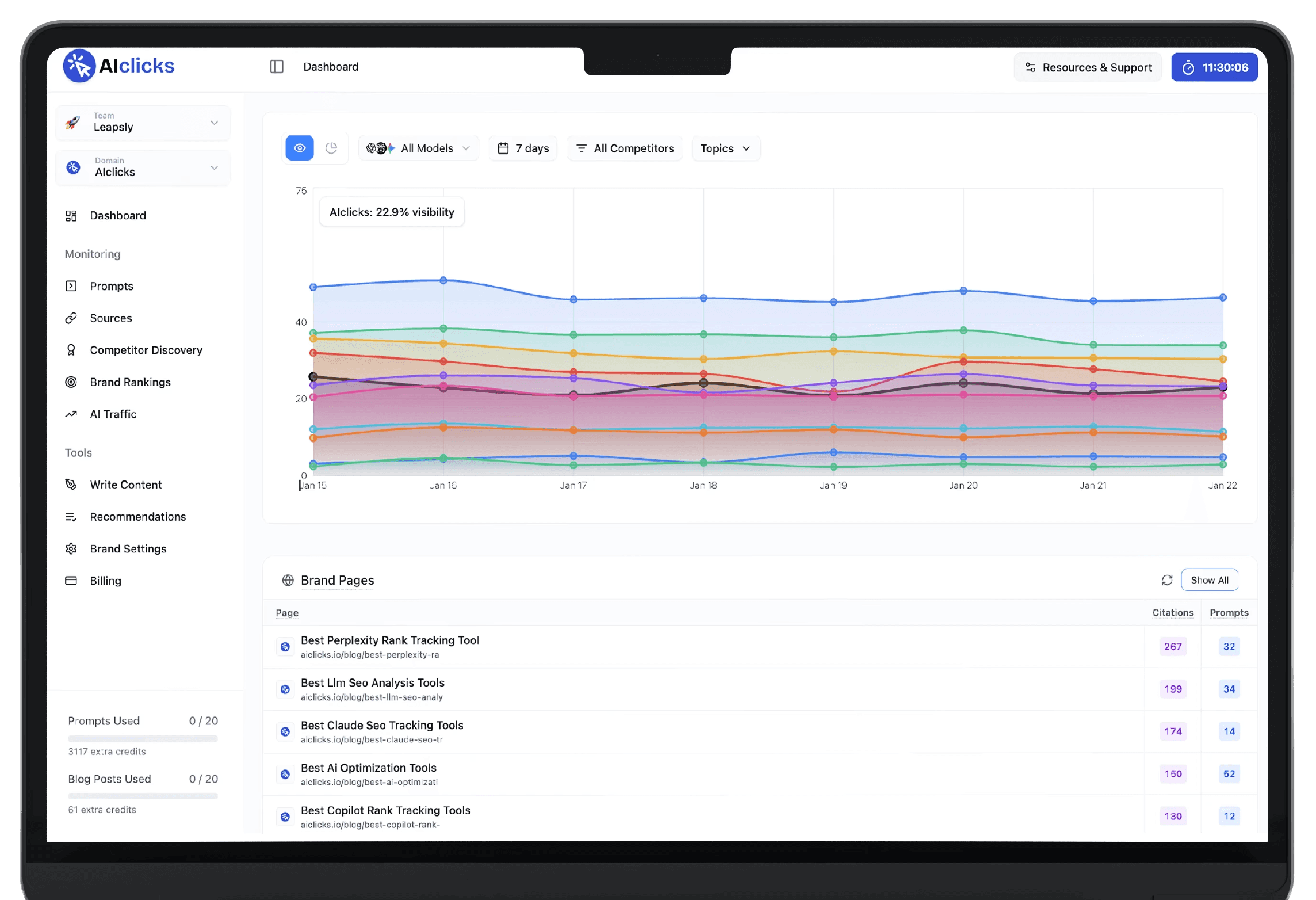
AIclicks gives you a live dashboard with daily ChatGPT mention rate, citation rate, sentiment, and share-of-voice across your tracked prompts, plus GA4 referral attribution for the traffic ChatGPT does send back.
Choose Your Plan
Flexible pricing that grows with your team. Upgrade or downgrade at any time.
Monthly
Yearly
-20%
Starter
Perfect for individuals & small teams
$49
/ month
Billed annually — you save $142
Choose 3 from:
Daily

" height="16px" id="fvSweaOBo" transform="translate(1 0)" width="14px"/></svg>)
" width="14px"><path d="M 13.864 5.629 L 13.3 5.629 L 13.3 5.6 L 7 5.6 L 7 8.4 L 10.956 8.4 C 10.379 10.03 8.828 11.2 7 11.2 C 4.681 11.2 2.8 9.319 2.8 7 C 2.8 4.681 4.681 2.8 7 2.8 C 8.071 2.8 9.045 3.204 9.786 3.864 L 11.766 1.884 C 10.516 0.719 8.844 0 7 0 C 3.134 0 0 3.134 0 7 C 0 10.866 3.134 14 7 14 C 10.866 14 14 10.866 14 7 C 14 6.531 13.952 6.073 13.864 5.629 Z" fill="rgb(255, 193, 7)" height="14px" id="H_YjfTNpn" width="14px"/><path d="M 0 3.742 L 2.3 5.429 C 2.922 3.888 4.429 2.8 6.193 2.8 C 7.264 2.8 8.238 3.204 8.979 3.864 L 10.959 1.884 C 9.709 0.719 8.037 0 6.193 0 C 3.504 0 1.172 1.518 0 3.742 Z" fill="rgb(255, 61, 0)" height="5.428500000000002px" id="PlkthQDhg" transform="translate(0.875 0)" width="10.959199999999996px"/><path d="M 6.232 5.581 C 8.04 5.581 9.683 4.889 10.925 3.764 L 8.758 1.931 C 8.032 2.483 7.144 2.782 6.232 2.781 C 4.411 2.781 2.865 1.62 2.283 0 L 0 1.759 C 1.159 4.026 3.511 5.581 6.232 5.581 Z" fill="rgb(76, 175, 80)" height="5.581099999999999px" id="WlnJ5gngE" transform="translate(0.7 8.4)" width="10.924899999999994px"/><path d="M 6.864 0.029 L 6.3 0.029 L 6.3 0 L 0 0 L 0 2.8 L 3.956 2.8 C 3.68 3.576 3.183 4.254 2.526 4.75 L 2.527 4.749 L 4.693 6.582 C 4.54 6.722 7 4.9 7 1.4 C 7 0.931 6.952 0.473 6.864 0.029 Z" fill="rgb(25, 118, 210)" height="6.589883930775992px" id="x_rSW275p" transform="translate(7 5.6)" width="7px"/></g></svg>)
" height="16px" id="hHS98fTxZ" width="16px"/></svg>)
 scale(1 1) translate(-1.861736945942159, -1.1170155383302638)" id="P20NzAvj0-699428820-radial-gradient" r="0.9935228066204626"><stop offset="0" stop-color="rgb(0, 174, 255)"/><stop offset="1" stop-color="rgb(7, 54, 196)"/></radialGradient><radialGradient cx="0.48250042504016705" cy="1.8366934653567062" gradient-transform="translate(0.48250042504016705, 1.8366934653567062) scale(1 1) translate(-0.48250042504016705, -1.8366934653567062)" id="UEWZqVjij-699428820-radial-gradient" r="0.9176890228114506"><stop offset="0" stop-color="rgb(255, 182, 87)"/><stop offset="1" stop-color="rgb(192, 43, 60)"/></radialGradient><linearGradient id="jyMN3TmKx-699428820-linear-gradient" x1="0.4594862532842614" x2="0.5405137467157386" y1="0" y2="1"><stop offset="0" stop-color="rgb(13, 145, 225)"/><stop offset="1" stop-color="rgb(255, 200, 0)"/></linearGradient><linearGradient id="xhMNwDFG0-699428820-linear-gradient" x1="0.4784828731548295" x2="0.5215171268451705" y1="5.551115123125783e-17" y2="1"><stop offset="0" stop-color="rgb(61, 203, 255)"/><stop offset="1" stop-color="rgba(5, 136, 247, 0)"/></linearGradient><radialGradient cx="1.4305090871482182" cy="0.34866158048251783" gradient-transform="translate(1.4305090871482182, 0.34866158048251783) scale(1 1) translate(-1.4305090871482182, -0.34866158048251783)" id="i79kAqaS4-699428820-radial-gradient" r="1.3362743412697924"><stop offset="0" stop-color="rgb(140, 72, 255)"/><stop offset="1" stop-color="rgb(255, 177, 82)"/></radialGradient><linearGradient id="mcxvno3tX-699428820-linear-gradient" x1="0.49844355920154226" x2="0.5015564407984577" y1="0" y2="1"><stop offset="0" stop-color="rgb(248, 173, 250)"/><stop offset="1" stop-color="rgba(168, 110, 221, 0)"/></linearGradient></defs><g d="M 11.605 1.219 C 11.397 0.499 10.739 0.002 9.989 0 L 9.498 0 C 8.682 0.002 7.985 0.588 7.842 1.391 L 7 6.016 L 7.209 5.296 C 7.416 4.574 8.075 4.076 8.825 4.074 L 11.681 4.074 L 12.879 4.545 L 14.033 4.074 L 13.697 4.074 C 12.947 4.072 12.289 3.575 12.081 2.855 Z M 4.413 13.387 C 4.618 14.111 5.278 14.611 6.031 14.613 L 7.075 14.613 C 7.988 14.613 8.735 13.88 8.758 12.96 L 8.871 8.5 L 8.633 9.319 C 8.426 10.039 7.768 10.537 7.018 10.539 L 4.138 10.539 L 3.111 9.977 L 2 10.539 L 2.331 10.539 C 3.084 10.542 3.743 11.042 3.949 11.766 L 4.413 13.387 Z M 9.999 0 L 4.167 0 C 2.501 0 1.501 2.221 0.834 4.441 C 0.045 7.073 -0.989 10.591 2.001 10.591 L 4.519 10.591 C 5.273 10.591 5.933 10.089 6.139 9.36 C 6.577 7.815 7.345 5.121 7.948 3.069 C 8.255 2.027 8.509 1.132 8.901 0.575 C 9.148 0.212 9.56 -0.004 9.999 0 M 9.999 0 L 4.167 0 C 2.501 0 1.501 2.221 0.834 4.441 C 0.045 7.073 -0.989 10.591 2.001 10.591 L 4.519 10.591 C 5.273 10.591 5.933 10.089 6.139 9.36 C 6.577 7.815 7.345 5.121 7.948 3.069 C 8.255 2.027 8.509 1.132 8.901 0.575 C 9.148 0.212 9.56 -0.004 9.999 0 M 6 14.593 L 11.833 14.593 C 13.499 14.593 14.499 12.372 15.166 10.151 C 15.955 7.519 16.989 4 13.999 4 L 11.48 4 C 10.725 4.002 10.063 4.505 9.86 5.232 C 9.266 7.332 8.663 9.429 8.051 11.523 C 7.745 12.566 7.49 13.461 7.098 14.019 C 6.851 14.382 6.439 14.597 6 14.593 M 6 14.593 L 11.833 14.593 C 13.499 14.593 14.499 12.372 15.166 10.151 C 15.955 7.519 16.989 4 13.999 4 L 11.48 4 C 10.725 4.002 10.063 4.505 9.86 5.232 C 9.266 7.332 8.663 9.429 8.051 11.523 C 7.745 12.566 7.49 13.461 7.098 14.019 C 6.851 14.382 6.439 14.597 6 14.593" fill="transparent" height="14.613333333333333px" id="QzkBy4Ibc" transform="translate(0 1)" width="16.00011071294081px"><path d="M 4.605 1.219 C 4.397 0.499 3.739 0.002 2.989 0 L 2.498 0 C 1.682 0.002 0.985 0.588 0.842 1.391 L 0 6.016 L 0.209 5.296 C 0.416 4.574 1.075 4.076 1.825 4.074 L 4.681 4.074 L 5.879 4.545 L 7.033 4.074 L 6.697 4.074 C 5.947 4.072 5.289 3.575 5.081 2.855 Z" fill="url(%23P20NzAvj0-699428820-radial-gradient)" height="6.016px" id="P20NzAvj0" transform="translate(7 0)" width="7.0333333333333385px"/><path d="M 2.413 4.887 C 2.618 5.611 3.278 6.111 4.031 6.113 L 5.075 6.113 C 5.988 6.113 6.735 5.38 6.758 4.46 L 6.871 0 L 6.633 0.819 C 6.426 1.539 5.768 2.037 5.018 2.039 L 2.138 2.039 L 1.111 1.477 L 0 2.039 L 0.331 2.039 C 1.084 2.042 1.743 2.542 1.949 3.266 L 2.413 4.887 Z" fill="url(%23UEWZqVjij-699428820-radial-gradient)" height="6.113333333333333px" id="UEWZqVjij" transform="translate(2 8.5)" width="6.871333333333332px"/><path d="M 9.999 0 L 4.167 0 C 2.501 0 1.501 2.221 0.834 4.441 C 0.045 7.073 -0.989 10.591 2.001 10.591 L 4.519 10.591 C 5.273 10.591 5.933 10.089 6.139 9.36 C 6.577 7.815 7.345 5.121 7.948 3.069 C 8.255 2.027 8.509 1.132 8.901 0.575 C 9.148 0.212 9.56 -0.004 9.999 0" fill="url(%23jyMN3TmKx-699428820-linear-gradient)" height="10.591388755215167px" id="jyMN3TmKx" width="9.999444046274142px"/><path d="M 9.999 0 L 4.167 0 C 2.501 0 1.501 2.221 0.834 4.441 C 0.045 7.073 -0.989 10.591 2.001 10.591 L 4.519 10.591 C 5.273 10.591 5.933 10.089 6.139 9.36 C 6.577 7.815 7.345 5.121 7.948 3.069 C 8.255 2.027 8.509 1.132 8.901 0.575 C 9.148 0.212 9.56 -0.004 9.999 0" fill="url(%23xhMNwDFG0-699428820-linear-gradient)" height="10.591388755215167px" id="xhMNwDFG0" width="9.999444046274142px"/><path d="M 0 10.593 L 5.833 10.593 C 7.499 10.593 8.499 8.372 9.166 6.151 C 9.955 3.519 10.989 0 7.999 0 L 5.48 0 C 4.725 0.002 4.063 0.505 3.86 1.232 C 3.266 3.332 2.663 5.429 2.051 7.523 C 1.745 8.566 1.49 9.461 1.098 10.019 C 0.851 10.382 0.439 10.597 0 10.593" fill="url(%23i79kAqaS4-699428820-radial-gradient)" height="10.593388755215164px" id="i79kAqaS4" transform="translate(6 4)" width="10.000110712940803px"/><path d="M 0 10.593 L 5.833 10.593 C 7.499 10.593 8.499 8.372 9.166 6.151 C 9.955 3.519 10.989 0 7.999 0 L 5.48 0 C 4.725 0.002 4.063 0.505 3.86 1.232 C 3.266 3.332 2.663 5.429 2.051 7.523 C 1.745 8.566 1.49 9.461 1.098 10.019 C 0.851 10.382 0.439 10.597 0 10.593" fill="url(%23mcxvno3tX-699428820-linear-gradient)" height="10.593388755215164px" id="mcxvno3tX" transform="translate(6 4)" width="10.000110712940803px"/></g></svg>)
" height="15.360666565427872px" id="HZPvvPBv7" transform="translate(0 0.5)" width="16px"/></svg>)
Tracked prompts
30
Websites you can add
3
LLMs you can track
3
Countries per project
1
LLM responses / mo
4,650
AI-optimized articles per month
10
Integrations
-
Support
Pro
For growing teams for more power
$140
/ month
Billed annually — you save $454
Choose 4 from:
Daily
Tracked prompts
150
Websites you can add
Unlimited
LLMs you can track
4
Countries per project
Unlimited
LLM responses / mo
18,600
AI-optimized articles per month
20
Integrations
Google Analytics
Support
BUSINESS
Best for medium-sized organizations
$357
/ month
Billed annually — you save $1198
Choose 6 from:
Daily
Tracked prompts
300
Websites you can add
Unlimited
LLMs you can track
6
Countries per project
Unlimited
LLM responses / mo
55,800
AI-optimized articles per month
30
Integrations
Google Analytics, API
Support
Dedicated account specialist
Become the #1 Answer in AI
Succeed in GEO yourself, or let us do all the work.
Do it yourself
Use AIclicks to see exactly where you appear across 10+ AI platforms, spot the gaps competitors are filling, and act on clear weekly recommendations.
From $59/month · Cancel anytime
Done for you
We Do All the Work for You
Our team manages your complete search presence: traditional SEO and GEO strategy, content, implementation, and reporting. You focus on prospective students.
Custom pricing · Minimum 3-month engagement
The AI SEO agency trusted by 1,000+ brands worldwide
From solo founders to multi-client agencies, AIclicks runs the full AI SEO agency program for organizations of every shape and size that want to be cited across every AI surface.
4.9/5 stars on G2






FAQ
When will we actually see more inquiries from search?
Expect the first ranking movement in 3 to 6 months and real inquiry volume between 6 and 12. The complication is the recruitment cycle: a program page has to be ranking before the application window opens, so work started in spring pays off for the following year’s intake, not this one. Community college and adult programs move faster than competitive graduate terms. Anyone promising results inside a single term is guessing.
Is ranking on Google enough now that students ask ChatGPT?
No, and the .edu advantage does not carry over. Ahrefs analysed 863,000 keywords and found only 38% of pages cited in AI Overviews also ranked in the top 10, down from 76% a year earlier. For institutions it is worse: assistants assemble college shortlists from Niche, U.S. News, Reddit and College Confidential rather than from your site. Being accurately listed there is now a separate job from ranking.
Why can't we just follow standard local SEO advice?
Because 3 things about institutions break the standard playbook. Your site is enormous and decentralised, so the same degree exists on 4 URLs owned by 4 offices and they compete with each other. Your demand is seasonal, tied to application deadlines rather than steady month to month. And your rivals for the comparison queries are Niche, U.S. News and BigFuture, not the school across town.
How much do higher ed SEO agencies charge?
Agency retainers for higher education cluster around $3,000 to $10,000 a month, with one-off audits and technical projects running $5,000 to $30,000. Offshore shops quote far less and are common on Reddit threads, but verifiable higher-ed case studies are rare. Judge the number against your current cost per enrolled student, including the lead-buy contracts with rankings portals, rather than against zero. Organic inquiries typically cost 60% to 70% less than paid.
How does SEO fit with our paid enrollment advertising?
They cover different halves of the cycle. Paid search and social buy visibility during the deadline crunch and stop the day the budget closes; organic carries the year-round research traffic that fills next year’s funnel. Most institutions run both, using paid data to decide which programs deserve a proper page. Reddit ads are unusually cheap for education because subreddit targeting is precise, which makes it a useful test bed before committing content budget.
Where should we start if resources are limited?
Start with the program pages for your 5 highest-enrolling degrees, consolidated to one URL each and written the way students search. Then the cost and financial aid hub, because price is the question that kills inquiries. Then admissions requirements and deadlines. Then your Google Business Profile and IPEDS record, which are free and feed the panel. The news blog comes last, and most institutions start there.
What numbers prove search is driving enrollment?
Measure inquiries and application starts from organic search, not rankings. Tag request-information forms by landing page so Slate attributes them properly, and reconcile against applications and deposits rather than sessions. In Search Console, watch impressions on program and cost terms, which rise before positions do. Track separately whether your institution is named in AI answers for your key program queries, because that traffic often arrives with no referrer at all.
Should we hire an agency or build this in-house?
Split it by who holds the knowledge. Program copy, faculty bios, event posts and review requests belong in-house, because only your admissions and academic staff know what a degree actually involves. Technical work, schema, PDF cleanup, catalog redirects and link building usually need a specialist. If you hire out, insist on someone who has worked inside a decentralised .edu and can name your CMS, because a generalist will produce recommendations no department will implement.
Further Reading
Go deeper on GEO, AI search, and visibility tracking.