SEO for Healthcare Organizations:
A patient looks up symptoms, then a specialty, then a name, and by the time they call they have already read your reviews, checked whether you take their plan, and asked an AI assistant who else to consider. Visibility decides who gets that call.









Why Healthcare Organizations Need SEO
About 1 in 20 Google searches is health related, and a growing share now ends in an AI answer the patient never scrolls past. Three problems keep providers out of both.
Nobody types orthopedic service line. They type shoulder pain that will not go away, or doctor accepting new patients on my plan. Sites built around departments and hospital org charts match none of it, so the patient reads a competitor’s condition page, books there, and your access team never learns of it.
Search primary care doctor near me anywhere in the US and page one belongs to Healthgrades, Zocdoc, and the find-a-doctor tool of the region’s largest health system, which lists hundreds of employed physicians on one domain. An independent practice competes against aggregated authority it cannot assemble alone.
Most practices pay a medical web vendor a monthly maintenance fee of somewhere between $250 and $800, plus agency retainers of $800 to $3,000 a month, and still cannot get a new condition page published without raising a ticket. The money buys the upkeep of a template. It does not buy a single asset you own.
How SEO Works for Healthcare Organizations
Search Engine Optimization projects are long-term investments for providers, where each task supplements the others and creates compound results over time.
01
Keywords, page structure, and the signals Google reads directly
On-page work in healthcare fails on vocabulary before it fails on anything else. Clinicians name pages after specialties and service lines; patients type symptoms, procedures and insurance plans. Google also files every one of these pages under YMYL, Your Money or Your Life, and will not rank a clinical claim that nobody credentialed appears to have made. So the pages that carry the weight are the condition pages, the procedure pages, the provider profiles with board certification and hospital affiliation visible, and the accepted-insurance page. Not the newsroom, and not the service line hub that lists departments without explaining a single one.
Clinical explainers age extremely well. A page on what happens during a colonoscopy, or how long recovery after a knee replacement actually takes, still earns appointments 5 years later because the procedure barely changes and the anxiety never does. What decays is everything tied to a date: the flu clinic notice, the new wing groundbreaking, the awareness month post, the physician who left in 2023 and still has a live profile. Most provider sites carry hundreds of the second kind and a dozen of the first. Reverse that ratio, then put a review date and a clinician’s name on each explainer.
1
Rebuild each service line as one page per condition and procedure, titled the way patients type it, with the treating physician named.
2
When a clinician leaves, 301 their profile to the department page rather than deleting it, and pull their name from every scheduling widget.
3
Mark every provider profile with Physician schema carrying medicalSpecialty, NPI and hospital affiliation, and each site with MedicalClinic, then test in Rich Results Test.
4
Publish a page per accepted plan and one per specialty naming which providers take new patients, because both rank all year.
02
Care is bought within driving distance of home or work, which is why nearly every high-intent medical query carries a location or a near me. The map pack, only 3 results deep, sits above the health system finders and the directories, and it is the one placement where a single-site practice beats an organization running 200 locations. What decides it is distance, how complete the profile is, and how much recent review activity you have.
Pick the narrowest true primary category, Family Practice Physician or Urgent Care Center rather than Medical Clinic, and add each specialty you genuinely staff as a service. List every insurance network you are in. Set real hours including walk-in and weekend cover, add the online booking link so Google can surface a Book button, and answer upfront what actually decides the call: new patient waits, referral requirements, parking, telehealth, and whether you see children.
Healthcare has a citation layer no other industry shares. Healthgrades, Zocdoc, Vitals, WebMD Care, Doximity and RateMDs sit on the consumer side; the NPPES NPI registry, CAQH ProView and every payer’s provider directory sit underneath them and feed the rest. Payers are legally required to keep those directories verified, so a stale suite number in CAQH propagates into plan finders patients trust more than your site. Fix the source record, not the symptoms.
1
Set the narrowest accurate primary category, list accepted plans as attributes, and connect your scheduler so Google shows a Book Online button.
2
Each clinic needs a separate profile, a separate landing page, and a roster showing only the providers who actually hold hours at that address.
3
Correct the NPPES NPI record and CAQH ProView first, then push the same name, suite and phone through Healthgrades, Vitals and each payer portal.
4
Add a profile update weekly showing current new-patient availability, the next open appointment, or a seasonal service such as flu and travel vaccination.
03
Topic authority, inbound links, and content that earns traffic
Before a patient books they are trying to settle 3 things: is this serious, who treats it, and will insurance cover it. Content that settles all 3 plainly outperforms anything written for a keyword. A page explaining when back pain needs imaging, or what a first cardiology visit involves and what it costs with and without coverage, earns the appointment because it removes the reason to keep searching.
A patient who already knows they need the procedure is now picking a provider, and they want evidence rather than mission statements. Give them the named surgeon’s volume and fellowship, wait time to first appointment, which plans are in network, and what the visit costs. Put it on the procedure page, not behind a contact form. Most sites lose this patient at the moment they cannot confirm coverage.
Medical links come from institutions rather than outreach. Residency and nursing programs list affiliated faculty. County health departments publish partner and clinic-finder pages. Hospitals link to the independent groups they credential. Patient advocacy nonprofits, from arthritis to diabetes charities, maintain provider resource lists and will add you on request. Local news health desks keep a short list of clinicians who answer the phone during an outbreak or a recall. None of it is bought.
1
Publish an annual cost guide per procedure showing self-pay price and typical out-of-pocket by plan type, sourced from your own chargemaster.
2
Template one page per specialty per site you operate, pulling the real roster, hours and directions from your provider data rather than swapping place names.
3
Build one hub covering accepted plans, prior authorization, deductibles, self-pay rates, financial assistance and No Surprises Act estimates, then link every procedure page in.
4
Give each platform and accreditation you hold its own page: da Vinci robotics, Epic MyChart access, Joint Commission certification.
04
Site speed, crawlability, Core Web Vitals, and mobile health
The failure hiding in plain sight is the find-a-doctor tool. Provider directories are usually third-party search widgets that render results in JavaScript after the page loads, so the profiles exist for patients and not for crawlers. A system can publish 2,000 credentialed physicians and have Google index the search box. AI crawlers are stricter still, since most do not execute JavaScript at all. Server-side rendering, or static profile URLs behind the widget, is the whole fix.
The patient deciding where to go is often unwell, on a phone, and comparing 2 or 3 options in a waiting room or a parking lot. They want current wait times, a phone number that dials, and a booking flow that does not demand account creation before showing an available slot. Patient portals and chat widgets are the usual culprits: heavy scripts that block rendering and a cookie banner covering the call button. Slow here does not mean annoyed. It means gone.
1
Run URL Inspection in Search Console on 3 provider profiles and compare rendered HTML against source; if bios are missing, enable server-side rendering.
2
Profile your appointment request and location finder pages in PageSpeed Insights, the heaviest on a medical site, targeting Interaction to Next Paint under 200 milliseconds.
3
Compress provider headshots to WebP sized for the actual render box, set explicit dimensions, and lazy-load facility galleries below the fold.
4
Keep provider profiles and location pages in their own sitemap files, and resubmit whenever a clinician joins, leaves or changes network status.
05
Star ratings, review volume, and response strategy that builds trust
Star ratings carry more weight in healthcare than anywhere else, because a patient is choosing who gets to examine them and has no other way to judge. Managing them is harder than in any other trade. Ratings are split across Google, Healthgrades, Vitals and the payer’s own star system, HIPAA stops you from confirming anyone was ever seen, and a large group has to track hundreds of individual provider ratings alongside the clinic’s.
Ask while the visit is still fresh, which in practice means a text sent within 2 hours of discharge rather than an email the following week. Most practice management and patient engagement platforms already do this, so the work is turning it on and routing it correctly, with the request naming the clinician the patient actually saw. Ask after routine visits too, not only procedures, because the routine ones are where your volume is.
1
Fire the review request from Athenahealth, Tebra or Luma Health 2 hours after checkout, addressed from the provider who ran the appointment.
2
Reply inside 24 hours with a generic apology and an offline contact route, never confirming treatment, since even denying a detail discloses protected health information.
3
Show each clinician’s own reviews on their profile and condition-specific ones on the matching procedure page, rather than a single site-wide testimonial slider.
4
Survey the referring physicians who send you patients as well, because their comments on access and turnaround drive referral volume no consumer review touches.
Google is No Longer the Only Place Your patients are Searching
Patients are using AI to find answers, and they trust what it tells them. Invest in GEO to get recommended in those answers.
1 Billion
Questions ChatGPT receives every single day
38%
Your #1 top ranking page on Google would be cited by AI
14%
of providers optimise for GEO. The rest are invisible in AI answers


You can rank #1 for “provider near me” and still not exist in ChatGPT’s answer. Run a free GEO audit to see where your brand actually stands.
GEO vs SEO: Same Goal, Different Methods
GEO is wider than SEO. AI recommends the brands that show up across the sources it reads, so your presence in forums, social platforms and medical blogs decides your odds. AIclicks measures the three metrics below so you know which to work on first.
AI Assistant
Where should I go for a same-day sick visit?
Your Medical Group
Citation Rate
Shows how many AI answers about healthcare organizations name your brand, out of every 100. Models pull from the same trusted pages over and over, so citations compound: once you are in, staying in gets easier. Find the competitor pages AI cites most, then publish your own version of each.
Your Medical Group
82% positive
Competitor A
54% positive
Competitor B
38% positive
Brand Sentiment
Shows how AI describes you when your brand comes up: positive, neutral or negative. Tone is what separates being mentioned from being recommended, and models repeat whatever framing they find. Track the negative mentions back to the reviews and threads behind them, then publish content that answers those directly.
Others 52%
You 24%
— 24%
Your Medical Group
AI mention share of voice — medical category
Competitors
Not Cited
Share of Voice in AI
Shows how much of the medical conversation belongs to you rather than your competitors. This is the metric that matters most, the GEO version of a Google ranking. With only 1–5 brands named per answer, the market is winner-takes-more and every point is taken from someone.
The Dashboard Your Dedicated AI Search Team Works In
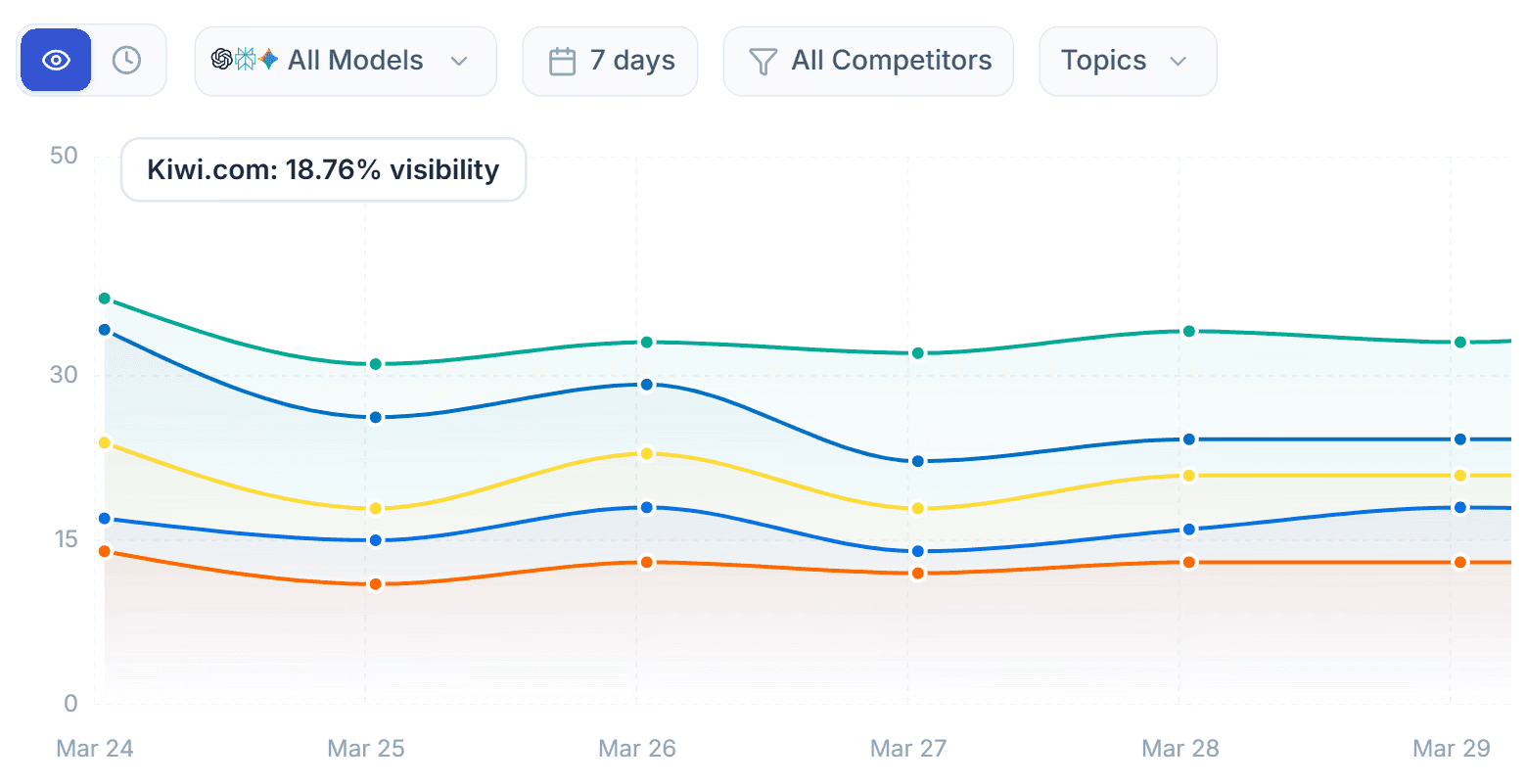
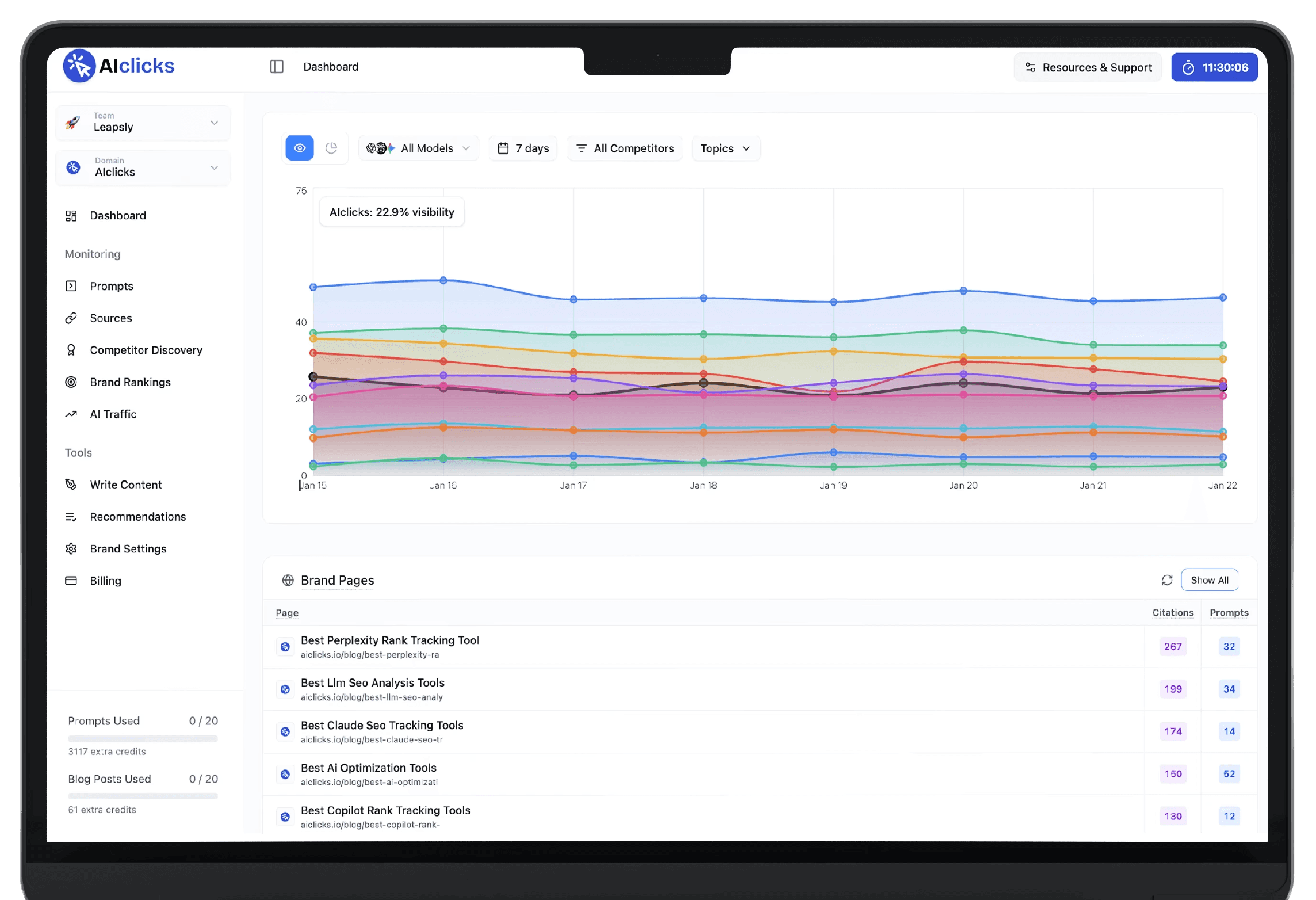
AIclicks gives you a live dashboard with daily ChatGPT mention rate, citation rate, sentiment, and share-of-voice across your tracked prompts, plus GA4 referral attribution for the traffic ChatGPT does send back.
Choose Your Plan
Flexible pricing that grows with your team. Upgrade or downgrade at any time.
Monthly
Yearly
-20%
Starter
Perfect for individuals & small teams
$49
/ month
Billed annually — you save $142
Choose 3 from:
Daily

" height="16px" id="fvSweaOBo" transform="translate(1 0)" width="14px"/></svg>)
" width="14px"><path d="M 13.864 5.629 L 13.3 5.629 L 13.3 5.6 L 7 5.6 L 7 8.4 L 10.956 8.4 C 10.379 10.03 8.828 11.2 7 11.2 C 4.681 11.2 2.8 9.319 2.8 7 C 2.8 4.681 4.681 2.8 7 2.8 C 8.071 2.8 9.045 3.204 9.786 3.864 L 11.766 1.884 C 10.516 0.719 8.844 0 7 0 C 3.134 0 0 3.134 0 7 C 0 10.866 3.134 14 7 14 C 10.866 14 14 10.866 14 7 C 14 6.531 13.952 6.073 13.864 5.629 Z" fill="rgb(255, 193, 7)" height="14px" id="H_YjfTNpn" width="14px"/><path d="M 0 3.742 L 2.3 5.429 C 2.922 3.888 4.429 2.8 6.193 2.8 C 7.264 2.8 8.238 3.204 8.979 3.864 L 10.959 1.884 C 9.709 0.719 8.037 0 6.193 0 C 3.504 0 1.172 1.518 0 3.742 Z" fill="rgb(255, 61, 0)" height="5.428500000000002px" id="PlkthQDhg" transform="translate(0.875 0)" width="10.959199999999996px"/><path d="M 6.232 5.581 C 8.04 5.581 9.683 4.889 10.925 3.764 L 8.758 1.931 C 8.032 2.483 7.144 2.782 6.232 2.781 C 4.411 2.781 2.865 1.62 2.283 0 L 0 1.759 C 1.159 4.026 3.511 5.581 6.232 5.581 Z" fill="rgb(76, 175, 80)" height="5.581099999999999px" id="WlnJ5gngE" transform="translate(0.7 8.4)" width="10.924899999999994px"/><path d="M 6.864 0.029 L 6.3 0.029 L 6.3 0 L 0 0 L 0 2.8 L 3.956 2.8 C 3.68 3.576 3.183 4.254 2.526 4.75 L 2.527 4.749 L 4.693 6.582 C 4.54 6.722 7 4.9 7 1.4 C 7 0.931 6.952 0.473 6.864 0.029 Z" fill="rgb(25, 118, 210)" height="6.589883930775992px" id="x_rSW275p" transform="translate(7 5.6)" width="7px"/></g></svg>)
" height="16px" id="hHS98fTxZ" width="16px"/></svg>)
 scale(1 1) translate(-1.861736945942159, -1.1170155383302638)" id="P20NzAvj0-699428820-radial-gradient" r="0.9935228066204626"><stop offset="0" stop-color="rgb(0, 174, 255)"/><stop offset="1" stop-color="rgb(7, 54, 196)"/></radialGradient><radialGradient cx="0.48250042504016705" cy="1.8366934653567062" gradient-transform="translate(0.48250042504016705, 1.8366934653567062) scale(1 1) translate(-0.48250042504016705, -1.8366934653567062)" id="UEWZqVjij-699428820-radial-gradient" r="0.9176890228114506"><stop offset="0" stop-color="rgb(255, 182, 87)"/><stop offset="1" stop-color="rgb(192, 43, 60)"/></radialGradient><linearGradient id="jyMN3TmKx-699428820-linear-gradient" x1="0.4594862532842614" x2="0.5405137467157386" y1="0" y2="1"><stop offset="0" stop-color="rgb(13, 145, 225)"/><stop offset="1" stop-color="rgb(255, 200, 0)"/></linearGradient><linearGradient id="xhMNwDFG0-699428820-linear-gradient" x1="0.4784828731548295" x2="0.5215171268451705" y1="5.551115123125783e-17" y2="1"><stop offset="0" stop-color="rgb(61, 203, 255)"/><stop offset="1" stop-color="rgba(5, 136, 247, 0)"/></linearGradient><radialGradient cx="1.4305090871482182" cy="0.34866158048251783" gradient-transform="translate(1.4305090871482182, 0.34866158048251783) scale(1 1) translate(-1.4305090871482182, -0.34866158048251783)" id="i79kAqaS4-699428820-radial-gradient" r="1.3362743412697924"><stop offset="0" stop-color="rgb(140, 72, 255)"/><stop offset="1" stop-color="rgb(255, 177, 82)"/></radialGradient><linearGradient id="mcxvno3tX-699428820-linear-gradient" x1="0.49844355920154226" x2="0.5015564407984577" y1="0" y2="1"><stop offset="0" stop-color="rgb(248, 173, 250)"/><stop offset="1" stop-color="rgba(168, 110, 221, 0)"/></linearGradient></defs><g d="M 11.605 1.219 C 11.397 0.499 10.739 0.002 9.989 0 L 9.498 0 C 8.682 0.002 7.985 0.588 7.842 1.391 L 7 6.016 L 7.209 5.296 C 7.416 4.574 8.075 4.076 8.825 4.074 L 11.681 4.074 L 12.879 4.545 L 14.033 4.074 L 13.697 4.074 C 12.947 4.072 12.289 3.575 12.081 2.855 Z M 4.413 13.387 C 4.618 14.111 5.278 14.611 6.031 14.613 L 7.075 14.613 C 7.988 14.613 8.735 13.88 8.758 12.96 L 8.871 8.5 L 8.633 9.319 C 8.426 10.039 7.768 10.537 7.018 10.539 L 4.138 10.539 L 3.111 9.977 L 2 10.539 L 2.331 10.539 C 3.084 10.542 3.743 11.042 3.949 11.766 L 4.413 13.387 Z M 9.999 0 L 4.167 0 C 2.501 0 1.501 2.221 0.834 4.441 C 0.045 7.073 -0.989 10.591 2.001 10.591 L 4.519 10.591 C 5.273 10.591 5.933 10.089 6.139 9.36 C 6.577 7.815 7.345 5.121 7.948 3.069 C 8.255 2.027 8.509 1.132 8.901 0.575 C 9.148 0.212 9.56 -0.004 9.999 0 M 9.999 0 L 4.167 0 C 2.501 0 1.501 2.221 0.834 4.441 C 0.045 7.073 -0.989 10.591 2.001 10.591 L 4.519 10.591 C 5.273 10.591 5.933 10.089 6.139 9.36 C 6.577 7.815 7.345 5.121 7.948 3.069 C 8.255 2.027 8.509 1.132 8.901 0.575 C 9.148 0.212 9.56 -0.004 9.999 0 M 6 14.593 L 11.833 14.593 C 13.499 14.593 14.499 12.372 15.166 10.151 C 15.955 7.519 16.989 4 13.999 4 L 11.48 4 C 10.725 4.002 10.063 4.505 9.86 5.232 C 9.266 7.332 8.663 9.429 8.051 11.523 C 7.745 12.566 7.49 13.461 7.098 14.019 C 6.851 14.382 6.439 14.597 6 14.593 M 6 14.593 L 11.833 14.593 C 13.499 14.593 14.499 12.372 15.166 10.151 C 15.955 7.519 16.989 4 13.999 4 L 11.48 4 C 10.725 4.002 10.063 4.505 9.86 5.232 C 9.266 7.332 8.663 9.429 8.051 11.523 C 7.745 12.566 7.49 13.461 7.098 14.019 C 6.851 14.382 6.439 14.597 6 14.593" fill="transparent" height="14.613333333333333px" id="QzkBy4Ibc" transform="translate(0 1)" width="16.00011071294081px"><path d="M 4.605 1.219 C 4.397 0.499 3.739 0.002 2.989 0 L 2.498 0 C 1.682 0.002 0.985 0.588 0.842 1.391 L 0 6.016 L 0.209 5.296 C 0.416 4.574 1.075 4.076 1.825 4.074 L 4.681 4.074 L 5.879 4.545 L 7.033 4.074 L 6.697 4.074 C 5.947 4.072 5.289 3.575 5.081 2.855 Z" fill="url(%23P20NzAvj0-699428820-radial-gradient)" height="6.016px" id="P20NzAvj0" transform="translate(7 0)" width="7.0333333333333385px"/><path d="M 2.413 4.887 C 2.618 5.611 3.278 6.111 4.031 6.113 L 5.075 6.113 C 5.988 6.113 6.735 5.38 6.758 4.46 L 6.871 0 L 6.633 0.819 C 6.426 1.539 5.768 2.037 5.018 2.039 L 2.138 2.039 L 1.111 1.477 L 0 2.039 L 0.331 2.039 C 1.084 2.042 1.743 2.542 1.949 3.266 L 2.413 4.887 Z" fill="url(%23UEWZqVjij-699428820-radial-gradient)" height="6.113333333333333px" id="UEWZqVjij" transform="translate(2 8.5)" width="6.871333333333332px"/><path d="M 9.999 0 L 4.167 0 C 2.501 0 1.501 2.221 0.834 4.441 C 0.045 7.073 -0.989 10.591 2.001 10.591 L 4.519 10.591 C 5.273 10.591 5.933 10.089 6.139 9.36 C 6.577 7.815 7.345 5.121 7.948 3.069 C 8.255 2.027 8.509 1.132 8.901 0.575 C 9.148 0.212 9.56 -0.004 9.999 0" fill="url(%23jyMN3TmKx-699428820-linear-gradient)" height="10.591388755215167px" id="jyMN3TmKx" width="9.999444046274142px"/><path d="M 9.999 0 L 4.167 0 C 2.501 0 1.501 2.221 0.834 4.441 C 0.045 7.073 -0.989 10.591 2.001 10.591 L 4.519 10.591 C 5.273 10.591 5.933 10.089 6.139 9.36 C 6.577 7.815 7.345 5.121 7.948 3.069 C 8.255 2.027 8.509 1.132 8.901 0.575 C 9.148 0.212 9.56 -0.004 9.999 0" fill="url(%23xhMNwDFG0-699428820-linear-gradient)" height="10.591388755215167px" id="xhMNwDFG0" width="9.999444046274142px"/><path d="M 0 10.593 L 5.833 10.593 C 7.499 10.593 8.499 8.372 9.166 6.151 C 9.955 3.519 10.989 0 7.999 0 L 5.48 0 C 4.725 0.002 4.063 0.505 3.86 1.232 C 3.266 3.332 2.663 5.429 2.051 7.523 C 1.745 8.566 1.49 9.461 1.098 10.019 C 0.851 10.382 0.439 10.597 0 10.593" fill="url(%23i79kAqaS4-699428820-radial-gradient)" height="10.593388755215164px" id="i79kAqaS4" transform="translate(6 4)" width="10.000110712940803px"/><path d="M 0 10.593 L 5.833 10.593 C 7.499 10.593 8.499 8.372 9.166 6.151 C 9.955 3.519 10.989 0 7.999 0 L 5.48 0 C 4.725 0.002 4.063 0.505 3.86 1.232 C 3.266 3.332 2.663 5.429 2.051 7.523 C 1.745 8.566 1.49 9.461 1.098 10.019 C 0.851 10.382 0.439 10.597 0 10.593" fill="url(%23mcxvno3tX-699428820-linear-gradient)" height="10.593388755215164px" id="mcxvno3tX" transform="translate(6 4)" width="10.000110712940803px"/></g></svg>)
" height="15.360666565427872px" id="HZPvvPBv7" transform="translate(0 0.5)" width="16px"/></svg>)
Tracked prompts
30
Websites you can add
3
LLMs you can track
3
Countries per project
1
LLM responses / mo
4,650
AI-optimized articles per month
10
Integrations
-
Support
Pro
For growing teams for more power
$140
/ month
Billed annually — you save $454
Choose 4 from:
Daily
Tracked prompts
150
Websites you can add
Unlimited
LLMs you can track
4
Countries per project
Unlimited
LLM responses / mo
18,600
AI-optimized articles per month
20
Integrations
Google Analytics
Support
BUSINESS
Best for medium-sized organizations
$357
/ month
Billed annually — you save $1198
Choose 6 from:
Daily
Tracked prompts
300
Websites you can add
Unlimited
LLMs you can track
6
Countries per project
Unlimited
LLM responses / mo
55,800
AI-optimized articles per month
30
Integrations
Google Analytics, API
Support
Dedicated account specialist
Become the #1 Answer in AI
Succeed in GEO yourself, or let us do all the work.
Do it yourself
Use AIclicks to see exactly where you appear across 10+ AI platforms, spot the gaps competitors are filling, and act on clear weekly recommendations.
From $59/month · Cancel anytime
Done for you
We Do All the Work for You
Our team manages your complete search presence: traditional SEO and GEO strategy, content, implementation, and reporting. You focus on patients.
Custom pricing · Minimum 3-month engagement
The AI SEO agency trusted by 1,000+ brands worldwide
From solo founders to multi-client agencies, AIclicks runs the full AI SEO agency program for organizations of every shape and size that want to be cited across every AI surface.
4.9/5 stars on G2






FAQ
How long does healthcare SEO take to bring patients?
Expect local movement in 3 to 4 months and steady appointment volume around 6 to 12. Google Business Profile and review work move first because they compound fastest. Condition and procedure rankings take longer, since YMYL content has to earn credential and citation signals before it ranks at all. Competitive specialty terms where a large health system already owns the results can run past 18 months. Watch impressions, which rise before positions.
Should we optimize for Google or for AI assistants?
Both, and healthcare is the harder case. Ahrefs analysed 863,000 keywords and found only 38% of pages cited in AI Overviews also ranked in the top 10, down from 76% a year earlier. On health questions assistants hedge, disclaim and cite a very short list of sources they consider safe. Getting into that list means credentialed authorship, review dates, clean schema, and third-party corroboration. Almost nobody in healthcare measures whether they are in it.
Is healthcare SEO really that different from normal SEO?
Yes, in 3 specific ways. Google treats every clinical page as YMYL and expects visible credentials, a named medical reviewer and a review date before it ranks you. HIPAA restricts what you can publish about any individual patient, which rules out the case studies other industries lean on. And your provider data lives in payer directories and the NPI registry, so a listing fix has to start in systems most agencies have never opened.
What is a realistic SEO budget for a practice?
Published rates sit near $800 to $3,000 monthly for a single site, and $5,000 upward for multi-location groups or hospital service lines. Separately, most practices already pay a medical website vendor $250 to $800 a month for maintenance that includes no SEO at all. Audit that line first. Then judge the retainer on cost per new patient against the lifetime value of a panel slot, not on the invoice.
Do we still need Google Ads if SEO works?
They cover different windows. Paid search fills next week’s schedule and stops the day the card is declined; organic builds the pages that keep producing after the campaign ends. Most groups buy ads for elective service lines the big systems dominate, and let organic carry symptom, coverage and cost queries, which cost far less to win. Let the ad data sequence your content: whichever keywords convert to kept appointments deserve a page.
Which pages should a clinic build first?
Claim the Google Business Profile before anything else, since it is free and outranks your homepage for the searches that matter. Then make provider profiles crawlable, because in healthcare they are the highest-converting page type and usually the ones hidden behind JavaScript. Then a page for each of your top 5 conditions or procedures in patient language. Then accepted insurance. Location pages after that. The news section is last, and mostly optional.
How do we know the SEO work is paying off?
Measure booked and kept appointments from organic, not positions. Every location page needs call tracking, because most medical enquiries are still phone calls and analytics loses them. Tag online scheduling starts and completions separately, since drop-off between the two is usually a technical problem. In your profile insights, calls and direction requests move before any ranking does. Then reconcile against the practice management system, because a new patient record is the only outcome that pays.
Should we keep this in-house or hire an agency?
Split it, and start by looking hard at your website vendor. Clinical accuracy, medical review sign-off, profile photos and review requests have to stay inside the practice; nobody outside it can approve a clinical claim. Rendering fixes, schema, provider data cleanup and link work want an outside specialist. Before signing, test whether they can discuss HIPAA marketing rules and CAQH provider records without guessing. A generalist will publish content your compliance officer then has to pull.
Further Reading
Go deeper on GEO, AI search, and visibility tracking.