SEO for Gyms and Studios:
Nobody joins a gym on impulse. They search on a Sunday evening, compare 3 places on a phone, hunt for a price and a class time that fits their shift, then read reviews until one feels worth walking into. That shortlist forms before you meet them.









Why Gyms and Studios Need SEO
Google says 76% of people who search for something nearby on a phone visit a business within a day. Most gyms lose that visit before it starts, for 3 reasons.
The 2 things every prospect wants are your price and your class times, and both usually live inside a Mindbody or Wodify widget that loads after the page does. Google indexes the wrapper, not the schedule. So you never rank for evening yoga or month-to-month membership, and the visitor bounces looking for a number.
Search gyms near me in a US city and the first organic results belong to Planet Fitness, 24 Hour Fitness and Snap Fitness, with SilverSneakers listing everyone else underneath. Chains rank on 2,700 location pages and a national ad budget. Your single site is competing with a franchise footprint, not a neighbour.
Most gyms pour the whole budget into Meta ads and a January challenge funnel, then pay again for every single lead that walks in once and never returns. Agencies quote another $2,500 to $5,000 a month to keep it running. Switch it off in February and the enquiries stop that week, because nothing was ever built.
How SEO Works for Gyms and Studios
Search Engine Optimization projects are long-term investments for gyms, where each task supplements the others and creates compound results over time.
01
Keywords, page structure, and the signals Google reads directly
On-page work in fitness fails on a structural problem: the pages that decide a membership are not really pages. Your timetable, your prices and your trial signup all sit inside a booking platform, rendered by JavaScript or pushed onto a vendor subdomain, so the words a prospect searched for exist nowhere Google can read them. What is left to optimise is a homepage, an about page and a contact form. The pages that actually earn joins are one per programme, one per coach, a real pricing page in HTML, and a first-visit page that answers what happens when I walk in.
The durable pages are the ones tied to a decision rather than a date. What a beginner should expect in their first class, what a month costs with no contract, how kids programmes are graded, whether you can freeze a membership: those questions get asked identically every year and the answers barely move. What churns is everything the industry loves to publish. The 6-week transformation challenge, the new equipment announcement, the holiday hours post and the New Year offer all die by February and quietly become most of the blog. Write fewer of those and revisit the pricing page every time you change a rate.
1
Give every programme its own page, titled how people search: crossfit classes, kids jiu jitsu, personal training prices, over-50s strength.
2
Unpublish last January’s challenge pages and retired class formats each quarter, redirecting every one into the programme page that replaced it.
3
Use ExerciseGym or HealthClub schema rather than plain LocalBusiness, add Offer markup on the pricing page, and validate in Rich Results Test.
4
Publish a plain HTML pricing page, a first-class explainer and a cancellation policy page; all 3 rank in July, not just January.
02
Map Pack visibility, citations, and proximity signals
Almost nobody drives past 3 closer gyms to reach yours. Membership demand collapses to a radius of a few miles, so the map pack, all 3 slots of it, takes the clicks before anyone scrolls to a website at all. It is also the one surface where an independent outranks a franchise. Google weighs proximity, prominence and relevance; you cannot move the building, so the other 2 are the whole game, and both are free to work on.
Pick the narrowest true primary category, Boxing Gym or Indoor Cycling Studio rather than Gym, and keep the broad ones as secondaries. Then work the attributes Google added specifically for fitness: sauna, basketball court, gender-neutral changing rooms, free parking, 24-hour access. List every class as a service with a price. Load photos of the floor at 6am and 7pm, not an empty rack, and answer cost, contract and parking yourself in the Q&A.
Fitness has a citation layer general advice never mentions. Beyond Apple Business Connect, Bing Places and Yelp, the ones that move gym rankings are ClassPass, the Mindbody marketplace, the CrossFit affiliate map, and the Medicare fitness networks: SilverSneakers, Renew Active and Silver&Fit. Those network listings send walk-ins on their own. Every one needs the identical name, unit number and phone, because a studio that trades under 2 names online splits its own signal.
1
Set the narrowest primary category, tick every fitness attribute Google offers, and list each class as a service with its real price.
2
Give each site its own profile and page; let staff trainers claim practitioner listings under Personal Trainer so they do not clash with yours.
3
Run BrightLocal across ClassPass, Mindbody, SilverSneakers and Apple Business Connect, then fix every unit number and trading-name variant you find.
4
Publish next week’s timetable and any open class slots as a Google Business Profile update every Sunday, since posts expire after 7 days.
03
Topic authority, inbound links, and content that earns traffic
Before anyone books a tour they are working out whether they will be the least fit person in the room. That anxiety, not equipment, drives the research phase. Content that names the real barrier wins: what a first class actually involves, what to wear, whether beginners are separated, what happens if you cannot finish. A page written for someone who has not trained in 6 years converts better than any facility tour ever will.
Someone who has already decided to join is now comparing 3 gyms on 4 things: price, contract length, class times that fit their shift, and whether the coaching is any good. Put all 4 on the page. Publish the actual rate, say whether it is month-to-month, show the timetable as text, and name the coaches with their certifications. Most gyms hide price behind a form and lose the comparison by default.
Gym links come from the calendar, not from outreach. Sponsor the local 5K and you land on the results page and the entry form. Host a charity workout and the organiser links to you. Affiliate bodies list their gyms: CrossFit, Gracie Barra, F45 and Orangetheory all publish locator pages. Physios, chiropractors and running shops trade referral links happily because the traffic flows both ways, and none of it costs a placement fee.
1
Publish an annual guide comparing gym types in your area, CrossFit against big-box against boutique, with honest price bands for each.
2
Build one page per class format per neighbourhood you draw from, with genuine transit, parking and childcare detail rather than a swapped place name.
3
Cluster every how much does a gym cost question into one hub: joining fees, month-to-month, class packs, freezes, cancellation, and corporate rates.
4
Write a page for each coach and each method you run, Hyrox, Les Mills, Reformer Pilates, since people search the format before the gym.
04
Site speed, crawlability, Core Web Vitals, and mobile health
The failure almost every gym shares is the booking widget. Mindbody, Wodify, Zen Planner and Glofox inject the timetable, prices and signup flow through JavaScript, or park them on a vendor subdomain entirely. Google renders a page with a spinner where the content should be, so none of it is indexed and none of it is quotable. Owners assume the schedule is on their site. What is on their site is an empty container.
Gym searches happen in dead time: on a bus, in a car park, at 10pm after deciding tomorrow is the day. The visitor wants a price and a class time within seconds. Fitness sites are the worst offenders for weight, because the hero is usually a full-width autoplaying video of the floor and the gallery ships uncompressed camera files. Load that over 4G and the person has already opened the next gym in the map pack.
1
Fetch your timetable page with JavaScript disabled, or use Search Console URL Inspection; if the classes vanish, publish them as static HTML too.
2
Run PageSpeed Insights on the homepage, replace the autoplaying hero video with a poster image, and recheck Largest Contentful Paint on a mid-range Android.
3
Serve class and facility photos as WebP at display size, lazy-load the gallery, and set explicit dimensions so the join button stops moving.
4
Keep programme, coach and pricing URLs in a sitemap separate from blog posts, and resubmit whenever the timetable or rates change.
05
Star ratings, review volume, and response strategy that builds trust
Reviews decide gym searches because everything else on the profile looks identical: same equipment brands, same class names, same photos of a squat rack. The rating is the only differentiator a stranger can read. Collecting them is awkward, though. Members are sweaty, in a rush, and heading to work. The ones who write unprompted are the ones cancelling over a billing charge, which is why an unmanaged gym drifts toward a rating its members would not recognise.
The moment to ask is roughly 30 minutes after a check-in, by text, while the endorphins are still doing the work. A review link sent by SMS gets tapped far more often than the same request by email, which most members never open. Wire it to the check-in event in your management software so it fires on a milestone: 10th class, first pull-up, 6-month anniversary. Ask across the whole membership, not only the people who already love you.
1
Fire the review text from Wodify, PushPress or Zen Planner 30 minutes after a member checks in, not the next morning.
2
Answer inside a day and name the fix, since most 1-star gym reviews are cancellation or direct-debit disputes rather than anything about the training.
3
Place reviews mentioning a specific class on that programme page, and pull the aggregate rating onto the pricing page where hesitation peaks.
4
Ask personal training and kids-programme clients separately, because parents write longer reviews than members and those land on your trainers’ practitioner listings.
Google is No Longer the Only Place Your members are Searching
Members are using AI to find answers, and they trust what it tells them. Invest in GEO to get recommended in those answers.
1 Billion
Questions ChatGPT receives every single day
38%
Your #1 top ranking page on Google would be cited by AI
14%
of gyms optimise for GEO. The rest are invisible in AI answers


You can rank #1 for “gym near me” and still not exist in ChatGPT’s answer. Run a free GEO audit to see where your brand actually stands.
GEO vs SEO: Same Goal, Different Methods
GEO is wider than SEO. AI recommends the brands that show up across the sources it reads, so your presence in forums, social platforms and fitness blogs decides your odds. AIclicks measures the three metrics below so you know which to work on first.
AI Assistant
Where should I train near me without a contract?
Your Gym
Citation Rate
Shows how many AI answers about gyms and studios name your brand, out of every 100. Models pull from the same trusted pages over and over, so citations compound: once you are in, staying in gets easier. Find the competitor pages AI cites most, then publish your own version of each.
Your Gym
82% positive
Competitor A
54% positive
Competitor B
38% positive
Brand Sentiment
Shows how AI describes you when your brand comes up: positive, neutral or negative. Tone is what separates being mentioned from being recommended, and models repeat whatever framing they find. Track the negative mentions back to the reviews and threads behind them, then publish content that answers those directly.
Others 52%
You 24%
— 24%
Your Gym
AI mention share of voice — fitness category
Competitors
Not Cited
Share of Voice in AI
Shows how much of the fitness conversation belongs to you rather than your competitors. This is the metric that matters most, the GEO version of a Google ranking. With only 1–5 brands named per answer, the market is winner-takes-more and every point is taken from someone.
The Dashboard Your Dedicated AI Search Team Works In
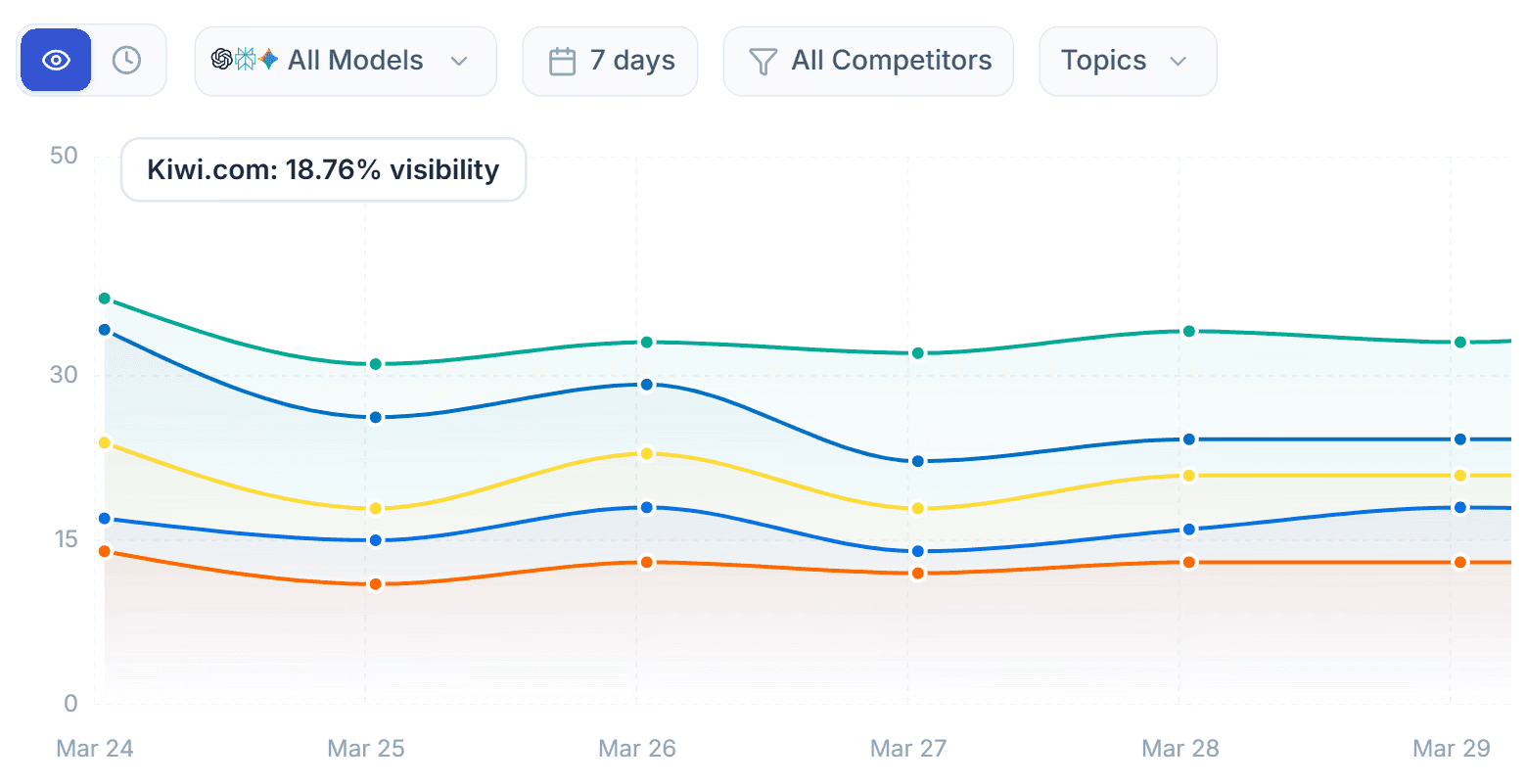
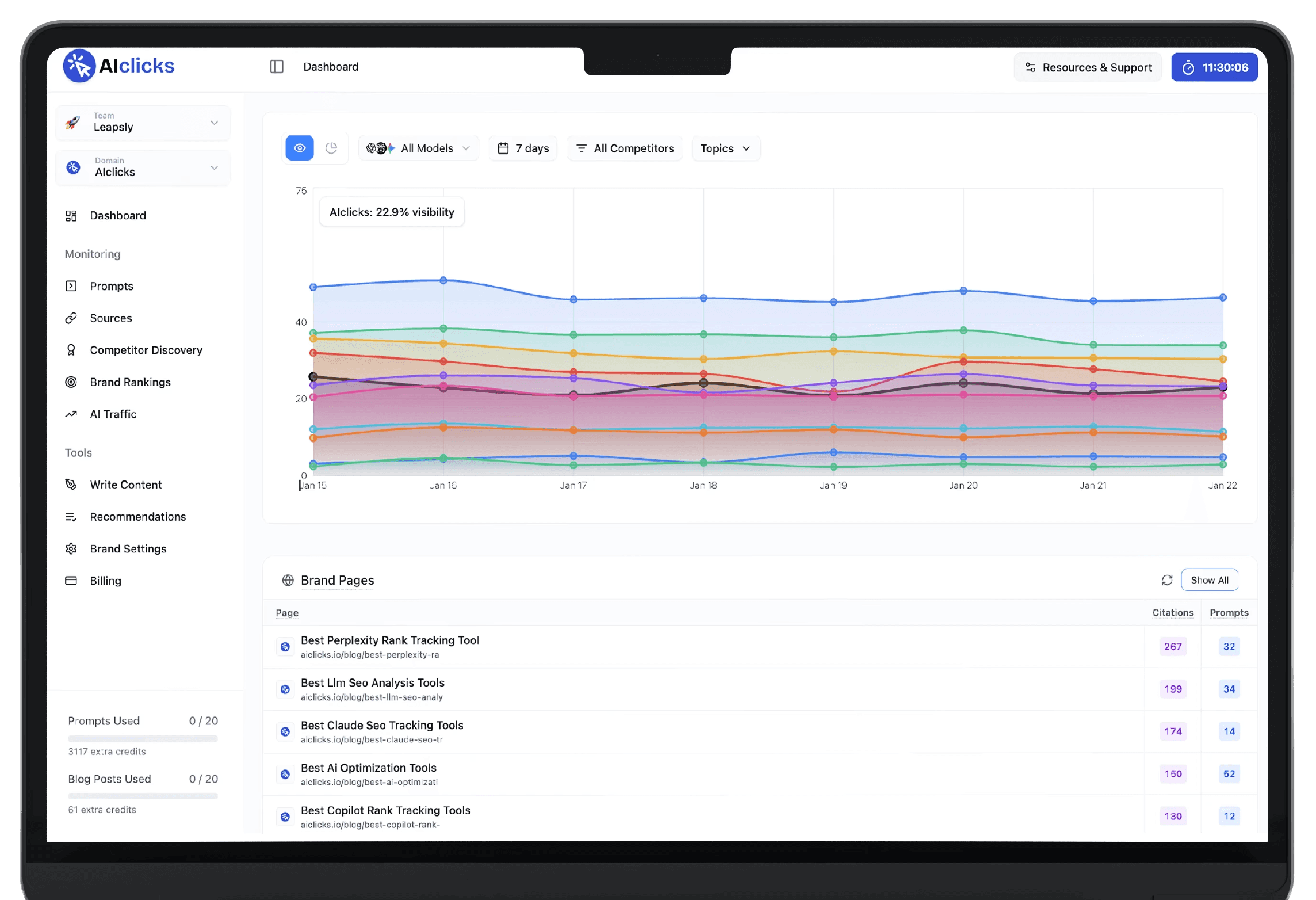
AIclicks gives you a live dashboard with daily ChatGPT mention rate, citation rate, sentiment, and share-of-voice across your tracked prompts, plus GA4 referral attribution for the traffic ChatGPT does send back.
Choose Your Plan
Flexible pricing that grows with your team. Upgrade or downgrade at any time.
Monthly
Yearly
-20%
Starter
Perfect for individuals & small teams
$49
/ month
Billed annually — you save $142
Choose 3 from:
Daily

" height="16px" id="fvSweaOBo" transform="translate(1 0)" width="14px"/></svg>)
" width="14px"><path d="M 13.864 5.629 L 13.3 5.629 L 13.3 5.6 L 7 5.6 L 7 8.4 L 10.956 8.4 C 10.379 10.03 8.828 11.2 7 11.2 C 4.681 11.2 2.8 9.319 2.8 7 C 2.8 4.681 4.681 2.8 7 2.8 C 8.071 2.8 9.045 3.204 9.786 3.864 L 11.766 1.884 C 10.516 0.719 8.844 0 7 0 C 3.134 0 0 3.134 0 7 C 0 10.866 3.134 14 7 14 C 10.866 14 14 10.866 14 7 C 14 6.531 13.952 6.073 13.864 5.629 Z" fill="rgb(255, 193, 7)" height="14px" id="H_YjfTNpn" width="14px"/><path d="M 0 3.742 L 2.3 5.429 C 2.922 3.888 4.429 2.8 6.193 2.8 C 7.264 2.8 8.238 3.204 8.979 3.864 L 10.959 1.884 C 9.709 0.719 8.037 0 6.193 0 C 3.504 0 1.172 1.518 0 3.742 Z" fill="rgb(255, 61, 0)" height="5.428500000000002px" id="PlkthQDhg" transform="translate(0.875 0)" width="10.959199999999996px"/><path d="M 6.232 5.581 C 8.04 5.581 9.683 4.889 10.925 3.764 L 8.758 1.931 C 8.032 2.483 7.144 2.782 6.232 2.781 C 4.411 2.781 2.865 1.62 2.283 0 L 0 1.759 C 1.159 4.026 3.511 5.581 6.232 5.581 Z" fill="rgb(76, 175, 80)" height="5.581099999999999px" id="WlnJ5gngE" transform="translate(0.7 8.4)" width="10.924899999999994px"/><path d="M 6.864 0.029 L 6.3 0.029 L 6.3 0 L 0 0 L 0 2.8 L 3.956 2.8 C 3.68 3.576 3.183 4.254 2.526 4.75 L 2.527 4.749 L 4.693 6.582 C 4.54 6.722 7 4.9 7 1.4 C 7 0.931 6.952 0.473 6.864 0.029 Z" fill="rgb(25, 118, 210)" height="6.589883930775992px" id="x_rSW275p" transform="translate(7 5.6)" width="7px"/></g></svg>)
" height="16px" id="hHS98fTxZ" width="16px"/></svg>)
 scale(1 1) translate(-1.861736945942159, -1.1170155383302638)" id="P20NzAvj0-699428820-radial-gradient" r="0.9935228066204626"><stop offset="0" stop-color="rgb(0, 174, 255)"/><stop offset="1" stop-color="rgb(7, 54, 196)"/></radialGradient><radialGradient cx="0.48250042504016705" cy="1.8366934653567062" gradient-transform="translate(0.48250042504016705, 1.8366934653567062) scale(1 1) translate(-0.48250042504016705, -1.8366934653567062)" id="UEWZqVjij-699428820-radial-gradient" r="0.9176890228114506"><stop offset="0" stop-color="rgb(255, 182, 87)"/><stop offset="1" stop-color="rgb(192, 43, 60)"/></radialGradient><linearGradient id="jyMN3TmKx-699428820-linear-gradient" x1="0.4594862532842614" x2="0.5405137467157386" y1="0" y2="1"><stop offset="0" stop-color="rgb(13, 145, 225)"/><stop offset="1" stop-color="rgb(255, 200, 0)"/></linearGradient><linearGradient id="xhMNwDFG0-699428820-linear-gradient" x1="0.4784828731548295" x2="0.5215171268451705" y1="5.551115123125783e-17" y2="1"><stop offset="0" stop-color="rgb(61, 203, 255)"/><stop offset="1" stop-color="rgba(5, 136, 247, 0)"/></linearGradient><radialGradient cx="1.4305090871482182" cy="0.34866158048251783" gradient-transform="translate(1.4305090871482182, 0.34866158048251783) scale(1 1) translate(-1.4305090871482182, -0.34866158048251783)" id="i79kAqaS4-699428820-radial-gradient" r="1.3362743412697924"><stop offset="0" stop-color="rgb(140, 72, 255)"/><stop offset="1" stop-color="rgb(255, 177, 82)"/></radialGradient><linearGradient id="mcxvno3tX-699428820-linear-gradient" x1="0.49844355920154226" x2="0.5015564407984577" y1="0" y2="1"><stop offset="0" stop-color="rgb(248, 173, 250)"/><stop offset="1" stop-color="rgba(168, 110, 221, 0)"/></linearGradient></defs><g d="M 11.605 1.219 C 11.397 0.499 10.739 0.002 9.989 0 L 9.498 0 C 8.682 0.002 7.985 0.588 7.842 1.391 L 7 6.016 L 7.209 5.296 C 7.416 4.574 8.075 4.076 8.825 4.074 L 11.681 4.074 L 12.879 4.545 L 14.033 4.074 L 13.697 4.074 C 12.947 4.072 12.289 3.575 12.081 2.855 Z M 4.413 13.387 C 4.618 14.111 5.278 14.611 6.031 14.613 L 7.075 14.613 C 7.988 14.613 8.735 13.88 8.758 12.96 L 8.871 8.5 L 8.633 9.319 C 8.426 10.039 7.768 10.537 7.018 10.539 L 4.138 10.539 L 3.111 9.977 L 2 10.539 L 2.331 10.539 C 3.084 10.542 3.743 11.042 3.949 11.766 L 4.413 13.387 Z M 9.999 0 L 4.167 0 C 2.501 0 1.501 2.221 0.834 4.441 C 0.045 7.073 -0.989 10.591 2.001 10.591 L 4.519 10.591 C 5.273 10.591 5.933 10.089 6.139 9.36 C 6.577 7.815 7.345 5.121 7.948 3.069 C 8.255 2.027 8.509 1.132 8.901 0.575 C 9.148 0.212 9.56 -0.004 9.999 0 M 9.999 0 L 4.167 0 C 2.501 0 1.501 2.221 0.834 4.441 C 0.045 7.073 -0.989 10.591 2.001 10.591 L 4.519 10.591 C 5.273 10.591 5.933 10.089 6.139 9.36 C 6.577 7.815 7.345 5.121 7.948 3.069 C 8.255 2.027 8.509 1.132 8.901 0.575 C 9.148 0.212 9.56 -0.004 9.999 0 M 6 14.593 L 11.833 14.593 C 13.499 14.593 14.499 12.372 15.166 10.151 C 15.955 7.519 16.989 4 13.999 4 L 11.48 4 C 10.725 4.002 10.063 4.505 9.86 5.232 C 9.266 7.332 8.663 9.429 8.051 11.523 C 7.745 12.566 7.49 13.461 7.098 14.019 C 6.851 14.382 6.439 14.597 6 14.593 M 6 14.593 L 11.833 14.593 C 13.499 14.593 14.499 12.372 15.166 10.151 C 15.955 7.519 16.989 4 13.999 4 L 11.48 4 C 10.725 4.002 10.063 4.505 9.86 5.232 C 9.266 7.332 8.663 9.429 8.051 11.523 C 7.745 12.566 7.49 13.461 7.098 14.019 C 6.851 14.382 6.439 14.597 6 14.593" fill="transparent" height="14.613333333333333px" id="QzkBy4Ibc" transform="translate(0 1)" width="16.00011071294081px"><path d="M 4.605 1.219 C 4.397 0.499 3.739 0.002 2.989 0 L 2.498 0 C 1.682 0.002 0.985 0.588 0.842 1.391 L 0 6.016 L 0.209 5.296 C 0.416 4.574 1.075 4.076 1.825 4.074 L 4.681 4.074 L 5.879 4.545 L 7.033 4.074 L 6.697 4.074 C 5.947 4.072 5.289 3.575 5.081 2.855 Z" fill="url(%23P20NzAvj0-699428820-radial-gradient)" height="6.016px" id="P20NzAvj0" transform="translate(7 0)" width="7.0333333333333385px"/><path d="M 2.413 4.887 C 2.618 5.611 3.278 6.111 4.031 6.113 L 5.075 6.113 C 5.988 6.113 6.735 5.38 6.758 4.46 L 6.871 0 L 6.633 0.819 C 6.426 1.539 5.768 2.037 5.018 2.039 L 2.138 2.039 L 1.111 1.477 L 0 2.039 L 0.331 2.039 C 1.084 2.042 1.743 2.542 1.949 3.266 L 2.413 4.887 Z" fill="url(%23UEWZqVjij-699428820-radial-gradient)" height="6.113333333333333px" id="UEWZqVjij" transform="translate(2 8.5)" width="6.871333333333332px"/><path d="M 9.999 0 L 4.167 0 C 2.501 0 1.501 2.221 0.834 4.441 C 0.045 7.073 -0.989 10.591 2.001 10.591 L 4.519 10.591 C 5.273 10.591 5.933 10.089 6.139 9.36 C 6.577 7.815 7.345 5.121 7.948 3.069 C 8.255 2.027 8.509 1.132 8.901 0.575 C 9.148 0.212 9.56 -0.004 9.999 0" fill="url(%23jyMN3TmKx-699428820-linear-gradient)" height="10.591388755215167px" id="jyMN3TmKx" width="9.999444046274142px"/><path d="M 9.999 0 L 4.167 0 C 2.501 0 1.501 2.221 0.834 4.441 C 0.045 7.073 -0.989 10.591 2.001 10.591 L 4.519 10.591 C 5.273 10.591 5.933 10.089 6.139 9.36 C 6.577 7.815 7.345 5.121 7.948 3.069 C 8.255 2.027 8.509 1.132 8.901 0.575 C 9.148 0.212 9.56 -0.004 9.999 0" fill="url(%23xhMNwDFG0-699428820-linear-gradient)" height="10.591388755215167px" id="xhMNwDFG0" width="9.999444046274142px"/><path d="M 0 10.593 L 5.833 10.593 C 7.499 10.593 8.499 8.372 9.166 6.151 C 9.955 3.519 10.989 0 7.999 0 L 5.48 0 C 4.725 0.002 4.063 0.505 3.86 1.232 C 3.266 3.332 2.663 5.429 2.051 7.523 C 1.745 8.566 1.49 9.461 1.098 10.019 C 0.851 10.382 0.439 10.597 0 10.593" fill="url(%23i79kAqaS4-699428820-radial-gradient)" height="10.593388755215164px" id="i79kAqaS4" transform="translate(6 4)" width="10.000110712940803px"/><path d="M 0 10.593 L 5.833 10.593 C 7.499 10.593 8.499 8.372 9.166 6.151 C 9.955 3.519 10.989 0 7.999 0 L 5.48 0 C 4.725 0.002 4.063 0.505 3.86 1.232 C 3.266 3.332 2.663 5.429 2.051 7.523 C 1.745 8.566 1.49 9.461 1.098 10.019 C 0.851 10.382 0.439 10.597 0 10.593" fill="url(%23mcxvno3tX-699428820-linear-gradient)" height="10.593388755215164px" id="mcxvno3tX" transform="translate(6 4)" width="10.000110712940803px"/></g></svg>)
" height="15.360666565427872px" id="HZPvvPBv7" transform="translate(0 0.5)" width="16px"/></svg>)
Tracked prompts
30
Websites you can add
3
LLMs you can track
3
Countries per project
1
LLM responses / mo
4,650
AI-optimized articles per month
10
Integrations
-
Support
Pro
For growing teams for more power
$140
/ month
Billed annually — you save $454
Choose 4 from:
Daily
Tracked prompts
150
Websites you can add
Unlimited
LLMs you can track
4
Countries per project
Unlimited
LLM responses / mo
18,600
AI-optimized articles per month
20
Integrations
Google Analytics
Support
BUSINESS
Best for medium-sized organizations
$357
/ month
Billed annually — you save $1198
Choose 6 from:
Daily
Tracked prompts
300
Websites you can add
Unlimited
LLMs you can track
6
Countries per project
Unlimited
LLM responses / mo
55,800
AI-optimized articles per month
30
Integrations
Google Analytics, API
Support
Dedicated account specialist
Become the #1 Answer in AI
Succeed in GEO yourself, or let us do all the work.
Do it yourself
Use AIclicks to see exactly where you appear across 10+ AI platforms, spot the gaps competitors are filling, and act on clear weekly recommendations.
From $59/month · Cancel anytime
Done for you
We Do All the Work for You
Our team manages your complete search presence: traditional SEO and GEO strategy, content, implementation, and reporting. You focus on members.
Custom pricing · Minimum 3-month engagement
The AI SEO agency trusted by 1,000+ brands worldwide
From solo founders to multi-client agencies, AIclicks runs the full AI SEO agency program for organizations of every shape and size that want to be cited across every AI surface.
4.9/5 stars on G2







FAQ
How long before SEO fills classes at a gym?
Map pack movement usually shows in 6 to 12 weeks, and meaningful joins from organic search in 3 to 6 months. Ranking for best gym in a busy US city takes 9 to 12 months, because that is a review-volume and link problem rather than a page problem. Gyms in quieter markets move faster. Watch profile calls and direction requests first; they rise well before memberships do.
Should we bother with AI search or just Google?
Both, and gyms are unusually exposed on the AI side. Ahrefs analysed 863,000 keywords and found only 38% of pages cited in AI Overviews also ranked in the top 10, down from 76% a year earlier. Worse, the facts an assistant needs from you, price, contract terms and class times, usually sit inside a booking widget it cannot read, so it answers from Yelp and the chains instead.
How is gym SEO different from normal local SEO?
Fitness has 3 quirks generic advice misses. Your most searched content, the timetable and the price, lives in third-party software rather than on your site, so it needs republishing as HTML. Google Business Profile offers dozens of narrow fitness categories and gym-only attributes, and the wrong pick costs you rankings. And your trainers can claim their own practitioner listings, which either extend your reach or compete with it.
What should a gym budget for SEO each month?
Specialist gym consultants typically quote $500 to $2,500 a month, full agencies $2,500 to $5,000 and up, and tools add another $100 to $200. A single-site studio in a quiet market does not need the top band. Judge it against what a member is worth over their whole time with you rather than against the retainer, and against what you already spend on paid social every January.
Do Facebook ads still work better than SEO?
They work differently. Meta ads fill a challenge intake fast and stop the day you pause them, which is why most gyms are permanently renting demand. Search captures the person who has already decided to join and is choosing between 3 places, so it converts higher and costs nothing per click once ranked. Run both if you can: use the ad data to decide which class pages to build first.
Do we even need a website, or is Instagram enough?
Instagram is not enough, because it does not appear when someone searches gyms near me and it publishes nothing Google or an assistant can quote. Build in this order: Google Business Profile first, since it is free and outranks websites. Then a pricing page in plain HTML. Then one page per programme. Then a first-visit page for nervous beginners. Then a static copy of the timetable. The blog is last.
How do we know local SEO brought us members?
Attribute joins, not rankings. Add a source field to the signup form and train the front desk to ask new members how they found you, because walk-ins never show in analytics. Track calls and direction requests in Google Business Profile insights, which move first. In Search Console, watch impressions on programme and pricing terms. Then reconcile against your management software: trials booked and contracts started are the only numbers that pay rent.
Should we do this ourselves or hire someone?
Split it. Nobody outside the gym can write the first-visit page or answer a review about a coach, and profile posts, photos and review asks all belong to your front desk. Hire out the parts that need a specialist: getting the timetable out of the booking widget, schema, site speed and citation cleanup. If you do hire, ask which gym management platform they have worked with, because that is where the technical problem lives.
Further Reading
Go deeper on GEO, AI search, and visibility tracking.