SEO for Franchises:
A customer never searches at brand level. They search for what is open near them right now, tap whatever the map shows first, and never learn the sign belongs to a system with hundreds of units. Every location you own is discovered alone.









Why Franchises Need SEO
Roughly 46% of Google searches carry local intent, and the answer increasingly arrives before the click. Franchise brands are measured nationally while every unit is judged one query at a time.
Corporate ships every unit the same location page: address, hours, a stock photo and 80 words nobody can edit. Franchisees who ask for a paragraph about their own market wait a quarter for a ticket to clear. The page ranks for the brand name and nothing else, so the searches that would fill the store go elsewhere.
Search fast food near me and DoorDash, Grubhub and Yelp sit above every brand’s own locator. They rank on a listing of your own store, built from your own data, monetised by pushing whichever unit pays the higher commission. Your best-performing location competes with a page about itself that it does not control.
Every unit pays into the national brand fund, typically 1% to 4% of gross sales on top of royalties, and that buys television, sponsorships and a corporate campaign. Add $400 to $1,500 a month per location to manage listings. Stop paying and the visibility disappears, because nothing was built on the unit’s page.
How SEO Works for Franchises
Search Engine Optimization projects are long-term investments for franchisees, where each task supplements the others and creates compound results over time.
01
Keywords, page structure, and the signals Google reads directly
On-page work in a franchise system is a governance problem before it is a writing problem. Nobody can change a page alone: brand standards dictate the headline, legal reviews any claim that touches the Franchise Disclosure Document, and the franchisee who actually knows the market has no login. So every location page ships identical because identical is the only thing that clears approval. The pages that matter are the location pages, the service-plus-market pages beneath them, and the franchise development pages selling units. The corporate blog is not one of them.
What holds value is anything tied to a place rather than a promotion. A location page carrying real parking directions, the hours that genuinely differ from brand standard, the neighbourhoods it serves and reviews written about that address will still be earning visits in 5 years, because the address does not move. What churns is the limited-time offer page, the grand opening announcement and the seasonal promotion, all of which stay indexed long after the offer expires. Most systems have this inverted: a location page written once at launch and never touched, and a promotions folder refreshed every 6 weeks.
1
Give every franchisee an editable block on their location page for services, parking and staff, then require 150 unique words before launch.
2
When a unit closes or transfers, 301 its location page to the nearest open store and mark its Google Business Profile permanently closed.
3
Mark each location page with LocalBusiness schema and a branchOf property pointing at the brand’s Organization node, plus geo coordinates and areaServed.
4
Publish a franchise cost page built from Item 7 of your FDD, covering total investment, franchise fee, royalty and working capital.
02
Map Pack visibility, citations, and proximity signals
Almost every dollar a franchise system takes comes from someone within a few miles of a unit, which is why the map pack decides more revenue than the homepage does. Roughly 46% of Google searches carry local intent, and the 3 results Google shows above everything else are chosen per query, per ZIP code. A brand with 300 units is not fighting 300 battles for one ranking; it is fighting 300 separate map packs, each with its own winner.
A complete franchise profile uses the brand name exactly as the standards manual writes it, with no city appended, because a name variant is the fastest way to get a listing suspended. Set the narrowest accurate category, then add the services that unit genuinely offers rather than the full brand menu. Load photos of that store, not brand assets. Fill the attributes customers filter by: drive-thru, late hours, wheelchair access, and whether the unit accepts the app.
Franchise citations flow from data aggregators before they reach directories, so fixing Yelp by hand fixes nothing. Push verified records through Data Axle, Foursquare and Neustar Localeze, then claim Apple Business Connect and Bing Places per unit. Food systems add DoorDash, Uber Eats and Grubhub, which function as citations whether you sell through them or not. One suite number entered differently by one franchisee propagates across dozens of sites and takes months to unwind.
1
Verify every unit under the exact brand name, set one narrow primary category, and complete the attribute list customers filter by in Maps.
2
Manage units in Google Business Profile location groups, upload changes by spreadsheet, and give each franchisee manager access to their own listing only.
3
Run Yext, Uberall or BrightLocal across all units quarterly, and lock phone and address fields so franchisees cannot edit them locally.
4
Schedule one Google Business Profile post per unit each week through SOCi or Vendasta, using approved brand assets the franchisee can localise.
03
Topic authority, inbound links, and content that earns traffic
Franchise systems serve 2 audiences that research completely differently. A customer comparing options wants to know what this unit actually stocks, whether it takes their loyalty app, and how late it is open tonight, and they will not read a brand story to find out. A prospective franchisee is running a different search entirely, comparing total investment against 3 other concepts. Both journeys end on your site, and most systems only build for one.
Someone who has already chosen the brand is now choosing which unit, and the deciding factors are boring: which one is closer, which one is open, which one has the better rating, and which one has the thing in stock. Put live hours, a real phone number that rings at the store rather than a call centre, that unit’s reviews and its current offers on the location page. Systems lose these customers to a delivery marketplace at exactly this step.
Franchise links come from 2 layers that rarely talk to each other. At brand level: the International Franchise Association member directory, trade press like Franchise Times and 1851 Franchise, supplier and equipment partners, and the annual ranking lists every system already submits to. At unit level: the chamber each franchisee joins, the youth team they sponsor, the local paper covering a new opening. Corporate cannot earn the second layer, and franchisees will never earn the first.
1
Publish a yearly comparison of your concept against the 3 competing systems buyers shortlist, using published Item 7 investment ranges rather than adjectives.
2
Generate one page per service per unit from your location feed, such as /locations/your-city/oil-change, with genuinely different service lists and pricing.
3
Cluster every how much does a franchise cost query into one hub covering franchise fee, royalty, ad fund, build-out and SBA financing.
4
Write a page for each national brand or equipment line your units carry, since customers search the product name long before they search your concept.
04
Site speed, crawlability, Core Web Vitals, and mobile health
The failure hiding in almost every franchise site is the store locator. It renders as a JavaScript map with a ZIP code box, and the individual location URLs exist only after someone types into that box. Googlebot never types. So those pages sit in the sitemap with no internal link pointing at them, orphaned from the site that is supposed to be passing them authority. Systems that moved their locator to a separate subdomain made it worse.
The franchise search happens in a car park or a car, on one bar of signal, from someone deciding between you and whatever else is 2 minutes away. That visitor hits the locator first, which is the heaviest page on the site: a mapping SDK, a fonts bundle and every unit’s data loaded before anything paints. If they cannot see hours and a tappable phone number within a couple of seconds, they open Maps instead and you never appear in the session.
1
Crawl the site in Screaming Frog with JavaScript rendering off; any location page reachable only through the ZIP search box needs a static directory link.
2
Run PageSpeed Insights on the store locator over throttled mobile, defer the mapping SDK until interaction, and target Interaction to Next Paint under 200 milliseconds.
3
Serve each unit’s storefront and interior photos as WebP at display size, and lazy-load the menu or product galleries below the fold.
4
Keep location pages in their own sitemap with accurate lastmod dates, and regenerate it automatically whenever a unit opens, closes or changes hours.
05
Star ratings, review volume, and response strategy that builds trust
Reviews are the only ranking signal a franchise cannot centralise, and they are the one customers read first. A system’s rating is not an average; it is hundreds of separate ratings, and the customer only ever sees the one nearest them. A single unit sliding to 3.6 stars pulls it out of the map pack in its own market while corporate’s dashboard still shows 4.5 across the network. Worse, angry reviewers name the brand, so one unit’s failure lands on every other unit.
Ask at the transaction, from the system the unit already runs. A receipt link from Toast or Square, or a job-complete trigger in ServiceTitan or Jobber, fires while the customer is still on the premises and still holding the phone. Route it to that unit’s profile, never to a brand-wide review page, because a review filed against corporate does nothing for the store that earned it. Then set a floor: every unit asks every customer, and corporate audits review velocity monthly.
1
Fire the review request from Toast, Square or ServiceTitan at transaction close, linking directly to that unit’s Google Business Profile rather than a brand form.
2
Reply within 24 hours from the unit, not corporate, and route anything mentioning food safety or injury to legal before it is answered publicly.
3
Pull that unit’s own Google reviews onto its location page with Review schema, so the proof matches the address the visitor is checking.
4
Collect reviews from your own franchisees on Glassdoor and Indeed too, because franchise buyers research operator satisfaction before they ever request an FDD.
Google is No Longer the Only Place Your customers are Searching
Customers are using AI to find answers, and they trust what it tells them. Invest in GEO to get recommended in those answers.
1 Billion
Questions ChatGPT receives every single day
38%
Your #1 top ranking page on Google would be cited by AI
14%
of franchisees optimise for GEO. The rest are invisible in AI answers


You can rank #1 for “franchisee near me” and still not exist in ChatGPT’s answer. Run a free GEO audit to see where your brand actually stands.
GEO vs SEO: Same Goal, Different Methods
GEO is wider than SEO. AI recommends the brands that show up across the sources it reads, so your presence in forums, social platforms and franchise blogs decides your odds. AIclicks measures the three metrics below so you know which to work on first.
AI Assistant
What is the best fast food place open now?
Your Brand
Citation Rate
Shows how many AI answers about franchises name your brand, out of every 100. Models pull from the same trusted pages over and over, so citations compound: once you are in, staying in gets easier. Find the competitor pages AI cites most, then publish your own version of each.
Your Brand
82% positive
Competitor A
54% positive
Competitor B
38% positive
Brand Sentiment
Shows how AI describes you when your brand comes up: positive, neutral or negative. Tone is what separates being mentioned from being recommended, and models repeat whatever framing they find. Track the negative mentions back to the reviews and threads behind them, then publish content that answers those directly.
Others 52%
You 24%
— 24%
Your Brand
AI mention share of voice — franchise category
Competitors
Not Cited
Share of Voice in AI
Shows how much of the franchise conversation belongs to you rather than your competitors. This is the metric that matters most, the GEO version of a Google ranking. With only 1–5 brands named per answer, the market is winner-takes-more and every point is taken from someone.
The Dashboard Your Dedicated AI Search Team Works In
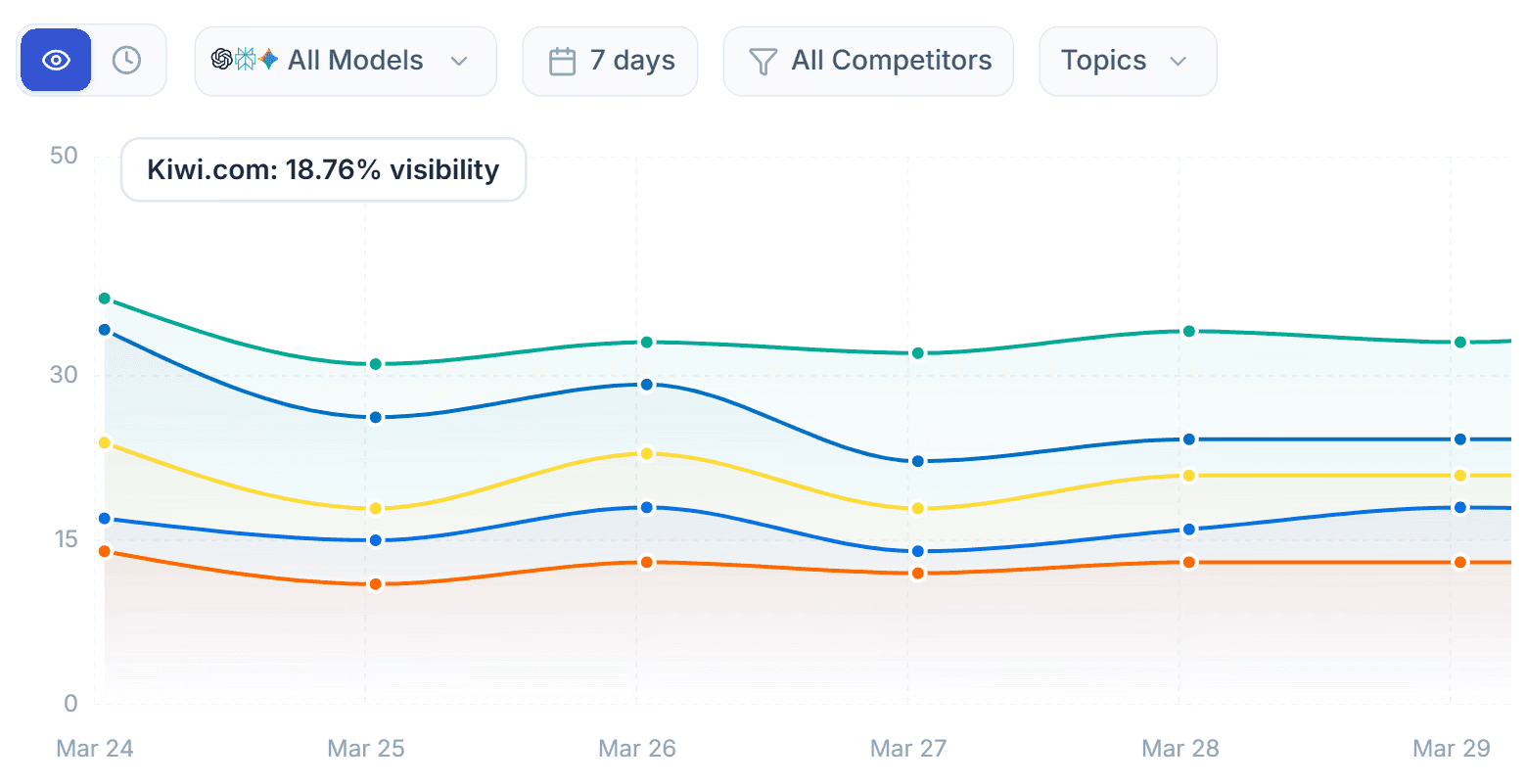
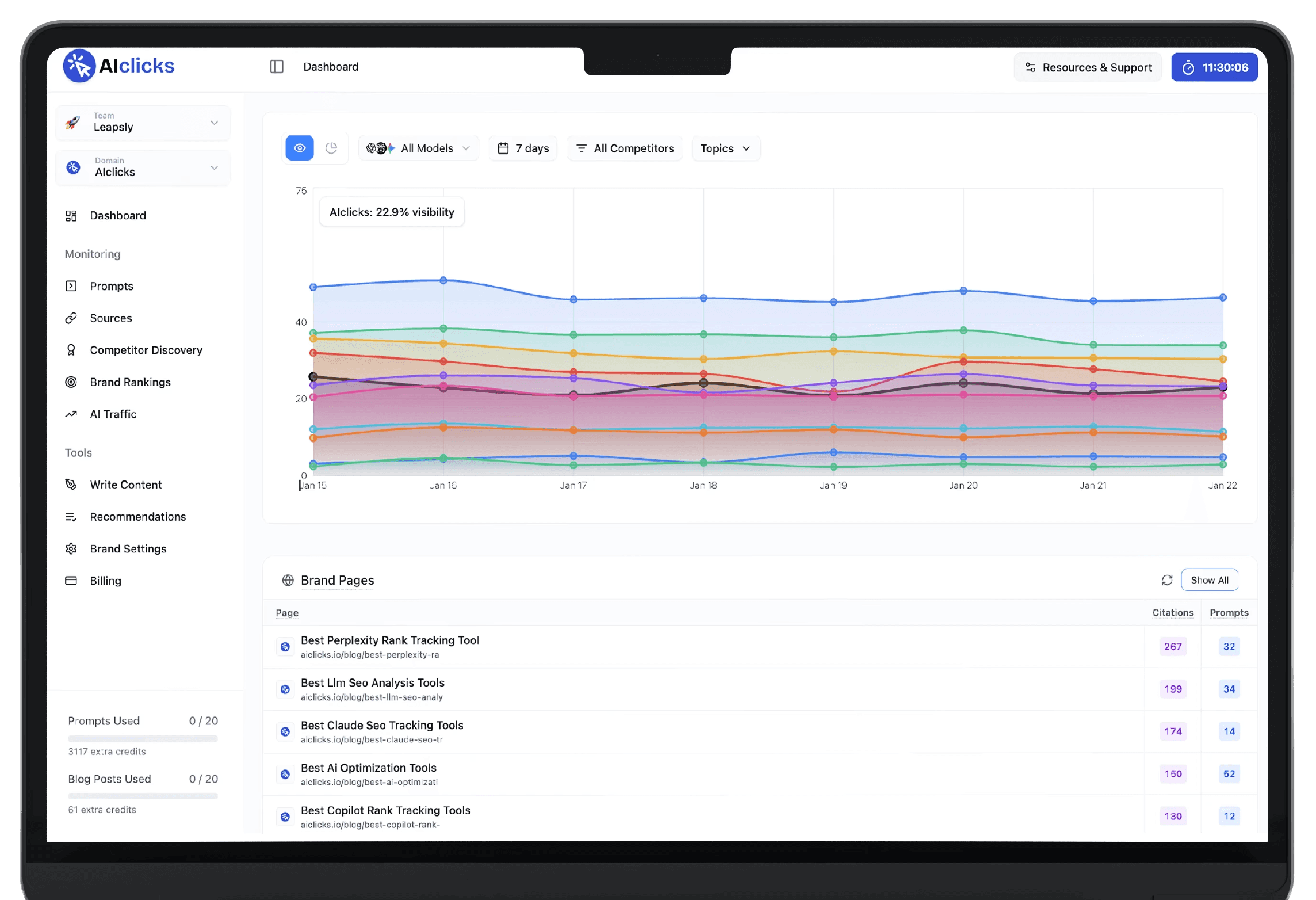
AIclicks gives you a live dashboard with daily ChatGPT mention rate, citation rate, sentiment, and share-of-voice across your tracked prompts, plus GA4 referral attribution for the traffic ChatGPT does send back.
Choose Your Plan
Flexible pricing that grows with your team. Upgrade or downgrade at any time.
Monthly
Yearly
-20%
Starter
Perfect for individuals & small teams
$49
/ month
Billed annually — you save $142
Choose 3 from:
Daily

" height="16px" id="fvSweaOBo" transform="translate(1 0)" width="14px"/></svg>)
" width="14px"><path d="M 13.864 5.629 L 13.3 5.629 L 13.3 5.6 L 7 5.6 L 7 8.4 L 10.956 8.4 C 10.379 10.03 8.828 11.2 7 11.2 C 4.681 11.2 2.8 9.319 2.8 7 C 2.8 4.681 4.681 2.8 7 2.8 C 8.071 2.8 9.045 3.204 9.786 3.864 L 11.766 1.884 C 10.516 0.719 8.844 0 7 0 C 3.134 0 0 3.134 0 7 C 0 10.866 3.134 14 7 14 C 10.866 14 14 10.866 14 7 C 14 6.531 13.952 6.073 13.864 5.629 Z" fill="rgb(255, 193, 7)" height="14px" id="H_YjfTNpn" width="14px"/><path d="M 0 3.742 L 2.3 5.429 C 2.922 3.888 4.429 2.8 6.193 2.8 C 7.264 2.8 8.238 3.204 8.979 3.864 L 10.959 1.884 C 9.709 0.719 8.037 0 6.193 0 C 3.504 0 1.172 1.518 0 3.742 Z" fill="rgb(255, 61, 0)" height="5.428500000000002px" id="PlkthQDhg" transform="translate(0.875 0)" width="10.959199999999996px"/><path d="M 6.232 5.581 C 8.04 5.581 9.683 4.889 10.925 3.764 L 8.758 1.931 C 8.032 2.483 7.144 2.782 6.232 2.781 C 4.411 2.781 2.865 1.62 2.283 0 L 0 1.759 C 1.159 4.026 3.511 5.581 6.232 5.581 Z" fill="rgb(76, 175, 80)" height="5.581099999999999px" id="WlnJ5gngE" transform="translate(0.7 8.4)" width="10.924899999999994px"/><path d="M 6.864 0.029 L 6.3 0.029 L 6.3 0 L 0 0 L 0 2.8 L 3.956 2.8 C 3.68 3.576 3.183 4.254 2.526 4.75 L 2.527 4.749 L 4.693 6.582 C 4.54 6.722 7 4.9 7 1.4 C 7 0.931 6.952 0.473 6.864 0.029 Z" fill="rgb(25, 118, 210)" height="6.589883930775992px" id="x_rSW275p" transform="translate(7 5.6)" width="7px"/></g></svg>)
" height="16px" id="hHS98fTxZ" width="16px"/></svg>)
 scale(1 1) translate(-1.861736945942159, -1.1170155383302638)" id="P20NzAvj0-699428820-radial-gradient" r="0.9935228066204626"><stop offset="0" stop-color="rgb(0, 174, 255)"/><stop offset="1" stop-color="rgb(7, 54, 196)"/></radialGradient><radialGradient cx="0.48250042504016705" cy="1.8366934653567062" gradient-transform="translate(0.48250042504016705, 1.8366934653567062) scale(1 1) translate(-0.48250042504016705, -1.8366934653567062)" id="UEWZqVjij-699428820-radial-gradient" r="0.9176890228114506"><stop offset="0" stop-color="rgb(255, 182, 87)"/><stop offset="1" stop-color="rgb(192, 43, 60)"/></radialGradient><linearGradient id="jyMN3TmKx-699428820-linear-gradient" x1="0.4594862532842614" x2="0.5405137467157386" y1="0" y2="1"><stop offset="0" stop-color="rgb(13, 145, 225)"/><stop offset="1" stop-color="rgb(255, 200, 0)"/></linearGradient><linearGradient id="xhMNwDFG0-699428820-linear-gradient" x1="0.4784828731548295" x2="0.5215171268451705" y1="5.551115123125783e-17" y2="1"><stop offset="0" stop-color="rgb(61, 203, 255)"/><stop offset="1" stop-color="rgba(5, 136, 247, 0)"/></linearGradient><radialGradient cx="1.4305090871482182" cy="0.34866158048251783" gradient-transform="translate(1.4305090871482182, 0.34866158048251783) scale(1 1) translate(-1.4305090871482182, -0.34866158048251783)" id="i79kAqaS4-699428820-radial-gradient" r="1.3362743412697924"><stop offset="0" stop-color="rgb(140, 72, 255)"/><stop offset="1" stop-color="rgb(255, 177, 82)"/></radialGradient><linearGradient id="mcxvno3tX-699428820-linear-gradient" x1="0.49844355920154226" x2="0.5015564407984577" y1="0" y2="1"><stop offset="0" stop-color="rgb(248, 173, 250)"/><stop offset="1" stop-color="rgba(168, 110, 221, 0)"/></linearGradient></defs><g d="M 11.605 1.219 C 11.397 0.499 10.739 0.002 9.989 0 L 9.498 0 C 8.682 0.002 7.985 0.588 7.842 1.391 L 7 6.016 L 7.209 5.296 C 7.416 4.574 8.075 4.076 8.825 4.074 L 11.681 4.074 L 12.879 4.545 L 14.033 4.074 L 13.697 4.074 C 12.947 4.072 12.289 3.575 12.081 2.855 Z M 4.413 13.387 C 4.618 14.111 5.278 14.611 6.031 14.613 L 7.075 14.613 C 7.988 14.613 8.735 13.88 8.758 12.96 L 8.871 8.5 L 8.633 9.319 C 8.426 10.039 7.768 10.537 7.018 10.539 L 4.138 10.539 L 3.111 9.977 L 2 10.539 L 2.331 10.539 C 3.084 10.542 3.743 11.042 3.949 11.766 L 4.413 13.387 Z M 9.999 0 L 4.167 0 C 2.501 0 1.501 2.221 0.834 4.441 C 0.045 7.073 -0.989 10.591 2.001 10.591 L 4.519 10.591 C 5.273 10.591 5.933 10.089 6.139 9.36 C 6.577 7.815 7.345 5.121 7.948 3.069 C 8.255 2.027 8.509 1.132 8.901 0.575 C 9.148 0.212 9.56 -0.004 9.999 0 M 9.999 0 L 4.167 0 C 2.501 0 1.501 2.221 0.834 4.441 C 0.045 7.073 -0.989 10.591 2.001 10.591 L 4.519 10.591 C 5.273 10.591 5.933 10.089 6.139 9.36 C 6.577 7.815 7.345 5.121 7.948 3.069 C 8.255 2.027 8.509 1.132 8.901 0.575 C 9.148 0.212 9.56 -0.004 9.999 0 M 6 14.593 L 11.833 14.593 C 13.499 14.593 14.499 12.372 15.166 10.151 C 15.955 7.519 16.989 4 13.999 4 L 11.48 4 C 10.725 4.002 10.063 4.505 9.86 5.232 C 9.266 7.332 8.663 9.429 8.051 11.523 C 7.745 12.566 7.49 13.461 7.098 14.019 C 6.851 14.382 6.439 14.597 6 14.593 M 6 14.593 L 11.833 14.593 C 13.499 14.593 14.499 12.372 15.166 10.151 C 15.955 7.519 16.989 4 13.999 4 L 11.48 4 C 10.725 4.002 10.063 4.505 9.86 5.232 C 9.266 7.332 8.663 9.429 8.051 11.523 C 7.745 12.566 7.49 13.461 7.098 14.019 C 6.851 14.382 6.439 14.597 6 14.593" fill="transparent" height="14.613333333333333px" id="QzkBy4Ibc" transform="translate(0 1)" width="16.00011071294081px"><path d="M 4.605 1.219 C 4.397 0.499 3.739 0.002 2.989 0 L 2.498 0 C 1.682 0.002 0.985 0.588 0.842 1.391 L 0 6.016 L 0.209 5.296 C 0.416 4.574 1.075 4.076 1.825 4.074 L 4.681 4.074 L 5.879 4.545 L 7.033 4.074 L 6.697 4.074 C 5.947 4.072 5.289 3.575 5.081 2.855 Z" fill="url(%23P20NzAvj0-699428820-radial-gradient)" height="6.016px" id="P20NzAvj0" transform="translate(7 0)" width="7.0333333333333385px"/><path d="M 2.413 4.887 C 2.618 5.611 3.278 6.111 4.031 6.113 L 5.075 6.113 C 5.988 6.113 6.735 5.38 6.758 4.46 L 6.871 0 L 6.633 0.819 C 6.426 1.539 5.768 2.037 5.018 2.039 L 2.138 2.039 L 1.111 1.477 L 0 2.039 L 0.331 2.039 C 1.084 2.042 1.743 2.542 1.949 3.266 L 2.413 4.887 Z" fill="url(%23UEWZqVjij-699428820-radial-gradient)" height="6.113333333333333px" id="UEWZqVjij" transform="translate(2 8.5)" width="6.871333333333332px"/><path d="M 9.999 0 L 4.167 0 C 2.501 0 1.501 2.221 0.834 4.441 C 0.045 7.073 -0.989 10.591 2.001 10.591 L 4.519 10.591 C 5.273 10.591 5.933 10.089 6.139 9.36 C 6.577 7.815 7.345 5.121 7.948 3.069 C 8.255 2.027 8.509 1.132 8.901 0.575 C 9.148 0.212 9.56 -0.004 9.999 0" fill="url(%23jyMN3TmKx-699428820-linear-gradient)" height="10.591388755215167px" id="jyMN3TmKx" width="9.999444046274142px"/><path d="M 9.999 0 L 4.167 0 C 2.501 0 1.501 2.221 0.834 4.441 C 0.045 7.073 -0.989 10.591 2.001 10.591 L 4.519 10.591 C 5.273 10.591 5.933 10.089 6.139 9.36 C 6.577 7.815 7.345 5.121 7.948 3.069 C 8.255 2.027 8.509 1.132 8.901 0.575 C 9.148 0.212 9.56 -0.004 9.999 0" fill="url(%23xhMNwDFG0-699428820-linear-gradient)" height="10.591388755215167px" id="xhMNwDFG0" width="9.999444046274142px"/><path d="M 0 10.593 L 5.833 10.593 C 7.499 10.593 8.499 8.372 9.166 6.151 C 9.955 3.519 10.989 0 7.999 0 L 5.48 0 C 4.725 0.002 4.063 0.505 3.86 1.232 C 3.266 3.332 2.663 5.429 2.051 7.523 C 1.745 8.566 1.49 9.461 1.098 10.019 C 0.851 10.382 0.439 10.597 0 10.593" fill="url(%23i79kAqaS4-699428820-radial-gradient)" height="10.593388755215164px" id="i79kAqaS4" transform="translate(6 4)" width="10.000110712940803px"/><path d="M 0 10.593 L 5.833 10.593 C 7.499 10.593 8.499 8.372 9.166 6.151 C 9.955 3.519 10.989 0 7.999 0 L 5.48 0 C 4.725 0.002 4.063 0.505 3.86 1.232 C 3.266 3.332 2.663 5.429 2.051 7.523 C 1.745 8.566 1.49 9.461 1.098 10.019 C 0.851 10.382 0.439 10.597 0 10.593" fill="url(%23mcxvno3tX-699428820-linear-gradient)" height="10.593388755215164px" id="mcxvno3tX" transform="translate(6 4)" width="10.000110712940803px"/></g></svg>)
" height="15.360666565427872px" id="HZPvvPBv7" transform="translate(0 0.5)" width="16px"/></svg>)
Tracked prompts
30
Websites you can add
3
LLMs you can track
3
Countries per project
1
LLM responses / mo
4,650
AI-optimized articles per month
10
Integrations
-
Support
Pro
For growing teams for more power
$140
/ month
Billed annually — you save $454
Choose 4 from:
Daily
Tracked prompts
150
Websites you can add
Unlimited
LLMs you can track
4
Countries per project
Unlimited
LLM responses / mo
18,600
AI-optimized articles per month
20
Integrations
Google Analytics
Support
BUSINESS
Best for medium-sized organizations
$357
/ month
Billed annually — you save $1198
Choose 6 from:
Daily
Tracked prompts
300
Websites you can add
Unlimited
LLMs you can track
6
Countries per project
Unlimited
LLM responses / mo
55,800
AI-optimized articles per month
30
Integrations
Google Analytics, API
Support
Dedicated account specialist
Become the #1 Answer in AI
Succeed in GEO yourself, or let us do all the work.
Do it yourself
Use AIclicks to see exactly where you appear across 10+ AI platforms, spot the gaps competitors are filling, and act on clear weekly recommendations.
From $59/month · Cancel anytime
Done for you
We Do All the Work for You
Our team manages your complete search presence: traditional SEO and GEO strategy, content, implementation, and reporting. You focus on customers.
Custom pricing · Minimum 3-month engagement
The AI SEO agency trusted by 1,000+ brands worldwide
From solo founders to multi-client agencies, AIclicks runs the full AI SEO agency program for organizations of every shape and size that want to be cited across every AI surface.
4.9/5 stars on G2






FAQ
How long does franchise SEO take to show results?
Map pack movement for an individual unit usually shows in 60 to 90 days once its profile is verified and reviews start arriving. System-wide organic gains on location and service pages take 9 to 12 months, because you are rebuilding several hundred pages and their internal linking, not one site. New units open faster: a profile claimed on day one typically ranks locally within a quarter.
Should franchises optimise for Google or for AI search?
Both, and franchising is unusually exposed on the AI side. Ahrefs analysed 863,000 keywords and found only 38% of pages cited in AI Overviews also ranked in the top 10, down from 76% a year earlier. Worse, an assistant asked for a recommendation has no ZIP code to work from, so it answers at brand level, usually by quoting a marketplace listing rather than your locator.
How is franchise SEO different from normal local SEO?
Franchising breaks local SEO in 3 places. You are optimising hundreds of near-identical pages, so duplication is the default rather than a mistake. Your competitors include your own units: the protected territory in Item 12 of your agreement means nothing to Google, which only measures distance. And nobody owns the whole job, because corporate controls the site while franchisees control the profiles.
What should a franchise budget for SEO?
Budget in 2 lines. Per unit, published local packages run roughly $400 to $1,500 a month covering listings, reviews and the location page. At brand level, the hub work, schema, locator rebuild and reporting typically sits between $5,000 and $20,000 a month depending on unit count. Set it against the national brand fund you already collect, usually 1% to 4% of gross sales, and compare cost per unit.
How does SEO fit with our national ad spend?
They aim at different levels. National brand advertising and paid search create demand for the concept; SEO decides which unit captures it when someone finally searches. Most systems also run Local Services Ads or geo-targeted campaigns per unit, which are useful for new openings with no review history yet. Use the ad data to prioritise: whichever markets convert cheapest are the ones worth building pages and citations for first.
Which pages should a franchise build first?
Fix the locator first, because nothing else ranks if the location pages are orphaned. Then verify a Google Business Profile for every open unit. Then rewrite the top 20 location pages by revenue with genuinely local detail, and template the rest from what you learn. Then the franchise development pages: a cost hub and a state-by-state territory page. The corporate blog comes last, if at all.
How do we tell if franchise SEO is working?
Measure per unit, then roll up. Rankings averaged across a network hide everything: 20 units winning can mask 40 that are invisible. Track calls, direction requests and website clicks in Google Business Profile per location, use call tracking numbers that still match your listed number through a dynamic swap, and segment Search Console by the locations folder. Then reconcile against unit-level sales, since that is the only number franchisees care about.
Should corporate run SEO or should each franchisee?
Split it by what only one side can do. Corporate owns the site architecture, schema, locator, sitemaps and the vendor contract for listings management, because those have to be identical everywhere. Franchisees own photos, hours, review requests and answering questions about their own market, because nobody at head office knows the parking situation. Put the split in the operations manual with a deadline, or it quietly becomes nobody’s job.
Further Reading
Go deeper on GEO, AI search, and visibility tracking.