SEO for Flower Shops:
Nobody plans a flower purchase. Someone remembers an anniversary at 4 pm, a funeral is Thursday, or a bride is comparing 6 studios on a Sunday night. Each of them opens a phone, and whoever appears first gets the order.









Why Flower Shops Need SEO
Flowers get bought on impulse, on a phone, minutes after the thought. Every florist SEO guide stops at Google Business Profile, and none of them mention where buyers now ask first.
The wedding installs, sympathy tributes and seasonal designs you are proudest of sit in a grid Google cannot read and no AI assistant will quote. Meanwhile the site shows a catalog of arrangements you did not design. Buyers searching sympathy flowers delivered today land on a shop that wrote it.
Type flower delivery near me anywhere in the US and the first organic results belong to 1-800-Flowers and Teleflora, with Yelp underneath. They win on domain strength that a one-shop business will never accumulate, then hand the order back to you at a fraction of what the buyer actually paid.
Between wire commissions, clearinghouse charges and a monthly platform fee, a $125 order can lose roughly 25% before a single stem is bought. Then February arrives and you bid against national brands for your own name. None of it ever accumulates. Stop paying and the orders stop the same week.
How SEO Works for Flower Shops
Search Engine Optimization projects are long-term investments for florists, where each task supplements the others and creates compound results over time.
01
Keywords, page structure, and the signals Google reads directly
Flower shop sites are organised the way a cooler is organised: roses, lilies, orchids, then arrangements sorted by price. Buyers search by occasion and urgency instead. Nobody types gerbera arrangement; they type sympathy flowers delivered today, or funeral standing spray, or anniversary flowers under $75. The pages that earn orders are occasion pages, a same-day delivery page, a sympathy page written for someone who has just had bad news, and a wedding and events page. Product listings pulled from a wire service catalog carry the same names and descriptions as thousands of other shops, so they rank for nothing.
The durable pages are the ones tied to a reason rather than a date. A sympathy and funeral flowers page, a page explaining what a bridal bouquet actually costs, and a delivery page listing your cut-off time and the areas you cover will still be pulling orders in 5 years, because grief, weddings and forgotten anniversaries do not go out of season. What churns is everything built for one week: the Valentine’s collection, the Mother’s Day promotion, the pumpkin centrepiece post. Most shops publish those, delete them in March, and rebuild them from scratch the following winter.
1
Build a standalone page for sympathy, birthday, anniversary, congratulations and get-well flowers, each with its own delivery cut-off and price band.
2
Never delete the Valentine’s Day collection URL. Keep one permanent occasion page, swap the products inside it each year, and 301 retired SKUs into it.
3
Use schema.org Florist rather than generic LocalBusiness, and add Product with OfferShippingDetails and deliveryLeadTime to every arrangement, then validate in Rich Results Test.
4
Publish flower meaning, seasonality and care guides that rank all year: what is in season each month, and how long each stem lasts.
02
Map Pack visibility, citations, and proximity signals
Almost every flower order is local by definition, because someone has to physically drive the arrangement to a door within a few hours. That makes the 3-result map pack the most valuable real estate in the trade: it sits above 1-800-Flowers, above Teleflora, above Yelp, and it is the only place a single shop can beat a national network. Winning it turns on proximity, profile completeness and review volume, and only proximity is fixed.
Set the primary category to Florist, then add Flower Delivery, Wedding Florist and Dried Flower Shop only if you genuinely do them. Load the Products tab with real arrangements you designed, priced, not stock catalog images. Set special hours for Valentine’s Day and Mother’s Day weeks before they arrive, turn on the order cut-off in your description, and answer the questions that decide the sale: same-day, delivery radius, funeral home delivery, and whether you take a photo before it leaves.
Yelp, Bing Places and Apple Maps are table stakes. Floristry adds 2 layers on top. The wedding layer is The Knot, WeddingWire and Zola, where couples shortlist before Google gets a look. The trade layer is the Society of American Florists directory, your state florists association, and the shop-finder pages the wire services run. Then the preferred-vendor lists at funeral homes and venues you deliver to. Each needs the identical shop name and number, because an old landline on 3 of them splits the signal.
1
Set Florist as the primary category, then populate the Google Business Profile Products tab with your own arrangements, real prices and real photographs.
2
Give each storefront its own profile and its own delivery-area page; never list a studio you only design from as a second retail location.
3
Run BrightLocal across The Knot, WeddingWire, Zola and Yelp each quarter, and delete the duplicate listing your wire service created for you.
4
Post one Google Business Profile update a week showing this week’s actual arrangement, with the stems named and the price, not a promotion.
03
Topic authority, inbound links, and content that earns traffic
Most flower buying is anxiety. Somebody has a funeral on Thursday and no idea what is appropriate to send, or a first anniversary and no idea what $60 actually buys. Content that answers plainly outperforms anything written to rank: what to send when a colleague loses a parent, what a casket spray costs versus a standing wreath, which flowers survive an office desk, what is genuinely in season in March. Write these once and they earn orders every year.
A buyer who has decided they want flowers today is now choosing a shop, and the questions are brutally practical. What time do you stop taking same-day orders. Do you deliver to that ZIP. Will it look like the photograph. Does someone text a picture before it goes out. Put the cut-off time, the delivery map, the substitution policy and photographs of arrangements you actually made on the page, not buried in a policy page nobody opens.
Floral links are a byproduct of the work you already do. Wedding photographers publish full galleries and will credit the florist if you ask while the images are fresh; venues, planners and rental companies keep vendor lists. Funeral homes list recommended shops. Local news covers the parade float and the hospital lobby arrangement you donated. Farms and growers you buy from publish stockist pages. None of it costs money, and all of it needs asking within a week.
1
Publish an annual sympathy flowers guide covering casket sprays, standing wreaths and what each costs, then refresh the prices every January.
2
Build one page per neighbourhood and ZIP you deliver to, naming the hospitals, funeral homes and venues you reach and your cut-off for each.
3
Cluster every wedding flower budget question into one hub: bouquet, boutonniere, ceremony arch, centrepiece and reinstallation costs, with genuine ranges rather than contact us.
4
Write a page for each speciality you genuinely carry, such as garden roses, preserved and dried arrangements, or Dutch tulips, since buyers search varieties.
04
Site speed, crawlability, Core Web Vitals, and mobile health
Flower shops reset their own rankings once a year without noticing. The Valentine’s Day collection goes live in late January on a fresh URL, sells hard for 10 days, then gets unpublished in March along with every product inside it. Come December the whole thing is rebuilt on a new address. Google spends 60 to 90 days learning to trust a page, so the shop arrives at its biggest week every single year with a page that has no history.
Floral sites are the heaviest small-business sites on the web, because the product is visual and shops upload straight from a phone or a photographer’s export. A single arrangement photo at full resolution can be 6 megabytes, and a category page shows 24 of them. The buyer is standing outside a hospital or in a car park with 1 bar of signal, deciding in seconds. If the grid is still grey when they look up, they order from whoever loaded.
1
Pull last year’s sitemap from the Wayback Machine, list every seasonal URL that now 404s in Search Console, and restore or 301 each one.
2
Run PageSpeed Insights on your busiest occasion category rather than the homepage, and fix whatever the Largest Contentful Paint element turns out to be.
3
Resize every arrangement photo to display width, convert to WebP with Squoosh or ShortPixel, and lazy-load everything below the first row.
4
Keep occasion and delivery pages in a sitemap separate from products, and request indexing 8 weeks before Valentine’s Day, not 8 days.
05
Star ratings, review volume, and response strategy that builds trust
Flowers are bought sight unseen for someone else, which makes the star rating the only evidence a buyer has that what arrives will resemble the photograph. Floristry also has a review problem no other trade shares: the person who pays never sees the arrangement, and the person who sees it never wrote the order. Add substitutions, a courier running late on Valentine’s Day, and wire orders arriving under someone else’s brand, and the reviews you earn rarely match the work you did.
Ask the sender, not the recipient, and ask the hour after delivery is confirmed. That is the one moment the buyer feels relief and has proof: send the delivery photograph by text with the review link underneath it. Podium and Birdeye will fire that from a delivery status change, and Floranext or your POS can trigger it on order completion. Weddings are different. Ask the couple 2 weeks after the honeymoon, when the photographs have landed.
1
Text the sender a photo of the delivered arrangement with the Google review link underneath, triggered from Podium or your POS delivery status.
2
Reply within 12 hours, name the substitution you made and why, and offer a redo, since most 1-star florist reviews are expectation gaps.
3
Pull sympathy reviews onto the sympathy page and wedding reviews onto the wedding page, marked up with Review schema rather than a homepage carousel.
4
Ask your weekly corporate and hotel lobby accounts too, since standing-order clients are your most consistent reviewers and nobody ever thinks to ask them.
Google is No Longer the Only Place Your buyers are Searching
Buyers are using AI to find answers, and they trust what it tells them. Invest in GEO to get recommended in those answers.
1 Billion
Questions ChatGPT receives every single day
38%
Your #1 top ranking page on Google would be cited by AI
14%
of florists optimise for GEO. The rest are invisible in AI answers


You can rank #1 for “florist near me” and still not exist in ChatGPT’s answer. Run a free GEO audit to see where your brand actually stands.
GEO vs SEO: Same Goal, Different Methods
GEO is wider than SEO. AI recommends the brands that show up across the sources it reads, so your presence in forums, social platforms and floral blogs decides your odds. AIclicks measures the three metrics below so you know which to work on first.
AI Assistant
Which local florist is best for sympathy flowers?
Your Flower Shop
Citation Rate
Shows how many AI answers about flower shops name your brand, out of every 100. Models pull from the same trusted pages over and over, so citations compound: once you are in, staying in gets easier. Find the competitor pages AI cites most, then publish your own version of each.
Your Flower Shop
82% positive
Competitor A
54% positive
Competitor B
38% positive
Brand Sentiment
Shows how AI describes you when your brand comes up: positive, neutral or negative. Tone is what separates being mentioned from being recommended, and models repeat whatever framing they find. Track the negative mentions back to the reviews and threads behind them, then publish content that answers those directly.
Others 52%
You 24%
— 24%
Your Flower Shop
AI mention share of voice — floral category
Competitors
Not Cited
Share of Voice in AI
Shows how much of the floral conversation belongs to you rather than your competitors. This is the metric that matters most, the GEO version of a Google ranking. With only 1–5 brands named per answer, the market is winner-takes-more and every point is taken from someone.
The Dashboard Your Dedicated AI Search Team Works In
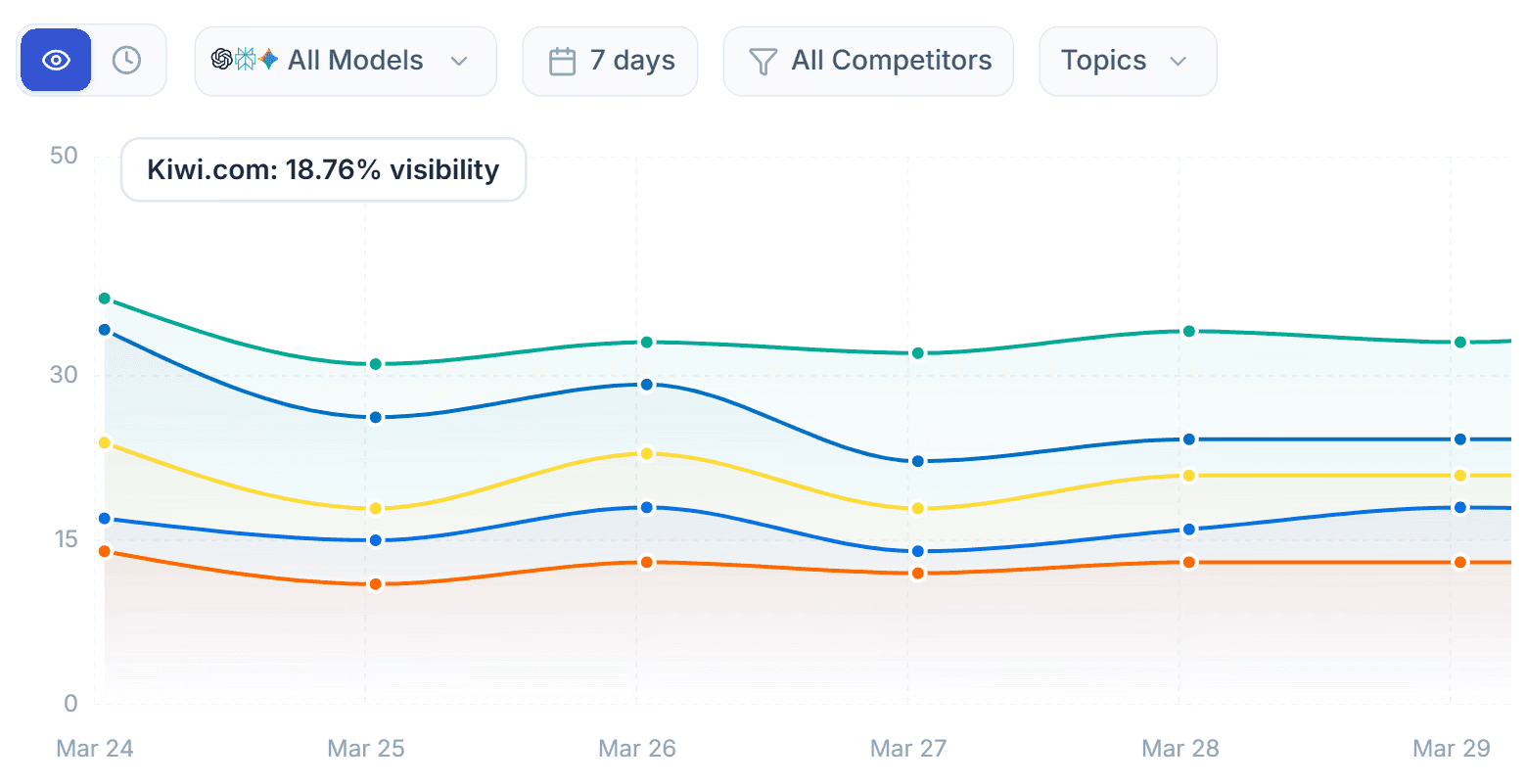
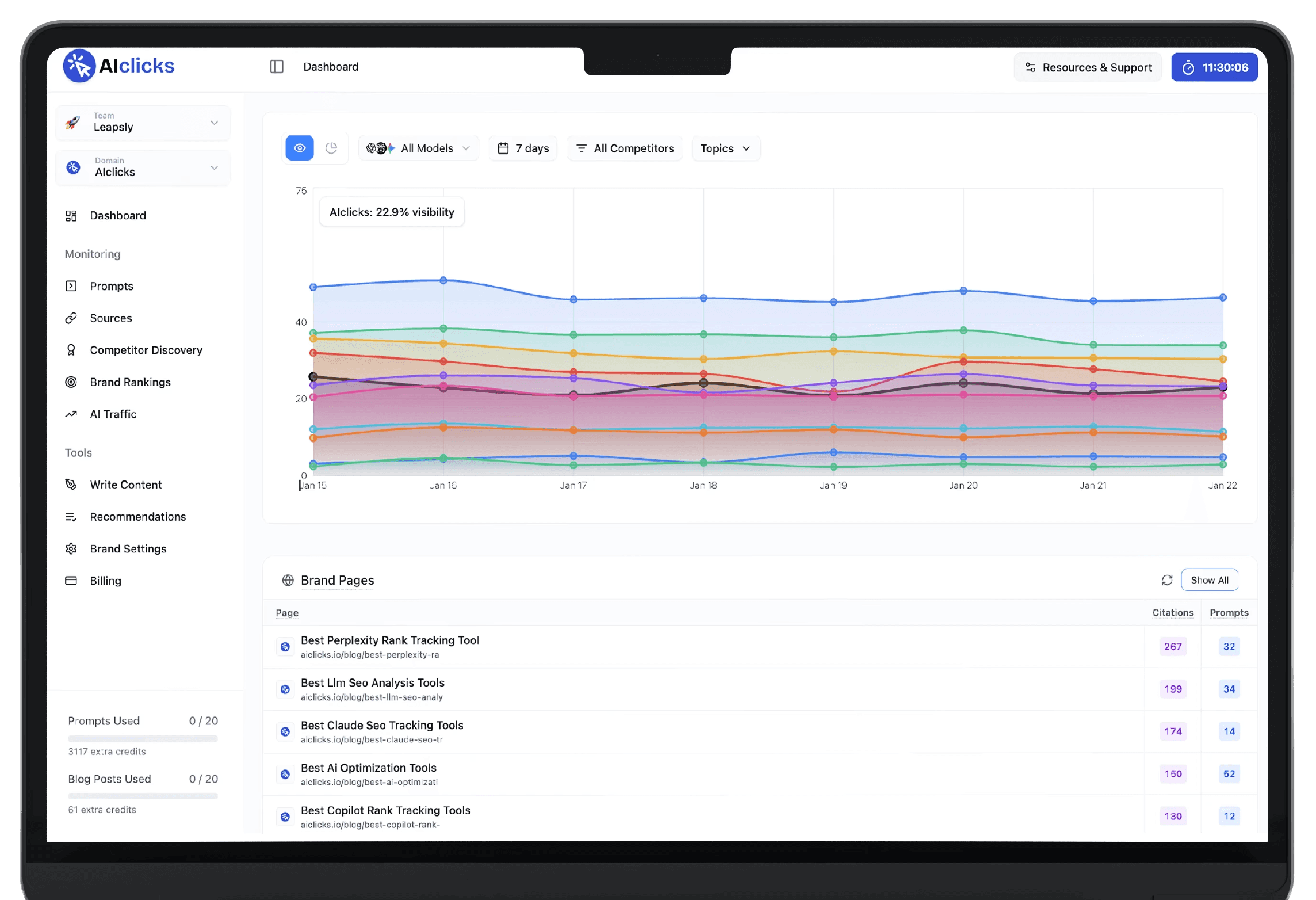
AIclicks gives you a live dashboard with daily ChatGPT mention rate, citation rate, sentiment, and share-of-voice across your tracked prompts, plus GA4 referral attribution for the traffic ChatGPT does send back.
Choose Your Plan
Flexible pricing that grows with your team. Upgrade or downgrade at any time.
Monthly
Yearly
-20%
Starter
Perfect for individuals & small teams
$49
/ month
Billed annually — you save $142
Choose 3 from:
Daily

" height="16px" id="fvSweaOBo" transform="translate(1 0)" width="14px"/></svg>)
" width="14px"><path d="M 13.864 5.629 L 13.3 5.629 L 13.3 5.6 L 7 5.6 L 7 8.4 L 10.956 8.4 C 10.379 10.03 8.828 11.2 7 11.2 C 4.681 11.2 2.8 9.319 2.8 7 C 2.8 4.681 4.681 2.8 7 2.8 C 8.071 2.8 9.045 3.204 9.786 3.864 L 11.766 1.884 C 10.516 0.719 8.844 0 7 0 C 3.134 0 0 3.134 0 7 C 0 10.866 3.134 14 7 14 C 10.866 14 14 10.866 14 7 C 14 6.531 13.952 6.073 13.864 5.629 Z" fill="rgb(255, 193, 7)" height="14px" id="H_YjfTNpn" width="14px"/><path d="M 0 3.742 L 2.3 5.429 C 2.922 3.888 4.429 2.8 6.193 2.8 C 7.264 2.8 8.238 3.204 8.979 3.864 L 10.959 1.884 C 9.709 0.719 8.037 0 6.193 0 C 3.504 0 1.172 1.518 0 3.742 Z" fill="rgb(255, 61, 0)" height="5.428500000000002px" id="PlkthQDhg" transform="translate(0.875 0)" width="10.959199999999996px"/><path d="M 6.232 5.581 C 8.04 5.581 9.683 4.889 10.925 3.764 L 8.758 1.931 C 8.032 2.483 7.144 2.782 6.232 2.781 C 4.411 2.781 2.865 1.62 2.283 0 L 0 1.759 C 1.159 4.026 3.511 5.581 6.232 5.581 Z" fill="rgb(76, 175, 80)" height="5.581099999999999px" id="WlnJ5gngE" transform="translate(0.7 8.4)" width="10.924899999999994px"/><path d="M 6.864 0.029 L 6.3 0.029 L 6.3 0 L 0 0 L 0 2.8 L 3.956 2.8 C 3.68 3.576 3.183 4.254 2.526 4.75 L 2.527 4.749 L 4.693 6.582 C 4.54 6.722 7 4.9 7 1.4 C 7 0.931 6.952 0.473 6.864 0.029 Z" fill="rgb(25, 118, 210)" height="6.589883930775992px" id="x_rSW275p" transform="translate(7 5.6)" width="7px"/></g></svg>)
" height="16px" id="hHS98fTxZ" width="16px"/></svg>)
 scale(1 1) translate(-1.861736945942159, -1.1170155383302638)" id="P20NzAvj0-699428820-radial-gradient" r="0.9935228066204626"><stop offset="0" stop-color="rgb(0, 174, 255)"/><stop offset="1" stop-color="rgb(7, 54, 196)"/></radialGradient><radialGradient cx="0.48250042504016705" cy="1.8366934653567062" gradient-transform="translate(0.48250042504016705, 1.8366934653567062) scale(1 1) translate(-0.48250042504016705, -1.8366934653567062)" id="UEWZqVjij-699428820-radial-gradient" r="0.9176890228114506"><stop offset="0" stop-color="rgb(255, 182, 87)"/><stop offset="1" stop-color="rgb(192, 43, 60)"/></radialGradient><linearGradient id="jyMN3TmKx-699428820-linear-gradient" x1="0.4594862532842614" x2="0.5405137467157386" y1="0" y2="1"><stop offset="0" stop-color="rgb(13, 145, 225)"/><stop offset="1" stop-color="rgb(255, 200, 0)"/></linearGradient><linearGradient id="xhMNwDFG0-699428820-linear-gradient" x1="0.4784828731548295" x2="0.5215171268451705" y1="5.551115123125783e-17" y2="1"><stop offset="0" stop-color="rgb(61, 203, 255)"/><stop offset="1" stop-color="rgba(5, 136, 247, 0)"/></linearGradient><radialGradient cx="1.4305090871482182" cy="0.34866158048251783" gradient-transform="translate(1.4305090871482182, 0.34866158048251783) scale(1 1) translate(-1.4305090871482182, -0.34866158048251783)" id="i79kAqaS4-699428820-radial-gradient" r="1.3362743412697924"><stop offset="0" stop-color="rgb(140, 72, 255)"/><stop offset="1" stop-color="rgb(255, 177, 82)"/></radialGradient><linearGradient id="mcxvno3tX-699428820-linear-gradient" x1="0.49844355920154226" x2="0.5015564407984577" y1="0" y2="1"><stop offset="0" stop-color="rgb(248, 173, 250)"/><stop offset="1" stop-color="rgba(168, 110, 221, 0)"/></linearGradient></defs><g d="M 11.605 1.219 C 11.397 0.499 10.739 0.002 9.989 0 L 9.498 0 C 8.682 0.002 7.985 0.588 7.842 1.391 L 7 6.016 L 7.209 5.296 C 7.416 4.574 8.075 4.076 8.825 4.074 L 11.681 4.074 L 12.879 4.545 L 14.033 4.074 L 13.697 4.074 C 12.947 4.072 12.289 3.575 12.081 2.855 Z M 4.413 13.387 C 4.618 14.111 5.278 14.611 6.031 14.613 L 7.075 14.613 C 7.988 14.613 8.735 13.88 8.758 12.96 L 8.871 8.5 L 8.633 9.319 C 8.426 10.039 7.768 10.537 7.018 10.539 L 4.138 10.539 L 3.111 9.977 L 2 10.539 L 2.331 10.539 C 3.084 10.542 3.743 11.042 3.949 11.766 L 4.413 13.387 Z M 9.999 0 L 4.167 0 C 2.501 0 1.501 2.221 0.834 4.441 C 0.045 7.073 -0.989 10.591 2.001 10.591 L 4.519 10.591 C 5.273 10.591 5.933 10.089 6.139 9.36 C 6.577 7.815 7.345 5.121 7.948 3.069 C 8.255 2.027 8.509 1.132 8.901 0.575 C 9.148 0.212 9.56 -0.004 9.999 0 M 9.999 0 L 4.167 0 C 2.501 0 1.501 2.221 0.834 4.441 C 0.045 7.073 -0.989 10.591 2.001 10.591 L 4.519 10.591 C 5.273 10.591 5.933 10.089 6.139 9.36 C 6.577 7.815 7.345 5.121 7.948 3.069 C 8.255 2.027 8.509 1.132 8.901 0.575 C 9.148 0.212 9.56 -0.004 9.999 0 M 6 14.593 L 11.833 14.593 C 13.499 14.593 14.499 12.372 15.166 10.151 C 15.955 7.519 16.989 4 13.999 4 L 11.48 4 C 10.725 4.002 10.063 4.505 9.86 5.232 C 9.266 7.332 8.663 9.429 8.051 11.523 C 7.745 12.566 7.49 13.461 7.098 14.019 C 6.851 14.382 6.439 14.597 6 14.593 M 6 14.593 L 11.833 14.593 C 13.499 14.593 14.499 12.372 15.166 10.151 C 15.955 7.519 16.989 4 13.999 4 L 11.48 4 C 10.725 4.002 10.063 4.505 9.86 5.232 C 9.266 7.332 8.663 9.429 8.051 11.523 C 7.745 12.566 7.49 13.461 7.098 14.019 C 6.851 14.382 6.439 14.597 6 14.593" fill="transparent" height="14.613333333333333px" id="QzkBy4Ibc" transform="translate(0 1)" width="16.00011071294081px"><path d="M 4.605 1.219 C 4.397 0.499 3.739 0.002 2.989 0 L 2.498 0 C 1.682 0.002 0.985 0.588 0.842 1.391 L 0 6.016 L 0.209 5.296 C 0.416 4.574 1.075 4.076 1.825 4.074 L 4.681 4.074 L 5.879 4.545 L 7.033 4.074 L 6.697 4.074 C 5.947 4.072 5.289 3.575 5.081 2.855 Z" fill="url(%23P20NzAvj0-699428820-radial-gradient)" height="6.016px" id="P20NzAvj0" transform="translate(7 0)" width="7.0333333333333385px"/><path d="M 2.413 4.887 C 2.618 5.611 3.278 6.111 4.031 6.113 L 5.075 6.113 C 5.988 6.113 6.735 5.38 6.758 4.46 L 6.871 0 L 6.633 0.819 C 6.426 1.539 5.768 2.037 5.018 2.039 L 2.138 2.039 L 1.111 1.477 L 0 2.039 L 0.331 2.039 C 1.084 2.042 1.743 2.542 1.949 3.266 L 2.413 4.887 Z" fill="url(%23UEWZqVjij-699428820-radial-gradient)" height="6.113333333333333px" id="UEWZqVjij" transform="translate(2 8.5)" width="6.871333333333332px"/><path d="M 9.999 0 L 4.167 0 C 2.501 0 1.501 2.221 0.834 4.441 C 0.045 7.073 -0.989 10.591 2.001 10.591 L 4.519 10.591 C 5.273 10.591 5.933 10.089 6.139 9.36 C 6.577 7.815 7.345 5.121 7.948 3.069 C 8.255 2.027 8.509 1.132 8.901 0.575 C 9.148 0.212 9.56 -0.004 9.999 0" fill="url(%23jyMN3TmKx-699428820-linear-gradient)" height="10.591388755215167px" id="jyMN3TmKx" width="9.999444046274142px"/><path d="M 9.999 0 L 4.167 0 C 2.501 0 1.501 2.221 0.834 4.441 C 0.045 7.073 -0.989 10.591 2.001 10.591 L 4.519 10.591 C 5.273 10.591 5.933 10.089 6.139 9.36 C 6.577 7.815 7.345 5.121 7.948 3.069 C 8.255 2.027 8.509 1.132 8.901 0.575 C 9.148 0.212 9.56 -0.004 9.999 0" fill="url(%23xhMNwDFG0-699428820-linear-gradient)" height="10.591388755215167px" id="xhMNwDFG0" width="9.999444046274142px"/><path d="M 0 10.593 L 5.833 10.593 C 7.499 10.593 8.499 8.372 9.166 6.151 C 9.955 3.519 10.989 0 7.999 0 L 5.48 0 C 4.725 0.002 4.063 0.505 3.86 1.232 C 3.266 3.332 2.663 5.429 2.051 7.523 C 1.745 8.566 1.49 9.461 1.098 10.019 C 0.851 10.382 0.439 10.597 0 10.593" fill="url(%23i79kAqaS4-699428820-radial-gradient)" height="10.593388755215164px" id="i79kAqaS4" transform="translate(6 4)" width="10.000110712940803px"/><path d="M 0 10.593 L 5.833 10.593 C 7.499 10.593 8.499 8.372 9.166 6.151 C 9.955 3.519 10.989 0 7.999 0 L 5.48 0 C 4.725 0.002 4.063 0.505 3.86 1.232 C 3.266 3.332 2.663 5.429 2.051 7.523 C 1.745 8.566 1.49 9.461 1.098 10.019 C 0.851 10.382 0.439 10.597 0 10.593" fill="url(%23mcxvno3tX-699428820-linear-gradient)" height="10.593388755215164px" id="mcxvno3tX" transform="translate(6 4)" width="10.000110712940803px"/></g></svg>)
" height="15.360666565427872px" id="HZPvvPBv7" transform="translate(0 0.5)" width="16px"/></svg>)
Tracked prompts
30
Websites you can add
3
LLMs you can track
3
Countries per project
1
LLM responses / mo
4,650
AI-optimized articles per month
10
Integrations
-
Support
Pro
For growing teams for more power
$140
/ month
Billed annually — you save $454
Choose 4 from:
Daily
Tracked prompts
150
Websites you can add
Unlimited
LLMs you can track
4
Countries per project
Unlimited
LLM responses / mo
18,600
AI-optimized articles per month
20
Integrations
Google Analytics
Support
BUSINESS
Best for medium-sized organizations
$357
/ month
Billed annually — you save $1198
Choose 6 from:
Daily
Tracked prompts
300
Websites you can add
Unlimited
LLMs you can track
6
Countries per project
Unlimited
LLM responses / mo
55,800
AI-optimized articles per month
30
Integrations
Google Analytics, API
Support
Dedicated account specialist
Become the #1 Answer in AI
Succeed in GEO yourself, or let us do all the work.
Do it yourself
Use AIclicks to see exactly where you appear across 10+ AI platforms, spot the gaps competitors are filling, and act on clear weekly recommendations.
From $59/month · Cancel anytime
Done for you
We Do All the Work for You
Our team manages your complete search presence: traditional SEO and GEO strategy, content, implementation, and reporting. You focus on buyers.
Custom pricing · Minimum 3-month engagement
The AI SEO agency trusted by 1,000+ brands worldwide
From solo founders to multi-client agencies, AIclicks runs the full AI SEO agency program for organizations of every shape and size that want to be cited across every AI surface.
4.9/5 stars on G2







FAQ
How long does SEO take to work for florists?
Map pack movement usually shows in 2 to 3 months, and steady order volume around 4 to 6. Floristry adds a timing rule nobody mentions: you cannot rank into a season you did not prepare for. A Valentine’s Day page published in late January is already too late, because Google needs roughly 60 to 90 days to trust it. Build seasonal pages the autumn before.
Should we optimise for Google or for AI search?
Both, and floristry is unusually exposed on the AI side. Ahrefs analysed 863,000 keywords and found only 38% of pages cited in AI Overviews also ranked in the top 10, down from 76% a year earlier. Asked who to use for sympathy flowers, an assistant answers from reviews, structured delivery details and shop pages it can parse, not from your Instagram grid.
How is florist SEO different from normal local SEO?
Three differences matter. Demand is violently seasonal, so a page has to be trusted months before the week it earns from. Your competition includes the wire services you belong to, which outrank you and then sell you your own customer back. And half your inventory changes weekly, which means product URLs churn in a way no plumber or salon ever deals with.
What should a flower shop budget for SEO?
Florist-specific SEO plans advertise from around $495 a month for a single shop, and general local agencies quote $800 to $2,500 for content and links on top. Multi-location shops run higher. Judge it against what you already lose: a wire order can shed roughly 25% of its value in fees before you buy a stem, on every order, forever. SEO fees stop; the wire percentage does not.
How does SEO fit with our Valentine's Day ads?
They cover different weeks. Ads are how you survive the 2 spikes, when 1-800-Flowers bids the cost per click into absurdity and you need volume regardless. Organic is how you own the other 50 weeks, where sympathy, birthday and corporate orders quietly pay the rent. Most shops overspend in February and underspend in June. Use your ad data to decide which occasion page to build next.
Which pages should a flower shop build first?
Claim the Google Business Profile before anything else; it is free and it outranks your own homepage. Then a same-day delivery page carrying your cut-off time and delivery area. Then sympathy and funeral flowers, which is the highest-intent and least competitive money page in the trade. Then weddings and events if you take that work. Occasion pages after that. The blog is last, and mostly optional.
How do we tell if our SEO is working?
Count direct orders, not rankings. Flower buying is half phone calls, so put call tracking on the site or they vanish from analytics entirely. Watch Google Business Profile insights for calls and direction requests, which move first. Then check the number that matters most: what share of your monthly orders came direct versus through a wire service. If that share is not climbing, nothing else counts.
Should we do this ourselves or hire someone?
Split it by who holds the camera. Photographing your own arrangements, posting weekly, answering reviews and writing the sympathy page in your own words has to happen in-house, because no agency knows what you actually made this week. Hire out the technical layer: schema, seasonal URL structure, image pipelines and citation cleanup. Avoid anyone whose plan is 4 blog posts a month about flower meanings.
Further Reading
Go deeper on GEO, AI search, and visibility tracking.