
SEO for Flooring Companies:
A homeowner picks their floor before they pick a contractor. They spend weeks comparing luxury vinyl plank against engineered hardwood, save photos, then search for someone to install it. By then the shortlist is 3 names long, and search decided all 3.









Why Flooring Companies Need SEO
More than 60% of flooring shoppers start online, weighing luxury vinyl against hardwood for weeks before booking an estimate. That research now runs through AI answers as often as Google.
Flooring is bought with the eyes, and your best proof lives in a gallery lightbox with 200 photos on one URL and no captions. Nobody can search their way in. Meanwhile the homeowner typing waterproof vinyl plank for a basement finds a manufacturer page, not the crew who installs it.
Search flooring installation near me in a US city and the first organic results belong to Home Depot, Thumbtack, Lowe’s and Angi before any local installer appears. Thumbtack and Angi then resell that homeowner to 4 or 5 competitors as a shared lead, and you pay to be one of them.
Shared leads from the big marketplaces run $25 to $90 each and land in 4 inboxes at once, so you are quoting against 3 rivals before you drive out. Add a website subscription and an agency retainer that typically runs from $1,500 to $5,000 a month, and none of it ever accumulates.
How SEO Works for Flooring Companies
Search Engine Optimization projects are long-term investments for flooring contractors, where each task supplements the others and creates compound results over time.
01
Keywords, page structure, and the signals Google reads directly
On-page work in flooring is unusual because most of the site was never written by the company at all. Dealer platforms ingest the Shaw, Mohawk and Mannington catalogs and generate thousands of product pages, so the handful of pages you actually control get buried inside a feed every competing dealer also carries. The pages that earn work are the ones no vendor supplies: one page per material and service combination, hardwood refinishing, luxury vinyl plank installation, tile shower work, subfloor levelling and pet-resistant carpet, each written around the job rather than the SKU.
The durable assets in flooring are the decision pages. A comparison of luxury vinyl plank against engineered hardwood, a real cost per square foot installed, an honest page on what happens when a slab is not flat, all keep pulling homeowners in for years, because the materials change slowly and the anxiety about ruining a floor does not. What churns is the promotional layer: this month’s Memorial Day sale banner, the discontinued colour range, the closeout event page from 2 seasons ago. Most dealer sites carry dozens of those and 3 real decision pages. Reverse that ratio.
1
Build one page per material and service, luxury vinyl plank installation, hardwood refinishing, tile shower, each with real installed pricing per square foot.
2
Find discontinued SKUs and expired sale pages in Search Console, then 301 each into the material category page that replaced it.
3
Add Product and Offer schema with real installed price ranges to material pages, keep HomeAndConstructionBusiness on the profile, and validate in Rich Results Test.
4
Publish installed cost per square foot for every material you fit, plus a 1,000 square foot job breakdown, updated annually.
02
Map Pack visibility, citations, and proximity signals
Nearly half of all Google searches carry local intent, and in flooring the figure is higher still, because a homeowner will not ship a crew across the state to level a subfloor. That puts the 3-result map pack above every organic listing, above Home Depot and above Angi. It is the one position a 6-van independent can take from a national brand, and it turns on category, photos and reviews rather than budget.
Pick the primary category that matches what you sell: Flooring Store if people walk into a showroom, Flooring Contractor if they do not. Add hardwood refinishing, tile and carpet as separate services with descriptions. Then post job photos from the business account, captioned with the material and the room, because Google counts owner uploads differently from customer ones. Set a service area rather than a pin if crews travel, and pre-answer subfloor, timeline and furniture-moving questions in the Q&A.
Flooring has 2 citation layers. The general one is Yelp, Bing Places, Apple Maps, Nextdoor and the BBB. The layer that actually moves flooring is visual and trade: Houzz, where homeowners browse before they ever search, Angi, Thumbtack, Porch, and the certified-installer directories run by Shaw, Mohawk, Mannington and Karndean. NWFA and NTCA membership listings count too. All of them need the identical legal name, suite and phone, because one stray variant across 30 listings dilutes the whole set.
1
Set Flooring Store or Flooring Contractor as primary, then list hardwood refinishing, LVP, tile and carpet as discrete services with descriptions.
2
Give each showroom its own profile and page; for crew-only territories use service area businesses in Google Business Profile, never a fake address.
3
Run BrightLocal or Whitespark across Houzz, Angi, Thumbtack, Porch and every manufacturer installer locator, correcting each name and suite variant.
4
Make crews upload 2 job photos a week to the profile, captioned with material and room, so the activity signal never goes flat.
03
Topic authority, inbound links, and content that earns traffic
Homeowners spend weeks choosing the floor before they choose anyone to lay it, and the questions are always the same: will this survive a dog, will it work over a basement slab, is engineered hardwood real wood, what does the underlay add. Content that answers those honestly outranks anything written about your showroom, because it arrives while the reader still has an open decision and no shortlist.
Once the material is chosen the homeowner is comparing installers, and they want evidence. Publish completed jobs as individual pages with the square footage, the product actually fitted, how long the crew was on site, and what the subfloor needed. Put the installed price range on the page instead of behind a form. Flooring buyers abandon quotes they cannot estimate themselves, and the store that publishes numbers gets the call from the one who already trusts them.
Flooring links come from the trades around you rather than from publishers. Manufacturers list certified installers, and that listing is a link most dealers never claim. Interior designers, kitchen and bath remodellers, custom builders, property managers and estate agents all publish trusted-trades pages. Floor Covering Weekly and Floor Trends cover retailers who do something worth covering. Add the youth teams you sponsor and the chamber, and the link profile builds itself out of relationships you already have.
1
Publish a comparison per material pair homeowners actually weigh: LVP versus laminate, engineered versus solid hardwood, porcelain tile versus vinyl, each with installed costs.
2
Build one page per material per town you cover, each carrying a real job from that town with photos, not a swapped place name.
3
Cluster every affordability question into one hub: installed cost per square foot, removal and disposal, subfloor prep, underlay, and dealer finance options.
4
Write a page for each brand you are certified to fit, Shaw, Mohawk, Coretec, Karndean, since homeowners search the product name before the installer.
04
Site speed, crawlability, Core Web Vitals, and mobile health
The failure almost every flooring site shares is a catalog it did not write. Dealer website platforms syndicate the manufacturer feed, so a store selling 4 brands ends up with 12,000 product pages that are byte-identical to every other dealer carrying the same lines, plus filter URLs for colour, width and species multiplying on top. Google spends its crawl on that and never reaches your installation pages. Vendors sell the catalog as an SEO feature. It is the opposite.
Flooring pages carry a load no other trade site does. The room visualiser, Roomvo or one of its rivals, pulls a third-party script and a texture library before anything paints, and dealers drop it on every material page. The homeowner opening that page is standing in a half-emptied room on a phone, deciding whether to book an estimate this afternoon. If it blocks render, or the call button sits under a chat bubble, they tap the next result.
1
Crawl with Screaming Frog, then noindex thin catalog SKUs and block colour and width filter parameters in robots.txt so installation pages get crawled.
2
Run PageSpeed Insights on a page carrying the Roomvo visualiser, defer the embed until tapped, and target Largest Contentful Paint under 2.5 seconds.
3
Serve before-and-after job photos as WebP at display size with width and height set, and lazy-load everything below the first 4 images.
4
Keep installation, town and project pages in a sitemap separate from the product catalog, and resubmit whenever a completed job page goes live.
05
Star ratings, review volume, and response strategy that builds trust
A homeowner is about to let strangers rip up their house for a week, so the star rating carries more weight here than almost any other trade. Volume and recency beat perfection: 80 reviews at 4.7 stars outrank 12 at 5.0, and 5 reviews from the last month outrank 50 from 3 years ago. The difficulty is that flooring jobs are infrequent and often subcontracted, so the crew who earned the review never asks for it.
Ask on the last day, while the customer is standing on the new floor with the furniture still in the hall. That is the peak, and it decays fast: wait 2 days and the response rate drops, wait 2 weeks and the job is just an invoice. Wire the request to the job-complete status in Jobber, ServiceTitan or Floorzap so it fires without anyone remembering, and send it from the lead installer’s name rather than the company’s.
1
Trigger the review link from job-complete status in Jobber, ServiceTitan or Floorzap, sent while the crew is still loading the van.
2
Reply within 24 hours to gapping, cupping or scratch complaints with the moisture reading and the manufacturer warranty terms, then move it offline.
3
Pull reviews that name a material onto that material’s page, so hardwood refinishing proof sits beside the hardwood refinishing quote button.
4
Ask the builders, designers and property managers you subcontract for too, and collect Houzz reviews as well, since homeowners browse Houzz before Google.
Google is No Longer the Only Place Your homeowners are Searching
Homeowners are using AI to find answers, and they trust what it tells them. Invest in GEO to get recommended in those answers.
1 Billion
Questions ChatGPT receives every single day
38%
Your #1 top ranking page on Google would be cited by AI
14%
of flooring contractors optimise for GEO. The rest are invisible in AI answers


You can rank #1 for “flooring contractor near me” and still not exist in ChatGPT’s answer. Run a free GEO audit to see where your brand actually stands.
GEO vs SEO: Same Goal, Different Methods
GEO is wider than SEO. AI recommends the brands that show up across the sources it reads, so your presence in forums, social platforms and flooring blogs decides your odds. AIclicks measures the three metrics below so you know which to work on first.
AI Assistant
Which flooring company near me does luxury vinyl?
Your Flooring Company
Citation Rate
Shows how many AI answers about flooring companies name your brand, out of every 100. Models pull from the same trusted pages over and over, so citations compound: once you are in, staying in gets easier. Find the competitor pages AI cites most, then publish your own version of each.
Your Flooring Company
82% positive
Competitor A
54% positive
Competitor B
38% positive
Brand Sentiment
Shows how AI describes you when your brand comes up: positive, neutral or negative. Tone is what separates being mentioned from being recommended, and models repeat whatever framing they find. Track the negative mentions back to the reviews and threads behind them, then publish content that answers those directly.
Others 52%
You 24%
— 24%
Your Flooring Company
AI mention share of voice — flooring category
Competitors
Not Cited
Share of Voice in AI
Shows how much of the flooring conversation belongs to you rather than your competitors. This is the metric that matters most, the GEO version of a Google ranking. With only 1–5 brands named per answer, the market is winner-takes-more and every point is taken from someone.
The Dashboard Your Dedicated AI Search Team Works In
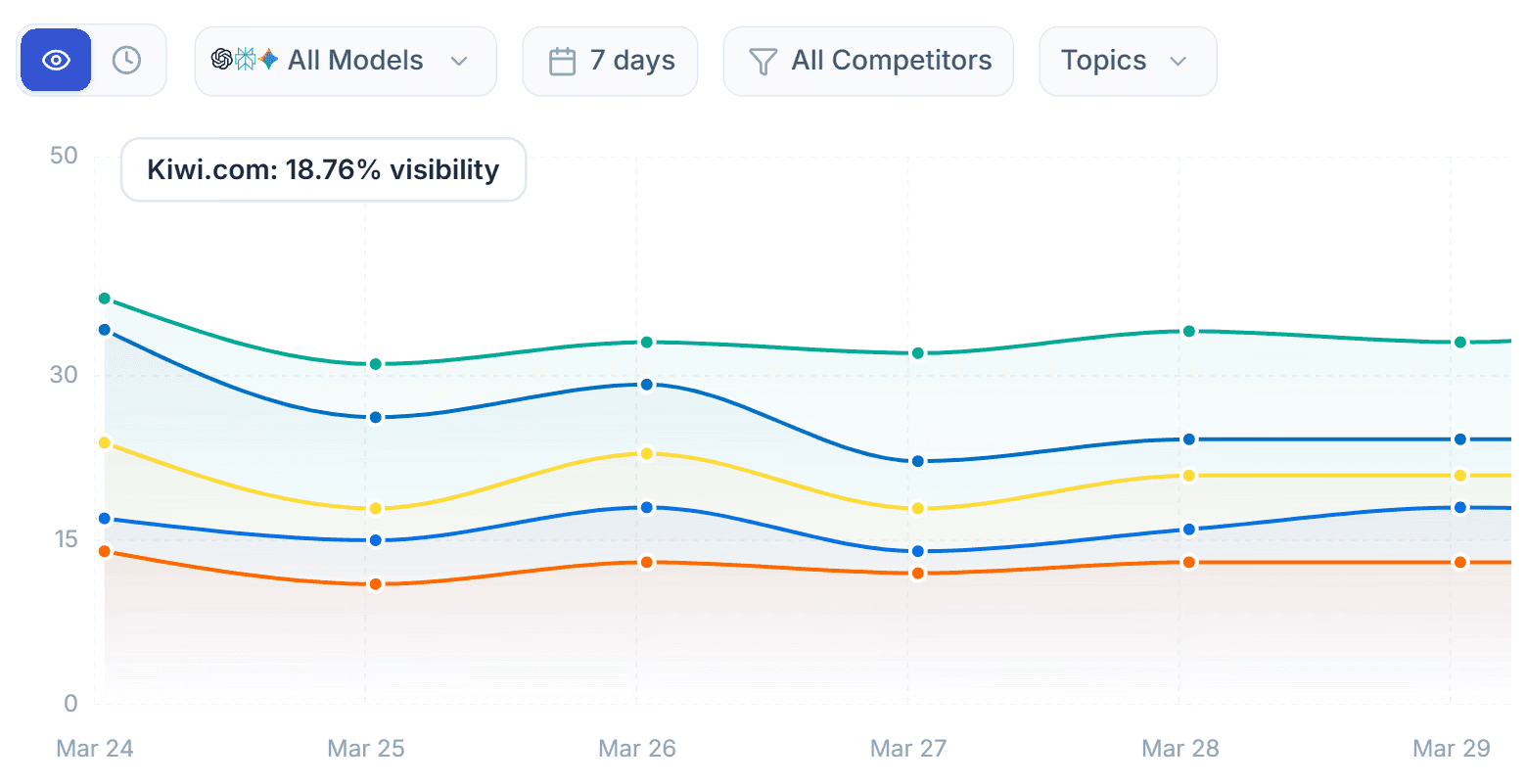
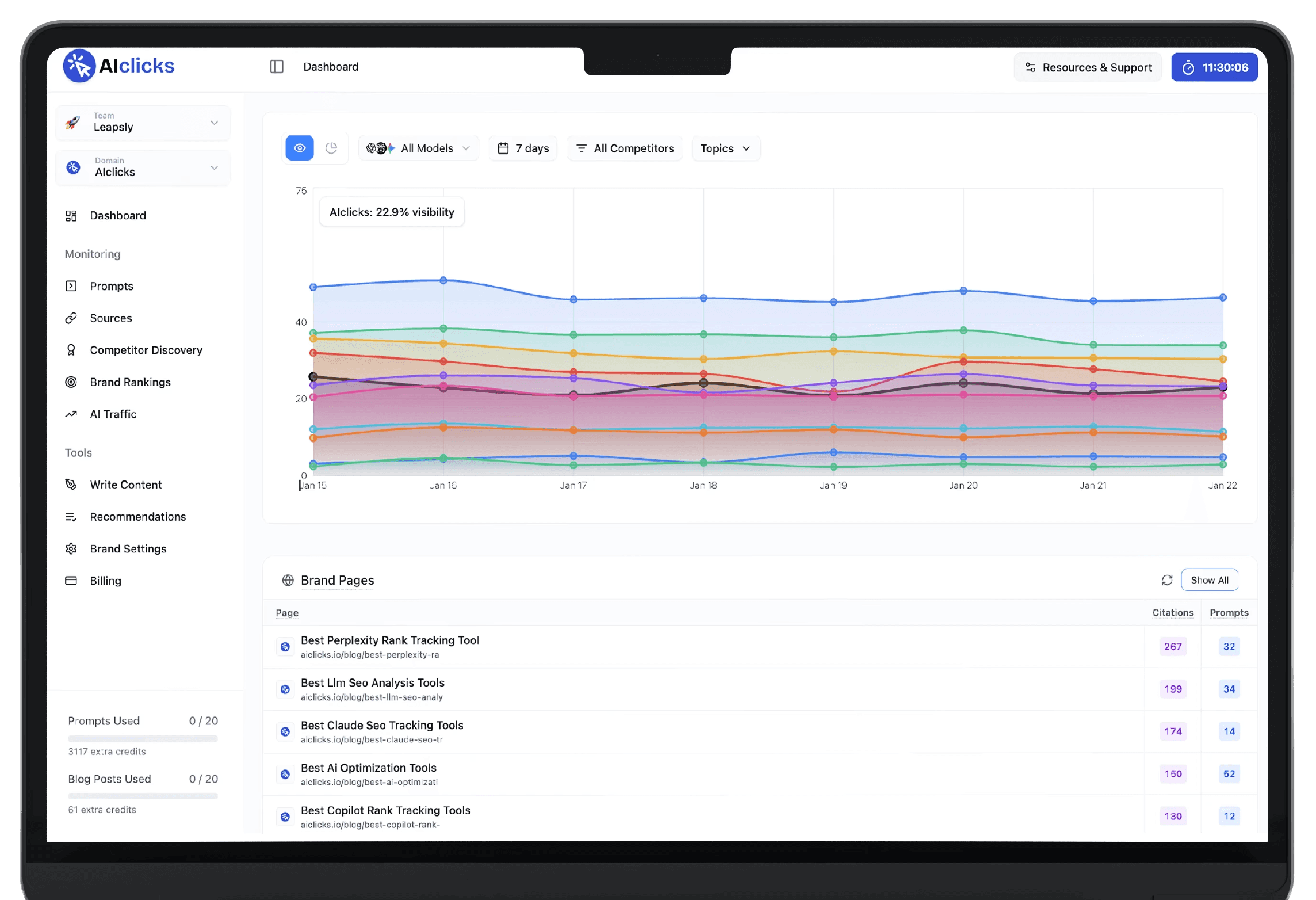
AIclicks gives you a live dashboard with daily ChatGPT mention rate, citation rate, sentiment, and share-of-voice across your tracked prompts, plus GA4 referral attribution for the traffic ChatGPT does send back.
Choose Your Plan
Flexible pricing that grows with your team. Upgrade or downgrade at any time.
Monthly
Yearly
-20%
Starter
Perfect for individuals & small teams
$49
/ month
Billed annually — you save $142
Choose 3 from:
Daily

" height="16px" id="fvSweaOBo" transform="translate(1 0)" width="14px"/></svg>)
" width="14px"><path d="M 13.864 5.629 L 13.3 5.629 L 13.3 5.6 L 7 5.6 L 7 8.4 L 10.956 8.4 C 10.379 10.03 8.828 11.2 7 11.2 C 4.681 11.2 2.8 9.319 2.8 7 C 2.8 4.681 4.681 2.8 7 2.8 C 8.071 2.8 9.045 3.204 9.786 3.864 L 11.766 1.884 C 10.516 0.719 8.844 0 7 0 C 3.134 0 0 3.134 0 7 C 0 10.866 3.134 14 7 14 C 10.866 14 14 10.866 14 7 C 14 6.531 13.952 6.073 13.864 5.629 Z" fill="rgb(255, 193, 7)" height="14px" id="H_YjfTNpn" width="14px"/><path d="M 0 3.742 L 2.3 5.429 C 2.922 3.888 4.429 2.8 6.193 2.8 C 7.264 2.8 8.238 3.204 8.979 3.864 L 10.959 1.884 C 9.709 0.719 8.037 0 6.193 0 C 3.504 0 1.172 1.518 0 3.742 Z" fill="rgb(255, 61, 0)" height="5.428500000000002px" id="PlkthQDhg" transform="translate(0.875 0)" width="10.959199999999996px"/><path d="M 6.232 5.581 C 8.04 5.581 9.683 4.889 10.925 3.764 L 8.758 1.931 C 8.032 2.483 7.144 2.782 6.232 2.781 C 4.411 2.781 2.865 1.62 2.283 0 L 0 1.759 C 1.159 4.026 3.511 5.581 6.232 5.581 Z" fill="rgb(76, 175, 80)" height="5.581099999999999px" id="WlnJ5gngE" transform="translate(0.7 8.4)" width="10.924899999999994px"/><path d="M 6.864 0.029 L 6.3 0.029 L 6.3 0 L 0 0 L 0 2.8 L 3.956 2.8 C 3.68 3.576 3.183 4.254 2.526 4.75 L 2.527 4.749 L 4.693 6.582 C 4.54 6.722 7 4.9 7 1.4 C 7 0.931 6.952 0.473 6.864 0.029 Z" fill="rgb(25, 118, 210)" height="6.589883930775992px" id="x_rSW275p" transform="translate(7 5.6)" width="7px"/></g></svg>)
" height="16px" id="hHS98fTxZ" width="16px"/></svg>)
 scale(1 1) translate(-1.861736945942159, -1.1170155383302638)" id="P20NzAvj0-699428820-radial-gradient" r="0.9935228066204626"><stop offset="0" stop-color="rgb(0, 174, 255)"/><stop offset="1" stop-color="rgb(7, 54, 196)"/></radialGradient><radialGradient cx="0.48250042504016705" cy="1.8366934653567062" gradient-transform="translate(0.48250042504016705, 1.8366934653567062) scale(1 1) translate(-0.48250042504016705, -1.8366934653567062)" id="UEWZqVjij-699428820-radial-gradient" r="0.9176890228114506"><stop offset="0" stop-color="rgb(255, 182, 87)"/><stop offset="1" stop-color="rgb(192, 43, 60)"/></radialGradient><linearGradient id="jyMN3TmKx-699428820-linear-gradient" x1="0.4594862532842614" x2="0.5405137467157386" y1="0" y2="1"><stop offset="0" stop-color="rgb(13, 145, 225)"/><stop offset="1" stop-color="rgb(255, 200, 0)"/></linearGradient><linearGradient id="xhMNwDFG0-699428820-linear-gradient" x1="0.4784828731548295" x2="0.5215171268451705" y1="5.551115123125783e-17" y2="1"><stop offset="0" stop-color="rgb(61, 203, 255)"/><stop offset="1" stop-color="rgba(5, 136, 247, 0)"/></linearGradient><radialGradient cx="1.4305090871482182" cy="0.34866158048251783" gradient-transform="translate(1.4305090871482182, 0.34866158048251783) scale(1 1) translate(-1.4305090871482182, -0.34866158048251783)" id="i79kAqaS4-699428820-radial-gradient" r="1.3362743412697924"><stop offset="0" stop-color="rgb(140, 72, 255)"/><stop offset="1" stop-color="rgb(255, 177, 82)"/></radialGradient><linearGradient id="mcxvno3tX-699428820-linear-gradient" x1="0.49844355920154226" x2="0.5015564407984577" y1="0" y2="1"><stop offset="0" stop-color="rgb(248, 173, 250)"/><stop offset="1" stop-color="rgba(168, 110, 221, 0)"/></linearGradient></defs><g d="M 11.605 1.219 C 11.397 0.499 10.739 0.002 9.989 0 L 9.498 0 C 8.682 0.002 7.985 0.588 7.842 1.391 L 7 6.016 L 7.209 5.296 C 7.416 4.574 8.075 4.076 8.825 4.074 L 11.681 4.074 L 12.879 4.545 L 14.033 4.074 L 13.697 4.074 C 12.947 4.072 12.289 3.575 12.081 2.855 Z M 4.413 13.387 C 4.618 14.111 5.278 14.611 6.031 14.613 L 7.075 14.613 C 7.988 14.613 8.735 13.88 8.758 12.96 L 8.871 8.5 L 8.633 9.319 C 8.426 10.039 7.768 10.537 7.018 10.539 L 4.138 10.539 L 3.111 9.977 L 2 10.539 L 2.331 10.539 C 3.084 10.542 3.743 11.042 3.949 11.766 L 4.413 13.387 Z M 9.999 0 L 4.167 0 C 2.501 0 1.501 2.221 0.834 4.441 C 0.045 7.073 -0.989 10.591 2.001 10.591 L 4.519 10.591 C 5.273 10.591 5.933 10.089 6.139 9.36 C 6.577 7.815 7.345 5.121 7.948 3.069 C 8.255 2.027 8.509 1.132 8.901 0.575 C 9.148 0.212 9.56 -0.004 9.999 0 M 9.999 0 L 4.167 0 C 2.501 0 1.501 2.221 0.834 4.441 C 0.045 7.073 -0.989 10.591 2.001 10.591 L 4.519 10.591 C 5.273 10.591 5.933 10.089 6.139 9.36 C 6.577 7.815 7.345 5.121 7.948 3.069 C 8.255 2.027 8.509 1.132 8.901 0.575 C 9.148 0.212 9.56 -0.004 9.999 0 M 6 14.593 L 11.833 14.593 C 13.499 14.593 14.499 12.372 15.166 10.151 C 15.955 7.519 16.989 4 13.999 4 L 11.48 4 C 10.725 4.002 10.063 4.505 9.86 5.232 C 9.266 7.332 8.663 9.429 8.051 11.523 C 7.745 12.566 7.49 13.461 7.098 14.019 C 6.851 14.382 6.439 14.597 6 14.593 M 6 14.593 L 11.833 14.593 C 13.499 14.593 14.499 12.372 15.166 10.151 C 15.955 7.519 16.989 4 13.999 4 L 11.48 4 C 10.725 4.002 10.063 4.505 9.86 5.232 C 9.266 7.332 8.663 9.429 8.051 11.523 C 7.745 12.566 7.49 13.461 7.098 14.019 C 6.851 14.382 6.439 14.597 6 14.593" fill="transparent" height="14.613333333333333px" id="QzkBy4Ibc" transform="translate(0 1)" width="16.00011071294081px"><path d="M 4.605 1.219 C 4.397 0.499 3.739 0.002 2.989 0 L 2.498 0 C 1.682 0.002 0.985 0.588 0.842 1.391 L 0 6.016 L 0.209 5.296 C 0.416 4.574 1.075 4.076 1.825 4.074 L 4.681 4.074 L 5.879 4.545 L 7.033 4.074 L 6.697 4.074 C 5.947 4.072 5.289 3.575 5.081 2.855 Z" fill="url(%23P20NzAvj0-699428820-radial-gradient)" height="6.016px" id="P20NzAvj0" transform="translate(7 0)" width="7.0333333333333385px"/><path d="M 2.413 4.887 C 2.618 5.611 3.278 6.111 4.031 6.113 L 5.075 6.113 C 5.988 6.113 6.735 5.38 6.758 4.46 L 6.871 0 L 6.633 0.819 C 6.426 1.539 5.768 2.037 5.018 2.039 L 2.138 2.039 L 1.111 1.477 L 0 2.039 L 0.331 2.039 C 1.084 2.042 1.743 2.542 1.949 3.266 L 2.413 4.887 Z" fill="url(%23UEWZqVjij-699428820-radial-gradient)" height="6.113333333333333px" id="UEWZqVjij" transform="translate(2 8.5)" width="6.871333333333332px"/><path d="M 9.999 0 L 4.167 0 C 2.501 0 1.501 2.221 0.834 4.441 C 0.045 7.073 -0.989 10.591 2.001 10.591 L 4.519 10.591 C 5.273 10.591 5.933 10.089 6.139 9.36 C 6.577 7.815 7.345 5.121 7.948 3.069 C 8.255 2.027 8.509 1.132 8.901 0.575 C 9.148 0.212 9.56 -0.004 9.999 0" fill="url(%23jyMN3TmKx-699428820-linear-gradient)" height="10.591388755215167px" id="jyMN3TmKx" width="9.999444046274142px"/><path d="M 9.999 0 L 4.167 0 C 2.501 0 1.501 2.221 0.834 4.441 C 0.045 7.073 -0.989 10.591 2.001 10.591 L 4.519 10.591 C 5.273 10.591 5.933 10.089 6.139 9.36 C 6.577 7.815 7.345 5.121 7.948 3.069 C 8.255 2.027 8.509 1.132 8.901 0.575 C 9.148 0.212 9.56 -0.004 9.999 0" fill="url(%23xhMNwDFG0-699428820-linear-gradient)" height="10.591388755215167px" id="xhMNwDFG0" width="9.999444046274142px"/><path d="M 0 10.593 L 5.833 10.593 C 7.499 10.593 8.499 8.372 9.166 6.151 C 9.955 3.519 10.989 0 7.999 0 L 5.48 0 C 4.725 0.002 4.063 0.505 3.86 1.232 C 3.266 3.332 2.663 5.429 2.051 7.523 C 1.745 8.566 1.49 9.461 1.098 10.019 C 0.851 10.382 0.439 10.597 0 10.593" fill="url(%23i79kAqaS4-699428820-radial-gradient)" height="10.593388755215164px" id="i79kAqaS4" transform="translate(6 4)" width="10.000110712940803px"/><path d="M 0 10.593 L 5.833 10.593 C 7.499 10.593 8.499 8.372 9.166 6.151 C 9.955 3.519 10.989 0 7.999 0 L 5.48 0 C 4.725 0.002 4.063 0.505 3.86 1.232 C 3.266 3.332 2.663 5.429 2.051 7.523 C 1.745 8.566 1.49 9.461 1.098 10.019 C 0.851 10.382 0.439 10.597 0 10.593" fill="url(%23mcxvno3tX-699428820-linear-gradient)" height="10.593388755215164px" id="mcxvno3tX" transform="translate(6 4)" width="10.000110712940803px"/></g></svg>)
" height="15.360666565427872px" id="HZPvvPBv7" transform="translate(0 0.5)" width="16px"/></svg>)
Tracked prompts
30
Websites you can add
3
LLMs you can track
3
Countries per project
1
LLM responses / mo
4,650
AI-optimized articles per month
10
Integrations
-
Support
Pro
For growing teams for more power
$140
/ month
Billed annually — you save $454
Choose 4 from:
Daily
Tracked prompts
150
Websites you can add
Unlimited
LLMs you can track
4
Countries per project
Unlimited
LLM responses / mo
18,600
AI-optimized articles per month
20
Integrations
Google Analytics
Support
BUSINESS
Best for medium-sized organizations
$357
/ month
Billed annually — you save $1198
Choose 6 from:
Daily
Tracked prompts
300
Websites you can add
Unlimited
LLMs you can track
6
Countries per project
Unlimited
LLM responses / mo
55,800
AI-optimized articles per month
30
Integrations
Google Analytics, API
Support
Dedicated account specialist
Become the #1 Answer in AI
Succeed in GEO yourself, or let us do all the work.
Do it yourself
Use AIclicks to see exactly where you appear across 10+ AI platforms, spot the gaps competitors are filling, and act on clear weekly recommendations.
From $59/month · Cancel anytime
Done for you
We Do All the Work for You
Our team manages your complete search presence: traditional SEO and GEO strategy, content, implementation, and reporting. You focus on homeowners.
Custom pricing · Minimum 3-month engagement
The AI SEO agency trusted by 1,000+ brands worldwide
From solo founders to multi-client agencies, AIclicks runs the full AI SEO agency program for organizations of every shape and size that want to be cited across every AI surface.
4.9/5 stars on G2







FAQ
How long before SEO brings in flooring jobs?
Map pack movement usually shows in 60 to 90 days, and booked estimates from organic search around 4 to 6 months. Competitive material terms in a big metro take 9 to 12 months. Flooring companies that keep it up for 12 to 18 months routinely find organic becomes their largest lead source. The early signal to watch is Google Business Profile calls and direction requests, which move well before rankings do.
Should we bother with ChatGPT or just Google?
Both, and ranking no longer buys you the answer. Ahrefs analysed 863,000 keywords and found only 38% of pages cited in AI Overviews also ranked in the top 10, down from 76% a year earlier. Homeowners now ask assistants which flooring suits a basement and who installs it locally. Those answers are assembled from reviews, trade listings and pages that state prices plainly, not from a syndicated product catalog.
How is flooring SEO different from normal local SEO?
Three things. The buyer chooses the product before the installer, so you compete for material queries as well as service ones. Your site probably carries a syndicated manufacturer catalog that every rival dealer also carries, which generic advice never mentions. And your visual directory layer, Houzz plus manufacturer installer locators, matters more than the general citation list. Advice built for plumbers misses all 3 and leaves your biggest levers untouched.
What should a flooring company budget for SEO?
Home services agencies typically quote $1,500 to $3,000 a month for one showroom in a quiet market, $3,000 to $7,500 to compete properly in a busy metro, and more for multi-branch groups. Several contractor specialists will not take clients under $2 million in revenue at all. Judge it against shared marketplace leads at $25 to $90 each that 4 rivals also received, and against a job averaging around $3,000.
How does SEO fit with our Google and Facebook ads?
Ads fill next week’s calendar; SEO fills next year’s and lowers what a job costs to win. Most flooring companies run Local Services Ads and Google Ads on high-margin material terms while building organic strength on cost, comparison and refinishing queries that are cheaper to rank for. Use the ad data to pick your content order: whichever keywords actually produced signed contracts, not clicks, deserve a page first.
Which pages should a flooring company build first?
Google Business Profile first, because it is free and it sits above Home Depot in the map pack. Then a page for your 2 highest-margin services, usually hardwood refinishing and luxury vinyl installation, with installed prices on them. Then an installed cost guide. Then completed job pages, which double as local proof and as link bait for designers. Town pages come after that, and the blog last.
How do we know the SEO is actually working?
Count booked estimates and signed contracts by source, not rankings. A flooring store can rank first for a head term and close 2 jobs in 3 months, which is what most reports hide. Put call tracking on the site, tag every lead with its landing page in your CRM, and follow it through to the closed sale. In Search Console watch impressions on material terms, since those rise before positions do.
Should we do this ourselves or hire someone?
Split it. Photos, review requests, profile posts and completed job write-ups have to come from your crews, because nobody outside the business knows what the subfloor looked like. Hand out the technical layer: catalog crawl control, schema, site speed and citation cleanup. If you hire, ask the agency directly what they would do about your syndicated product catalog. The ones who sold you the website will not want to answer.
Further Reading
Go deeper on GEO, AI search, and visibility tracking.