SEO for Advisory Firms:
Nobody hires an advisor cold. They check your credentials on BrokerCheck, read your reviews, compare 3 firms, and increasingly ask ChatGPT who is worth talking to, all before they ever book the introductory call. Search decides who makes that list.









Why Advisory Firms Need SEO
A 2026 Ficomm study found 1 in 4 investors under 45 used AI tools to find an advisor, and 15% of those with $15 million or more did.
Advisory sites are built around what the firm sells: wealth management, investment management, planning. Prospects search what just happened to them, an inherited IRA, a first RSU vest, a severance package, a 401k left at a former employer. Those searches land on a custodian’s blog, not yours.
Type financial advisor near me and the organic results under the map pack belong to Fidelity, Edward Jones and NAPFA, never an independent firm. They win on brand recognition and aggregate authority no single practice can match, then hand the traffic to whichever advisors pay for placement.
Advisor lead platforms sell the same introduction to several firms at once, and a broker-dealer marketing package runs about $2,000 a month before an agency retainer of $2,500 to $6,000 on top. Stop paying and the pipeline empties that week. You rented attention; you never owned a real asset.
How SEO Works for Advisory Firms
Search Engine Optimization projects are long-term investments for financial advisors, where each task supplements the others and creates compound results over time.
01
Keywords, page structure, and the signals Google reads directly
Two gatekeepers sit between an advisory firm and a published page. Google sorts financial content into the your-money-or-your-life bucket and raises the evidence it wants before ranking anything. Your compliance officer reads the same draft against the SEC marketing rule and strikes whatever sounds like a promise. Most firms answer that by publishing once, getting approval once, and never revisiting the page. A page approved in 2022 is still describing contribution limits that changed twice since. The assets that genuinely earn search traffic are niche planning pages, advisor bios listing credentials and CRD numbers, and an honest fee page, not the syndicated market commentary feed.
Rules age slowly; markets do not. A page explaining how an inherited IRA must be drawn down, or what actually happens to a 401k when someone changes employer, or how a 1% assets-under-management fee compares with a flat retainer, keeps producing enquiries for years. Quarterly market commentary, Fed reaction pieces and January outlook posts are dead within weeks, and on most advisory sites they outnumber everything else by a wide margin. None of that is exciting work. It is a shorter list of pages, built around rules and decisions instead of markets, with the numbers checked every January when the limits move.
1
Replace the single wealth management page with one page per client situation: inherited IRA, RSU vesting, business sale, 401k rollover.
2
Unpublish market commentary older than 18 months and outdated contribution-limit posts, redirecting each into the evergreen planning page that replaced it.
3
Mark the firm up as FinancialService, each advisor as Person with hasCredential for CFP or CFA, then validate in Rich Results Test.
4
Publish your actual fee schedule, minimums and what fee-only means, since cost questions run at steady volume every month of the year.
02
Map Pack visibility, citations, and proximity signals
Most people still want an advisor they can sit across from, which is why near me and city-plus-advisor queries carry more commercial intent than anything else in the category. Those 3 map results outrank Fidelity, outrank NAPFA, and represent the single position where an independent firm still beats a national brand on equal terms. Get shown there or be a scroll away, which in practice means nowhere.
Google does not offer a Financial Advisor category, so pick Financial Planner and add Financial Consultant or Investment Service as secondaries. If you meet clients by appointment only, set the profile as a service area business rather than publishing a home address. Load real photographs of the office and the team. Then pre-answer the 3 questions that decide every enquiry in the Q&A: are you a fiduciary, how do you charge, and what is your minimum.
Advisory firms have a citation layer general local SEO never mentions. NAPFA, the CFP Board’s letsmakeaplan.org, the FPA’s PlannerSearch, XY Planning Network and Wealthtender all carry weight because each verifies something: registration, credential, fee model. Underneath them sit FINRA BrokerCheck and the SEC adviser database, which prospects check before they call. Every listing needs the identical legal entity name, suite and phone, because your DBA and your registered name drifting apart across 30 profiles quietly cancels the trust every listing was built to carry.
1
Choose Financial Planner as the primary category, list each planning service separately, and pre-answer fiduciary, fee and minimum questions in Q&A.
2
Register a separate profile per branch, and match each to a page that names its advisors, hours and the areas it covers.
3
Run BrightLocal across NAPFA, PlannerSearch, BrokerCheck and your ADV filing, and align every listing to the exact registered entity name.
4
Post once a week to the profile: a deadline reminder, a plain answer to a planning question, a new credential earned.
03
Topic authority, inbound links, and content that earns traffic
Before anyone books a call they are trying to answer 3 questions they will not ask out loud: whether they have enough to be worth an advisor’s time, what this will actually cost, and whether they are about to be sold something. Content that answers those plainly, including your real minimum and what happens if someone is below it, converts far better than another portfolio-construction explainer.
Someone who has decided to hire an advisor is now choosing between 3 of them, and they want evidence. Show the fee schedule in numbers, name the CFP or CPA who will actually run the relationship, describe what the first 90 days look like, and link your Form CRS rather than burying it. Put that on the service page, not 3 clicks into an About section. The commonest reason a prospect leaves an advisory site is that nobody would tell them what it costs.
Advisor links come from the profession and the press, not from outreach. Kitces.com, Wealthtender, XY Planning Network and NAPFA all publish contributor and member pages. Reporters at trade titles and personal finance desks need a planner who answers on deadline, and one quote usually earns the link. The CPAs, estate attorneys and business brokers you already trade referrals with have resource pages nobody has asked to be listed on. Your alma mater lists alumni. None of it costs money.
1
Publish an annual fee-only versus commission comparison and a how to vet an advisor checklist, each linking to BrokerCheck for verification.
2
Template one page per profession you serve, such as financial planning for physicians or for engineers with RSUs, using real plan details.
3
Cluster every advisor cost question into one hub: 1% assets under management, flat retainers, hourly planning, and what a robo alternative charges.
4
Give each designation and specialism you hold its own page, such as CFP, CFA, CPWA or certified divorce financial analyst work.
04
Site speed, crawlability, Core Web Vitals, and mobile health
The failure specific to this profession is that the site pulling your rankings may not be yours. Broker-dealer and network advisors get a microsite on the parent domain, so the bio, the photo and the contact form all rank for the parent while your own domain stays invisible. Add the syndicated commentary feed from a vendor like FMG Suite, published verbatim on hundreds of advisor sites, and a disclosure footer longer than the page itself.
Prospects compare advisors on a phone in the evening, usually with 2 or 3 tabs open and a spreadsheet of questions. The heaviest thing on most advisory sites is what they meet first: an embedded scheduling widget, a risk-tolerance questionnaire iframe, and a retirement calculator loading its own framework. If the scheduling button takes 4 seconds to appear, or the fee page is a PDF that opens sideways, they book with whoever loaded.
1
Search your own advisor name and see which domain ranks; if it is the parent microsite, canonicalise and rebuild the bio on your site.
2
Run PageSpeed Insights on the page holding your Calendly embed and calculators, and lazy-load every third-party script below the fold.
3
Convert gated PDF whitepapers and fee schedules into indexable HTML pages, and compress team headshots to WebP at their rendered size.
4
Split planning and location URLs into their own sitemap, away from commentary archives, and resubmit whenever your ADV, fees or credentials change.
05
Star ratings, review volume, and response strategy that builds trust
Reviews carry more weight here than in any comparable local business, because a prospect is about to hand a stranger control of everything they have saved. They are also the only industry where testimonials were effectively banned until the SEC rewrote the marketing rule. Many firms still behave as if they cannot ask. Meanwhile the reviews that do exist come from the 2 people who had a fee dispute, and Google shows them first.
Asking is allowed, provided you disclose whether the reviewer is a client, whether anything was paid for the review, and any conflict, then keep the records. The moment that works is the end of the annual review meeting, when the plan has just been updated and the outcome is fresh, not a quarterly statement email. Platforms built for this, Indyfin and Wealthtender, handle the disclosure and archiving so compliance signs off once rather than every time.
1
Fire the request from Redtail or Wealthbox when the annual review is marked complete, using a compliance-approved template with the required disclosures.
2
Answer inside a day, but never name or confirm a relationship; state your service standards and move the conversation to a phone call.
3
Place retirement reviews on the retirement planning page and business-owner reviews on the exit planning page, with the required disclosure beneath each.
4
Ask the CPAs and estate attorneys you co-advise with for reviews, disclosing them as non-clients, which the marketing rule expressly permits.
Google is No Longer the Only Place Your prospects are Searching
Prospects are using AI to find answers, and they trust what it tells them. Invest in GEO to get recommended in those answers.
1 Billion
Questions ChatGPT receives every single day
38%
Your #1 top ranking page on Google would be cited by AI
14%
of financial advisors optimise for GEO. The rest are invisible in AI answers


You can rank #1 for “financial advisor near me” and still not exist in ChatGPT’s answer. Run a free GEO audit to see where your brand actually stands.
GEO vs SEO: Same Goal, Different Methods
GEO is wider than SEO. AI recommends the brands that show up across the sources it reads, so your presence in forums, social platforms and advisory blogs decides your odds. AIclicks measures the three metrics below so you know which to work on first.
AI Assistant
Which advisor should I trust with a 401k rollover?
Your Advisory Firm
Citation Rate
Shows how many AI answers about advisory firms name your brand, out of every 100. Models pull from the same trusted pages over and over, so citations compound: once you are in, staying in gets easier. Find the competitor pages AI cites most, then publish your own version of each.
Your Advisory Firm
82% positive
Competitor A
54% positive
Competitor B
38% positive
Brand Sentiment
Shows how AI describes you when your brand comes up: positive, neutral or negative. Tone is what separates being mentioned from being recommended, and models repeat whatever framing they find. Track the negative mentions back to the reviews and threads behind them, then publish content that answers those directly.
Others 52%
You 24%
— 24%
Your Advisory Firm
AI mention share of voice — advisory category
Competitors
Not Cited
Share of Voice in AI
Shows how much of the advisory conversation belongs to you rather than your competitors. This is the metric that matters most, the GEO version of a Google ranking. With only 1–5 brands named per answer, the market is winner-takes-more and every point is taken from someone.
The Dashboard Your Dedicated AI Search Team Works In
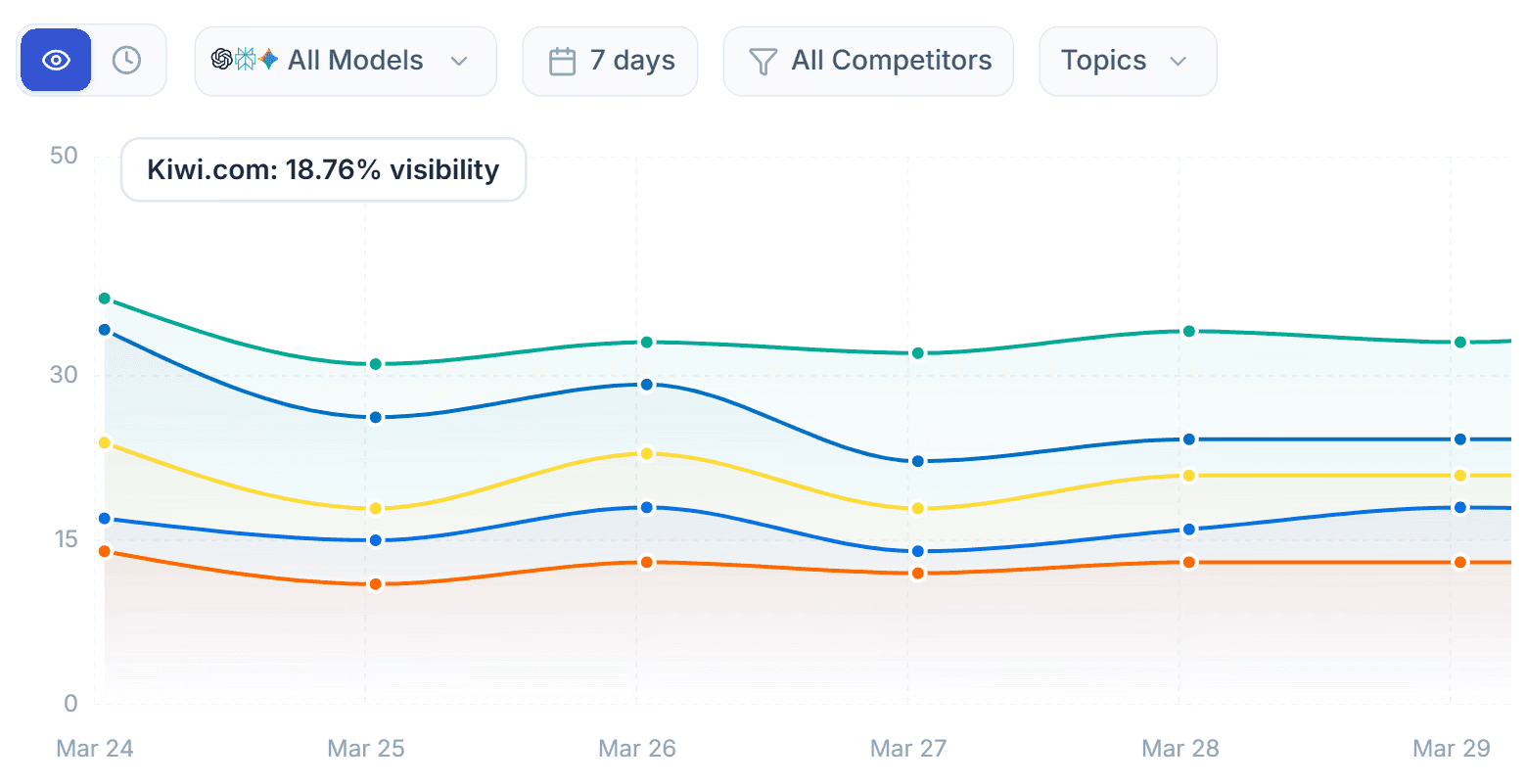
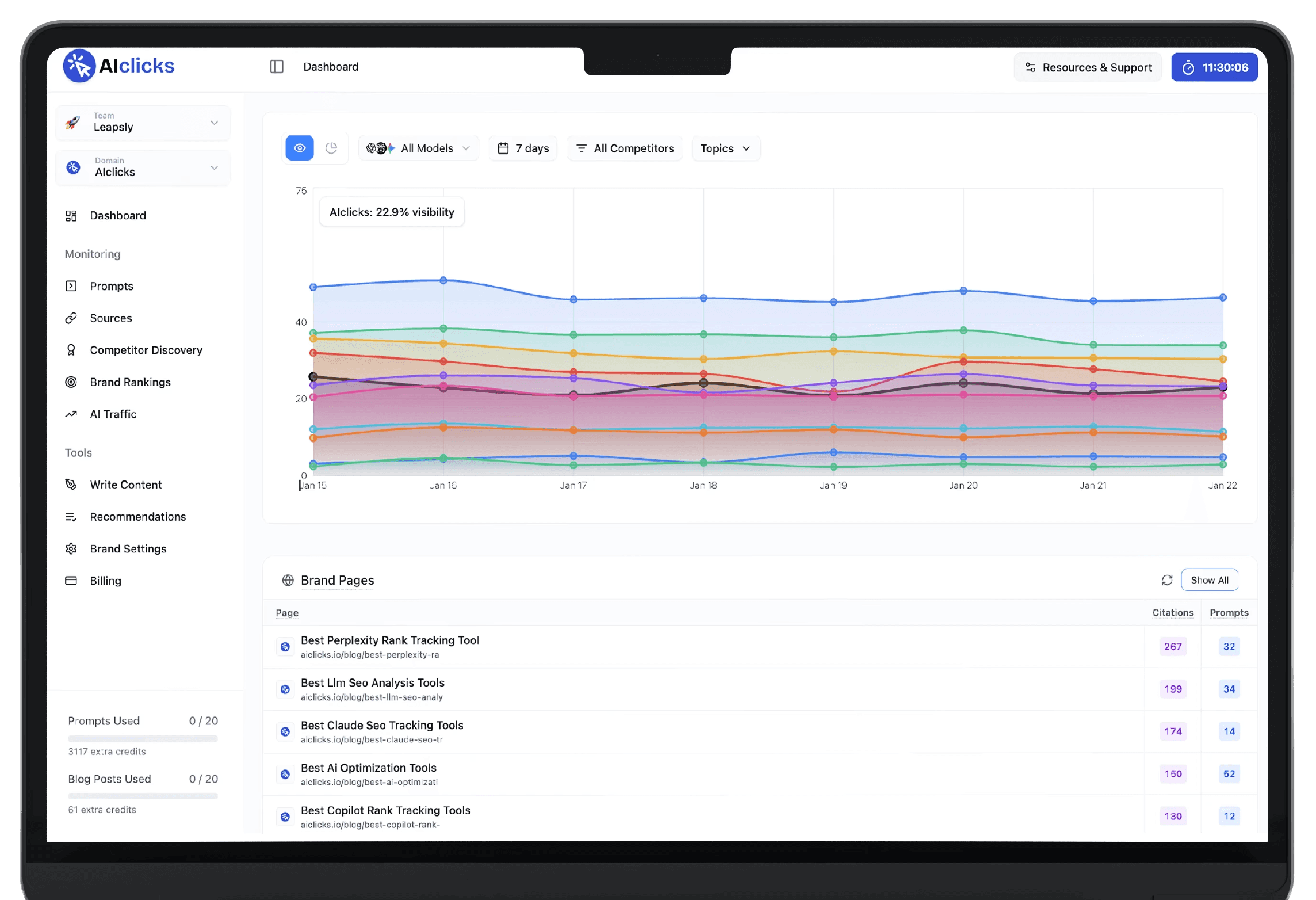
AIclicks gives you a live dashboard with daily ChatGPT mention rate, citation rate, sentiment, and share-of-voice across your tracked prompts, plus GA4 referral attribution for the traffic ChatGPT does send back.
Choose Your Plan
Flexible pricing that grows with your team. Upgrade or downgrade at any time.
Monthly
Yearly
-20%
Starter
Perfect for individuals & small teams
$49
/ month
Billed annually — you save $142
Choose 3 from:
Daily

" height="16px" id="fvSweaOBo" transform="translate(1 0)" width="14px"/></svg>)
" width="14px"><path d="M 13.864 5.629 L 13.3 5.629 L 13.3 5.6 L 7 5.6 L 7 8.4 L 10.956 8.4 C 10.379 10.03 8.828 11.2 7 11.2 C 4.681 11.2 2.8 9.319 2.8 7 C 2.8 4.681 4.681 2.8 7 2.8 C 8.071 2.8 9.045 3.204 9.786 3.864 L 11.766 1.884 C 10.516 0.719 8.844 0 7 0 C 3.134 0 0 3.134 0 7 C 0 10.866 3.134 14 7 14 C 10.866 14 14 10.866 14 7 C 14 6.531 13.952 6.073 13.864 5.629 Z" fill="rgb(255, 193, 7)" height="14px" id="H_YjfTNpn" width="14px"/><path d="M 0 3.742 L 2.3 5.429 C 2.922 3.888 4.429 2.8 6.193 2.8 C 7.264 2.8 8.238 3.204 8.979 3.864 L 10.959 1.884 C 9.709 0.719 8.037 0 6.193 0 C 3.504 0 1.172 1.518 0 3.742 Z" fill="rgb(255, 61, 0)" height="5.428500000000002px" id="PlkthQDhg" transform="translate(0.875 0)" width="10.959199999999996px"/><path d="M 6.232 5.581 C 8.04 5.581 9.683 4.889 10.925 3.764 L 8.758 1.931 C 8.032 2.483 7.144 2.782 6.232 2.781 C 4.411 2.781 2.865 1.62 2.283 0 L 0 1.759 C 1.159 4.026 3.511 5.581 6.232 5.581 Z" fill="rgb(76, 175, 80)" height="5.581099999999999px" id="WlnJ5gngE" transform="translate(0.7 8.4)" width="10.924899999999994px"/><path d="M 6.864 0.029 L 6.3 0.029 L 6.3 0 L 0 0 L 0 2.8 L 3.956 2.8 C 3.68 3.576 3.183 4.254 2.526 4.75 L 2.527 4.749 L 4.693 6.582 C 4.54 6.722 7 4.9 7 1.4 C 7 0.931 6.952 0.473 6.864 0.029 Z" fill="rgb(25, 118, 210)" height="6.589883930775992px" id="x_rSW275p" transform="translate(7 5.6)" width="7px"/></g></svg>)
" height="16px" id="hHS98fTxZ" width="16px"/></svg>)
 scale(1 1) translate(-1.861736945942159, -1.1170155383302638)" id="P20NzAvj0-699428820-radial-gradient" r="0.9935228066204626"><stop offset="0" stop-color="rgb(0, 174, 255)"/><stop offset="1" stop-color="rgb(7, 54, 196)"/></radialGradient><radialGradient cx="0.48250042504016705" cy="1.8366934653567062" gradient-transform="translate(0.48250042504016705, 1.8366934653567062) scale(1 1) translate(-0.48250042504016705, -1.8366934653567062)" id="UEWZqVjij-699428820-radial-gradient" r="0.9176890228114506"><stop offset="0" stop-color="rgb(255, 182, 87)"/><stop offset="1" stop-color="rgb(192, 43, 60)"/></radialGradient><linearGradient id="jyMN3TmKx-699428820-linear-gradient" x1="0.4594862532842614" x2="0.5405137467157386" y1="0" y2="1"><stop offset="0" stop-color="rgb(13, 145, 225)"/><stop offset="1" stop-color="rgb(255, 200, 0)"/></linearGradient><linearGradient id="xhMNwDFG0-699428820-linear-gradient" x1="0.4784828731548295" x2="0.5215171268451705" y1="5.551115123125783e-17" y2="1"><stop offset="0" stop-color="rgb(61, 203, 255)"/><stop offset="1" stop-color="rgba(5, 136, 247, 0)"/></linearGradient><radialGradient cx="1.4305090871482182" cy="0.34866158048251783" gradient-transform="translate(1.4305090871482182, 0.34866158048251783) scale(1 1) translate(-1.4305090871482182, -0.34866158048251783)" id="i79kAqaS4-699428820-radial-gradient" r="1.3362743412697924"><stop offset="0" stop-color="rgb(140, 72, 255)"/><stop offset="1" stop-color="rgb(255, 177, 82)"/></radialGradient><linearGradient id="mcxvno3tX-699428820-linear-gradient" x1="0.49844355920154226" x2="0.5015564407984577" y1="0" y2="1"><stop offset="0" stop-color="rgb(248, 173, 250)"/><stop offset="1" stop-color="rgba(168, 110, 221, 0)"/></linearGradient></defs><g d="M 11.605 1.219 C 11.397 0.499 10.739 0.002 9.989 0 L 9.498 0 C 8.682 0.002 7.985 0.588 7.842 1.391 L 7 6.016 L 7.209 5.296 C 7.416 4.574 8.075 4.076 8.825 4.074 L 11.681 4.074 L 12.879 4.545 L 14.033 4.074 L 13.697 4.074 C 12.947 4.072 12.289 3.575 12.081 2.855 Z M 4.413 13.387 C 4.618 14.111 5.278 14.611 6.031 14.613 L 7.075 14.613 C 7.988 14.613 8.735 13.88 8.758 12.96 L 8.871 8.5 L 8.633 9.319 C 8.426 10.039 7.768 10.537 7.018 10.539 L 4.138 10.539 L 3.111 9.977 L 2 10.539 L 2.331 10.539 C 3.084 10.542 3.743 11.042 3.949 11.766 L 4.413 13.387 Z M 9.999 0 L 4.167 0 C 2.501 0 1.501 2.221 0.834 4.441 C 0.045 7.073 -0.989 10.591 2.001 10.591 L 4.519 10.591 C 5.273 10.591 5.933 10.089 6.139 9.36 C 6.577 7.815 7.345 5.121 7.948 3.069 C 8.255 2.027 8.509 1.132 8.901 0.575 C 9.148 0.212 9.56 -0.004 9.999 0 M 9.999 0 L 4.167 0 C 2.501 0 1.501 2.221 0.834 4.441 C 0.045 7.073 -0.989 10.591 2.001 10.591 L 4.519 10.591 C 5.273 10.591 5.933 10.089 6.139 9.36 C 6.577 7.815 7.345 5.121 7.948 3.069 C 8.255 2.027 8.509 1.132 8.901 0.575 C 9.148 0.212 9.56 -0.004 9.999 0 M 6 14.593 L 11.833 14.593 C 13.499 14.593 14.499 12.372 15.166 10.151 C 15.955 7.519 16.989 4 13.999 4 L 11.48 4 C 10.725 4.002 10.063 4.505 9.86 5.232 C 9.266 7.332 8.663 9.429 8.051 11.523 C 7.745 12.566 7.49 13.461 7.098 14.019 C 6.851 14.382 6.439 14.597 6 14.593 M 6 14.593 L 11.833 14.593 C 13.499 14.593 14.499 12.372 15.166 10.151 C 15.955 7.519 16.989 4 13.999 4 L 11.48 4 C 10.725 4.002 10.063 4.505 9.86 5.232 C 9.266 7.332 8.663 9.429 8.051 11.523 C 7.745 12.566 7.49 13.461 7.098 14.019 C 6.851 14.382 6.439 14.597 6 14.593" fill="transparent" height="14.613333333333333px" id="QzkBy4Ibc" transform="translate(0 1)" width="16.00011071294081px"><path d="M 4.605 1.219 C 4.397 0.499 3.739 0.002 2.989 0 L 2.498 0 C 1.682 0.002 0.985 0.588 0.842 1.391 L 0 6.016 L 0.209 5.296 C 0.416 4.574 1.075 4.076 1.825 4.074 L 4.681 4.074 L 5.879 4.545 L 7.033 4.074 L 6.697 4.074 C 5.947 4.072 5.289 3.575 5.081 2.855 Z" fill="url(%23P20NzAvj0-699428820-radial-gradient)" height="6.016px" id="P20NzAvj0" transform="translate(7 0)" width="7.0333333333333385px"/><path d="M 2.413 4.887 C 2.618 5.611 3.278 6.111 4.031 6.113 L 5.075 6.113 C 5.988 6.113 6.735 5.38 6.758 4.46 L 6.871 0 L 6.633 0.819 C 6.426 1.539 5.768 2.037 5.018 2.039 L 2.138 2.039 L 1.111 1.477 L 0 2.039 L 0.331 2.039 C 1.084 2.042 1.743 2.542 1.949 3.266 L 2.413 4.887 Z" fill="url(%23UEWZqVjij-699428820-radial-gradient)" height="6.113333333333333px" id="UEWZqVjij" transform="translate(2 8.5)" width="6.871333333333332px"/><path d="M 9.999 0 L 4.167 0 C 2.501 0 1.501 2.221 0.834 4.441 C 0.045 7.073 -0.989 10.591 2.001 10.591 L 4.519 10.591 C 5.273 10.591 5.933 10.089 6.139 9.36 C 6.577 7.815 7.345 5.121 7.948 3.069 C 8.255 2.027 8.509 1.132 8.901 0.575 C 9.148 0.212 9.56 -0.004 9.999 0" fill="url(%23jyMN3TmKx-699428820-linear-gradient)" height="10.591388755215167px" id="jyMN3TmKx" width="9.999444046274142px"/><path d="M 9.999 0 L 4.167 0 C 2.501 0 1.501 2.221 0.834 4.441 C 0.045 7.073 -0.989 10.591 2.001 10.591 L 4.519 10.591 C 5.273 10.591 5.933 10.089 6.139 9.36 C 6.577 7.815 7.345 5.121 7.948 3.069 C 8.255 2.027 8.509 1.132 8.901 0.575 C 9.148 0.212 9.56 -0.004 9.999 0" fill="url(%23xhMNwDFG0-699428820-linear-gradient)" height="10.591388755215167px" id="xhMNwDFG0" width="9.999444046274142px"/><path d="M 0 10.593 L 5.833 10.593 C 7.499 10.593 8.499 8.372 9.166 6.151 C 9.955 3.519 10.989 0 7.999 0 L 5.48 0 C 4.725 0.002 4.063 0.505 3.86 1.232 C 3.266 3.332 2.663 5.429 2.051 7.523 C 1.745 8.566 1.49 9.461 1.098 10.019 C 0.851 10.382 0.439 10.597 0 10.593" fill="url(%23i79kAqaS4-699428820-radial-gradient)" height="10.593388755215164px" id="i79kAqaS4" transform="translate(6 4)" width="10.000110712940803px"/><path d="M 0 10.593 L 5.833 10.593 C 7.499 10.593 8.499 8.372 9.166 6.151 C 9.955 3.519 10.989 0 7.999 0 L 5.48 0 C 4.725 0.002 4.063 0.505 3.86 1.232 C 3.266 3.332 2.663 5.429 2.051 7.523 C 1.745 8.566 1.49 9.461 1.098 10.019 C 0.851 10.382 0.439 10.597 0 10.593" fill="url(%23mcxvno3tX-699428820-linear-gradient)" height="10.593388755215164px" id="mcxvno3tX" transform="translate(6 4)" width="10.000110712940803px"/></g></svg>)
" height="15.360666565427872px" id="HZPvvPBv7" transform="translate(0 0.5)" width="16px"/></svg>)
Tracked prompts
30
Websites you can add
3
LLMs you can track
3
Countries per project
1
LLM responses / mo
4,650
AI-optimized articles per month
10
Integrations
-
Support
Pro
For growing teams for more power
$140
/ month
Billed annually — you save $454
Choose 4 from:
Daily
Tracked prompts
150
Websites you can add
Unlimited
LLMs you can track
4
Countries per project
Unlimited
LLM responses / mo
18,600
AI-optimized articles per month
20
Integrations
Google Analytics
Support
BUSINESS
Best for medium-sized organizations
$357
/ month
Billed annually — you save $1198
Choose 6 from:
Daily
Tracked prompts
300
Websites you can add
Unlimited
LLMs you can track
6
Countries per project
Unlimited
LLM responses / mo
55,800
AI-optimized articles per month
30
Integrations
Google Analytics, API
Support
Dedicated account specialist
Become the #1 Answer in AI
Succeed in GEO yourself, or let us do all the work.
Do it yourself
Use AIclicks to see exactly where you appear across 10+ AI platforms, spot the gaps competitors are filling, and act on clear weekly recommendations.
From $59/month · Cancel anytime
Done for you
We Do All the Work for You
Our team manages your complete search presence: traditional SEO and GEO strategy, content, implementation, and reporting. You focus on prospects.
Custom pricing · Minimum 3-month engagement
The AI SEO agency trusted by 1,000+ brands worldwide
From solo founders to multi-client agencies, AIclicks runs the full AI SEO agency program for organizations of every shape and size that want to be cited across every AI surface.
4.9/5 stars on G2





FAQ
How long before SEO brings an advisory firm new clients?
Expect the map pack to move first, inside 3 or 4 months, with genuine enquiry flow closer to 8 months. Advisory terms sit in a slower lane than most local industries because Google wants credential and citation signals it can verify before it will rank financial pages at all. Firms with a narrow niche or a quieter market often move faster. Anyone guaranteeing first-page placement inside 90 days has not read the SEC marketing rule either.
Is Google still the priority, or is it ChatGPT?
Both, and financial queries behave differently from every other industry. Ahrefs analysed 863,000 keywords and found only 38% of pages cited in AI Overviews also ranked in the top 10, down from 76% a year earlier. Worse for advisors, assistants hedge on money questions: asked to name someone, they usually point at NAPFA, the CFP Board and BrokerCheck instead of a firm. Getting named means being cited on those sources too.
How is advisor SEO unlike ordinary local SEO?
Three things. Financial pages fall in the your-money-or-your-life bucket, so Google wants a named, credentialed author and a verifiable registration before it ranks you. The SEC marketing rule governs what you may claim, how testimonials must be disclosed, and how long every version has to be archived. And your real competitors for the head terms are Fidelity, Edward Jones and NAPFA, not the firm on the next block.
What should a financial advisor budget for SEO?
Specialist advisor SEO retainers typically run $2,000 to $4,000 monthly for a firm in one market and $5,000 to $10,000 for multi-office or national-niche work. Compare that against what you already spend: broker-dealer marketing packages sit near $2,000 a month, and lead platforms charge per introduction they also sell to 3 competitors. Judge any of it on cost per funded relationship, not on traffic or retainer size.
Where does SEO sit next to our paid lead spend?
They do different jobs. Paid search and lead platforms buy introductions today and stop the moment the card is declined; organic compounds and lowers your cost per client over years. Nearly every firm runs both, buying ads on niche terms that organic cannot reach yet, then letting the ad data decide which planning pages deserve building first. Measure both on funded accounts, not clicks or impressions.
What should we build before anything else?
The Google Business Profile, which costs nothing and outranks everything below the map. Then a real fee page with numbers on it, which filters out the enquiries you do not want. Then your 2 strongest niche planning pages, written for one situation each. Then advisor bios carrying credentials, registration and CRD numbers. Market commentary comes last, if at all. Most firms do it in reverse and cannot work out why the site is quiet.
How would we know if this is actually working?
Measure introductory calls booked from organic search, then funded accounts. Rankings are not the number. Install call tracking, because advisory enquiries still arrive by phone and vanish from analytics otherwise. In Search Console watch impressions on planning terms, which rise months before positions do. Track Google Business Profile calls and direction requests separately. And run your own name and niche as prompts through ChatGPT monthly to see who gets named instead of you.
Can we do this ourselves or do we outsource?
Divide it. Whatever needs your own voice belongs in-house: profile updates, review requests, and answering the questions prospects actually ask in writing. Buy in the specialist work: schema, page speed, crawl fixes and the directory cleanup. If you do hire, test the agency on one question before signing: what does the SEC marketing rule require on a page carrying a client testimonial? A generalist will produce content your chief compliance officer has to unpick.
Further Reading
Go deeper on GEO, AI search, and visibility tracking.