SEO for Event Companies:
Nobody hears about your event from your homepage. They search a topic and a date, scan whatever Eventbrite and the local tourism calendar put in front of them, then ask ChatGPT which conferences are worth the flight. Your registration page is rarely in that conversation.









Why Event Companies Need SEO
Search for events near me and Google answers with its own event carousel before a single website appears. Everything below it is competing for what the carousel did not already satisfy.
Most organisers launch a fresh URL for each edition, promote it hard for 6 months, then delete or redirect it the week after doors close. Every sponsor link, press mention and ranking signal the campaign earned goes with it. Next year you start from an empty page and buy the traffic again.
Search networking events near me in a US city and Eventbrite and Meetup sit above almost every organiser that actually runs the event. They aggregate thousands of listings, so they win on domain authority no single event brand can match, and they take a cut of the tickets you sold them.
Event marketing budgets go to paid social, retargeting and premium listing fees, and the spend resets the day the campaign ends. Specialist event SEO typically runs $1,500 to $8,000 as a sprint, or from around $700 a month on retainer. The difference is that one still exists next year.
How SEO Works for Event Companies
Search Engine Optimization projects are long-term investments for event organisers, where each task supplements the others and creates compound results over time.
01
Keywords, page structure, and the signals Google reads directly
On-page work is strange for events because the thing you are optimising has an expiry date printed on it. A conference page has to rank for a topic, a year and a place at once, and the year changes annually while the topic stays put. Most organisers solve this by rewriting the title every January and nothing else. The pages that matter are the registration page, the agenda, one page per session track, and a page per speaker, because speaker names carry their own search demand and pull in an audience that has never heard of your event.
The durable assets are the ones that have no date in them. A page explaining what a trade show booth actually costs, or how to get a conference approved by your manager, earns traffic in every month of every year and feeds the registration page when demand spikes. What churns is the speaker announcement, the early-bird countdown and the venue change notice. Most event sites are almost entirely churn. The fix is to run one permanent event hub at a stable URL, with the year as a section inside it rather than a new site every edition.
1
Keep one URL per event across editions, such as /summit/, and move the previous year into /summit/2025/ rather than deleting it.
2
Turn finished event pages into recap pages with session recordings and a save-the-date block, then 301 only genuine duplicates.
3
Mark every listing with Event schema including offers, eventStatus and eventAttendanceMode, then validate in Google’s Rich Results Test before tickets go live.
4
Publish undated guides your audience searches all year: exhibitor cost breakdowns, first-timer checklists, and how to justify the ticket internally.
02
Map Pack visibility, citations, and proximity signals
Event demand is local twice over: attendees search by city, and Google answers before any website does. Its event carousel sits at the top of events near me results, pulled straight from Event structured data and listing platforms rather than from whoever ranks first. That carousel is the events industry’s map pack. Getting into it costs nothing but correct markup, and it puts you above tourism calendars and ticketing giants alike.
A Google Business Profile still matters for the company behind the events. Pick Event Planner or Event Venue as the primary category rather than the vague Marketing Agency, add every service you sell, and use the Events post type for each upcoming date so it surfaces in the profile. Load photographs of a real crowd in the real room, not renders. List load-in hours and box office hours separately, and pre-answer parking, accessibility and refund questions in the Q and A.
Events have their own citation layer, and it is not Yelp. The ones that feed Google’s event results are Eventbrite, Meetup, Bandsintown, Songkick, AllEvents.in, 10Times and Facebook Events, plus your regional tourism board calendar and chamber of commerce listing. Trade shows add Trade Show News Network and ExpoDatabase. Every one needs the identical event name, start time and venue address, because a listing with last year’s time is how Google decides your feed is unreliable.
1
Set the primary category to Event Planner or Event Venue, then publish each date as an Events post on the profile.
2
Give each recurring city edition its own profile, page and Event schema entry, never one page listing 5 dates and 5 venues.
3
Audit Eventbrite, Meetup, 10Times, Bandsintown and your tourism board listing every quarter with BrightLocal, correcting stale times and dead ticket links.
4
Pitch one submission a week to a regional tourism calendar, a university events board or an industry association diary, each linking your hub.
03
Topic authority, inbound links, and content that earns traffic
Before anyone registers they are working out whether this event is the right one, whether their manager will sign it off, and what the trip actually costs once flights and a hotel are added. Content that answers those honestly outperforms another speaker announcement. A comparison of the 8 conferences in your sector, a full cost breakdown, and a ready-to-send justification email do more for registrations than anything written about your venue.
Someone who has decided to attend is now deciding whether to buy from you or from a reseller. Put the full agenda on the page as HTML rather than a PDF, name every speaker with their title, publish the room layout, and show last year’s attendee list breakdown by job role and company size. Then make the ticket tiers legible without a click. Organisers lose these registrations at the point where the price is hidden behind a form.
Links in events are the easiest of any industry to earn and the most often wasted. Every sponsor, exhibitor, speaker and media partner has a website and a contractual reason to mention you, yet most organisers send them a logo pack with no link brief. Ask for the link, specify the URL, and give them the anchor. Add association member directories, university department calendars and the venue’s own what’s on page, all of which link on request.
1
Publish a yearly roundup of every conference in your sector, including rivals, since best X conferences 2026 outranks any single event page.
2
Build one indexable page per session track and per workshop, each with its own Event schema, instead of a single scrolling agenda.
3
Cluster every cost question into one hub: ticket tiers, group rates, exhibitor booth pricing, travel budgets and what a company should expect to approve.
4
Give each keynote speaker a permanent bio page with their talk archive, because their name has search volume your event brand does not.
04
Site speed, crawlability, Core Web Vitals, and mobile health
The failure nobody catches is the calendar crawl trap. Event plugins like The Events Calendar generate a URL for every month, every category and every filter combination, so Googlebot spends its budget on empty archives stretching into 2031 while your registration page waits to be indexed. Worse, many listing feeds render only in JavaScript, so the individual events never exist as crawlable pages at all. Search Console reports thousands of URLs discovered and almost none indexed.
Ticket decisions happen on a phone, usually on a commute or in a group chat where someone has pasted the link. That visitor is 3 taps from checkout and has no patience for a 4 megabyte hero video, an embedded map, a countdown widget and a third-party ticket iframe all loading at once. The iframe is the usual culprit: it blocks rendering, and the buy button appears last. Half the drop-off blamed on price is really the checkout never arriving.
1
Crawl with Screaming Frog, then robots-block or noindex empty month, tag and filter archives so Googlebot reaches actual event pages.
2
Run PageSpeed Insights on the registration page with the ticket widget live, and lazy-load the checkout iframe until the button is tapped.
3
Serve last year’s crowd and stage galleries as WebP at display width, and replace autoplaying sizzle reels with a poster image plus click-to-play.
4
Keep event pages in their own sitemap with accurate lastmod, and ping Bing IndexNow whenever a date, venue or speaker changes.
05
Star ratings, review volume, and response strategy that builds trust
Nobody buys a ticket to something they cannot verify, and an event offers no trial. The rating is the only evidence a first-time attendee has that the last edition was worth the money. Collecting it is awkward, because the audience disperses the moment it ends and your relationship with them is a single weekend a year. Reviews also fragment across Google, Eventbrite, Meetup and the app store rating of your event app, so no single score represents you.
Ask while people are still in the building. The request that works is a QR code on the badge and on the closing slide, not the survey email that lands on Monday when the inbox has won. If you run Cvent, Swapcard or Hopin, fire the prompt from the app the moment a session is marked attended. Ask every attendee rather than only the sponsors and speakers, because a review profile built from insiders reads exactly like one.
1
Print the Google review link as a QR code on badges and the closing slide, and trigger a Swapcard push before people leave.
2
Answer refund and queue complaints within 24 hours naming what changes next edition, since attendees read the reply more closely than the review.
3
Put last year’s attendee quotes and photo evidence directly on the registration page beside the ticket tiers, not on a separate testimonials page.
4
Collect reviews from exhibitors and sponsors as well, because lead quality testimonials are what sells next year’s booth space and floor plan.
Google is No Longer the Only Place Your attendees are Searching
Attendees are using AI to find answers, and they trust what it tells them. Invest in GEO to get recommended in those answers.
1 Billion
Questions ChatGPT receives every single day
38%
Your #1 top ranking page on Google would be cited by AI
14%
of event organisers optimise for GEO. The rest are invisible in AI answers


You can rank #1 for “event organiser near me” and still not exist in ChatGPT’s answer. Run a free GEO audit to see where your brand actually stands.
GEO vs SEO: Same Goal, Different Methods
GEO is wider than SEO. AI recommends the brands that show up across the sources it reads, so your presence in forums, social platforms and event blogs decides your odds. AIclicks measures the three metrics below so you know which to work on first.
AI Assistant
Which conferences should I attend in my industry?
Your Event
Citation Rate
Shows how many AI answers about event companies name your brand, out of every 100. Models pull from the same trusted pages over and over, so citations compound: once you are in, staying in gets easier. Find the competitor pages AI cites most, then publish your own version of each.
Your Event
82% positive
Competitor A
54% positive
Competitor B
38% positive
Brand Sentiment
Shows how AI describes you when your brand comes up: positive, neutral or negative. Tone is what separates being mentioned from being recommended, and models repeat whatever framing they find. Track the negative mentions back to the reviews and threads behind them, then publish content that answers those directly.
Others 52%
You 24%
— 24%
Your Event
AI mention share of voice — event category
Competitors
Not Cited
Share of Voice in AI
Shows how much of the event conversation belongs to you rather than your competitors. This is the metric that matters most, the GEO version of a Google ranking. With only 1–5 brands named per answer, the market is winner-takes-more and every point is taken from someone.
The Dashboard Your Dedicated AI Search Team Works In
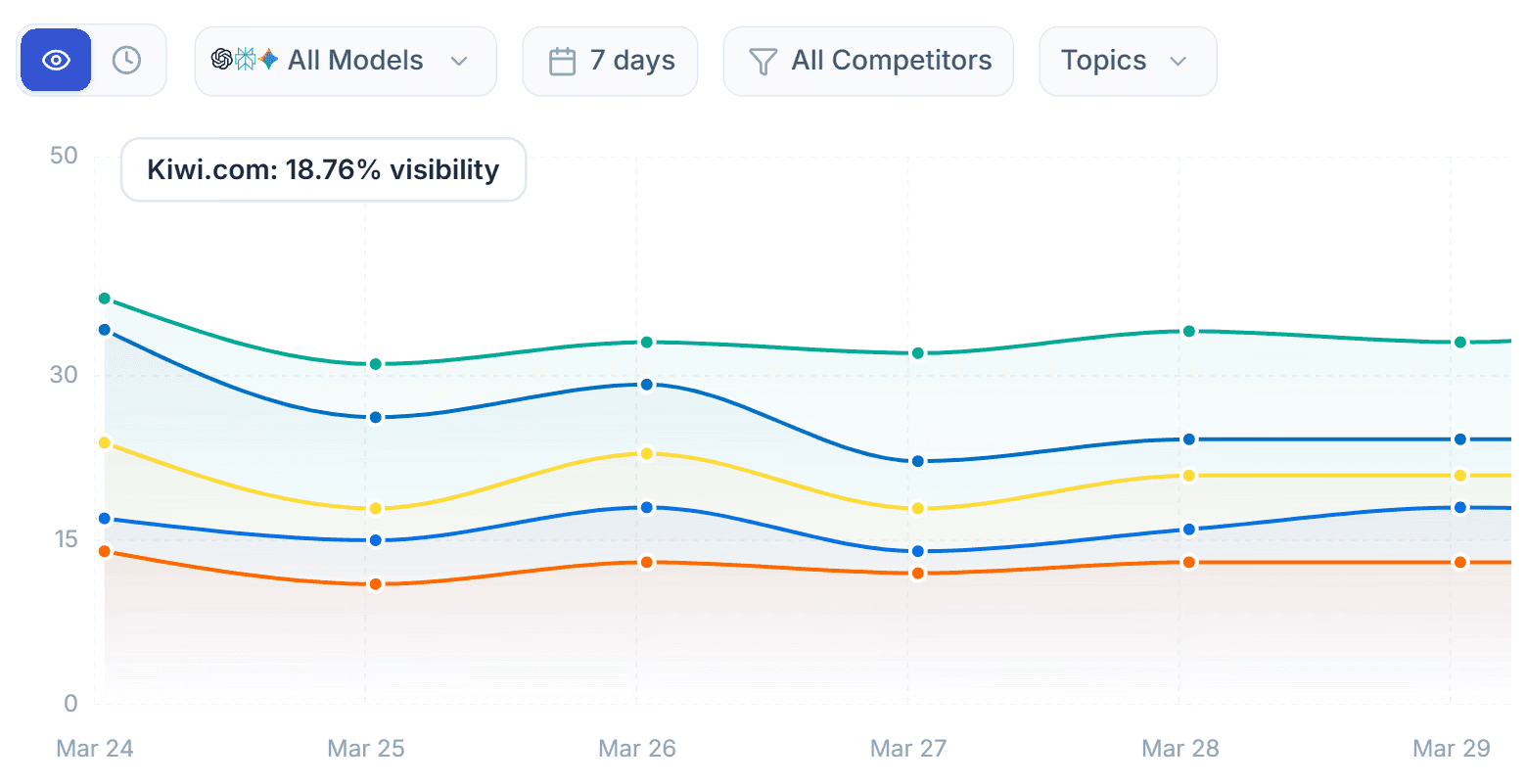
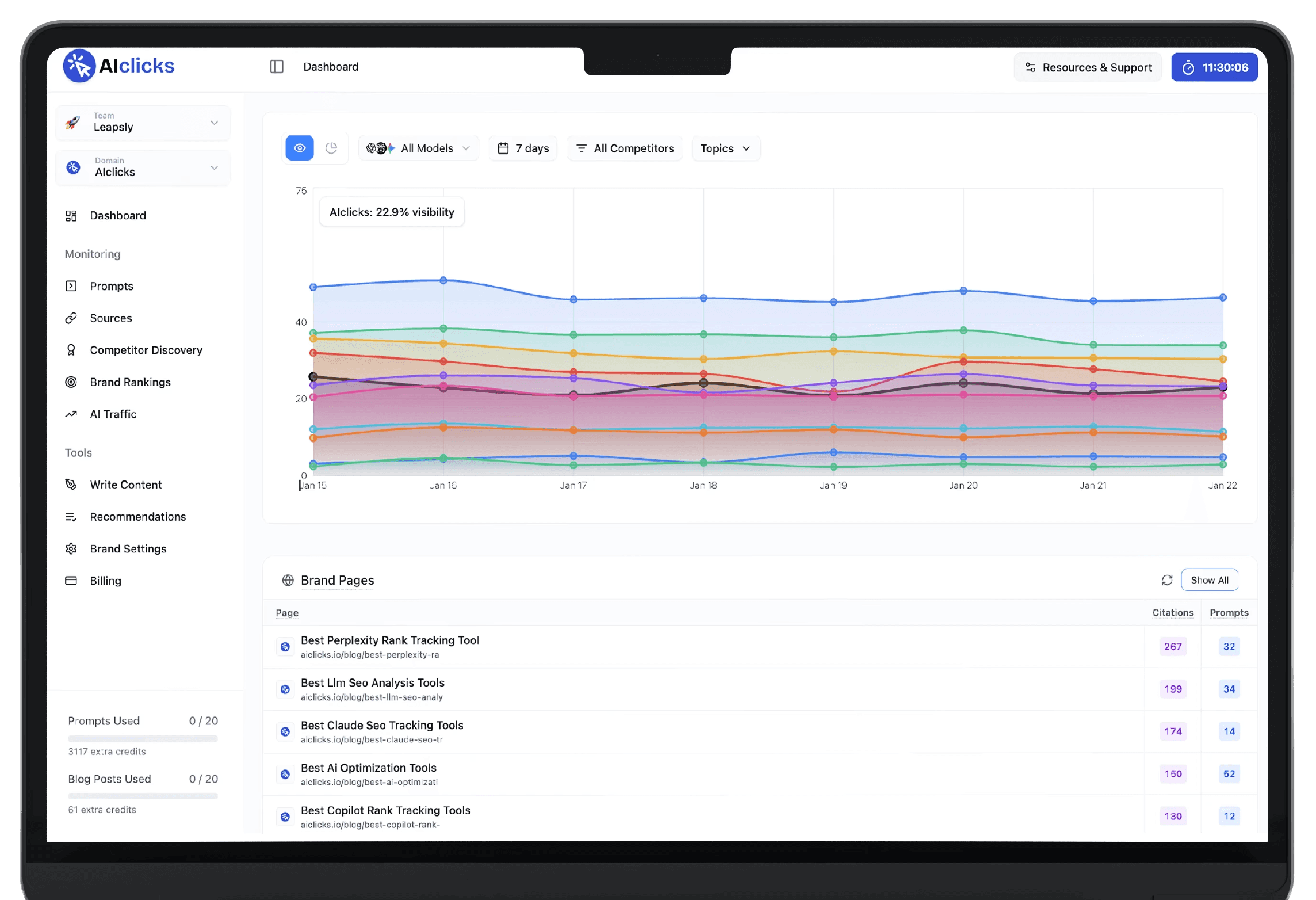
AIclicks gives you a live dashboard with daily ChatGPT mention rate, citation rate, sentiment, and share-of-voice across your tracked prompts, plus GA4 referral attribution for the traffic ChatGPT does send back.
Choose Your Plan
Flexible pricing that grows with your team. Upgrade or downgrade at any time.
Monthly
Yearly
-20%
Starter
Perfect for individuals & small teams
$49
/ month
Billed annually — you save $142
Choose 3 from:
Daily

" height="16px" id="fvSweaOBo" transform="translate(1 0)" width="14px"/></svg>)
" width="14px"><path d="M 13.864 5.629 L 13.3 5.629 L 13.3 5.6 L 7 5.6 L 7 8.4 L 10.956 8.4 C 10.379 10.03 8.828 11.2 7 11.2 C 4.681 11.2 2.8 9.319 2.8 7 C 2.8 4.681 4.681 2.8 7 2.8 C 8.071 2.8 9.045 3.204 9.786 3.864 L 11.766 1.884 C 10.516 0.719 8.844 0 7 0 C 3.134 0 0 3.134 0 7 C 0 10.866 3.134 14 7 14 C 10.866 14 14 10.866 14 7 C 14 6.531 13.952 6.073 13.864 5.629 Z" fill="rgb(255, 193, 7)" height="14px" id="H_YjfTNpn" width="14px"/><path d="M 0 3.742 L 2.3 5.429 C 2.922 3.888 4.429 2.8 6.193 2.8 C 7.264 2.8 8.238 3.204 8.979 3.864 L 10.959 1.884 C 9.709 0.719 8.037 0 6.193 0 C 3.504 0 1.172 1.518 0 3.742 Z" fill="rgb(255, 61, 0)" height="5.428500000000002px" id="PlkthQDhg" transform="translate(0.875 0)" width="10.959199999999996px"/><path d="M 6.232 5.581 C 8.04 5.581 9.683 4.889 10.925 3.764 L 8.758 1.931 C 8.032 2.483 7.144 2.782 6.232 2.781 C 4.411 2.781 2.865 1.62 2.283 0 L 0 1.759 C 1.159 4.026 3.511 5.581 6.232 5.581 Z" fill="rgb(76, 175, 80)" height="5.581099999999999px" id="WlnJ5gngE" transform="translate(0.7 8.4)" width="10.924899999999994px"/><path d="M 6.864 0.029 L 6.3 0.029 L 6.3 0 L 0 0 L 0 2.8 L 3.956 2.8 C 3.68 3.576 3.183 4.254 2.526 4.75 L 2.527 4.749 L 4.693 6.582 C 4.54 6.722 7 4.9 7 1.4 C 7 0.931 6.952 0.473 6.864 0.029 Z" fill="rgb(25, 118, 210)" height="6.589883930775992px" id="x_rSW275p" transform="translate(7 5.6)" width="7px"/></g></svg>)
" height="16px" id="hHS98fTxZ" width="16px"/></svg>)
 scale(1 1) translate(-1.861736945942159, -1.1170155383302638)" id="P20NzAvj0-699428820-radial-gradient" r="0.9935228066204626"><stop offset="0" stop-color="rgb(0, 174, 255)"/><stop offset="1" stop-color="rgb(7, 54, 196)"/></radialGradient><radialGradient cx="0.48250042504016705" cy="1.8366934653567062" gradient-transform="translate(0.48250042504016705, 1.8366934653567062) scale(1 1) translate(-0.48250042504016705, -1.8366934653567062)" id="UEWZqVjij-699428820-radial-gradient" r="0.9176890228114506"><stop offset="0" stop-color="rgb(255, 182, 87)"/><stop offset="1" stop-color="rgb(192, 43, 60)"/></radialGradient><linearGradient id="jyMN3TmKx-699428820-linear-gradient" x1="0.4594862532842614" x2="0.5405137467157386" y1="0" y2="1"><stop offset="0" stop-color="rgb(13, 145, 225)"/><stop offset="1" stop-color="rgb(255, 200, 0)"/></linearGradient><linearGradient id="xhMNwDFG0-699428820-linear-gradient" x1="0.4784828731548295" x2="0.5215171268451705" y1="5.551115123125783e-17" y2="1"><stop offset="0" stop-color="rgb(61, 203, 255)"/><stop offset="1" stop-color="rgba(5, 136, 247, 0)"/></linearGradient><radialGradient cx="1.4305090871482182" cy="0.34866158048251783" gradient-transform="translate(1.4305090871482182, 0.34866158048251783) scale(1 1) translate(-1.4305090871482182, -0.34866158048251783)" id="i79kAqaS4-699428820-radial-gradient" r="1.3362743412697924"><stop offset="0" stop-color="rgb(140, 72, 255)"/><stop offset="1" stop-color="rgb(255, 177, 82)"/></radialGradient><linearGradient id="mcxvno3tX-699428820-linear-gradient" x1="0.49844355920154226" x2="0.5015564407984577" y1="0" y2="1"><stop offset="0" stop-color="rgb(248, 173, 250)"/><stop offset="1" stop-color="rgba(168, 110, 221, 0)"/></linearGradient></defs><g d="M 11.605 1.219 C 11.397 0.499 10.739 0.002 9.989 0 L 9.498 0 C 8.682 0.002 7.985 0.588 7.842 1.391 L 7 6.016 L 7.209 5.296 C 7.416 4.574 8.075 4.076 8.825 4.074 L 11.681 4.074 L 12.879 4.545 L 14.033 4.074 L 13.697 4.074 C 12.947 4.072 12.289 3.575 12.081 2.855 Z M 4.413 13.387 C 4.618 14.111 5.278 14.611 6.031 14.613 L 7.075 14.613 C 7.988 14.613 8.735 13.88 8.758 12.96 L 8.871 8.5 L 8.633 9.319 C 8.426 10.039 7.768 10.537 7.018 10.539 L 4.138 10.539 L 3.111 9.977 L 2 10.539 L 2.331 10.539 C 3.084 10.542 3.743 11.042 3.949 11.766 L 4.413 13.387 Z M 9.999 0 L 4.167 0 C 2.501 0 1.501 2.221 0.834 4.441 C 0.045 7.073 -0.989 10.591 2.001 10.591 L 4.519 10.591 C 5.273 10.591 5.933 10.089 6.139 9.36 C 6.577 7.815 7.345 5.121 7.948 3.069 C 8.255 2.027 8.509 1.132 8.901 0.575 C 9.148 0.212 9.56 -0.004 9.999 0 M 9.999 0 L 4.167 0 C 2.501 0 1.501 2.221 0.834 4.441 C 0.045 7.073 -0.989 10.591 2.001 10.591 L 4.519 10.591 C 5.273 10.591 5.933 10.089 6.139 9.36 C 6.577 7.815 7.345 5.121 7.948 3.069 C 8.255 2.027 8.509 1.132 8.901 0.575 C 9.148 0.212 9.56 -0.004 9.999 0 M 6 14.593 L 11.833 14.593 C 13.499 14.593 14.499 12.372 15.166 10.151 C 15.955 7.519 16.989 4 13.999 4 L 11.48 4 C 10.725 4.002 10.063 4.505 9.86 5.232 C 9.266 7.332 8.663 9.429 8.051 11.523 C 7.745 12.566 7.49 13.461 7.098 14.019 C 6.851 14.382 6.439 14.597 6 14.593 M 6 14.593 L 11.833 14.593 C 13.499 14.593 14.499 12.372 15.166 10.151 C 15.955 7.519 16.989 4 13.999 4 L 11.48 4 C 10.725 4.002 10.063 4.505 9.86 5.232 C 9.266 7.332 8.663 9.429 8.051 11.523 C 7.745 12.566 7.49 13.461 7.098 14.019 C 6.851 14.382 6.439 14.597 6 14.593" fill="transparent" height="14.613333333333333px" id="QzkBy4Ibc" transform="translate(0 1)" width="16.00011071294081px"><path d="M 4.605 1.219 C 4.397 0.499 3.739 0.002 2.989 0 L 2.498 0 C 1.682 0.002 0.985 0.588 0.842 1.391 L 0 6.016 L 0.209 5.296 C 0.416 4.574 1.075 4.076 1.825 4.074 L 4.681 4.074 L 5.879 4.545 L 7.033 4.074 L 6.697 4.074 C 5.947 4.072 5.289 3.575 5.081 2.855 Z" fill="url(%23P20NzAvj0-699428820-radial-gradient)" height="6.016px" id="P20NzAvj0" transform="translate(7 0)" width="7.0333333333333385px"/><path d="M 2.413 4.887 C 2.618 5.611 3.278 6.111 4.031 6.113 L 5.075 6.113 C 5.988 6.113 6.735 5.38 6.758 4.46 L 6.871 0 L 6.633 0.819 C 6.426 1.539 5.768 2.037 5.018 2.039 L 2.138 2.039 L 1.111 1.477 L 0 2.039 L 0.331 2.039 C 1.084 2.042 1.743 2.542 1.949 3.266 L 2.413 4.887 Z" fill="url(%23UEWZqVjij-699428820-radial-gradient)" height="6.113333333333333px" id="UEWZqVjij" transform="translate(2 8.5)" width="6.871333333333332px"/><path d="M 9.999 0 L 4.167 0 C 2.501 0 1.501 2.221 0.834 4.441 C 0.045 7.073 -0.989 10.591 2.001 10.591 L 4.519 10.591 C 5.273 10.591 5.933 10.089 6.139 9.36 C 6.577 7.815 7.345 5.121 7.948 3.069 C 8.255 2.027 8.509 1.132 8.901 0.575 C 9.148 0.212 9.56 -0.004 9.999 0" fill="url(%23jyMN3TmKx-699428820-linear-gradient)" height="10.591388755215167px" id="jyMN3TmKx" width="9.999444046274142px"/><path d="M 9.999 0 L 4.167 0 C 2.501 0 1.501 2.221 0.834 4.441 C 0.045 7.073 -0.989 10.591 2.001 10.591 L 4.519 10.591 C 5.273 10.591 5.933 10.089 6.139 9.36 C 6.577 7.815 7.345 5.121 7.948 3.069 C 8.255 2.027 8.509 1.132 8.901 0.575 C 9.148 0.212 9.56 -0.004 9.999 0" fill="url(%23xhMNwDFG0-699428820-linear-gradient)" height="10.591388755215167px" id="xhMNwDFG0" width="9.999444046274142px"/><path d="M 0 10.593 L 5.833 10.593 C 7.499 10.593 8.499 8.372 9.166 6.151 C 9.955 3.519 10.989 0 7.999 0 L 5.48 0 C 4.725 0.002 4.063 0.505 3.86 1.232 C 3.266 3.332 2.663 5.429 2.051 7.523 C 1.745 8.566 1.49 9.461 1.098 10.019 C 0.851 10.382 0.439 10.597 0 10.593" fill="url(%23i79kAqaS4-699428820-radial-gradient)" height="10.593388755215164px" id="i79kAqaS4" transform="translate(6 4)" width="10.000110712940803px"/><path d="M 0 10.593 L 5.833 10.593 C 7.499 10.593 8.499 8.372 9.166 6.151 C 9.955 3.519 10.989 0 7.999 0 L 5.48 0 C 4.725 0.002 4.063 0.505 3.86 1.232 C 3.266 3.332 2.663 5.429 2.051 7.523 C 1.745 8.566 1.49 9.461 1.098 10.019 C 0.851 10.382 0.439 10.597 0 10.593" fill="url(%23mcxvno3tX-699428820-linear-gradient)" height="10.593388755215164px" id="mcxvno3tX" transform="translate(6 4)" width="10.000110712940803px"/></g></svg>)
" height="15.360666565427872px" id="HZPvvPBv7" transform="translate(0 0.5)" width="16px"/></svg>)
Tracked prompts
30
Websites you can add
3
LLMs you can track
3
Countries per project
1
LLM responses / mo
4,650
AI-optimized articles per month
10
Integrations
-
Support
Pro
For growing teams for more power
$140
/ month
Billed annually — you save $454
Choose 4 from:
Daily
Tracked prompts
150
Websites you can add
Unlimited
LLMs you can track
4
Countries per project
Unlimited
LLM responses / mo
18,600
AI-optimized articles per month
20
Integrations
Google Analytics
Support
BUSINESS
Best for medium-sized organizations
$357
/ month
Billed annually — you save $1198
Choose 6 from:
Daily
Tracked prompts
300
Websites you can add
Unlimited
LLMs you can track
6
Countries per project
Unlimited
LLM responses / mo
55,800
AI-optimized articles per month
30
Integrations
Google Analytics, API
Support
Dedicated account specialist
Become the #1 Answer in AI
Succeed in GEO yourself, or let us do all the work.
Do it yourself
Use AIclicks to see exactly where you appear across 10+ AI platforms, spot the gaps competitors are filling, and act on clear weekly recommendations.
From $59/month · Cancel anytime
Done for you
We Do All the Work for You
Our team manages your complete search presence: traditional SEO and GEO strategy, content, implementation, and reporting. You focus on attendees.
Custom pricing · Minimum 3-month engagement
The AI SEO agency trusted by 1,000+ brands worldwide
From solo founders to multi-client agencies, AIclicks runs the full AI SEO agency program for organizations of every shape and size that want to be cited across every AI surface.
4.9/5 stars on G2







FAQ
How long before event SEO actually sells tickets?
Start at least 6 months out. A brand new event page needs 3 to 6 months to rank for topic and location terms, and the last 8 weeks before doors open is when demand peaks, which is far too late to begin. Recurring events are different: if you keep the same URL across editions, the second year ranks in weeks because the authority never left.
Should we optimise for Google or for ChatGPT?
Both, and events are unusually exposed on the AI side. Ahrefs analysed 863,000 keywords and found only 38% of pages cited in AI Overviews also ranked in the top 10, down from 76% a year earlier. Ranking no longer carries you into the answer. When someone asks an assistant which conferences to attend, it names events it recognises as stable entities, which is exactly what deleting your page every year prevents.
How is event SEO different from normal local SEO?
Three things. Your ranking target has a deadline, so there is no waiting a year for authority to build. Google serves an event carousel fed by Event structured data rather than by your local pack position, so schema does work that citations do elsewhere. And your competition is Eventbrite, Meetup and the regional tourism calendar, all of which list your event and outrank you with it.
What should we budget for event SEO?
Specialist event agencies typically price it 2 ways: a project sprint of roughly $1,500 to $8,000 tied to one campaign, or a retainer from around $700 a month for a single event up to $5,000 or more for an organiser running a full calendar. Judge it against your listing fees and paid social, and measure cost per registration rather than the retainer alone.
Does SEO replace the paid ads we run?
No, it changes what the ads have to do. Paid social and search still carry the final push in the 6 weeks before doors open, when urgency does the selling. Organic covers the 10 months when nobody is running ads and people are still searching your topic. Use ad data to choose content: the queries that convert to registrations are the ones worth a permanent page.
Which pages should we build before the next event?
The permanent hub first, at a URL with no year in it, because everything else links to it. Then Event schema on every listing, since that is what gets you into Google’s event carousel. Then the agenda and speaker pages as real HTML. Then one undated guide answering the cost question your audience always asks. The blog and the recap gallery come last.
How do we know if event SEO is working?
Measure registrations attributed to organic search, not rankings, and compare the same point in the campaign year over year rather than month to month, because event traffic is seasonal by design. Watch Search Console impressions on your topic and location terms, which rise before positions do. Check the Rich Results report to confirm your Event markup is still valid, since a single date error removes you from the carousel.
Should we hire an agency or do this in-house?
Split it by what only you can do. Your team knows the agenda, the speakers and the sponsor relationships, so listings, schema updates and link requests to partners belong in-house and take hours, not days. Bring in help for the technical layer: the calendar crawl trap, page speed on the registration page, and the migration plan that stops next year’s site wiping this year’s authority.
Further Reading
Go deeper on GEO, AI search, and visibility tracking.