SEO for Estate Agencies:
A homeowner thinking about selling checks Rightmove for sold prices on their street, compares Google ratings for 4 local branches, then asks ChatGPT which agency actually gets houses away quickly. All of that happens well before anyone picks up the phone to book a valuation.









Why Estate Agencies Need SEO
Vendors research agents for weeks before booking a valuation, and Whitespark’s 2026 survey puts Google Business Profile signals at roughly 32% of local pack weight. Portals answer the rest, including inside AI.
An agency selling across 8 or 9 surrounding villages usually has a single areas we cover page listing them all. Each village is its own search term with its own winner, and the vendor who types their own town name lands on a rival who wrote the page. You never learn the valuation request existed.
Type estate agents near me from almost any postcode and Rightmove’s agent finder appears above all the independents, with Zoopla and OnTheMarket behind it. The portals rank on authority assembled out of your own stock, then sell your rivals a featured position on the very page that buried you.
Portal listing fees are the biggest line on most agency marketing budgets, and in 2026 a group of agents filed a class action seeking around £1.5bn in damages over what they called unsustainable charges. Layer an SEO retainer of £750 to £3,000 a month on top and you are still renting placement.
How SEO Works for Estate Agencies
Search Engine Optimization projects are long-term investments for estate agents, where each task supplements the others and creates compound results over time.
01
Keywords, page structure, and the signals Google reads directly
Estate agency on-page work runs into a problem few other trades have: most agencies operate 2 websites that look like one. The marketing pages sit in a CMS the agency can edit, while every property page, branch page and search result is generated by the CRM behind it, whether that is Reapit, Alto, Jupix or Dezrez. Title tags, H1s and internal links on that half are templated by the vendor and often cannot be touched at all. The pages you genuinely control are the ones that matter most anyway: the valuation page, the lettings and landlord service pages, the branch pages and the area guides.
Two page types age well and neither of them is a property. Area guides earn for years because every fresh intake of buyers asks the same questions about catchments, station times and what a 3-bed semi actually goes for. Fee and process pages do the same, since nobody sells a house often enough to remember how it works. What decays is everything carrying a date: instruction announcements, open house weekends, a market update still quoting last winter’s figures. Most agency blogs consist almost entirely of the second sort, so traffic resets every time the stock turns over.
1
Ask your website vendor for template-level control of listing title tags and H1s, or move property pages onto your own CMS.
2
Set the CRM to convert completed listings into dated sold-price records rather than deleting them, and redirect withdrawn instructions to the branch page.
3
Mark branch pages with RealEstateAgent schema, listings with Residence and Offer, fee tables with FAQPage, then confirm each template in Search Console’s enhancement reports.
4
Publish a page stating your sales fee, tie-in period and withdrawal terms in plain figures; it ranks year-round and filters out price shoppers.
02
Map Pack visibility, citations, and proximity signals
Nobody instructs an agent 40 miles away. Google reads almost every property query as local, which is why the map pack sits above Rightmove’s agent finder and takes the call before the portal gets a look. Distance is fixed. What moves is how complete the profile is and how recent the reviews are, and Whitespark puts those 2 signals at over half of local pack weight between them. That is the whole opportunity for an independent branch.
Choose Real Estate Agency as the primary category and add Letting Agency, Property Management Company or Estate Appraiser only where you genuinely trade. Upload photographs of the office frontage, the team and properties you actually sold, not stock interiors. List honest opening hours including Saturday viewings. Then fill the Q&A yourself: fees, tie-in length, whether viewings are accompanied, which postcodes you cover, and how soon you can value.
Estate agency has a citation layer generic guides skip. The general tier is Yell, Thomson Local, FreeIndex, Scoot, 192.com, Apple Maps and Bing Places. The tier that carries weight is the trade one: Propertymark, The Property Ombudsman, RICS where you hold it, Kerfuffle and your local chamber, plus your Rightmove, Zoopla and OnTheMarket agent profiles. Rebrand a branch and you have roughly 40 records to correct; leave half stale and Google stops trusting any of them.
1
Pick Real Estate Agency as your primary GBP category, then seed 5 Q&A entries on fees, tie-in period, valuation lead time and accompanied viewings.
2
Verify a separate Google Business Profile per branch with its own phone number and staff photos; one profile will never rank a second office.
3
Audit Yell, Thomson Local, FreeIndex, 192.com and your Propertymark entry in BrightLocal every 6 months, matching one master name and address format.
4
Publish a Google Business Profile post each week showing an achieved price against the asking price, with the area name in the opening line.
03
Topic authority, inbound links, and content that earns traffic
Sellers spend months circling the decision before they name an agent. They want to know what their house is worth now, what agents actually charge and whether the fee is negotiable, how long a sale is taking locally, and what a sole agency tie-in commits them to. Answer those plainly and you reach people half a year before the portal lead forms do, while nobody else is competing for the attention.
A vendor who has already committed to moving is now picking between the 3 agents who came round. What settles it is evidence: your average time to exchange against the local figure, the percentage of asking price you actually achieve, fall-through rate, and named staff with the sales they handled. Put that on the branch page and the valuation page rather than behind a form, because the comparison sites publish those numbers about you whether you do or not.
Links in this trade come from the chain around a move. Conveyancing solicitors, mortgage brokers, surveyors, removal firms, storage companies and photographers all keep recommended-supplier pages, and the yes rate on a swap is high. Local papers and parish magazines will run a market commentary tied to a national housing story, and sponsorship of a junior club or a village fete earns a page nobody thinks to claim. Propertymark and your chamber list members as standard.
1
Publish a dated monthly market update per area using Land Registry sold prices and your own instruction numbers, not national headlines rewritten.
2
Scale one area guide template across every village, suburb and postcode district you cover, each with its own catchment data, station times and stock mix.
3
Group the money questions into a single hub covering agent fees, EPC costs, conveyancing, removals, stamp duty and what a seller actually nets.
4
Give each specialism its own page, whether that is new homes, park homes, HMO lettings, probate sales or listed buildings, backed by completed examples.
04
Site speed, crawlability, Core Web Vitals, and mobile health
The failure almost nobody spots is that the property search is a JavaScript app. Sites built on Reapit, Alto, Jupix or Expert Agent feeds render listings client-side from an API, so the HTML Googlebot receives is an empty container with a spinner. Floorplans, EPCs and brochures then sit in PDFs and images where no crawler and no AI assistant can read a word of them. The agency assumes its stock is indexed. Very little of it is.
A viewing decision happens on a phone, in a car outside the house, on whatever signal the street has. That is the worst possible moment to serve a gallery of 30 uncompressed photographs, an embedded video tour, a mortgage calculator and a chat widget that loads before the phone number does. More than 70% of property searches are mobile. If the page hesitates, the buyer swipes back to the portal app, which never hesitates.
1
Open a live property URL in Search Console’s URL Inspection, view the crawled HTML, and if the listing copy is absent demand server-side rendering.
2
Profile your heaviest listing page in PageSpeed Insights under throttled 4G, then strip whatever drags Largest Contentful Paint beyond 2.5 seconds.
3
Repeat floorplan dimensions and the EPC band as HTML text beside the image, convert photography to WebP at display size, lazy-loading after the third frame.
4
Ping IndexNow from the CRM whenever an instruction goes live or completes, and keep area guides in a sitemap separate from property URLs.
05
Star ratings, review volume, and response strategy that builds trust
Whitespark puts review signals at roughly 20% of local pack weight, and in property they decide the shortlist as well as the ranking. The difficulty is timing and volume. An agency handles maybe 120 completions a year, spread across sellers, buyers, landlords and tenants who each had a completely different experience of the same transaction. The buyer who lost the sealed bid is motivated to write; the vendor who got asking price has already moved on.
Ask on completion day, from the negotiator who ran the sale, while the keys are still being handed over. A week later they are unpacking and the moment has gone. Wire the request into the CRM so it fires on status change to completed, as a single link in a short message rather than a form. Do the same at the end of a first tenancy, and lettings quietly becomes your largest source of reviews.
1
Trigger the request from Reapit or Alto on status change to completed, naming the negotiator who handled the sale instead of the branch.
2
Reply within 24 hours, never name the property or the price, and point to your Property Ombudsman complaints procedure instead of arguing the facts publicly.
3
Pull the reviews that name a village or a difficult chain onto the matching area guide, where the vendor is actually making up their mind.
4
Chase reviews from landlords at annual renewal, since a managed portfolio produces willing reviewers every year while a sale produces one, once.
Google is No Longer the Only Place Your vendors are Searching
Vendors are using AI to find answers, and they trust what it tells them. Invest in GEO to get recommended in those answers.
1 Billion
Questions ChatGPT receives every single day
38%
Your #1 top ranking page on Google would be cited by AI
14%
of estate agents optimise for GEO. The rest are invisible in AI answers


You can rank #1 for “estate agent near me” and still not exist in ChatGPT’s answer. Run a free GEO audit to see where your brand actually stands.
GEO vs SEO: Same Goal, Different Methods
GEO is wider than SEO. AI recommends the brands that show up across the sources it reads, so your presence in forums, social platforms and estate agency blogs decides your odds. AIclicks measures the three metrics below so you know which to work on first.
AI Assistant
Who are the best local agents for selling quickly?
Your Estate Agency
Citation Rate
Shows how many AI answers about estate agencies name your brand, out of every 100. Models pull from the same trusted pages over and over, so citations compound: once you are in, staying in gets easier. Find the competitor pages AI cites most, then publish your own version of each.
Your Estate Agency
82% positive
Competitor A
54% positive
Competitor B
38% positive
Brand Sentiment
Shows how AI describes you when your brand comes up: positive, neutral or negative. Tone is what separates being mentioned from being recommended, and models repeat whatever framing they find. Track the negative mentions back to the reviews and threads behind them, then publish content that answers those directly.
Others 52%
You 24%
— 24%
Your Estate Agency
AI mention share of voice — estate agency category
Competitors
Not Cited
Share of Voice in AI
Shows how much of the estate agency conversation belongs to you rather than your competitors. This is the metric that matters most, the GEO version of a Google ranking. With only 1–5 brands named per answer, the market is winner-takes-more and every point is taken from someone.
The Dashboard Your Dedicated AI Search Team Works In
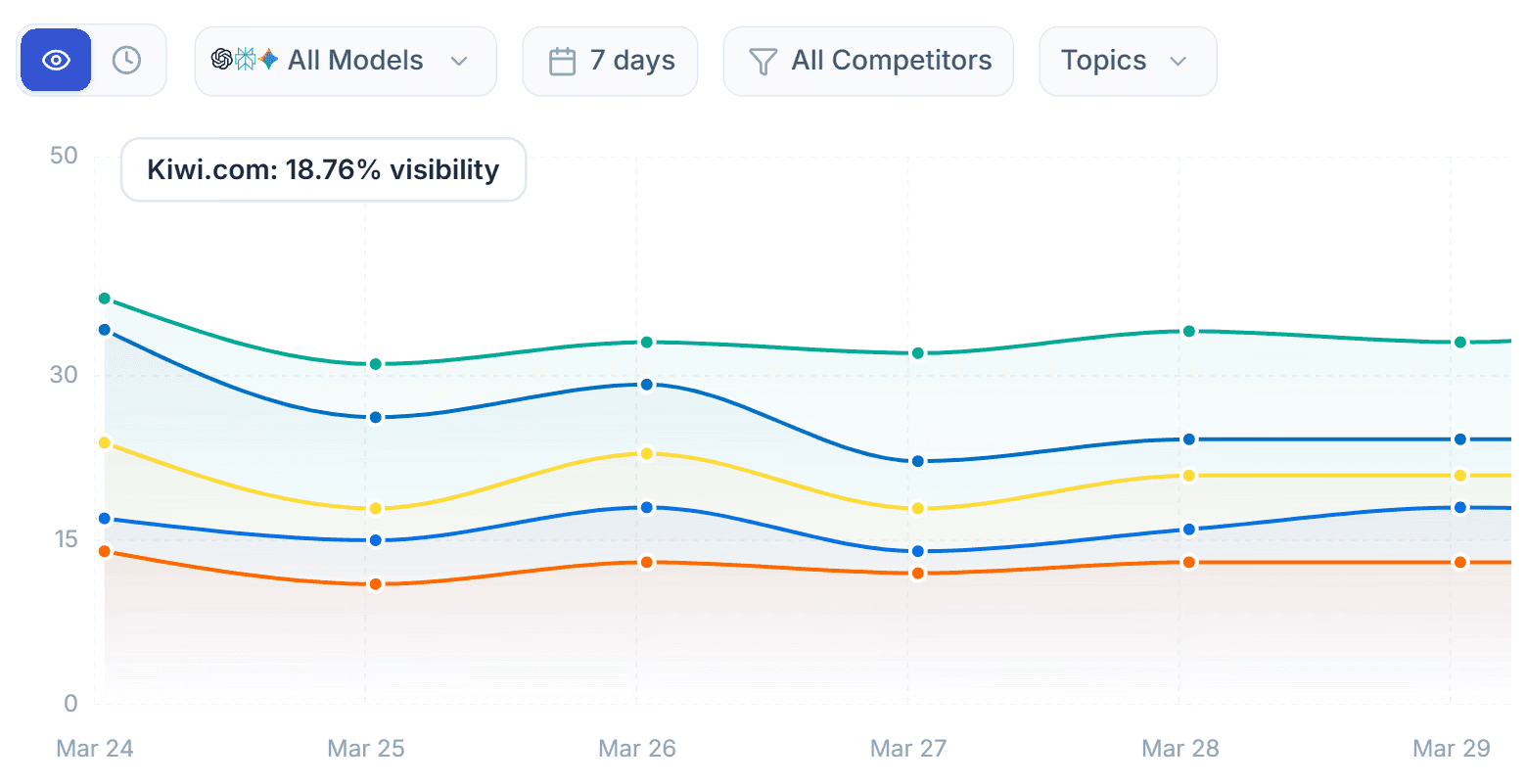
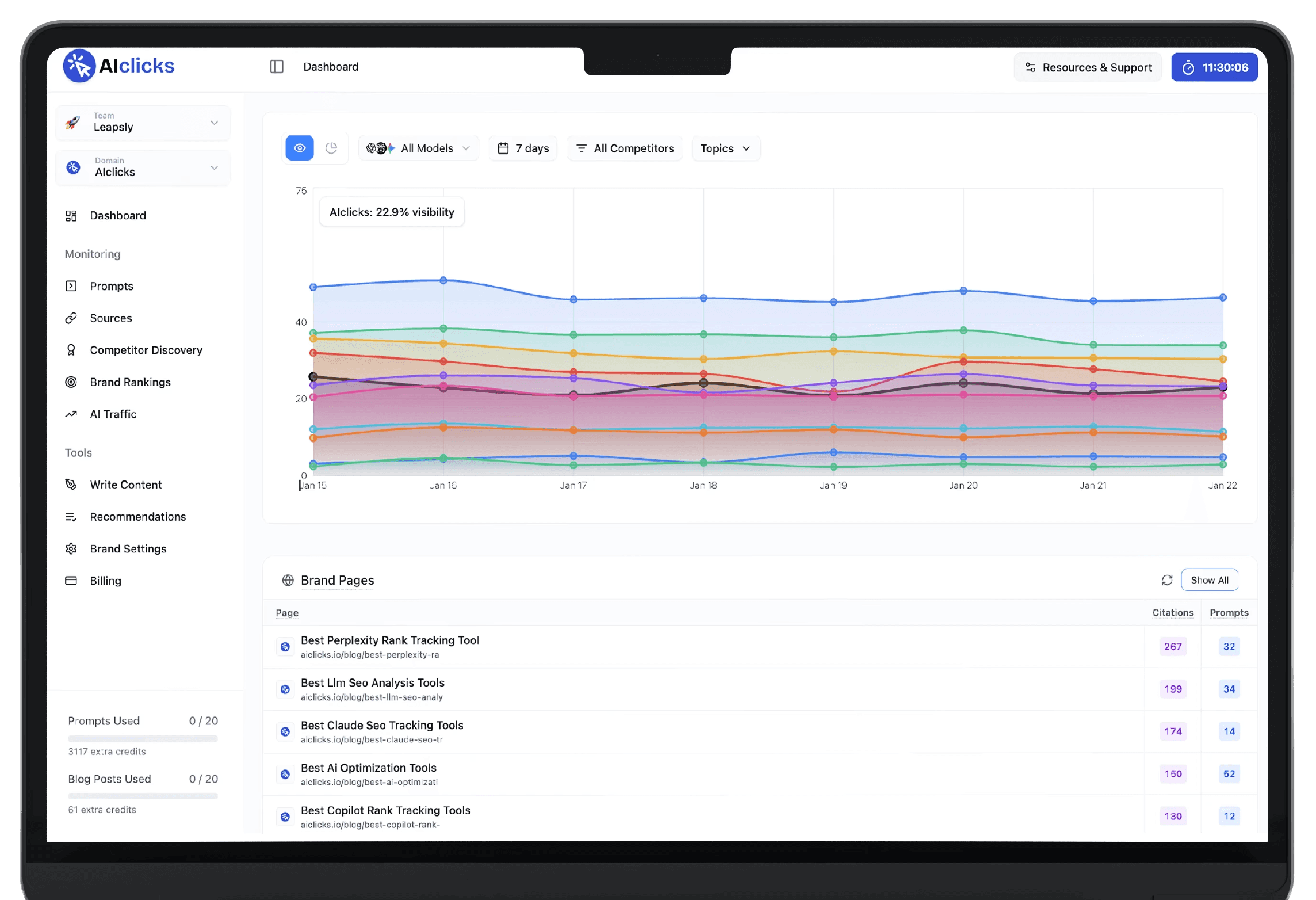
AIclicks gives you a live dashboard with daily ChatGPT mention rate, citation rate, sentiment, and share-of-voice across your tracked prompts, plus GA4 referral attribution for the traffic ChatGPT does send back.
Choose Your Plan
Flexible pricing that grows with your team. Upgrade or downgrade at any time.
Monthly
Yearly
-20%
Starter
Perfect for individuals & small teams
$49
/ month
Billed annually — you save $142
Choose 3 from:
Daily

" height="16px" id="fvSweaOBo" transform="translate(1 0)" width="14px"/></svg>)
" width="14px"><path d="M 13.864 5.629 L 13.3 5.629 L 13.3 5.6 L 7 5.6 L 7 8.4 L 10.956 8.4 C 10.379 10.03 8.828 11.2 7 11.2 C 4.681 11.2 2.8 9.319 2.8 7 C 2.8 4.681 4.681 2.8 7 2.8 C 8.071 2.8 9.045 3.204 9.786 3.864 L 11.766 1.884 C 10.516 0.719 8.844 0 7 0 C 3.134 0 0 3.134 0 7 C 0 10.866 3.134 14 7 14 C 10.866 14 14 10.866 14 7 C 14 6.531 13.952 6.073 13.864 5.629 Z" fill="rgb(255, 193, 7)" height="14px" id="H_YjfTNpn" width="14px"/><path d="M 0 3.742 L 2.3 5.429 C 2.922 3.888 4.429 2.8 6.193 2.8 C 7.264 2.8 8.238 3.204 8.979 3.864 L 10.959 1.884 C 9.709 0.719 8.037 0 6.193 0 C 3.504 0 1.172 1.518 0 3.742 Z" fill="rgb(255, 61, 0)" height="5.428500000000002px" id="PlkthQDhg" transform="translate(0.875 0)" width="10.959199999999996px"/><path d="M 6.232 5.581 C 8.04 5.581 9.683 4.889 10.925 3.764 L 8.758 1.931 C 8.032 2.483 7.144 2.782 6.232 2.781 C 4.411 2.781 2.865 1.62 2.283 0 L 0 1.759 C 1.159 4.026 3.511 5.581 6.232 5.581 Z" fill="rgb(76, 175, 80)" height="5.581099999999999px" id="WlnJ5gngE" transform="translate(0.7 8.4)" width="10.924899999999994px"/><path d="M 6.864 0.029 L 6.3 0.029 L 6.3 0 L 0 0 L 0 2.8 L 3.956 2.8 C 3.68 3.576 3.183 4.254 2.526 4.75 L 2.527 4.749 L 4.693 6.582 C 4.54 6.722 7 4.9 7 1.4 C 7 0.931 6.952 0.473 6.864 0.029 Z" fill="rgb(25, 118, 210)" height="6.589883930775992px" id="x_rSW275p" transform="translate(7 5.6)" width="7px"/></g></svg>)
" height="16px" id="hHS98fTxZ" width="16px"/></svg>)
 scale(1 1) translate(-1.861736945942159, -1.1170155383302638)" id="P20NzAvj0-699428820-radial-gradient" r="0.9935228066204626"><stop offset="0" stop-color="rgb(0, 174, 255)"/><stop offset="1" stop-color="rgb(7, 54, 196)"/></radialGradient><radialGradient cx="0.48250042504016705" cy="1.8366934653567062" gradient-transform="translate(0.48250042504016705, 1.8366934653567062) scale(1 1) translate(-0.48250042504016705, -1.8366934653567062)" id="UEWZqVjij-699428820-radial-gradient" r="0.9176890228114506"><stop offset="0" stop-color="rgb(255, 182, 87)"/><stop offset="1" stop-color="rgb(192, 43, 60)"/></radialGradient><linearGradient id="jyMN3TmKx-699428820-linear-gradient" x1="0.4594862532842614" x2="0.5405137467157386" y1="0" y2="1"><stop offset="0" stop-color="rgb(13, 145, 225)"/><stop offset="1" stop-color="rgb(255, 200, 0)"/></linearGradient><linearGradient id="xhMNwDFG0-699428820-linear-gradient" x1="0.4784828731548295" x2="0.5215171268451705" y1="5.551115123125783e-17" y2="1"><stop offset="0" stop-color="rgb(61, 203, 255)"/><stop offset="1" stop-color="rgba(5, 136, 247, 0)"/></linearGradient><radialGradient cx="1.4305090871482182" cy="0.34866158048251783" gradient-transform="translate(1.4305090871482182, 0.34866158048251783) scale(1 1) translate(-1.4305090871482182, -0.34866158048251783)" id="i79kAqaS4-699428820-radial-gradient" r="1.3362743412697924"><stop offset="0" stop-color="rgb(140, 72, 255)"/><stop offset="1" stop-color="rgb(255, 177, 82)"/></radialGradient><linearGradient id="mcxvno3tX-699428820-linear-gradient" x1="0.49844355920154226" x2="0.5015564407984577" y1="0" y2="1"><stop offset="0" stop-color="rgb(248, 173, 250)"/><stop offset="1" stop-color="rgba(168, 110, 221, 0)"/></linearGradient></defs><g d="M 11.605 1.219 C 11.397 0.499 10.739 0.002 9.989 0 L 9.498 0 C 8.682 0.002 7.985 0.588 7.842 1.391 L 7 6.016 L 7.209 5.296 C 7.416 4.574 8.075 4.076 8.825 4.074 L 11.681 4.074 L 12.879 4.545 L 14.033 4.074 L 13.697 4.074 C 12.947 4.072 12.289 3.575 12.081 2.855 Z M 4.413 13.387 C 4.618 14.111 5.278 14.611 6.031 14.613 L 7.075 14.613 C 7.988 14.613 8.735 13.88 8.758 12.96 L 8.871 8.5 L 8.633 9.319 C 8.426 10.039 7.768 10.537 7.018 10.539 L 4.138 10.539 L 3.111 9.977 L 2 10.539 L 2.331 10.539 C 3.084 10.542 3.743 11.042 3.949 11.766 L 4.413 13.387 Z M 9.999 0 L 4.167 0 C 2.501 0 1.501 2.221 0.834 4.441 C 0.045 7.073 -0.989 10.591 2.001 10.591 L 4.519 10.591 C 5.273 10.591 5.933 10.089 6.139 9.36 C 6.577 7.815 7.345 5.121 7.948 3.069 C 8.255 2.027 8.509 1.132 8.901 0.575 C 9.148 0.212 9.56 -0.004 9.999 0 M 9.999 0 L 4.167 0 C 2.501 0 1.501 2.221 0.834 4.441 C 0.045 7.073 -0.989 10.591 2.001 10.591 L 4.519 10.591 C 5.273 10.591 5.933 10.089 6.139 9.36 C 6.577 7.815 7.345 5.121 7.948 3.069 C 8.255 2.027 8.509 1.132 8.901 0.575 C 9.148 0.212 9.56 -0.004 9.999 0 M 6 14.593 L 11.833 14.593 C 13.499 14.593 14.499 12.372 15.166 10.151 C 15.955 7.519 16.989 4 13.999 4 L 11.48 4 C 10.725 4.002 10.063 4.505 9.86 5.232 C 9.266 7.332 8.663 9.429 8.051 11.523 C 7.745 12.566 7.49 13.461 7.098 14.019 C 6.851 14.382 6.439 14.597 6 14.593 M 6 14.593 L 11.833 14.593 C 13.499 14.593 14.499 12.372 15.166 10.151 C 15.955 7.519 16.989 4 13.999 4 L 11.48 4 C 10.725 4.002 10.063 4.505 9.86 5.232 C 9.266 7.332 8.663 9.429 8.051 11.523 C 7.745 12.566 7.49 13.461 7.098 14.019 C 6.851 14.382 6.439 14.597 6 14.593" fill="transparent" height="14.613333333333333px" id="QzkBy4Ibc" transform="translate(0 1)" width="16.00011071294081px"><path d="M 4.605 1.219 C 4.397 0.499 3.739 0.002 2.989 0 L 2.498 0 C 1.682 0.002 0.985 0.588 0.842 1.391 L 0 6.016 L 0.209 5.296 C 0.416 4.574 1.075 4.076 1.825 4.074 L 4.681 4.074 L 5.879 4.545 L 7.033 4.074 L 6.697 4.074 C 5.947 4.072 5.289 3.575 5.081 2.855 Z" fill="url(%23P20NzAvj0-699428820-radial-gradient)" height="6.016px" id="P20NzAvj0" transform="translate(7 0)" width="7.0333333333333385px"/><path d="M 2.413 4.887 C 2.618 5.611 3.278 6.111 4.031 6.113 L 5.075 6.113 C 5.988 6.113 6.735 5.38 6.758 4.46 L 6.871 0 L 6.633 0.819 C 6.426 1.539 5.768 2.037 5.018 2.039 L 2.138 2.039 L 1.111 1.477 L 0 2.039 L 0.331 2.039 C 1.084 2.042 1.743 2.542 1.949 3.266 L 2.413 4.887 Z" fill="url(%23UEWZqVjij-699428820-radial-gradient)" height="6.113333333333333px" id="UEWZqVjij" transform="translate(2 8.5)" width="6.871333333333332px"/><path d="M 9.999 0 L 4.167 0 C 2.501 0 1.501 2.221 0.834 4.441 C 0.045 7.073 -0.989 10.591 2.001 10.591 L 4.519 10.591 C 5.273 10.591 5.933 10.089 6.139 9.36 C 6.577 7.815 7.345 5.121 7.948 3.069 C 8.255 2.027 8.509 1.132 8.901 0.575 C 9.148 0.212 9.56 -0.004 9.999 0" fill="url(%23jyMN3TmKx-699428820-linear-gradient)" height="10.591388755215167px" id="jyMN3TmKx" width="9.999444046274142px"/><path d="M 9.999 0 L 4.167 0 C 2.501 0 1.501 2.221 0.834 4.441 C 0.045 7.073 -0.989 10.591 2.001 10.591 L 4.519 10.591 C 5.273 10.591 5.933 10.089 6.139 9.36 C 6.577 7.815 7.345 5.121 7.948 3.069 C 8.255 2.027 8.509 1.132 8.901 0.575 C 9.148 0.212 9.56 -0.004 9.999 0" fill="url(%23xhMNwDFG0-699428820-linear-gradient)" height="10.591388755215167px" id="xhMNwDFG0" width="9.999444046274142px"/><path d="M 0 10.593 L 5.833 10.593 C 7.499 10.593 8.499 8.372 9.166 6.151 C 9.955 3.519 10.989 0 7.999 0 L 5.48 0 C 4.725 0.002 4.063 0.505 3.86 1.232 C 3.266 3.332 2.663 5.429 2.051 7.523 C 1.745 8.566 1.49 9.461 1.098 10.019 C 0.851 10.382 0.439 10.597 0 10.593" fill="url(%23i79kAqaS4-699428820-radial-gradient)" height="10.593388755215164px" id="i79kAqaS4" transform="translate(6 4)" width="10.000110712940803px"/><path d="M 0 10.593 L 5.833 10.593 C 7.499 10.593 8.499 8.372 9.166 6.151 C 9.955 3.519 10.989 0 7.999 0 L 5.48 0 C 4.725 0.002 4.063 0.505 3.86 1.232 C 3.266 3.332 2.663 5.429 2.051 7.523 C 1.745 8.566 1.49 9.461 1.098 10.019 C 0.851 10.382 0.439 10.597 0 10.593" fill="url(%23mcxvno3tX-699428820-linear-gradient)" height="10.593388755215164px" id="mcxvno3tX" transform="translate(6 4)" width="10.000110712940803px"/></g></svg>)
" height="15.360666565427872px" id="HZPvvPBv7" transform="translate(0 0.5)" width="16px"/></svg>)
Tracked prompts
30
Websites you can add
3
LLMs you can track
3
Countries per project
1
LLM responses / mo
4,650
AI-optimized articles per month
10
Integrations
-
Support
Pro
For growing teams for more power
$140
/ month
Billed annually — you save $454
Choose 4 from:
Daily
Tracked prompts
150
Websites you can add
Unlimited
LLMs you can track
4
Countries per project
Unlimited
LLM responses / mo
18,600
AI-optimized articles per month
20
Integrations
Google Analytics
Support
BUSINESS
Best for medium-sized organizations
$357
/ month
Billed annually — you save $1198
Choose 6 from:
Daily
Tracked prompts
300
Websites you can add
Unlimited
LLMs you can track
6
Countries per project
Unlimited
LLM responses / mo
55,800
AI-optimized articles per month
30
Integrations
Google Analytics, API
Support
Dedicated account specialist
Become the #1 Answer in AI
Succeed in GEO yourself, or let us do all the work.
Do it yourself
Use AIclicks to see exactly where you appear across 10+ AI platforms, spot the gaps competitors are filling, and act on clear weekly recommendations.
From $59/month · Cancel anytime
Done for you
We Do All the Work for You
Our team manages your complete search presence: traditional SEO and GEO strategy, content, implementation, and reporting. You focus on vendors.
Custom pricing · Minimum 3-month engagement
The AI SEO agency trusted by 1,000+ brands worldwide
From solo founders to multi-client agencies, AIclicks runs the full AI SEO agency program for organizations of every shape and size that want to be cited across every AI surface.
4.9/5 stars on G2







FAQ
How long until we see valuation enquiries from SEO?
Expect map pack and profile movement inside 2 to 4 months, area-term rankings shifting around month 6, and a steady flow of valuation requests somewhere between 6 and 12 months. Agents on Reddit consistently report the same window before leads become predictable. A single-branch independent in a quiet market moves faster than a group competing across a busy town. Impressions in Search Console are the honest early signal; they move well before anything else does.
Is it worth optimising for ChatGPT as well as Google?
Both, and AI is where agencies are least prepared. Across 863,000 keywords, Ahrefs found that just 38% of pages cited in AI Overviews were also ranking in the top 10, against 76% a year earlier. Ranking no longer buys you the citation. Worse, when someone asks an assistant which agent to use, the answer is usually assembled from portal agent profiles and comparison sites, not from your website. Nobody in this trade is measuring that yet.
Why is estate agency SEO harder than plain local SEO?
Three things. Half your website is generated by a CRM you cannot edit, so standard on-page advice stops dead at the property search. Listings die on completion, which makes tidying dead URLs a standing job rather than a project you finish. And the head terms belong to the portals you already pay, ranking on authority they built from your own stock. Generic local SEO guidance addresses none of it.
What does estate agent SEO actually cost per month?
Retainers typically run £750 to £1,500 a month for a single branch in a quiet market, £1,500 to £3,000 to compete across a busy town, and higher again for multi-branch groups needing custom work on the CRM feed. Judge it against portal spend rather than against zero, since a mid-sized agency often pays more for listing fees in a quarter than a year of search work costs. Two extra instructions usually cover it.
Should we cut portal spend to pay for SEO?
Not straight away, and probably not entirely. Portal listings and paid search put you in front of movers this week and stop the day you cancel; organic builds pages that keep producing with no per-listing fee attached. Run both while the organic side matures, and let the ad data choose which areas deserve a guide. Then judge everything on cost per instruction won rather than cost per lead, because portal enquiries convert at a much lower rate.
What should we build first, blog or area pages?
The Google Business Profile comes first; it is free and it outranks the portals on map queries. Next comes the valuation page, the highest-intent search a vendor ever makes. Then one branch page per office and an area guide for your 3 strongest patches, written from actual local knowledge. Then a fee and process page carrying real figures. Property listings come last; they are stock, not strategy. Most agencies open with a blog and wonder why nothing shifts.
How do we tell whether SEO is producing instructions?
Count market appraisals booked from organic search; nothing else settles the argument. Vendor enquiries mostly arrive as phone calls, so without call tracking they never appear in analytics at all. Stamp the landing page onto every valuation form and carry that source through to the CRM, so a signed instruction can be traced to the page that produced it. Area-term impressions in Search Console rise months ahead of any position change.
Should our marketing person run this or an agency?
Divide it along the line of local knowledge. Area guides, market commentary, listing copy and review requests have to stay with your negotiators, because nobody outside the branch can describe a street they have never driven down or a chain they have never held together. Hand out the technical layer: rendering, schema, Core Web Vitals, citation cleanup and anything touching the CRM feed. If you outsource content, insist the writer works from your own sold data.
Further Reading
Go deeper on GEO, AI search, and visibility tracking.