SEO for Engineering Firms:
A stalled permit, a cracked slab, a wall someone wants removed: the search happens long before the call. Owners compare 3 firms, confirm who holds a license in the state, and increasingly let an AI assistant narrow the list first.









Why Engineering Firms Need SEO
Every question Google attaches to an engineer search is about cost. Firms answer it in a gated PDF, so Google and ChatGPT quote whoever published a plain web page instead.
Most firm sites collapse civil, structural, mechanical and forensic work into a single capabilities page carrying 6 bullet points. Those bullets represent 6 distinct searches, 6 distinct buyers, and 6 competitors who each wrote a real page. Nobody hunting a stamped letter for a wall removal will ever land on yours.
Search structural engineer near me in a US city and Thumbtack and Yelp appear above firms that actually hold P.E. registration. Neither company employs a single engineer. Both win on accumulated review counts and sheer page volume, then charge your competitors for the introduction that your own reputation created.
Work arrives by referral, so a principal who relocates or loses a contact starts from nothing, which is what engineers describe on Reddit. Meanwhile budget goes to booth space, directory listings and unbilled proposal hours chasing RFQs won 1 time in 5. Retainers of $2,000 to $6,000 a month buy activity, not pages.
How SEO Works for Engineering Firms
Search Engine Optimization projects are long-term investments for engineers, where each task supplements the others and creates compound results over time.
01
Keywords, page structure, and the signals Google reads directly
Engineering on-page work breaks on vocabulary. Firms organize a site the way they organize a company: by discipline, by contract vehicle, by the word multidiscipline. Buyers organize a search around an asset and a symptom, typing cracked foundation inspection, load bearing wall removal letter, or engineer stamp for permit. None of those strings appears anywhere on a page headed Structural Engineering Services. What converts instead is one URL per deliverable, phrased the way the buyer phrased it, alongside a licensure page stating which states each engineer is registered in. Engineers write for peer review, and Google has never sat on a review panel.
Code outlasts news, and the pages tied to code outlast everything else on the site. Something explaining when a building department demands a P.E. stamp, or what a letter of structural certification actually covers, keeps producing inquiries for years, because the code cycle moves slowly and the confusion never resolves. The short-lived material is the stuff the profession most enjoys posting: the project win, the new hire, the conference booth, the annual ranking. Value gone in roughly 2 weeks. Most firms refresh that feed monthly and have not opened a service page since launch day.
1
Break the capabilities page apart, giving each deliverable its own URL: foundation inspection report, load bearing wall letter, permit set, forensic assessment.
2
Retire pages built on a superseded code cycle, update the references, and 301 abandoned project pages into the discipline page that replaced them.
3
Tag every engineer as Person with hasCredential carrying the P.E. license, the firm as ProfessionalService, then check it in Schema Markup Validator.
4
Publish plain explainers on when a P.E. stamp is required, what an inspection report contains, and how long submittal review takes.
02
Map Pack visibility, citations, and proximity signals
More engineering demand is local than firms admit. Licensure runs state by state, the site visit is billable and physical, and knowing a building department’s submittal quirks is half the value. So a three-result map pack outranks the entire organic column on engineer searches, Thumbtack included. The firms occupying those slots are rarely the biggest in the market; they are the ones carrying review counts in the low hundreds.
Pick the narrowest category that is still accurate, Structural Engineer ahead of Engineer, then enter each deliverable separately under services with its own description. Load photographs from real site visits, crack monitoring, framing, foundation work, instead of stock renderings. Publish honest hours and your report turnaround. Answer upfront what a caller always asks: does the report carry a stamp, how fast does it arrive, and which states do you hold registration in.
Verification is the whole game in this sector’s directory layer, and generic local SEO advice skips it entirely. The ACEC member directory, NSPE and its state societies, NCSEA-affiliated structural engineer associations, and your state board of professional engineers register each confirm someone is genuinely licensed, which is precisely why Google weights them. Add thebluebook.com and Thomasnet for contractor-side discovery. Let 30 records disagree on your suite number and all 30 stop counting.
1
Make Structural Engineer or Civil Engineering Company the primary category, enter every deliverable under services, and post photographs taken on actual site visits.
2
Every registered office wants its own profile, plus a location page listing only the engineers who hold that state’s P.E. license.
3
Audit ACEC, NSPE, thebluebook.com, Thumbtack and your state licensing board with Yext or Moz Local, then reconcile every spelling of the firm name.
4
Publish a weekly profile update straight from the field: a foundation assessment, a permit approval, a note on a code change taking effect.
03
Topic authority, inbound links, and content that earns traffic
Every question Google attaches to an engineer search is financial: what a structural engineer costs, what they charge, what a consultation costs. Under that sits a more honest one, which is whether they need an engineer at all or whether the contractor’s letter will satisfy the building department. A page answering that plainly, including the cases where the answer is no, out-earns anything written about your software stack.
An owner past the point of deciding is now picking between firms, and proof at their own scale is what settles it. Show a project sheet for their asset type, name whoever will seal the drawings, quote turnaround in business days, and state the fee basis, lump sum, hourly or a percentage of construction. Say outright which states you are registered in. These inquiries die at the moment nobody can tell whether a small job is worth your attention.
Engineering links are institutional, which makes them unusually gettable. ACEC and NSPE chapters publish member and committee pages. University engineering departments list adjuncts, capstone sponsors and ABET advisory board members. The architects, contractors and home inspectors who refer you will link if asked. Trade press including ENR, STRUCTURE magazine and Consulting-Specifying Engineer takes bylined technical articles. Standards committees at ASTM, ACI and AISC publish member rosters. Not one of those requires a budget.
1
Publish a yearly fee guide giving real dollar ranges for an inspection report, a stamped letter, and a full permit set.
2
Build one page per deliverable per jurisdiction you are licensed in, covering that building department’s submittal checklist and review timeline.
3
Pull every money question under a single hub: hourly rates, lump sum design fees, percentage of construction cost, and the price of a site visit.
4
Write one authority page per code or standard you design to, such as ASCE 7 wind and seismic loads, ACI 318, or AISC 360.
04
Site speed, crawlability, Core Web Vitals, and mobile health
This sector fails in a way no other local business does: the PDF library. Spec sheets, project sheets, technical papers and the statement of qualifications all ship as PDFs, indexed under titles like Microsoft Word SOQ Rev C final. They hold no internal links, no canonical and no HTML twin, so they rank thinly or quietly cannibalize the service page. The gated ones fare worse still, sitting behind a download form no crawler and no language model will ever complete.
Engineering sites carry weight in an unusual combination: project galleries straight off the camera, embedded PDF viewers, and 3D model previews that load on first render. The person deciding is often on a job site with 1 bar of signal, or a homeowner holding a phone the evening a crack appeared. Nothing painted within a couple of seconds, or a phone number that will not dial on tap, sends them back to the results.
1
Set Screaming Frog to include PDFs, crawl, then list every document that ranks with no HTML equivalent and repair its title metadata.
2
Test your longest project page in PageSpeed Insights, the one carrying the embedded model viewer, and get Largest Contentful Paint below 2.5 seconds.
3
Export site photography, crack surveys and drawing excerpts as WebP sized to their display box, defer everything offscreen, and declare dimensions.
4
Separate deliverable and location URLs into their own sitemap, away from news and PDFs, and resubmit whenever a code reference or fee changes.
05
Star ratings, review volume, and response strategy that builds trust
Nothing shifts a map pack like review volume, and the firms holding those 3 slots carry counts in the low hundreds, not the low teens. Engineering makes that unusually hard. Half the work delivers bad news, the client is frequently a contractor or architect who will not endorse a consultant in public, public agency clients are barred outright, and whoever signs the contract is rarely the person who ever reads the report.
Ask on the day the building department accepts the submittal, not the day you invoice. That is when a client feels what they paid for, and your project system already stamps that date. Trigger the request off that status, and sign it from the engineer who ran the site visit, not the firm. Just a link and one line of text, with no portal login. Do it on the $600 letters as well and volume stops being a problem.
1
Fire the request from Deltek Vantagepoint, Unanet or Ajera when a deliverable is marked issued, signed by the engineer of record.
2
Reply within 48 hours by restating the scope and the standard applied, and never re-argue an engineering finding in public.
3
Put inspection reviews on the inspection page and permit-letter reviews on the permit page, keeping the evidence beside the thing being bought.
4
Realtors, home inspectors and general contractors who send you work describe turnaround and report clarity far better than a homeowner can.
Google is No Longer the Only Place Your clients are Searching
Clients are using AI to find answers, and they trust what it tells them. Invest in GEO to get recommended in those answers.
1 Billion
Questions ChatGPT receives every single day
38%
Your #1 top ranking page on Google would be cited by AI
14%
of engineers optimise for GEO. The rest are invisible in AI answers


You can rank #1 for “engineer near me” and still not exist in ChatGPT’s answer. Run a free GEO audit to see where your brand actually stands.
GEO vs SEO: Same Goal, Different Methods
GEO is wider than SEO. AI recommends the brands that show up across the sources it reads, so your presence in forums, social platforms and engineering blogs decides your odds. AIclicks measures the three metrics below so you know which to work on first.
AI Assistant
Which engineer can inspect my foundation crack?
Your Engineering Firm
Citation Rate
Shows how many AI answers about engineering firms name your brand, out of every 100. Models pull from the same trusted pages over and over, so citations compound: once you are in, staying in gets easier. Find the competitor pages AI cites most, then publish your own version of each.
Your Engineering Firm
82% positive
Competitor A
54% positive
Competitor B
38% positive
Brand Sentiment
Shows how AI describes you when your brand comes up: positive, neutral or negative. Tone is what separates being mentioned from being recommended, and models repeat whatever framing they find. Track the negative mentions back to the reviews and threads behind them, then publish content that answers those directly.
Others 52%
You 24%
— 24%
Your Engineering Firm
AI mention share of voice — engineering category
Competitors
Not Cited
Share of Voice in AI
Shows how much of the engineering conversation belongs to you rather than your competitors. This is the metric that matters most, the GEO version of a Google ranking. With only 1–5 brands named per answer, the market is winner-takes-more and every point is taken from someone.
The Dashboard Your Dedicated AI Search Team Works In
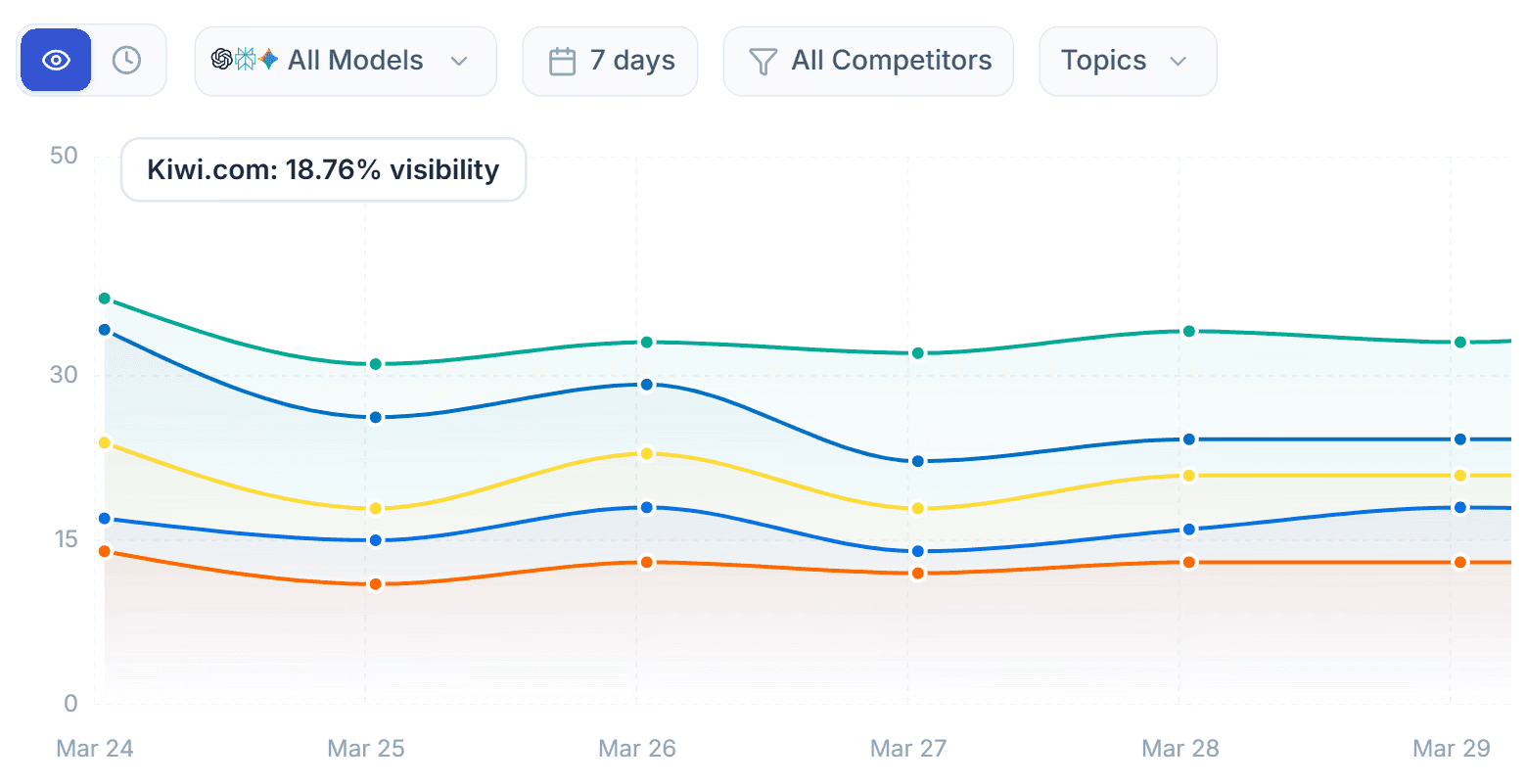
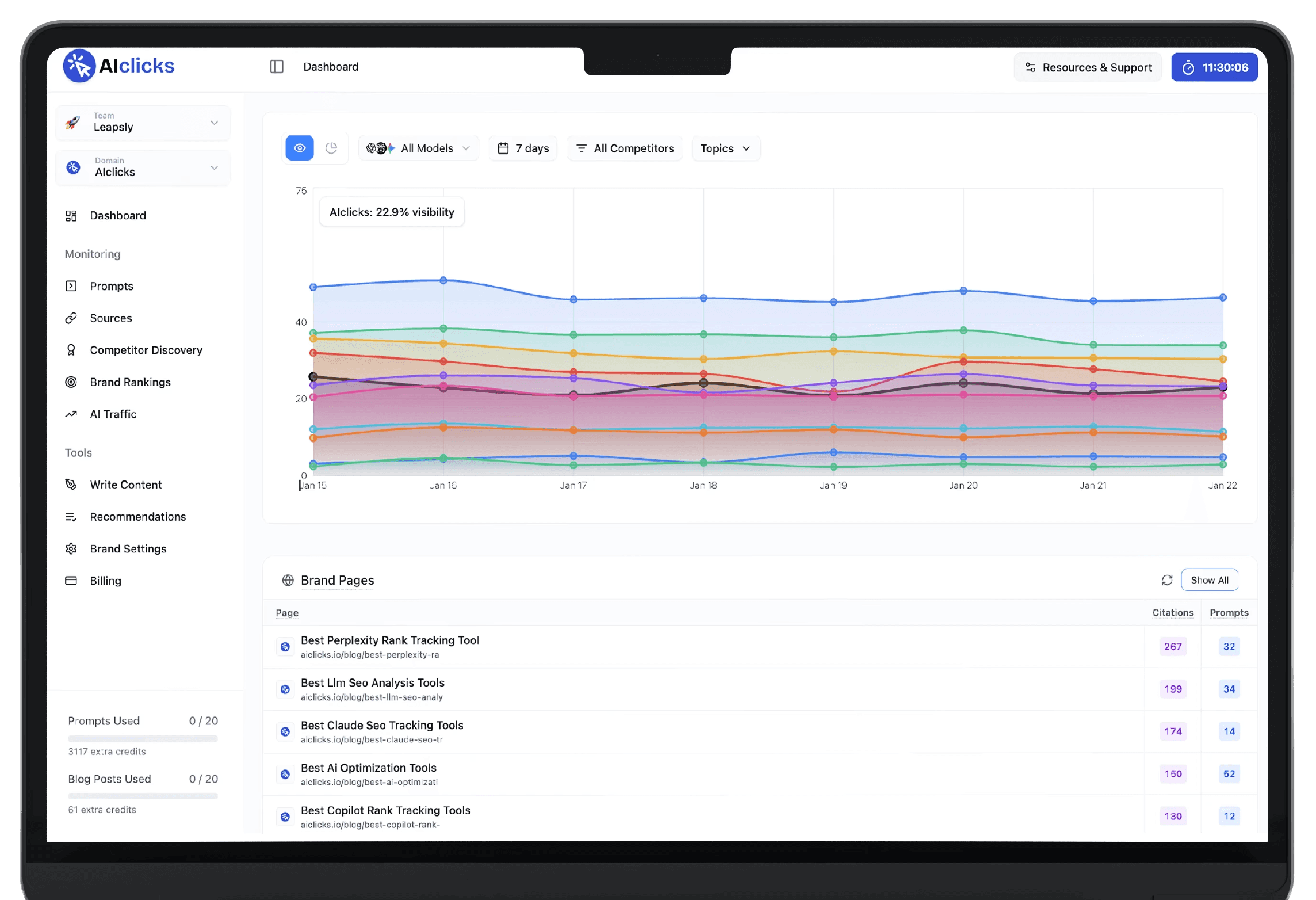
AIclicks gives you a live dashboard with daily ChatGPT mention rate, citation rate, sentiment, and share-of-voice across your tracked prompts, plus GA4 referral attribution for the traffic ChatGPT does send back.
Choose Your Plan
Flexible pricing that grows with your team. Upgrade or downgrade at any time.
Monthly
Yearly
-20%
Starter
Perfect for individuals & small teams
$49
/ month
Billed annually — you save $142
Choose 3 from:
Daily

" height="16px" id="fvSweaOBo" transform="translate(1 0)" width="14px"/></svg>)
" width="14px"><path d="M 13.864 5.629 L 13.3 5.629 L 13.3 5.6 L 7 5.6 L 7 8.4 L 10.956 8.4 C 10.379 10.03 8.828 11.2 7 11.2 C 4.681 11.2 2.8 9.319 2.8 7 C 2.8 4.681 4.681 2.8 7 2.8 C 8.071 2.8 9.045 3.204 9.786 3.864 L 11.766 1.884 C 10.516 0.719 8.844 0 7 0 C 3.134 0 0 3.134 0 7 C 0 10.866 3.134 14 7 14 C 10.866 14 14 10.866 14 7 C 14 6.531 13.952 6.073 13.864 5.629 Z" fill="rgb(255, 193, 7)" height="14px" id="H_YjfTNpn" width="14px"/><path d="M 0 3.742 L 2.3 5.429 C 2.922 3.888 4.429 2.8 6.193 2.8 C 7.264 2.8 8.238 3.204 8.979 3.864 L 10.959 1.884 C 9.709 0.719 8.037 0 6.193 0 C 3.504 0 1.172 1.518 0 3.742 Z" fill="rgb(255, 61, 0)" height="5.428500000000002px" id="PlkthQDhg" transform="translate(0.875 0)" width="10.959199999999996px"/><path d="M 6.232 5.581 C 8.04 5.581 9.683 4.889 10.925 3.764 L 8.758 1.931 C 8.032 2.483 7.144 2.782 6.232 2.781 C 4.411 2.781 2.865 1.62 2.283 0 L 0 1.759 C 1.159 4.026 3.511 5.581 6.232 5.581 Z" fill="rgb(76, 175, 80)" height="5.581099999999999px" id="WlnJ5gngE" transform="translate(0.7 8.4)" width="10.924899999999994px"/><path d="M 6.864 0.029 L 6.3 0.029 L 6.3 0 L 0 0 L 0 2.8 L 3.956 2.8 C 3.68 3.576 3.183 4.254 2.526 4.75 L 2.527 4.749 L 4.693 6.582 C 4.54 6.722 7 4.9 7 1.4 C 7 0.931 6.952 0.473 6.864 0.029 Z" fill="rgb(25, 118, 210)" height="6.589883930775992px" id="x_rSW275p" transform="translate(7 5.6)" width="7px"/></g></svg>)
" height="16px" id="hHS98fTxZ" width="16px"/></svg>)
 scale(1 1) translate(-1.861736945942159, -1.1170155383302638)" id="P20NzAvj0-699428820-radial-gradient" r="0.9935228066204626"><stop offset="0" stop-color="rgb(0, 174, 255)"/><stop offset="1" stop-color="rgb(7, 54, 196)"/></radialGradient><radialGradient cx="0.48250042504016705" cy="1.8366934653567062" gradient-transform="translate(0.48250042504016705, 1.8366934653567062) scale(1 1) translate(-0.48250042504016705, -1.8366934653567062)" id="UEWZqVjij-699428820-radial-gradient" r="0.9176890228114506"><stop offset="0" stop-color="rgb(255, 182, 87)"/><stop offset="1" stop-color="rgb(192, 43, 60)"/></radialGradient><linearGradient id="jyMN3TmKx-699428820-linear-gradient" x1="0.4594862532842614" x2="0.5405137467157386" y1="0" y2="1"><stop offset="0" stop-color="rgb(13, 145, 225)"/><stop offset="1" stop-color="rgb(255, 200, 0)"/></linearGradient><linearGradient id="xhMNwDFG0-699428820-linear-gradient" x1="0.4784828731548295" x2="0.5215171268451705" y1="5.551115123125783e-17" y2="1"><stop offset="0" stop-color="rgb(61, 203, 255)"/><stop offset="1" stop-color="rgba(5, 136, 247, 0)"/></linearGradient><radialGradient cx="1.4305090871482182" cy="0.34866158048251783" gradient-transform="translate(1.4305090871482182, 0.34866158048251783) scale(1 1) translate(-1.4305090871482182, -0.34866158048251783)" id="i79kAqaS4-699428820-radial-gradient" r="1.3362743412697924"><stop offset="0" stop-color="rgb(140, 72, 255)"/><stop offset="1" stop-color="rgb(255, 177, 82)"/></radialGradient><linearGradient id="mcxvno3tX-699428820-linear-gradient" x1="0.49844355920154226" x2="0.5015564407984577" y1="0" y2="1"><stop offset="0" stop-color="rgb(248, 173, 250)"/><stop offset="1" stop-color="rgba(168, 110, 221, 0)"/></linearGradient></defs><g d="M 11.605 1.219 C 11.397 0.499 10.739 0.002 9.989 0 L 9.498 0 C 8.682 0.002 7.985 0.588 7.842 1.391 L 7 6.016 L 7.209 5.296 C 7.416 4.574 8.075 4.076 8.825 4.074 L 11.681 4.074 L 12.879 4.545 L 14.033 4.074 L 13.697 4.074 C 12.947 4.072 12.289 3.575 12.081 2.855 Z M 4.413 13.387 C 4.618 14.111 5.278 14.611 6.031 14.613 L 7.075 14.613 C 7.988 14.613 8.735 13.88 8.758 12.96 L 8.871 8.5 L 8.633 9.319 C 8.426 10.039 7.768 10.537 7.018 10.539 L 4.138 10.539 L 3.111 9.977 L 2 10.539 L 2.331 10.539 C 3.084 10.542 3.743 11.042 3.949 11.766 L 4.413 13.387 Z M 9.999 0 L 4.167 0 C 2.501 0 1.501 2.221 0.834 4.441 C 0.045 7.073 -0.989 10.591 2.001 10.591 L 4.519 10.591 C 5.273 10.591 5.933 10.089 6.139 9.36 C 6.577 7.815 7.345 5.121 7.948 3.069 C 8.255 2.027 8.509 1.132 8.901 0.575 C 9.148 0.212 9.56 -0.004 9.999 0 M 9.999 0 L 4.167 0 C 2.501 0 1.501 2.221 0.834 4.441 C 0.045 7.073 -0.989 10.591 2.001 10.591 L 4.519 10.591 C 5.273 10.591 5.933 10.089 6.139 9.36 C 6.577 7.815 7.345 5.121 7.948 3.069 C 8.255 2.027 8.509 1.132 8.901 0.575 C 9.148 0.212 9.56 -0.004 9.999 0 M 6 14.593 L 11.833 14.593 C 13.499 14.593 14.499 12.372 15.166 10.151 C 15.955 7.519 16.989 4 13.999 4 L 11.48 4 C 10.725 4.002 10.063 4.505 9.86 5.232 C 9.266 7.332 8.663 9.429 8.051 11.523 C 7.745 12.566 7.49 13.461 7.098 14.019 C 6.851 14.382 6.439 14.597 6 14.593 M 6 14.593 L 11.833 14.593 C 13.499 14.593 14.499 12.372 15.166 10.151 C 15.955 7.519 16.989 4 13.999 4 L 11.48 4 C 10.725 4.002 10.063 4.505 9.86 5.232 C 9.266 7.332 8.663 9.429 8.051 11.523 C 7.745 12.566 7.49 13.461 7.098 14.019 C 6.851 14.382 6.439 14.597 6 14.593" fill="transparent" height="14.613333333333333px" id="QzkBy4Ibc" transform="translate(0 1)" width="16.00011071294081px"><path d="M 4.605 1.219 C 4.397 0.499 3.739 0.002 2.989 0 L 2.498 0 C 1.682 0.002 0.985 0.588 0.842 1.391 L 0 6.016 L 0.209 5.296 C 0.416 4.574 1.075 4.076 1.825 4.074 L 4.681 4.074 L 5.879 4.545 L 7.033 4.074 L 6.697 4.074 C 5.947 4.072 5.289 3.575 5.081 2.855 Z" fill="url(%23P20NzAvj0-699428820-radial-gradient)" height="6.016px" id="P20NzAvj0" transform="translate(7 0)" width="7.0333333333333385px"/><path d="M 2.413 4.887 C 2.618 5.611 3.278 6.111 4.031 6.113 L 5.075 6.113 C 5.988 6.113 6.735 5.38 6.758 4.46 L 6.871 0 L 6.633 0.819 C 6.426 1.539 5.768 2.037 5.018 2.039 L 2.138 2.039 L 1.111 1.477 L 0 2.039 L 0.331 2.039 C 1.084 2.042 1.743 2.542 1.949 3.266 L 2.413 4.887 Z" fill="url(%23UEWZqVjij-699428820-radial-gradient)" height="6.113333333333333px" id="UEWZqVjij" transform="translate(2 8.5)" width="6.871333333333332px"/><path d="M 9.999 0 L 4.167 0 C 2.501 0 1.501 2.221 0.834 4.441 C 0.045 7.073 -0.989 10.591 2.001 10.591 L 4.519 10.591 C 5.273 10.591 5.933 10.089 6.139 9.36 C 6.577 7.815 7.345 5.121 7.948 3.069 C 8.255 2.027 8.509 1.132 8.901 0.575 C 9.148 0.212 9.56 -0.004 9.999 0" fill="url(%23jyMN3TmKx-699428820-linear-gradient)" height="10.591388755215167px" id="jyMN3TmKx" width="9.999444046274142px"/><path d="M 9.999 0 L 4.167 0 C 2.501 0 1.501 2.221 0.834 4.441 C 0.045 7.073 -0.989 10.591 2.001 10.591 L 4.519 10.591 C 5.273 10.591 5.933 10.089 6.139 9.36 C 6.577 7.815 7.345 5.121 7.948 3.069 C 8.255 2.027 8.509 1.132 8.901 0.575 C 9.148 0.212 9.56 -0.004 9.999 0" fill="url(%23xhMNwDFG0-699428820-linear-gradient)" height="10.591388755215167px" id="xhMNwDFG0" width="9.999444046274142px"/><path d="M 0 10.593 L 5.833 10.593 C 7.499 10.593 8.499 8.372 9.166 6.151 C 9.955 3.519 10.989 0 7.999 0 L 5.48 0 C 4.725 0.002 4.063 0.505 3.86 1.232 C 3.266 3.332 2.663 5.429 2.051 7.523 C 1.745 8.566 1.49 9.461 1.098 10.019 C 0.851 10.382 0.439 10.597 0 10.593" fill="url(%23i79kAqaS4-699428820-radial-gradient)" height="10.593388755215164px" id="i79kAqaS4" transform="translate(6 4)" width="10.000110712940803px"/><path d="M 0 10.593 L 5.833 10.593 C 7.499 10.593 8.499 8.372 9.166 6.151 C 9.955 3.519 10.989 0 7.999 0 L 5.48 0 C 4.725 0.002 4.063 0.505 3.86 1.232 C 3.266 3.332 2.663 5.429 2.051 7.523 C 1.745 8.566 1.49 9.461 1.098 10.019 C 0.851 10.382 0.439 10.597 0 10.593" fill="url(%23mcxvno3tX-699428820-linear-gradient)" height="10.593388755215164px" id="mcxvno3tX" transform="translate(6 4)" width="10.000110712940803px"/></g></svg>)
" height="15.360666565427872px" id="HZPvvPBv7" transform="translate(0 0.5)" width="16px"/></svg>)
Tracked prompts
30
Websites you can add
3
LLMs you can track
3
Countries per project
1
LLM responses / mo
4,650
AI-optimized articles per month
10
Integrations
-
Support
Pro
For growing teams for more power
$140
/ month
Billed annually — you save $454
Choose 4 from:
Daily
Tracked prompts
150
Websites you can add
Unlimited
LLMs you can track
4
Countries per project
Unlimited
LLM responses / mo
18,600
AI-optimized articles per month
20
Integrations
Google Analytics
Support
BUSINESS
Best for medium-sized organizations
$357
/ month
Billed annually — you save $1198
Choose 6 from:
Daily
Tracked prompts
300
Websites you can add
Unlimited
LLMs you can track
6
Countries per project
Unlimited
LLM responses / mo
55,800
AI-optimized articles per month
30
Integrations
Google Analytics, API
Support
Dedicated account specialist
Become the #1 Answer in AI
Succeed in GEO yourself, or let us do all the work.
Do it yourself
Use AIclicks to see exactly where you appear across 10+ AI platforms, spot the gaps competitors are filling, and act on clear weekly recommendations.
From $59/month · Cancel anytime
Done for you
We Do All the Work for You
Our team manages your complete search presence: traditional SEO and GEO strategy, content, implementation, and reporting. You focus on clients.
Custom pricing · Minimum 3-month engagement
The AI SEO agency trusted by 1,000+ brands worldwide
From solo founders to multi-client agencies, AIclicks runs the full AI SEO agency program for organizations of every shape and size that want to be cited across every AI surface.
4.9/5 stars on G2







FAQ
What is a realistic timeline for engineering SEO?
Profile and map visibility tends to move first, inside 3 to 4 months, with discipline and deliverable terms landing between 6 and 12. Agencies commonly cite a 3 to 6 month window before anything is legible, which matches what happens once service pages finally exist as separate URLs. Procurement then adds its own delay: an owner who found you during design may not raise a purchase order for 2 quarters.
Are we losing work to ChatGPT and AI Overviews?
Quite possibly, and engineering is more exposed than most sectors. Ahrefs analyzed 863,000 keywords and found only 38% of pages cited in AI Overviews also ranked in the top 10, down from 76% a year earlier. A good position no longer buys a mention. Worse, the material proving your competence sits in gated PDFs and stamped drawings, and no model quotes a document it cannot open.
What makes engineering SEO unlike standard local SEO?
Registration is the biggest difference. It runs state by state, so every page has to say where you can legally seal drawings, and directories that verify licensure outrank ones that do not. Your buyers also come from 2 directions: homeowners searching a symptom, and contractors or developers searching a discipline. Then there is the proof problem, because your best work sits inside PDFs and drawings that search engines read poorly.
What should an engineering firm budget for SEO?
Technical B2B retainers generally land between $1,500 and $5,000 monthly for a single-discipline firm in one market, rising to $5,000 or $10,000 where several disciplines or states are in play. Weigh that against spending that leaves nothing behind: booth space at a trade show, paid directory placements, and the unbilled principal hours burned losing 4 proposals out of every 5.
Is Google Ads worth running alongside SEO for engineers?
For residential deliverables, yes; for design contracts, rarely. Inspection and permit-letter searches convert the same week and clear at sensible cost per click, so ads pay there. Large project work is awarded through qualifications and relationships, and nobody selects a bridge consultant from a paid result. Use ads as research instead: point a small budget at one deliverable for a few weeks, then write whichever page the conversion data justifies.
Which pages should an engineering firm build first?
Start with the Google Business Profile. It is free, and it outranks the entire organic column. Next, build the page for your highest-volume deliverable, usually the inspection report or the permit letter, in the language an owner would actually use. Then fees, because cost is what Google asks on every engineer search. Then a registration page naming each state you are licensed in. News can wait indefinitely.
Which numbers actually tell us this is working?
Proposals sent and jobs opened from organic search, never rankings. Engineering inquiries land by phone and by form, sometimes months apart, so call tracking and per-page form tagging are mandatory or the phone half vanishes from analytics. In Search Console, follow impressions on deliverable terms; those climb ahead of position. Finally, tie the total back to Deltek or whatever runs your projects, since opened jobs are the only honest number.
Can we handle engineering SEO without hiring anyone?
Partly, and the division follows expertise. Only someone inside the firm can explain when a stamp is required or what a report actually covers, so a licensed engineer should own the writing, plus profile updates and review requests. Hand out the crawl work, schema, PDF cleanup and directory sync. When choosing a vendor, make them show a technical site where they pulled documents back out of a form gate.
Further Reading
Go deeper on GEO, AI search, and visibility tracking.