SEO for Electrical Contractors:
A tripped panel at 9 at night does not get a referral call. It gets a phone, a map, and 3 listings with star ratings. Whoever appears there wins the dispatch, and the rest of the trade never learns the job existed.









Why Electrical Contractors Need SEO
Roughly 230,000 people a month type electrician near me into Google, and most never scroll past the 3 map results. Everyone else is competing for what is left.
Panel upgrades, EV chargers, whole-home rewiring and standby generators are your margin, and on most sites they are 4 bullets under a Services dropdown. Each is a separate search with its own price question and a competitor already answering it. The homeowner books that competitor and you never see it.
Search electrician near me in a US city and the first organic result is usually Thumbtack or the Better Business Bureau, with Yelp and Angi close behind. They rank on aggregate authority that no single shop can match, then sell your competitors a boosted spot inside the listing that already beat you.
Most shops run $1,000 to $2,000 a month into Google Ads plus a marketplace subscription that resells the same enquiry to 3 or 4 rivals, so the job goes to whoever calls back fastest. Published agency retainers sit around $1,495 to $4,995 a month on top. Pause any of it and the calls stop that week.
How SEO Works for Electrical Contractors
Search Engine Optimization projects are long-term investments for electricians, where each task supplements the others and creates compound results over time.
01
Keywords, page structure, and the signals Google reads directly
On-page work breaks down for electrical contractors because the trade vocabulary and the customer vocabulary barely overlap. You sell a 200-amp service upgrade; the homeowner types breaker box keeps tripping or my lights dim when the AC starts. You install a Level 2 EVSE; they search Tesla charger installation cost. Most sites are written in the first language and searched in the second, so the page never matches the query. The pages that carry the weight are one per service, plus an emergency page and a pricing page, not the blog. Google also reads electrical work as safety content and wants a license number visible.
The durable pages are the ones tied to a fault or a fixture rather than a date. A page explaining why a breaker trips when the microwave runs, or what a panel upgrade actually costs and why the permit adds a week, keeps earning calls for years because houses keep failing the same way. What churns is the seasonal post: the storm-season generator special, the holiday lighting tip, the announcement that you hired 2 apprentices. Those are dead within a month and they make up most contractor blogs. Write fewer pages, about faults and fixtures, and revisit the price ranges every year.
1
Build one page per service titled the way homeowners search: panel upgrade cost, breaker keeps tripping, EV charger installation, generator hookup.
2
Unpublish expired rebate and storm-season pages each quarter in Search Console, redirecting the utility rebate posts into the service page that replaced them.
3
Use schema.org Electrician rather than generic LocalBusiness, add Service and areaServed for each trade offering, then validate in Google’s Rich Results Test.
4
Publish explainers on AFCI and GFCI requirements, permit and inspection steps, and load calculations, questions homeowners ask on every estimate call.
02
Map Pack visibility, citations, and proximity signals
Nobody drives 2 counties for an outlet. Electrical demand is bounded by drive time, which is why the 3-result map pack sits above every organic listing, including Thumbtack and the BBB. Most local searchers pick from those 3 and never scroll further. For most shops the map pack produces more booked jobs in a month than the whole website does, and claiming the profile costs nothing but an afternoon.
Set the primary category to Electrician, then add secondary ones you genuinely hold, such as Electrical installation service or Generator shop. Most electricians run as a service-area business, so hide the address and draw the service area by the towns you actually dispatch to, not a 60-mile circle. Load photos of branded vans, finished panels and rough-ins rather than stock. List the license number, 24-hour cover if you offer it, and answer parking, permits and call-out fees in Q&A.
Electrical has 3 citation layers. General: Google, Bing Places, Apple Business Connect, Yelp, Nextdoor and the BBB. Trade: NECA and IEC member directories, your state electrical licensing register, and the local builders exchange. The layer nobody claims is manufacturer installer locators, Qmerit for EV charging, Generac and Kohler dealer finders, Lutron and Tesla certified installer lists. Those send buying traffic and links. Every entry needs the same legal name, suite and phone or the signal dilutes.
1
Pick Electrician as primary category, list every service with its own description, and set service areas by dispatch town rather than radius.
2
Give each yard or branch its own profile, its own staffed page and its own phone line, never 3 addresses on one contact page.
3
Run Whitespark or BrightLocal across Yelp, Angi, the BBB, Qmerit and every dealer locator you hold, correcting name and suite variants.
4
Post one Google Business Profile update a week from the field: a finished panel, an EV charger commissioned, a same-day slot open.
03
Topic authority, inbound links, and content that earns traffic
Before a homeowner calls, they are trying to work out whether the problem is dangerous, whether it needs a permit, and roughly what it will cost. Content that answers those 3 honestly beats anything written to rank. A page on what a 200-amp service upgrade runs and why older homes cost more, or which faults mean stop using the circuit tonight, earns the call because it treats the reader as capable of a decision.
The homeowner who has already decided on the generator or the charger is now choosing an installer, and they want evidence. Show the license and bond numbers, the manufacturer certifications you actually hold, photos of your own finished work rather than the manufacturer’s brochure, and a flat-rate range with what changes it. Say who pulls the permit and who schedules inspection. Most contractors lose this reader at the point of not publishing a number.
Electrical links come from the supply house and the job site, not from outreach. Distributors and manufacturers publish certified installer pages the moment you complete training. General contractors, home builders and solar installers you sub for will list you on their trade pages if asked. Utility rebate programs publish approved contractor lists. Add the chamber, the trade school where you take apprentices, and the youth team whose shirts carry your name. None of it costs anything.
1
Publish a yearly cost guide per job type, panel upgrade, rewire, EV charger, generator, with real flat-rate bands and what pushes them up.
2
Build one page per service per town you dispatch to, citing local permit offices, housing stock age and utility, not swapped place names.
3
Cluster every affordability question into one hub: utility rebates, panel upgrade incentives, financing through Wisetack or GreenSky, and what a service call costs.
4
Write a page for each brand you install, Generac, Tesla Wall Connector, Lutron, Eaton or Square D, because homeowners search brands first.
04
Site speed, crawlability, Core Web Vitals, and mobile health
The failure nobody sees is the swapped phone number. Almost every contractor site runs dynamic number insertion from CallRail or a field-service platform, which rewrites the number in the browser after load. Crawlers and AI scrapers that do not run scripts read whatever sits in the raw HTML, usually an old tracking line that matches nothing on your Google profile or any directory. You have a NAP mismatch on every page and it looks fine on screen.
The highest-intent electrical search happens one-handed, in a dark hallway, by someone who just heard a bang from the panel. They are not reading. They want a number and a sentence saying you answer at night. If the site drags a booking widget, a chat bubble and a hero video onto the screen before the call button renders, they are already dialling the next van. Test it on a mid-range phone over 4G, not on the office fibre.
1
Fetch your pages with JavaScript disabled or use Search Console’s URL inspection, and confirm the raw HTML number matches your Google profile exactly.
2
Run PageSpeed Insights on the emergency page, defer the Housecall Pro or ServiceTitan booking script, and hold Largest Contentful Paint under 2.5 seconds.
3
Serve before-and-after panel and rough-in photos as WebP at display size with explicit width and height, since crews upload straight from phone cameras.
4
Keep service and town pages in a sitemap separate from blog archives, and resubmit whenever pricing, licensing or a certification changes.
05
Star ratings, review volume, and response strategy that builds trust
Reviews carry the map pack in this trade because a stranger is about to be alone in the house with the power off. The difficulty is volume and timing. A single shop runs 6 vans and 20 calls a day, and the tech who did the work leaves before anyone thinks about asking. Reviews also skew: the customer who got a $9,000 rewire quote writes, the one whose outlet was fixed in 20 minutes does not.
Ask at the tailgate, while the tech is packing up and the breaker they just fixed is still on the customer’s mind. A text with the review link sent from the job as the invoice closes converts far better than an email the next morning. Wire it into Jobber, Housecall Pro or ServiceTitan so it fires on job completion, signed with the tech’s first name. Ask on every call, including the 30-minute ones, or the profile reads as curated.
1
Configure Jobber, Housecall Pro or Podium to text the review link the moment the tech marks the job complete on their tablet.
2
Reply within 24 hours to pricing complaints with the scope and code requirement that drove the quote, never with an argument about the invoice.
3
Pull generator reviews onto the generator page and charger reviews onto the EV page, rather than one site-wide testimonial slider nobody reads.
4
Ask property managers, general contractors and builders you sub for to review the commercial side, since those read differently to a homeowner comparing quotes.
Google is No Longer the Only Place Your customers are Searching
Customers are using AI to find answers, and they trust what it tells them. Invest in GEO to get recommended in those answers.
1 Billion
Questions ChatGPT receives every single day
38%
Your #1 top ranking page on Google would be cited by AI
14%
of electricians optimise for GEO. The rest are invisible in AI answers


You can rank #1 for “electrician near me” and still not exist in ChatGPT’s answer. Run a free GEO audit to see where your brand actually stands.
GEO vs SEO: Same Goal, Different Methods
GEO is wider than SEO. AI recommends the brands that show up across the sources it reads, so your presence in forums, social platforms and electrical blogs decides your odds. AIclicks measures the three metrics below so you know which to work on first.
AI Assistant
Which electrician should I call for a tripping breaker?
Your Company
Citation Rate
Shows how many AI answers about electrical contractors name your brand, out of every 100. Models pull from the same trusted pages over and over, so citations compound: once you are in, staying in gets easier. Find the competitor pages AI cites most, then publish your own version of each.
Your Company
82% positive
Competitor A
54% positive
Competitor B
38% positive
Brand Sentiment
Shows how AI describes you when your brand comes up: positive, neutral or negative. Tone is what separates being mentioned from being recommended, and models repeat whatever framing they find. Track the negative mentions back to the reviews and threads behind them, then publish content that answers those directly.
Others 52%
You 24%
— 24%
Your Company
AI mention share of voice — electrical category
Competitors
Not Cited
Share of Voice in AI
Shows how much of the electrical conversation belongs to you rather than your competitors. This is the metric that matters most, the GEO version of a Google ranking. With only 1–5 brands named per answer, the market is winner-takes-more and every point is taken from someone.
The Dashboard Your Dedicated AI Search Team Works In
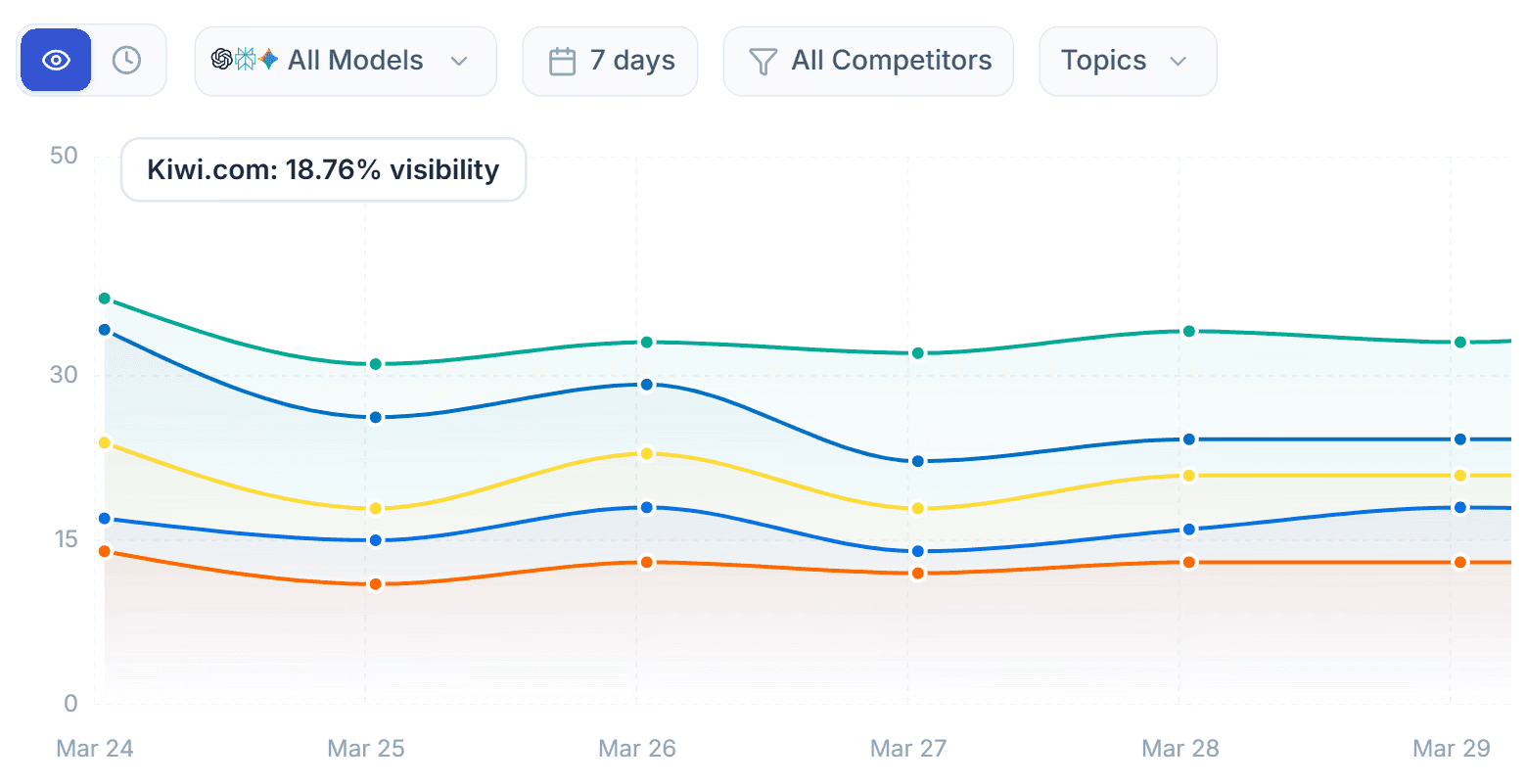
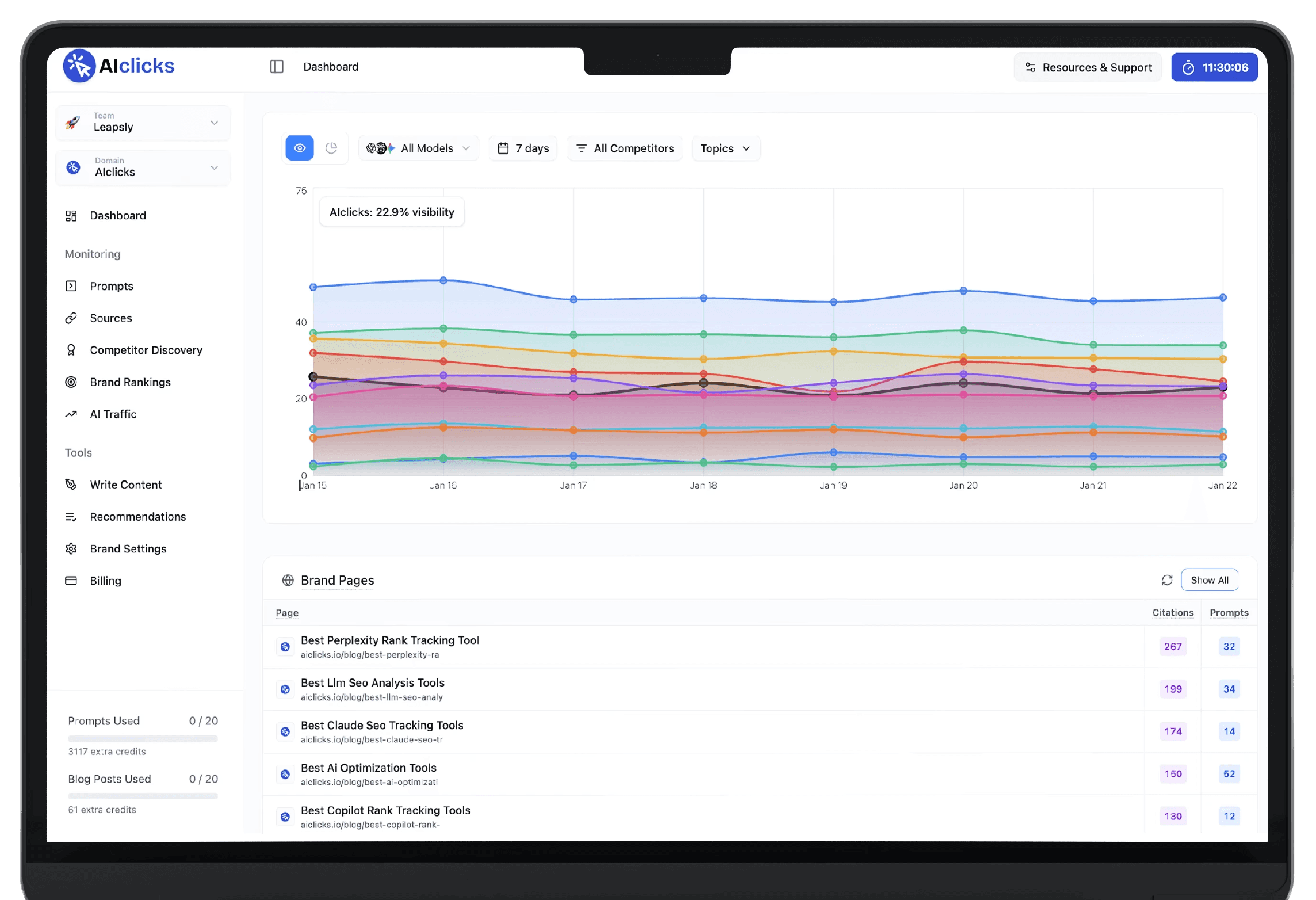
AIclicks gives you a live dashboard with daily ChatGPT mention rate, citation rate, sentiment, and share-of-voice across your tracked prompts, plus GA4 referral attribution for the traffic ChatGPT does send back.
Choose Your Plan
Flexible pricing that grows with your team. Upgrade or downgrade at any time.
Monthly
Yearly
-20%
Starter
Perfect for individuals & small teams
$49
/ month
Billed annually — you save $142
Choose 3 from:
Daily

" height="16px" id="fvSweaOBo" transform="translate(1 0)" width="14px"/></svg>)
" width="14px"><path d="M 13.864 5.629 L 13.3 5.629 L 13.3 5.6 L 7 5.6 L 7 8.4 L 10.956 8.4 C 10.379 10.03 8.828 11.2 7 11.2 C 4.681 11.2 2.8 9.319 2.8 7 C 2.8 4.681 4.681 2.8 7 2.8 C 8.071 2.8 9.045 3.204 9.786 3.864 L 11.766 1.884 C 10.516 0.719 8.844 0 7 0 C 3.134 0 0 3.134 0 7 C 0 10.866 3.134 14 7 14 C 10.866 14 14 10.866 14 7 C 14 6.531 13.952 6.073 13.864 5.629 Z" fill="rgb(255, 193, 7)" height="14px" id="H_YjfTNpn" width="14px"/><path d="M 0 3.742 L 2.3 5.429 C 2.922 3.888 4.429 2.8 6.193 2.8 C 7.264 2.8 8.238 3.204 8.979 3.864 L 10.959 1.884 C 9.709 0.719 8.037 0 6.193 0 C 3.504 0 1.172 1.518 0 3.742 Z" fill="rgb(255, 61, 0)" height="5.428500000000002px" id="PlkthQDhg" transform="translate(0.875 0)" width="10.959199999999996px"/><path d="M 6.232 5.581 C 8.04 5.581 9.683 4.889 10.925 3.764 L 8.758 1.931 C 8.032 2.483 7.144 2.782 6.232 2.781 C 4.411 2.781 2.865 1.62 2.283 0 L 0 1.759 C 1.159 4.026 3.511 5.581 6.232 5.581 Z" fill="rgb(76, 175, 80)" height="5.581099999999999px" id="WlnJ5gngE" transform="translate(0.7 8.4)" width="10.924899999999994px"/><path d="M 6.864 0.029 L 6.3 0.029 L 6.3 0 L 0 0 L 0 2.8 L 3.956 2.8 C 3.68 3.576 3.183 4.254 2.526 4.75 L 2.527 4.749 L 4.693 6.582 C 4.54 6.722 7 4.9 7 1.4 C 7 0.931 6.952 0.473 6.864 0.029 Z" fill="rgb(25, 118, 210)" height="6.589883930775992px" id="x_rSW275p" transform="translate(7 5.6)" width="7px"/></g></svg>)
" height="16px" id="hHS98fTxZ" width="16px"/></svg>)
 scale(1 1) translate(-1.861736945942159, -1.1170155383302638)" id="P20NzAvj0-699428820-radial-gradient" r="0.9935228066204626"><stop offset="0" stop-color="rgb(0, 174, 255)"/><stop offset="1" stop-color="rgb(7, 54, 196)"/></radialGradient><radialGradient cx="0.48250042504016705" cy="1.8366934653567062" gradient-transform="translate(0.48250042504016705, 1.8366934653567062) scale(1 1) translate(-0.48250042504016705, -1.8366934653567062)" id="UEWZqVjij-699428820-radial-gradient" r="0.9176890228114506"><stop offset="0" stop-color="rgb(255, 182, 87)"/><stop offset="1" stop-color="rgb(192, 43, 60)"/></radialGradient><linearGradient id="jyMN3TmKx-699428820-linear-gradient" x1="0.4594862532842614" x2="0.5405137467157386" y1="0" y2="1"><stop offset="0" stop-color="rgb(13, 145, 225)"/><stop offset="1" stop-color="rgb(255, 200, 0)"/></linearGradient><linearGradient id="xhMNwDFG0-699428820-linear-gradient" x1="0.4784828731548295" x2="0.5215171268451705" y1="5.551115123125783e-17" y2="1"><stop offset="0" stop-color="rgb(61, 203, 255)"/><stop offset="1" stop-color="rgba(5, 136, 247, 0)"/></linearGradient><radialGradient cx="1.4305090871482182" cy="0.34866158048251783" gradient-transform="translate(1.4305090871482182, 0.34866158048251783) scale(1 1) translate(-1.4305090871482182, -0.34866158048251783)" id="i79kAqaS4-699428820-radial-gradient" r="1.3362743412697924"><stop offset="0" stop-color="rgb(140, 72, 255)"/><stop offset="1" stop-color="rgb(255, 177, 82)"/></radialGradient><linearGradient id="mcxvno3tX-699428820-linear-gradient" x1="0.49844355920154226" x2="0.5015564407984577" y1="0" y2="1"><stop offset="0" stop-color="rgb(248, 173, 250)"/><stop offset="1" stop-color="rgba(168, 110, 221, 0)"/></linearGradient></defs><g d="M 11.605 1.219 C 11.397 0.499 10.739 0.002 9.989 0 L 9.498 0 C 8.682 0.002 7.985 0.588 7.842 1.391 L 7 6.016 L 7.209 5.296 C 7.416 4.574 8.075 4.076 8.825 4.074 L 11.681 4.074 L 12.879 4.545 L 14.033 4.074 L 13.697 4.074 C 12.947 4.072 12.289 3.575 12.081 2.855 Z M 4.413 13.387 C 4.618 14.111 5.278 14.611 6.031 14.613 L 7.075 14.613 C 7.988 14.613 8.735 13.88 8.758 12.96 L 8.871 8.5 L 8.633 9.319 C 8.426 10.039 7.768 10.537 7.018 10.539 L 4.138 10.539 L 3.111 9.977 L 2 10.539 L 2.331 10.539 C 3.084 10.542 3.743 11.042 3.949 11.766 L 4.413 13.387 Z M 9.999 0 L 4.167 0 C 2.501 0 1.501 2.221 0.834 4.441 C 0.045 7.073 -0.989 10.591 2.001 10.591 L 4.519 10.591 C 5.273 10.591 5.933 10.089 6.139 9.36 C 6.577 7.815 7.345 5.121 7.948 3.069 C 8.255 2.027 8.509 1.132 8.901 0.575 C 9.148 0.212 9.56 -0.004 9.999 0 M 9.999 0 L 4.167 0 C 2.501 0 1.501 2.221 0.834 4.441 C 0.045 7.073 -0.989 10.591 2.001 10.591 L 4.519 10.591 C 5.273 10.591 5.933 10.089 6.139 9.36 C 6.577 7.815 7.345 5.121 7.948 3.069 C 8.255 2.027 8.509 1.132 8.901 0.575 C 9.148 0.212 9.56 -0.004 9.999 0 M 6 14.593 L 11.833 14.593 C 13.499 14.593 14.499 12.372 15.166 10.151 C 15.955 7.519 16.989 4 13.999 4 L 11.48 4 C 10.725 4.002 10.063 4.505 9.86 5.232 C 9.266 7.332 8.663 9.429 8.051 11.523 C 7.745 12.566 7.49 13.461 7.098 14.019 C 6.851 14.382 6.439 14.597 6 14.593 M 6 14.593 L 11.833 14.593 C 13.499 14.593 14.499 12.372 15.166 10.151 C 15.955 7.519 16.989 4 13.999 4 L 11.48 4 C 10.725 4.002 10.063 4.505 9.86 5.232 C 9.266 7.332 8.663 9.429 8.051 11.523 C 7.745 12.566 7.49 13.461 7.098 14.019 C 6.851 14.382 6.439 14.597 6 14.593" fill="transparent" height="14.613333333333333px" id="QzkBy4Ibc" transform="translate(0 1)" width="16.00011071294081px"><path d="M 4.605 1.219 C 4.397 0.499 3.739 0.002 2.989 0 L 2.498 0 C 1.682 0.002 0.985 0.588 0.842 1.391 L 0 6.016 L 0.209 5.296 C 0.416 4.574 1.075 4.076 1.825 4.074 L 4.681 4.074 L 5.879 4.545 L 7.033 4.074 L 6.697 4.074 C 5.947 4.072 5.289 3.575 5.081 2.855 Z" fill="url(%23P20NzAvj0-699428820-radial-gradient)" height="6.016px" id="P20NzAvj0" transform="translate(7 0)" width="7.0333333333333385px"/><path d="M 2.413 4.887 C 2.618 5.611 3.278 6.111 4.031 6.113 L 5.075 6.113 C 5.988 6.113 6.735 5.38 6.758 4.46 L 6.871 0 L 6.633 0.819 C 6.426 1.539 5.768 2.037 5.018 2.039 L 2.138 2.039 L 1.111 1.477 L 0 2.039 L 0.331 2.039 C 1.084 2.042 1.743 2.542 1.949 3.266 L 2.413 4.887 Z" fill="url(%23UEWZqVjij-699428820-radial-gradient)" height="6.113333333333333px" id="UEWZqVjij" transform="translate(2 8.5)" width="6.871333333333332px"/><path d="M 9.999 0 L 4.167 0 C 2.501 0 1.501 2.221 0.834 4.441 C 0.045 7.073 -0.989 10.591 2.001 10.591 L 4.519 10.591 C 5.273 10.591 5.933 10.089 6.139 9.36 C 6.577 7.815 7.345 5.121 7.948 3.069 C 8.255 2.027 8.509 1.132 8.901 0.575 C 9.148 0.212 9.56 -0.004 9.999 0" fill="url(%23jyMN3TmKx-699428820-linear-gradient)" height="10.591388755215167px" id="jyMN3TmKx" width="9.999444046274142px"/><path d="M 9.999 0 L 4.167 0 C 2.501 0 1.501 2.221 0.834 4.441 C 0.045 7.073 -0.989 10.591 2.001 10.591 L 4.519 10.591 C 5.273 10.591 5.933 10.089 6.139 9.36 C 6.577 7.815 7.345 5.121 7.948 3.069 C 8.255 2.027 8.509 1.132 8.901 0.575 C 9.148 0.212 9.56 -0.004 9.999 0" fill="url(%23xhMNwDFG0-699428820-linear-gradient)" height="10.591388755215167px" id="xhMNwDFG0" width="9.999444046274142px"/><path d="M 0 10.593 L 5.833 10.593 C 7.499 10.593 8.499 8.372 9.166 6.151 C 9.955 3.519 10.989 0 7.999 0 L 5.48 0 C 4.725 0.002 4.063 0.505 3.86 1.232 C 3.266 3.332 2.663 5.429 2.051 7.523 C 1.745 8.566 1.49 9.461 1.098 10.019 C 0.851 10.382 0.439 10.597 0 10.593" fill="url(%23i79kAqaS4-699428820-radial-gradient)" height="10.593388755215164px" id="i79kAqaS4" transform="translate(6 4)" width="10.000110712940803px"/><path d="M 0 10.593 L 5.833 10.593 C 7.499 10.593 8.499 8.372 9.166 6.151 C 9.955 3.519 10.989 0 7.999 0 L 5.48 0 C 4.725 0.002 4.063 0.505 3.86 1.232 C 3.266 3.332 2.663 5.429 2.051 7.523 C 1.745 8.566 1.49 9.461 1.098 10.019 C 0.851 10.382 0.439 10.597 0 10.593" fill="url(%23mcxvno3tX-699428820-linear-gradient)" height="10.593388755215164px" id="mcxvno3tX" transform="translate(6 4)" width="10.000110712940803px"/></g></svg>)
" height="15.360666565427872px" id="HZPvvPBv7" transform="translate(0 0.5)" width="16px"/></svg>)
Tracked prompts
30
Websites you can add
3
LLMs you can track
3
Countries per project
1
LLM responses / mo
4,650
AI-optimized articles per month
10
Integrations
-
Support
Pro
For growing teams for more power
$140
/ month
Billed annually — you save $454
Choose 4 from:
Daily
Tracked prompts
150
Websites you can add
Unlimited
LLMs you can track
4
Countries per project
Unlimited
LLM responses / mo
18,600
AI-optimized articles per month
20
Integrations
Google Analytics
Support
BUSINESS
Best for medium-sized organizations
$357
/ month
Billed annually — you save $1198
Choose 6 from:
Daily
Tracked prompts
300
Websites you can add
Unlimited
LLMs you can track
6
Countries per project
Unlimited
LLM responses / mo
55,800
AI-optimized articles per month
30
Integrations
Google Analytics, API
Support
Dedicated account specialist
Become the #1 Answer in AI
Succeed in GEO yourself, or let us do all the work.
Do it yourself
Use AIclicks to see exactly where you appear across 10+ AI platforms, spot the gaps competitors are filling, and act on clear weekly recommendations.
From $59/month · Cancel anytime
Done for you
We Do All the Work for You
Our team manages your complete search presence: traditional SEO and GEO strategy, content, implementation, and reporting. You focus on customers.
Custom pricing · Minimum 3-month engagement
The AI SEO agency trusted by 1,000+ brands worldwide
From solo founders to multi-client agencies, AIclicks runs the full AI SEO agency program for organizations of every shape and size that want to be cited across every AI surface.
4.9/5 stars on G2







FAQ
How long does SEO take to work for electricians?
Map pack movement usually shows in 2 to 3 months, with real call volume around 3 to 6. Competitive service terms in a big metro can take 9 to 12. Google Business Profile and citation cleanup compound fastest, which is why the profile comes first. The early signal to watch is map pack impressions and direction requests, both of which rise well before booked jobs do.
Should we bother with AI search or just Google?
Both, and for trades they work differently. Ahrefs analysed 863,000 keywords and found only 38% of pages cited in AI Overviews also ranked in the top 10, down from 76% a year earlier. Ranking no longer carries you into the answer. When someone asks an assistant who to call, it assembles the shortlist from directories, review platforms and best electrician roundups, not from your site. You have to be present in those.
How is electrician SEO different from normal local SEO?
Three things separate them. You are a service-area business, so proximity is set by where Google thinks you are, not by an address customers visit. Your competition includes Thumbtack, Angi and the BBB, which own the head terms outright and resell the same enquiry to 4 shops. And your best links sit in manufacturer installer locators and utility rebate lists that generic local SEO never mentions.
What should an electrical contractor budget for SEO?
Published rates for the trade run roughly $750 to $3,000 a month for a single shop in a quiet market, and $1,500 to $5,000 to compete properly in a busy one, with setup fees on top. Multi-branch operations go higher. The $300 a month offers that circulate on Reddit buy a directory bot and nothing else. Judge it against cost per booked job, not against the retainer.
How does SEO fit with our Google Ads and LSAs?
They stack rather than compete. Local Services Ads and the Google Guaranteed badge sit above everything and win the panic call today; organic and the map pack lower your cost per job over time. Most shops run LSAs on emergency terms while building organic strength on panel, charger and generator work, which is higher ticket and less urgent. Use the ads data to decide which service page to build next.
Which pages should an electrical business build first?
Start with the Google Business Profile, because it is free and it outranks your website. Then the emergency page, which catches the highest-intent searches in the trade. Then one page each for your 3 highest-margin services, written in homeowner language with real price bands. Then a pricing page and the towns you actually dispatch to. The blog is last. Most shops build it first and wonder why nothing moves.
How do we know if the SEO is actually working?
Count booked jobs from organic, not rankings. Put call tracking on the site so phone enquiries attribute properly, then reconcile against Jobber or ServiceTitan so you see revenue rather than clicks. Watch Google Business Profile insights for calls and direction requests, which move first, and Search Console impressions on service terms, which rise before positions do. If a report shows traffic without jobs, ask what it cost per job.
Should we do this in-house or hire someone?
Split it. Profile posts, job photos and review requests belong in-house, because only your techs are on the jobs and nobody outside knows which towns you dispatch to. Schema, site speed, the tracking-number problem and citation cleanup need a specialist. If you hire out, pick someone who can explain service-area business settings and manufacturer installer directories without googling them, and who will report on booked jobs rather than rankings.
Further Reading
Go deeper on GEO, AI search, and visibility tracking.