SEO for Educational Institutions:
A family narrows their list before anyone calls admissions. They compare tuition on Niche, read parent reviews, ask ChatGPT which schools suit a kid like theirs, and book 2 tours. Your open house attendance was decided months earlier, in search.









School sites mirror the org chart: Academics, Divisions, Student Life. A parent hunting a dyslexia program, or a high schooler looking up an online RN-to-BSN, lands 4 clicks from anything that answers them, usually on a department page written for accreditors. The inquiry never happens, and your CRM records nothing.
Type private schools near me into Google in a US city and Niche and U.S. News sit above almost every school’s own site. They aggregate test scores, tuition and parent reviews across thousands of schools, so families compare you inside someone else’s ranking table, on data you did not supply and cannot correct quickly.
Institutions end up buying the same families twice: paid search inquiries that can run well past $100 each, then purchased name lists from the College Board and the ACT on top. Agency retainers of between $2,500 and $9,000 a month sit above both of those. Stop the cycle and next year’s funnel starts out empty again.
How SEO Works for Educational Institutions
Search Engine Optimization projects are long-term investments for schools, where each task supplements the others and creates compound results over time.
01
Keywords, page structure, and the signals Google reads directly
On-page work in education fails on governance before it fails on craft. A university site is edited by 40 departments in the same CMS, each owning its own title tags, and no one person can change them. Worse, institutions name pages the way registrars do. Nobody searches Master of Business Administration with Enterprise Leadership Concentration; they search MBA leadership programs near me. The pages that genuinely produce inquiries are your individual program pages, your tuition and aid page, your admissions requirements page, not the president’s welcome letter or the news feed.
The assets that hold value answer a choice, not a calendar. A page spelling out what a dyslexia program actually involves, or what tuition costs after aid for a family on one income, keeps pulling inquiries for years. The churn is everything stamped with an academic year: orientation schedules, commencement galleries, the spring musical, last cycle’s application deadlines. Most institutions publish 300 of those and 6 of the first kind, then wonder why traffic peaks every August and collapses. Write fewer pages, about choices rather than dates, and re-date the cost figures each cycle.
1
Break the academics directory apart so each program has its own URL, named the way applicants type it: online RN-to-BSN, not Nursing Division.
2
301 last cycle’s application deadline and event pages into the evergreen equivalent, and redirect teach-out programs into the degree that replaced them.
3
Mark every program with EducationalOccupationalProgram schema and every class with Course, then confirm both validate cleanly in Search Console.
4
Publish a career-outcomes page per degree and a net price page per family income band; both rank all 12 months.
02
Map Pack visibility, citations, and proximity signals
Almost all K-12 demand and most community college demand never leaves the county line, and even at 4-year institutions the majority of undergraduates still enroll in their home state. So the map pack becomes the highest-leverage position in education, because that is where a single campus can still outrank Niche and U.S. News. The 3 schools in that pack take the tour bookings; the rest of the page fights over leftovers.
Set the category as tightly as the truth allows, Preparatory School or Montessori School rather than the generic School, then add every division you run as a secondary. Load real campus photography: classrooms mid-lesson, the science labs, the athletics fields, not a stock lecture hall. Publish an indoor Street View tour, because a virtual walkthrough is the single thing every family wants before booking. Pre-answer tuition, aid, bus routes, uniform policy and application deadlines in the Q&A, and set office hours, not class hours.
Education carries a citation layer that generic local advice never reaches. Niche, GreatSchools, Private School Review, College Board BigFuture, Peterson’s and the NCES school directory all feed the comparison sites and the AI answers built on top of them. Your accreditor’s member listing and your state education department register matter too, because both are treated as verification. All of them must carry the same registered name, street address and main line, or the signal splinters across 30 profiles.
1
Choose the narrowest true primary category, add grade levels as attributes, and commission a Google Street View indoor tour of the campus.
2
Every campus deserves a profile, a landing page and a review stream of its own, naming the divisions actually taught there.
3
Audit Niche, GreatSchools, Private School Review and your accreditor listing in BrightLocal, correcting every legal-name and campus-address variant.
4
Publish an open house date, a signing day or an aid deadline to the profile every week, with photos from that event.
03
Topic authority, inbound links, and content that earns traffic
Before a family requests information they are settling arguments with each other. Is this worth the tuition. What is the actual difference between IB and AP, or Montessori and a traditional classroom. Will aid close the gap on one income. Pages that take those questions seriously, naming the year your tuition rose and why, outperform anything written about your mission statement. This is also the stage where an AI assistant is doing the summarizing.
A family that has settled on a type of school is now down to 3 finalists, and they want evidence. Published tuition with the aid ranges actually awarded, matriculation or job-placement data with real numbers, the names and credentials of the teachers who will stand in front of their child, class size by grade, and how long the application takes. All of it belongs on the program page, rather than behind an inquiry form. Schools lose families at the gate.
Education links are institutional and mostly free. Your accreditor, athletic conference and state association all publish member directories. Articulation and dual-enrollment agreements earn a link from every partner institution. Faculty quoted on a curriculum story earn one from the trade press; a standing Qwoted alert makes that repeatable. Alumni employers, feeder schools, and the department-level associations your teachers already belong to will link if someone asks. None of it requires paying for placement.
1
Run an annual IB versus AP, Montessori versus traditional, or public versus private comparison, with your own enrollment and outcome data inside it.
2
Template a landing page for each program crossed with each feeder district, carrying genuine commute times, bus routes and tuition-assistance detail.
3
Build a single financial-aid hub covering published tuition, net price by income band, scholarships, 529 plans, sibling discounts and voucher eligibility.
4
Give each curriculum or credential you actually deliver its own page: IB Diploma, AP Capstone, dual enrollment, CTE pathways.
04
Site speed, crawlability, Core Web Vitals, and mobile health
Education’s signature technical failure is a site that eats itself. An academic calendar generates a new crawlable URL for every date, so a crawler spends weeks on empty day views it will never rank. Meanwhile the 200-page PDF course catalog outranks the HTML program page it duplicates, and half the departments sit on their own subdomains, splitting authority the institution spent decades earning across 12 separate sites. None of it shows up in a rankings report, which is why it survives for years.
Prospective students research on a phone, usually late, usually while doing something else, and the pages they land on are the heaviest a school owns: hero video of campus, 60-image galleries, an embedded virtual tour that loads before anything else. If the tuition figure needs 5 seconds before it renders, or the application portal throws a desktop-only layout at them, they close the tab. The next school in the list has already published its number.
1
Run a Screaming Frog crawl, block calendar date parameters in robots.txt, and canonical each PDF catalog to its HTML program page.
2
Test the campus tour and gallery pages in PageSpeed Insights, deferring the tour embed until a click rather than on load.
3
Convert campus and classroom photography to WebP, render it at container width, and defer everything under the fold.
4
Split programs, admissions and campus pages into their own sitemap, keeping the events calendar out of it, and ping IndexNow when tuition changes.
05
Star ratings, review volume, and response strategy that builds trust
Reviews decide school choice because a family is handing over a child and 12 years, and the star rating is the only outside opinion available to them. Managing those reviews is harder here than anywhere. FERPA stops you confirming a student ever enrolled, let alone answering the specifics of a complaint. Niche and GreatSchools carry anonymous student and parent ratings you cannot moderate at all, and those ratings are what a model repeats when a parent asks it to compare schools.
Ask in the week a re-enrollment contract is signed, or the day a senior’s acceptance letter arrives, not in the June survey when everyone is exhausted. Wire the request into your student information system, so that status change alone triggers it, sent under the division head’s name rather than the marketing office’s. Ask across all grades, every year. A school that only asks graduating families builds a review profile weighted to people already halfway out the door.
1
Have Veracross, Blackbaud or FACTS send the review request the moment a re-enrollment contract is signed, over the division head’s signature.
2
Answer inside 48 hours in general terms only; FERPA bars you from confirming enrollment, however much detail a reviewer volunteers first.
3
Show the reviews naming a specific division or team on that division’s page, and quote Niche parent comments beside tuition.
4
Ask alumni and current staff for reviews too, since Niche publishes alumni voices alongside student ones and Glassdoor surfaces when parents research leadership.
Google is No Longer the Only Place Your families are Searching
Families are using AI to find answers, and they trust what it tells them. Invest in GEO to get recommended in those answers.
1 Billion
Questions ChatGPT receives every single day
38%
Your #1 top ranking page on Google would be cited by AI
14%
of schools optimise for GEO. The rest are invisible in AI answers


You can rank #1 for “school near me” and still not exist in ChatGPT’s answer. Run a free GEO audit to see where your brand actually stands.
GEO vs SEO: Same Goal, Different Methods
GEO is wider than SEO. AI recommends the brands that show up across the sources it reads, so your presence in forums, social platforms and academic blogs decides your odds. AIclicks measures the three metrics below so you know which to work on first.
AI Assistant
What school should I pick for my child?
Your School
Citation Rate
Shows how many AI answers about educational institutions name your brand, out of every 100. Models pull from the same trusted pages over and over, so citations compound: once you are in, staying in gets easier. Find the competitor pages AI cites most, then publish your own version of each.
Your School
82% positive
Competitor A
54% positive
Competitor B
38% positive
Brand Sentiment
Shows how AI describes you when your brand comes up: positive, neutral or negative. Tone is what separates being mentioned from being recommended, and models repeat whatever framing they find. Track the negative mentions back to the reviews and threads behind them, then publish content that answers those directly.
Others 52%
You 24%
— 24%
Your School
AI mention share of voice — academic category
Competitors
Not Cited
Share of Voice in AI
Shows how much of the academic conversation belongs to you rather than your competitors. This is the metric that matters most, the GEO version of a Google ranking. With only 1–5 brands named per answer, the market is winner-takes-more and every point is taken from someone.
The Dashboard Your Dedicated AI Search Team Works In
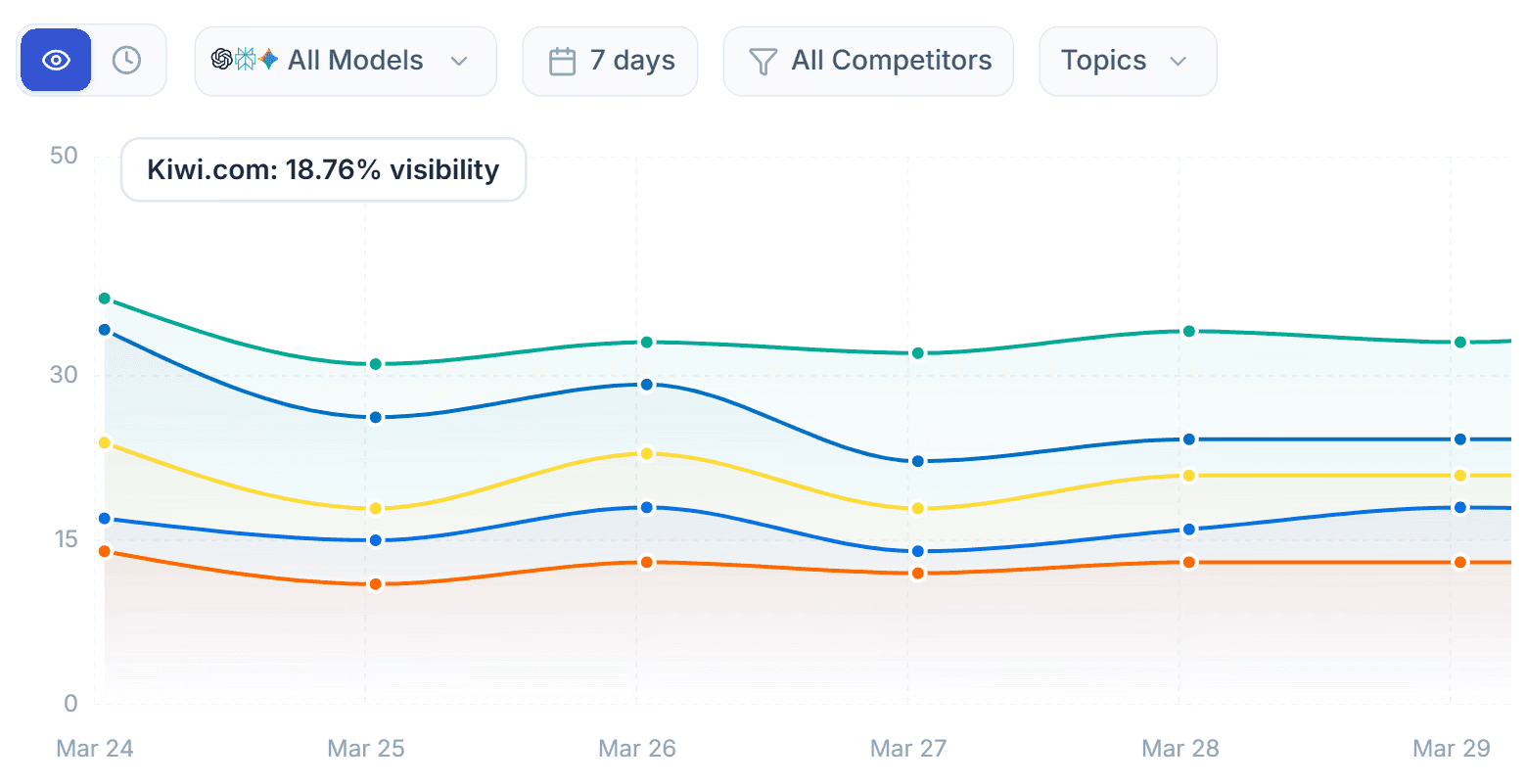
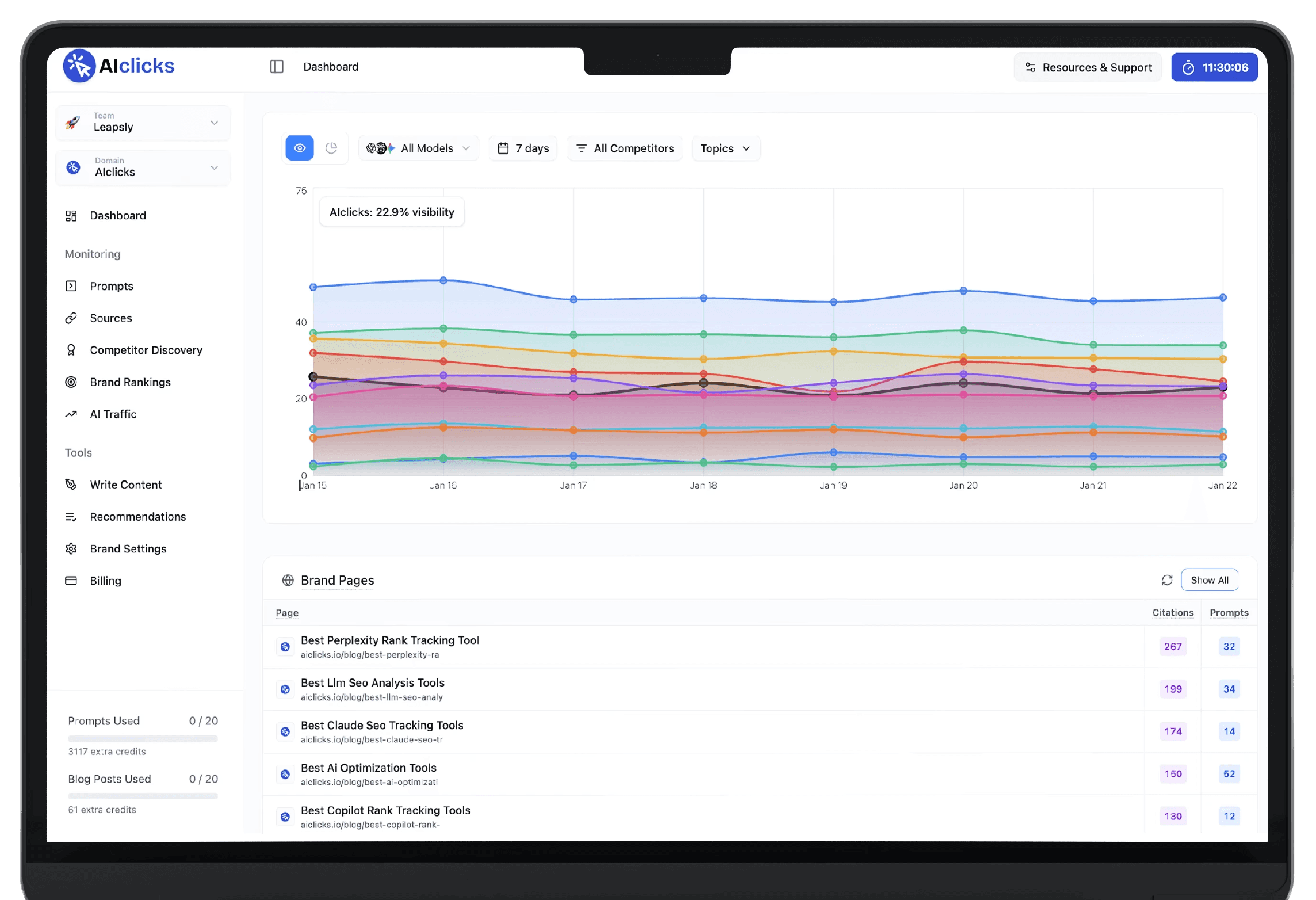
AIclicks gives you a live dashboard with daily ChatGPT mention rate, citation rate, sentiment, and share-of-voice across your tracked prompts, plus GA4 referral attribution for the traffic ChatGPT does send back.
Choose Your Plan
Flexible pricing that grows with your team. Upgrade or downgrade at any time.
Monthly
Yearly
-20%
Starter
Perfect for individuals & small teams
$49
/ month
Billed annually — you save $142
Choose 3 from:
Daily

" height="16px" id="fvSweaOBo" transform="translate(1 0)" width="14px"/></svg>)
" width="14px"><path d="M 13.864 5.629 L 13.3 5.629 L 13.3 5.6 L 7 5.6 L 7 8.4 L 10.956 8.4 C 10.379 10.03 8.828 11.2 7 11.2 C 4.681 11.2 2.8 9.319 2.8 7 C 2.8 4.681 4.681 2.8 7 2.8 C 8.071 2.8 9.045 3.204 9.786 3.864 L 11.766 1.884 C 10.516 0.719 8.844 0 7 0 C 3.134 0 0 3.134 0 7 C 0 10.866 3.134 14 7 14 C 10.866 14 14 10.866 14 7 C 14 6.531 13.952 6.073 13.864 5.629 Z" fill="rgb(255, 193, 7)" height="14px" id="H_YjfTNpn" width="14px"/><path d="M 0 3.742 L 2.3 5.429 C 2.922 3.888 4.429 2.8 6.193 2.8 C 7.264 2.8 8.238 3.204 8.979 3.864 L 10.959 1.884 C 9.709 0.719 8.037 0 6.193 0 C 3.504 0 1.172 1.518 0 3.742 Z" fill="rgb(255, 61, 0)" height="5.428500000000002px" id="PlkthQDhg" transform="translate(0.875 0)" width="10.959199999999996px"/><path d="M 6.232 5.581 C 8.04 5.581 9.683 4.889 10.925 3.764 L 8.758 1.931 C 8.032 2.483 7.144 2.782 6.232 2.781 C 4.411 2.781 2.865 1.62 2.283 0 L 0 1.759 C 1.159 4.026 3.511 5.581 6.232 5.581 Z" fill="rgb(76, 175, 80)" height="5.581099999999999px" id="WlnJ5gngE" transform="translate(0.7 8.4)" width="10.924899999999994px"/><path d="M 6.864 0.029 L 6.3 0.029 L 6.3 0 L 0 0 L 0 2.8 L 3.956 2.8 C 3.68 3.576 3.183 4.254 2.526 4.75 L 2.527 4.749 L 4.693 6.582 C 4.54 6.722 7 4.9 7 1.4 C 7 0.931 6.952 0.473 6.864 0.029 Z" fill="rgb(25, 118, 210)" height="6.589883930775992px" id="x_rSW275p" transform="translate(7 5.6)" width="7px"/></g></svg>)
" height="16px" id="hHS98fTxZ" width="16px"/></svg>)
 scale(1 1) translate(-1.861736945942159, -1.1170155383302638)" id="P20NzAvj0-699428820-radial-gradient" r="0.9935228066204626"><stop offset="0" stop-color="rgb(0, 174, 255)"/><stop offset="1" stop-color="rgb(7, 54, 196)"/></radialGradient><radialGradient cx="0.48250042504016705" cy="1.8366934653567062" gradient-transform="translate(0.48250042504016705, 1.8366934653567062) scale(1 1) translate(-0.48250042504016705, -1.8366934653567062)" id="UEWZqVjij-699428820-radial-gradient" r="0.9176890228114506"><stop offset="0" stop-color="rgb(255, 182, 87)"/><stop offset="1" stop-color="rgb(192, 43, 60)"/></radialGradient><linearGradient id="jyMN3TmKx-699428820-linear-gradient" x1="0.4594862532842614" x2="0.5405137467157386" y1="0" y2="1"><stop offset="0" stop-color="rgb(13, 145, 225)"/><stop offset="1" stop-color="rgb(255, 200, 0)"/></linearGradient><linearGradient id="xhMNwDFG0-699428820-linear-gradient" x1="0.4784828731548295" x2="0.5215171268451705" y1="5.551115123125783e-17" y2="1"><stop offset="0" stop-color="rgb(61, 203, 255)"/><stop offset="1" stop-color="rgba(5, 136, 247, 0)"/></linearGradient><radialGradient cx="1.4305090871482182" cy="0.34866158048251783" gradient-transform="translate(1.4305090871482182, 0.34866158048251783) scale(1 1) translate(-1.4305090871482182, -0.34866158048251783)" id="i79kAqaS4-699428820-radial-gradient" r="1.3362743412697924"><stop offset="0" stop-color="rgb(140, 72, 255)"/><stop offset="1" stop-color="rgb(255, 177, 82)"/></radialGradient><linearGradient id="mcxvno3tX-699428820-linear-gradient" x1="0.49844355920154226" x2="0.5015564407984577" y1="0" y2="1"><stop offset="0" stop-color="rgb(248, 173, 250)"/><stop offset="1" stop-color="rgba(168, 110, 221, 0)"/></linearGradient></defs><g d="M 11.605 1.219 C 11.397 0.499 10.739 0.002 9.989 0 L 9.498 0 C 8.682 0.002 7.985 0.588 7.842 1.391 L 7 6.016 L 7.209 5.296 C 7.416 4.574 8.075 4.076 8.825 4.074 L 11.681 4.074 L 12.879 4.545 L 14.033 4.074 L 13.697 4.074 C 12.947 4.072 12.289 3.575 12.081 2.855 Z M 4.413 13.387 C 4.618 14.111 5.278 14.611 6.031 14.613 L 7.075 14.613 C 7.988 14.613 8.735 13.88 8.758 12.96 L 8.871 8.5 L 8.633 9.319 C 8.426 10.039 7.768 10.537 7.018 10.539 L 4.138 10.539 L 3.111 9.977 L 2 10.539 L 2.331 10.539 C 3.084 10.542 3.743 11.042 3.949 11.766 L 4.413 13.387 Z M 9.999 0 L 4.167 0 C 2.501 0 1.501 2.221 0.834 4.441 C 0.045 7.073 -0.989 10.591 2.001 10.591 L 4.519 10.591 C 5.273 10.591 5.933 10.089 6.139 9.36 C 6.577 7.815 7.345 5.121 7.948 3.069 C 8.255 2.027 8.509 1.132 8.901 0.575 C 9.148 0.212 9.56 -0.004 9.999 0 M 9.999 0 L 4.167 0 C 2.501 0 1.501 2.221 0.834 4.441 C 0.045 7.073 -0.989 10.591 2.001 10.591 L 4.519 10.591 C 5.273 10.591 5.933 10.089 6.139 9.36 C 6.577 7.815 7.345 5.121 7.948 3.069 C 8.255 2.027 8.509 1.132 8.901 0.575 C 9.148 0.212 9.56 -0.004 9.999 0 M 6 14.593 L 11.833 14.593 C 13.499 14.593 14.499 12.372 15.166 10.151 C 15.955 7.519 16.989 4 13.999 4 L 11.48 4 C 10.725 4.002 10.063 4.505 9.86 5.232 C 9.266 7.332 8.663 9.429 8.051 11.523 C 7.745 12.566 7.49 13.461 7.098 14.019 C 6.851 14.382 6.439 14.597 6 14.593 M 6 14.593 L 11.833 14.593 C 13.499 14.593 14.499 12.372 15.166 10.151 C 15.955 7.519 16.989 4 13.999 4 L 11.48 4 C 10.725 4.002 10.063 4.505 9.86 5.232 C 9.266 7.332 8.663 9.429 8.051 11.523 C 7.745 12.566 7.49 13.461 7.098 14.019 C 6.851 14.382 6.439 14.597 6 14.593" fill="transparent" height="14.613333333333333px" id="QzkBy4Ibc" transform="translate(0 1)" width="16.00011071294081px"><path d="M 4.605 1.219 C 4.397 0.499 3.739 0.002 2.989 0 L 2.498 0 C 1.682 0.002 0.985 0.588 0.842 1.391 L 0 6.016 L 0.209 5.296 C 0.416 4.574 1.075 4.076 1.825 4.074 L 4.681 4.074 L 5.879 4.545 L 7.033 4.074 L 6.697 4.074 C 5.947 4.072 5.289 3.575 5.081 2.855 Z" fill="url(%23P20NzAvj0-699428820-radial-gradient)" height="6.016px" id="P20NzAvj0" transform="translate(7 0)" width="7.0333333333333385px"/><path d="M 2.413 4.887 C 2.618 5.611 3.278 6.111 4.031 6.113 L 5.075 6.113 C 5.988 6.113 6.735 5.38 6.758 4.46 L 6.871 0 L 6.633 0.819 C 6.426 1.539 5.768 2.037 5.018 2.039 L 2.138 2.039 L 1.111 1.477 L 0 2.039 L 0.331 2.039 C 1.084 2.042 1.743 2.542 1.949 3.266 L 2.413 4.887 Z" fill="url(%23UEWZqVjij-699428820-radial-gradient)" height="6.113333333333333px" id="UEWZqVjij" transform="translate(2 8.5)" width="6.871333333333332px"/><path d="M 9.999 0 L 4.167 0 C 2.501 0 1.501 2.221 0.834 4.441 C 0.045 7.073 -0.989 10.591 2.001 10.591 L 4.519 10.591 C 5.273 10.591 5.933 10.089 6.139 9.36 C 6.577 7.815 7.345 5.121 7.948 3.069 C 8.255 2.027 8.509 1.132 8.901 0.575 C 9.148 0.212 9.56 -0.004 9.999 0" fill="url(%23jyMN3TmKx-699428820-linear-gradient)" height="10.591388755215167px" id="jyMN3TmKx" width="9.999444046274142px"/><path d="M 9.999 0 L 4.167 0 C 2.501 0 1.501 2.221 0.834 4.441 C 0.045 7.073 -0.989 10.591 2.001 10.591 L 4.519 10.591 C 5.273 10.591 5.933 10.089 6.139 9.36 C 6.577 7.815 7.345 5.121 7.948 3.069 C 8.255 2.027 8.509 1.132 8.901 0.575 C 9.148 0.212 9.56 -0.004 9.999 0" fill="url(%23xhMNwDFG0-699428820-linear-gradient)" height="10.591388755215167px" id="xhMNwDFG0" width="9.999444046274142px"/><path d="M 0 10.593 L 5.833 10.593 C 7.499 10.593 8.499 8.372 9.166 6.151 C 9.955 3.519 10.989 0 7.999 0 L 5.48 0 C 4.725 0.002 4.063 0.505 3.86 1.232 C 3.266 3.332 2.663 5.429 2.051 7.523 C 1.745 8.566 1.49 9.461 1.098 10.019 C 0.851 10.382 0.439 10.597 0 10.593" fill="url(%23i79kAqaS4-699428820-radial-gradient)" height="10.593388755215164px" id="i79kAqaS4" transform="translate(6 4)" width="10.000110712940803px"/><path d="M 0 10.593 L 5.833 10.593 C 7.499 10.593 8.499 8.372 9.166 6.151 C 9.955 3.519 10.989 0 7.999 0 L 5.48 0 C 4.725 0.002 4.063 0.505 3.86 1.232 C 3.266 3.332 2.663 5.429 2.051 7.523 C 1.745 8.566 1.49 9.461 1.098 10.019 C 0.851 10.382 0.439 10.597 0 10.593" fill="url(%23mcxvno3tX-699428820-linear-gradient)" height="10.593388755215164px" id="mcxvno3tX" transform="translate(6 4)" width="10.000110712940803px"/></g></svg>)
" height="15.360666565427872px" id="HZPvvPBv7" transform="translate(0 0.5)" width="16px"/></svg>)
Tracked prompts
30
Websites you can add
3
LLMs you can track
3
Countries per project
1
LLM responses / mo
4,650
AI-optimized articles per month
10
Integrations
-
Support
Pro
For growing teams for more power
$140
/ month
Billed annually — you save $454
Choose 4 from:
Daily
Tracked prompts
150
Websites you can add
Unlimited
LLMs you can track
4
Countries per project
Unlimited
LLM responses / mo
18,600
AI-optimized articles per month
20
Integrations
Google Analytics
Support
BUSINESS
Best for medium-sized organizations
$357
/ month
Billed annually — you save $1198
Choose 6 from:
Daily
Tracked prompts
300
Websites you can add
Unlimited
LLMs you can track
6
Countries per project
Unlimited
LLM responses / mo
55,800
AI-optimized articles per month
30
Integrations
Google Analytics, API
Support
Dedicated account specialist
Become the #1 Answer in AI
Succeed in GEO yourself, or let us do all the work.
Do it yourself
Use AIclicks to see exactly where you appear across 10+ AI platforms, spot the gaps competitors are filling, and act on clear weekly recommendations.
From $59/month · Cancel anytime
Done for you
We Do All the Work for You
Our team manages your complete search presence: traditional SEO and GEO strategy, content, implementation, and reporting. You focus on families.
Custom pricing · Minimum 3-month engagement
The AI SEO agency trusted by 1,000+ brands worldwide
From solo founders to multi-client agencies, AIclicks runs the full AI SEO agency program for organizations of every shape and size that want to be cited across every AI surface.
4.9/5 stars on G2







FAQ
How long before SEO increases our enrollment inquiries?
Map and local visibility usually shifts inside 4 months; program-page rankings take 6 to 12. The honest complication is that education runs on an annual cycle, so work finished in March mostly pays off in the following inquiry season rather than this one. Institutions in less crowded markets move faster. Watch inquiry-form submissions by landing page from month 2, since those move first.
Is Google still worth it if families ask AI?
Both, and the split matters more every year. Ahrefs looked at 863,000 keywords and found only 38% of pages cited in AI Overviews also ranked in the top 10, down from 76% a year earlier. A top-10 slot guarantees nothing now. When a parent asks an assistant to compare schools for a specific child, the model leans on ranking portals and parent forums it can quote cleanly. Being accurate, accredited and structured is what gets a school named.
Why is school SEO its own discipline?
Three things separate them. Demand is seasonal and annual, so a missed application window costs a full year rather than a week. Your competitors are ranking sites, Niche and U.S. News, that hold data about you that you did not write. And FERPA plus accreditation rules limit what a school may say publicly about students and outcomes, which shapes every testimonial, photo and results page. Advice written for a generic local business misses all 3 entirely.
What should a school budget for SEO each year?
Budget roughly $1,500 to $4,000 each month for one campus, and $5,000 to $15,000 where many programs and departments need coordinating. Offshore agencies quote a fraction of that, which is why they dominate the education threads on Reddit; the recurring complaint is that nobody can verify the case studies. Weigh any retainer beside what a single inquiry costs you today, rather than beside zero.
How should paid enrollment ads and SEO work together?
Each covers a stretch the other cannot. Ads and purchased name lists fill this year’s funnel, then go quiet the moment finance closes the budget; organic and AI visibility keep earning between cycles, when families research quietly and no campaign is live. Run both, and put paid search on the program terms organic cannot reach yet. Judge the pair on cost per enrolled student, never on clicks or names bought.
Which pages should we fix first on our site?
Start free: the Google Business Profile plus your Niche and GreatSchools listings, which cost nothing and outrank your own site. Then the tuition and financial aid page, the most-read page on almost every school site and usually the vaguest. Then one page per program, phrased the way applicants actually ask. Requirements and application deadlines follow. The news feed comes last, and most schools start there.
How can we tell the work is paying off?
Count inquiries and applications produced by organic search, not by ranking positions. Tag each inquiry form with its landing page and match it against Slate, Blackbaud or whichever CRM admissions actually uses, so the pages producing applicants rather than visitors become visible. Search Console impressions on program terms are the earliest honest signal available. Track tour bookings and open house registrations separately, because those are the closest leading indicator of enrollment.
Do we need an agency, or can staff handle this?
Divide it by where the knowledge actually lives. Profile upkeep, review requests, program copy and answering family questions should stay with staff, since only admissions hears what applicants ask. Technical work, schema, crawl cleanup and link building need a specialist. Any outside hire must be fluent in FERPA, accreditor rules and the annual enrollment cycle. A generalist agency will publish outcome claims your accreditation office then has to retract.
Further Reading
Go deeper on GEO, AI search, and visibility tracking.