SEO for Medical Practices:
Patients research a doctor before they trust one. They compare review scores, check whether you take their insurance, and read what an AI assistant says about your practice, all before reception ever picks up. Search visibility now decides who gets considered at all.









Why Medical Practices Need SEO
Google AI Overviews now sit above the results for a large share of health queries, and Ahrefs found only 38% of the pages they cite were ranking in the top 10.
Your site is organised by department because that is how the practice is organised. Patients search foot doctor, not podiatrist, and itchy rash that will not heal, not dermatology. Every one of those is a page you have not written, and a competitor with plainer language collects the appointment instead.
Search primary care doctor near me in a US city and the page fills with regional hospital systems and booking platforms like Zocdoc before one independent practice appears. Health systems bring huge domain authority and platforms bring aggregate reviews. A clinic competes with institutions, not peers.
Specialist agencies quote $1,500 to $5,000 a month for a single-location practice, and more in competitive markets. Much of it goes to paid placement that stops the day the invoice does. Meanwhile the assets that would keep working, credentialed condition pages and a maintained profile, never get built.
How SEO Works for Medical Practices
Search Engine Optimization projects are long-term investments for doctors, where each task supplements the others and creates compound results over time.
01
Keywords, page structure, and the signals Google reads directly
Medical on-page work runs into the strictest standard Google applies to anything. Health content is YMYL, and the search quality guidelines expect visible evidence that a qualified person wrote it. A page about a treatment, published anonymously, will lose to an identical page carrying a physician’s name, board certification and a medically reviewed by line. That single difference outweighs most of what generic SEO advice tells you to do. The pages carrying this weight are your condition pages, your treatment pages and your physician bios, which double as your credibility infrastructure.
Condition and treatment pages are the durable layer. What to expect at a colonoscopy, how long recovery takes after a knee replacement, whether a symptom warrants an appointment: these questions repeat every year, from new patients, in identical words. A page answering one of them properly keeps producing appointments indefinitely. What churns is the practice news feed, the flu clinic announcement, the awareness-month post. Those age out within weeks and dilute the site’s topical focus while they sit there. A practice with 40 condition pages and no blog will outperform one with the reverse almost every time.
1
Rewrite service pages under the words patients use, keeping the clinical term as a subheading rather than the title.
2
When a doctor leaves, redirect their bio to the department page rather than deleting it, preserving the links it earned.
3
Apply Physician and MedicalOrganization schema with specialty, credentials and hospital affiliations, since these feed both rich results and AI citations.
4
Publish one page per condition you treat, reviewed and signed by a named physician, and revisit the clinical detail annually.
02
Map Pack visibility, citations, and proximity signals
Most medical demand is local and most of it converts through the map pack rather than the website. A patient searching for a doctor near them sees 3 practices with ratings, hours and a call button before any organic result loads. That block outranks the hospital systems that dominate everything below it, which makes it the one competitive surface where an independent practice starts level. Proximity you cannot change; completeness and reviews you can.
Pick the precise specialty as the primary category, Family Practice Physician or Orthopedic Surgeon rather than Doctor or Medical Clinic, because the generic option competes against everything. List each service separately with its own description. Add real photos of the building, the entrance and the waiting room, which reduce no-shows as much as they help rankings. Then pre-populate the Q&A with what reception is asked 20 times a day: parking, insurance, wait times, whether you take new patients.
The citations that matter in medicine are the health directories rather than the general ones. Healthgrades, Zocdoc, Vitals, WebMD and your specialty board’s own find-a-physician tool carry weight because they verify licensure. Insurer provider directories matter just as much, since patients filter by plan first. The catch is that these listings are often populated from stale claims data, so a practice can have 4 addresses in circulation without knowing. Every mismatch weakens the whole set.
1
Set the primary category to your precise specialty, never Doctor or Medical Clinic, and list every procedure as its own service.
2
Give each clinic its own profile and a substantive page naming the physicians who practise there, with LocalBusiness schema.
3
Check Healthgrades, Zocdoc, Vitals and every insurer portal for outdated addresses pulled from old claims data, and correct each one.
4
Post weekly on seasonal health topics, new appointment availability or a physician introduction, since Google rewards visibly maintained profiles.
03
Topic authority, inbound links, and content that earns traffic
Patients researching care are usually trying to answer one anxious question: is this serious enough to see someone about? Content that answers it directly, with a clear line on when to book and when to wait, builds more trust than any credential list. The same reader wants to know what the visit involves, what it costs with and without insurance, and how long they will wait for an appointment. Very few practice websites answer any of that.
The patient who has decided to book is choosing between you and 2 others, and the deciding factors are mundane. Do you take their plan. How soon can they be seen. Who exactly will they see, and what are that person’s credentials. Is there parking. Put all of it on the page rather than behind a contact form, and make the booking path one click. Practices lose decided patients to an unanswered insurance question more often than to a competitor’s clinical reputation.
Medical links come from institutions rather than outreach. Hospital affiliation pages, residency and medical school alumni directories, specialty society member listings and clinical trial registries all link out and rarely get claimed. Local health reporting needs a clinician willing to comment on a seasonal story. Community health fairs, employer wellness programmes and school sports physicals produce sponsor pages. None of this is link building in the SEO sense; it is documenting relationships the practice already has.
1
Publish an annual guide to what each common visit costs with and without insurance, which almost no practice site currently offers.
2
Build a page per condition per clinic location, naming the physicians who treat it there rather than swapping the city name.
3
Cluster every coverage question into one hub: plans accepted, self-pay pricing, referral requirements, deductibles, and what happens if you are out of network.
4
Write a page for each procedure and device you actually use, since patients increasingly search the brand name before the specialty.
04
Site speed, crawlability, Core Web Vitals, and mobile health
The technical failure specific to medicine is the patient form. Practices bolt on a contact form, a symptom questionnaire or a chat widget from a general web vendor, and it starts collecting health information over a channel with no Business Associate Agreement behind it. It is a compliance exposure first and an SEO problem second, because these third-party scripts are also the heaviest things on the page. Most practices have never audited what their forms transmit or where it lands.
Medical searches happen on phones, often by someone unwell, sometimes by a relative standing in a hospital car park. Patience is minimal. Medical sites are also unusually image-heavy, carrying team portraits and facility photography that push Largest Contentful Paint well past the 2.5 second threshold. If the page stalls, or the appointment button is buried under a cookie notice and a chat bubble, the patient goes back and books with whoever loads first.
1
Inventory every form, chat widget and booking script, confirm encrypted transmission, and get a Business Associate Agreement from each vendor.
2
Run PageSpeed Insights on your heaviest physician bio and target Largest Contentful Paint under 2.5 seconds and layout shift under 0.1.
3
Convert physician portraits and facility galleries to WebP at display dimensions, with width and height declared to prevent shifting.
4
Separate condition, physician and location pages into their own sitemaps, and resubmit whenever a clinician joins or a page is reviewed.
05
Star ratings, review volume, and response strategy that builds trust
Reviews carry more weight in medicine than in almost any other local category, because the patient is choosing who to trust with their health and has no way to assess clinical skill. What they can assess is whether they were listened to. That is also why medical reviews are so hard to manage: they rarely describe the medicine at all, and a five-star physician can carry a three-star rating earned entirely by the billing department and the wait time.
The right moment is checkout, while the patient is still in the building and the visit went well. A text sent within an hour of discharge, from the practice rather than a generic platform, converts far better than an email the following week. Wire it into the practice management system so it fires on visit completion and never on a cancelled or no-show appointment. Ask every patient rather than selectively, which is both more effective and the only defensible approach.
1
Trigger a review text from Athenahealth, Epic or Weave within an hour of visit completion, sent under the practice name.
2
Respond within 24 hours acknowledging the concern without confirming the person was ever a patient, then move the conversation offline.
3
Display reviews naming a specific doctor on that doctor’s bio page, where they reinforce the credentials rather than sitting anonymously site-wide.
4
Ask about scheduling and billing experience separately, since those drive most negative ratings and are fixable without touching clinical care.
Google is No Longer the Only Place Your patients are Searching
Patients are using AI to find answers, and they trust what it tells them. Invest in GEO to get recommended in those answers.
1 Billion
Questions ChatGPT receives every single day
38%
Your #1 top ranking page on Google would be cited by AI
14%
of doctors optimise for GEO. The rest are invisible in AI answers


You can rank #1 for “doctor near me” and still not exist in ChatGPT’s answer. Run a free GEO audit to see where your brand actually stands.
GEO vs SEO: Same Goal, Different Methods
GEO is wider than SEO. AI recommends the brands that show up across the sources it reads, so your presence in forums, social platforms and medical blogs decides your odds. AIclicks measures the three metrics below so you know which to work on first.
AI Assistant
Which clinic takes new patients on my insurance?
Your Practice
Citation Rate
Shows how many AI answers about medical practices name your brand, out of every 100. Models pull from the same trusted pages over and over, so citations compound: once you are in, staying in gets easier. Find the competitor pages AI cites most, then publish your own version of each.
Your Practice
82% positive
Competitor A
54% positive
Competitor B
38% positive
Brand Sentiment
Shows how AI describes you when your brand comes up: positive, neutral or negative. Tone is what separates being mentioned from being recommended, and models repeat whatever framing they find. Track the negative mentions back to the reviews and threads behind them, then publish content that answers those directly.
Others 52%
You 24%
— 24%
Your Practice
AI mention share of voice — medical category
Competitors
Not Cited
Share of Voice in AI
Shows how much of the medical conversation belongs to you rather than your competitors. This is the metric that matters most, the GEO version of a Google ranking. With only 1–5 brands named per answer, the market is winner-takes-more and every point is taken from someone.
The Dashboard Your Dedicated AI Search Team Works In
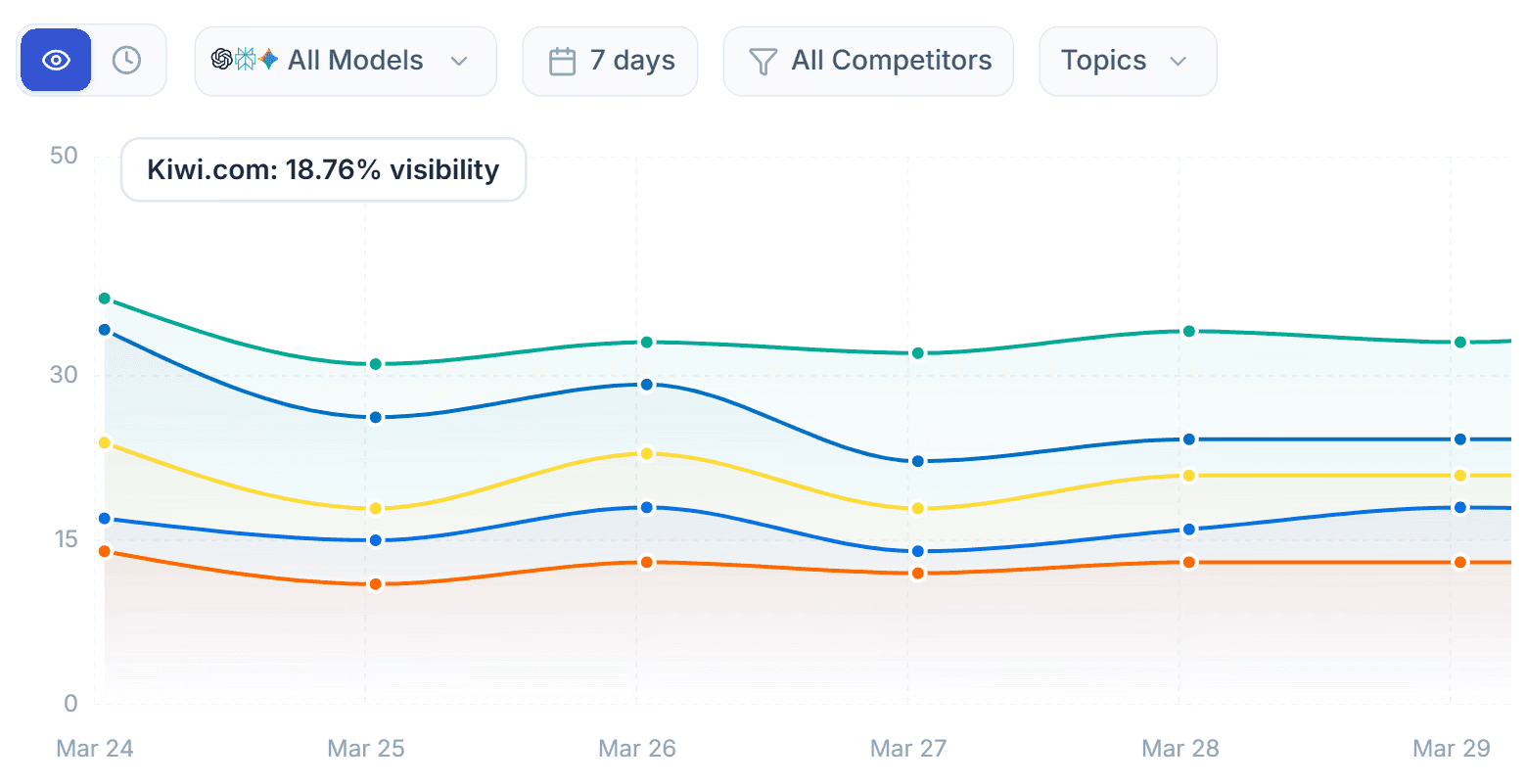
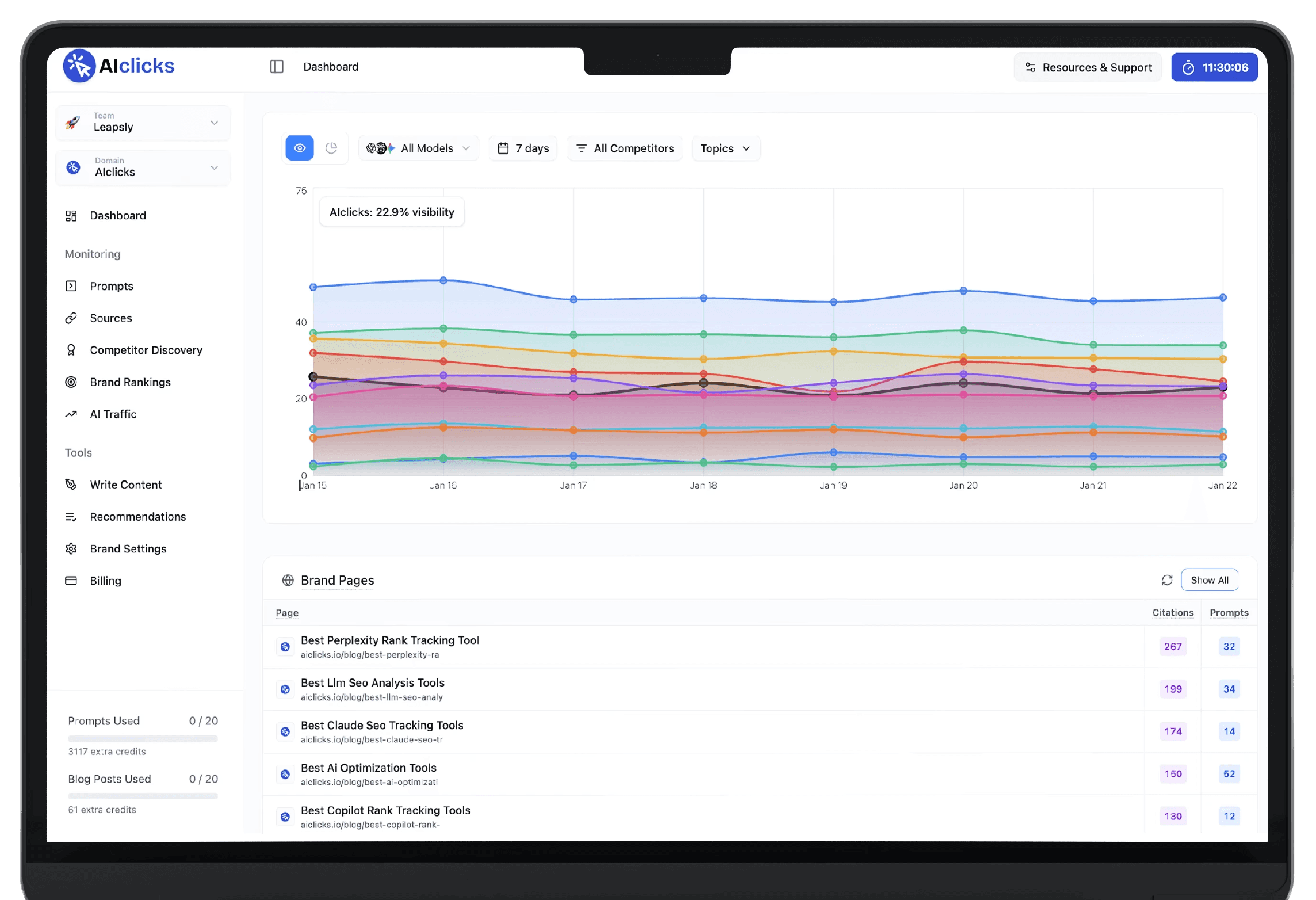
AIclicks gives you a live dashboard with daily ChatGPT mention rate, citation rate, sentiment, and share-of-voice across your tracked prompts, plus GA4 referral attribution for the traffic ChatGPT does send back.
Choose Your Plan
Flexible pricing that grows with your team. Upgrade or downgrade at any time.
Monthly
Yearly
-20%
Starter
Perfect for individuals & small teams
$49
/ month
Billed annually — you save $142
Choose 3 from:
Daily

" height="16px" id="fvSweaOBo" transform="translate(1 0)" width="14px"/></svg>)
" width="14px"><path d="M 13.864 5.629 L 13.3 5.629 L 13.3 5.6 L 7 5.6 L 7 8.4 L 10.956 8.4 C 10.379 10.03 8.828 11.2 7 11.2 C 4.681 11.2 2.8 9.319 2.8 7 C 2.8 4.681 4.681 2.8 7 2.8 C 8.071 2.8 9.045 3.204 9.786 3.864 L 11.766 1.884 C 10.516 0.719 8.844 0 7 0 C 3.134 0 0 3.134 0 7 C 0 10.866 3.134 14 7 14 C 10.866 14 14 10.866 14 7 C 14 6.531 13.952 6.073 13.864 5.629 Z" fill="rgb(255, 193, 7)" height="14px" id="H_YjfTNpn" width="14px"/><path d="M 0 3.742 L 2.3 5.429 C 2.922 3.888 4.429 2.8 6.193 2.8 C 7.264 2.8 8.238 3.204 8.979 3.864 L 10.959 1.884 C 9.709 0.719 8.037 0 6.193 0 C 3.504 0 1.172 1.518 0 3.742 Z" fill="rgb(255, 61, 0)" height="5.428500000000002px" id="PlkthQDhg" transform="translate(0.875 0)" width="10.959199999999996px"/><path d="M 6.232 5.581 C 8.04 5.581 9.683 4.889 10.925 3.764 L 8.758 1.931 C 8.032 2.483 7.144 2.782 6.232 2.781 C 4.411 2.781 2.865 1.62 2.283 0 L 0 1.759 C 1.159 4.026 3.511 5.581 6.232 5.581 Z" fill="rgb(76, 175, 80)" height="5.581099999999999px" id="WlnJ5gngE" transform="translate(0.7 8.4)" width="10.924899999999994px"/><path d="M 6.864 0.029 L 6.3 0.029 L 6.3 0 L 0 0 L 0 2.8 L 3.956 2.8 C 3.68 3.576 3.183 4.254 2.526 4.75 L 2.527 4.749 L 4.693 6.582 C 4.54 6.722 7 4.9 7 1.4 C 7 0.931 6.952 0.473 6.864 0.029 Z" fill="rgb(25, 118, 210)" height="6.589883930775992px" id="x_rSW275p" transform="translate(7 5.6)" width="7px"/></g></svg>)
" height="16px" id="hHS98fTxZ" width="16px"/></svg>)
 scale(1 1) translate(-1.861736945942159, -1.1170155383302638)" id="P20NzAvj0-699428820-radial-gradient" r="0.9935228066204626"><stop offset="0" stop-color="rgb(0, 174, 255)"/><stop offset="1" stop-color="rgb(7, 54, 196)"/></radialGradient><radialGradient cx="0.48250042504016705" cy="1.8366934653567062" gradient-transform="translate(0.48250042504016705, 1.8366934653567062) scale(1 1) translate(-0.48250042504016705, -1.8366934653567062)" id="UEWZqVjij-699428820-radial-gradient" r="0.9176890228114506"><stop offset="0" stop-color="rgb(255, 182, 87)"/><stop offset="1" stop-color="rgb(192, 43, 60)"/></radialGradient><linearGradient id="jyMN3TmKx-699428820-linear-gradient" x1="0.4594862532842614" x2="0.5405137467157386" y1="0" y2="1"><stop offset="0" stop-color="rgb(13, 145, 225)"/><stop offset="1" stop-color="rgb(255, 200, 0)"/></linearGradient><linearGradient id="xhMNwDFG0-699428820-linear-gradient" x1="0.4784828731548295" x2="0.5215171268451705" y1="5.551115123125783e-17" y2="1"><stop offset="0" stop-color="rgb(61, 203, 255)"/><stop offset="1" stop-color="rgba(5, 136, 247, 0)"/></linearGradient><radialGradient cx="1.4305090871482182" cy="0.34866158048251783" gradient-transform="translate(1.4305090871482182, 0.34866158048251783) scale(1 1) translate(-1.4305090871482182, -0.34866158048251783)" id="i79kAqaS4-699428820-radial-gradient" r="1.3362743412697924"><stop offset="0" stop-color="rgb(140, 72, 255)"/><stop offset="1" stop-color="rgb(255, 177, 82)"/></radialGradient><linearGradient id="mcxvno3tX-699428820-linear-gradient" x1="0.49844355920154226" x2="0.5015564407984577" y1="0" y2="1"><stop offset="0" stop-color="rgb(248, 173, 250)"/><stop offset="1" stop-color="rgba(168, 110, 221, 0)"/></linearGradient></defs><g d="M 11.605 1.219 C 11.397 0.499 10.739 0.002 9.989 0 L 9.498 0 C 8.682 0.002 7.985 0.588 7.842 1.391 L 7 6.016 L 7.209 5.296 C 7.416 4.574 8.075 4.076 8.825 4.074 L 11.681 4.074 L 12.879 4.545 L 14.033 4.074 L 13.697 4.074 C 12.947 4.072 12.289 3.575 12.081 2.855 Z M 4.413 13.387 C 4.618 14.111 5.278 14.611 6.031 14.613 L 7.075 14.613 C 7.988 14.613 8.735 13.88 8.758 12.96 L 8.871 8.5 L 8.633 9.319 C 8.426 10.039 7.768 10.537 7.018 10.539 L 4.138 10.539 L 3.111 9.977 L 2 10.539 L 2.331 10.539 C 3.084 10.542 3.743 11.042 3.949 11.766 L 4.413 13.387 Z M 9.999 0 L 4.167 0 C 2.501 0 1.501 2.221 0.834 4.441 C 0.045 7.073 -0.989 10.591 2.001 10.591 L 4.519 10.591 C 5.273 10.591 5.933 10.089 6.139 9.36 C 6.577 7.815 7.345 5.121 7.948 3.069 C 8.255 2.027 8.509 1.132 8.901 0.575 C 9.148 0.212 9.56 -0.004 9.999 0 M 9.999 0 L 4.167 0 C 2.501 0 1.501 2.221 0.834 4.441 C 0.045 7.073 -0.989 10.591 2.001 10.591 L 4.519 10.591 C 5.273 10.591 5.933 10.089 6.139 9.36 C 6.577 7.815 7.345 5.121 7.948 3.069 C 8.255 2.027 8.509 1.132 8.901 0.575 C 9.148 0.212 9.56 -0.004 9.999 0 M 6 14.593 L 11.833 14.593 C 13.499 14.593 14.499 12.372 15.166 10.151 C 15.955 7.519 16.989 4 13.999 4 L 11.48 4 C 10.725 4.002 10.063 4.505 9.86 5.232 C 9.266 7.332 8.663 9.429 8.051 11.523 C 7.745 12.566 7.49 13.461 7.098 14.019 C 6.851 14.382 6.439 14.597 6 14.593 M 6 14.593 L 11.833 14.593 C 13.499 14.593 14.499 12.372 15.166 10.151 C 15.955 7.519 16.989 4 13.999 4 L 11.48 4 C 10.725 4.002 10.063 4.505 9.86 5.232 C 9.266 7.332 8.663 9.429 8.051 11.523 C 7.745 12.566 7.49 13.461 7.098 14.019 C 6.851 14.382 6.439 14.597 6 14.593" fill="transparent" height="14.613333333333333px" id="QzkBy4Ibc" transform="translate(0 1)" width="16.00011071294081px"><path d="M 4.605 1.219 C 4.397 0.499 3.739 0.002 2.989 0 L 2.498 0 C 1.682 0.002 0.985 0.588 0.842 1.391 L 0 6.016 L 0.209 5.296 C 0.416 4.574 1.075 4.076 1.825 4.074 L 4.681 4.074 L 5.879 4.545 L 7.033 4.074 L 6.697 4.074 C 5.947 4.072 5.289 3.575 5.081 2.855 Z" fill="url(%23P20NzAvj0-699428820-radial-gradient)" height="6.016px" id="P20NzAvj0" transform="translate(7 0)" width="7.0333333333333385px"/><path d="M 2.413 4.887 C 2.618 5.611 3.278 6.111 4.031 6.113 L 5.075 6.113 C 5.988 6.113 6.735 5.38 6.758 4.46 L 6.871 0 L 6.633 0.819 C 6.426 1.539 5.768 2.037 5.018 2.039 L 2.138 2.039 L 1.111 1.477 L 0 2.039 L 0.331 2.039 C 1.084 2.042 1.743 2.542 1.949 3.266 L 2.413 4.887 Z" fill="url(%23UEWZqVjij-699428820-radial-gradient)" height="6.113333333333333px" id="UEWZqVjij" transform="translate(2 8.5)" width="6.871333333333332px"/><path d="M 9.999 0 L 4.167 0 C 2.501 0 1.501 2.221 0.834 4.441 C 0.045 7.073 -0.989 10.591 2.001 10.591 L 4.519 10.591 C 5.273 10.591 5.933 10.089 6.139 9.36 C 6.577 7.815 7.345 5.121 7.948 3.069 C 8.255 2.027 8.509 1.132 8.901 0.575 C 9.148 0.212 9.56 -0.004 9.999 0" fill="url(%23jyMN3TmKx-699428820-linear-gradient)" height="10.591388755215167px" id="jyMN3TmKx" width="9.999444046274142px"/><path d="M 9.999 0 L 4.167 0 C 2.501 0 1.501 2.221 0.834 4.441 C 0.045 7.073 -0.989 10.591 2.001 10.591 L 4.519 10.591 C 5.273 10.591 5.933 10.089 6.139 9.36 C 6.577 7.815 7.345 5.121 7.948 3.069 C 8.255 2.027 8.509 1.132 8.901 0.575 C 9.148 0.212 9.56 -0.004 9.999 0" fill="url(%23xhMNwDFG0-699428820-linear-gradient)" height="10.591388755215167px" id="xhMNwDFG0" width="9.999444046274142px"/><path d="M 0 10.593 L 5.833 10.593 C 7.499 10.593 8.499 8.372 9.166 6.151 C 9.955 3.519 10.989 0 7.999 0 L 5.48 0 C 4.725 0.002 4.063 0.505 3.86 1.232 C 3.266 3.332 2.663 5.429 2.051 7.523 C 1.745 8.566 1.49 9.461 1.098 10.019 C 0.851 10.382 0.439 10.597 0 10.593" fill="url(%23i79kAqaS4-699428820-radial-gradient)" height="10.593388755215164px" id="i79kAqaS4" transform="translate(6 4)" width="10.000110712940803px"/><path d="M 0 10.593 L 5.833 10.593 C 7.499 10.593 8.499 8.372 9.166 6.151 C 9.955 3.519 10.989 0 7.999 0 L 5.48 0 C 4.725 0.002 4.063 0.505 3.86 1.232 C 3.266 3.332 2.663 5.429 2.051 7.523 C 1.745 8.566 1.49 9.461 1.098 10.019 C 0.851 10.382 0.439 10.597 0 10.593" fill="url(%23mcxvno3tX-699428820-linear-gradient)" height="10.593388755215164px" id="mcxvno3tX" transform="translate(6 4)" width="10.000110712940803px"/></g></svg>)
" height="15.360666565427872px" id="HZPvvPBv7" transform="translate(0 0.5)" width="16px"/></svg>)
Tracked prompts
30
Websites you can add
3
LLMs you can track
3
Countries per project
1
LLM responses / mo
4,650
AI-optimized articles per month
10
Integrations
-
Support
Pro
For growing teams for more power
$140
/ month
Billed annually — you save $454
Choose 4 from:
Daily
Tracked prompts
150
Websites you can add
Unlimited
LLMs you can track
4
Countries per project
Unlimited
LLM responses / mo
18,600
AI-optimized articles per month
20
Integrations
Google Analytics
Support
BUSINESS
Best for medium-sized organizations
$357
/ month
Billed annually — you save $1198
Choose 6 from:
Daily
Tracked prompts
300
Websites you can add
Unlimited
LLMs you can track
6
Countries per project
Unlimited
LLM responses / mo
55,800
AI-optimized articles per month
30
Integrations
Google Analytics, API
Support
Dedicated account specialist
Become the #1 Answer in AI
Succeed in GEO yourself, or let us do all the work.
Do it yourself
Use AIclicks to see exactly where you appear across 10+ AI platforms, spot the gaps competitors are filling, and act on clear weekly recommendations.
From $59/month · Cancel anytime
Done for you
We Do All the Work for You
Our team manages your complete search presence: traditional SEO and GEO strategy, content, implementation, and reporting. You focus on patients.
Custom pricing · Minimum 3-month engagement
The AI SEO agency trusted by 1,000+ brands worldwide
From solo founders to multi-client agencies, AIclicks runs the full AI SEO agency program for organizations of every shape and size that want to be cited across every AI surface.
4.9/5 stars on G2





FAQ
How long does medical SEO take to show results?
Local search and Google Business Profile work typically shows within 2 to 4 months. Organic rankings for condition and treatment terms build over 6 to 12 months, and competitive specialties in large metros can take 9 to 18. Primary care generally moves faster than surgical specialties because keyword competition is lower. Expect early signals at 3 months and genuine patient flow around 6, with returns compounding after that.
Should we focus on Google or AI search?
Both, and health queries make the distinction unusually sharp. AI Overviews appear constantly for symptom and condition searches but rarely for high-intent local ones like doctor near me. So informational content should be built to be cited, and local pages built to convert. Ahrefs found only 38% of pages cited in AI Overviews were ranking in the top 10, down from 76%, which means a good Google position no longer buys you the citation.
How is medical SEO different from generic local SEO?
3 differences matter. Health content sits under YMYL, so Google expects named, credentialed authors and medical review signals before ranking you. HIPAA governs how your site collects patient information, which constrains forms, chat and analytics in ways no other local business faces. And your competitors are hospital systems with enormous domain authority, not other independent practices. Advice written for restaurants and plumbers addresses none of this.
What should a medical practice budget for SEO?
Specialist healthcare agencies generally quote $1,500 to $5,000 a month for a single-location practice, and $3,000 to $10,000 or more for multi-location groups or competitive specialties. Some medical marketing vendors publish rates closer to $800 for basic single-clinic work. Judge any of it on cost per acquired patient measured against lifetime value, because a primary care patient and a surgical patient justify very different numbers.
How does SEO relate to the ads we run?
Ads fill this month’s schedule; SEO reduces what you need to spend next year. Most practices use paid search for high-value procedures and new service lines, while building organic strength on condition content and local terms. The discipline that matters is attribution: run call tracking on both, and compare cost per booked appointment rather than cost per click, because medical enquiries overwhelmingly arrive by phone.
Which pages should a medical practice build first?
Start with the Google Business Profile and the review process, because together they decide the local pack and cost nothing. Then physician bios with full credentials, which carry your E-E-A-T weight everywhere else on the site. Then an insurance page listing every accepted plan. Then condition pages for the things you actually treat, written in patient language. Location pages after that, and the news feed last or never.
How do we know if medical SEO is working?
New patient appointments from organic search is the only measure that counts. Because most medical enquiries are calls, install call tracking or the data simply will not exist. Watch Google Business Profile insights for calls and direction requests, which respond first. In Search Console, track impressions on condition terms rather than average position. Then reconcile against the practice management system, since booked and attended are different numbers.
Should we run medical SEO in-house or outsource?
Keep clinical judgement in-house. Nobody outside the practice can write or approve condition content, and review responses need someone who understands both the patient and HIPAA. Outsource technical SEO, schema, site speed and citation cleanup, which are specialist and one-off. When choosing an agency, confirm they can discuss YMYL, E-E-A-T and Business Associate Agreements fluently. Anyone guaranteeing page one rankings in a fixed timeframe should be declined.
Further Reading
Go deeper on GEO, AI search, and visibility tracking.