SEO for Divorce Law Firms:
By the time someone types your name into a search box they have already run a support calculator, read 4 guides, and asked an AI assistant what their state requires. The shortlist forms during that research, and a firm that published nothing for it never makes the list.









Why Divorce Law Firms Need SEO
Informational searches drive most of the traffic and most of the leads for divorce firms, and that is exactly the layer AI assistants now answer directly. Almost no family law site is built for either.
Someone weighing a divorce reads for months before they contact anybody. They price a filing, work out what custody would look like, check whether moving out matters. Almost no divorce firm publishes anything for that stretch. By the time they are ready to call, the firm that answered those questions is the only name they recognise.
Avvo and FindLaw aggregate tens of thousands of profiles, which buys a domain no individual practice can rival, then they charge your competitor for the top slot on the page that outranked you. Upstream it is worse: LegalZoom and Nolo own the how-do-I-file queries outright, and that reader never discovers a lawyer was an option.
Divorce sits in a small group of practice areas with a mature lead broker market. Firms pay per lead to services that sell the very same enquiry to 3 competitors at once, then pay again for the clicks, running $50 to $200 apiece. Stop either one and the intake goes quiet within days, because you were only renting the entire time.
How SEO Works for Divorce Law Firms
Search Engine Optimization projects are long-term investments for divorce lawyers, where each task supplements the others and creates compound results over time.
01
Keywords, page structure, and the signals Google reads directly
Family law sites are built almost entirely for the small slice of searches that are transactional. Agencies measure divorce lawyer plus a place name, build a page for it, and stop. But research on divorce firm traffic consistently shows informational queries producing the overwhelming majority of visits and most of the leads, while transactional pages produce a fraction of the traffic at a higher conversion rate. Both matter. In practice only one gets built. Google also files all of it under YMYL, which means an unsigned page written by a copywriter stalls where a credentialed one ranks.
The durable assets in this practice are tools rather than essays. A support calculator, a document checklist for a first consultation, a timeline showing how long each stage of a filing takes: those get bookmarked, shared in support groups, and linked without being asked. They also survive rewrites, because the underlying procedure moves slowly. What decays is anything indexed to a year. A 2024 guide to filing fees is worthless in 2026 and worse than worthless if it still ranks, because the first thing a prospect learns about your firm is that you publish stale numbers about money.
1
Publish the questions people search before hiring: how custody is decided, what property division means, whether moving out hurts your case.
2
Audit the blog in Search Console once a quarter and redirect every post with zero impressions into the guide that supersedes it.
3
Mark research guides as Article with a named attorney author and add FAQPage to cost pages, then run both through Google’s structured data validator.
4
Server-render child support and spousal maintenance calculators for your state; they outdraw every other page and convert readers who are still deciding.
02
Map Pack visibility, citations, and proximity signals
Jurisdiction does the work for you here. A petition gets filed where the parties live, which caps the market at driving distance and makes every one of these searches local by default. The research spreads everywhere, but the choosing happens inside 3 map results. Roughly 1 in 3 mobile searches carry location intent, and divorce carries it almost universally. That panel is where a solo practice outranks firms spending 10 times more.
A complete profile here does more than name a category, though the category matters: Divorce Lawyer pulls more than Family Law Attorney because divorce is the word people type. Beyond that, list mediation, custody and post-decree modification as separate services with descriptions. Add the consultation fee as an attribute rather than hiding it. Photograph the actual waiting room. Then answer the Q&A yourself before someone else does.
There is a credentialing tier here that general local checklists never reach. Avvo, FindLaw, Lawyers.com and Martindale-Hubbell all confirm bar admission before publishing you. Alongside them sit the referral channels: your county bar association’s lawyer referral service, mediate.com’s mediator roster, and Nolo’s DivorceNet profiles. Those send real enquiries as well as ranking signals, which is why an outdated suite number on one of them costs you twice over.
1
List mediation, custody and post-decree modification as separate services, publish the consultation fee as an attribute, and seed the Q&A yourself.
2
Give each staffed office its own profile, and never claim one at a virtual office, since Google suspends those listings permanently.
3
Reconcile your listing on Avvo, FindLaw, Lawyers.com, mediate.com and your county bar referral service, matching the exact name on your bar registration.
4
Answer one recurring intake question a week in the profile’s post feed, such as whether both spouses need separate attorneys.
03
Topic authority, inbound links, and content that earns traffic
The reader in this phase is not choosing a firm. They are deciding whether the situation needs a lawyer at all, and they are half hoping it does not. The content that wins them is the content willing to say when a lawyer is unnecessary: a truly uncontested filing with no children and no property, for instance. Firms flinch at publishing that. The ones that do it get remembered when the situation turns out to be complicated after all.
A reader who has decided wants proof, and in this practice proof is awkward to give. You cannot publish outcomes the way an injury firm publishes verdicts. What you can publish is process: how many consultations before filing, who covers a hearing when the lead attorney is in trial, what the retainer replenishment threshold is, how fast calls get returned. Concrete operational answers beat every adjective on the page, and almost nobody bothers to write them.
The link sources here are the people who clean up after a divorce rather than the ones who cause it. Realtors who specialise in selling a marital home, mortgage brokers handling a buyout, QDRO drafters, pension actuaries and appraisers all keep referral pages. Co-parenting platforms such as OurFamilyWizard and TalkingParents publish professional directories. Law school family law clinics list supervising attorneys, and continuing legal education providers list faculty. Teach one session and the link follows.
1
Publish a yearly comparison of hiring an attorney, using LegalZoom, or filing pro se, with real filing fees and where each one fails.
2
Template a page around each client type: fathers, military spouses, business owners, stay at home parents, retirees dividing pensions.
3
Group every money question into one hub: filing fees, flat fee divorce, payment plans, who pays attorney fees, legal aid eligibility.
4
Give collaborative divorce, mediation, arbitration, QDRO drafting and post-decree modification their own pages, since clients search the process before the firm.
04
Site speed, crawlability, Core Web Vitals, and mobile health
The thing nobody audits is the calculator. Support and property division calculators are the best traffic asset a divorce firm can own, and they are almost always embedded third-party widgets or client-side scripts that render after JavaScript runs. Google fetches the page and finds a heading, a form and 40 words. The tool works perfectly for anyone who arrives; the problem is that almost nobody does, and analytics cannot show traffic that never happened.
Divorce research is not one visit. The same person comes back 5 or 6 times across several weeks, in short bursts, on a phone, often with something else going on. Every one of those sessions is a chance to lose them, and a slow guide page is the easiest way. Long procedural articles outweigh everything else on a family law site, carrying embedded PDFs and unused fonts. Trim those and the return visit actually happens.
1
Fetch your calculator page with Search Console’s URL Inspection tool; if the rendered source shows only form labels, move the logic server-side.
2
Run your longest procedural guide through Lighthouse on a simulated 4G connection and cut whatever delays the main content beyond 2.5 seconds.
3
Delete stock photography of wedding rings and gavels, then serve real team and office images as WebP with fixed dimensions.
4
Split guides and calculators into their own sitemap with accurate lastmod dates, and ping IndexNow whenever a filing fee changes.
05
Star ratings, review volume, and response strategy that builds trust
Nothing outweighs reviews in this practice, and nothing is harder to collect. A contested matter can run past 18 months, so by the time it ends the client associates you with the worst period of their life and the invoice that came with it. Even a good result is a loss of something. Nobody walks out elated. The people who feel strongly enough to write unprompted are almost always the ones with a grievance.
So do not wait for the end. Ask at the milestone where relief actually peaks: temporary orders granted, a settlement reached at mediation, a custody schedule agreed. The client is still engaged, still grateful, and has not yet seen the final bill. Wire the request to that status change in Smokeball or MyCase, send it from the attorney who argued it, and offer initials instead of a full name without being asked.
Trigger the request in Smokeball or MyCase when temporary orders are entered, not at final billing months later.
2
Reply the same day without confirming any relationship existed; bar confidentiality still applies after a reviewer has published the details themselves.
3
Pull reviews mentioning responsiveness onto the consultation booking page, where the objection they answer is the one actually blocking the call.
4
Ask prenuptial agreement clients, whose matters end happily by definition and who carry none of the privacy problem a contested divorce does.
Google is No Longer the Only Place Your clients are Searching
Clients are using AI to find answers, and they trust what it tells them. Invest in GEO to get recommended in those answers.
1 Billion
Questions ChatGPT receives every single day
38%
Your #1 top ranking page on Google would be cited by AI
14%
of divorce lawyers optimise for GEO. The rest are invisible in AI answers


You can rank #1 for “divorce lawyer near me” and still not exist in ChatGPT’s answer. Run a free GEO audit to see where your brand actually stands.
GEO vs SEO: Same Goal, Different Methods
GEO is wider than SEO. AI recommends the brands that show up across the sources it reads, so your presence in forums, social platforms and matrimonial blogs decides your odds. AIclicks measures the three metrics below so you know which to work on first.
AI Assistant
Which divorce attorney is best for a business owner?
Your Divorce Firm
Citation Rate
Shows how many AI answers about divorce law firms name your brand, out of every 100. Models pull from the same trusted pages over and over, so citations compound: once you are in, staying in gets easier. Find the competitor pages AI cites most, then publish your own version of each.
Your Divorce Firm
82% positive
Competitor A
54% positive
Competitor B
38% positive
Brand Sentiment
Shows how AI describes you when your brand comes up: positive, neutral or negative. Tone is what separates being mentioned from being recommended, and models repeat whatever framing they find. Track the negative mentions back to the reviews and threads behind them, then publish content that answers those directly.
Others 52%
You 24%
— 24%
Your Divorce Firm
AI mention share of voice — matrimonial category
Competitors
Not Cited
Share of Voice in AI
Shows how much of the matrimonial conversation belongs to you rather than your competitors. This is the metric that matters most, the GEO version of a Google ranking. With only 1–5 brands named per answer, the market is winner-takes-more and every point is taken from someone.
The Dashboard Your Dedicated AI Search Team Works In
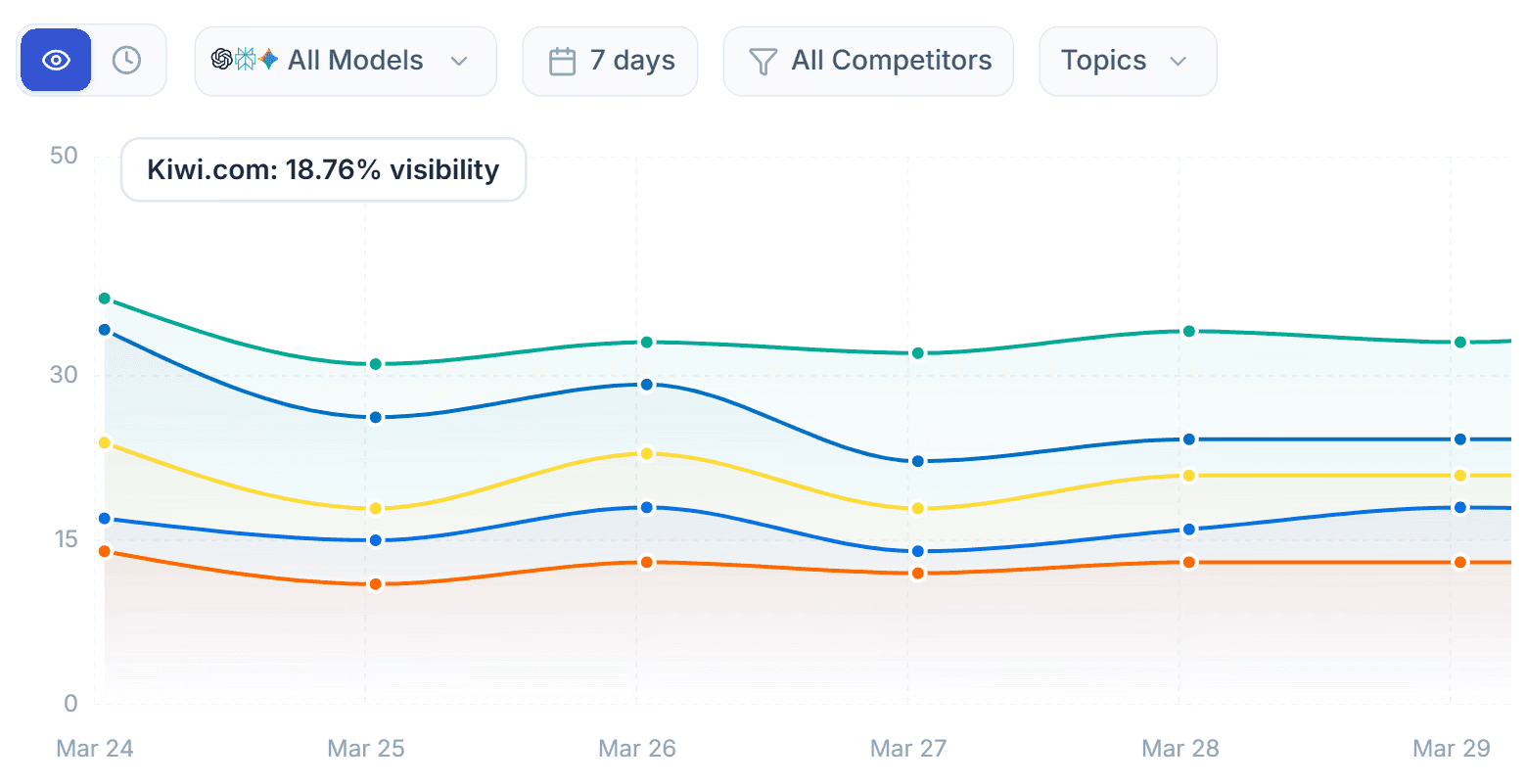
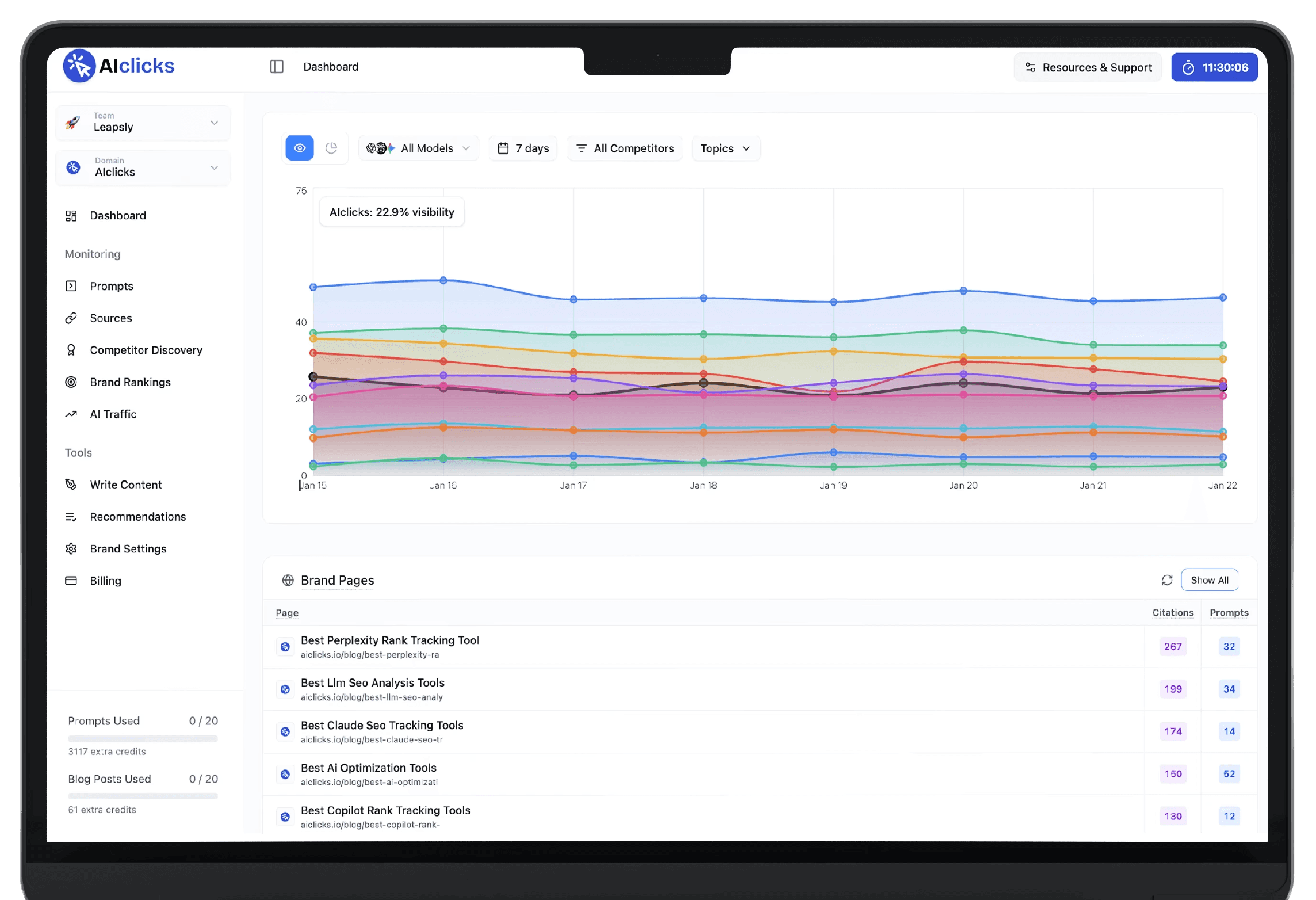
AIclicks gives you a live dashboard with daily ChatGPT mention rate, citation rate, sentiment, and share-of-voice across your tracked prompts, plus GA4 referral attribution for the traffic ChatGPT does send back.
Choose Your Plan
Flexible pricing that grows with your team. Upgrade or downgrade at any time.
Monthly
Yearly
-20%
Starter
Perfect for individuals & small teams
$49
/ month
Billed annually — you save $142
Choose 3 from:
Daily

" height="16px" id="fvSweaOBo" transform="translate(1 0)" width="14px"/></svg>)
" width="14px"><path d="M 13.864 5.629 L 13.3 5.629 L 13.3 5.6 L 7 5.6 L 7 8.4 L 10.956 8.4 C 10.379 10.03 8.828 11.2 7 11.2 C 4.681 11.2 2.8 9.319 2.8 7 C 2.8 4.681 4.681 2.8 7 2.8 C 8.071 2.8 9.045 3.204 9.786 3.864 L 11.766 1.884 C 10.516 0.719 8.844 0 7 0 C 3.134 0 0 3.134 0 7 C 0 10.866 3.134 14 7 14 C 10.866 14 14 10.866 14 7 C 14 6.531 13.952 6.073 13.864 5.629 Z" fill="rgb(255, 193, 7)" height="14px" id="H_YjfTNpn" width="14px"/><path d="M 0 3.742 L 2.3 5.429 C 2.922 3.888 4.429 2.8 6.193 2.8 C 7.264 2.8 8.238 3.204 8.979 3.864 L 10.959 1.884 C 9.709 0.719 8.037 0 6.193 0 C 3.504 0 1.172 1.518 0 3.742 Z" fill="rgb(255, 61, 0)" height="5.428500000000002px" id="PlkthQDhg" transform="translate(0.875 0)" width="10.959199999999996px"/><path d="M 6.232 5.581 C 8.04 5.581 9.683 4.889 10.925 3.764 L 8.758 1.931 C 8.032 2.483 7.144 2.782 6.232 2.781 C 4.411 2.781 2.865 1.62 2.283 0 L 0 1.759 C 1.159 4.026 3.511 5.581 6.232 5.581 Z" fill="rgb(76, 175, 80)" height="5.581099999999999px" id="WlnJ5gngE" transform="translate(0.7 8.4)" width="10.924899999999994px"/><path d="M 6.864 0.029 L 6.3 0.029 L 6.3 0 L 0 0 L 0 2.8 L 3.956 2.8 C 3.68 3.576 3.183 4.254 2.526 4.75 L 2.527 4.749 L 4.693 6.582 C 4.54 6.722 7 4.9 7 1.4 C 7 0.931 6.952 0.473 6.864 0.029 Z" fill="rgb(25, 118, 210)" height="6.589883930775992px" id="x_rSW275p" transform="translate(7 5.6)" width="7px"/></g></svg>)
" height="16px" id="hHS98fTxZ" width="16px"/></svg>)
 scale(1 1) translate(-1.861736945942159, -1.1170155383302638)" id="P20NzAvj0-699428820-radial-gradient" r="0.9935228066204626"><stop offset="0" stop-color="rgb(0, 174, 255)"/><stop offset="1" stop-color="rgb(7, 54, 196)"/></radialGradient><radialGradient cx="0.48250042504016705" cy="1.8366934653567062" gradient-transform="translate(0.48250042504016705, 1.8366934653567062) scale(1 1) translate(-0.48250042504016705, -1.8366934653567062)" id="UEWZqVjij-699428820-radial-gradient" r="0.9176890228114506"><stop offset="0" stop-color="rgb(255, 182, 87)"/><stop offset="1" stop-color="rgb(192, 43, 60)"/></radialGradient><linearGradient id="jyMN3TmKx-699428820-linear-gradient" x1="0.4594862532842614" x2="0.5405137467157386" y1="0" y2="1"><stop offset="0" stop-color="rgb(13, 145, 225)"/><stop offset="1" stop-color="rgb(255, 200, 0)"/></linearGradient><linearGradient id="xhMNwDFG0-699428820-linear-gradient" x1="0.4784828731548295" x2="0.5215171268451705" y1="5.551115123125783e-17" y2="1"><stop offset="0" stop-color="rgb(61, 203, 255)"/><stop offset="1" stop-color="rgba(5, 136, 247, 0)"/></linearGradient><radialGradient cx="1.4305090871482182" cy="0.34866158048251783" gradient-transform="translate(1.4305090871482182, 0.34866158048251783) scale(1 1) translate(-1.4305090871482182, -0.34866158048251783)" id="i79kAqaS4-699428820-radial-gradient" r="1.3362743412697924"><stop offset="0" stop-color="rgb(140, 72, 255)"/><stop offset="1" stop-color="rgb(255, 177, 82)"/></radialGradient><linearGradient id="mcxvno3tX-699428820-linear-gradient" x1="0.49844355920154226" x2="0.5015564407984577" y1="0" y2="1"><stop offset="0" stop-color="rgb(248, 173, 250)"/><stop offset="1" stop-color="rgba(168, 110, 221, 0)"/></linearGradient></defs><g d="M 11.605 1.219 C 11.397 0.499 10.739 0.002 9.989 0 L 9.498 0 C 8.682 0.002 7.985 0.588 7.842 1.391 L 7 6.016 L 7.209 5.296 C 7.416 4.574 8.075 4.076 8.825 4.074 L 11.681 4.074 L 12.879 4.545 L 14.033 4.074 L 13.697 4.074 C 12.947 4.072 12.289 3.575 12.081 2.855 Z M 4.413 13.387 C 4.618 14.111 5.278 14.611 6.031 14.613 L 7.075 14.613 C 7.988 14.613 8.735 13.88 8.758 12.96 L 8.871 8.5 L 8.633 9.319 C 8.426 10.039 7.768 10.537 7.018 10.539 L 4.138 10.539 L 3.111 9.977 L 2 10.539 L 2.331 10.539 C 3.084 10.542 3.743 11.042 3.949 11.766 L 4.413 13.387 Z M 9.999 0 L 4.167 0 C 2.501 0 1.501 2.221 0.834 4.441 C 0.045 7.073 -0.989 10.591 2.001 10.591 L 4.519 10.591 C 5.273 10.591 5.933 10.089 6.139 9.36 C 6.577 7.815 7.345 5.121 7.948 3.069 C 8.255 2.027 8.509 1.132 8.901 0.575 C 9.148 0.212 9.56 -0.004 9.999 0 M 9.999 0 L 4.167 0 C 2.501 0 1.501 2.221 0.834 4.441 C 0.045 7.073 -0.989 10.591 2.001 10.591 L 4.519 10.591 C 5.273 10.591 5.933 10.089 6.139 9.36 C 6.577 7.815 7.345 5.121 7.948 3.069 C 8.255 2.027 8.509 1.132 8.901 0.575 C 9.148 0.212 9.56 -0.004 9.999 0 M 6 14.593 L 11.833 14.593 C 13.499 14.593 14.499 12.372 15.166 10.151 C 15.955 7.519 16.989 4 13.999 4 L 11.48 4 C 10.725 4.002 10.063 4.505 9.86 5.232 C 9.266 7.332 8.663 9.429 8.051 11.523 C 7.745 12.566 7.49 13.461 7.098 14.019 C 6.851 14.382 6.439 14.597 6 14.593 M 6 14.593 L 11.833 14.593 C 13.499 14.593 14.499 12.372 15.166 10.151 C 15.955 7.519 16.989 4 13.999 4 L 11.48 4 C 10.725 4.002 10.063 4.505 9.86 5.232 C 9.266 7.332 8.663 9.429 8.051 11.523 C 7.745 12.566 7.49 13.461 7.098 14.019 C 6.851 14.382 6.439 14.597 6 14.593" fill="transparent" height="14.613333333333333px" id="QzkBy4Ibc" transform="translate(0 1)" width="16.00011071294081px"><path d="M 4.605 1.219 C 4.397 0.499 3.739 0.002 2.989 0 L 2.498 0 C 1.682 0.002 0.985 0.588 0.842 1.391 L 0 6.016 L 0.209 5.296 C 0.416 4.574 1.075 4.076 1.825 4.074 L 4.681 4.074 L 5.879 4.545 L 7.033 4.074 L 6.697 4.074 C 5.947 4.072 5.289 3.575 5.081 2.855 Z" fill="url(%23P20NzAvj0-699428820-radial-gradient)" height="6.016px" id="P20NzAvj0" transform="translate(7 0)" width="7.0333333333333385px"/><path d="M 2.413 4.887 C 2.618 5.611 3.278 6.111 4.031 6.113 L 5.075 6.113 C 5.988 6.113 6.735 5.38 6.758 4.46 L 6.871 0 L 6.633 0.819 C 6.426 1.539 5.768 2.037 5.018 2.039 L 2.138 2.039 L 1.111 1.477 L 0 2.039 L 0.331 2.039 C 1.084 2.042 1.743 2.542 1.949 3.266 L 2.413 4.887 Z" fill="url(%23UEWZqVjij-699428820-radial-gradient)" height="6.113333333333333px" id="UEWZqVjij" transform="translate(2 8.5)" width="6.871333333333332px"/><path d="M 9.999 0 L 4.167 0 C 2.501 0 1.501 2.221 0.834 4.441 C 0.045 7.073 -0.989 10.591 2.001 10.591 L 4.519 10.591 C 5.273 10.591 5.933 10.089 6.139 9.36 C 6.577 7.815 7.345 5.121 7.948 3.069 C 8.255 2.027 8.509 1.132 8.901 0.575 C 9.148 0.212 9.56 -0.004 9.999 0" fill="url(%23jyMN3TmKx-699428820-linear-gradient)" height="10.591388755215167px" id="jyMN3TmKx" width="9.999444046274142px"/><path d="M 9.999 0 L 4.167 0 C 2.501 0 1.501 2.221 0.834 4.441 C 0.045 7.073 -0.989 10.591 2.001 10.591 L 4.519 10.591 C 5.273 10.591 5.933 10.089 6.139 9.36 C 6.577 7.815 7.345 5.121 7.948 3.069 C 8.255 2.027 8.509 1.132 8.901 0.575 C 9.148 0.212 9.56 -0.004 9.999 0" fill="url(%23xhMNwDFG0-699428820-linear-gradient)" height="10.591388755215167px" id="xhMNwDFG0" width="9.999444046274142px"/><path d="M 0 10.593 L 5.833 10.593 C 7.499 10.593 8.499 8.372 9.166 6.151 C 9.955 3.519 10.989 0 7.999 0 L 5.48 0 C 4.725 0.002 4.063 0.505 3.86 1.232 C 3.266 3.332 2.663 5.429 2.051 7.523 C 1.745 8.566 1.49 9.461 1.098 10.019 C 0.851 10.382 0.439 10.597 0 10.593" fill="url(%23i79kAqaS4-699428820-radial-gradient)" height="10.593388755215164px" id="i79kAqaS4" transform="translate(6 4)" width="10.000110712940803px"/><path d="M 0 10.593 L 5.833 10.593 C 7.499 10.593 8.499 8.372 9.166 6.151 C 9.955 3.519 10.989 0 7.999 0 L 5.48 0 C 4.725 0.002 4.063 0.505 3.86 1.232 C 3.266 3.332 2.663 5.429 2.051 7.523 C 1.745 8.566 1.49 9.461 1.098 10.019 C 0.851 10.382 0.439 10.597 0 10.593" fill="url(%23mcxvno3tX-699428820-linear-gradient)" height="10.593388755215164px" id="mcxvno3tX" transform="translate(6 4)" width="10.000110712940803px"/></g></svg>)
" height="15.360666565427872px" id="HZPvvPBv7" transform="translate(0 0.5)" width="16px"/></svg>)
Tracked prompts
30
Websites you can add
3
LLMs you can track
3
Countries per project
1
LLM responses / mo
4,650
AI-optimized articles per month
10
Integrations
-
Support
Pro
For growing teams for more power
$140
/ month
Billed annually — you save $454
Choose 4 from:
Daily
Tracked prompts
150
Websites you can add
Unlimited
LLMs you can track
4
Countries per project
Unlimited
LLM responses / mo
18,600
AI-optimized articles per month
20
Integrations
Google Analytics
Support
BUSINESS
Best for medium-sized organizations
$357
/ month
Billed annually — you save $1198
Choose 6 from:
Daily
Tracked prompts
300
Websites you can add
Unlimited
LLMs you can track
6
Countries per project
Unlimited
LLM responses / mo
55,800
AI-optimized articles per month
30
Integrations
Google Analytics, API
Support
Dedicated account specialist
Become the #1 Answer in AI
Succeed in GEO yourself, or let us do all the work.
Do it yourself
Use AIclicks to see exactly where you appear across 10+ AI platforms, spot the gaps competitors are filling, and act on clear weekly recommendations.
From $59/month · Cancel anytime
Done for you
We Do All the Work for You
Our team manages your complete search presence: traditional SEO and GEO strategy, content, implementation, and reporting. You focus on clients.
Custom pricing · Minimum 3-month engagement
The AI SEO agency trusted by 1,000+ brands worldwide
From solo founders to multi-client agencies, AIclicks runs the full AI SEO agency program for organizations of every shape and size that want to be cited across every AI surface.
4.9/5 stars on G2







FAQ
How long until divorce SEO produces signed retainers?
Realistically 6 to 12 months for retainers, though the leading indicators move sooner. Informational guides can rank inside 3 to 6 months because competition on those queries is far lighter than on the head terms. Map pack visibility often shifts within 90 days of fixing the profile. Nothing about this is fast, and family law has a long consideration window layered on top, so early rankings still take months to convert.
Do people really ask ChatGPT for a divorce lawyer?
More than you would expect, and for a reason specific to this practice: a chat window feels like it is not keeping score. Ahrefs analysed 863,000 keywords and found only 38% of pages cited in AI Overviews also ranked in the top 10, down from 76% a year earlier, so ranking no longer earns the mention. Only 14% of marketers track whether they are cited at all.
Can a general local SEO agency handle this?
Not well, and 3 things explain why. Most of the demand and most of the leads sit in informational queries, not the near-me terms an agency will report on. Google classifies all of it as YMYL, which means an unattributed page stalls however carefully it is optimised. And the review problem is structural rather than a matter of asking harder. A generalist will treat all 3 as normal.
What does divorce lawyer SEO cost per month?
Agencies in this niche publish monthly retainers between $2,500 and $7,500, scaling with market size and how far behind you are starting. The comparison that matters is not zero. It is what you already pay per lead to brokers who resell the same enquiry, or per click in an auction you do not control. Judge the spend on cost per signed matter, nothing else.
Should we cut our Google Ads once rankings improve?
Reduce them deliberately, never all at once. The head term in a large market usually stays out of reach organically, so paid coverage there earns its place indefinitely. Everything softer, the cost questions, the process questions, the calculators, is cheap to win and expensive to buy. Move budget as each one starts producing consultations, and give it a full quarter, because these enquiries convert slowly enough to mask a mistake.
What is the first page we should build?
Set the profile aside, since it is not a page and should already be done. Build your state process guide first: what filing requires, how long each stage takes, what it costs. It absorbs the entire research phase and every other page can link out from it. Support calculators come next, then one situation page for uncontested filings, then custody. Attorney bios follow. Leave the blog until everything above is done, if ever.
Which numbers actually show the SEO is paying?
Signed matters attributed to organic search, and nothing softer than that. Most family law enquiries come in as calls, which disappear from analytics unless CallTrackingMetrics or something like it is running. Reconcile monthly against matters opened in your practice management system. Impression counts on process and cost queries move earliest, so pull those from Search Console rather than positions. Then check quarterly whether AI assistants name your firm.
How do we avoid hiring another bad SEO agency?
Ask for 3 current family law clients and call them yourself, unannounced. That single step removes most of the agencies people warn each other about online. Then check what they propose to keep in-house, because asking for reviews, posting to the profile and answering client questions in plain language all belong with the firm, not a contractor. Schema, page speed and directory cleanup are worth outsourcing. Anyone who cannot discuss attorney advertising rules is not a legal specialist.
Further Reading
Go deeper on GEO, AI search, and visibility tracking.