SEO for Construction Companies:
Nobody hires a builder from a billboard any more. They search, scroll photos of finished work, read a dozen reviews and check you are licensed, usually while standing in the room they want changed. The contractors who show up in that moment get the quote request.









Why Construction Companies Need SEO
Backlinko found just 0.63% of searchers ever click a result on page 2. For construction, where nobody compares more than a handful of firms, page one is the entire market.
Contractors document everything and publish nothing searchable. Hundreds of project photos sit in a gallery with filenames like IMG_4471, on a page called Portfolio, with no text saying what was built or where. A homeowner searching kitchen extension builder in your town finds a competitor with one written case study.
Search general contractor near me in a US city and Yelp usually takes the top organic slot, with the Better Business Bureau, HomeAdvisor and Houzz filling the page beneath it. Those platforms then sell your name back to you as a lead, at a price per enquiry, competing against 3 other contractors buying the same one.
A contractor can pay a marketplace for a shared lead, then pay again in Google Ads to reach the same homeowner, then discount the quote because 3 rivals bought the identical enquiry. None of that spending builds anything you own. The month you stop, the pipeline empties, and there is nothing left behind to show for it.
How SEO Works for Construction Companies
Search Engine Optimization projects are long-term investments for contractors, where each task supplements the others and creates compound results over time.
01
Keywords, page structure, and the signals Google reads directly
On-page work is awkward in construction because the two halves of the business search completely differently. A homeowner types basement remodel near me; a developer types commercial general contractor prequalification. The same website has to serve both without confusing Google about what it is. Most contractor sites resolve this by saying nothing specific at all, ending up with a services page that lists everything from roofing to tenant fit-outs in one paragraph. The pages that actually rank are single-service pages, project case studies with words in them, and a properly written service area page for each town.
Project case studies are the asset that keeps paying. A page describing a specific job, with the scope, the constraints, the timeline and photographs captioned properly, will rank for the phrases homeowners actually use and stay relevant for years, because a 1920s bungalow extension is the same problem in 2030. What churns is everything tied to the season and the cycle: the spring promotion, the equipment purchase announcement, the post about materials prices that was accurate for one quarter. Most contractor blogs are entirely the second kind, which is why they generate nothing.
1
Split the services page into one page per job type: kitchen remodels, basement conversions, roof replacements, commercial fit-outs, each written separately.
2
Unpublish expired seasonal offers and superseded material price posts, redirecting each into the service page it was promoting.
3
Apply GeneralContractor and LocalBusiness schema with licence numbers, service areas and accepted project types, then validate in Rich Results Test.
4
Turn each completed project into a written page covering scope, timeline, budget band and the problems solved, not just a photo gallery.
02
Map Pack visibility, citations, and proximity signals
Construction demand is defined by travel radius. Nobody hires a contractor 2 hours away for a bathroom, and the map pack is where that radius gets decided. 3 companies appear with a rating, a photo and a call button above every organic result, including Yelp and Houzz. It is the one position where a two-van outfit can outrank a national marketplace, and it is decided largely by proximity, category accuracy and review volume.
Pick the most specific accurate category, Bathroom Remodeler or Roofing Contractor rather than General Contractor, because the generic one competes with every trade in the city. Add each service separately. Then use the photo feature the way it was intended: finished projects, work in progress, the crew, the vehicles, updated monthly rather than uploaded once in 2019. List licence and insurance details, and set a service area rather than a single pin if you travel.
Construction carries 2 separate citation layers, and most contractors only work one. The residential layer is Google, Yelp, Houzz, Angi, HomeAdvisor, Thumbtack, Nextdoor and the Better Business Bureau. The commercial layer is entirely different: the Blue Book, ENR, Dodge, your state licensing register, and the trade association and union listings that developers actually check before issuing an invitation to bid. If you do both kinds of work, you need both, with identical details throughout.
1
Set the narrowest accurate primary category rather than General Contractor, add every trade as a service, and publish licence details.
2
For a single yard serving many towns, set a service area on the profile and build one genuinely distinct page per town.
3
Match your name, address and licence number across Angi, Houzz, the Blue Book and your state licensing register, then recheck quarterly.
4
Post a photo from an active site every week to the Google profile, with the town named in the caption.
03
Topic authority, inbound links, and content that earns traffic
Before anyone requests a quote they are trying to answer questions they are slightly embarrassed to ask: what does this actually cost, how long will my house be unusable, and do I need planning permission. Contractors avoid publishing cost content because every job differs. That reticence is exactly the gap. A page giving honest ranges with the variables explained will outrank and out-convert every competitor hiding behind contact us for a quote.
The client who has decided to build is now choosing who to trust with access to their home and a large deposit. They want proof: projects like theirs, in their area, with photographs that were clearly not bought. They want the licence number, the insurance position, whether you use subcontractors, and how payment is staged. Put that on the service page. Most contractors bury it, then wonder why quotes go to the firm that published a schedule of works.
Construction has more natural link sources than almost any trade, and almost nobody claims them. Suppliers and manufacturers run where-to-buy and certified-installer directories. Architects and designers credit the builder on project pages. Local press covers unusual builds and restorations. Trade associations publish member listings. The developments you have worked on list their contractors. Every one of these is a link that already exists as a relationship and only needs someone to ask for the hyperlink.
1
Publish a yearly cost guide per project type with genuine local ranges and the variables that move them, updated each spring.
2
Build one page per service per town, referencing local permit offices, typical housing stock and a project you actually completed there.
3
Cluster every affordability question into one hub: deposit structures, staged payments, financing options, and what drives a quote up mid-project.
4
Write a page for each system or brand you are certified to install, since those certifications carry search demand and supplier backlinks.
04
Site speed, crawlability, Core Web Vitals, and mobile health
The failure specific to construction is the photo-heavy site nobody has ever measured. Project galleries carry dozens of images straight off a phone at full resolution, often 12 megapixels each, on a page that also loads a video header of a drone shot. It looks impressive on the office desktop over fibre and takes 15 seconds on a phone at a job site. Contractors rarely find out, because they never browse their own website on mobile data.
The person searching for a contractor is frequently standing in the space they want changed, on a phone, with patchy signal, comparing 3 firms in 5 minutes. If the gallery stalls, the quote form demands 11 fields, or the phone number is baked into a header image, they move on. This matters more in construction than in most trades because the enquiry is high-value and one-off. You do not get a second impression.
1
Crawl the site with Screaming Frog, list every image over 200 kilobytes, and resize project photos to display dimensions.
2
Run PageSpeed Insights on your heaviest project gallery over a throttled mobile connection, and lazy-load everything below the fold.
3
Serve site photography as WebP with descriptive filenames and alt text naming the job type and town, replacing IMG_4471 entirely.
4
Keep service and town pages in a sitemap separate from the blog, and resubmit each time a project case study goes live.
05
Star ratings, review volume, and response strategy that builds trust
Reviews decide construction enquiries because the client is handing over a deposit and a door key to someone they have never met, on a job where going wrong is expensive and visible. They are also unusually hard to collect. Projects run for months, they end in snagging rather than celebration, and the client is often exhausted by handover. Meanwhile the one job that went badly generates a detailed review within hours, unprompted.
Ask at the walkthrough, standing in the finished room, when the client is happiest they will ever be about the work. Not after the final invoice clears, and certainly not by email 6 weeks later. Make it part of project closeout so the site manager does it every time rather than remembering occasionally. A short request from the person who ran the job, with a link, converts far better than anything sent from an office address.
1
Add the review request to your project closeout checklist in Buildertrend or Jobber, triggered at final walkthrough rather than final payment.
2
Reply within 24 hours with the timeline and what you offered to fix, never arguing the contract publicly in the response.
3
Place each client’s review directly on the case study page for their project, where the words and the photographs corroborate each other.
4
Ask architects, suppliers and subcontractors for reviews too, since professional endorsements carry weight with commercial clients that homeowner testimonials do not.
Google is No Longer the Only Place Your clients are Searching
Clients are using AI to find answers, and they trust what it tells them. Invest in GEO to get recommended in those answers.
1 Billion
Questions ChatGPT receives every single day
38%
Your #1 top ranking page on Google would be cited by AI
14%
of contractors optimise for GEO. The rest are invisible in AI answers


You can rank #1 for “contractor near me” and still not exist in ChatGPT’s answer. Run a free GEO audit to see where your brand actually stands.
GEO vs SEO: Same Goal, Different Methods
GEO is wider than SEO. AI recommends the brands that show up across the sources it reads, so your presence in forums, social platforms and construction blogs decides your odds. AIclicks measures the three metrics below so you know which to work on first.
AI Assistant
Which builder should I use for an extension?
Your Company
Citation Rate
Shows how many AI answers about construction companies name your brand, out of every 100. Models pull from the same trusted pages over and over, so citations compound: once you are in, staying in gets easier. Find the competitor pages AI cites most, then publish your own version of each.
Your Company
82% positive
Competitor A
54% positive
Competitor B
38% positive
Brand Sentiment
Shows how AI describes you when your brand comes up: positive, neutral or negative. Tone is what separates being mentioned from being recommended, and models repeat whatever framing they find. Track the negative mentions back to the reviews and threads behind them, then publish content that answers those directly.
Others 52%
You 24%
— 24%
Your Company
AI mention share of voice — construction category
Competitors
Not Cited
Share of Voice in AI
Shows how much of the construction conversation belongs to you rather than your competitors. This is the metric that matters most, the GEO version of a Google ranking. With only 1–5 brands named per answer, the market is winner-takes-more and every point is taken from someone.
The Dashboard Your Dedicated AI Search Team Works In
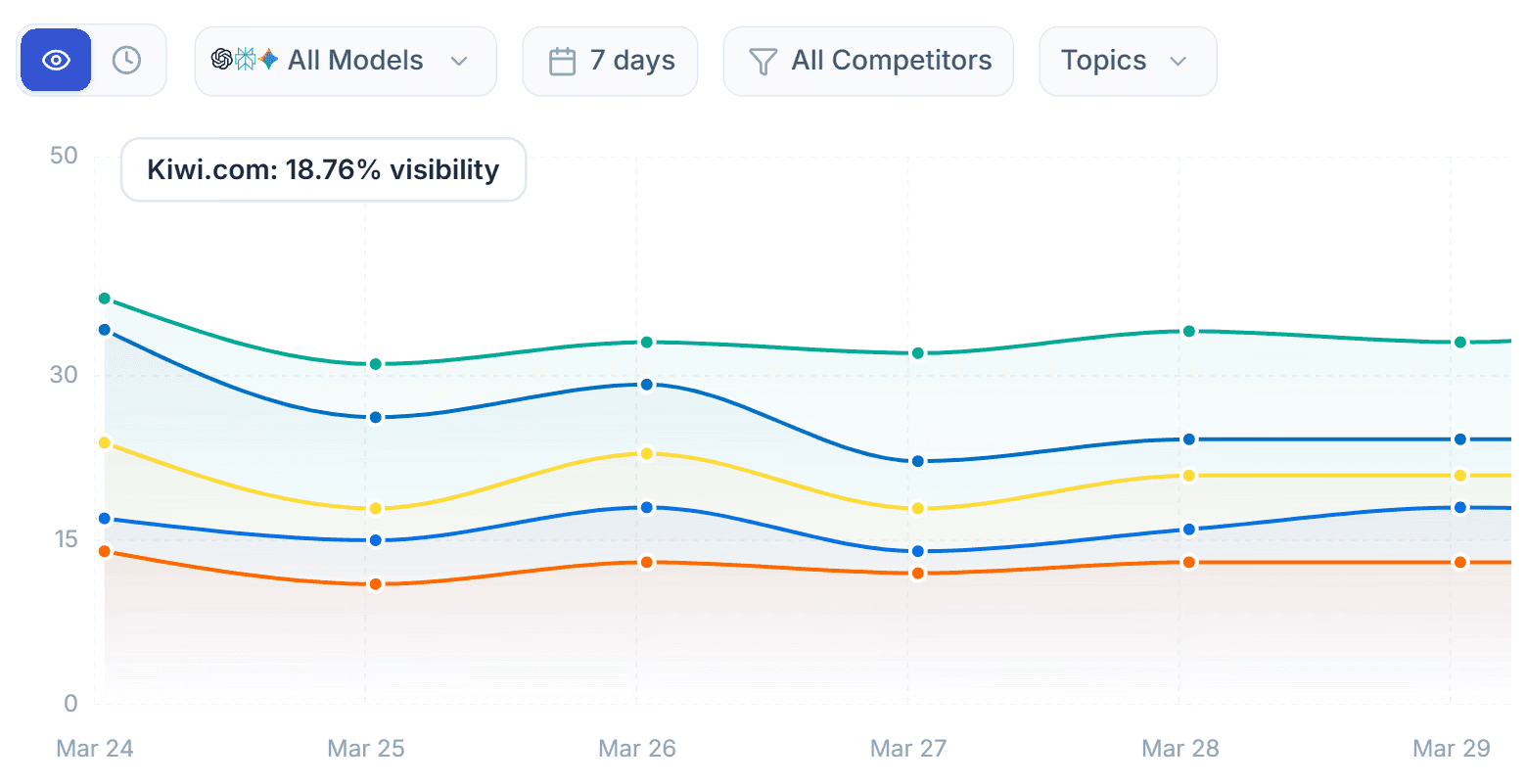
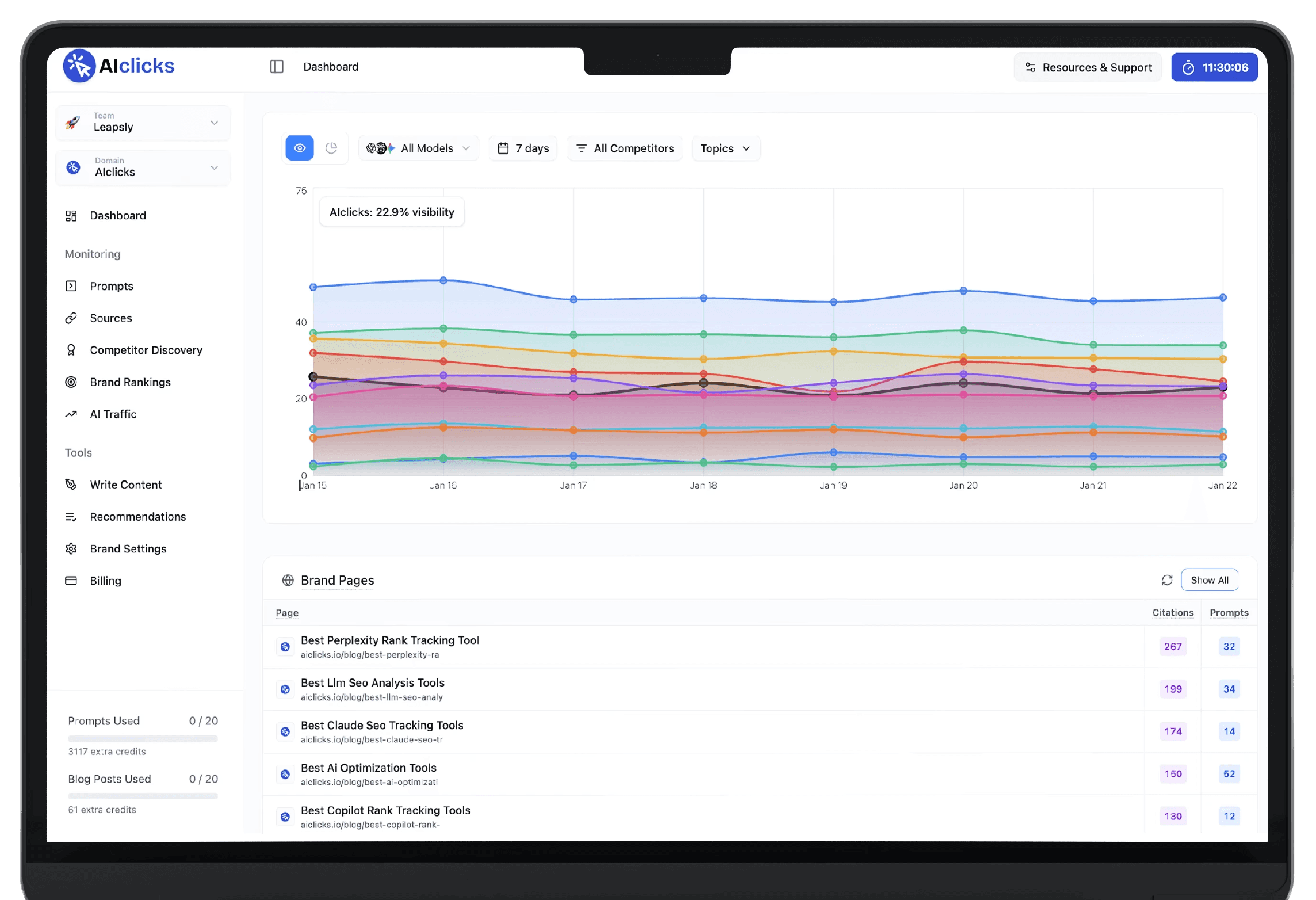
AIclicks gives you a live dashboard with daily ChatGPT mention rate, citation rate, sentiment, and share-of-voice across your tracked prompts, plus GA4 referral attribution for the traffic ChatGPT does send back.
Choose Your Plan
Flexible pricing that grows with your team. Upgrade or downgrade at any time.
Monthly
Yearly
-20%
Starter
Perfect for individuals & small teams
$49
/ month
Billed annually — you save $142
Choose 3 from:
Daily

" height="16px" id="fvSweaOBo" transform="translate(1 0)" width="14px"/></svg>)
" width="14px"><path d="M 13.864 5.629 L 13.3 5.629 L 13.3 5.6 L 7 5.6 L 7 8.4 L 10.956 8.4 C 10.379 10.03 8.828 11.2 7 11.2 C 4.681 11.2 2.8 9.319 2.8 7 C 2.8 4.681 4.681 2.8 7 2.8 C 8.071 2.8 9.045 3.204 9.786 3.864 L 11.766 1.884 C 10.516 0.719 8.844 0 7 0 C 3.134 0 0 3.134 0 7 C 0 10.866 3.134 14 7 14 C 10.866 14 14 10.866 14 7 C 14 6.531 13.952 6.073 13.864 5.629 Z" fill="rgb(255, 193, 7)" height="14px" id="H_YjfTNpn" width="14px"/><path d="M 0 3.742 L 2.3 5.429 C 2.922 3.888 4.429 2.8 6.193 2.8 C 7.264 2.8 8.238 3.204 8.979 3.864 L 10.959 1.884 C 9.709 0.719 8.037 0 6.193 0 C 3.504 0 1.172 1.518 0 3.742 Z" fill="rgb(255, 61, 0)" height="5.428500000000002px" id="PlkthQDhg" transform="translate(0.875 0)" width="10.959199999999996px"/><path d="M 6.232 5.581 C 8.04 5.581 9.683 4.889 10.925 3.764 L 8.758 1.931 C 8.032 2.483 7.144 2.782 6.232 2.781 C 4.411 2.781 2.865 1.62 2.283 0 L 0 1.759 C 1.159 4.026 3.511 5.581 6.232 5.581 Z" fill="rgb(76, 175, 80)" height="5.581099999999999px" id="WlnJ5gngE" transform="translate(0.7 8.4)" width="10.924899999999994px"/><path d="M 6.864 0.029 L 6.3 0.029 L 6.3 0 L 0 0 L 0 2.8 L 3.956 2.8 C 3.68 3.576 3.183 4.254 2.526 4.75 L 2.527 4.749 L 4.693 6.582 C 4.54 6.722 7 4.9 7 1.4 C 7 0.931 6.952 0.473 6.864 0.029 Z" fill="rgb(25, 118, 210)" height="6.589883930775992px" id="x_rSW275p" transform="translate(7 5.6)" width="7px"/></g></svg>)
" height="16px" id="hHS98fTxZ" width="16px"/></svg>)
 scale(1 1) translate(-1.861736945942159, -1.1170155383302638)" id="P20NzAvj0-699428820-radial-gradient" r="0.9935228066204626"><stop offset="0" stop-color="rgb(0, 174, 255)"/><stop offset="1" stop-color="rgb(7, 54, 196)"/></radialGradient><radialGradient cx="0.48250042504016705" cy="1.8366934653567062" gradient-transform="translate(0.48250042504016705, 1.8366934653567062) scale(1 1) translate(-0.48250042504016705, -1.8366934653567062)" id="UEWZqVjij-699428820-radial-gradient" r="0.9176890228114506"><stop offset="0" stop-color="rgb(255, 182, 87)"/><stop offset="1" stop-color="rgb(192, 43, 60)"/></radialGradient><linearGradient id="jyMN3TmKx-699428820-linear-gradient" x1="0.4594862532842614" x2="0.5405137467157386" y1="0" y2="1"><stop offset="0" stop-color="rgb(13, 145, 225)"/><stop offset="1" stop-color="rgb(255, 200, 0)"/></linearGradient><linearGradient id="xhMNwDFG0-699428820-linear-gradient" x1="0.4784828731548295" x2="0.5215171268451705" y1="5.551115123125783e-17" y2="1"><stop offset="0" stop-color="rgb(61, 203, 255)"/><stop offset="1" stop-color="rgba(5, 136, 247, 0)"/></linearGradient><radialGradient cx="1.4305090871482182" cy="0.34866158048251783" gradient-transform="translate(1.4305090871482182, 0.34866158048251783) scale(1 1) translate(-1.4305090871482182, -0.34866158048251783)" id="i79kAqaS4-699428820-radial-gradient" r="1.3362743412697924"><stop offset="0" stop-color="rgb(140, 72, 255)"/><stop offset="1" stop-color="rgb(255, 177, 82)"/></radialGradient><linearGradient id="mcxvno3tX-699428820-linear-gradient" x1="0.49844355920154226" x2="0.5015564407984577" y1="0" y2="1"><stop offset="0" stop-color="rgb(248, 173, 250)"/><stop offset="1" stop-color="rgba(168, 110, 221, 0)"/></linearGradient></defs><g d="M 11.605 1.219 C 11.397 0.499 10.739 0.002 9.989 0 L 9.498 0 C 8.682 0.002 7.985 0.588 7.842 1.391 L 7 6.016 L 7.209 5.296 C 7.416 4.574 8.075 4.076 8.825 4.074 L 11.681 4.074 L 12.879 4.545 L 14.033 4.074 L 13.697 4.074 C 12.947 4.072 12.289 3.575 12.081 2.855 Z M 4.413 13.387 C 4.618 14.111 5.278 14.611 6.031 14.613 L 7.075 14.613 C 7.988 14.613 8.735 13.88 8.758 12.96 L 8.871 8.5 L 8.633 9.319 C 8.426 10.039 7.768 10.537 7.018 10.539 L 4.138 10.539 L 3.111 9.977 L 2 10.539 L 2.331 10.539 C 3.084 10.542 3.743 11.042 3.949 11.766 L 4.413 13.387 Z M 9.999 0 L 4.167 0 C 2.501 0 1.501 2.221 0.834 4.441 C 0.045 7.073 -0.989 10.591 2.001 10.591 L 4.519 10.591 C 5.273 10.591 5.933 10.089 6.139 9.36 C 6.577 7.815 7.345 5.121 7.948 3.069 C 8.255 2.027 8.509 1.132 8.901 0.575 C 9.148 0.212 9.56 -0.004 9.999 0 M 9.999 0 L 4.167 0 C 2.501 0 1.501 2.221 0.834 4.441 C 0.045 7.073 -0.989 10.591 2.001 10.591 L 4.519 10.591 C 5.273 10.591 5.933 10.089 6.139 9.36 C 6.577 7.815 7.345 5.121 7.948 3.069 C 8.255 2.027 8.509 1.132 8.901 0.575 C 9.148 0.212 9.56 -0.004 9.999 0 M 6 14.593 L 11.833 14.593 C 13.499 14.593 14.499 12.372 15.166 10.151 C 15.955 7.519 16.989 4 13.999 4 L 11.48 4 C 10.725 4.002 10.063 4.505 9.86 5.232 C 9.266 7.332 8.663 9.429 8.051 11.523 C 7.745 12.566 7.49 13.461 7.098 14.019 C 6.851 14.382 6.439 14.597 6 14.593 M 6 14.593 L 11.833 14.593 C 13.499 14.593 14.499 12.372 15.166 10.151 C 15.955 7.519 16.989 4 13.999 4 L 11.48 4 C 10.725 4.002 10.063 4.505 9.86 5.232 C 9.266 7.332 8.663 9.429 8.051 11.523 C 7.745 12.566 7.49 13.461 7.098 14.019 C 6.851 14.382 6.439 14.597 6 14.593" fill="transparent" height="14.613333333333333px" id="QzkBy4Ibc" transform="translate(0 1)" width="16.00011071294081px"><path d="M 4.605 1.219 C 4.397 0.499 3.739 0.002 2.989 0 L 2.498 0 C 1.682 0.002 0.985 0.588 0.842 1.391 L 0 6.016 L 0.209 5.296 C 0.416 4.574 1.075 4.076 1.825 4.074 L 4.681 4.074 L 5.879 4.545 L 7.033 4.074 L 6.697 4.074 C 5.947 4.072 5.289 3.575 5.081 2.855 Z" fill="url(%23P20NzAvj0-699428820-radial-gradient)" height="6.016px" id="P20NzAvj0" transform="translate(7 0)" width="7.0333333333333385px"/><path d="M 2.413 4.887 C 2.618 5.611 3.278 6.111 4.031 6.113 L 5.075 6.113 C 5.988 6.113 6.735 5.38 6.758 4.46 L 6.871 0 L 6.633 0.819 C 6.426 1.539 5.768 2.037 5.018 2.039 L 2.138 2.039 L 1.111 1.477 L 0 2.039 L 0.331 2.039 C 1.084 2.042 1.743 2.542 1.949 3.266 L 2.413 4.887 Z" fill="url(%23UEWZqVjij-699428820-radial-gradient)" height="6.113333333333333px" id="UEWZqVjij" transform="translate(2 8.5)" width="6.871333333333332px"/><path d="M 9.999 0 L 4.167 0 C 2.501 0 1.501 2.221 0.834 4.441 C 0.045 7.073 -0.989 10.591 2.001 10.591 L 4.519 10.591 C 5.273 10.591 5.933 10.089 6.139 9.36 C 6.577 7.815 7.345 5.121 7.948 3.069 C 8.255 2.027 8.509 1.132 8.901 0.575 C 9.148 0.212 9.56 -0.004 9.999 0" fill="url(%23jyMN3TmKx-699428820-linear-gradient)" height="10.591388755215167px" id="jyMN3TmKx" width="9.999444046274142px"/><path d="M 9.999 0 L 4.167 0 C 2.501 0 1.501 2.221 0.834 4.441 C 0.045 7.073 -0.989 10.591 2.001 10.591 L 4.519 10.591 C 5.273 10.591 5.933 10.089 6.139 9.36 C 6.577 7.815 7.345 5.121 7.948 3.069 C 8.255 2.027 8.509 1.132 8.901 0.575 C 9.148 0.212 9.56 -0.004 9.999 0" fill="url(%23xhMNwDFG0-699428820-linear-gradient)" height="10.591388755215167px" id="xhMNwDFG0" width="9.999444046274142px"/><path d="M 0 10.593 L 5.833 10.593 C 7.499 10.593 8.499 8.372 9.166 6.151 C 9.955 3.519 10.989 0 7.999 0 L 5.48 0 C 4.725 0.002 4.063 0.505 3.86 1.232 C 3.266 3.332 2.663 5.429 2.051 7.523 C 1.745 8.566 1.49 9.461 1.098 10.019 C 0.851 10.382 0.439 10.597 0 10.593" fill="url(%23i79kAqaS4-699428820-radial-gradient)" height="10.593388755215164px" id="i79kAqaS4" transform="translate(6 4)" width="10.000110712940803px"/><path d="M 0 10.593 L 5.833 10.593 C 7.499 10.593 8.499 8.372 9.166 6.151 C 9.955 3.519 10.989 0 7.999 0 L 5.48 0 C 4.725 0.002 4.063 0.505 3.86 1.232 C 3.266 3.332 2.663 5.429 2.051 7.523 C 1.745 8.566 1.49 9.461 1.098 10.019 C 0.851 10.382 0.439 10.597 0 10.593" fill="url(%23mcxvno3tX-699428820-linear-gradient)" height="10.593388755215164px" id="mcxvno3tX" transform="translate(6 4)" width="10.000110712940803px"/></g></svg>)
" height="15.360666565427872px" id="HZPvvPBv7" transform="translate(0 0.5)" width="16px"/></svg>)
Tracked prompts
30
Websites you can add
3
LLMs you can track
3
Countries per project
1
LLM responses / mo
4,650
AI-optimized articles per month
10
Integrations
-
Support
Pro
For growing teams for more power
$140
/ month
Billed annually — you save $454
Choose 4 from:
Daily
Tracked prompts
150
Websites you can add
Unlimited
LLMs you can track
4
Countries per project
Unlimited
LLM responses / mo
18,600
AI-optimized articles per month
20
Integrations
Google Analytics
Support
BUSINESS
Best for medium-sized organizations
$357
/ month
Billed annually — you save $1198
Choose 6 from:
Daily
Tracked prompts
300
Websites you can add
Unlimited
LLMs you can track
6
Countries per project
Unlimited
LLM responses / mo
55,800
AI-optimized articles per month
30
Integrations
Google Analytics, API
Support
Dedicated account specialist
Become the #1 Answer in AI
Succeed in GEO yourself, or let us do all the work.
Do it yourself
Use AIclicks to see exactly where you appear across 10+ AI platforms, spot the gaps competitors are filling, and act on clear weekly recommendations.
From $59/month · Cancel anytime
Done for you
We Do All the Work for You
Our team manages your complete search presence: traditional SEO and GEO strategy, content, implementation, and reporting. You focus on clients.
Custom pricing · Minimum 3-month engagement
The AI SEO agency trusted by 1,000+ brands worldwide
From solo founders to multi-client agencies, AIclicks runs the full AI SEO agency program for organizations of every shape and size that want to be cited across every AI surface.
4.9/5 stars on G2







FAQ
How long does construction SEO take to work?
Ahrefs puts the average across industries at 3 to 6 months, and construction tends to sit at the faster end for local terms because competition is thinner than in law or medicine. Expect map pack movement within 2 to 3 months if the profile and reviews are handled properly, and organic rankings for service and town pages between 6 and 9. Commercial terms take longer, since the competing sites are older.
Should we focus on Google or AI search?
Google first, but do not ignore the other. Homeowners increasingly ask an assistant how to choose a contractor and what a job should cost before they search at all. Ahrefs found only 38% of pages cited in AI Overviews were also ranking in the top 10, down from 76%, so a good position no longer guarantees you appear in the answer. Written cost guides and clear specifications are what get quoted.
How is construction SEO different from generic local SEO?
The split between residential and commercial changes everything. Residential is a local search problem solved with the map pack, reviews and Angi-style directories. Commercial is a procurement problem solved with the Blue Book, prequalification documents and trade listings, where nobody uses near me at all. Seasonality is sharper too, so you have to build content ahead of demand rather than during it. Generic advice assumes one audience and one season.
What should a construction company budget for SEO?
Most contractors land between $1,000 and $4,000 a month depending on how many towns and trades they are competing for, with larger commercial firms higher. The useful comparison is what you already pay marketplaces per shared lead: if a single won project covers several months of retainer, the maths is straightforward. Measure it as cost per quote request and then per contract signed, not per click.
How does SEO work with the lead sites we pay?
Treat marketplaces as rented demand and SEO as owned. Angi, HomeAdvisor and Thumbtack deliver enquiries today, shared with competitors, at a price that rises. SEO delivers enquiries that arrive exclusively to you, at a cost that falls once the pages rank. Most contractors run both for a period, then reduce marketplace spend as organic and map pack volume grows. Track them separately or you will never know which is working.
Which pages should a construction company build first?
Google Business Profile first, with real photographs and the correct category, because it is free and sits above everything. Then a proper page for your single most profitable service. Then 3 written project case studies for that service, with scope and photographs captioned. Then a page for each town you genuinely serve. Cost guides after that. The general services page and the blog matter least and usually get built first.
How do we know if construction SEO is working?
Count quote requests from organic search, then contracts signed from those requests. Install call tracking, because most contractor enquiries are phone calls and otherwise vanish. Watch Google Business Profile insights for calls, direction requests and website clicks, which move earliest. In Search Console, track impressions on service and town terms rather than average position. Then compare cost per signed contract against what the lead marketplaces charge you.
Should we do this in-house or hire someone?
Photography and project write-ups have to come from inside. Nobody at an agency was on site, and the detail that makes a case study rank is detail only your project manager has. Keep profile updates and review requests in-house too. Outsource the technical work, image optimisation, schema and citation cleanup. If you hire an agency, ask whether they understand the difference between residential and commercial search, because most do not.
Further Reading
Go deeper on GEO, AI search, and visibility tracking.