SEO for Cleaning Companies:
Nobody hires a cleaner on impulse. They ask a neighborhood group, read 3 or 4 Google profiles, check whether you are bonded and insured, then ask ChatGPT who is trustworthy. All of that happens weeks before anyone fills in your quote form.









Why Cleaning Companies Need SEO
Nearly half of all Google searches carry local intent, and cleaning is about as local as demand gets. But clients now vet you in an assistant before they ever open Maps.
A recurring biweekly clean, a move-out clean for a tenant chasing a deposit, and an Airbnb turnover are 3 different searches with 3 different budgets. Most cleaning company sites answer all of them with one Services page and a quote button. The client who needed a Friday turnover books whoever wrote that page.
Search house cleaning services near me in a US city and the first organic result is Thumbtack, with Yelp and Care.com behind it. Below those sit franchise pages from Molly Maid, Merry Maids and Maid Brigade, each carrying the authority of a national domain. You appear inside their lists, ordered by who paid.
Most owners lean on Google’s Local Services Ads, where the same lead is sold on to 2 or 3 competitors and the cost per lead climbs higher every season. Add an agency retainer, where published cleaning packages start around $500 a month and run past $2,000, and none of it survives the month that you stop paying.
How SEO Works for Cleaning Companies
Search Engine Optimization projects are long-term investments for cleaners, where each task supplements the others and creates compound results over time.
01
Keywords, page structure, and the signals Google reads directly
On-page work is unusually hard here because one website is being asked to serve 2 buyers who share nothing. A homeowner types deep cleaning prices, move out cleaning checklist or biweekly house cleaning, decides in an evening and pays by card. A facility manager types office cleaning contract, day porter services or medical office janitorial, runs a bid process and signs for 3 years. Most cleaning company sites put both audiences behind a single Services tab. The pages that actually earn work are one page per job type, a published pricing page, and a separate commercial section with its own navigation.
What holds value is anything tied to a room, a deadline or a price. A page working out what a 3-bedroom deep clean costs, or a move-out checklist a tenant can hand to a landlord, still books work 4 years on because the question repeats every lease cycle. What churns is everything dated: the spring cleaning special, the new-year promotion, the announcement that you now use eco-friendly products. Those pages go stale in a season and then sit in the index quoting a rate you abandoned, which is a slow way to lose trust with people who came for a number.
1
Split the Services tab into standalone pages: recurring house cleaning, deep clean, move-out clean, post-construction, Airbnb turnover, office janitorial.
2
Pull last season’s promotion URLs from Search Console, unpublish them, and 301 each into the job page that now carries the live rate.
3
Wrap the published rates in Service and Offer markup with PriceSpecification, then mark cost questions as FAQPage so assistants can quote you.
4
Publish a rate page per job type and home size, plus an hourly-versus-flat-rate explainer. Both rank all year and filter out unqualified enquiries.
02
Map Pack visibility, citations, and proximity signals
Practically all of it is local, and practically all of it is recurring. A client who books a biweekly clean stays 2 years or more, which means one map pack position compounds in a way no other trade’s does. That 3-result block sits above Thumbtack, above Care.com, above every franchise location page, and it is the one place a 4-person cleaning company outranks a national brand. Proximity, profile completeness and review volume decide it.
Set House Cleaning Service as the primary category rather than Cleaners, then add Commercial Cleaning Service, Janitorial Service or Window Cleaning Service only where you genuinely sell them. Hide the address if you work out of a house and define coverage town by town instead of drawing a radius. Load photos of your own crew in uniform, list bonded and insured status, and pre-answer the questions that decide the booking: hourly or flat rate, whether you bring supplies, who has the key.
Everyone has the same base layer: Yelp, Angi, Thumbtack, Nextdoor, Bing Places and the Better Business Bureau. Residential cleaning adds Care.com, which homeowners search directly. What almost nobody claims is the trade layer: the ISSA member directory, GBAC STAR accredited facility listings, CIMS-certified organisation lists, and the Cleaning for a Reason partner locator. Those corroborate that a real, insured company exists behind the phone number, so the name and suite must match everywhere.
1
Choose House Cleaning Service as primary, upload crew photos rather than stock, and fill the Google Business Profile attributes for bonded, insured and background-checked staff.
2
Only open a second Google Business Profile where you hold a staffed office with signage; extra crews working from vans belong on the existing profile.
3
Run Whitespark or Yext across Yelp, Angi, Care.com, Nextdoor and your ISSA listing, then correct every LLC suffix and tracking-number variant.
4
Enable the Google Business Profile booking link so it opens your live availability, then post one real job photo set every week.
03
Topic authority, inbound links, and content that earns traffic
Before anyone books, they are settling 3 things: what it costs, who is coming into the house, and what actually gets done. Publish a rate table by home size and frequency, name what a standard clean includes and what it does not, and explain how staff are screened. A page comparing a deep clean against a recurring clean, with the hours each takes, does more than any amount of copy about attention to detail.
Someone who has already decided to hire is now down to 3 companies and wants proof. Show the checklist your crew works from, room by room. Name your insurance carrier and the bond amount. Say whether the same cleaner returns each visit, because that single answer decides more bookings than price does. Then publish cancellation and re-clean terms in plain language. Most sites hide all of it behind a quote form, and lose the reader there.
Links here come from the people who already send you work. Realtors and property managers publish preferred-vendor pages before every closing and turnover. Short-term rental co-hosts, interior designers, movers and home stagers all keep vendor lists. Add the ISSA and Cleaning for a Reason directories, your chamber, and the local paper’s small-business column, which runs a story on anyone who hires. Every one of those is free and none of them arrive unprompted.
1
Publish an annual guide comparing weekly, biweekly and monthly plans against one-off deep cleans, with real hours and rates for each home size.
2
Build one page per job type per town you staff, describing housing stock, typical square footage and drive time, not just a swapped place name.
3
Cluster every cost question into one hub: hourly versus flat rate, price per square foot, deep clean surcharge, supplies, tipping, and cancellation fees.
4
Give every credential its own page: ISSA membership, CIMS certification, GBAC STAR accreditation, Green Seal approved products, and your published room-by-room checklist.
04
Site speed, crawlability, Core Web Vitals, and mobile health
Almost every cleaning company now runs an instant-quote engine, and almost every one installs it wrong. BookingKoala, Launch27 and ZenMaid ship as an iframe or on a booking subdomain, so the pricing calculator, the service descriptions and the whole checkout sit on a host Google treats as a different site. The one thing every client searches for is your rate, and the rate exists only inside a widget that never renders as indexable text.
The booking happens on a phone, usually in the evening, usually by someone who has 4 tabs open comparing you against 2 others. Then the quote flow asks for bedrooms, bathrooms, square footage, frequency and an address before it shows a number. Every extra step on a phone keyboard costs bookings, and the widget itself is often the heaviest thing on the page. Show a price band first, and ask for the address last.
1
Crawl the site with Sitebulb and check whether the booking engine sits on a subdomain; if it does, reverse-proxy it onto a real path.
2
Run PageSpeed Insights on the booking page, the heaviest URL on most cleaning sites, and defer the widget script until the reader scrolls to it.
3
Serve crew and before-and-after shots as WebP at display size with explicit dimensions, and lazy-load the gallery; phone camera files run 4 megabytes each.
4
Keep job and town pages in a sitemap separate from blog posts, and resubmit it in Search Console whenever rates or covered towns change.
05
Star ratings, review volume, and response strategy that builds trust
You are asking a stranger to hand you a house key and an alarm code, so the star rating is doing work no other marketing can do. The difficulty is that recurring clients stop noticing. Someone on visit 40 is delighted and will never write anything, while the one person whose glass table got streaked writes 200 words the same evening. Cleaning companies also churn staff, so the review that praises a cleaner who left reads oddly a year later.
The moment is the end of the first clean, while the client is walking the rooms and the whole house smells different. That reaction fades by the second visit and never comes back. Send the request from ZenMaid, Jobber or Housecall Pro the moment the crew closes the job, signed with the lead cleaner’s name rather than the company’s. Then ask recurring clients once a quarter, on a different visit each time, so the flow never stops.
1
Trigger the review text from ZenMaid or BookingKoala when the first job is marked complete, signed by the cleaner who did the work.
2
Reply inside 24 hours, name the room or task, and offer a free return visit in writing; most complaints resolve on one revisit.
3
Place move-out reviews on the move-out page and recurring-plan reviews on the plan page, instead of one testimonials slider on the homepage.
4
Chase reviews from office managers after a contract renewal, since commercial clients mention insurance and reliability, which is what homeowners actually screen for.
Google is No Longer the Only Place Your clients are Searching
Clients are using AI to find answers, and they trust what it tells them. Invest in GEO to get recommended in those answers.
1 Billion
Questions ChatGPT receives every single day
38%
Your #1 top ranking page on Google would be cited by AI
14%
of cleaners optimise for GEO. The rest are invisible in AI answers


You can rank #1 for “cleaner near me” and still not exist in ChatGPT’s answer. Run a free GEO audit to see where your brand actually stands.
GEO vs SEO: Same Goal, Different Methods
GEO is wider than SEO. AI recommends the brands that show up across the sources it reads, so your presence in forums, social platforms and cleaning blogs decides your odds. AIclicks measures the three metrics below so you know which to work on first.
AI Assistant
What is a good cleaning company for weekly service?
Your Cleaning Co
Citation Rate
Shows how many AI answers about cleaning companies name your brand, out of every 100. Models pull from the same trusted pages over and over, so citations compound: once you are in, staying in gets easier. Find the competitor pages AI cites most, then publish your own version of each.
Your Cleaning Co
82% positive
Competitor A
54% positive
Competitor B
38% positive
Brand Sentiment
Shows how AI describes you when your brand comes up: positive, neutral or negative. Tone is what separates being mentioned from being recommended, and models repeat whatever framing they find. Track the negative mentions back to the reviews and threads behind them, then publish content that answers those directly.
Others 52%
You 24%
— 24%
Your Cleaning Co
AI mention share of voice — cleaning category
Competitors
Not Cited
Share of Voice in AI
Shows how much of the cleaning conversation belongs to you rather than your competitors. This is the metric that matters most, the GEO version of a Google ranking. With only 1–5 brands named per answer, the market is winner-takes-more and every point is taken from someone.
The Dashboard Your Dedicated AI Search Team Works In
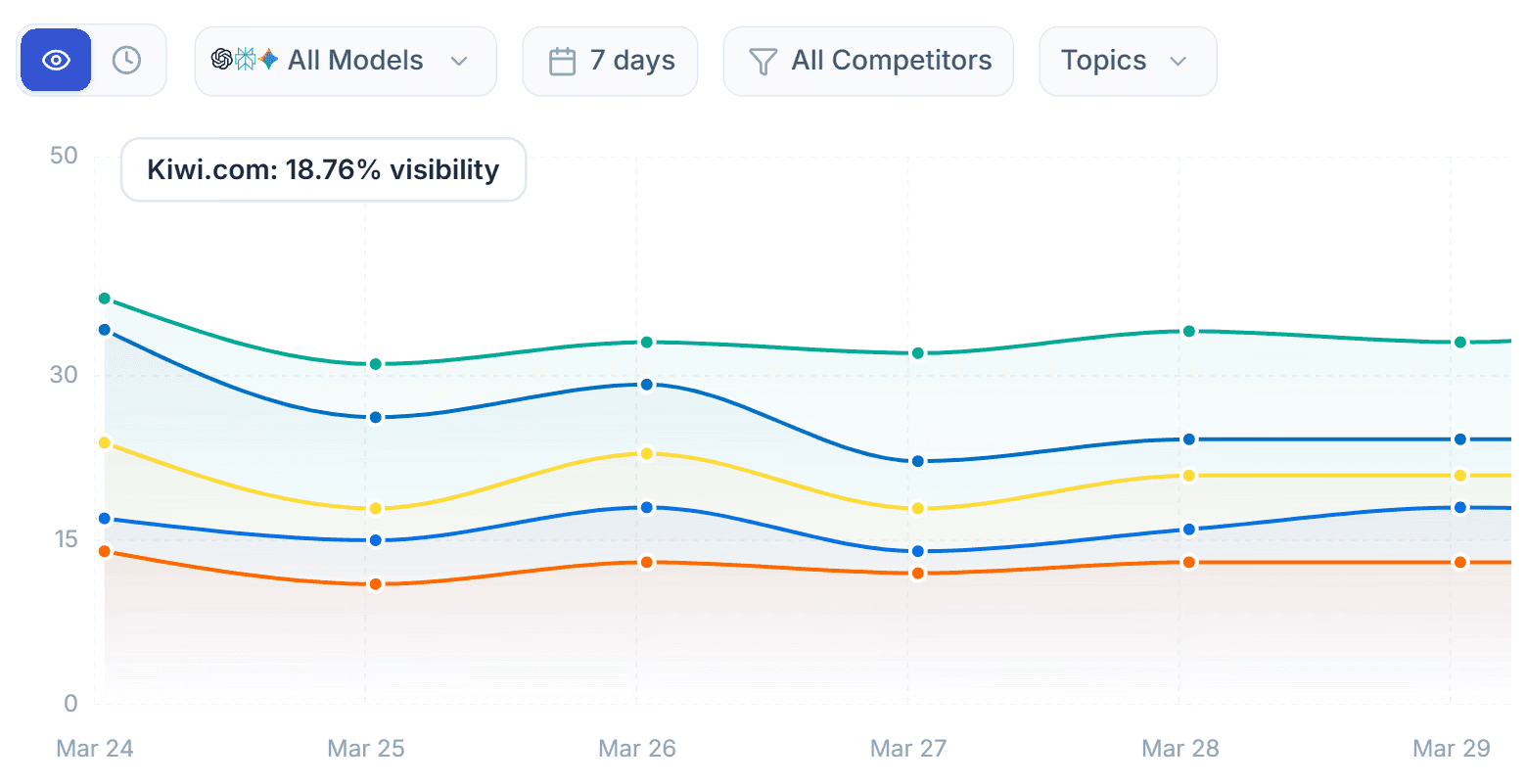
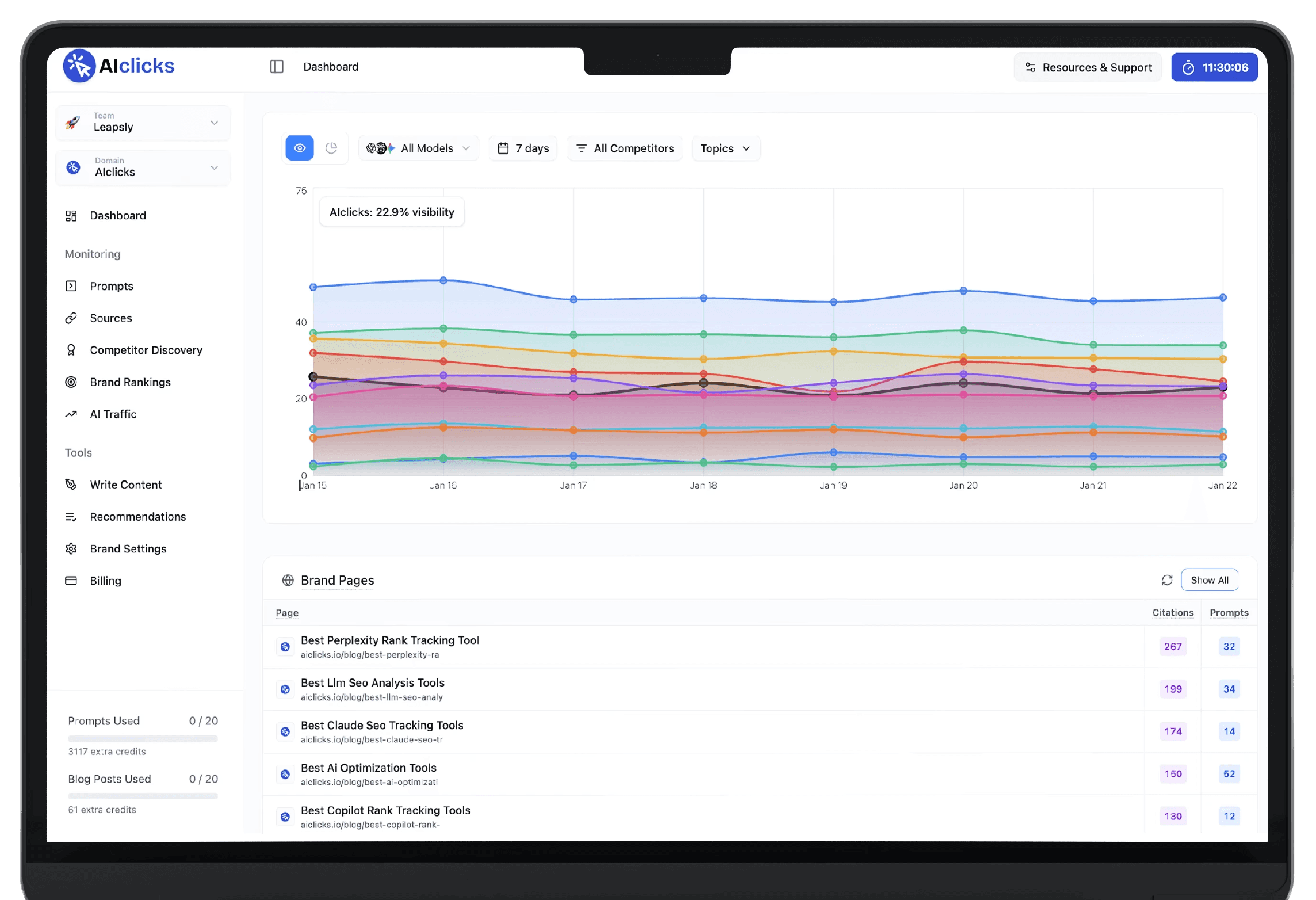
AIclicks gives you a live dashboard with daily ChatGPT mention rate, citation rate, sentiment, and share-of-voice across your tracked prompts, plus GA4 referral attribution for the traffic ChatGPT does send back.
Choose Your Plan
Flexible pricing that grows with your team. Upgrade or downgrade at any time.
Monthly
Yearly
-20%
Starter
Perfect for individuals & small teams
$49
/ month
Billed annually — you save $142
Choose 3 from:
Daily

" height="16px" id="fvSweaOBo" transform="translate(1 0)" width="14px"/></svg>)
" width="14px"><path d="M 13.864 5.629 L 13.3 5.629 L 13.3 5.6 L 7 5.6 L 7 8.4 L 10.956 8.4 C 10.379 10.03 8.828 11.2 7 11.2 C 4.681 11.2 2.8 9.319 2.8 7 C 2.8 4.681 4.681 2.8 7 2.8 C 8.071 2.8 9.045 3.204 9.786 3.864 L 11.766 1.884 C 10.516 0.719 8.844 0 7 0 C 3.134 0 0 3.134 0 7 C 0 10.866 3.134 14 7 14 C 10.866 14 14 10.866 14 7 C 14 6.531 13.952 6.073 13.864 5.629 Z" fill="rgb(255, 193, 7)" height="14px" id="H_YjfTNpn" width="14px"/><path d="M 0 3.742 L 2.3 5.429 C 2.922 3.888 4.429 2.8 6.193 2.8 C 7.264 2.8 8.238 3.204 8.979 3.864 L 10.959 1.884 C 9.709 0.719 8.037 0 6.193 0 C 3.504 0 1.172 1.518 0 3.742 Z" fill="rgb(255, 61, 0)" height="5.428500000000002px" id="PlkthQDhg" transform="translate(0.875 0)" width="10.959199999999996px"/><path d="M 6.232 5.581 C 8.04 5.581 9.683 4.889 10.925 3.764 L 8.758 1.931 C 8.032 2.483 7.144 2.782 6.232 2.781 C 4.411 2.781 2.865 1.62 2.283 0 L 0 1.759 C 1.159 4.026 3.511 5.581 6.232 5.581 Z" fill="rgb(76, 175, 80)" height="5.581099999999999px" id="WlnJ5gngE" transform="translate(0.7 8.4)" width="10.924899999999994px"/><path d="M 6.864 0.029 L 6.3 0.029 L 6.3 0 L 0 0 L 0 2.8 L 3.956 2.8 C 3.68 3.576 3.183 4.254 2.526 4.75 L 2.527 4.749 L 4.693 6.582 C 4.54 6.722 7 4.9 7 1.4 C 7 0.931 6.952 0.473 6.864 0.029 Z" fill="rgb(25, 118, 210)" height="6.589883930775992px" id="x_rSW275p" transform="translate(7 5.6)" width="7px"/></g></svg>)
" height="16px" id="hHS98fTxZ" width="16px"/></svg>)
 scale(1 1) translate(-1.861736945942159, -1.1170155383302638)" id="P20NzAvj0-699428820-radial-gradient" r="0.9935228066204626"><stop offset="0" stop-color="rgb(0, 174, 255)"/><stop offset="1" stop-color="rgb(7, 54, 196)"/></radialGradient><radialGradient cx="0.48250042504016705" cy="1.8366934653567062" gradient-transform="translate(0.48250042504016705, 1.8366934653567062) scale(1 1) translate(-0.48250042504016705, -1.8366934653567062)" id="UEWZqVjij-699428820-radial-gradient" r="0.9176890228114506"><stop offset="0" stop-color="rgb(255, 182, 87)"/><stop offset="1" stop-color="rgb(192, 43, 60)"/></radialGradient><linearGradient id="jyMN3TmKx-699428820-linear-gradient" x1="0.4594862532842614" x2="0.5405137467157386" y1="0" y2="1"><stop offset="0" stop-color="rgb(13, 145, 225)"/><stop offset="1" stop-color="rgb(255, 200, 0)"/></linearGradient><linearGradient id="xhMNwDFG0-699428820-linear-gradient" x1="0.4784828731548295" x2="0.5215171268451705" y1="5.551115123125783e-17" y2="1"><stop offset="0" stop-color="rgb(61, 203, 255)"/><stop offset="1" stop-color="rgba(5, 136, 247, 0)"/></linearGradient><radialGradient cx="1.4305090871482182" cy="0.34866158048251783" gradient-transform="translate(1.4305090871482182, 0.34866158048251783) scale(1 1) translate(-1.4305090871482182, -0.34866158048251783)" id="i79kAqaS4-699428820-radial-gradient" r="1.3362743412697924"><stop offset="0" stop-color="rgb(140, 72, 255)"/><stop offset="1" stop-color="rgb(255, 177, 82)"/></radialGradient><linearGradient id="mcxvno3tX-699428820-linear-gradient" x1="0.49844355920154226" x2="0.5015564407984577" y1="0" y2="1"><stop offset="0" stop-color="rgb(248, 173, 250)"/><stop offset="1" stop-color="rgba(168, 110, 221, 0)"/></linearGradient></defs><g d="M 11.605 1.219 C 11.397 0.499 10.739 0.002 9.989 0 L 9.498 0 C 8.682 0.002 7.985 0.588 7.842 1.391 L 7 6.016 L 7.209 5.296 C 7.416 4.574 8.075 4.076 8.825 4.074 L 11.681 4.074 L 12.879 4.545 L 14.033 4.074 L 13.697 4.074 C 12.947 4.072 12.289 3.575 12.081 2.855 Z M 4.413 13.387 C 4.618 14.111 5.278 14.611 6.031 14.613 L 7.075 14.613 C 7.988 14.613 8.735 13.88 8.758 12.96 L 8.871 8.5 L 8.633 9.319 C 8.426 10.039 7.768 10.537 7.018 10.539 L 4.138 10.539 L 3.111 9.977 L 2 10.539 L 2.331 10.539 C 3.084 10.542 3.743 11.042 3.949 11.766 L 4.413 13.387 Z M 9.999 0 L 4.167 0 C 2.501 0 1.501 2.221 0.834 4.441 C 0.045 7.073 -0.989 10.591 2.001 10.591 L 4.519 10.591 C 5.273 10.591 5.933 10.089 6.139 9.36 C 6.577 7.815 7.345 5.121 7.948 3.069 C 8.255 2.027 8.509 1.132 8.901 0.575 C 9.148 0.212 9.56 -0.004 9.999 0 M 9.999 0 L 4.167 0 C 2.501 0 1.501 2.221 0.834 4.441 C 0.045 7.073 -0.989 10.591 2.001 10.591 L 4.519 10.591 C 5.273 10.591 5.933 10.089 6.139 9.36 C 6.577 7.815 7.345 5.121 7.948 3.069 C 8.255 2.027 8.509 1.132 8.901 0.575 C 9.148 0.212 9.56 -0.004 9.999 0 M 6 14.593 L 11.833 14.593 C 13.499 14.593 14.499 12.372 15.166 10.151 C 15.955 7.519 16.989 4 13.999 4 L 11.48 4 C 10.725 4.002 10.063 4.505 9.86 5.232 C 9.266 7.332 8.663 9.429 8.051 11.523 C 7.745 12.566 7.49 13.461 7.098 14.019 C 6.851 14.382 6.439 14.597 6 14.593 M 6 14.593 L 11.833 14.593 C 13.499 14.593 14.499 12.372 15.166 10.151 C 15.955 7.519 16.989 4 13.999 4 L 11.48 4 C 10.725 4.002 10.063 4.505 9.86 5.232 C 9.266 7.332 8.663 9.429 8.051 11.523 C 7.745 12.566 7.49 13.461 7.098 14.019 C 6.851 14.382 6.439 14.597 6 14.593" fill="transparent" height="14.613333333333333px" id="QzkBy4Ibc" transform="translate(0 1)" width="16.00011071294081px"><path d="M 4.605 1.219 C 4.397 0.499 3.739 0.002 2.989 0 L 2.498 0 C 1.682 0.002 0.985 0.588 0.842 1.391 L 0 6.016 L 0.209 5.296 C 0.416 4.574 1.075 4.076 1.825 4.074 L 4.681 4.074 L 5.879 4.545 L 7.033 4.074 L 6.697 4.074 C 5.947 4.072 5.289 3.575 5.081 2.855 Z" fill="url(%23P20NzAvj0-699428820-radial-gradient)" height="6.016px" id="P20NzAvj0" transform="translate(7 0)" width="7.0333333333333385px"/><path d="M 2.413 4.887 C 2.618 5.611 3.278 6.111 4.031 6.113 L 5.075 6.113 C 5.988 6.113 6.735 5.38 6.758 4.46 L 6.871 0 L 6.633 0.819 C 6.426 1.539 5.768 2.037 5.018 2.039 L 2.138 2.039 L 1.111 1.477 L 0 2.039 L 0.331 2.039 C 1.084 2.042 1.743 2.542 1.949 3.266 L 2.413 4.887 Z" fill="url(%23UEWZqVjij-699428820-radial-gradient)" height="6.113333333333333px" id="UEWZqVjij" transform="translate(2 8.5)" width="6.871333333333332px"/><path d="M 9.999 0 L 4.167 0 C 2.501 0 1.501 2.221 0.834 4.441 C 0.045 7.073 -0.989 10.591 2.001 10.591 L 4.519 10.591 C 5.273 10.591 5.933 10.089 6.139 9.36 C 6.577 7.815 7.345 5.121 7.948 3.069 C 8.255 2.027 8.509 1.132 8.901 0.575 C 9.148 0.212 9.56 -0.004 9.999 0" fill="url(%23jyMN3TmKx-699428820-linear-gradient)" height="10.591388755215167px" id="jyMN3TmKx" width="9.999444046274142px"/><path d="M 9.999 0 L 4.167 0 C 2.501 0 1.501 2.221 0.834 4.441 C 0.045 7.073 -0.989 10.591 2.001 10.591 L 4.519 10.591 C 5.273 10.591 5.933 10.089 6.139 9.36 C 6.577 7.815 7.345 5.121 7.948 3.069 C 8.255 2.027 8.509 1.132 8.901 0.575 C 9.148 0.212 9.56 -0.004 9.999 0" fill="url(%23xhMNwDFG0-699428820-linear-gradient)" height="10.591388755215167px" id="xhMNwDFG0" width="9.999444046274142px"/><path d="M 0 10.593 L 5.833 10.593 C 7.499 10.593 8.499 8.372 9.166 6.151 C 9.955 3.519 10.989 0 7.999 0 L 5.48 0 C 4.725 0.002 4.063 0.505 3.86 1.232 C 3.266 3.332 2.663 5.429 2.051 7.523 C 1.745 8.566 1.49 9.461 1.098 10.019 C 0.851 10.382 0.439 10.597 0 10.593" fill="url(%23i79kAqaS4-699428820-radial-gradient)" height="10.593388755215164px" id="i79kAqaS4" transform="translate(6 4)" width="10.000110712940803px"/><path d="M 0 10.593 L 5.833 10.593 C 7.499 10.593 8.499 8.372 9.166 6.151 C 9.955 3.519 10.989 0 7.999 0 L 5.48 0 C 4.725 0.002 4.063 0.505 3.86 1.232 C 3.266 3.332 2.663 5.429 2.051 7.523 C 1.745 8.566 1.49 9.461 1.098 10.019 C 0.851 10.382 0.439 10.597 0 10.593" fill="url(%23mcxvno3tX-699428820-linear-gradient)" height="10.593388755215164px" id="mcxvno3tX" transform="translate(6 4)" width="10.000110712940803px"/></g></svg>)
" height="15.360666565427872px" id="HZPvvPBv7" transform="translate(0 0.5)" width="16px"/></svg>)
Tracked prompts
30
Websites you can add
3
LLMs you can track
3
Countries per project
1
LLM responses / mo
4,650
AI-optimized articles per month
10
Integrations
-
Support
Pro
For growing teams for more power
$140
/ month
Billed annually — you save $454
Choose 4 from:
Daily
Tracked prompts
150
Websites you can add
Unlimited
LLMs you can track
4
Countries per project
Unlimited
LLM responses / mo
18,600
AI-optimized articles per month
20
Integrations
Google Analytics
Support
BUSINESS
Best for medium-sized organizations
$357
/ month
Billed annually — you save $1198
Choose 6 from:
Daily
Tracked prompts
300
Websites you can add
Unlimited
LLMs you can track
6
Countries per project
Unlimited
LLM responses / mo
55,800
AI-optimized articles per month
30
Integrations
Google Analytics, API
Support
Dedicated account specialist
Become the #1 Answer in AI
Succeed in GEO yourself, or let us do all the work.
Do it yourself
Use AIclicks to see exactly where you appear across 10+ AI platforms, spot the gaps competitors are filling, and act on clear weekly recommendations.
From $59/month · Cancel anytime
Done for you
We Do All the Work for You
Our team manages your complete search presence: traditional SEO and GEO strategy, content, implementation, and reporting. You focus on clients.
Custom pricing · Minimum 3-month engagement
The AI SEO agency trusted by 1,000+ brands worldwide
From solo founders to multi-client agencies, AIclicks runs the full AI SEO agency program for organizations of every shape and size that want to be cited across every AI surface.
4.9/5 stars on G2







FAQ
How long until SEO actually fills our schedule?
Map pack movement usually shows in 2 to 3 months, and job pages follow between 3 and 6. Agencies in this trade quote 4 to 6 months on entry packages and 6 to 12 in competitive metros, which matches what actually happens. Recurring work stretches the payback further, because a client booked in month 4 is still on the calendar in month 30. Watch impressions on cost and move-out terms first.
Should we bother with ChatGPT and AI answers?
Yes, and ranking will not carry you there. Ahrefs analysed 863,000 keywords and found only 38% of pages cited in AI Overviews also ranked in the top 10, down from 76% a year earlier. Assistants have no proximity signal for cleaning, so they assemble answers from Thumbtack and Care.com roundups, neighborhood recommendation threads and review text. If none of those name you, you are absent from the recommendation entirely.
What makes cleaning SEO different from generic local SEO?
Three things. You are running 2 businesses on one domain, residential and commercial, and they need separate navigation, separate pages and separate keywords. Your pricing and booking live inside a third-party widget that Google often cannot read, so the highest-intent content on the site is invisible. And your competition is not only other cleaners but franchise networks with a national domain behind every city page. Generic local SEO advice addresses none of that.
What should a cleaning company budget for SEO?
Published packages in this trade start near $500 a month and run past $2,000, with most single-market operators landing between $800 and $1,500 and multi-city work higher. Judge it against what you already pay. If Local Services Ads cost you $30 to $80 per shared lead and you close a fraction of them, a retainer that lowers cost per booked plan is cheaper, provided it is measured that way.
How does this work with our Local Services Ads?
They do different jobs, and the trap is treating them as alternatives. Local Services Ads sell you a lead that 2 rivals also bought, priced by auction, and the flow stops the day you pause. Organic and map visibility keeps working and lowers what each recurring client costs to win. Run both, but let ad data pick your next page: the queries that produce standing bookings, not the cheapest clicks.
Which pages should a new cleaning company build first?
Google Business Profile first, because it is free and it sits above Thumbtack. Then a real pricing page with rates by home size and frequency, since that is the question everyone searches and almost nobody answers. Then a recurring-plan page and a move-out page, the 2 highest-intent jobs in residential work. Then town pages for places you genuinely staff. Commercial gets its own section once residential is stable. The blog is last.
How do we know the SEO is actually working?
Measure standing plans added, not positions. Almost every enquiry here starts as a call or a widget submission, so install CallRail and pass the landing page into the booking form as a hidden field, or the source disappears. Run a monthly Local Falcon grid scan and check whether your coverage reaches the towns you actually staff. Then reconcile with ZenMaid or Jobber, where revenue per client is the number that settles it.
Should we hire an agency or handle it ourselves?
Split it, and be honest that you will not learn this while running crews. Keep the parts only you can do: profile posts, job photos, review requests, and writing down what a clean actually includes. Contract out schema, page speed, the booking-subdomain fix and citation cleanup. Be careful with anyone bundling a website build into the retainer, because you end up renting a template you cannot move when the contract ends.
Further Reading
Go deeper on GEO, AI search, and visibility tracking.