SEO for Churches:
Someone who just moved, just had a baby, or just left the church they grew up in types churches near me on a Saturday night. They read your service times, scan your reviews, and decide before Sunday morning whether to walk in.









Why Churches Need SEO
More than 1 million people search churches near me every month, and roughly 40% of people who join a new church say they found it through Google first.
Your navigation says Connect, Next Steps, Rooted and Life Groups. Nobody types those. They type sunday service times, church with childcare near me, or non denominational church, and land on a congregation that used those words on the page. Your homepage title is your name and a tagline, telling Google nothing about where you meet.
Search churches near me in a US city and the results above the first congregation belong to Church Finder, Yelp’s religious organizations category, and your own denomination’s national find-a-church tool. Church Finder alone lists over 280,000 churches. You appear inside all 3 of them, with whatever address someone typed years ago.
Most churches put their outreach budget into Easter and Christmas postcard mailings, banners and boosted posts. That spend arrives once, gets recycled, and repeats next year. Meanwhile congregations have paid agencies $10,000 for church SEO that produced nothing but a report. Neither leaves you an asset that keeps working in March.
How SEO Works for Churches
Search Engine Optimization projects are long-term investments for congregations, where each task supplements the others and creates compound results over time.
01
Keywords, page structure, and the signals Google reads directly
On-page work is unusually hard for churches because the site is written in the church’s internal language rather than the language of the person looking for one. Ministries, Gather, Rooted, Next Steps and Life Groups mean something to a member and nothing to a stranger. The pages that actually earn visits are the plain ones: service times, what to expect on a first visit, kids and childcare, what we believe, weddings and funerals. Most church sites bury all 5 behind a hero video and a tagline, then wonder why the homepage ranks only for the church’s own name.
Two kinds of page live very different lives here. A page explaining what happens in the service, whether children are separated, and where to park will still be doing its job in 5 years, because the anxiety of walking in somewhere new never changes. Everything dated dies fast: the sermon series microsite, the fall kickoff, the mission trip update, and above all the event page created fresh every December at a new URL. The fix is boring. Keep one permanent URL for Christmas, one for Easter, one for vacation Bible school, and rewrite them each year instead of republishing.
1
Rewrite the homepage title as church name plus denomination plus city, then build a Plan Your Visit page with times, parking and childcare.
2
Stop publishing christmas-eve-2026 style URLs. Keep one /christmas/ page, update it annually, and 301 every dated duplicate into it.
3
Mark the building up with Church schema and every weekly service as an Event with eventSchedule and byDay, then test in Rich Results Test.
4
Publish standing pages for what we believe, childcare and kids check-in, funerals and weddings, and accessibility, since those questions arrive every week.
02
Map Pack visibility, citations, and proximity signals
Almost nobody drives past 6 closer churches to reach yours. Attendance comes from a 10 to 15 minute radius, which makes the 3-result map pack the most valuable position in the industry, and the one place a congregation of 80 can sit above Church Finder and Yelp. It is also where the search actually ends: many people never open a website, they read the profile, check the rating and the hours, and go.
Pick the specific category Google offers, Baptist church or Non-denominational church rather than plain Church. Then solve the hours problem: a profile showing Sunday only reads as closed all week, so list office hours as hours and put every service in a recurring Google post. Load real photos of the parking lot, the lobby, the kids check-in desk and the room mid-service. Pre-answer in Q&A what people are too embarrassed to ask: dress code, service length, whether visitors get singled out.
Churches have a citation layer general local SEO never mentions. Church Finder, Yelp’s religious organizations category, Apple Maps, Bing Places, Facebook and Nextdoor are the general tier. The tier that moves rankings is denominational: the United Methodist find-a-church directory, the UCC church finder, your synod, presbytery, diocese or association listing, and Mass Times and Parishes Online for Catholic parishes. Those are verified, free, and usually carry a live link. All of them need the identical legal name, address and phone.
1
Set the narrowest denominational category Google lists, add every service to Google Business Profile as a recurring event post, and upload 40 real photos.
2
Give each campus its own profile and its own /locations/ page naming the campus pastor and that building’s service times, never one shared page.
3
Run BrightLocal across Church Finder, Yelp, Apple Maps and your denomination’s directory, then fix every abbreviated saint, missing suffix and old office number.
4
Post to the profile every Monday with a photo from Sunday, this week’s sermon title, and the next event, so the listing never looks dormant.
03
Topic authority, inbound links, and content that earns traffic
Before anyone walks in they are quietly working out whether they will be comfortable. What do people wear. Will someone make me stand up. Is there anywhere to put a toddler. How long does it run. Will I be asked for money on the first visit. Answering those plainly, in a page rather than a paragraph, does more than any amount of writing about your vision statement. Life events drive the rest: a move, a new baby, a funeral, a wedding.
Someone who has decided to go somewhere this Sunday is now picking between 3 churches, and they want evidence rather than adjectives. Put the actual service times in text, not inside a graphic. Name the preaching pastor and let people hear a sermon without giving an email address. Show the kids check-in and security process, the parking, and the room as it really looks at 10 in the morning, half full and lit normally.
Church links are civic rather than commercial. Your denomination, association, presbytery or diocese publishes a member directory that links out. The school district lists the churches hosting after-school programs. Scout troops, recovery meetings and food pantries meeting in your building have their own listing pages. Local news covers the pantry, the shelter week, the free coat drive. Seminaries list alumni. Add the nonprofits you host and the venue-rental listings, and none of it costs anything.
1
Publish an annual guide to choosing a church after a move, comparing service length, music style, kids programs and what each denomination actually teaches.
2
Build one page per surrounding community you draw from, naming the school district, the drive time and the families who already attend from there.
3
Cluster every money question into one hub: tithing, online giving through Tithe.ly or Pushpay, tax receipts, and where the annual budget actually goes.
4
Give every branded program you run its own page: GriefShare, Celebrate Recovery, Awana, Financial Peace University, vacation Bible school. People search those names directly.
04
Site speed, crawlability, Core Web Vitals, and mobile health
The quiet problem is the events calendar. A WordPress church site running The Events Calendar generates a URL for every month, every category and every past occurrence, so Google spends its crawl on 2019 potlucks while the service times page waits. Add 6 years of Christmas Eve, VBS and mission trip pages nobody unpublished, and most of the indexed site is expired. Nobody notices, because the church still ranks for its own name.
The search that matters most happens at 8:50 on a Sunday morning, in a car, one-handed, by someone who has already decided to try somewhere. They want a time and an address. If the homepage opens with an autoplaying worship video, a full-screen giving popup and an embedded livestream player, the phone loads none of it fast enough. Over 60% of church searches are on mobile, and that visitor has one attempt in them.
1
Crawl with Screaming Frog, noindex every /events/ archive and past-event URL, then 410 the ones from previous years instead of leaving them live.
2
Run PageSpeed Insights on the sermon archive, the heaviest page on most church sites, and facade-load Boxcast, Resi or YouTube embeds.
3
Take the service times out of the Canva hero graphic and write them as HTML, then serve sermon series artwork as compressed WebP.
4
Keep visitor pages and campus pages in a sitemap separate from sermons and events, and resubmit whenever summer or holiday service times change.
05
Star ratings, review volume, and response strategy that builds trust
A star rating is the only evidence a stranger has that they will not be pounced on. It is also the hardest review profile in local search to manage, because reviewing a church feels strange to the people who love it, while the people most motivated to write are former members, ex-staff, and passers-by with a theological or political objection who never attended a service. Google will not remove any of it.
Ask after the moments people already feel something: a baptism, the last night of vacation Bible school, a funeral you handled well, a preschool graduation. Those land far better than a Sunday morning announcement. Automate it through Text In Church or Clearstream so the request goes out 2 days later from a person’s name, not the church office. Then ask 5 long-standing members a month rather than everyone at once, so the profile grows steadily.
1
Wire Text In Church or Planning Center workflows to send a review link 2 days after a baptism, wedding, funeral or VBS week.
2
Reply within 48 hours to doctrinal and ex-member reviews without arguing the theology, and never confirm pastoral or counselling details about the reviewer.
3
Pull reviews mentioning childcare onto the kids page and reviews mentioning the welcome onto Plan Your Visit, instead of one testimonials slider.
4
Ask the preschool parents, the wedding couples and the groups renting your hall, since all 3 review readily and their listings feed the same profile.
Google is No Longer the Only Place Your visitors are Searching
Visitors are using AI to find answers, and they trust what it tells them. Invest in GEO to get recommended in those answers.
1 Billion
Questions ChatGPT receives every single day
38%
Your #1 top ranking page on Google would be cited by AI
14%
of congregations optimise for GEO. The rest are invisible in AI answers


You can rank #1 for “congregation near me” and still not exist in ChatGPT’s answer. Run a free GEO audit to see where your brand actually stands.
GEO vs SEO: Same Goal, Different Methods
GEO is wider than SEO. AI recommends the brands that show up across the sources it reads, so your presence in forums, social platforms and church blogs decides your odds. AIclicks measures the three metrics below so you know which to work on first.
AI Assistant
Where should I go to church this Sunday?
Your Church
Citation Rate
Shows how many AI answers about churches name your brand, out of every 100. Models pull from the same trusted pages over and over, so citations compound: once you are in, staying in gets easier. Find the competitor pages AI cites most, then publish your own version of each.
Your Church
82% positive
Competitor A
54% positive
Competitor B
38% positive
Brand Sentiment
Shows how AI describes you when your brand comes up: positive, neutral or negative. Tone is what separates being mentioned from being recommended, and models repeat whatever framing they find. Track the negative mentions back to the reviews and threads behind them, then publish content that answers those directly.
Others 52%
You 24%
— 24%
Your Church
AI mention share of voice — church category
Competitors
Not Cited
Share of Voice in AI
Shows how much of the church conversation belongs to you rather than your competitors. This is the metric that matters most, the GEO version of a Google ranking. With only 1–5 brands named per answer, the market is winner-takes-more and every point is taken from someone.
The Dashboard Your Dedicated AI Search Team Works In
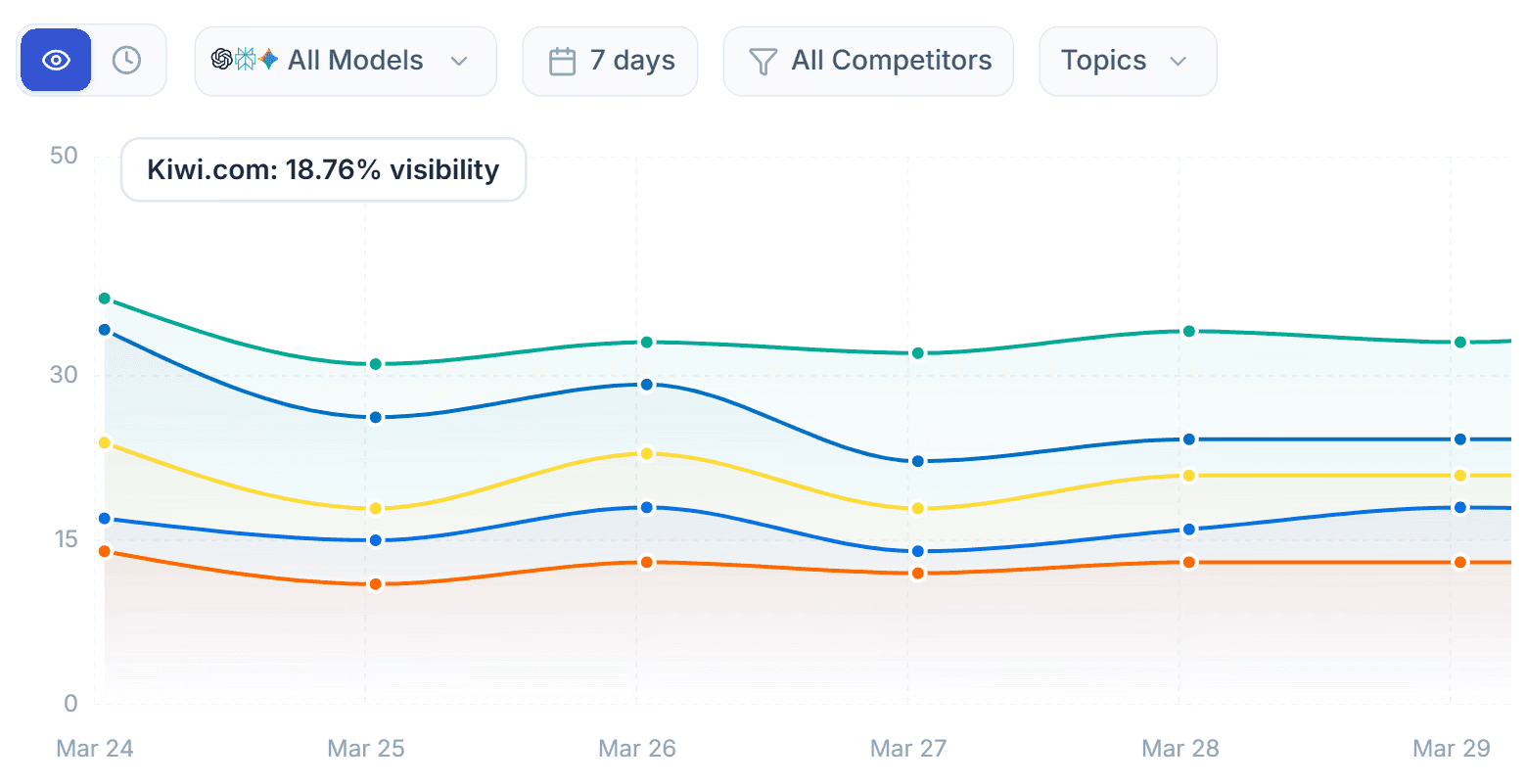
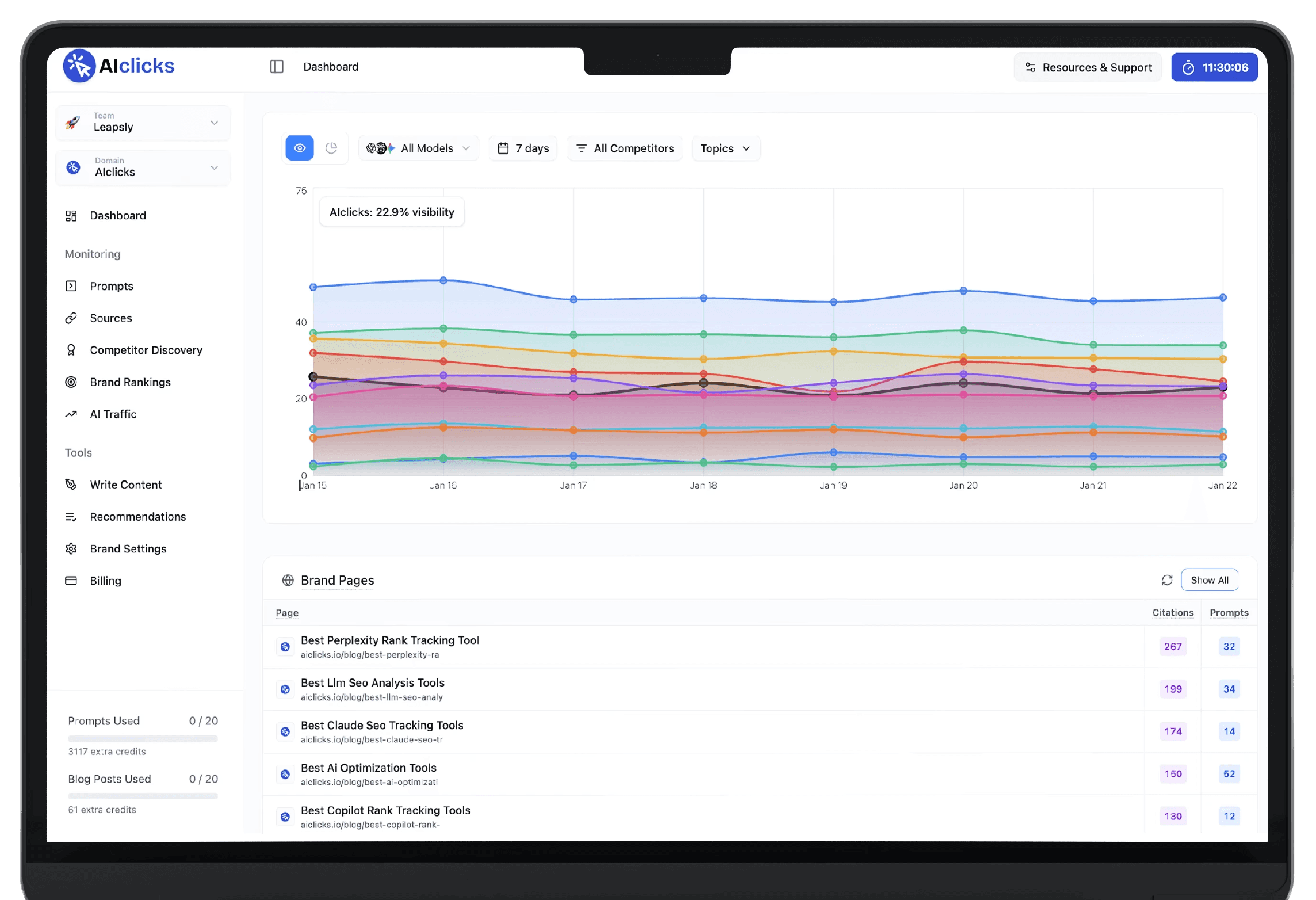
AIclicks gives you a live dashboard with daily ChatGPT mention rate, citation rate, sentiment, and share-of-voice across your tracked prompts, plus GA4 referral attribution for the traffic ChatGPT does send back.
Choose Your Plan
Flexible pricing that grows with your team. Upgrade or downgrade at any time.
Monthly
Yearly
-20%
Starter
Perfect for individuals & small teams
$49
/ month
Billed annually — you save $142
Choose 3 from:
Daily

" height="16px" id="fvSweaOBo" transform="translate(1 0)" width="14px"/></svg>)
" width="14px"><path d="M 13.864 5.629 L 13.3 5.629 L 13.3 5.6 L 7 5.6 L 7 8.4 L 10.956 8.4 C 10.379 10.03 8.828 11.2 7 11.2 C 4.681 11.2 2.8 9.319 2.8 7 C 2.8 4.681 4.681 2.8 7 2.8 C 8.071 2.8 9.045 3.204 9.786 3.864 L 11.766 1.884 C 10.516 0.719 8.844 0 7 0 C 3.134 0 0 3.134 0 7 C 0 10.866 3.134 14 7 14 C 10.866 14 14 10.866 14 7 C 14 6.531 13.952 6.073 13.864 5.629 Z" fill="rgb(255, 193, 7)" height="14px" id="H_YjfTNpn" width="14px"/><path d="M 0 3.742 L 2.3 5.429 C 2.922 3.888 4.429 2.8 6.193 2.8 C 7.264 2.8 8.238 3.204 8.979 3.864 L 10.959 1.884 C 9.709 0.719 8.037 0 6.193 0 C 3.504 0 1.172 1.518 0 3.742 Z" fill="rgb(255, 61, 0)" height="5.428500000000002px" id="PlkthQDhg" transform="translate(0.875 0)" width="10.959199999999996px"/><path d="M 6.232 5.581 C 8.04 5.581 9.683 4.889 10.925 3.764 L 8.758 1.931 C 8.032 2.483 7.144 2.782 6.232 2.781 C 4.411 2.781 2.865 1.62 2.283 0 L 0 1.759 C 1.159 4.026 3.511 5.581 6.232 5.581 Z" fill="rgb(76, 175, 80)" height="5.581099999999999px" id="WlnJ5gngE" transform="translate(0.7 8.4)" width="10.924899999999994px"/><path d="M 6.864 0.029 L 6.3 0.029 L 6.3 0 L 0 0 L 0 2.8 L 3.956 2.8 C 3.68 3.576 3.183 4.254 2.526 4.75 L 2.527 4.749 L 4.693 6.582 C 4.54 6.722 7 4.9 7 1.4 C 7 0.931 6.952 0.473 6.864 0.029 Z" fill="rgb(25, 118, 210)" height="6.589883930775992px" id="x_rSW275p" transform="translate(7 5.6)" width="7px"/></g></svg>)
" height="16px" id="hHS98fTxZ" width="16px"/></svg>)
 scale(1 1) translate(-1.861736945942159, -1.1170155383302638)" id="P20NzAvj0-699428820-radial-gradient" r="0.9935228066204626"><stop offset="0" stop-color="rgb(0, 174, 255)"/><stop offset="1" stop-color="rgb(7, 54, 196)"/></radialGradient><radialGradient cx="0.48250042504016705" cy="1.8366934653567062" gradient-transform="translate(0.48250042504016705, 1.8366934653567062) scale(1 1) translate(-0.48250042504016705, -1.8366934653567062)" id="UEWZqVjij-699428820-radial-gradient" r="0.9176890228114506"><stop offset="0" stop-color="rgb(255, 182, 87)"/><stop offset="1" stop-color="rgb(192, 43, 60)"/></radialGradient><linearGradient id="jyMN3TmKx-699428820-linear-gradient" x1="0.4594862532842614" x2="0.5405137467157386" y1="0" y2="1"><stop offset="0" stop-color="rgb(13, 145, 225)"/><stop offset="1" stop-color="rgb(255, 200, 0)"/></linearGradient><linearGradient id="xhMNwDFG0-699428820-linear-gradient" x1="0.4784828731548295" x2="0.5215171268451705" y1="5.551115123125783e-17" y2="1"><stop offset="0" stop-color="rgb(61, 203, 255)"/><stop offset="1" stop-color="rgba(5, 136, 247, 0)"/></linearGradient><radialGradient cx="1.4305090871482182" cy="0.34866158048251783" gradient-transform="translate(1.4305090871482182, 0.34866158048251783) scale(1 1) translate(-1.4305090871482182, -0.34866158048251783)" id="i79kAqaS4-699428820-radial-gradient" r="1.3362743412697924"><stop offset="0" stop-color="rgb(140, 72, 255)"/><stop offset="1" stop-color="rgb(255, 177, 82)"/></radialGradient><linearGradient id="mcxvno3tX-699428820-linear-gradient" x1="0.49844355920154226" x2="0.5015564407984577" y1="0" y2="1"><stop offset="0" stop-color="rgb(248, 173, 250)"/><stop offset="1" stop-color="rgba(168, 110, 221, 0)"/></linearGradient></defs><g d="M 11.605 1.219 C 11.397 0.499 10.739 0.002 9.989 0 L 9.498 0 C 8.682 0.002 7.985 0.588 7.842 1.391 L 7 6.016 L 7.209 5.296 C 7.416 4.574 8.075 4.076 8.825 4.074 L 11.681 4.074 L 12.879 4.545 L 14.033 4.074 L 13.697 4.074 C 12.947 4.072 12.289 3.575 12.081 2.855 Z M 4.413 13.387 C 4.618 14.111 5.278 14.611 6.031 14.613 L 7.075 14.613 C 7.988 14.613 8.735 13.88 8.758 12.96 L 8.871 8.5 L 8.633 9.319 C 8.426 10.039 7.768 10.537 7.018 10.539 L 4.138 10.539 L 3.111 9.977 L 2 10.539 L 2.331 10.539 C 3.084 10.542 3.743 11.042 3.949 11.766 L 4.413 13.387 Z M 9.999 0 L 4.167 0 C 2.501 0 1.501 2.221 0.834 4.441 C 0.045 7.073 -0.989 10.591 2.001 10.591 L 4.519 10.591 C 5.273 10.591 5.933 10.089 6.139 9.36 C 6.577 7.815 7.345 5.121 7.948 3.069 C 8.255 2.027 8.509 1.132 8.901 0.575 C 9.148 0.212 9.56 -0.004 9.999 0 M 9.999 0 L 4.167 0 C 2.501 0 1.501 2.221 0.834 4.441 C 0.045 7.073 -0.989 10.591 2.001 10.591 L 4.519 10.591 C 5.273 10.591 5.933 10.089 6.139 9.36 C 6.577 7.815 7.345 5.121 7.948 3.069 C 8.255 2.027 8.509 1.132 8.901 0.575 C 9.148 0.212 9.56 -0.004 9.999 0 M 6 14.593 L 11.833 14.593 C 13.499 14.593 14.499 12.372 15.166 10.151 C 15.955 7.519 16.989 4 13.999 4 L 11.48 4 C 10.725 4.002 10.063 4.505 9.86 5.232 C 9.266 7.332 8.663 9.429 8.051 11.523 C 7.745 12.566 7.49 13.461 7.098 14.019 C 6.851 14.382 6.439 14.597 6 14.593 M 6 14.593 L 11.833 14.593 C 13.499 14.593 14.499 12.372 15.166 10.151 C 15.955 7.519 16.989 4 13.999 4 L 11.48 4 C 10.725 4.002 10.063 4.505 9.86 5.232 C 9.266 7.332 8.663 9.429 8.051 11.523 C 7.745 12.566 7.49 13.461 7.098 14.019 C 6.851 14.382 6.439 14.597 6 14.593" fill="transparent" height="14.613333333333333px" id="QzkBy4Ibc" transform="translate(0 1)" width="16.00011071294081px"><path d="M 4.605 1.219 C 4.397 0.499 3.739 0.002 2.989 0 L 2.498 0 C 1.682 0.002 0.985 0.588 0.842 1.391 L 0 6.016 L 0.209 5.296 C 0.416 4.574 1.075 4.076 1.825 4.074 L 4.681 4.074 L 5.879 4.545 L 7.033 4.074 L 6.697 4.074 C 5.947 4.072 5.289 3.575 5.081 2.855 Z" fill="url(%23P20NzAvj0-699428820-radial-gradient)" height="6.016px" id="P20NzAvj0" transform="translate(7 0)" width="7.0333333333333385px"/><path d="M 2.413 4.887 C 2.618 5.611 3.278 6.111 4.031 6.113 L 5.075 6.113 C 5.988 6.113 6.735 5.38 6.758 4.46 L 6.871 0 L 6.633 0.819 C 6.426 1.539 5.768 2.037 5.018 2.039 L 2.138 2.039 L 1.111 1.477 L 0 2.039 L 0.331 2.039 C 1.084 2.042 1.743 2.542 1.949 3.266 L 2.413 4.887 Z" fill="url(%23UEWZqVjij-699428820-radial-gradient)" height="6.113333333333333px" id="UEWZqVjij" transform="translate(2 8.5)" width="6.871333333333332px"/><path d="M 9.999 0 L 4.167 0 C 2.501 0 1.501 2.221 0.834 4.441 C 0.045 7.073 -0.989 10.591 2.001 10.591 L 4.519 10.591 C 5.273 10.591 5.933 10.089 6.139 9.36 C 6.577 7.815 7.345 5.121 7.948 3.069 C 8.255 2.027 8.509 1.132 8.901 0.575 C 9.148 0.212 9.56 -0.004 9.999 0" fill="url(%23jyMN3TmKx-699428820-linear-gradient)" height="10.591388755215167px" id="jyMN3TmKx" width="9.999444046274142px"/><path d="M 9.999 0 L 4.167 0 C 2.501 0 1.501 2.221 0.834 4.441 C 0.045 7.073 -0.989 10.591 2.001 10.591 L 4.519 10.591 C 5.273 10.591 5.933 10.089 6.139 9.36 C 6.577 7.815 7.345 5.121 7.948 3.069 C 8.255 2.027 8.509 1.132 8.901 0.575 C 9.148 0.212 9.56 -0.004 9.999 0" fill="url(%23xhMNwDFG0-699428820-linear-gradient)" height="10.591388755215167px" id="xhMNwDFG0" width="9.999444046274142px"/><path d="M 0 10.593 L 5.833 10.593 C 7.499 10.593 8.499 8.372 9.166 6.151 C 9.955 3.519 10.989 0 7.999 0 L 5.48 0 C 4.725 0.002 4.063 0.505 3.86 1.232 C 3.266 3.332 2.663 5.429 2.051 7.523 C 1.745 8.566 1.49 9.461 1.098 10.019 C 0.851 10.382 0.439 10.597 0 10.593" fill="url(%23i79kAqaS4-699428820-radial-gradient)" height="10.593388755215164px" id="i79kAqaS4" transform="translate(6 4)" width="10.000110712940803px"/><path d="M 0 10.593 L 5.833 10.593 C 7.499 10.593 8.499 8.372 9.166 6.151 C 9.955 3.519 10.989 0 7.999 0 L 5.48 0 C 4.725 0.002 4.063 0.505 3.86 1.232 C 3.266 3.332 2.663 5.429 2.051 7.523 C 1.745 8.566 1.49 9.461 1.098 10.019 C 0.851 10.382 0.439 10.597 0 10.593" fill="url(%23mcxvno3tX-699428820-linear-gradient)" height="10.593388755215164px" id="mcxvno3tX" transform="translate(6 4)" width="10.000110712940803px"/></g></svg>)
" height="15.360666565427872px" id="HZPvvPBv7" transform="translate(0 0.5)" width="16px"/></svg>)
Tracked prompts
30
Websites you can add
3
LLMs you can track
3
Countries per project
1
LLM responses / mo
4,650
AI-optimized articles per month
10
Integrations
-
Support
Pro
For growing teams for more power
$140
/ month
Billed annually — you save $454
Choose 4 from:
Daily
Tracked prompts
150
Websites you can add
Unlimited
LLMs you can track
4
Countries per project
Unlimited
LLM responses / mo
18,600
AI-optimized articles per month
20
Integrations
Google Analytics
Support
BUSINESS
Best for medium-sized organizations
$357
/ month
Billed annually — you save $1198
Choose 6 from:
Daily
Tracked prompts
300
Websites you can add
Unlimited
LLMs you can track
6
Countries per project
Unlimited
LLM responses / mo
55,800
AI-optimized articles per month
30
Integrations
Google Analytics, API
Support
Dedicated account specialist
Become the #1 Answer in AI
Succeed in GEO yourself, or let us do all the work.
Do it yourself
Use AIclicks to see exactly where you appear across 10+ AI platforms, spot the gaps competitors are filling, and act on clear weekly recommendations.
From $59/month · Cancel anytime
Done for you
We Do All the Work for You
Our team manages your complete search presence: traditional SEO and GEO strategy, content, implementation, and reporting. You focus on visitors.
Custom pricing · Minimum 3-month engagement
The AI SEO agency trusted by 1,000+ brands worldwide
From solo founders to multi-client agencies, AIclicks runs the full AI SEO agency program for organizations of every shape and size that want to be cited across every AI surface.
4.9/5 stars on G2







FAQ
How long does church SEO take to work?
Map pack movement usually shows in 2 to 3 months, and organic rankings for service and denomination terms in 6 to 12. Churches in small towns move faster; one agency documented a church reaching page one within a week in a market with almost no competition. Larger metros with 40 churches in a 5 mile radius take a year. The first honest signal is direction requests on your profile, which rise long before attendance does.
Should we optimize for Google or for AI answers?
Both, and they reward different things. Ahrefs analysed 863,000 keywords and found only 38% of pages cited in AI Overviews also ranked in the top 10, down from 76% a year earlier. When someone new to a city asks ChatGPT to find a welcoming church, the answer is assembled from directory profiles, denominational listings and review text, not from your homepage. Almost no church is tracking whether it appears there at all.
How is church SEO different from normal local SEO?
Three things change. You are not selling anything, so the conversion is a person walking in on a Sunday and nothing in analytics records it. Your hours model is broken by default, because a profile open one morning a week reads as permanently closed. And you compete against your own denomination, whose national find-a-church directory outranks every member congregation. Generic local SEO advice addresses none of that.
What should a church budget for SEO each month?
Bundled church website and SEO packages start around $500 a month, which is what several church-specific vendors charge for a site plus ongoing optimisation. Standalone SEO for a single-campus church usually runs $750 to $2,000, and multi-campus work above that. Be careful at the top end: agencies have taken $10,000 from large churches for work that produced reports and no rankings. Judge it on first-time guests, not traffic.
Do we still need SEO with the Google Ad Grant?
Yes, because the grant and organic search cover different ground. The Google Ad Grant gives registered nonprofits up to $10,000 a month in free search ads, which is genuinely useful, but grant ads sit below paid bidders, cannot run on Maps, and get paused if click-through drops below the programme threshold. Nothing in the grant helps you appear in the map pack or in an AI answer. Run both, and let grant data tell you which pages to build.
Which pages should our church build first?
Google Business Profile first, because it is free and it sits above everything. Then a Plan Your Visit page with times, parking, dress and what happens to children. Then a kids and childcare page, which is the question that decides most family visits. Then what we believe, because people check before they commit a Sunday. Campus pages after that. Sermon archives and the blog come last, and only once the first 4 are genuinely finished.
What counts as good traffic for a church website?
Sessions are the wrong number. Track direction requests, calls and website clicks inside Google Business Profile, because most people never reach your site at all. On the site, measure clicks on service times, connect card submissions and map link taps rather than pageviews. Then reconcile against first-time guest counts in Planning Center or Breeze. A church website doing its job produces more new faces, not more analytics.
Should a volunteer do this or do we hire out?
Split it, and be realistic about volunteers. Profile posts, photos, review requests and answering visitor questions belong in-house, because only your people know what a Sunday actually feels like. Hire out the technical layer: schema, the events calendar cleanup, site speed and directory consistency. The common failure is a website built free by a member who then leaves, and nobody left holding the login. Whoever does the work, write down who owns it.
Further Reading
Go deeper on GEO, AI search, and visibility tracking.