SEO for Charities:
Someone deciding where to give checks the cause, then the charity, then whether the money actually lands. That research happens in Google and increasingly inside an AI answer, weeks before anyone reaches your donate page or fills in a volunteer form.









Why Charities Need SEO
Google gives eligible nonprofits $10,000 a month in free search ads, which tells you where supporters look first. What it does not fix is whether AI answers ever name you.
Most charity traffic is people who already knew you existed. The supporters you have not met search the cause, the symptom, the benefit or the crisis, and land on whoever wrote it. If your programme pages use your own internal language, grants, interventions, beneficiaries, you never appear in that search.
Search charities to donate to near me in a US city and GoFundMe, Charity Navigator and Candid sit above every individual charity. They aggregate hundreds of thousands of registered organisations, so they rank on scale you cannot match, then list you alongside every other competitor for the same donation.
Charity boards approve agency retainers of $1,500 to $5,000 a month and never see a donation attributed to them, which is the complaint filling the nonprofit forums. Meanwhile the $10,000 Ad Grant burns on low-quality clicks. Stop paying and the traffic stops, because nothing was built that keeps working.
How SEO Works for Charities
Search Engine Optimization projects are long-term investments for nonprofits, where each task supplements the others and creates compound results over time.
01
Keywords, page structure, and the signals Google reads directly
On-page work is harder for charities than for a business selling a product, because a charity has to rank for 3 different audiences with one website. Someone in crisis, someone deciding where to donate, and someone looking for volunteering all type completely different things, and a homepage written to satisfy trustees satisfies none of them. Much of the content is advice about health, benefits, bereavement or safety, which Google files under Your Money or Your Life and holds to a higher bar. The pages that carry the weight are your condition and support pages, your appeal pages, and your impact reporting, not the newsroom.
The durable assets are the ones tied to a need rather than a date. A page explaining what help someone can claim, how to spot a warning sign, or what a diagnosis actually means will still be found in 5 years, because the question does not change and the sector rarely writes it well. What churns is everything an appeal produces: the emergency landing page from 2 winters ago, the gala recap, the trustee appointment notice, the campaign hashtag microsite nobody redirected. Most charities publish 40 of those a year and 2 pages that anyone outside the mailing list ever searches for.
1
Rebuild each programme page around the words supporters type, not your grant terminology; check the wording in Google Search Console query data first.
2
Redirect expired appeal URLs and retired campaign microsites into the permanent programme page instead of leaving orphaned Classy or Donorbox pages indexed.
3
Mark the organisation up as NGO with a nonprofitStatus of Nonprofit501c3, add DonateAction to the donate page, and validate in Rich Results Test.
4
Publish plain-language guides to eligibility, entitlements and next steps for the people you serve; these rank year-round and attract links from public agency pages.
02
Map Pack visibility, citations, and proximity signals
Charity demand splits: national causes compete nationally, but the money and the volunteers are local. Charity shops, drop-in centres, food banks, hospices and donation points are all near me searches that trigger the map pack, and the map pack sits above every rating site. A regional charity that wins 3 map positions in its own area outranks GoFundMe there, which it will never do on a national donate query.
Set the primary category precisely: Charity, Food Bank, Thrift Store, Hospice or Volunteer Organisation are separate categories and they surface for separate searches. Add every site as its own profile, list what you accept and what you cannot take, publish genuine opening hours including donation-drop windows, and answer the questions that actually decide a visit in the Q&A: parking, whether you collect furniture, whether you need an appointment.
The charity citation layer is not Yelp. It is Candid, where your GuideStar profile and transparency seal feed most of the rest, Charity Navigator, GreatNonprofits, VolunteerMatch and Idealist for volunteer roles, plus your state charity registration and IRS exemption record. Corporate giving portals such as Benevity pull from those same feeds. One mismatched legal name or EIN across them and payroll-giving platforms quietly fail to find you.
1
Choose Food Bank, Thrift Store or Charity as the primary category rather than Non-Profit Organization, then list collections and services individually.
2
Give every charity shop, hub and hospice its own Google Business Profile and its own page listing stock, collection days and the team there.
3
Run BrightLocal across Candid, Charity Navigator, GreatNonprofits and VolunteerMatch, and force one legal name, one EIN and one address everywhere.
4
Publish one Google Business Profile post a week naming what the shop needs this week, a volunteer shift, or an open drop-off session.
03
Topic authority, inbound links, and content that earns traffic
Before anyone gives, they are quietly checking whether you are legitimate and whether the money reaches the work. Publish the answers: what proportion of income goes to programmes, what a specific gift actually buys, who is on the board and what they are paid, how a beneficiary is referred. Charities treat this as compliance content buried in an annual report. Written as pages, it is the highest-converting content on the site.
Someone who has decided to give is now choosing between you and 4 charities working on the same cause. They want the gift amounts spelled out, the tax receipt handled, the regular-giving option obvious, and proof that the last appeal did what it promised. Put outcome numbers and a named programme lead on the donate page itself, not 3 clicks into an impact PDF nobody opens.
Charities have the easiest link profile in any sector and the most dangerous. Corporate partners publish CSR pages, funders list grantees, universities cite your research, and journalists need a sector voice on deadline. All of that is free. The danger is the opposite offer: agencies approach small charities with a free website in exchange for hosting paid links to their clients. That is a link scheme, and the penalty lands on your domain.
1
Publish an annual how to choose a charity guide for your cause, comparing delivery models honestly, and cite Charity Navigator and Candid ratings.
2
Build one page per service per area you cover, with real referral routes, opening times and eligibility, not one paragraph with a place name swapped.
3
Cluster every where does my money go question into one hub: overheads, fundraising costs, executive pay, tax deductibility and what $25 actually funds.
4
Write a page for each named programme, research partnership and accreditation you hold, because funders and journalists search those names before they search yours.
04
Site speed, crawlability, Core Web Vitals, and mobile health
The failure nearly every charity shares is publishing in PDF. Annual accounts, research reports, policy briefings and service leaflets go up as PDFs, Google indexes them, and they start outranking the HTML pages that carry your navigation, your schema and your donate button. Then the donation flow itself sits on a third-party subdomain, so the one conversion that matters is measured somewhere else entirely and none of that equity comes back.
Charity traffic peaks in 2 moments, and both are mobile. A disaster appeal that hits the news sends thousands of people to one page at once, on phones, from a link in an article. So does a crisis search at 2 in the morning by someone who needs a helpline number now. If the appeal page carries an autoplaying video, a cookie wall and a donation widget that loads last, the moment is gone.
1
Filter Search Console by filetype PDF, find every report earning impressions, and republish the top ones as HTML pages with the PDF as a download.
2
Run PageSpeed Insights on your live appeal page, defer the donation widget and video, and target Largest Contentful Paint under 2.5 seconds.
3
Serve field and beneficiary photography as WebP at display size with srcset, since charity sites carry documentary imagery no e-commerce site would ship.
4
Keep support and programme pages in a sitemap separate from news and appeals, and ping IndexNow the hour an emergency appeal goes live.
05
Star ratings, review volume, and response strategy that builds trust
Trust is the entire proposition. A donor is handing money to strangers with no product to inspect, so the star rating on a charity shop, the Candid seal and the Charity Navigator score do the work a receipt would do anywhere else. Collecting them is awkward, because the people you help are often the last people you can ask. Safeguarding rules, and basic decency, stop you soliciting a public review from someone in crisis.
Ask the audiences you can. Volunteers finish a shift proud and will write about it that evening if the link reaches them before they get home. Event fundraisers are at their peak the hour they cross a finish line. Shop customers hold their phone at the till. Regular donors respond to the impact update, not the ask. Route each group to a different platform and the profile builds itself across the year.
1
Wire Bloomerang or Salesforce Nonprofit Cloud to send a GreatNonprofits link when a volunteer shift or event registration is marked complete.
2
Reply within 24 hours to overheads and executive pay criticism with the actual figures and a link to your accounts, never a defensive statement.
3
Put volunteer and donor reviews plus your Candid seal on the donate and volunteer pages, not in a site-wide testimonials strip.
4
Ask shop customers for Google reviews at the till, since retail is the one part of a charity people review without being prompted.
Google is No Longer the Only Place Your supporters are Searching
Supporters are using AI to find answers, and they trust what it tells them. Invest in GEO to get recommended in those answers.
1 Billion
Questions ChatGPT receives every single day
38%
Your #1 top ranking page on Google would be cited by AI
14%
of nonprofits optimise for GEO. The rest are invisible in AI answers


You can rank #1 for “nonprofit near me” and still not exist in ChatGPT’s answer. Run a free GEO audit to see where your brand actually stands.
GEO vs SEO: Same Goal, Different Methods
GEO is wider than SEO. AI recommends the brands that show up across the sources it reads, so your presence in forums, social platforms and charity blogs decides your odds. AIclicks measures the three metrics below so you know which to work on first.
AI Assistant
Where can I give that actually helps locally?
Your Charity
Citation Rate
Shows how many AI answers about charities name your brand, out of every 100. Models pull from the same trusted pages over and over, so citations compound: once you are in, staying in gets easier. Find the competitor pages AI cites most, then publish your own version of each.
Your Charity
82% positive
Competitor A
54% positive
Competitor B
38% positive
Brand Sentiment
Shows how AI describes you when your brand comes up: positive, neutral or negative. Tone is what separates being mentioned from being recommended, and models repeat whatever framing they find. Track the negative mentions back to the reviews and threads behind them, then publish content that answers those directly.
Others 52%
You 24%
— 24%
Your Charity
AI mention share of voice — charity category
Competitors
Not Cited
Share of Voice in AI
Shows how much of the charity conversation belongs to you rather than your competitors. This is the metric that matters most, the GEO version of a Google ranking. With only 1–5 brands named per answer, the market is winner-takes-more and every point is taken from someone.
The Dashboard Your Dedicated AI Search Team Works In
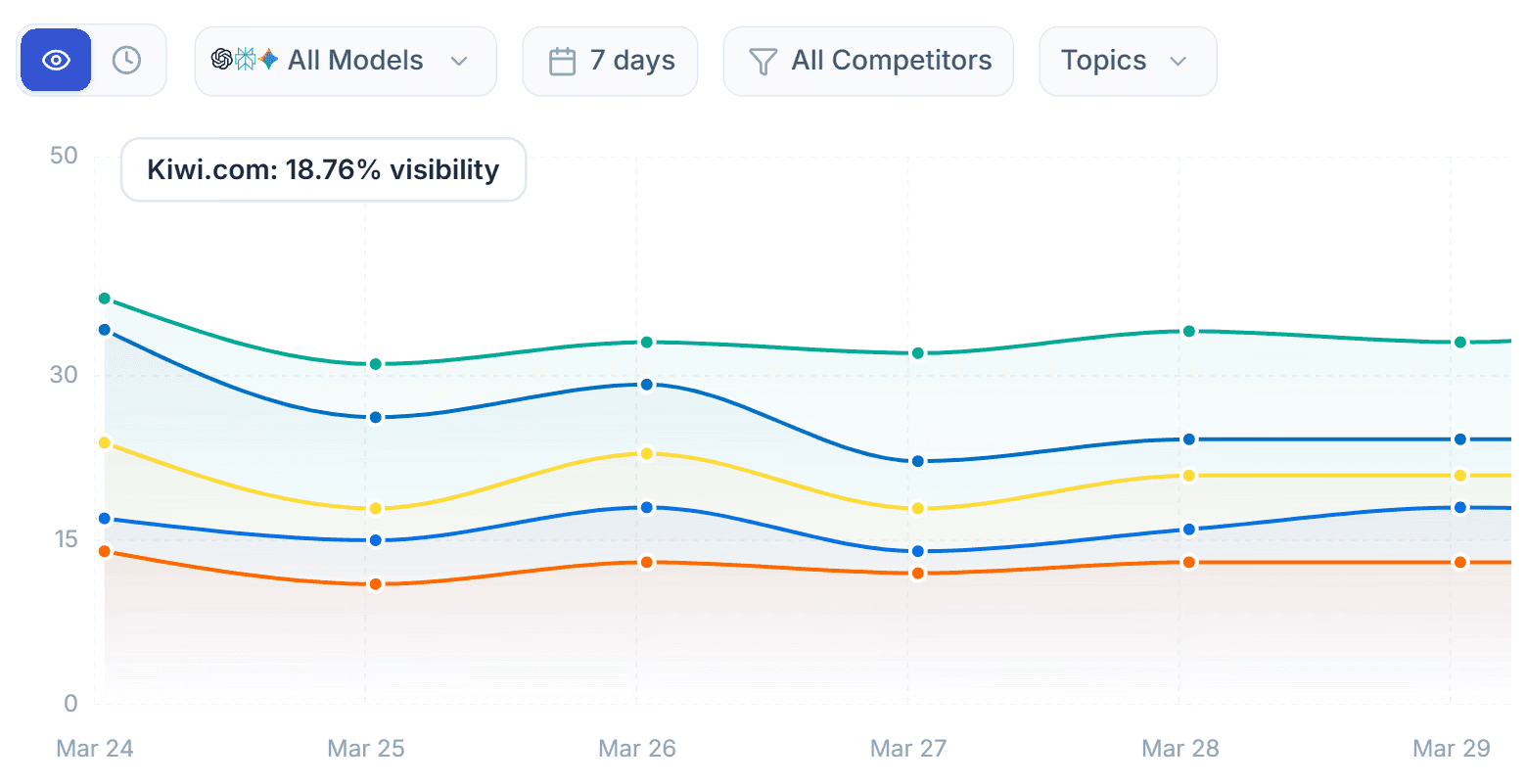
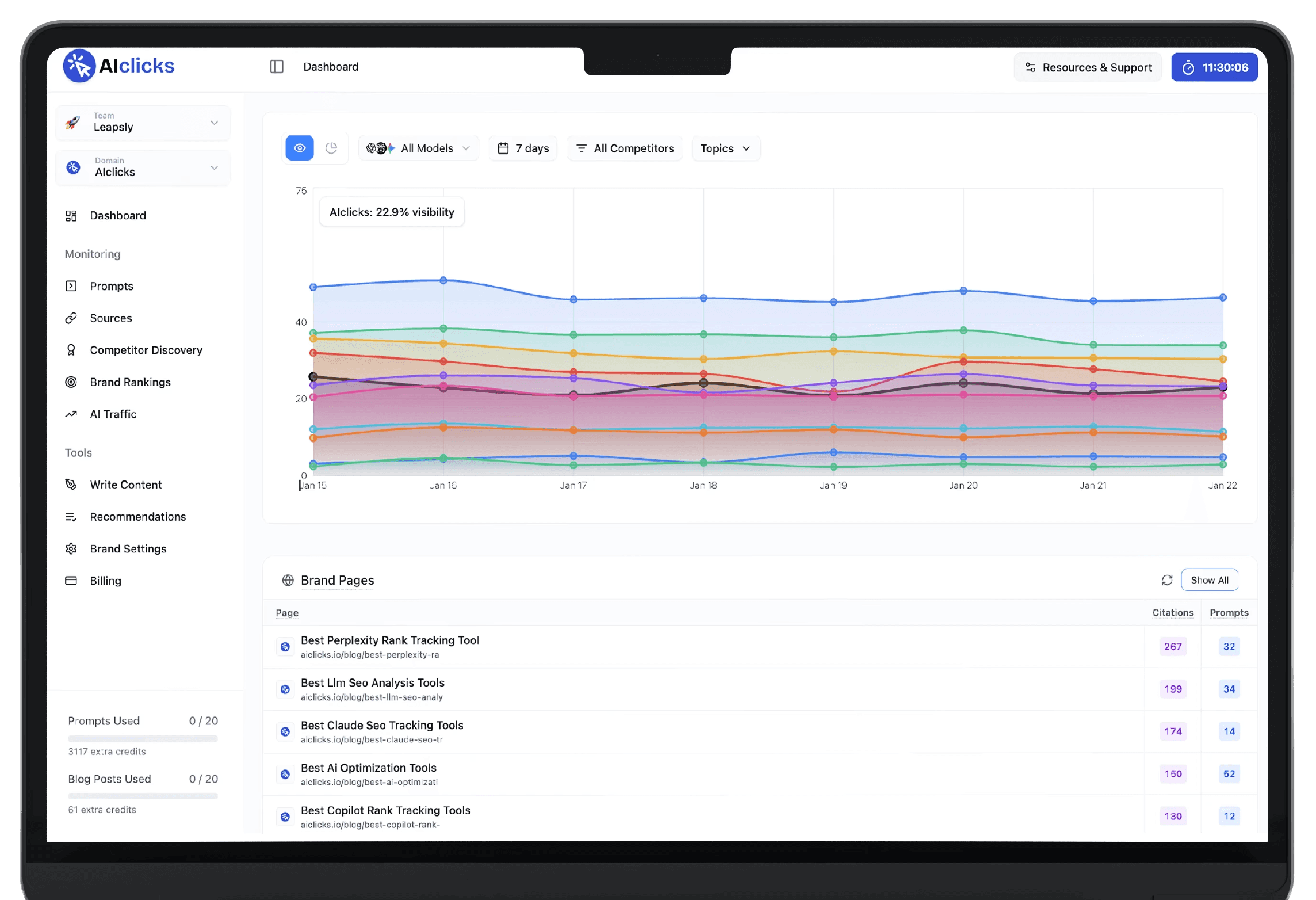
AIclicks gives you a live dashboard with daily ChatGPT mention rate, citation rate, sentiment, and share-of-voice across your tracked prompts, plus GA4 referral attribution for the traffic ChatGPT does send back.
Choose Your Plan
Flexible pricing that grows with your team. Upgrade or downgrade at any time.
Monthly
Yearly
-20%
Starter
Perfect for individuals & small teams
$49
/ month
Billed annually — you save $142
Choose 3 from:
Daily

" height="16px" id="fvSweaOBo" transform="translate(1 0)" width="14px"/></svg>)
" width="14px"><path d="M 13.864 5.629 L 13.3 5.629 L 13.3 5.6 L 7 5.6 L 7 8.4 L 10.956 8.4 C 10.379 10.03 8.828 11.2 7 11.2 C 4.681 11.2 2.8 9.319 2.8 7 C 2.8 4.681 4.681 2.8 7 2.8 C 8.071 2.8 9.045 3.204 9.786 3.864 L 11.766 1.884 C 10.516 0.719 8.844 0 7 0 C 3.134 0 0 3.134 0 7 C 0 10.866 3.134 14 7 14 C 10.866 14 14 10.866 14 7 C 14 6.531 13.952 6.073 13.864 5.629 Z" fill="rgb(255, 193, 7)" height="14px" id="H_YjfTNpn" width="14px"/><path d="M 0 3.742 L 2.3 5.429 C 2.922 3.888 4.429 2.8 6.193 2.8 C 7.264 2.8 8.238 3.204 8.979 3.864 L 10.959 1.884 C 9.709 0.719 8.037 0 6.193 0 C 3.504 0 1.172 1.518 0 3.742 Z" fill="rgb(255, 61, 0)" height="5.428500000000002px" id="PlkthQDhg" transform="translate(0.875 0)" width="10.959199999999996px"/><path d="M 6.232 5.581 C 8.04 5.581 9.683 4.889 10.925 3.764 L 8.758 1.931 C 8.032 2.483 7.144 2.782 6.232 2.781 C 4.411 2.781 2.865 1.62 2.283 0 L 0 1.759 C 1.159 4.026 3.511 5.581 6.232 5.581 Z" fill="rgb(76, 175, 80)" height="5.581099999999999px" id="WlnJ5gngE" transform="translate(0.7 8.4)" width="10.924899999999994px"/><path d="M 6.864 0.029 L 6.3 0.029 L 6.3 0 L 0 0 L 0 2.8 L 3.956 2.8 C 3.68 3.576 3.183 4.254 2.526 4.75 L 2.527 4.749 L 4.693 6.582 C 4.54 6.722 7 4.9 7 1.4 C 7 0.931 6.952 0.473 6.864 0.029 Z" fill="rgb(25, 118, 210)" height="6.589883930775992px" id="x_rSW275p" transform="translate(7 5.6)" width="7px"/></g></svg>)
" height="16px" id="hHS98fTxZ" width="16px"/></svg>)
 scale(1 1) translate(-1.861736945942159, -1.1170155383302638)" id="P20NzAvj0-699428820-radial-gradient" r="0.9935228066204626"><stop offset="0" stop-color="rgb(0, 174, 255)"/><stop offset="1" stop-color="rgb(7, 54, 196)"/></radialGradient><radialGradient cx="0.48250042504016705" cy="1.8366934653567062" gradient-transform="translate(0.48250042504016705, 1.8366934653567062) scale(1 1) translate(-0.48250042504016705, -1.8366934653567062)" id="UEWZqVjij-699428820-radial-gradient" r="0.9176890228114506"><stop offset="0" stop-color="rgb(255, 182, 87)"/><stop offset="1" stop-color="rgb(192, 43, 60)"/></radialGradient><linearGradient id="jyMN3TmKx-699428820-linear-gradient" x1="0.4594862532842614" x2="0.5405137467157386" y1="0" y2="1"><stop offset="0" stop-color="rgb(13, 145, 225)"/><stop offset="1" stop-color="rgb(255, 200, 0)"/></linearGradient><linearGradient id="xhMNwDFG0-699428820-linear-gradient" x1="0.4784828731548295" x2="0.5215171268451705" y1="5.551115123125783e-17" y2="1"><stop offset="0" stop-color="rgb(61, 203, 255)"/><stop offset="1" stop-color="rgba(5, 136, 247, 0)"/></linearGradient><radialGradient cx="1.4305090871482182" cy="0.34866158048251783" gradient-transform="translate(1.4305090871482182, 0.34866158048251783) scale(1 1) translate(-1.4305090871482182, -0.34866158048251783)" id="i79kAqaS4-699428820-radial-gradient" r="1.3362743412697924"><stop offset="0" stop-color="rgb(140, 72, 255)"/><stop offset="1" stop-color="rgb(255, 177, 82)"/></radialGradient><linearGradient id="mcxvno3tX-699428820-linear-gradient" x1="0.49844355920154226" x2="0.5015564407984577" y1="0" y2="1"><stop offset="0" stop-color="rgb(248, 173, 250)"/><stop offset="1" stop-color="rgba(168, 110, 221, 0)"/></linearGradient></defs><g d="M 11.605 1.219 C 11.397 0.499 10.739 0.002 9.989 0 L 9.498 0 C 8.682 0.002 7.985 0.588 7.842 1.391 L 7 6.016 L 7.209 5.296 C 7.416 4.574 8.075 4.076 8.825 4.074 L 11.681 4.074 L 12.879 4.545 L 14.033 4.074 L 13.697 4.074 C 12.947 4.072 12.289 3.575 12.081 2.855 Z M 4.413 13.387 C 4.618 14.111 5.278 14.611 6.031 14.613 L 7.075 14.613 C 7.988 14.613 8.735 13.88 8.758 12.96 L 8.871 8.5 L 8.633 9.319 C 8.426 10.039 7.768 10.537 7.018 10.539 L 4.138 10.539 L 3.111 9.977 L 2 10.539 L 2.331 10.539 C 3.084 10.542 3.743 11.042 3.949 11.766 L 4.413 13.387 Z M 9.999 0 L 4.167 0 C 2.501 0 1.501 2.221 0.834 4.441 C 0.045 7.073 -0.989 10.591 2.001 10.591 L 4.519 10.591 C 5.273 10.591 5.933 10.089 6.139 9.36 C 6.577 7.815 7.345 5.121 7.948 3.069 C 8.255 2.027 8.509 1.132 8.901 0.575 C 9.148 0.212 9.56 -0.004 9.999 0 M 9.999 0 L 4.167 0 C 2.501 0 1.501 2.221 0.834 4.441 C 0.045 7.073 -0.989 10.591 2.001 10.591 L 4.519 10.591 C 5.273 10.591 5.933 10.089 6.139 9.36 C 6.577 7.815 7.345 5.121 7.948 3.069 C 8.255 2.027 8.509 1.132 8.901 0.575 C 9.148 0.212 9.56 -0.004 9.999 0 M 6 14.593 L 11.833 14.593 C 13.499 14.593 14.499 12.372 15.166 10.151 C 15.955 7.519 16.989 4 13.999 4 L 11.48 4 C 10.725 4.002 10.063 4.505 9.86 5.232 C 9.266 7.332 8.663 9.429 8.051 11.523 C 7.745 12.566 7.49 13.461 7.098 14.019 C 6.851 14.382 6.439 14.597 6 14.593 M 6 14.593 L 11.833 14.593 C 13.499 14.593 14.499 12.372 15.166 10.151 C 15.955 7.519 16.989 4 13.999 4 L 11.48 4 C 10.725 4.002 10.063 4.505 9.86 5.232 C 9.266 7.332 8.663 9.429 8.051 11.523 C 7.745 12.566 7.49 13.461 7.098 14.019 C 6.851 14.382 6.439 14.597 6 14.593" fill="transparent" height="14.613333333333333px" id="QzkBy4Ibc" transform="translate(0 1)" width="16.00011071294081px"><path d="M 4.605 1.219 C 4.397 0.499 3.739 0.002 2.989 0 L 2.498 0 C 1.682 0.002 0.985 0.588 0.842 1.391 L 0 6.016 L 0.209 5.296 C 0.416 4.574 1.075 4.076 1.825 4.074 L 4.681 4.074 L 5.879 4.545 L 7.033 4.074 L 6.697 4.074 C 5.947 4.072 5.289 3.575 5.081 2.855 Z" fill="url(%23P20NzAvj0-699428820-radial-gradient)" height="6.016px" id="P20NzAvj0" transform="translate(7 0)" width="7.0333333333333385px"/><path d="M 2.413 4.887 C 2.618 5.611 3.278 6.111 4.031 6.113 L 5.075 6.113 C 5.988 6.113 6.735 5.38 6.758 4.46 L 6.871 0 L 6.633 0.819 C 6.426 1.539 5.768 2.037 5.018 2.039 L 2.138 2.039 L 1.111 1.477 L 0 2.039 L 0.331 2.039 C 1.084 2.042 1.743 2.542 1.949 3.266 L 2.413 4.887 Z" fill="url(%23UEWZqVjij-699428820-radial-gradient)" height="6.113333333333333px" id="UEWZqVjij" transform="translate(2 8.5)" width="6.871333333333332px"/><path d="M 9.999 0 L 4.167 0 C 2.501 0 1.501 2.221 0.834 4.441 C 0.045 7.073 -0.989 10.591 2.001 10.591 L 4.519 10.591 C 5.273 10.591 5.933 10.089 6.139 9.36 C 6.577 7.815 7.345 5.121 7.948 3.069 C 8.255 2.027 8.509 1.132 8.901 0.575 C 9.148 0.212 9.56 -0.004 9.999 0" fill="url(%23jyMN3TmKx-699428820-linear-gradient)" height="10.591388755215167px" id="jyMN3TmKx" width="9.999444046274142px"/><path d="M 9.999 0 L 4.167 0 C 2.501 0 1.501 2.221 0.834 4.441 C 0.045 7.073 -0.989 10.591 2.001 10.591 L 4.519 10.591 C 5.273 10.591 5.933 10.089 6.139 9.36 C 6.577 7.815 7.345 5.121 7.948 3.069 C 8.255 2.027 8.509 1.132 8.901 0.575 C 9.148 0.212 9.56 -0.004 9.999 0" fill="url(%23xhMNwDFG0-699428820-linear-gradient)" height="10.591388755215167px" id="xhMNwDFG0" width="9.999444046274142px"/><path d="M 0 10.593 L 5.833 10.593 C 7.499 10.593 8.499 8.372 9.166 6.151 C 9.955 3.519 10.989 0 7.999 0 L 5.48 0 C 4.725 0.002 4.063 0.505 3.86 1.232 C 3.266 3.332 2.663 5.429 2.051 7.523 C 1.745 8.566 1.49 9.461 1.098 10.019 C 0.851 10.382 0.439 10.597 0 10.593" fill="url(%23i79kAqaS4-699428820-radial-gradient)" height="10.593388755215164px" id="i79kAqaS4" transform="translate(6 4)" width="10.000110712940803px"/><path d="M 0 10.593 L 5.833 10.593 C 7.499 10.593 8.499 8.372 9.166 6.151 C 9.955 3.519 10.989 0 7.999 0 L 5.48 0 C 4.725 0.002 4.063 0.505 3.86 1.232 C 3.266 3.332 2.663 5.429 2.051 7.523 C 1.745 8.566 1.49 9.461 1.098 10.019 C 0.851 10.382 0.439 10.597 0 10.593" fill="url(%23mcxvno3tX-699428820-linear-gradient)" height="10.593388755215164px" id="mcxvno3tX" transform="translate(6 4)" width="10.000110712940803px"/></g></svg>)
" height="15.360666565427872px" id="HZPvvPBv7" transform="translate(0 0.5)" width="16px"/></svg>)
Tracked prompts
30
Websites you can add
3
LLMs you can track
3
Countries per project
1
LLM responses / mo
4,650
AI-optimized articles per month
10
Integrations
-
Support
Pro
For growing teams for more power
$140
/ month
Billed annually — you save $454
Choose 4 from:
Daily
Tracked prompts
150
Websites you can add
Unlimited
LLMs you can track
4
Countries per project
Unlimited
LLM responses / mo
18,600
AI-optimized articles per month
20
Integrations
Google Analytics
Support
BUSINESS
Best for medium-sized organizations
$357
/ month
Billed annually — you save $1198
Choose 6 from:
Daily
Tracked prompts
300
Websites you can add
Unlimited
LLMs you can track
6
Countries per project
Unlimited
LLM responses / mo
55,800
AI-optimized articles per month
30
Integrations
Google Analytics, API
Support
Dedicated account specialist
Become the #1 Answer in AI
Succeed in GEO yourself, or let us do all the work.
Do it yourself
Use AIclicks to see exactly where you appear across 10+ AI platforms, spot the gaps competitors are filling, and act on clear weekly recommendations.
From $59/month · Cancel anytime
Done for you
We Do All the Work for You
Our team manages your complete search presence: traditional SEO and GEO strategy, content, implementation, and reporting. You focus on supporters.
Custom pricing · Minimum 3-month engagement
The AI SEO agency trusted by 1,000+ brands worldwide
From solo founders to multi-client agencies, AIclicks runs the full AI SEO agency program for organizations of every shape and size that want to be cited across every AI surface.
4.9/5 stars on G2







FAQ
How long does SEO take to work for a charity?
Expect the first movement in 3 to 4 months and meaningful supporter growth around 6 to 9. Advice and support content in a crowded cause area, where you compete with national charities and health publishers, realistically takes 12 months. Charity shop and local service pages move faster because the map pack rewards profile work quickly. Build 6 months ahead of your giving season, not during it.
Should we optimise for Google or AI search?
Both, and charities are hit harder by the shift. Ahrefs analysed 863,000 keywords and found only 38% of pages cited in AI Overviews also ranked in the top 10, down from 76% a year earlier. Ranking no longer carries you into the answer. Ask an assistant which charity to support and it names organisations from ratings sites and news coverage, so being quotable, rated and consistently described matters as much as position.
How is charity SEO different from normal local SEO?
Three things. You are optimising for supporters, volunteers and beneficiaries at once, and they search in completely different language. Much of your content is health, benefits or safety advice, which Google treats as Your Money or Your Life and holds to a stricter standard. And your competition is not another charity down the road; it is Charity Navigator, GoFundMe and the national organisation with 100 staff working on the same cause.
What should a charity budget for SEO?
Agency retainers for the sector typically run $1,500 to $3,000 a month for a small charity, $3,000 to $8,000 for a regional one, and higher for national organisations with large content libraries. Many agencies discount for registered nonprofits, so ask. The number trustees should see is cost per new regular donor against lifetime value, not the retainer alone, and no proposal that cannot report that is worth signing.
How does SEO fit with our Google Ad Grant?
They feed each other, and most charities waste the grant without the organic side. The Ad Grant gives eligible nonprofits $10,000 a month in search ads, but it caps at a low bid, requires a 5% click-through rate, and only sends traffic to pages that already convert. Use grant data to find which cause terms actually produce donations, then build the organic pages for those terms.
Which pages should a charity build first?
Google Business Profiles first, one for every shop, hub or centre, because they are free and sit above everything. Then the single support or advice page your beneficiaries most need, written in their words. Then a where your money goes page, because it converts donors who are already convinced by the cause. Then programme pages, then volunteering. The newsroom and the annual report come last.
How do we prove SEO is actually working?
Report donations and sign-ups from organic search, not rankings. Tag the donate flow properly even when it sits on a third-party platform, because that is where most charity attribution breaks. Track volunteer applications, helpline clicks and shop direction requests separately, since those are outcomes too. In Search Console watch impressions on cause and advice terms, which rise months before positions do. Reconcile everything against your CRM.
Should we do this in-house or hire someone?
Split it, and be careful who you let near the domain. Your team knows the cause, the beneficiaries and the language they use, so writing and profile upkeep belong in-house. Technical work, schema and migrations need a specialist. Refuse any offer of a free or heavily discounted website in return for links to a third party; that arrangement is common in the sector and the penalty lands on you.
Further Reading
Go deeper on GEO, AI search, and visibility tracking.