SEO for Casinos:
A player deciding where to spend Saturday night checks the map, scans the star rating, and asks an AI assistant which floor pays better, all before your host ever sees them. Whoever shows up in those 3 checks gets the trip.









Why Casinos Need SEO
Google restricts gambling ads to certified advertisers in approved states, so the channel most industries lean on is capped. Organic and AI visibility is where players actually find a floor.
A casino resort sells gaming, a hotel, 6 restaurants, a spa, concerts, a poker room and a sportsbook, then describes the whole resort on one single page. Someone searching for a late-night buffet, a poker tournament schedule, or a room with a comp rate never finds you at all, and the floor never even sees the visit.
Type casinos near me anywhere in the US and the first organic results are usually Yelp, Tripadvisor or a visitors bureau round-up, not a casino. Casino City and 500 Nations carry domain authority no single property will ever accumulate, then sell the casino next door a placement above you in the listing that beat you.
Google only serves gambling ads from certified advertisers in approved states, and the formats it allows are narrow. So casinos push the budget into radio, billboards and direct mail, at rates that reset to zero each month. Meanwhile agencies that take gambling work quote $5,000 to $20,000 a month, largely for links.
How SEO Works for Casinos
Search Engine Optimization projects are long-term investments for casino operators, where each task supplements the others and creates compound results over time.
01
Keywords, page structure, and the signals Google reads directly
On-page work is unusually hard for casinos because the site is really 7 businesses wearing one domain. Gaming, hotel, dining, entertainment, meetings, sportsbook and the players club each have their own searchers, their own language and their own competitors, yet most properties give the whole thing a single navigation bar and a promotions page. Google also treats gambling as YMYL, so a page about payouts or wagering is held to a stricter evidence standard than a page about a steakhouse. The pages that carry the weight are your gaming floor pages, your promotions hub, your entertainment calendar and your hotel booking path.
What holds value is anything describing how the property works, rather than what happens to be on this month. A page explaining how your tier credits and comps are earned, what the poker room rake and blind structures are, or which slot denominations sit where on the floor will still be earning visits in 3 years. What churns is everything with a date on it: the weekend giveaway, the tribute act, the seasonal buffet menu. Most casinos have the ratio inverted, running a promotions feed that turns over weekly while the players club page has not been touched since the site launched.
1
Give slots, table games, poker and the sportsbook their own pages with real game counts, limits and hours, not one gaming page.
2
Set an expiry date on every promotion and event URL in your CMS, then 301 each one into the relevant evergreen hub page.
3
Mark up every show with Event schema and the property with Casino and Hotel types, then confirm both parse in Rich Results Test.
4
Write standing pages for tier levels, comp earning rates, free play rules and self-exclusion, the questions your call centre answers every day.
02
Map Pack visibility, citations, and proximity signals
Casino demand is drive-time demand. Outside a handful of destination markets, players choose from properties within about an hour’s drive, which is why 3 map pack slots absorb the clicks on casinos near me before a single organic listing is reached. That pack is also the one place where a lone tribal property can outrank both Yelp and Tripadvisor, and claiming it costs nothing at all.
Pick Casino as the primary category rather than Entertainment, then add Hotel, Restaurant, Bar and Event Venue as separate profiles for the outlets that have their own entrance and phone. Load real floor photography, not renders. Post the actual 24-hour gaming hours separately from restaurant hours. Pre-answer what decides a visit in the Q&A: age limit, smoking policy, ATM and cash access, dress code, parking cost and whether the poker room is running.
Gaming carries a citation layer general local SEO never mentions. Casino City, World Casino Directory, 500 Nations and American Casino Guide list properties by state and feed the comparison pages players read. Tripadvisor, Yelp and Apple Maps cover the visit itself, and your state gaming commission or tribal gaming authority register is the licence-level record Google can verify against. Every one needs the identical property name, suite and phone, because a rebrand that reaches 6 of 30 listings quietly splits the signal.
1
Choose Casino for the primary category, add the sportsbook and hotel as secondary categories, and list every outlet as its own service.
2
Give each property a dedicated profile, a dedicated site section and separate reviews, and never point 3 casinos at one corporate homepage.
3
Audit Casino City, World Casino Directory, Tripadvisor and Yelp in BrightLocal, then correct every legacy property name left over from the last rebrand.
4
Publish a Google Business Profile post every week for the headline act, tournament or giveaway, with the date and ticket link attached.
03
Topic authority, inbound links, and content that earns traffic
Before a player picks a property they are working out 3 things: what it costs to be there, what the floor actually holds, and whether they will be treated well. Content that answers those plainly beats anything written for rankings. A page listing minimum table limits by day of week, or what a comped room genuinely requires, earns trust at the exact moment somebody is deciding between you and the property 40 minutes further on.
The player who has decided to go out tonight is choosing where, and they want specifics: is the poker room running, what time does the band start, is there a table minimum they can afford, can they still get a room. Put the answers on the page rather than behind a phone number. Casinos lose these visits at the point where the site says call for details and a competitor published the schedule.
Casino links are hard to buy and easy to earn badly, which is why so much of the industry sits on paid guest posts nobody reads. Every source that actually counts is offline. Convention and visitors bureaus list gaming venues. Touring artists, promoters and ticketing platforms link to venue pages. Tribal nations, charitable foundations and the events you sponsor publish partner pages. Trade press like Casino Journal and Global Gaming Business will cover a genuine floor expansion or a new property opening.
1
Publish a yearly guide to table minimums, slot denominations and poker rake at your property, the comparison players build spreadsheets to answer.
2
Build one templated page per show, tournament and giveaway, with Event schema, seating map and a ticket link, published 6 weeks ahead.
3
Put tier credits, free play, comped rooms, resort fees and parking charges into a single hub answering what a night out realistically costs.
4
Build a page for every machine brand on your floor, such as Dragon Link, Lightning Link or Ultimate Fire Link, since players search games first.
04
Site speed, crawlability, Core Web Vitals, and mobile health
The failure almost every casino shares is content Google never sees. The age gate or state-eligibility interstitial that fires before anything renders, the promotions feed pulled in by JavaScript after load, and the entertainment calendar embedded as a Ticketmaster or Etix iframe all leave the crawler with an empty page. The property has hundreds of events a year and none of them exist in the HTML. It goes unnoticed for years, because the brand term still returns the site at position one.
Casino traffic peaks on a phone in a car park or on the sofa at 8 in the evening, deciding between 2 properties an hour apart. That reader wants hours, the show time and the drive, in that order. Casino sites are among the heaviest on the web because they carry full-bleed video headers, carousel promotions and a chat widget, and a Largest Contentful Paint over 4 seconds on a mid-range Android loses the visit to the property with the lighter page.
1
Fetch your events and promotions pages with Search Console’s URL Inspection and compare the rendered HTML against what a visitor sees.
2
Run PageSpeed Insights on the homepage, replace the autoplay hero video with a poster image, and defer the carousel until after first paint.
3
Convert promotion tiles and entertainment headshots to WebP sized for the slot they occupy, and stop uploading print-resolution artwork from the design team.
4
Keep events and promotions in their own sitemap that regenerates nightly, and ping IndexNow through Bing so new shows surface within hours.
05
Star ratings, review volume, and response strategy that builds trust
No local business collects reviews at casino volume: a mid-size property can carry 20,000 Google ratings, and the score barely moves however hard you work. That is the trap. The average is anchored by a decade of history, so the only lever left is recency and the replies underneath. Casinos also attract a review population no other industry has, where the star rating tracks whether somebody won, and a losing session reads as a complaint about the machines being tight.
Ask when the visit ends well and the player is still in the building, not in an email 3 days on, once the loss has settled in. The best moments are the tournament payout desk, the hotel checkout counter and the players club window after a tier upgrade. Print the QR code on the ticket-in ticket-out voucher envelope and on the room key card. Then reply to everything, because on a profile this size the replies are the only thing you clearly wrote.
1
Wire your player management system, Konami Synkros or IGT Advantage, to text the review link after a jackpot handpay or tier upgrade.
2
Answer within 24 hours, never dispute a player’s account of a machine, and move payout and exclusion disputes to a named host offline.
3
Pull steakhouse reviews onto the dining page and poker room reviews onto the poker page, instead of one testimonials strip on the homepage.
4
Chase Tripadvisor and Google reviews for the hotel, spa and concert venue separately, since those visitors rate the stay rather than their luck.
Google is No Longer the Only Place Your players are Searching
Players are using AI to find answers, and they trust what it tells them. Invest in GEO to get recommended in those answers.
1 Billion
Questions ChatGPT receives every single day
38%
Your #1 top ranking page on Google would be cited by AI
14%
of casino operators optimise for GEO. The rest are invisible in AI answers


You can rank #1 for “casino operator near me” and still not exist in ChatGPT’s answer. Run a free GEO audit to see where your brand actually stands.
GEO vs SEO: Same Goal, Different Methods
GEO is wider than SEO. AI recommends the brands that show up across the sources it reads, so your presence in forums, social platforms and gaming blogs decides your odds. AIclicks measures the three metrics below so you know which to work on first.
AI Assistant
Where should I go gambling this weekend nearby?
Your Casino
Citation Rate
Shows how many AI answers about casinos name your brand, out of every 100. Models pull from the same trusted pages over and over, so citations compound: once you are in, staying in gets easier. Find the competitor pages AI cites most, then publish your own version of each.
Your Casino
82% positive
Competitor A
54% positive
Competitor B
38% positive
Brand Sentiment
Shows how AI describes you when your brand comes up: positive, neutral or negative. Tone is what separates being mentioned from being recommended, and models repeat whatever framing they find. Track the negative mentions back to the reviews and threads behind them, then publish content that answers those directly.
Others 52%
You 24%
— 24%
Your Casino
AI mention share of voice — gaming category
Competitors
Not Cited
Share of Voice in AI
Shows how much of the gaming conversation belongs to you rather than your competitors. This is the metric that matters most, the GEO version of a Google ranking. With only 1–5 brands named per answer, the market is winner-takes-more and every point is taken from someone.
The Dashboard Your Dedicated AI Search Team Works In
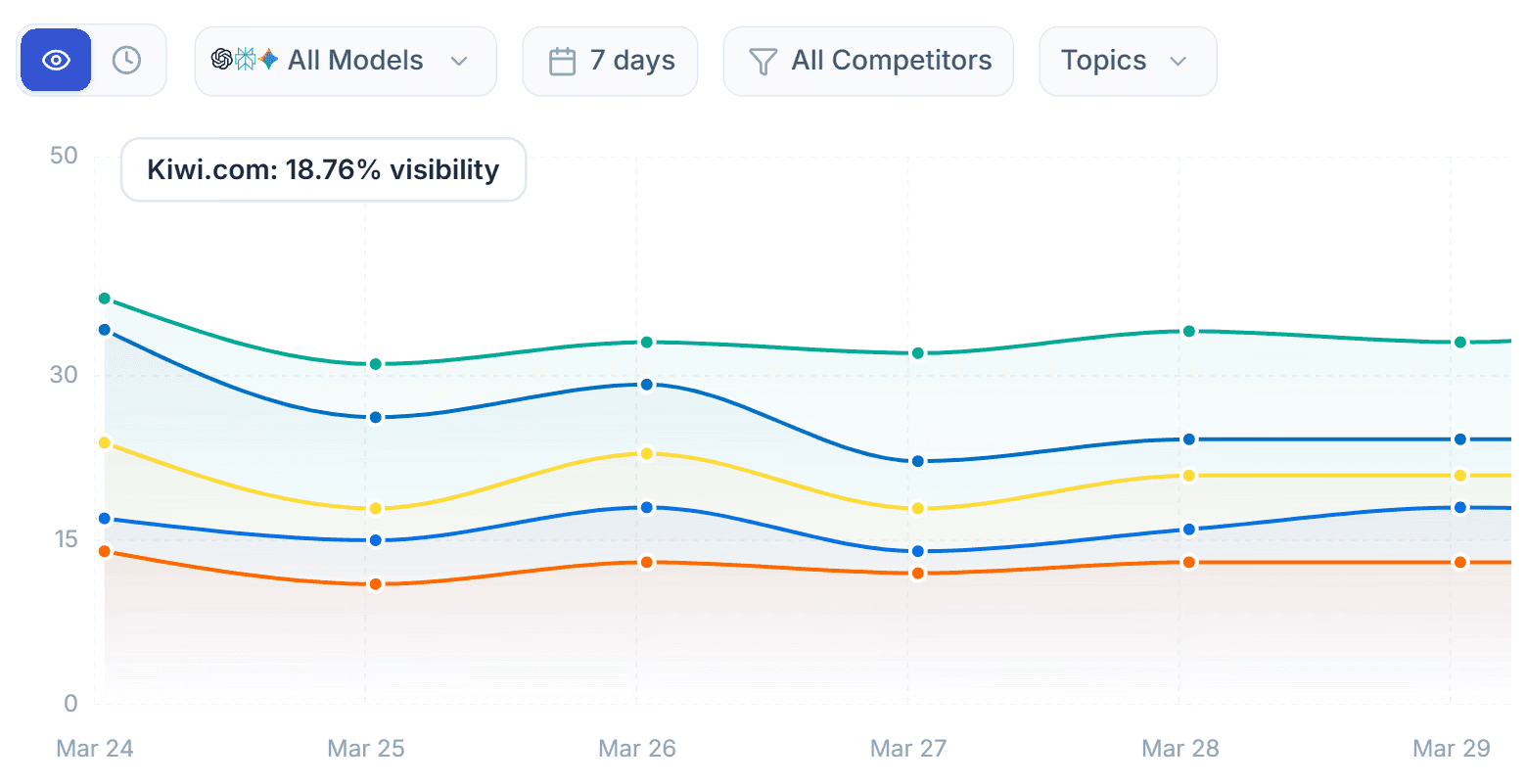
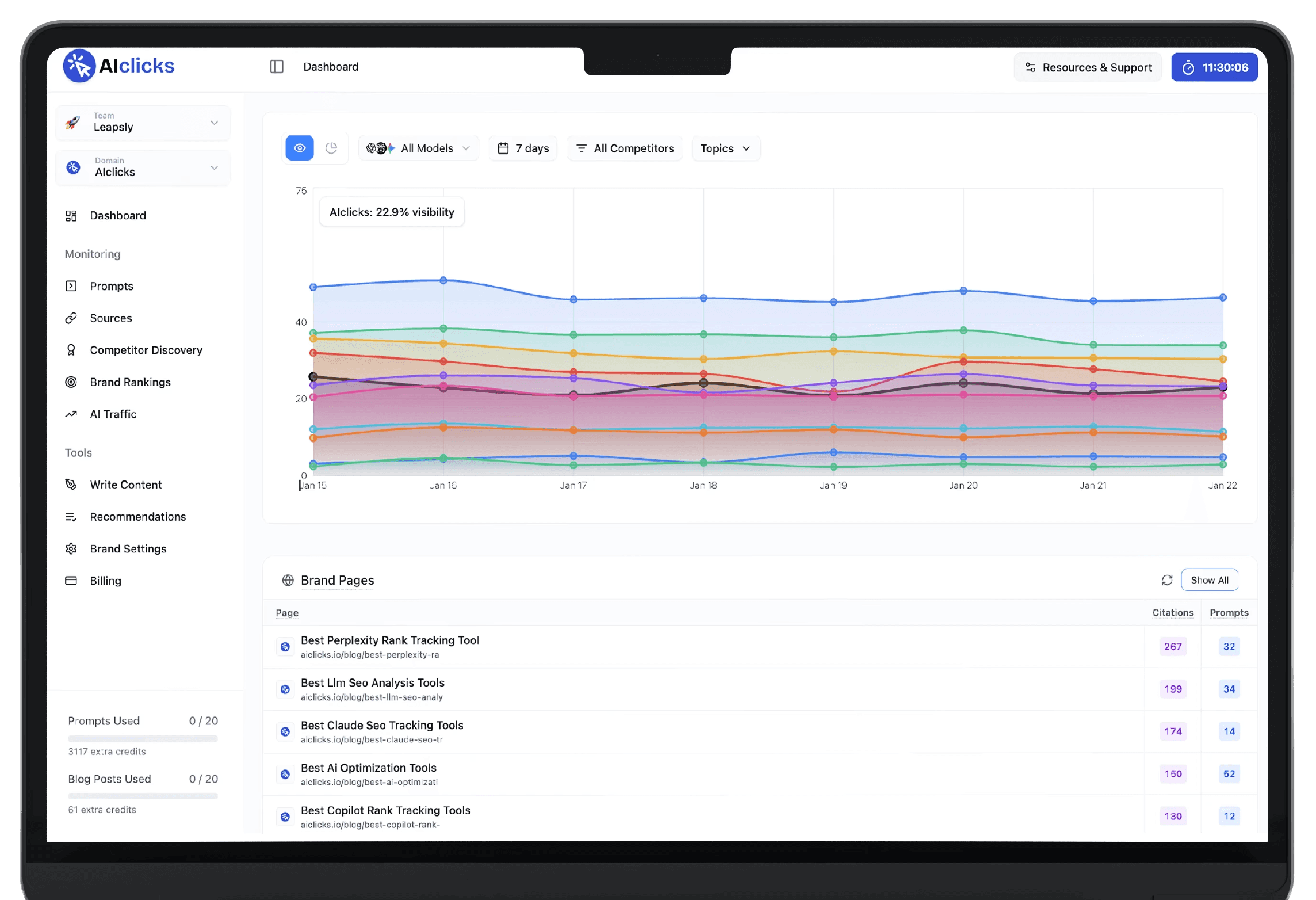
AIclicks gives you a live dashboard with daily ChatGPT mention rate, citation rate, sentiment, and share-of-voice across your tracked prompts, plus GA4 referral attribution for the traffic ChatGPT does send back.
Choose Your Plan
Flexible pricing that grows with your team. Upgrade or downgrade at any time.
Monthly
Yearly
-20%
Starter
Perfect for individuals & small teams
$49
/ month
Billed annually — you save $142
Choose 3 from:
Daily

" height="16px" id="fvSweaOBo" transform="translate(1 0)" width="14px"/></svg>)
" width="14px"><path d="M 13.864 5.629 L 13.3 5.629 L 13.3 5.6 L 7 5.6 L 7 8.4 L 10.956 8.4 C 10.379 10.03 8.828 11.2 7 11.2 C 4.681 11.2 2.8 9.319 2.8 7 C 2.8 4.681 4.681 2.8 7 2.8 C 8.071 2.8 9.045 3.204 9.786 3.864 L 11.766 1.884 C 10.516 0.719 8.844 0 7 0 C 3.134 0 0 3.134 0 7 C 0 10.866 3.134 14 7 14 C 10.866 14 14 10.866 14 7 C 14 6.531 13.952 6.073 13.864 5.629 Z" fill="rgb(255, 193, 7)" height="14px" id="H_YjfTNpn" width="14px"/><path d="M 0 3.742 L 2.3 5.429 C 2.922 3.888 4.429 2.8 6.193 2.8 C 7.264 2.8 8.238 3.204 8.979 3.864 L 10.959 1.884 C 9.709 0.719 8.037 0 6.193 0 C 3.504 0 1.172 1.518 0 3.742 Z" fill="rgb(255, 61, 0)" height="5.428500000000002px" id="PlkthQDhg" transform="translate(0.875 0)" width="10.959199999999996px"/><path d="M 6.232 5.581 C 8.04 5.581 9.683 4.889 10.925 3.764 L 8.758 1.931 C 8.032 2.483 7.144 2.782 6.232 2.781 C 4.411 2.781 2.865 1.62 2.283 0 L 0 1.759 C 1.159 4.026 3.511 5.581 6.232 5.581 Z" fill="rgb(76, 175, 80)" height="5.581099999999999px" id="WlnJ5gngE" transform="translate(0.7 8.4)" width="10.924899999999994px"/><path d="M 6.864 0.029 L 6.3 0.029 L 6.3 0 L 0 0 L 0 2.8 L 3.956 2.8 C 3.68 3.576 3.183 4.254 2.526 4.75 L 2.527 4.749 L 4.693 6.582 C 4.54 6.722 7 4.9 7 1.4 C 7 0.931 6.952 0.473 6.864 0.029 Z" fill="rgb(25, 118, 210)" height="6.589883930775992px" id="x_rSW275p" transform="translate(7 5.6)" width="7px"/></g></svg>)
" height="16px" id="hHS98fTxZ" width="16px"/></svg>)
 scale(1 1) translate(-1.861736945942159, -1.1170155383302638)" id="P20NzAvj0-699428820-radial-gradient" r="0.9935228066204626"><stop offset="0" stop-color="rgb(0, 174, 255)"/><stop offset="1" stop-color="rgb(7, 54, 196)"/></radialGradient><radialGradient cx="0.48250042504016705" cy="1.8366934653567062" gradient-transform="translate(0.48250042504016705, 1.8366934653567062) scale(1 1) translate(-0.48250042504016705, -1.8366934653567062)" id="UEWZqVjij-699428820-radial-gradient" r="0.9176890228114506"><stop offset="0" stop-color="rgb(255, 182, 87)"/><stop offset="1" stop-color="rgb(192, 43, 60)"/></radialGradient><linearGradient id="jyMN3TmKx-699428820-linear-gradient" x1="0.4594862532842614" x2="0.5405137467157386" y1="0" y2="1"><stop offset="0" stop-color="rgb(13, 145, 225)"/><stop offset="1" stop-color="rgb(255, 200, 0)"/></linearGradient><linearGradient id="xhMNwDFG0-699428820-linear-gradient" x1="0.4784828731548295" x2="0.5215171268451705" y1="5.551115123125783e-17" y2="1"><stop offset="0" stop-color="rgb(61, 203, 255)"/><stop offset="1" stop-color="rgba(5, 136, 247, 0)"/></linearGradient><radialGradient cx="1.4305090871482182" cy="0.34866158048251783" gradient-transform="translate(1.4305090871482182, 0.34866158048251783) scale(1 1) translate(-1.4305090871482182, -0.34866158048251783)" id="i79kAqaS4-699428820-radial-gradient" r="1.3362743412697924"><stop offset="0" stop-color="rgb(140, 72, 255)"/><stop offset="1" stop-color="rgb(255, 177, 82)"/></radialGradient><linearGradient id="mcxvno3tX-699428820-linear-gradient" x1="0.49844355920154226" x2="0.5015564407984577" y1="0" y2="1"><stop offset="0" stop-color="rgb(248, 173, 250)"/><stop offset="1" stop-color="rgba(168, 110, 221, 0)"/></linearGradient></defs><g d="M 11.605 1.219 C 11.397 0.499 10.739 0.002 9.989 0 L 9.498 0 C 8.682 0.002 7.985 0.588 7.842 1.391 L 7 6.016 L 7.209 5.296 C 7.416 4.574 8.075 4.076 8.825 4.074 L 11.681 4.074 L 12.879 4.545 L 14.033 4.074 L 13.697 4.074 C 12.947 4.072 12.289 3.575 12.081 2.855 Z M 4.413 13.387 C 4.618 14.111 5.278 14.611 6.031 14.613 L 7.075 14.613 C 7.988 14.613 8.735 13.88 8.758 12.96 L 8.871 8.5 L 8.633 9.319 C 8.426 10.039 7.768 10.537 7.018 10.539 L 4.138 10.539 L 3.111 9.977 L 2 10.539 L 2.331 10.539 C 3.084 10.542 3.743 11.042 3.949 11.766 L 4.413 13.387 Z M 9.999 0 L 4.167 0 C 2.501 0 1.501 2.221 0.834 4.441 C 0.045 7.073 -0.989 10.591 2.001 10.591 L 4.519 10.591 C 5.273 10.591 5.933 10.089 6.139 9.36 C 6.577 7.815 7.345 5.121 7.948 3.069 C 8.255 2.027 8.509 1.132 8.901 0.575 C 9.148 0.212 9.56 -0.004 9.999 0 M 9.999 0 L 4.167 0 C 2.501 0 1.501 2.221 0.834 4.441 C 0.045 7.073 -0.989 10.591 2.001 10.591 L 4.519 10.591 C 5.273 10.591 5.933 10.089 6.139 9.36 C 6.577 7.815 7.345 5.121 7.948 3.069 C 8.255 2.027 8.509 1.132 8.901 0.575 C 9.148 0.212 9.56 -0.004 9.999 0 M 6 14.593 L 11.833 14.593 C 13.499 14.593 14.499 12.372 15.166 10.151 C 15.955 7.519 16.989 4 13.999 4 L 11.48 4 C 10.725 4.002 10.063 4.505 9.86 5.232 C 9.266 7.332 8.663 9.429 8.051 11.523 C 7.745 12.566 7.49 13.461 7.098 14.019 C 6.851 14.382 6.439 14.597 6 14.593 M 6 14.593 L 11.833 14.593 C 13.499 14.593 14.499 12.372 15.166 10.151 C 15.955 7.519 16.989 4 13.999 4 L 11.48 4 C 10.725 4.002 10.063 4.505 9.86 5.232 C 9.266 7.332 8.663 9.429 8.051 11.523 C 7.745 12.566 7.49 13.461 7.098 14.019 C 6.851 14.382 6.439 14.597 6 14.593" fill="transparent" height="14.613333333333333px" id="QzkBy4Ibc" transform="translate(0 1)" width="16.00011071294081px"><path d="M 4.605 1.219 C 4.397 0.499 3.739 0.002 2.989 0 L 2.498 0 C 1.682 0.002 0.985 0.588 0.842 1.391 L 0 6.016 L 0.209 5.296 C 0.416 4.574 1.075 4.076 1.825 4.074 L 4.681 4.074 L 5.879 4.545 L 7.033 4.074 L 6.697 4.074 C 5.947 4.072 5.289 3.575 5.081 2.855 Z" fill="url(%23P20NzAvj0-699428820-radial-gradient)" height="6.016px" id="P20NzAvj0" transform="translate(7 0)" width="7.0333333333333385px"/><path d="M 2.413 4.887 C 2.618 5.611 3.278 6.111 4.031 6.113 L 5.075 6.113 C 5.988 6.113 6.735 5.38 6.758 4.46 L 6.871 0 L 6.633 0.819 C 6.426 1.539 5.768 2.037 5.018 2.039 L 2.138 2.039 L 1.111 1.477 L 0 2.039 L 0.331 2.039 C 1.084 2.042 1.743 2.542 1.949 3.266 L 2.413 4.887 Z" fill="url(%23UEWZqVjij-699428820-radial-gradient)" height="6.113333333333333px" id="UEWZqVjij" transform="translate(2 8.5)" width="6.871333333333332px"/><path d="M 9.999 0 L 4.167 0 C 2.501 0 1.501 2.221 0.834 4.441 C 0.045 7.073 -0.989 10.591 2.001 10.591 L 4.519 10.591 C 5.273 10.591 5.933 10.089 6.139 9.36 C 6.577 7.815 7.345 5.121 7.948 3.069 C 8.255 2.027 8.509 1.132 8.901 0.575 C 9.148 0.212 9.56 -0.004 9.999 0" fill="url(%23jyMN3TmKx-699428820-linear-gradient)" height="10.591388755215167px" id="jyMN3TmKx" width="9.999444046274142px"/><path d="M 9.999 0 L 4.167 0 C 2.501 0 1.501 2.221 0.834 4.441 C 0.045 7.073 -0.989 10.591 2.001 10.591 L 4.519 10.591 C 5.273 10.591 5.933 10.089 6.139 9.36 C 6.577 7.815 7.345 5.121 7.948 3.069 C 8.255 2.027 8.509 1.132 8.901 0.575 C 9.148 0.212 9.56 -0.004 9.999 0" fill="url(%23xhMNwDFG0-699428820-linear-gradient)" height="10.591388755215167px" id="xhMNwDFG0" width="9.999444046274142px"/><path d="M 0 10.593 L 5.833 10.593 C 7.499 10.593 8.499 8.372 9.166 6.151 C 9.955 3.519 10.989 0 7.999 0 L 5.48 0 C 4.725 0.002 4.063 0.505 3.86 1.232 C 3.266 3.332 2.663 5.429 2.051 7.523 C 1.745 8.566 1.49 9.461 1.098 10.019 C 0.851 10.382 0.439 10.597 0 10.593" fill="url(%23i79kAqaS4-699428820-radial-gradient)" height="10.593388755215164px" id="i79kAqaS4" transform="translate(6 4)" width="10.000110712940803px"/><path d="M 0 10.593 L 5.833 10.593 C 7.499 10.593 8.499 8.372 9.166 6.151 C 9.955 3.519 10.989 0 7.999 0 L 5.48 0 C 4.725 0.002 4.063 0.505 3.86 1.232 C 3.266 3.332 2.663 5.429 2.051 7.523 C 1.745 8.566 1.49 9.461 1.098 10.019 C 0.851 10.382 0.439 10.597 0 10.593" fill="url(%23mcxvno3tX-699428820-linear-gradient)" height="10.593388755215164px" id="mcxvno3tX" transform="translate(6 4)" width="10.000110712940803px"/></g></svg>)
" height="15.360666565427872px" id="HZPvvPBv7" transform="translate(0 0.5)" width="16px"/></svg>)
Tracked prompts
30
Websites you can add
3
LLMs you can track
3
Countries per project
1
LLM responses / mo
4,650
AI-optimized articles per month
10
Integrations
-
Support
Pro
For growing teams for more power
$140
/ month
Billed annually — you save $454
Choose 4 from:
Daily
Tracked prompts
150
Websites you can add
Unlimited
LLMs you can track
4
Countries per project
Unlimited
LLM responses / mo
18,600
AI-optimized articles per month
20
Integrations
Google Analytics
Support
BUSINESS
Best for medium-sized organizations
$357
/ month
Billed annually — you save $1198
Choose 6 from:
Daily
Tracked prompts
300
Websites you can add
Unlimited
LLMs you can track
6
Countries per project
Unlimited
LLM responses / mo
55,800
AI-optimized articles per month
30
Integrations
Google Analytics, API
Support
Dedicated account specialist
Become the #1 Answer in AI
Succeed in GEO yourself, or let us do all the work.
Do it yourself
Use AIclicks to see exactly where you appear across 10+ AI platforms, spot the gaps competitors are filling, and act on clear weekly recommendations.
From $59/month · Cancel anytime
Done for you
We Do All the Work for You
Our team manages your complete search presence: traditional SEO and GEO strategy, content, implementation, and reporting. You focus on players.
Custom pricing · Minimum 3-month engagement
The AI SEO agency trusted by 1,000+ brands worldwide
From solo founders to multi-client agencies, AIclicks runs the full AI SEO agency program for organizations of every shape and size that want to be cited across every AI surface.
4.9/5 stars on G2







FAQ
How long does casino SEO take to show results?
Map pack gains land first, typically inside 3 months once the profile and citations are cleaned up. Organic rankings on gaming, dining and event terms take 9 to 12 months in most markets, and a crowded drive-time market with 5 casinos chasing the same players takes longer. Track direction requests and calls from the profile before you track positions; they move first. Anyone quoting a top spot inside a month is selling links.
Should we bother with AI search or just Google?
Both, and the gap between them is the point. Ahrefs analysed 863,000 keywords and found only 38% of pages cited in AI Overviews also ranked in the top 10, down from 76% a year earlier. Gambling is also a category where assistants hedge, disclaim and then name 2 or 3 venues. Being one of the named venues is worth more than any ranking, and almost no casino tracks it.
What makes casino SEO different from standard local SEO?
Three things separate it. Paid search is restricted by Google’s gambling policy, so organic carries weight it does not carry in other trades. Google treats gambling as YMYL and looks for visible licensing, age gating and responsible gaming information before it trusts a page. And the niche is saturated with bought links, so the tactics that move fastest are the ones most likely to get a property penalised. A standard local checklist addresses none of this.
What should a casino budget for SEO each month?
Agencies that take gambling clients typically quote $3,000 to $8,000 monthly for one property, rising to $8,000 to $20,000 when link acquisition is included. Casino link placements alone are quoted anywhere from $300 to $2,000 each, which is where most of a gambling retainer disappears. Judge it against what a marginal trip is worth: at typical win per visit, a few hundred extra visits a month pays the invoice.
How does SEO work with the ads we can run?
Differently to most industries, because your ad options are limited before you spend a dollar. Google requires gambling certification and only permits ads in approved jurisdictions, and the big outdoor and broadcast buys you replace it with cannot be attributed. Organic and AI visibility are the only channels that keep working with the budget switched off. Use whatever paid you are allowed to run to test which offers and events actually pull, then build pages around the winners.
Which pages should a casino build first?
The Google Business Profile comes first, plus a separate one for every outlet that has its own door. Then split the gaming page into slots, tables, poker and sportsbook, each with real counts and limits. Then the entertainment calendar, rendered server-side so Google can read it. Then the players club and comps hub, which answers the questions your call centre repeats all day. Hotel and dining after that. The promotions feed is last, and it should mostly redirect.
How do we know the SEO is actually working?
Measure carded play from people who arrived through search, not rankings. Tag the hotel booking engine and the ticketing handoff so those conversions attribute, run call tracking on the reservations line, and reconcile against the player management system by acquisition source. In Search Console watch impressions on game, event and dining terms rather than average position. Then run the same prompts players ask ChatGPT and record whether your property is named.
Do we keep this in-house or bring someone in?
Divide it, and vet whoever you bring in. Profile updates, event listings, photography and review replies belong in-house, because marketing already has the calendar and the compliance sign-off. Technical rendering work, schema and citation cleanup need a specialist. The warning is that a large share of gambling SEO providers sell link networks with a strategy deck attached. Ask what happens to the rankings if every purchased link is removed, and listen carefully.
Further Reading
Go deeper on GEO, AI search, and visibility tracking.