SEO for Carpet Cleaning Companies:
A pet accident, a move-out deadline or guests arriving Friday sends someone to their phone. They read the first 3 map listings, scan the star ratings, and now ask ChatGPT which cleaner is worth calling. Search visibility decides which vans get booked.









Why Carpet Cleaning Companies Need SEO
Google now shows an AI Overview on roughly 21% of searches, and carpet cleaning queries are exactly the question-shaped kind that trigger them. Three problems sit between you and that answer.
Run a grid scan and the pattern is always the same: top 3 within a mile or 2 of the pin itself, then nothing at all across the far side of the service area you actually drive to. A hidden service-area address means that Google ranks you on proximity alone, and proximity does not stretch.
The top organic result for carpet cleaning near me is not a cleaner. It is Stanley Steemer, Servpro and Chem-Dry, with Yelp and Thumbtack filling the rest. Independents appear only inside those pages, as a row in a list ordered by who bought placement rather than who does the better job.
Most cleaners pay Thumbtack or Angi for each lead, then mail $99 three-room coupons out to the same households, then hire an agency on a $1,000-plus monthly retainer and get back a traffic report only 6 months later. Stop paying for any of it and the calendar empties that very same week.
How SEO Works for Carpet Cleaning Companies
Search Engine Optimization projects are long-term investments for carpet cleaners, where each task supplements the others and creates compound results over time.
01
Keywords, page structure, and the signals Google reads directly
On-page work fails here because the trade’s vocabulary and the customer’s vocabulary barely overlap. You sell hot water extraction, encapsulation and low-moisture cleaning. Nobody types those. They type pet urine smell in carpet, how much to clean 3 rooms, and move-out carpet cleaning. Then the whole business gets compressed onto one URL with an accordion, so those searches have nowhere to land. The pages that earn calls are single-job pages written in the customer’s words, plus a real pricing page and a service-area page that names the towns rather than listing ZIP codes.
What holds value here is anything tied to a stain rather than a season. A page on removing pet urine from carpet padding, or what a move-out clean costs a tenant getting a deposit back, keeps producing bookings for years because the problem repeats and the answer does not change. What churns is the promotion: the spring special, the holiday 3-rooms-for-$99 offer, the Black Friday upholstery deal. Those pages go stale in weeks, then sit unlinked with an expired price on them, which is the fastest way to teach a customer that your published pricing cannot be trusted.
1
Break the services block apart: one page each for pet urine removal, area rug cleaning, tile and grout, move-out cleans.
2
Find last season’s coupon URLs in Search Console, unpublish them, and point each 301 at the service page holding the current price.
3
Use LocalBusiness with the HomeAndConstructionBusiness subtype, add areaServed and a Service entry per job, then check it in the Rich Results Test.
4
Publish one page per stain type: red wine, pet urine, candle wax, coffee, blood. These rank all year and feed AI answers.
02
Map Pack visibility, citations, and proximity signals
Practically every carpet cleaning search is local and practically every one is urgent. Nobody drives 40 miles to book a cleaner, and nobody books 3 weeks out. That makes the 3-result map pack the whole game: it sits above Stanley Steemer, above Thumbtack, above everything, and it is the one place a single-van operator outranks a national franchise. Proximity, profile completeness and review volume decide it, and you control 2 of those.
Pick Carpet Cleaning Service as the primary category, then add Upholstery Cleaning Service, Rug Cleaning Service and Water Damage Restoration Service as secondaries only where you genuinely do the work. Hide the address if you run from a home or a shop, and set the service area by town rather than by radius. Load before-and-after photos of real jobs, list dry times, and pre-answer the questions that decide the booking: pricing, pet safety, how long until furniture goes back.
Everyone has the same base listings: Yelp, Angi, Thumbtack, Nextdoor, Bing Places and the Better Business Bureau. What separates you from the $79-a-room outfit is the certification layer. The IICRC Find a Pro locator, the Carpet and Rug Institute’s Seal of Approval list, WoolSafe’s approved service provider register and any mill-approved cleaner program you hold all get corroborated by Google. Homeowners check them before letting a stranger near a wool rug, so name and phone must match everywhere.
1
Choose Carpet Cleaning Service as primary, hide the address as a service-area business, and list every town you cover individually.
2
Only create a second profile where you hold a staffed address, never a virtual office; run extra trucks under one profile instead.
3
Run BrightLocal or Moz Local across Yelp, Angi, Thumbtack and your IICRC listing, and fix every phone and suffix variant.
4
Publish a Google Business Profile update every week from the van: a before-and-after shot, this week’s open slots, a seasonal reminder.
03
Topic authority, inbound links, and content that earns traffic
Nobody books blind. The reader is settling 3 questions first: whether the stain actually comes out, whether it is safe around a toddler and a dog, and what the bill lands at. Answer those honestly and you beat anything written about your equipment. A straight page on what hot water extraction does that a rented machine cannot, with real dry times, earns trust at the moment the reader is choosing.
Someone who has decided they need a professional is now picking between you and 4 others, and they want evidence. Publish per-room and per-square-foot pricing with what is included, name the certification the technician holds, show before-and-after photos of carpet like theirs rather than showroom shots, and say plainly how soon you can come. Most cleaners lose this reader at the pricing question, because the price is hidden inside a quote form.
Links come from the people who already refer you. Property managers and leasing offices publish approved-contractor pages. Flooring retailers and rug dealers list cleaners they trust with a warranty claim. Interior designers, house cleaning firms and restoration contractors all keep partner lists. Add the IICRC and CRI directories, your chamber, and the youth team whose shirts you sponsor. None of it costs money; all of it needs someone to ask.
1
Publish a yearly steam versus dry cleaning comparison covering dry times, cost per room and which carpet fibers each method suits.
2
Give each town you genuinely serve its own service page, with real detail: housing stock, drive time, the apartment complexes on your route.
3
Build one hub for every cost question: price per room, per square foot, stairs, pet treatment, minimum charge, and what the $99 deals exclude.
4
Write a page for each credential and system you run: IICRC certifications held, truck-mount versus portable, WoolSafe-approved solutions, encapsulation for commercial accounts.
04
Site speed, crawlability, Core Web Vitals, and mobile health
What quietly sinks most carpet cleaning sites is the one-page build. Services, pricing, service area and the contact form all sit in collapsed accordion panels on a single URL, so the whole business competes for one ranking slot. Google will rank that URL for carpet cleaning and nothing else. Pet stain removal, upholstery, area rugs, tile and grout and every town you cover have nowhere to live, and the owner concludes the trade is simply competitive.
The highest-intent carpet cleaning search happens on a phone, one-handed, by someone standing over a fresh stain with a towel in the other hand. They want a price band and a number to call. Google’s own data puts the probability of a bounce up 32% when load time goes from 1 second to 3. Add a full-resolution before-and-after gallery, a chat bubble and a coupon pop-up, and you have built a page that loses to the next result.
1
Count indexable URLs in a Screaming Frog crawl; anything under 10 means the accordion panels each need promoting to a standalone page.
2
Run PageSpeed Insights on the before-and-after gallery, the heaviest page most cleaning sites have; Largest Contentful Paint over 2.5 seconds loses the click.
3
Convert job photos to WebP sized for the slot they sit in, and lazy-load anything below the fold; camera roll files run 4 megabytes.
4
Separate service and town pages into their own sitemap away from blog posts, then resubmit it whenever pricing, dry times or covered towns change.
05
Star ratings, review volume, and response strategy that builds trust
Reviews decide this trade because the customer is letting a stranger into their home with a hose running through the front door, and the star rating is all the proof they have. The difficulty is volume and timing. A cleaner does 4 to 6 jobs a day, so a rival with 5 years of steady asking sits on 1,800 reviews while you sit on 40. Worse, the person most motivated to write is the one whose stain came back.
Ask in the doorway, while the carpet is still dark and the customer is walking the rooms with you. That is the peak, and it decays by dinner. Hand over your own phone with the review form already loaded, rather than promising a link later. If you automate it, fire the text from Jobber, Housecall Pro or Podium as the technician marks the job complete, signed with that technician’s name. Ask on every job, not only the big ones.
1
Wire Jobber, Housecall Pro or ServiceTitan to text the Google review link the moment the technician closes the job on their tablet.
2
Answer inside 24 hours and offer a free re-clean in writing; wicking and resoiling complaints usually resolve on a second visit.
3
Pull pet-odor reviews onto the pet stain page and rug reviews onto the rug page, instead of one site-wide testimonial slider.
4
Ask property managers and office facilities contacts for reviews after a scheduled maintenance clean; B2B reviews read as proof to residential buyers too.
Google is No Longer the Only Place Your customers are Searching
Customers are using AI to find answers, and they trust what it tells them. Invest in GEO to get recommended in those answers.
1 Billion
Questions ChatGPT receives every single day
38%
Your #1 top ranking page on Google would be cited by AI
14%
of carpet cleaners optimise for GEO. The rest are invisible in AI answers


You can rank #1 for “carpet cleaner near me” and still not exist in ChatGPT’s answer. Run a free GEO audit to see where your brand actually stands.
GEO vs SEO: Same Goal, Different Methods
GEO is wider than SEO. AI recommends the brands that show up across the sources it reads, so your presence in forums, social platforms and carpet cleaning blogs decides your odds. AIclicks measures the three metrics below so you know which to work on first.
AI Assistant
Which carpet cleaner near me is best for pet stains?
Your Company
Citation Rate
Shows how many AI answers about carpet cleaning companies name your brand, out of every 100. Models pull from the same trusted pages over and over, so citations compound: once you are in, staying in gets easier. Find the competitor pages AI cites most, then publish your own version of each.
Your Company
82% positive
Competitor A
54% positive
Competitor B
38% positive
Brand Sentiment
Shows how AI describes you when your brand comes up: positive, neutral or negative. Tone is what separates being mentioned from being recommended, and models repeat whatever framing they find. Track the negative mentions back to the reviews and threads behind them, then publish content that answers those directly.
Others 52%
You 24%
— 24%
Your Company
AI mention share of voice — carpet cleaning category
Competitors
Not Cited
Share of Voice in AI
Shows how much of the carpet cleaning conversation belongs to you rather than your competitors. This is the metric that matters most, the GEO version of a Google ranking. With only 1–5 brands named per answer, the market is winner-takes-more and every point is taken from someone.
The Dashboard Your Dedicated AI Search Team Works In
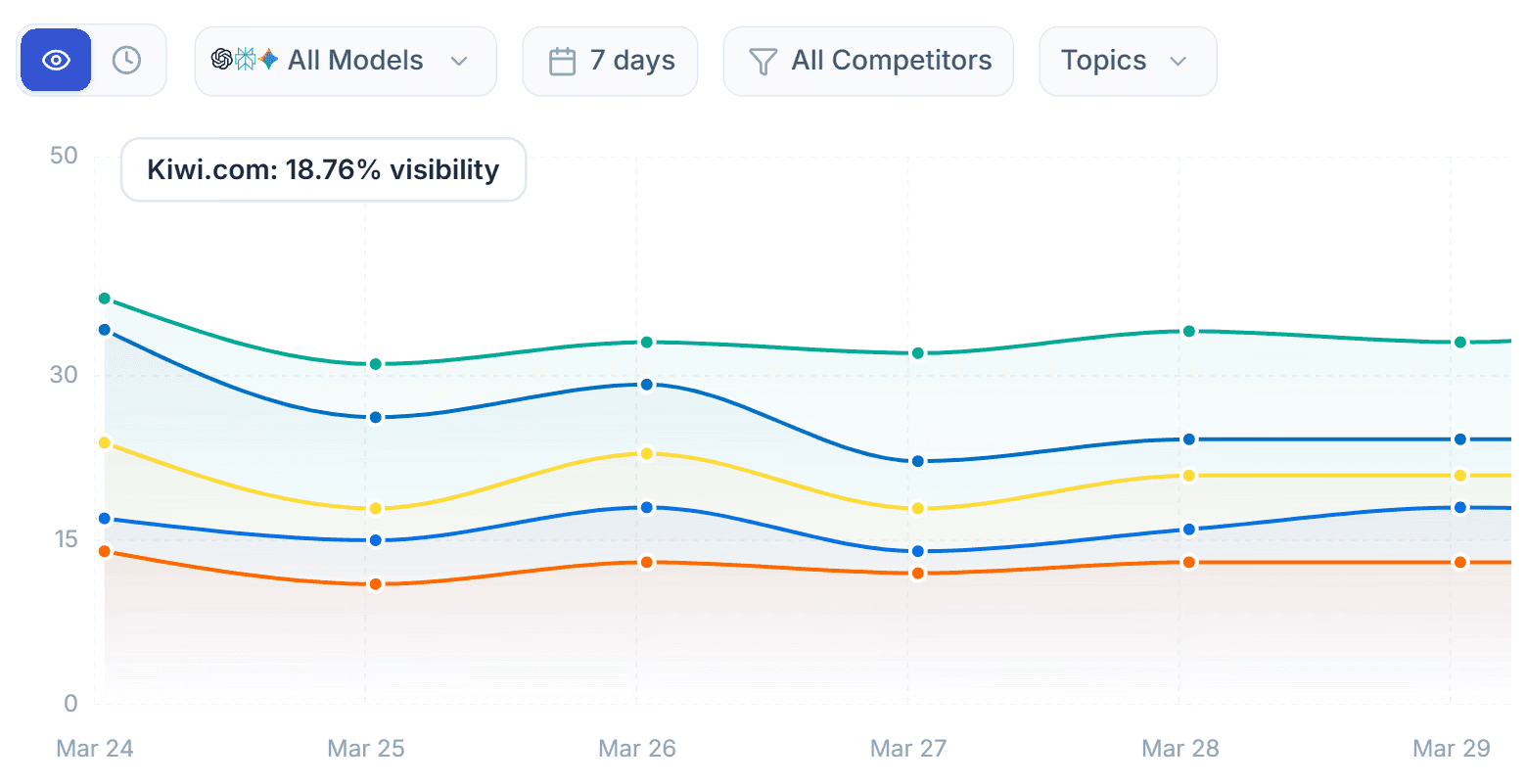
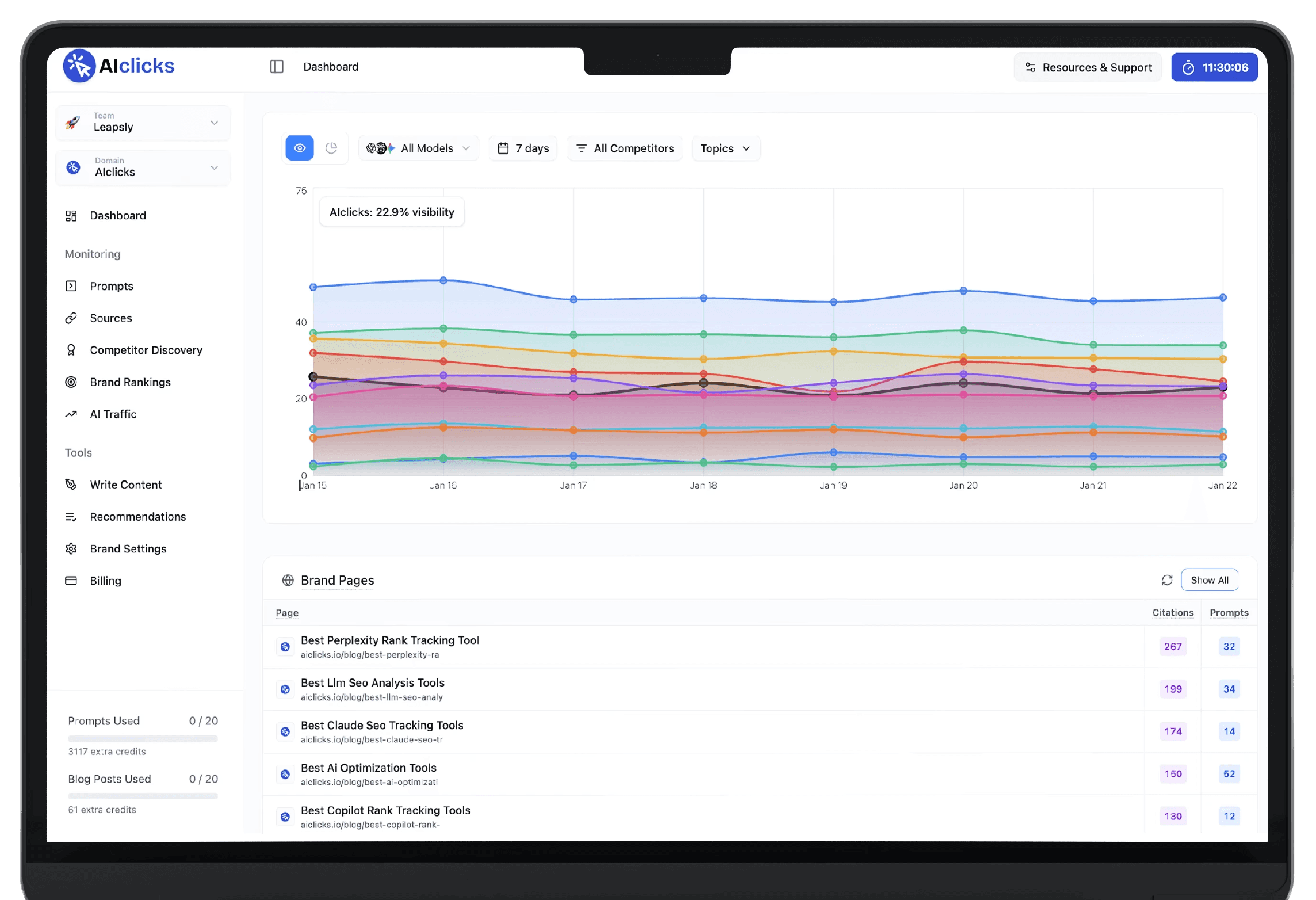
AIclicks gives you a live dashboard with daily ChatGPT mention rate, citation rate, sentiment, and share-of-voice across your tracked prompts, plus GA4 referral attribution for the traffic ChatGPT does send back.
Choose Your Plan
Flexible pricing that grows with your team. Upgrade or downgrade at any time.
Monthly
Yearly
-20%
Starter
Perfect for individuals & small teams
$49
/ month
Billed annually — you save $142
Choose 3 from:
Daily

" height="16px" id="fvSweaOBo" transform="translate(1 0)" width="14px"/></svg>)
" width="14px"><path d="M 13.864 5.629 L 13.3 5.629 L 13.3 5.6 L 7 5.6 L 7 8.4 L 10.956 8.4 C 10.379 10.03 8.828 11.2 7 11.2 C 4.681 11.2 2.8 9.319 2.8 7 C 2.8 4.681 4.681 2.8 7 2.8 C 8.071 2.8 9.045 3.204 9.786 3.864 L 11.766 1.884 C 10.516 0.719 8.844 0 7 0 C 3.134 0 0 3.134 0 7 C 0 10.866 3.134 14 7 14 C 10.866 14 14 10.866 14 7 C 14 6.531 13.952 6.073 13.864 5.629 Z" fill="rgb(255, 193, 7)" height="14px" id="H_YjfTNpn" width="14px"/><path d="M 0 3.742 L 2.3 5.429 C 2.922 3.888 4.429 2.8 6.193 2.8 C 7.264 2.8 8.238 3.204 8.979 3.864 L 10.959 1.884 C 9.709 0.719 8.037 0 6.193 0 C 3.504 0 1.172 1.518 0 3.742 Z" fill="rgb(255, 61, 0)" height="5.428500000000002px" id="PlkthQDhg" transform="translate(0.875 0)" width="10.959199999999996px"/><path d="M 6.232 5.581 C 8.04 5.581 9.683 4.889 10.925 3.764 L 8.758 1.931 C 8.032 2.483 7.144 2.782 6.232 2.781 C 4.411 2.781 2.865 1.62 2.283 0 L 0 1.759 C 1.159 4.026 3.511 5.581 6.232 5.581 Z" fill="rgb(76, 175, 80)" height="5.581099999999999px" id="WlnJ5gngE" transform="translate(0.7 8.4)" width="10.924899999999994px"/><path d="M 6.864 0.029 L 6.3 0.029 L 6.3 0 L 0 0 L 0 2.8 L 3.956 2.8 C 3.68 3.576 3.183 4.254 2.526 4.75 L 2.527 4.749 L 4.693 6.582 C 4.54 6.722 7 4.9 7 1.4 C 7 0.931 6.952 0.473 6.864 0.029 Z" fill="rgb(25, 118, 210)" height="6.589883930775992px" id="x_rSW275p" transform="translate(7 5.6)" width="7px"/></g></svg>)
" height="16px" id="hHS98fTxZ" width="16px"/></svg>)
 scale(1 1) translate(-1.861736945942159, -1.1170155383302638)" id="P20NzAvj0-699428820-radial-gradient" r="0.9935228066204626"><stop offset="0" stop-color="rgb(0, 174, 255)"/><stop offset="1" stop-color="rgb(7, 54, 196)"/></radialGradient><radialGradient cx="0.48250042504016705" cy="1.8366934653567062" gradient-transform="translate(0.48250042504016705, 1.8366934653567062) scale(1 1) translate(-0.48250042504016705, -1.8366934653567062)" id="UEWZqVjij-699428820-radial-gradient" r="0.9176890228114506"><stop offset="0" stop-color="rgb(255, 182, 87)"/><stop offset="1" stop-color="rgb(192, 43, 60)"/></radialGradient><linearGradient id="jyMN3TmKx-699428820-linear-gradient" x1="0.4594862532842614" x2="0.5405137467157386" y1="0" y2="1"><stop offset="0" stop-color="rgb(13, 145, 225)"/><stop offset="1" stop-color="rgb(255, 200, 0)"/></linearGradient><linearGradient id="xhMNwDFG0-699428820-linear-gradient" x1="0.4784828731548295" x2="0.5215171268451705" y1="5.551115123125783e-17" y2="1"><stop offset="0" stop-color="rgb(61, 203, 255)"/><stop offset="1" stop-color="rgba(5, 136, 247, 0)"/></linearGradient><radialGradient cx="1.4305090871482182" cy="0.34866158048251783" gradient-transform="translate(1.4305090871482182, 0.34866158048251783) scale(1 1) translate(-1.4305090871482182, -0.34866158048251783)" id="i79kAqaS4-699428820-radial-gradient" r="1.3362743412697924"><stop offset="0" stop-color="rgb(140, 72, 255)"/><stop offset="1" stop-color="rgb(255, 177, 82)"/></radialGradient><linearGradient id="mcxvno3tX-699428820-linear-gradient" x1="0.49844355920154226" x2="0.5015564407984577" y1="0" y2="1"><stop offset="0" stop-color="rgb(248, 173, 250)"/><stop offset="1" stop-color="rgba(168, 110, 221, 0)"/></linearGradient></defs><g d="M 11.605 1.219 C 11.397 0.499 10.739 0.002 9.989 0 L 9.498 0 C 8.682 0.002 7.985 0.588 7.842 1.391 L 7 6.016 L 7.209 5.296 C 7.416 4.574 8.075 4.076 8.825 4.074 L 11.681 4.074 L 12.879 4.545 L 14.033 4.074 L 13.697 4.074 C 12.947 4.072 12.289 3.575 12.081 2.855 Z M 4.413 13.387 C 4.618 14.111 5.278 14.611 6.031 14.613 L 7.075 14.613 C 7.988 14.613 8.735 13.88 8.758 12.96 L 8.871 8.5 L 8.633 9.319 C 8.426 10.039 7.768 10.537 7.018 10.539 L 4.138 10.539 L 3.111 9.977 L 2 10.539 L 2.331 10.539 C 3.084 10.542 3.743 11.042 3.949 11.766 L 4.413 13.387 Z M 9.999 0 L 4.167 0 C 2.501 0 1.501 2.221 0.834 4.441 C 0.045 7.073 -0.989 10.591 2.001 10.591 L 4.519 10.591 C 5.273 10.591 5.933 10.089 6.139 9.36 C 6.577 7.815 7.345 5.121 7.948 3.069 C 8.255 2.027 8.509 1.132 8.901 0.575 C 9.148 0.212 9.56 -0.004 9.999 0 M 9.999 0 L 4.167 0 C 2.501 0 1.501 2.221 0.834 4.441 C 0.045 7.073 -0.989 10.591 2.001 10.591 L 4.519 10.591 C 5.273 10.591 5.933 10.089 6.139 9.36 C 6.577 7.815 7.345 5.121 7.948 3.069 C 8.255 2.027 8.509 1.132 8.901 0.575 C 9.148 0.212 9.56 -0.004 9.999 0 M 6 14.593 L 11.833 14.593 C 13.499 14.593 14.499 12.372 15.166 10.151 C 15.955 7.519 16.989 4 13.999 4 L 11.48 4 C 10.725 4.002 10.063 4.505 9.86 5.232 C 9.266 7.332 8.663 9.429 8.051 11.523 C 7.745 12.566 7.49 13.461 7.098 14.019 C 6.851 14.382 6.439 14.597 6 14.593 M 6 14.593 L 11.833 14.593 C 13.499 14.593 14.499 12.372 15.166 10.151 C 15.955 7.519 16.989 4 13.999 4 L 11.48 4 C 10.725 4.002 10.063 4.505 9.86 5.232 C 9.266 7.332 8.663 9.429 8.051 11.523 C 7.745 12.566 7.49 13.461 7.098 14.019 C 6.851 14.382 6.439 14.597 6 14.593" fill="transparent" height="14.613333333333333px" id="QzkBy4Ibc" transform="translate(0 1)" width="16.00011071294081px"><path d="M 4.605 1.219 C 4.397 0.499 3.739 0.002 2.989 0 L 2.498 0 C 1.682 0.002 0.985 0.588 0.842 1.391 L 0 6.016 L 0.209 5.296 C 0.416 4.574 1.075 4.076 1.825 4.074 L 4.681 4.074 L 5.879 4.545 L 7.033 4.074 L 6.697 4.074 C 5.947 4.072 5.289 3.575 5.081 2.855 Z" fill="url(%23P20NzAvj0-699428820-radial-gradient)" height="6.016px" id="P20NzAvj0" transform="translate(7 0)" width="7.0333333333333385px"/><path d="M 2.413 4.887 C 2.618 5.611 3.278 6.111 4.031 6.113 L 5.075 6.113 C 5.988 6.113 6.735 5.38 6.758 4.46 L 6.871 0 L 6.633 0.819 C 6.426 1.539 5.768 2.037 5.018 2.039 L 2.138 2.039 L 1.111 1.477 L 0 2.039 L 0.331 2.039 C 1.084 2.042 1.743 2.542 1.949 3.266 L 2.413 4.887 Z" fill="url(%23UEWZqVjij-699428820-radial-gradient)" height="6.113333333333333px" id="UEWZqVjij" transform="translate(2 8.5)" width="6.871333333333332px"/><path d="M 9.999 0 L 4.167 0 C 2.501 0 1.501 2.221 0.834 4.441 C 0.045 7.073 -0.989 10.591 2.001 10.591 L 4.519 10.591 C 5.273 10.591 5.933 10.089 6.139 9.36 C 6.577 7.815 7.345 5.121 7.948 3.069 C 8.255 2.027 8.509 1.132 8.901 0.575 C 9.148 0.212 9.56 -0.004 9.999 0" fill="url(%23jyMN3TmKx-699428820-linear-gradient)" height="10.591388755215167px" id="jyMN3TmKx" width="9.999444046274142px"/><path d="M 9.999 0 L 4.167 0 C 2.501 0 1.501 2.221 0.834 4.441 C 0.045 7.073 -0.989 10.591 2.001 10.591 L 4.519 10.591 C 5.273 10.591 5.933 10.089 6.139 9.36 C 6.577 7.815 7.345 5.121 7.948 3.069 C 8.255 2.027 8.509 1.132 8.901 0.575 C 9.148 0.212 9.56 -0.004 9.999 0" fill="url(%23xhMNwDFG0-699428820-linear-gradient)" height="10.591388755215167px" id="xhMNwDFG0" width="9.999444046274142px"/><path d="M 0 10.593 L 5.833 10.593 C 7.499 10.593 8.499 8.372 9.166 6.151 C 9.955 3.519 10.989 0 7.999 0 L 5.48 0 C 4.725 0.002 4.063 0.505 3.86 1.232 C 3.266 3.332 2.663 5.429 2.051 7.523 C 1.745 8.566 1.49 9.461 1.098 10.019 C 0.851 10.382 0.439 10.597 0 10.593" fill="url(%23i79kAqaS4-699428820-radial-gradient)" height="10.593388755215164px" id="i79kAqaS4" transform="translate(6 4)" width="10.000110712940803px"/><path d="M 0 10.593 L 5.833 10.593 C 7.499 10.593 8.499 8.372 9.166 6.151 C 9.955 3.519 10.989 0 7.999 0 L 5.48 0 C 4.725 0.002 4.063 0.505 3.86 1.232 C 3.266 3.332 2.663 5.429 2.051 7.523 C 1.745 8.566 1.49 9.461 1.098 10.019 C 0.851 10.382 0.439 10.597 0 10.593" fill="url(%23mcxvno3tX-699428820-linear-gradient)" height="10.593388755215164px" id="mcxvno3tX" transform="translate(6 4)" width="10.000110712940803px"/></g></svg>)
" height="15.360666565427872px" id="HZPvvPBv7" transform="translate(0 0.5)" width="16px"/></svg>)
Tracked prompts
30
Websites you can add
3
LLMs you can track
3
Countries per project
1
LLM responses / mo
4,650
AI-optimized articles per month
10
Integrations
-
Support
Pro
For growing teams for more power
$140
/ month
Billed annually — you save $454
Choose 4 from:
Daily
Tracked prompts
150
Websites you can add
Unlimited
LLMs you can track
4
Countries per project
Unlimited
LLM responses / mo
18,600
AI-optimized articles per month
20
Integrations
Google Analytics
Support
BUSINESS
Best for medium-sized organizations
$357
/ month
Billed annually — you save $1198
Choose 6 from:
Daily
Tracked prompts
300
Websites you can add
Unlimited
LLMs you can track
6
Countries per project
Unlimited
LLM responses / mo
55,800
AI-optimized articles per month
30
Integrations
Google Analytics, API
Support
Dedicated account specialist
Become the #1 Answer in AI
Succeed in GEO yourself, or let us do all the work.
Do it yourself
Use AIclicks to see exactly where you appear across 10+ AI platforms, spot the gaps competitors are filling, and act on clear weekly recommendations.
From $59/month · Cancel anytime
Done for you
We Do All the Work for You
Our team manages your complete search presence: traditional SEO and GEO strategy, content, implementation, and reporting. You focus on customers.
Custom pricing · Minimum 3-month engagement
The AI SEO agency trusted by 1,000+ brands worldwide
From solo founders to multi-client agencies, AIclicks runs the full AI SEO agency program for organizations of every shape and size that want to be cited across every AI surface.
4.9/5 stars on G2







FAQ
How long before carpet cleaning SEO fills the schedule?
Expect the map pack to shift in 2 to 3 months and service pages to follow in 3 to 6. That is faster than most trades, because the competition here is thin: most cleaners have a one-page site and a neglected profile. Competitive metros with several established operators take longer, closer to 9 months. The first honest signal is grid coverage widening, not the phone.
Do we need to worry about AI search yet?
Yes, and it does not follow from ranking. In an Ahrefs study of 863,000 keywords, only 38% of the pages quoted in AI Overviews were also sitting in the top 10, against 76% the year before. Worse for this trade: assistants have no proximity data, so they pull names out of Thumbtack and Yelp roundups and review text. If those never mention you, you are absent from the answer.
How is this different from normal local SEO?
Three ways. You are a service-area business with a hidden address, so rankings decay with distance from a pin nobody sees, and standard advice about optimizing a storefront does not apply. Most cleaners run their entire business on a single URL, so there is nothing for Google to rank against 20 different searches. And your credentials, IICRC and CRI, form a citation layer general local SEO guides have never heard of.
What should we budget for SEO each month?
Agency quotes in this trade land between $1,000 and $3,000 a month for a single-market operator, with entry packages near $1,200 and multi-truck or multi-market work running $4,000 and up. Judge it against what you already spend. If you pay a lead platform $30 to $60 per shared lead and mail coupons on top, a retainer that eventually lowers your cost per booked job is the cheaper line.
How does this work with our Google Ads and LSAs?
Different jobs. Local Services Ads and paid search buy slots for the week you are paying, and go quiet the moment the card is declined. Map pack and organic visibility keeps compounding and drags down what each booked job costs. Most cleaners run ads on terms they cannot yet rank for, then let the ad data pick the next service page: whichever keywords convert to booked jobs deserve one.
Which pages should we build first?
Start with the Google Business Profile. It costs nothing and it outranks the franchises on the query that matters. Then a real pricing page with per-room numbers, since that is the question everyone searches and nobody answers. Then one page each for pet stain removal, upholstery and area rugs. Then town pages, one per place you genuinely drive to. The blog comes last, and only for stain questions.
How do we tell whether the money is coming back?
Count booked jobs from organic and maps, not rankings. Put CallRail on the site so phone calls attribute to the page that produced them, because almost every inquiry here is a call. Run a monthly grid scan with Local Falcon or BrightLocal to watch coverage spread outward from the pin. Then reconcile against Jobber or Housecall Pro: jobs on the calendar and average ticket are the numbers that pay.
Is this worth handling in-house or contracting out?
Split it. Nobody outside the business can ask for reviews, take job photos or post to the profile from the van, so keep that in-house; it is also the highest-return work. Hire out the technical layer: schema, page speed, breaking the one-pager into real pages, citation cleanup. Whoever you pick, make them tell you upfront how booked jobs will be reported. Anyone quoting traffic is measuring the wrong thing.
Further Reading
Go deeper on GEO, AI search, and visibility tracking.