
SEO for Car Dealerships:
A car shopper spends more than 14 hours researching before they walk a lot, and almost none of it happens on a dealership website. They start on CarGurus, read DealerRater, ask ChatGPT which store to trust, then arrive having already chosen.









Why Car Dealerships Need SEO
Cox Automotive finds roughly 80% of car buyers use third-party sites during their research. Those sites are the ones AI assistants read when someone asks which dealer to trust.
A dealership sells finance, service, parts and trade appraisals, and on most sites all 4 of them are stubs. The finance page is a bare credit application; the service page is a phone number. Shoppers searching for brake repair near them, or for approval with bad credit, land somewhere else entirely.
Search used cars for sale near me and CarGurus, Cars.com, Carfax, Autotrader and TrueCar all take the organic results before any dealership appears. Every one of them is listing your own inventory, from a feed that you pay to syndicate. You fund the aggregate authority that keeps you off page one.
Dealers spend heavily on marketplace lead packages, OEM co-op digital and paid search, and the meter resets each month. Meanwhile the OEM-certified website platform runs from about $1,500 a month before any SEO package starts. Stop paying and the lead flow stops with it, because nothing was built.
How SEO Works for Car Dealerships
Search Engine Optimization projects are long-term investments for car dealers, where each task supplements the others and creates compound results over time.
01
Keywords, page structure, and the signals Google reads directly
On-page work in this industry fights the inventory itself. A vehicle detail page for a specific year, make and model exists for the 30 to 60 days that unit sits on the lot, and then it is gone, taking whatever ranking it earned with it. Worse, the description on it usually came straight from the manufacturer feed, so hundreds of stores publish the same paragraph. The pages that actually carry weight are the ones that outlive the stock: body style pages, your buy here pay here or financing page, the service and parts pages, and the store’s own about page.
A minivan page is durable; a 2019 Honda Odyssey page is not. You will always stock minivans, trucks and midsize SUVs, so a page built around a body style keeps earning while the units underneath it rotate. The same is true of a proper financing page covering approval requirements, down payments and the paperwork, and of each fixed ops service you sell. What churns is the dated stuff: this month’s manufacturer incentive, the tent sale announcement, the model year launch post. Most dealer blogs are 90% of that, and it is why the blog never moves anything.
1
Replace year-make-model landing pages with body style pages for trucks, minivans and midsize SUVs, which hold their ranking as individual units sell through.
2
When a unit sells, 301 its vehicle detail page to the matching body style page rather than letting the platform serve a 404.
3
Mark inventory with Google’s vehicle listing structured data and the storefront with AutoDealer schema, then confirm both in the Rich Results Test.
4
Build one deep buy here pay here and financing page covering approval requirements, down payments and trade equity, instead of thin variants per phrasing.
02
Map Pack visibility, citations, and proximity signals
Nobody flies across the country to buy a used Civic. Car shopping collapses to whatever is inside a comfortable drive, which is why Google puts the 3-result map pack ahead of CarGurus and Autotrader on every near me query. That block is the only ground where a single-rooftop store outranks a national marketplace, and it is decided by distance from the searcher, how complete the profile is, and how many reviews you have. Distance you cannot change; the other 2 are entirely yours.
Primary category should be Used Car Dealer or Car Dealer, never the vaguer Motor Vehicle Dealer, with Used Truck Dealer, Auto Market and Car Finance and Loan Company added as secondaries. Load lot photos taken on a phone at the store, not OEM press shots. List genuine hours, including whether the service lane opens Saturday, and answer upfront the things that decide a visit: trade appraisals, credit requirements, and whether the price online is the price.
Beneath the general directories sits an automotive tier that generic advice never mentions. Google, Bing Places, Apple Business Connect and Yelp are the baseline; the ones that move dealer rankings are DealerRater, your Cars.com and Autotrader dealer profiles, Edmunds, CarGurus, Carfax dealer pages, the Better Business Bureau and Nextdoor, plus your state dealer association listing. Every one has to carry the same store name, street address and sales line, because the DBA on your license and the name on the sign rarely match.
1
Set Used Car Dealer as primary, max out secondary categories, and upload phone photos from the lot weekly so geotagged imagery keeps arriving.
2
Run separate profiles for sales and the service lane, each linked to its own page, and set up a distinct profile per rooftop.
3
Audit DealerRater, Cars.com, Autotrader, Edmunds and Carfax dealer profiles with BrightLocal, and kill every legacy listing left by a previous owner or DBA.
4
Post to the profile 4 to 6 times a month on a rotation: fresh arrivals by body style, a customer review, one service offer.
03
Topic authority, inbound links, and content that earns traffic
Shoppers arrive with 2 anxieties nobody at the store hears: whether the payment will actually work, and whether the car has a history somebody is hiding. Content that answers both plainly outperforms anything written about your award wall. Explain what a doc fee is, what happens to a trade with negative equity, how your reconditioning process works, and what the inspection actually covers. That is the material AI assistants quote when a shopper asks how to avoid getting burned.
Once the shopper has settled on a body style, they are choosing a store, and they want proof rather than adjectives. Put the reconditioning checklist, the warranty terms, the actual out-the-door pricing policy and finance-specific reviews on the page, not 3 clicks away behind a lead form. Name the sales manager who handles trades. Dealers lose these buyers at exactly the point where a price is missing and a credit application is asked for instead.
Dealer links come from the town and the trade, not from outreach. Youth sports sponsorships, high school booster clubs, the chamber of commerce and charity drives all publish sponsor pages with a logo and a link, and you are probably already paying for several without claiming them. Body shops, detailers, insurance agents and driving schools trade links happily. Trade press works too: Automotive News, CBT News and ASOTU cover dealer operators who will actually go on record.
1
Publish a recurring comparison per segment you stock, such as Wrangler versus 4Runner, using real mileage, EPA figures and your own reconditioning notes.
2
Template one page per body style per town in your market area, using genuine drive times and local landmarks rather than a swapped place name.
3
Build one payment hub covering down payments, subprime approval odds, negative equity, doc fees, and what monthly payment a given income supports.
4
Write an authority page for each franchise you hold and each certified pre-owned program you sell, since shoppers search the brand before the store.
04
Site speed, crawlability, Core Web Vitals, and mobile health
The failure nobody sees is crawl waste. A store turning 100 units a month generates thousands of vehicle detail pages a year, and the platform quietly serves 404s or soft redirects when each one sells. Google spends the crawl budget on dead stock while your body style and service pages go weeks without a visit. Worse, most dealer platforms inject inventory with JavaScript, so a crawler that does not render sees an empty shell where the cars should be.
Car shopping happens on a phone, in the evening, usually with a marketplace tab already open. Nothing on a dealer site weighs more than the search results page: 40 vehicles, 30 photos each, and a filter widget that reflows every time a checkbox moves. If the first tap costs 5 seconds, the shopper is back on CarGurus, where the same inventory loads instantly. Dealer sites also hide content behind enormous headers, so nothing useful sits above the fold.
1
Run a full Screaming Frog crawl, then open Search Console crawl stats to see what share of requests hit sold vehicle detail pages.
2
Run PageSpeed Insights against your busiest search results page rather than the homepage, and get mobile Largest Contentful Paint below 2.5 seconds.
3
Have HomeNet or your merchandising tool export photos as WebP sized for the grid, lazy-load everything past the first 3, and pin dimensions.
4
Generate the inventory sitemap nightly from the DMS feed, keep it separate from static pages, and push changes to Bing through IndexNow.
05
Star ratings, review volume, and response strategy that builds trust
No industry carries more inherited distrust than this one, which is why the star rating does more work than the website. It is also uniquely hard to manage. The review a customer writes is usually about finance, not the car, and it lands after a 4-hour negotiation when nobody feels warm. Sales staff turn over fast, so the reviewer names a person who left months ago. And service customers, who visit far more often, are almost never asked.
Ask at delivery, not by email the next week. The moment is when the customer is standing beside the car with the keys in their hand and you are taking the photo: a QR code on the last page of the deal jacket, scanned there, with the picture attached. A review with a real face and a real vehicle outweighs 10 anonymous ones. Then ask again in the service drive, which produces far more willing reviewers than sales ever will.
1
Put a QR code on the last page of the deal jacket, and have VinSolutions or DealerSocket send a follow-up link the same afternoon.
2
Reply within 24 hours on Google and DealerRater, name the manager who will call, and never argue the numbers in public.
3
Pull finance reviews onto the financing page and service reviews onto the service page, and embed the live Google feed on body style pages.
4
Ask every service and parts customer at check-out, since fixed ops sees the same driver several times a year and sales sees them once.
Google is No Longer the Only Place Your shoppers are Searching
Shoppers are using AI to find answers, and they trust what it tells them. Invest in GEO to get recommended in those answers.
1 Billion
Questions ChatGPT receives every single day
38%
Your #1 top ranking page on Google would be cited by AI
14%
of car dealers optimise for GEO. The rest are invisible in AI answers


You can rank #1 for “car dealer near me” and still not exist in ChatGPT’s answer. Run a free GEO audit to see where your brand actually stands.
GEO vs SEO: Same Goal, Different Methods
GEO is wider than SEO. AI recommends the brands that show up across the sources it reads, so your presence in forums, social platforms and automotive blogs decides your odds. AIclicks measures the three metrics below so you know which to work on first.
AI Assistant
Which used car dealer near me can I trust?
Your Dealership
Citation Rate
Shows how many AI answers about car dealerships name your brand, out of every 100. Models pull from the same trusted pages over and over, so citations compound: once you are in, staying in gets easier. Find the competitor pages AI cites most, then publish your own version of each.
Your Dealership
82% positive
Competitor A
54% positive
Competitor B
38% positive
Brand Sentiment
Shows how AI describes you when your brand comes up: positive, neutral or negative. Tone is what separates being mentioned from being recommended, and models repeat whatever framing they find. Track the negative mentions back to the reviews and threads behind them, then publish content that answers those directly.
Others 52%
You 24%
— 24%
Your Dealership
AI mention share of voice — automotive category
Competitors
Not Cited
Share of Voice in AI
Shows how much of the automotive conversation belongs to you rather than your competitors. This is the metric that matters most, the GEO version of a Google ranking. With only 1–5 brands named per answer, the market is winner-takes-more and every point is taken from someone.
The Dashboard Your Dedicated AI Search Team Works In
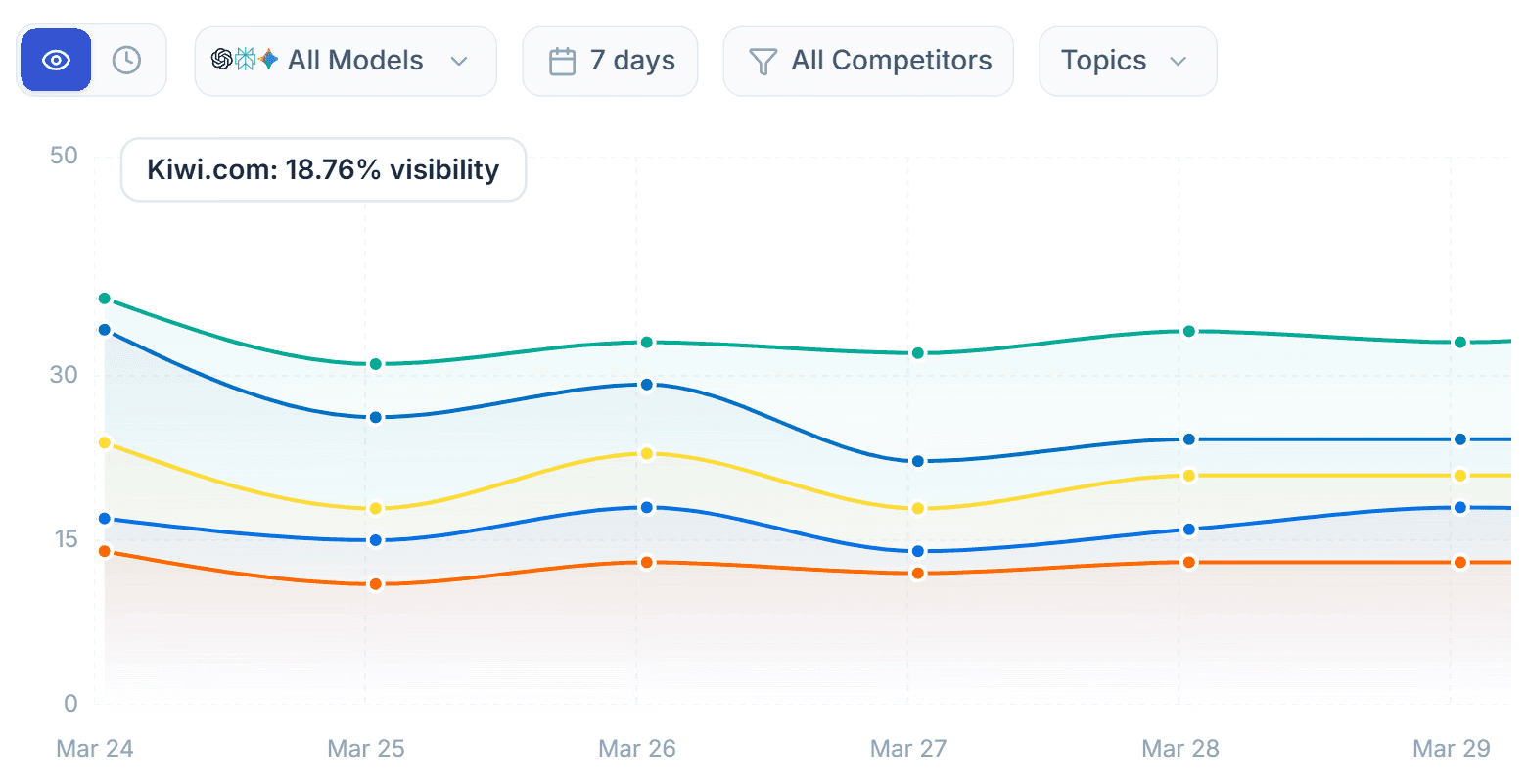
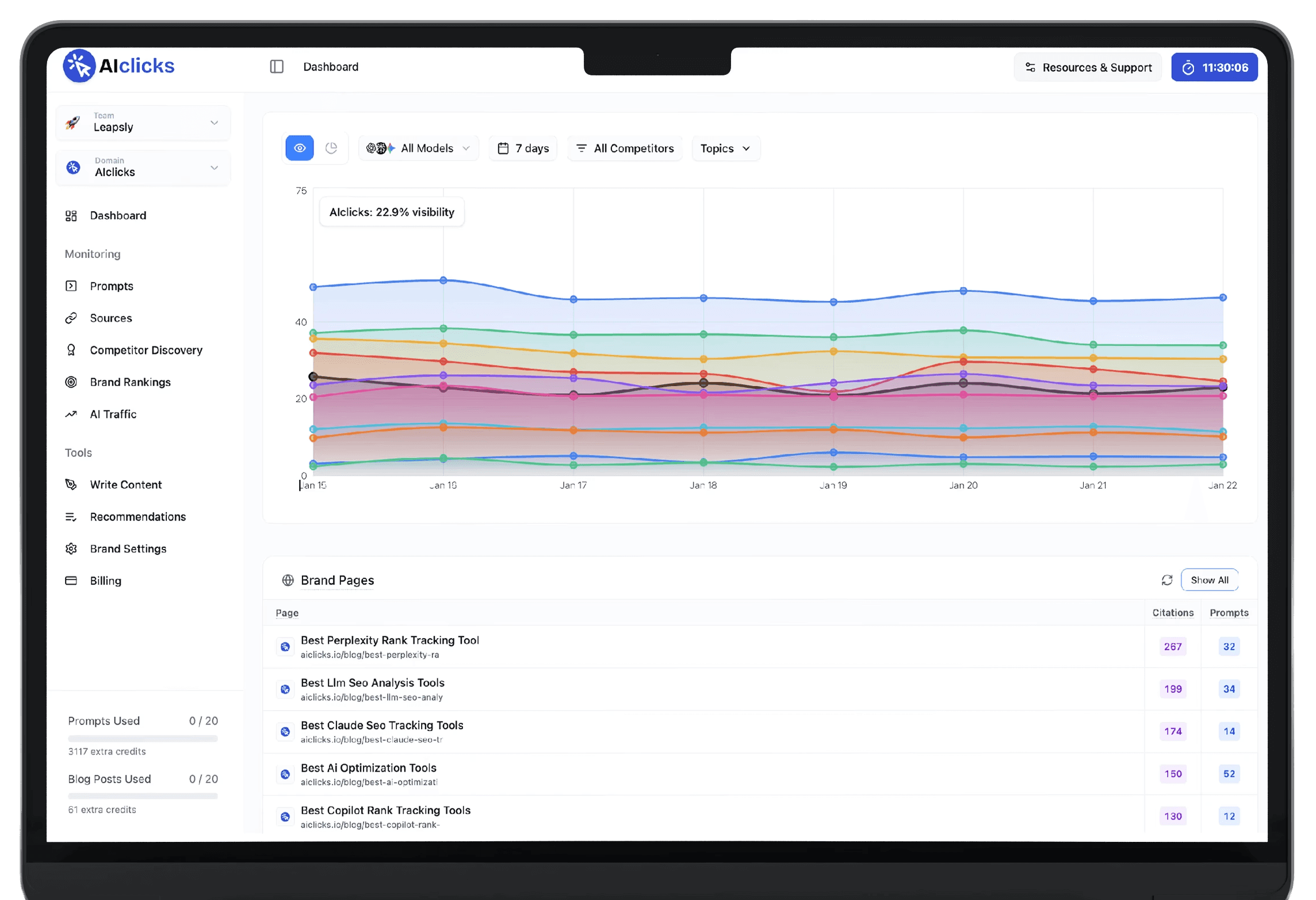
AIclicks gives you a live dashboard with daily ChatGPT mention rate, citation rate, sentiment, and share-of-voice across your tracked prompts, plus GA4 referral attribution for the traffic ChatGPT does send back.
Choose Your Plan
Flexible pricing that grows with your team. Upgrade or downgrade at any time.
Monthly
Yearly
Up to -29%
Starter
Perfect for individuals & small teams
$59
/ month
Available models:
Choose 3
"/><stop offset="1" stop-color="rgba(8, 185, 98, 0)"/></linearGradient><linearGradient id="hJUVwhqZB-1613936830-linear-gradient" x1="0.3395303928804616" x2="0.476593977066777" y1="0.24867958142438143" y2="0.46334251958138"><stop offset="0" stop-color="rgb(249, 69, 67)"/><stop offset="1" stop-color="rgba(249, 69, 67, 0)"/></linearGradient><linearGradient id="wn0ymHGDQ-1613936830-linear-gradient" x1="0.1444535416969564" x2="0.4119080840985462" y1="0.5361246991153902" y2="0.5089504307584071"><stop offset="0" stop-color="rgb(250, 188, 18)"/><stop offset="1" stop-color="rgba(250, 188, 18, 0)"/></linearGradient></defs><g fill="transparent" height="14.665541127764115px" id="U0r63sL8m" transform="translate(0.333 0.669)" width="14.66554112776413px"><path d="M 13.077 6.555 C 11.97 6.083 10.963 5.404 10.111 4.554 C 8.924 3.365 8.077 1.88 7.659 0.253 C 7.621 0.104 7.487 0 7.334 0 C 7.18 0 7.047 0.104 7.009 0.253 C 6.589 1.88 5.743 3.365 4.556 4.554 C 3.704 5.404 2.697 6.083 1.589 6.555 C 1.156 6.741 0.711 6.891 0.255 7.007 C 0.105 7.043 0 7.178 0 7.332 C 0 7.486 0.105 7.62 0.255 7.657 C 0.711 7.771 1.155 7.921 1.589 8.108 C 2.697 8.58 3.704 9.259 4.556 10.109 C 5.743 11.298 6.59 12.783 7.009 14.411 C 7.046 14.56 7.18 14.666 7.334 14.666 C 7.488 14.666 7.622 14.56 7.659 14.411 C 7.773 13.954 7.923 13.51 8.11 13.075 C 8.582 11.968 9.261 10.961 10.111 10.109 C 11.3 8.922 12.786 8.075 14.413 7.657 C 14.561 7.619 14.666 7.485 14.666 7.332 C 14.666 7.178 14.561 7.045 14.413 7.007 C 13.956 6.892 13.51 6.741 13.077 6.555 Z" fill="rgb(49, 134, 255)" height="14.665541127764115px" id="LOkIOmYaI" width="14.66554112776413px"/><path d="M 13.077 6.555 C 11.97 6.083 10.963 5.404 10.111 4.554 C 8.924 3.365 8.077 1.88 7.659 0.253 C 7.621 0.104 7.487 0 7.334 0 C 7.18 0 7.047 0.104 7.009 0.253 C 6.589 1.88 5.743 3.365 4.556 4.554 C 3.704 5.404 2.697 6.083 1.589 6.555 C 1.156 6.741 0.711 6.891 0.255 7.007 C 0.105 7.043 0 7.178 0 7.332 C 0 7.486 0.105 7.62 0.255 7.657 C 0.711 7.771 1.155 7.921 1.589 8.108 C 2.697 8.58 3.704 9.259 4.556 10.109 C 5.743 11.298 6.59 12.783 7.009 14.411 C 7.046 14.56 7.18 14.666 7.334 14.666 C 7.488 14.666 7.622 14.56 7.659 14.411 C 7.773 13.954 7.923 13.51 8.11 13.075 C 8.582 11.968 9.261 10.961 10.111 10.109 C 11.3 8.922 12.786 8.075 14.413 7.657 C 14.561 7.619 14.666 7.485 14.666 7.332 C 14.666 7.178 14.561 7.045 14.413 7.007 C 13.956 6.892 13.51 6.741 13.077 6.555 Z" fill="url(%23yNlONYaJC-1613936830-linear-gradient)" height="14.665541127764115px" id="yNlONYaJC" width="14.66554112776413px"/><path d="M 13.077 6.555 C 11.97 6.083 10.963 5.404 10.111 4.554 C 8.924 3.365 8.077 1.88 7.659 0.253 C 7.621 0.104 7.487 0 7.334 0 C 7.18 0 7.047 0.104 7.009 0.253 C 6.589 1.88 5.743 3.365 4.556 4.554 C 3.704 5.404 2.697 6.083 1.589 6.555 C 1.156 6.741 0.711 6.891 0.255 7.007 C 0.105 7.043 0 7.178 0 7.332 C 0 7.486 0.105 7.62 0.255 7.657 C 0.711 7.771 1.155 7.921 1.589 8.108 C 2.697 8.58 3.704 9.259 4.556 10.109 C 5.743 11.298 6.59 12.783 7.009 14.411 C 7.046 14.56 7.18 14.666 7.334 14.666 C 7.488 14.666 7.622 14.56 7.659 14.411 C 7.773 13.954 7.923 13.51 8.11 13.075 C 8.582 11.968 9.261 10.961 10.111 10.109 C 11.3 8.922 12.786 8.075 14.413 7.657 C 14.561 7.619 14.666 7.485 14.666 7.332 C 14.666 7.178 14.561 7.045 14.413 7.007 C 13.956 6.892 13.51 6.741 13.077 6.555 Z" fill="url(%23hJUVwhqZB-1613936830-linear-gradient)" height="14.665541127764115px" id="hJUVwhqZB" width="14.66554112776413px"/><path d="M 13.077 6.555 C 11.97 6.083 10.963 5.404 10.111 4.554 C 8.924 3.365 8.077 1.88 7.659 0.253 C 7.621 0.104 7.487 0 7.334 0 C 7.18 0 7.047 0.104 7.009 0.253 C 6.589 1.88 5.743 3.365 4.556 4.554 C 3.704 5.404 2.697 6.083 1.589 6.555 C 1.156 6.741 0.711 6.891 0.255 7.007 C 0.105 7.043 0 7.178 0 7.332 C 0 7.486 0.105 7.62 0.255 7.657 C 0.711 7.771 1.155 7.921 1.589 8.108 C 2.697 8.58 3.704 9.259 4.556 10.109 C 5.743 11.298 6.59 12.783 7.009 14.411 C 7.046 14.56 7.18 14.666 7.334 14.666 C 7.488 14.666 7.622 14.56 7.659 14.411 C 7.773 13.954 7.923 13.51 8.11 13.075 C 8.582 11.968 9.261 10.961 10.111 10.109 C 11.3 8.922 12.786 8.075 14.413 7.657 C 14.561 7.619 14.666 7.485 14.666 7.332 C 14.666 7.178 14.561 7.045 14.413 7.007 C 13.956 6.892 13.51 6.741 13.077 6.555 Z" fill="url(%23wn0ymHGDQ-1613936830-linear-gradient)" height="14.665541127764115px" id="wn0ymHGDQ" width="14.66554112776413px"/></g></svg>)
 scale(1 1) translate(-1.861736945942159, -1.1170155383302638)" id="P20NzAvj0-164015040-radial-gradient" r="0.9935228066204626"><stop offset="0" stop-color="rgb(0, 174, 255)"/><stop offset="1" stop-color="rgb(7, 54, 196)"/></radialGradient><radialGradient cx="0.48250042504016705" cy="1.8366934653567062" gradient-transform="translate(0.48250042504016705, 1.8366934653567062) scale(1 1) translate(-0.48250042504016705, -1.8366934653567062)" id="UEWZqVjij-164015040-radial-gradient" r="0.9176890228114506"><stop offset="0" stop-color="rgb(255, 182, 87)"/><stop offset="1" stop-color="rgb(192, 43, 60)"/></radialGradient><linearGradient id="jyMN3TmKx-164015040-linear-gradient" x1="0.4594862532842614" x2="0.5405137467157386" y1="0" y2="1"><stop offset="0" stop-color="rgb(13, 145, 225)"/><stop offset="1" stop-color="rgb(255, 200, 0)"/></linearGradient><linearGradient id="xhMNwDFG0-164015040-linear-gradient" x1="0.4784828731548295" x2="0.5215171268451705" y1="5.551115123125783e-17" y2="1"><stop offset="0" stop-color="rgb(61, 203, 255)"/><stop offset="1" stop-color="rgba(5, 136, 247, 0)"/></linearGradient><radialGradient cx="1.4305090871482182" cy="0.34866158048251783" gradient-transform="translate(1.4305090871482182, 0.34866158048251783) scale(1 1) translate(-1.4305090871482182, -0.34866158048251783)" id="i79kAqaS4-164015040-radial-gradient" r="1.3362743412697924"><stop offset="0" stop-color="rgb(140, 72, 255)"/><stop offset="1" stop-color="rgb(255, 177, 82)"/></radialGradient><linearGradient id="mcxvno3tX-164015040-linear-gradient" x1="0.49844355920154226" x2="0.5015564407984577" y1="0" y2="1"><stop offset="0" stop-color="rgb(248, 173, 250)"/><stop offset="1" stop-color="rgba(168, 110, 221, 0)"/></linearGradient></defs><g fill="transparent" height="14.613333333333333px" id="QzkBy4Ibc" transform="translate(0 1)" width="16.00011071294081px"><path d="M 4.605 1.219 C 4.397 0.499 3.739 0.002 2.989 0 L 2.498 0 C 1.682 0.002 0.985 0.588 0.842 1.391 L 0 6.016 L 0.209 5.296 C 0.416 4.574 1.075 4.076 1.825 4.074 L 4.681 4.074 L 5.879 4.545 L 7.033 4.074 L 6.697 4.074 C 5.947 4.072 5.289 3.575 5.081 2.855 Z" fill="url(%23P20NzAvj0-164015040-radial-gradient)" height="6.016px" id="P20NzAvj0" transform="translate(7 0)" width="7.0333333333333385px"/><path d="M 2.413 4.887 C 2.618 5.611 3.278 6.111 4.031 6.113 L 5.075 6.113 C 5.988 6.113 6.735 5.38 6.758 4.46 L 6.871 0 L 6.633 0.819 C 6.426 1.539 5.768 2.037 5.018 2.039 L 2.138 2.039 L 1.111 1.477 L 0 2.039 L 0.331 2.039 C 1.084 2.042 1.743 2.542 1.949 3.266 L 2.413 4.887 Z" fill="url(%23UEWZqVjij-164015040-radial-gradient)" height="6.113333333333333px" id="UEWZqVjij" transform="translate(2 8.5)" width="6.871333333333332px"/><path d="M 9.999 0 L 4.167 0 C 2.501 0 1.501 2.221 0.834 4.441 C 0.045 7.073 -0.989 10.591 2.001 10.591 L 4.519 10.591 C 5.273 10.591 5.933 10.089 6.139 9.36 C 6.577 7.815 7.345 5.121 7.948 3.069 C 8.255 2.027 8.509 1.132 8.901 0.575 C 9.148 0.212 9.56 -0.004 9.999 0" fill="url(%23jyMN3TmKx-164015040-linear-gradient)" height="10.591388755215167px" id="jyMN3TmKx" width="9.999444046274142px"/><path d="M 9.999 0 L 4.167 0 C 2.501 0 1.501 2.221 0.834 4.441 C 0.045 7.073 -0.989 10.591 2.001 10.591 L 4.519 10.591 C 5.273 10.591 5.933 10.089 6.139 9.36 C 6.577 7.815 7.345 5.121 7.948 3.069 C 8.255 2.027 8.509 1.132 8.901 0.575 C 9.148 0.212 9.56 -0.004 9.999 0" fill="url(%23xhMNwDFG0-164015040-linear-gradient)" height="10.591388755215167px" id="xhMNwDFG0" width="9.999444046274142px"/><path d="M 0 10.593 L 5.833 10.593 C 7.499 10.593 8.499 8.372 9.166 6.151 C 9.955 3.519 10.989 0 7.999 0 L 5.48 0 C 4.725 0.002 4.063 0.505 3.86 1.232 C 3.266 3.332 2.663 5.429 2.051 7.523 C 1.745 8.566 1.49 9.461 1.098 10.019 C 0.851 10.382 0.439 10.597 0 10.593" fill="url(%23i79kAqaS4-164015040-radial-gradient)" height="10.593388755215164px" id="i79kAqaS4" transform="translate(6 4)" width="10.000110712940803px"/><path d="M 0 10.593 L 5.833 10.593 C 7.499 10.593 8.499 8.372 9.166 6.151 C 9.955 3.519 10.989 0 7.999 0 L 5.48 0 C 4.725 0.002 4.063 0.505 3.86 1.232 C 3.266 3.332 2.663 5.429 2.051 7.523 C 1.745 8.566 1.49 9.461 1.098 10.019 C 0.851 10.382 0.439 10.597 0 10.593" fill="url(%23mcxvno3tX-164015040-linear-gradient)" height="10.593388755215164px" id="mcxvno3tX" transform="translate(6 4)" width="10.000110712940803px"/></g></svg>)
" width="14px"><path d="M 13.864 5.629 L 13.3 5.629 L 13.3 5.6 L 7 5.6 L 7 8.4 L 10.956 8.4 C 10.379 10.03 8.828 11.2 7 11.2 C 4.681 11.2 2.8 9.319 2.8 7 C 2.8 4.681 4.681 2.8 7 2.8 C 8.071 2.8 9.045 3.204 9.786 3.864 L 11.766 1.884 C 10.516 0.719 8.844 0 7 0 C 3.134 0 0 3.134 0 7 C 0 10.866 3.134 14 7 14 C 10.866 14 14 10.866 14 7 C 14 6.531 13.952 6.073 13.864 5.629 Z" fill="rgb(255, 193, 7)" height="14px" id="H_YjfTNpn" width="14px"/><path d="M 0 3.742 L 2.3 5.429 C 2.922 3.888 4.429 2.8 6.193 2.8 C 7.264 2.8 8.238 3.204 8.979 3.864 L 10.959 1.884 C 9.709 0.719 8.037 0 6.193 0 C 3.504 0 1.172 1.518 0 3.742 Z" fill="rgb(255, 61, 0)" height="5.428500000000002px" id="PlkthQDhg" transform="translate(0.875 0)" width="10.959199999999996px"/><path d="M 6.232 5.581 C 8.04 5.581 9.683 4.889 10.925 3.764 L 8.758 1.931 C 8.032 2.483 7.144 2.782 6.232 2.781 C 4.411 2.781 2.865 1.62 2.283 0 L 0 1.759 C 1.159 4.026 3.511 5.581 6.232 5.581 Z" fill="rgb(76, 175, 80)" height="5.581099999999999px" id="WlnJ5gngE" transform="translate(0.7 8.4)" width="10.924899999999994px"/><path d="M 6.864 0.029 L 6.3 0.029 L 6.3 0 L 0 0 L 0 2.8 L 3.956 2.8 C 3.68 3.576 3.183 4.254 2.526 4.75 L 2.527 4.749 L 4.693 6.582 C 4.54 6.722 7 4.9 7 1.4 C 7 0.931 6.952 0.473 6.864 0.029 Z" fill="rgb(25, 118, 210)" height="6.589883930775992px" id="x_rSW275p" transform="translate(7 5.6)" width="7px"/></g></svg>)
" height="16px" id="q1w6uG2oS" width="16px"/><path d="M 0 0 L 2.75 0 L 3.25 0.75 C 3.397 0.959 3.397 0.959 3.544 1.167 C 3.633 1.293 3.718 1.42 3.803 1.548 C 3.899 1.693 3.998 1.837 4.096 1.981 C 4.116 2.01 4.136 2.04 4.157 2.07 L 4.282 2.253 C 4.381 2.398 4.479 2.542 4.578 2.688 L 4.813 3.031 L 5.281 3.719 C 5.297 1.878 5.297 1.878 5.313 0 L 8 0 L 8 7.313 L 5.25 7.313 L 5 6.938 C 4.927 6.829 4.853 6.721 4.779 6.613 C 4.738 6.553 4.697 6.493 4.656 6.433 C 4.635 6.403 4.615 6.372 4.593 6.341 C 4.494 6.196 4.396 6.051 4.297 5.906 C 4.258 5.849 4.219 5.792 4.18 5.734 C 3.945 5.391 3.945 5.391 3.887 5.305 C 3.848 5.248 3.809 5.19 3.77 5.133 C 3.671 4.989 3.573 4.844 3.474 4.7 C 3.454 4.671 3.434 4.641 3.414 4.611 L 3.303 4.449 C 3.109 4.164 2.914 3.879 2.719 3.594 L 2.688 7.313 L 0 7.313 Z" fill="rgb(254, 254, 254)" height="7.3125px" id="WNyVvfc4Q" transform="translate(4 4.344)" width="8px"/></g></svg>)
" height="16px" id="hHS98fTxZ" width="16px"/></svg>)
" height="15.360666565427872px" id="HZPvvPBv7" transform="translate(0 0.5)" width="16px"/></svg>)
" height="16px" id="fvSweaOBo" transform="translate(1 0)" width="14px"/></svg>)
" width="16.000000150044762px"><path d="M 0 0 L 2.286 0 L 2.286 2.285 L 0 2.285 Z M 9.143 0 L 11.429 0 L 11.429 2.285 L 9.143 2.285 Z" fill="rgb(255, 215, 0)" height="2.2853333730697605px" id="XDxc7xXlz" transform="translate(2.285 0)" width="11.429333483378093px"/><path d="M 0 0 L 4.571 0 L 4.571 2.286 L 0.001 2.286 L 0.001 0 Z M 6.857 0 L 11.429 0 L 11.429 2.286 L 6.857 2.286 Z" fill="rgb(255, 175, 0)" height="2.2859999999999987px" id="N9UNabGQi" transform="translate(2.285 2.285)" width="11.428666993459064px"/><path d="M 0 0 L 11.429 0 L 11.429 2.285 L 0 2.285 Z" fill="rgb(255, 130, 5)" height="2.285333333333334px" id="F6jzJcWIa" transform="translate(2.285 4.572)" width="11.429333333333318px"/><path d="M 0 0 L 2.286 0 L 2.286 2.285 L 0 2.285 Z M 4.572 0 L 6.858 0 L 6.858 2.285 L 4.572 2.285 Z M 9.143 0 L 11.429 0 L 11.429 2.285 L 9.143 2.285 Z" fill="rgb(250, 80, 15)" height="2.285333333333341px" id="lZIS0Knhv" transform="translate(2.285 6.857)" width="11.429333483378093px"/><path d="M 0 0 L 6.857 0 L 6.857 2.286 L 0 2.286 Z M 9.143 0 L 16 0 L 16 2.286 L 9.143 2.286 Z" fill="rgb(225, 5, 0)" height="2.2860000000000067px" id="kVCqBnwj5" transform="translate(0 9.143)" width="16.000000150044762px"/></g></svg>)
" height="11.773060984766769px" id="h_FswPjJW" transform="translate(0 2)" width="16px"/></svg>)
"/><stop offset="1" stop-color="rgba(111, 105, 247, 0.84)"/></linearGradient></defs><path d="M 7.736 0.227 C 7.998 0.687 8.259 1.148 8.519 1.61 C 8.54 1.648 8.58 1.671 8.624 1.671 L 12.325 1.671 C 12.441 1.671 12.54 1.744 12.622 1.889 L 13.592 3.602 C 13.718 3.827 13.752 3.921 13.608 4.16 C 13.434 4.447 13.266 4.736 13.101 5.027 L 12.856 5.465 C 12.786 5.596 12.708 5.652 12.83 5.807 L 14.598 8.898 C 14.712 9.099 14.672 9.227 14.569 9.411 C 14.278 9.935 13.981 10.454 13.679 10.971 C 13.573 11.153 13.444 11.221 13.226 11.218 C 12.709 11.208 12.191 11.211 11.674 11.229 C 11.652 11.23 11.631 11.243 11.62 11.262 C 11.024 12.318 10.423 13.372 9.817 14.422 C 9.704 14.617 9.564 14.664 9.334 14.665 C 8.669 14.667 7.999 14.667 7.322 14.666 C 7.194 14.666 7.076 14.597 7.012 14.485 L 6.122 12.937 C 6.112 12.916 6.09 12.903 6.067 12.904 L 2.655 12.904 C 2.474 12.925 2.29 12.904 2.118 12.843 L 1.05 10.996 C 0.985 10.885 0.985 10.748 1.048 10.636 L 1.853 9.223 C 1.876 9.182 1.876 9.132 1.853 9.091 C 1.434 8.366 1.017 7.639 0.603 6.91 L 0.076 5.98 C -0.03 5.773 -0.039 5.649 0.14 5.337 C 0.45 4.795 0.758 4.253 1.064 3.713 C 1.152 3.557 1.267 3.49 1.454 3.489 C 2.029 3.487 2.604 3.487 3.18 3.489 C 3.209 3.489 3.236 3.473 3.251 3.447 L 5.122 0.183 C 5.179 0.082 5.287 0.02 5.403 0.019 C 5.752 0.019 6.105 0.019 6.458 0.015 L 7.136 0 C 7.364 -0.002 7.619 0.021 7.736 0.227 Z M 5.448 0.495 C 5.434 0.495 5.421 0.503 5.414 0.515 L 3.503 3.859 C 3.484 3.891 3.45 3.911 3.413 3.911 L 1.502 3.911 C 1.465 3.911 1.456 3.927 1.475 3.96 L 5.348 10.731 C 5.365 10.759 5.357 10.772 5.326 10.773 L 3.462 10.783 C 3.407 10.781 3.355 10.811 3.329 10.86 L 2.449 12.4 C 2.42 12.452 2.435 12.479 2.494 12.479 L 6.305 12.484 C 6.336 12.484 6.358 12.497 6.374 12.525 L 7.31 14.161 C 7.34 14.215 7.371 14.215 7.402 14.161 L 10.74 8.321 L 11.262 7.399 C 11.268 7.388 11.28 7.381 11.294 7.381 C 11.307 7.381 11.319 7.388 11.326 7.399 L 12.275 9.086 C 12.29 9.112 12.317 9.128 12.346 9.127 L 14.188 9.114 C 14.198 9.114 14.207 9.109 14.212 9.101 C 14.216 9.092 14.216 9.082 14.212 9.074 L 12.278 5.683 C 12.264 5.66 12.264 5.631 12.278 5.608 L 12.474 5.27 L 13.22 3.952 C 13.236 3.925 13.228 3.911 13.197 3.911 L 5.467 3.911 C 5.428 3.911 5.418 3.893 5.438 3.859 L 6.394 2.189 C 6.409 2.166 6.409 2.137 6.394 2.113 L 5.484 0.516 C 5.477 0.503 5.463 0.495 5.448 0.495 Z M 9.642 5.842 C 9.672 5.842 9.68 5.855 9.664 5.882 L 9.11 6.859 L 7.368 9.915 C 7.361 9.928 7.348 9.935 7.334 9.935 C 7.321 9.935 7.308 9.927 7.301 9.915 L 4.999 5.894 C 4.986 5.871 4.992 5.859 5.018 5.858 L 5.162 5.85 L 9.643 5.842 Z" fill="url(%23tQeV94Hej-2378146866-linear-gradient)" height="14.666803901115054px" id="tQeV94Hej" transform="translate(0.334 0.667)" width="14.666853829200518px"/></svg>)
"/><stop offset="1" stop-color="rgb(0, 130, 251)"/></linearGradient><linearGradient id="XoohPYtnc-4167441858-linear-gradient" x1="0.49748743718592964" x2="0.5025125628140703" y1="1" y2="0"><stop offset="0" stop-color="rgb(0, 130, 251)"/><stop offset="1" stop-color="rgb(0, 100, 224)"/></linearGradient></defs><g fill="transparent" height="10.648083623693367px" id="GCikEMp7l" transform="translate(0 3)" width="16.031777012206874px"><path d="M 1.732 7.022 C 1.732 7.634 1.866 8.104 2.042 8.389 C 2.272 8.761 2.615 8.919 2.965 8.919 C 3.417 8.919 3.83 8.807 4.626 7.706 C 5.264 6.823 6.015 5.584 6.521 4.808 L 7.377 3.492 C 7.972 2.578 8.661 1.563 9.45 0.874 C 10.094 0.312 10.79 0 11.489 0 C 12.664 0 13.783 0.681 14.639 1.957 C 15.576 3.356 16.031 5.117 16.031 6.934 C 16.031 8.014 15.818 8.808 15.456 9.436 C 15.106 10.042 14.423 10.648 13.276 10.648 L 13.276 8.919 C 14.258 8.919 14.504 8.016 14.504 6.982 C 14.504 5.509 14.16 3.875 13.404 2.707 C 12.867 1.878 12.171 1.372 11.406 1.372 C 10.578 1.372 9.912 1.996 9.163 3.11 C 8.765 3.701 8.356 4.422 7.897 5.235 L 7.392 6.13 C 6.378 7.929 6.121 8.339 5.613 9.015 C 4.724 10.199 3.965 10.648 2.965 10.648 C 1.78 10.648 1.03 10.135 0.565 9.361 C 0.186 8.73 0 7.903 0 6.96 Z" fill="rgb(0, 129, 251)" height="10.648083623693367px" id="EFHjavbNi" width="16.031219512195094px"/><path d="M 0 2.079 C 0.794 0.856 1.94 0 3.254 0 C 4.014 0 4.771 0.225 5.561 0.87 C 6.425 1.575 7.346 2.737 8.495 4.651 L 8.907 5.337 C 9.902 6.994 10.467 7.847 10.799 8.249 C 11.225 8.765 11.523 8.919 11.91 8.919 C 12.893 8.919 13.138 8.016 13.138 6.982 L 14.666 6.934 C 14.666 8.014 14.453 8.808 14.091 9.436 C 13.74 10.042 13.058 10.648 11.91 10.648 C 11.197 10.648 10.564 10.493 9.865 9.834 C 9.328 9.327 8.7 8.428 8.216 7.62 L 6.779 5.218 C 6.057 4.013 5.395 3.114 5.012 2.707 C 4.6 2.27 4.071 1.741 3.226 1.741 C 2.542 1.741 1.961 2.221 1.475 2.955 Z" fill="url(%23wFB73gkDY-4167441858-linear-gradient)" height="10.648083623693367px" id="wFB73gkDY" transform="translate(1.366 0)" width="14.665923344947657px"/><path d="M 4.591 1.741 C 3.907 1.741 3.326 2.221 2.84 2.955 C 2.152 3.993 1.732 5.538 1.732 7.022 C 1.732 7.634 1.866 8.104 2.042 8.389 L 0.565 9.361 C 0.186 8.73 0 7.903 0 6.96 C 0 5.246 0.471 3.459 1.365 2.079 C 2.159 0.856 3.305 0 4.619 0 Z" fill="url(%23XoohPYtnc-4167441858-linear-gradient)" height="9.360836236933778px" id="XoohPYtnc" width="4.61881533101041px"/></g></svg>)
Tracked prompts
30
Websites you can add
1
Clicky AI Agent
✓
LLMs you can track
3
Countries per project
1
LLM responses / mo
4,650
AI-optimized articles per month
5
Integrations
CMS
Support
Pro
For growing teams for more power
$189
/ month
Available models:
Choose 4
Tracked prompts
150
Websites you can add
Unlimited
Clicky AI Agent
✓
LLMs you can track
4
Countries per project
Unlimited
LLM responses / mo
18,600
AI-optimized articles per month
15
Integrations
GA4, API, MCP, CMS
Support
Slack
BUSINESS
Best for medium-sized organizations
$499
/ month
Available models:
Choose 6
Tracked prompts
300
Websites you can add
Unlimited
Clicky AI Agent
✓
LLMs you can track
6
Countries per project
Unlimited
LLM responses / mo
55,800
AI-optimized articles per month
30
Integrations
GA4, API, MCP, CMS
Support
Dedicated account specialist
Become the #1 Answer in AI
Succeed in GEO yourself, or let us do all the work.
Do it yourself
Use AIclicks to see exactly where you appear across 10+ AI platforms, spot the gaps competitors are filling, and act on clear weekly recommendations.
From $59/month · Cancel anytime
Done for you
We Do All the Work for You
Our team manages your complete search presence: traditional SEO and GEO strategy, content, implementation, and reporting. You focus on shoppers.
Custom pricing · Minimum 3-month engagement
The AI SEO agency trusted by 1,000+ brands worldwide
From solo founders to multi-client agencies, AIclicks runs the full AI SEO agency program for organizations of every shape and size that want to be cited across every AI surface.
4.9/5 stars on G2







FAQ
How long before dealership SEO actually brings people to the lot?
Google Business Profile and citation work usually moves within 30 to 60 days, and organic movement on body style and financing terms shows around 3 to 6 months. Agencies working independent lots report meaningful click growth in that window, with 12 to 18 months to compound. Franchise stores in dense metros take longer, because you are competing with the marketplaces as well as neighbouring rooftops. Any vendor guaranteeing a number one ranking cannot deliver it, because nobody controls Google.
Should we bother with AI search or just Google?
Both, and for dealers they pull from different places. Ahrefs looked at 863,000 keywords and found only 38% of pages cited in AI Overviews also ranked in the top 10, down from 76% a year earlier. Position on the blue links stopped guaranteeing a mention. When a shopper asks an assistant which store to trust, it assembles that answer from your Google reviews, DealerRater, marketplace profiles and local forum threads, not from your website.
Why can't we just use standard local SEO advice?
Three things change the job. Your product catalogue turns over completely every few months, so the ranking asset has to be the body style page rather than the vehicle. Your own inventory feed is syndicated to CarGurus, Cars.com and Autotrader, which then outrank you with it. And OEM programmes restrict what franchise stores may say about pricing and imagery. No generic local SEO playbook accounts for any of that.
What does SEO for a car dealership actually cost?
It splits by dealer type. Independent lots are quoted roughly $150 to $2,500 a month depending on how much content and citation work is included, and a standalone Google Business Profile cleanup runs about $300 to $750. Franchise stores pay far more: the OEM-certified website platform alone starts near $1,500 a month, with real SEO packages from $3,000 up. Agencies publishing rates for dealer groups typically quote $2,000 to $10,000 per rooftop.
Do we still need CarGurus and paid search?
They do different jobs, and marketplaces are the awkward one. Paid search and CarGurus lead packages buy volume this month and stop the day you cancel. SEO builds the branded and body style visibility that keeps working, and it lowers what you pay per lead over time. Most stores should keep the listings running while shifting a slice of budget into pages they own. Judge both on cost per sold unit.
Which pages should a dealership build first?
Claim and finish the Google Business Profile before touching the website; it outranks everything you own and costs nothing. Then the financing page, because roughly half of non-branded dealer clicks carry credit intent. Then a body style page for each segment you always stock. Then the service and parts pages, which most stores never optimise despite fixed ops carrying the gross. The blog comes last. The order matters more than the volume, and almost every store gets it backwards.
What should we track to see if it works?
Sold units attributed to organic, not rankings. Install call tracking with dynamic number insertion, since the majority of dealer leads still arrive as a phone call that analytics never records. Check the profile insights for call taps and direction requests; those numbers shift before anything organic does. In Search Console, separate branded queries from the rest, since 80 to 90% of dealer clicks are people typing your store name and they mask everything else. Then reconcile against the DMS.
Should we handle this in-house or hire a vendor?
Keep the store-specific half in-house and buy the technical half. Lot photos, profile posts, review requests and answering the questions your sales floor hears every day should stay with the store, since no outside vendor knows your stock or your town. Schema, crawl and platform work needs a specialist. Be careful with vendors selling programmatic page generation, the complaint dealers repeat most often online, and insist on owning the domain in your own registrar account rather than the vendor’s.