SEO for Home Builders:
A buyer spends 9 to 18 months researching before they walk into a model home. They compare floor plans, read reviews, price out lots, and ask ChatGPT which builders are worth a call. That whole shortlist forms before you meet them.









Why Home Builders Need SEO
Roughly 445,000 home builders compete in the US, and buyers narrow that list on their phones and inside AI assistants long before anyone books a model home tour.
Most builder sites bury floor plans behind a gallery slider and a PDF download. A buyer searching for a 4-bedroom single-story under $400,000 lands on a competitor who gave that plan its own indexable page with square footage, elevations and a price band. You never see the enquiry that never happened.
Search new construction homes near me in a US city and Zillow, Trulia and NewHomeSource sit above the builders who pour the foundations. They aggregate every subdivision in the market, then charge builders for placement and leads on the listings that outranked them. You rent access to your own buyers.
Builders pay portals a per-lead fee, then bid on construction keywords that run $50 to $150 a click, then buy Parade of Homes signage on top. Agency retainers typically add $1,500 to $5,000 a month. Switch the spend off and the pipeline empties the same week, because nothing underneath it was ever owned.
How SEO Works for Home Builders
Search Engine Optimization projects are long-term investments for builders, where each task supplements the others and creates compound results over time.
01
Keywords, page structure, and the signals Google reads directly
On-page work breaks down for builders because the site is really an inventory catalogue pretending to be a brochure. One builder can carry 40 floor plans, 12 communities and a rotating list of quick move-in homes, and every one of those is a separate search with a separate buyer behind it. Most sites collapse all of it into one Our Homes page and a gallery. The pages that earn traffic are the individual floor plan page, the community page and the quick move-in page, each on its own indexable URL with square footage, beds, baths and a starting price in the HTML rather than locked inside a PDF.
The durable assets are the ones tied to a decision rather than to inventory. What it costs per square foot to build on your own lot, how a draw schedule works, what an allowance actually covers, what happens at the 11-month warranty walkthrough: those questions arrive with every buyer and the answers barely change. Inventory pages churn by design. A community sells out, a plan gets discontinued, a spec home closes, and the page that ranked last quarter is now a dead end. Builders usually invest the effort backwards, refreshing the homepage hero every season while the process and cost pages sit untouched for years.
1
Give every floor plan its own URL with beds, baths, square footage and a starting price in crawlable text, not a PDF.
2
When a community sells out, keep the URL live as a completed-community case study or 301 it to the nearest active community.
3
Mark the company with GeneralContractor schema, floor plans with Product and Offer, and quick move-in listings with SingleFamilyResidence, then validate in Rich Results Test.
4
Publish cost-per-square-foot, draw schedule, allowance and build-timeline explainers; they rank all year and survive every change to your inventory.
02
Map Pack visibility, citations, and proximity signals
Nobody builds a house 4 states away. The buyer is choosing a school district, a commute and a lot, which makes every meaningful query local by definition. That is why the map pack sits above Zillow and NewHomeSource on builder searches, and why the 3 profiles inside it collect the calls. It is also the only surface where a builder finishing 20 homes a year can outrank a national portal, and claiming it costs nothing.
Set the primary category to Custom Home Builder or Home Builder rather than Construction Company, then add remodeling, design-build and general contracting as services with descriptions. Load photos of finished exteriors, kitchens and the model home instead of renderings. List the model home hours separately from the office, mark service areas by county rather than a radius, and pre-answer the questions that decide a call: build time, price range, whether you build on the buyer’s land.
Builders have a citation layer general local SEO never mentions. Houzz, NewHomeSource, BuildZoom, Angi and HomeAdvisor carry the consumer weight, but the listings that signal legitimacy are your local Home Builders Association member page, your NAHB designation, your state contractor licence register and your 2-10 Home Buyers Warranty enrolment. Every one needs the identical legal entity name, suite and phone, because builders trade under a DBA and the mismatch compounds quietly.
1
Choose Custom Home Builder as the primary category, list every service with a description, and give the model home its own profile and hours.
2
Give each sales office and model home its own profile tied to its own community page, never one profile covering 6 subdivisions.
3
Run BrightLocal or Yext across Houzz, BuildZoom, NewHomeSource and your state licence register, and collapse every DBA and suite-number variant.
4
Post one Google Business Profile update a week from the jobsite: a slab pour, a framing walk, a new quick move-in release.
03
Topic authority, inbound links, and content that earns traffic
A buyer 12 months out is not searching for a builder yet. They are trying to work out whether building beats buying at current rates, what a lot really costs once you add site work and utilities, and how long the whole thing takes. Content that answers those plainly, with real numbers and the parts that go wrong, gets read and saved long before anyone fills in a form.
The buyer who has decided to build is now comparing 3 builders and looking for evidence. Publish the standard specification sheet, the included-versus-allowance list, the draw schedule, the warranty terms and the actual build calendar from permit to closing. Put finished-home photography beside each floor plan, not in a separate gallery. Builders lose these buyers at the point where the site refuses to publish a starting price.
Builder links come from the supply chain and the trade press. Window, cabinet, truss and appliance manufacturers all run dealer and featured-project pages. Architects, interior designers, structural engineers and lenders will trade project credits. Your local Home Builders Association publishes a member directory and a Parade of Homes entry list every year. Trade titles such as Builder, Pro Builder and Fine Homebuilding take submissions. None of it costs a link fee.
1
Publish an annual cost-per-square-foot guide by home size and finish level, updated each January, and a straight build-versus-buy comparison.
2
Build one page per floor plan per community, with lot inventory, school zoning and HOA detail, never the same text with a name swapped.
3
Cluster construction-to-permanent loans, draw schedules, lot financing, builder incentives and rate buydowns into one hub, then link each spoke from the plan pages.
4
Write a page for each system you standardise on, such as Andersen windows, ZIP System sheathing or ENERGY STAR certification, since buyers search brands first.
04
Site speed, crawlability, Core Web Vitals, and mobile health
The failure unique to builders is inventory rot. A site accumulates hundreds of lot, spec and floor plan URLs, and when a community closes out those pages are either deleted in bulk or left live with a sold badge. Google keeps crawling the dead ones, so a new subdivision can wait weeks to get indexed while crawl budget burns on homes that closed 2 years ago. Nobody notices because the homepage still ranks for the company name.
Builder sites are the heaviest local business sites there are: drone flyovers, 3D tours, interactive site maps, and galleries of 60 uncompressed interior shots. Buyers open them on a phone while parked outside a jobsite or standing in a half-finished model home, usually on whatever signal the subdivision has. If the floor plan takes 6 seconds to render, or the site map needs a desktop to use, they close it and open the next builder in the list.
1
Crawl the site with Screaming Frog, list every sold-out lot and spec URL, then 301 each into its parent community page.
2
Run Lighthouse against your heaviest floor plan page, the one carrying the 3D tour, and cut Largest Contentful Paint below 2.5 seconds.
3
Convert exterior, interior and drone photography to WebP at display size and lazy-load anything below the fold; renderings compress harder than photos.
4
Keep communities, floor plans and quick move-in homes in separate sitemaps with accurate lastmod, and ping Google whenever a spec home is released.
05
Star ratings, review volume, and response strategy that builds trust
Nothing carries more weight in a builder search than reviews, because the buyer is handing over the biggest payment of their life to a company that will hold it for a year. The reviews are also the hardest in any trade to collect. The build runs 9 to 14 months and includes at least one delay, one change order argument and one punch list nobody enjoys. By closing, the customer remembers the friction, not the house.
Ask twice, and never at closing. The first request goes 2 weeks after move-in, while the buyer is still showing the house to everyone they know. The second goes after the 11-month warranty visit, once the small defects are fixed and the relief is genuine. Wire both into Buildertrend or CoConstruct so they fire on a milestone rather than when someone remembers. Send them from the project manager who ran the build, by name.
1
Trigger the review link from Buildertrend at 2 weeks post-move-in and again after the 11-month warranty visit, signed by the project manager.
2
Reply within 48 hours naming the specific delay and the fix, because most builder complaints are schedule and change-order disputes future buyers already expect.
3
Pull reviews that name a specific floor plan or community onto that page, and syndicate verified surveys from GuildQuality or Eliant alongside them.
4
Ask realtors, lenders and repeat trade partners for reviews too; referral-side reviews carry weight with buyers who arrived through an agent.
Google is No Longer the Only Place Your buyers are Searching
Buyers are using AI to find answers, and they trust what it tells them. Invest in GEO to get recommended in those answers.
1 Billion
Questions ChatGPT receives every single day
38%
Your #1 top ranking page on Google would be cited by AI
14%
of builders optimise for GEO. The rest are invisible in AI answers


You can rank #1 for “builder near me” and still not exist in ChatGPT’s answer. Run a free GEO audit to see where your brand actually stands.
GEO vs SEO: Same Goal, Different Methods
GEO is wider than SEO. AI recommends the brands that show up across the sources it reads, so your presence in forums, social platforms and homebuilding blogs decides your odds. AIclicks measures the three metrics below so you know which to work on first.
AI Assistant
Which builder should I use to build on my lot?
Your Home Builder
Citation Rate
Shows how many AI answers about home builders name your brand, out of every 100. Models pull from the same trusted pages over and over, so citations compound: once you are in, staying in gets easier. Find the competitor pages AI cites most, then publish your own version of each.
Your Home Builder
82% positive
Competitor A
54% positive
Competitor B
38% positive
Brand Sentiment
Shows how AI describes you when your brand comes up: positive, neutral or negative. Tone is what separates being mentioned from being recommended, and models repeat whatever framing they find. Track the negative mentions back to the reviews and threads behind them, then publish content that answers those directly.
Others 52%
You 24%
— 24%
Your Home Builder
AI mention share of voice — homebuilding category
Competitors
Not Cited
Share of Voice in AI
Shows how much of the homebuilding conversation belongs to you rather than your competitors. This is the metric that matters most, the GEO version of a Google ranking. With only 1–5 brands named per answer, the market is winner-takes-more and every point is taken from someone.
The Dashboard Your Dedicated AI Search Team Works In
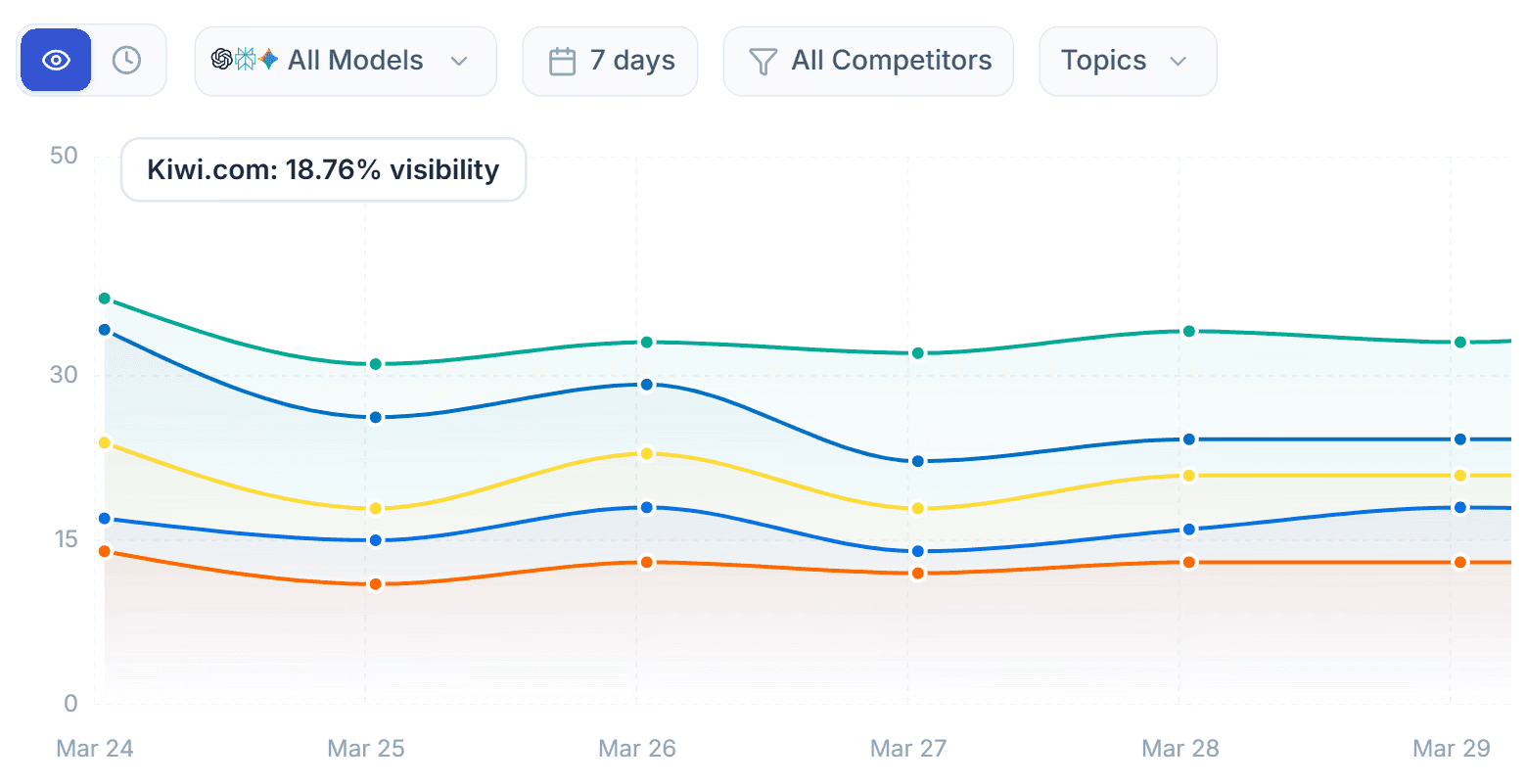
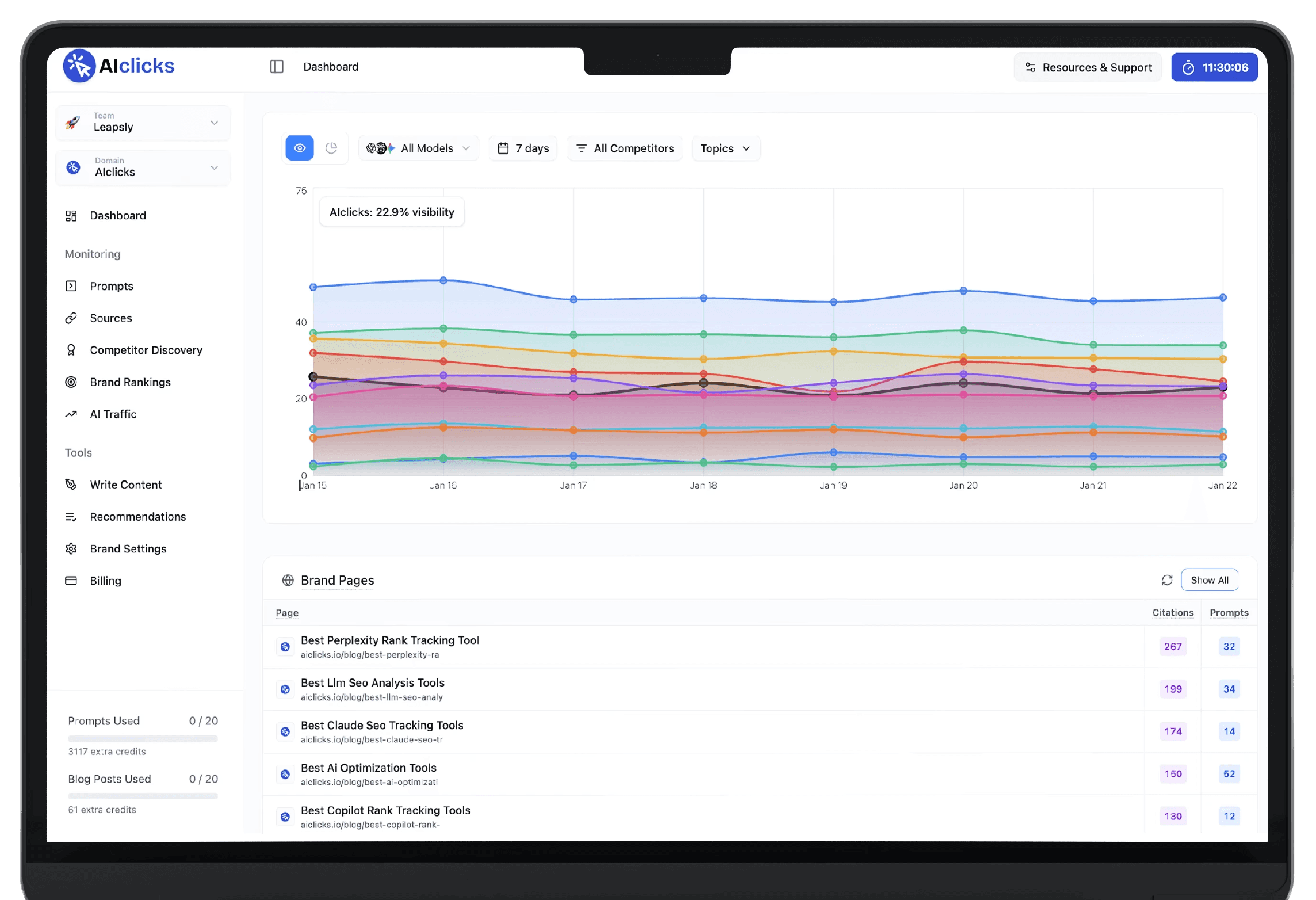
AIclicks gives you a live dashboard with daily ChatGPT mention rate, citation rate, sentiment, and share-of-voice across your tracked prompts, plus GA4 referral attribution for the traffic ChatGPT does send back.
Choose Your Plan
Flexible pricing that grows with your team. Upgrade or downgrade at any time.
Monthly
Yearly
-20%
Starter
Perfect for individuals & small teams
$49
/ month
Billed annually — you save $142
Choose 3 from:
Daily

" height="16px" id="fvSweaOBo" transform="translate(1 0)" width="14px"/></svg>)
" width="14px"><path d="M 13.864 5.629 L 13.3 5.629 L 13.3 5.6 L 7 5.6 L 7 8.4 L 10.956 8.4 C 10.379 10.03 8.828 11.2 7 11.2 C 4.681 11.2 2.8 9.319 2.8 7 C 2.8 4.681 4.681 2.8 7 2.8 C 8.071 2.8 9.045 3.204 9.786 3.864 L 11.766 1.884 C 10.516 0.719 8.844 0 7 0 C 3.134 0 0 3.134 0 7 C 0 10.866 3.134 14 7 14 C 10.866 14 14 10.866 14 7 C 14 6.531 13.952 6.073 13.864 5.629 Z" fill="rgb(255, 193, 7)" height="14px" id="H_YjfTNpn" width="14px"/><path d="M 0 3.742 L 2.3 5.429 C 2.922 3.888 4.429 2.8 6.193 2.8 C 7.264 2.8 8.238 3.204 8.979 3.864 L 10.959 1.884 C 9.709 0.719 8.037 0 6.193 0 C 3.504 0 1.172 1.518 0 3.742 Z" fill="rgb(255, 61, 0)" height="5.428500000000002px" id="PlkthQDhg" transform="translate(0.875 0)" width="10.959199999999996px"/><path d="M 6.232 5.581 C 8.04 5.581 9.683 4.889 10.925 3.764 L 8.758 1.931 C 8.032 2.483 7.144 2.782 6.232 2.781 C 4.411 2.781 2.865 1.62 2.283 0 L 0 1.759 C 1.159 4.026 3.511 5.581 6.232 5.581 Z" fill="rgb(76, 175, 80)" height="5.581099999999999px" id="WlnJ5gngE" transform="translate(0.7 8.4)" width="10.924899999999994px"/><path d="M 6.864 0.029 L 6.3 0.029 L 6.3 0 L 0 0 L 0 2.8 L 3.956 2.8 C 3.68 3.576 3.183 4.254 2.526 4.75 L 2.527 4.749 L 4.693 6.582 C 4.54 6.722 7 4.9 7 1.4 C 7 0.931 6.952 0.473 6.864 0.029 Z" fill="rgb(25, 118, 210)" height="6.589883930775992px" id="x_rSW275p" transform="translate(7 5.6)" width="7px"/></g></svg>)
" height="16px" id="hHS98fTxZ" width="16px"/></svg>)
 scale(1 1) translate(-1.861736945942159, -1.1170155383302638)" id="P20NzAvj0-699428820-radial-gradient" r="0.9935228066204626"><stop offset="0" stop-color="rgb(0, 174, 255)"/><stop offset="1" stop-color="rgb(7, 54, 196)"/></radialGradient><radialGradient cx="0.48250042504016705" cy="1.8366934653567062" gradient-transform="translate(0.48250042504016705, 1.8366934653567062) scale(1 1) translate(-0.48250042504016705, -1.8366934653567062)" id="UEWZqVjij-699428820-radial-gradient" r="0.9176890228114506"><stop offset="0" stop-color="rgb(255, 182, 87)"/><stop offset="1" stop-color="rgb(192, 43, 60)"/></radialGradient><linearGradient id="jyMN3TmKx-699428820-linear-gradient" x1="0.4594862532842614" x2="0.5405137467157386" y1="0" y2="1"><stop offset="0" stop-color="rgb(13, 145, 225)"/><stop offset="1" stop-color="rgb(255, 200, 0)"/></linearGradient><linearGradient id="xhMNwDFG0-699428820-linear-gradient" x1="0.4784828731548295" x2="0.5215171268451705" y1="5.551115123125783e-17" y2="1"><stop offset="0" stop-color="rgb(61, 203, 255)"/><stop offset="1" stop-color="rgba(5, 136, 247, 0)"/></linearGradient><radialGradient cx="1.4305090871482182" cy="0.34866158048251783" gradient-transform="translate(1.4305090871482182, 0.34866158048251783) scale(1 1) translate(-1.4305090871482182, -0.34866158048251783)" id="i79kAqaS4-699428820-radial-gradient" r="1.3362743412697924"><stop offset="0" stop-color="rgb(140, 72, 255)"/><stop offset="1" stop-color="rgb(255, 177, 82)"/></radialGradient><linearGradient id="mcxvno3tX-699428820-linear-gradient" x1="0.49844355920154226" x2="0.5015564407984577" y1="0" y2="1"><stop offset="0" stop-color="rgb(248, 173, 250)"/><stop offset="1" stop-color="rgba(168, 110, 221, 0)"/></linearGradient></defs><g d="M 11.605 1.219 C 11.397 0.499 10.739 0.002 9.989 0 L 9.498 0 C 8.682 0.002 7.985 0.588 7.842 1.391 L 7 6.016 L 7.209 5.296 C 7.416 4.574 8.075 4.076 8.825 4.074 L 11.681 4.074 L 12.879 4.545 L 14.033 4.074 L 13.697 4.074 C 12.947 4.072 12.289 3.575 12.081 2.855 Z M 4.413 13.387 C 4.618 14.111 5.278 14.611 6.031 14.613 L 7.075 14.613 C 7.988 14.613 8.735 13.88 8.758 12.96 L 8.871 8.5 L 8.633 9.319 C 8.426 10.039 7.768 10.537 7.018 10.539 L 4.138 10.539 L 3.111 9.977 L 2 10.539 L 2.331 10.539 C 3.084 10.542 3.743 11.042 3.949 11.766 L 4.413 13.387 Z M 9.999 0 L 4.167 0 C 2.501 0 1.501 2.221 0.834 4.441 C 0.045 7.073 -0.989 10.591 2.001 10.591 L 4.519 10.591 C 5.273 10.591 5.933 10.089 6.139 9.36 C 6.577 7.815 7.345 5.121 7.948 3.069 C 8.255 2.027 8.509 1.132 8.901 0.575 C 9.148 0.212 9.56 -0.004 9.999 0 M 9.999 0 L 4.167 0 C 2.501 0 1.501 2.221 0.834 4.441 C 0.045 7.073 -0.989 10.591 2.001 10.591 L 4.519 10.591 C 5.273 10.591 5.933 10.089 6.139 9.36 C 6.577 7.815 7.345 5.121 7.948 3.069 C 8.255 2.027 8.509 1.132 8.901 0.575 C 9.148 0.212 9.56 -0.004 9.999 0 M 6 14.593 L 11.833 14.593 C 13.499 14.593 14.499 12.372 15.166 10.151 C 15.955 7.519 16.989 4 13.999 4 L 11.48 4 C 10.725 4.002 10.063 4.505 9.86 5.232 C 9.266 7.332 8.663 9.429 8.051 11.523 C 7.745 12.566 7.49 13.461 7.098 14.019 C 6.851 14.382 6.439 14.597 6 14.593 M 6 14.593 L 11.833 14.593 C 13.499 14.593 14.499 12.372 15.166 10.151 C 15.955 7.519 16.989 4 13.999 4 L 11.48 4 C 10.725 4.002 10.063 4.505 9.86 5.232 C 9.266 7.332 8.663 9.429 8.051 11.523 C 7.745 12.566 7.49 13.461 7.098 14.019 C 6.851 14.382 6.439 14.597 6 14.593" fill="transparent" height="14.613333333333333px" id="QzkBy4Ibc" transform="translate(0 1)" width="16.00011071294081px"><path d="M 4.605 1.219 C 4.397 0.499 3.739 0.002 2.989 0 L 2.498 0 C 1.682 0.002 0.985 0.588 0.842 1.391 L 0 6.016 L 0.209 5.296 C 0.416 4.574 1.075 4.076 1.825 4.074 L 4.681 4.074 L 5.879 4.545 L 7.033 4.074 L 6.697 4.074 C 5.947 4.072 5.289 3.575 5.081 2.855 Z" fill="url(%23P20NzAvj0-699428820-radial-gradient)" height="6.016px" id="P20NzAvj0" transform="translate(7 0)" width="7.0333333333333385px"/><path d="M 2.413 4.887 C 2.618 5.611 3.278 6.111 4.031 6.113 L 5.075 6.113 C 5.988 6.113 6.735 5.38 6.758 4.46 L 6.871 0 L 6.633 0.819 C 6.426 1.539 5.768 2.037 5.018 2.039 L 2.138 2.039 L 1.111 1.477 L 0 2.039 L 0.331 2.039 C 1.084 2.042 1.743 2.542 1.949 3.266 L 2.413 4.887 Z" fill="url(%23UEWZqVjij-699428820-radial-gradient)" height="6.113333333333333px" id="UEWZqVjij" transform="translate(2 8.5)" width="6.871333333333332px"/><path d="M 9.999 0 L 4.167 0 C 2.501 0 1.501 2.221 0.834 4.441 C 0.045 7.073 -0.989 10.591 2.001 10.591 L 4.519 10.591 C 5.273 10.591 5.933 10.089 6.139 9.36 C 6.577 7.815 7.345 5.121 7.948 3.069 C 8.255 2.027 8.509 1.132 8.901 0.575 C 9.148 0.212 9.56 -0.004 9.999 0" fill="url(%23jyMN3TmKx-699428820-linear-gradient)" height="10.591388755215167px" id="jyMN3TmKx" width="9.999444046274142px"/><path d="M 9.999 0 L 4.167 0 C 2.501 0 1.501 2.221 0.834 4.441 C 0.045 7.073 -0.989 10.591 2.001 10.591 L 4.519 10.591 C 5.273 10.591 5.933 10.089 6.139 9.36 C 6.577 7.815 7.345 5.121 7.948 3.069 C 8.255 2.027 8.509 1.132 8.901 0.575 C 9.148 0.212 9.56 -0.004 9.999 0" fill="url(%23xhMNwDFG0-699428820-linear-gradient)" height="10.591388755215167px" id="xhMNwDFG0" width="9.999444046274142px"/><path d="M 0 10.593 L 5.833 10.593 C 7.499 10.593 8.499 8.372 9.166 6.151 C 9.955 3.519 10.989 0 7.999 0 L 5.48 0 C 4.725 0.002 4.063 0.505 3.86 1.232 C 3.266 3.332 2.663 5.429 2.051 7.523 C 1.745 8.566 1.49 9.461 1.098 10.019 C 0.851 10.382 0.439 10.597 0 10.593" fill="url(%23i79kAqaS4-699428820-radial-gradient)" height="10.593388755215164px" id="i79kAqaS4" transform="translate(6 4)" width="10.000110712940803px"/><path d="M 0 10.593 L 5.833 10.593 C 7.499 10.593 8.499 8.372 9.166 6.151 C 9.955 3.519 10.989 0 7.999 0 L 5.48 0 C 4.725 0.002 4.063 0.505 3.86 1.232 C 3.266 3.332 2.663 5.429 2.051 7.523 C 1.745 8.566 1.49 9.461 1.098 10.019 C 0.851 10.382 0.439 10.597 0 10.593" fill="url(%23mcxvno3tX-699428820-linear-gradient)" height="10.593388755215164px" id="mcxvno3tX" transform="translate(6 4)" width="10.000110712940803px"/></g></svg>)
" height="15.360666565427872px" id="HZPvvPBv7" transform="translate(0 0.5)" width="16px"/></svg>)
Tracked prompts
30
Websites you can add
3
LLMs you can track
3
Countries per project
1
LLM responses / mo
4,650
AI-optimized articles per month
10
Integrations
-
Support
Pro
For growing teams for more power
$140
/ month
Billed annually — you save $454
Choose 4 from:
Daily
Tracked prompts
150
Websites you can add
Unlimited
LLMs you can track
4
Countries per project
Unlimited
LLM responses / mo
18,600
AI-optimized articles per month
20
Integrations
Google Analytics
Support
BUSINESS
Best for medium-sized organizations
$357
/ month
Billed annually — you save $1198
Choose 6 from:
Daily
Tracked prompts
300
Websites you can add
Unlimited
LLMs you can track
6
Countries per project
Unlimited
LLM responses / mo
55,800
AI-optimized articles per month
30
Integrations
Google Analytics, API
Support
Dedicated account specialist
Become the #1 Answer in AI
Succeed in GEO yourself, or let us do all the work.
Do it yourself
Use AIclicks to see exactly where you appear across 10+ AI platforms, spot the gaps competitors are filling, and act on clear weekly recommendations.
From $59/month · Cancel anytime
Done for you
We Do All the Work for You
Our team manages your complete search presence: traditional SEO and GEO strategy, content, implementation, and reporting. You focus on buyers.
Custom pricing · Minimum 3-month engagement
The AI SEO agency trusted by 1,000+ brands worldwide
From solo founders to multi-client agencies, AIclicks runs the full AI SEO agency program for organizations of every shape and size that want to be cited across every AI surface.
4.9/5 stars on G2







FAQ
How long does SEO take to work for a builder?
Expect map pack movement in 2 to 4 months and traceable enquiries around 5 to 6. Community and floor plan terms in a competitive metro realistically take 9 to 12 months. The lag is longer than most trades because a buyer who finds you today may not sign for another year, so the first honest signal is Search Console impressions on plan and community terms, not signed contracts.
Do we need to worry about ChatGPT as well as Google?
Yes, and for builders the risk is specific. Ahrefs analysed 863,000 keywords and found only 38% of pages cited in AI Overviews also ranked in the top 10, down from 76% a year earlier. Worse, when a buyer asks an assistant who builds in their area, it usually answers from Houzz, NewHomeSource and Reddit threads, the same aggregators already outranking you. Ranking no longer puts you in the answer.
How is builder SEO different from normal local SEO?
Scale and shelf life. A plumber has 15 pages; a builder has hundreds of community, floor plan, lot and spec pages that change every month, which turns crawl budget and redirect discipline into a weekly job rather than an annual audit. The sales cycle is also 9 to 18 months long, so the content that wins is process and cost explainers, not the near-me pages generic local advice starts with.
What should a home builder budget for SEO each month?
Published rates cluster around $1,500 to $5,000 a month for a builder in one market, and $3,000 to $8,000 for multi-community operations targeting several metros. Anything under $1,000 buys directory submissions and thin city pages, which is what most builders mean when they say SEO did not work. Judge it against your cost per portal lead and a $50 to $150 construction keyword click, not against zero.
How does SEO fit with the portal leads we buy?
They solve different problems. Portal leads and Google Ads fill next quarter’s appointments and stop the day you cancel; organic and AI visibility compound and lower cost per contract over time. Most builders keep paid running on quick move-in inventory that has to move now, while building organic strength on cost, financing and process terms that are cheaper to rank for. Measure both on cost per signed contract.
Which pages should a builder build first on the site?
Google Business Profile first, because it is free and sits above the portals. Then one indexable page per floor plan with a starting price. Then a page per active community with lot inventory and school zoning. Then the cost-to-build and financing hub, which catches buyers a year out. Location pages after that, and only for markets you genuinely build in. The blog is last.
What should we measure to prove SEO is paying off?
Track appointments set from organic, not rankings. Put call tracking on the site, because builder enquiries are still mostly phone calls, and tag every form by landing page so the floor plan that produced it is visible. Watch Google Business Profile direction requests, which spike before model home visits do. Then reconcile against your CRM: model home tours booked and contracts written are the numbers that pay.
Should we hire an SEO agency or handle it internally?
Split it. Jobsite photos, profile posts, review requests and the honest answers about cost and schedule have to come from your team, because nobody outside knows your specification. Outsource the technical layer: inventory redirects, schema, sitemaps, site speed. When vetting an agency, ask where they rank for their own terms and how they handle a community that sells out. A generalist will not have an answer.
Further Reading
Go deeper on GEO, AI search, and visibility tracking.