SEO for Banks:
Nobody opens an account on a whim. They compare fees on a rate table, check whether a branch is still open, read the reviews for that branch, then ask an assistant which bank is actually any good. Search decides who survives that shortlist.









Why Banks Need SEO
Roughly 9 in 10 people research a financial product online before contacting a lender, and banks near me alone draws about 30,000 US searches a month.
Most bank sites give checking, savings, home equity and business lending a paragraph each, then a disclosure twice as long. The rate loads from a third-party engine, so the number never reaches the HTML. Someone comparing accounts leaves without the figure they came for, and you never see it.
Search best bank near me anywhere in the US and Bankrate and NerdWallet sit in the organic results above nearly every institution. They rank on aggregate authority and rate tables no single bank can match, then place your competitors in the same list on commercial terms. You appear as a row.
Banks fund CD specials and checking bonuses quarter after quarter, buy placement on the same comparison sites that outrank them, and defend their own brand term in paid search. Retainers of $2,000 to $5,000 a month sit on top. Stop the offer and the deposit run rate flattens within a few weeks.
How SEO Works for Banks
Search Engine Optimization projects are long-term investments for banks, where each task supplements the others and creates compound results over time.
01
Keywords, page structure, and the signals Google reads directly
On-page work is slower in banking than in any comparable industry, because nothing publishes until compliance clears it. Marketing writes a checking page; legal returns it with the claim struck, the rate replaced by a variable-disclosure sentence, and a Truth in Savings block appended that runs longer than the copy. What survives ranks for nothing. The second problem is naming: the page is titled after the internal product, Premier Interest Checking, while customers search free checking with no minimum balance. The pages carrying weight here are product pages, branch pages, rate pages and calculators, never the blog.
Explanatory pages age extremely well. A page on what FDIC insurance actually covers, how long a mobile deposit hold lasts, or the difference between a wire and an ACH transfer will still be earning visits in 5 years, because the mechanics do not change and the anxiety does not either. What churns is everything tied to a quarter: the CD special, the lobby closure notice, the shred event recap, the merger announcement from 2 charters ago. Those quietly become most of a bank blog. Write fewer pages, about mechanics rather than moments, and date every rate page.
1
Retitle every product page in customer language, free checking with no minimum, not the internal brand name your product committee approved.
2
Unpublish last quarter’s CD special and bonus landing pages, then 301 each into the standing product page rather than leaving them indexed.
3
Mark up accounts with BankAccount and LoanOrCredit schema, including annualPercentageRate and feesAndCommissionsSpecification, then validate in Google’s Rich Results Test.
4
Publish FDIC coverage, routing number and hold-time explainers plus mortgage and savings calculators, which rank all year regardless of what rates do.
02
Map Pack visibility, citations, and proximity signals
Local is the one arena where a community bank beats a national one, because distance is a ranking factor nobody can buy. Banks near me draws roughly 30,000 US searches a month, and around 90% of bank near me queries come from a phone. The map pack sits above Bankrate, above NerdWallet, above every national brand’s locator page. Three branches win the calls; everyone else waits for the scroll.
A complete branch profile picks the narrowest accurate category, Savings Bank or Federal Credit Union rather than the generic Bank, then lists notary service, safe deposit boxes, wire transfers and coin counting as individual services. Banking is one of the few sectors with 2 sets of hours, so publish lobby and drive-up separately. Add the appointment link, real branch photos, and pre-answered questions on non-customer check cashing.
Banking carries a registry layer general local SEO never mentions. FDIC BankFind holds your certificate number, legal name and every branch address; NCUA does the same for credit unions; NMLS Consumer Access lists each loan officer. Underneath sit DepositAccounts, Bauer Financial and the institution profiles on Bankrate and WalletHub. Regulators and AI systems both treat those records as authoritative, so a pre-merger name still sitting in one quietly contradicts your own site.
1
Publish lobby hours and drive-up hours separately on every branch profile, and list notary, safe deposit and wire service as distinct services.
2
Give each branch its own profile and its own page, and claim every standalone ATM as a separate listing rather than a service.
3
Match legal name, street and phone across FDIC BankFind, NMLS Consumer Access, DepositAccounts and Bauer Financial; one pre-merger record undoes the rest.
4
Post weekly from each branch profile: a rate change, a shred day, a financial literacy session, the lender who actually sits there.
03
Topic authority, inbound links, and content that earns traffic
People researching money are anxious and very specific. They want to know what FDIC coverage protects once a bank failure makes the news, how much it takes to open a business account, whether a home equity line beats a cash-out refinance this year, what an escrow shortage letter means. Compliance rarely blocks explaining; it blocks claiming. That distinction is the whole opportunity, because comparison sites only summarise what you can document properly.
Someone who has decided they want a business checking account is now choosing where to open it. They want the maintenance fee, the minimum balance, the transaction cap, the ACH and mobile deposit limits, and how many days opening takes. Most banks bury all of it in a PDF rate sheet, which Google reads badly and assistants rarely quote. Put the fee schedule on the page as text instead.
Bank links come from obligations you already carry. Community Reinvestment Act activity generates sponsorships, financial literacy sessions and affordable housing partnerships every year, and almost none of those partner pages get claimed. Your state bankers association and the ICBA publish member directories. Housing finance agencies list approved lenders and the SBA lists preferred ones. American Banker and ABA Banking Journal quote practitioners on deposit conditions.
1
Publish an annual guide comparing your own checking tiers on fees, minimums and transaction limits, the format Bankrate ranks for and you do not.
2
Build one page per product per town you lend in, such as small business banking, with real underwriting detail rather than a swapped place name.
3
Cluster every fee question into one hub covering overdraft, monthly maintenance, wire, foreign transaction and ATM surcharge, with the schedule in HTML.
4
Write a page for each programme you genuinely originate: SBA 7(a), FHA, USDA rural, state down-payment assistance, construction and home equity lines.
04
Site speed, crawlability, Core Web Vitals, and mobile health
The failure specific to banking is that your branch pages are not on your website. Most institutions hand the locator to a vendor, so every location URL lives on a subdomain while products sit on www, splitting authority into 2 pools that barely link to each other. On smaller sites the locator is a JavaScript widget rendering addresses client side, so nothing crawlable is published and AI crawlers see an empty page.
Around 90% of bank near me searches happen on a phone, usually from somebody working out whether it is worth driving over before the lobby shuts. That page is carrying a chat widget, a tag manager, device-fingerprinting fraud scripts, an accessibility overlay and a third-party rate engine. On most bank sites at least one loads in the head, so the browser waits on an API round trip before anything renders.
1
Crawl the locator subdomain and www together in Screaming Frog; move branch pages into a www subfolder, or at minimum link them both ways.
2
Load your rates page with JavaScript disabled; if the yield disappears, server-render it so Google and AI crawlers can read the number.
3
Audit head-loaded tags in PageSpeed Insights: chat, fraud fingerprinting, accessibility overlays and rate engines belong after first paint, not before it.
4
Keep branch and product pages in a sitemap separate from the blog, and update lastmod every time a rate sheet is reissued.
05
Star ratings, review volume, and response strategy that builds trust
Bank reviews skew negative by design. Nobody writes 5 stars because a deposit cleared; they write after a hold, an overdraft fee, or a 40-minute wait at the only open teller window. Ratings in the 2 to 3 star range are common even at well-run institutions. Every branch carries its own score, so one understaffed location drags the map pack down, and staff cannot ask in any way that references an account.
Ask at the moments that genuinely went well: the day a loan funds, the morning a business account opens, the closing table on a mortgage. Not after a teller transaction, and never by mass email to the deposit base. Wire the request into the loan origination system so it fires on funding, signed by the lender who handled it, and give each branch manager a QR card for the desk, because the ask lands hardest in person.
1
Fire the review request from nCino or Encompass on the day a loan funds, signed by the lender whose name is on the file.
2
Respond within 24 hours and move it offline, never confirming an account exists, because Gramm-Leach-Bliley binds you even when the reviewer overshares.
3
Surface each branch’s reviews on that branch page and lending reviews on the loan product page, not in one site-wide testimonial slider.
4
Ask treasury management and commercial lending clients too, since a business owner’s review carries further with the next business owner comparing banks.
Google is No Longer the Only Place Your customers are Searching
Customers are using AI to find answers, and they trust what it tells them. Invest in GEO to get recommended in those answers.
1 Billion
Questions ChatGPT receives every single day
38%
Your #1 top ranking page on Google would be cited by AI
14%
of banks optimise for GEO. The rest are invisible in AI answers


You can rank #1 for “bank near me” and still not exist in ChatGPT’s answer. Run a free GEO audit to see where your brand actually stands.
GEO vs SEO: Same Goal, Different Methods
GEO is wider than SEO. AI recommends the brands that show up across the sources it reads, so your presence in forums, social platforms and banking blogs decides your odds. AIclicks measures the three metrics below so you know which to work on first.
AI Assistant
Which local bank should I open a checking account with?
Your Bank
Citation Rate
Shows how many AI answers about banks name your brand, out of every 100. Models pull from the same trusted pages over and over, so citations compound: once you are in, staying in gets easier. Find the competitor pages AI cites most, then publish your own version of each.
Your Bank
82% positive
Competitor A
54% positive
Competitor B
38% positive
Brand Sentiment
Shows how AI describes you when your brand comes up: positive, neutral or negative. Tone is what separates being mentioned from being recommended, and models repeat whatever framing they find. Track the negative mentions back to the reviews and threads behind them, then publish content that answers those directly.
Others 52%
You 24%
— 24%
Your Bank
AI mention share of voice — banking category
Competitors
Not Cited
Share of Voice in AI
Shows how much of the banking conversation belongs to you rather than your competitors. This is the metric that matters most, the GEO version of a Google ranking. With only 1–5 brands named per answer, the market is winner-takes-more and every point is taken from someone.
The Dashboard Your Dedicated AI Search Team Works In
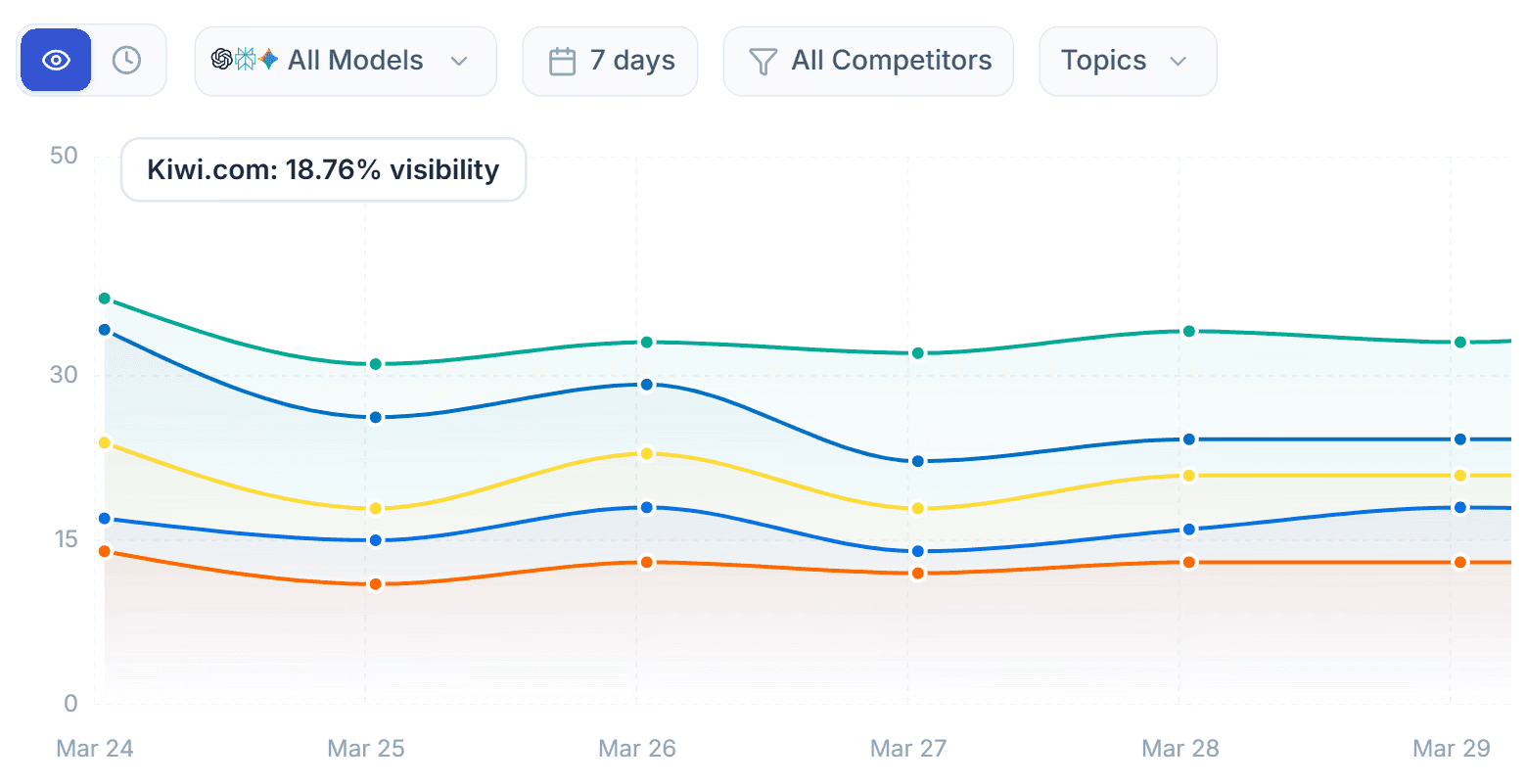
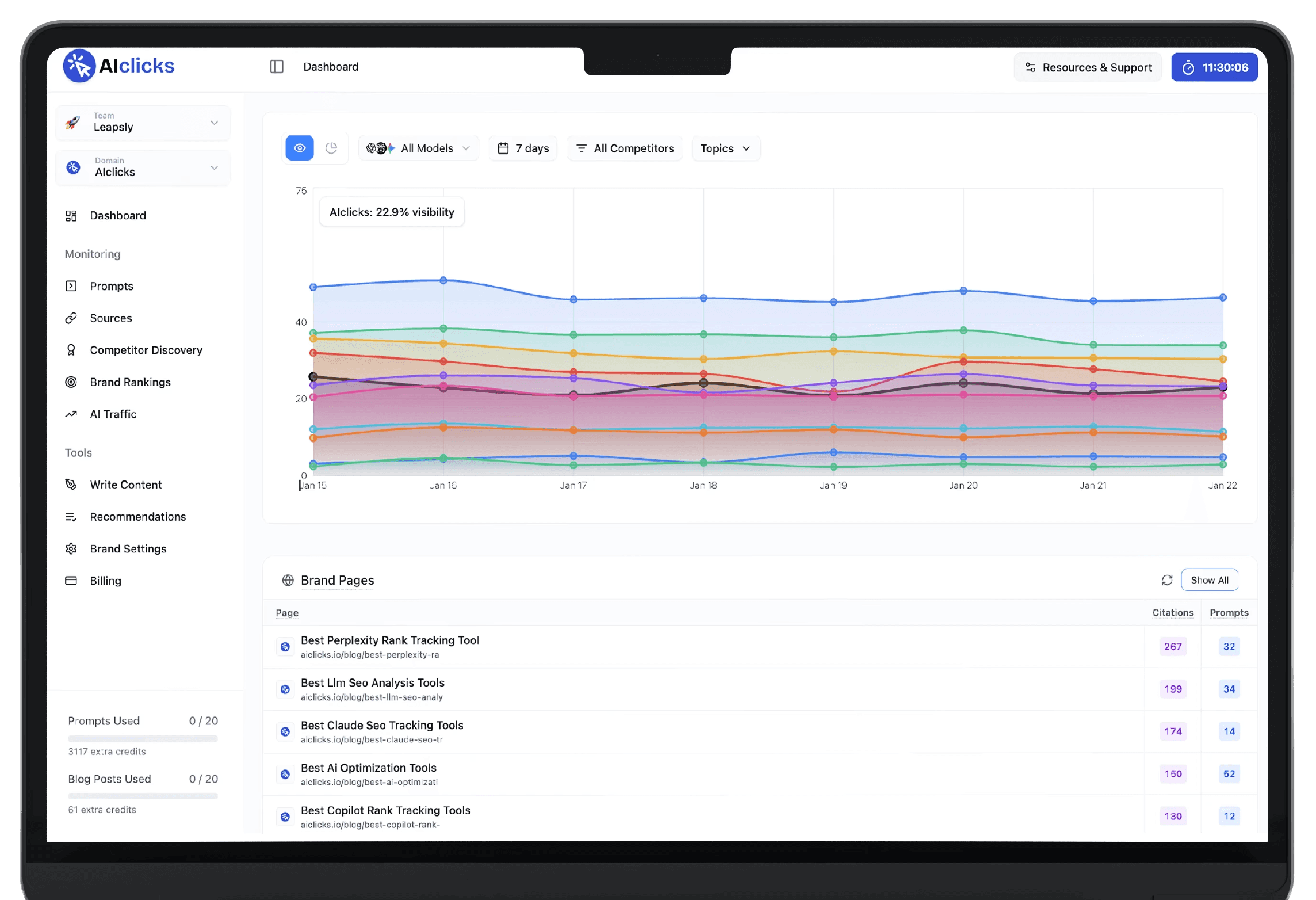
AIclicks gives you a live dashboard with daily ChatGPT mention rate, citation rate, sentiment, and share-of-voice across your tracked prompts, plus GA4 referral attribution for the traffic ChatGPT does send back.
Choose Your Plan
Flexible pricing that grows with your team. Upgrade or downgrade at any time.
Monthly
Yearly
-20%
Starter
Perfect for individuals & small teams
$49
/ month
Billed annually — you save $142
Choose 3 from:
Daily

" height="16px" id="fvSweaOBo" transform="translate(1 0)" width="14px"/></svg>)
" width="14px"><path d="M 13.864 5.629 L 13.3 5.629 L 13.3 5.6 L 7 5.6 L 7 8.4 L 10.956 8.4 C 10.379 10.03 8.828 11.2 7 11.2 C 4.681 11.2 2.8 9.319 2.8 7 C 2.8 4.681 4.681 2.8 7 2.8 C 8.071 2.8 9.045 3.204 9.786 3.864 L 11.766 1.884 C 10.516 0.719 8.844 0 7 0 C 3.134 0 0 3.134 0 7 C 0 10.866 3.134 14 7 14 C 10.866 14 14 10.866 14 7 C 14 6.531 13.952 6.073 13.864 5.629 Z" fill="rgb(255, 193, 7)" height="14px" id="H_YjfTNpn" width="14px"/><path d="M 0 3.742 L 2.3 5.429 C 2.922 3.888 4.429 2.8 6.193 2.8 C 7.264 2.8 8.238 3.204 8.979 3.864 L 10.959 1.884 C 9.709 0.719 8.037 0 6.193 0 C 3.504 0 1.172 1.518 0 3.742 Z" fill="rgb(255, 61, 0)" height="5.428500000000002px" id="PlkthQDhg" transform="translate(0.875 0)" width="10.959199999999996px"/><path d="M 6.232 5.581 C 8.04 5.581 9.683 4.889 10.925 3.764 L 8.758 1.931 C 8.032 2.483 7.144 2.782 6.232 2.781 C 4.411 2.781 2.865 1.62 2.283 0 L 0 1.759 C 1.159 4.026 3.511 5.581 6.232 5.581 Z" fill="rgb(76, 175, 80)" height="5.581099999999999px" id="WlnJ5gngE" transform="translate(0.7 8.4)" width="10.924899999999994px"/><path d="M 6.864 0.029 L 6.3 0.029 L 6.3 0 L 0 0 L 0 2.8 L 3.956 2.8 C 3.68 3.576 3.183 4.254 2.526 4.75 L 2.527 4.749 L 4.693 6.582 C 4.54 6.722 7 4.9 7 1.4 C 7 0.931 6.952 0.473 6.864 0.029 Z" fill="rgb(25, 118, 210)" height="6.589883930775992px" id="x_rSW275p" transform="translate(7 5.6)" width="7px"/></g></svg>)
" height="16px" id="hHS98fTxZ" width="16px"/></svg>)
 scale(1 1) translate(-1.861736945942159, -1.1170155383302638)" id="P20NzAvj0-699428820-radial-gradient" r="0.9935228066204626"><stop offset="0" stop-color="rgb(0, 174, 255)"/><stop offset="1" stop-color="rgb(7, 54, 196)"/></radialGradient><radialGradient cx="0.48250042504016705" cy="1.8366934653567062" gradient-transform="translate(0.48250042504016705, 1.8366934653567062) scale(1 1) translate(-0.48250042504016705, -1.8366934653567062)" id="UEWZqVjij-699428820-radial-gradient" r="0.9176890228114506"><stop offset="0" stop-color="rgb(255, 182, 87)"/><stop offset="1" stop-color="rgb(192, 43, 60)"/></radialGradient><linearGradient id="jyMN3TmKx-699428820-linear-gradient" x1="0.4594862532842614" x2="0.5405137467157386" y1="0" y2="1"><stop offset="0" stop-color="rgb(13, 145, 225)"/><stop offset="1" stop-color="rgb(255, 200, 0)"/></linearGradient><linearGradient id="xhMNwDFG0-699428820-linear-gradient" x1="0.4784828731548295" x2="0.5215171268451705" y1="5.551115123125783e-17" y2="1"><stop offset="0" stop-color="rgb(61, 203, 255)"/><stop offset="1" stop-color="rgba(5, 136, 247, 0)"/></linearGradient><radialGradient cx="1.4305090871482182" cy="0.34866158048251783" gradient-transform="translate(1.4305090871482182, 0.34866158048251783) scale(1 1) translate(-1.4305090871482182, -0.34866158048251783)" id="i79kAqaS4-699428820-radial-gradient" r="1.3362743412697924"><stop offset="0" stop-color="rgb(140, 72, 255)"/><stop offset="1" stop-color="rgb(255, 177, 82)"/></radialGradient><linearGradient id="mcxvno3tX-699428820-linear-gradient" x1="0.49844355920154226" x2="0.5015564407984577" y1="0" y2="1"><stop offset="0" stop-color="rgb(248, 173, 250)"/><stop offset="1" stop-color="rgba(168, 110, 221, 0)"/></linearGradient></defs><g d="M 11.605 1.219 C 11.397 0.499 10.739 0.002 9.989 0 L 9.498 0 C 8.682 0.002 7.985 0.588 7.842 1.391 L 7 6.016 L 7.209 5.296 C 7.416 4.574 8.075 4.076 8.825 4.074 L 11.681 4.074 L 12.879 4.545 L 14.033 4.074 L 13.697 4.074 C 12.947 4.072 12.289 3.575 12.081 2.855 Z M 4.413 13.387 C 4.618 14.111 5.278 14.611 6.031 14.613 L 7.075 14.613 C 7.988 14.613 8.735 13.88 8.758 12.96 L 8.871 8.5 L 8.633 9.319 C 8.426 10.039 7.768 10.537 7.018 10.539 L 4.138 10.539 L 3.111 9.977 L 2 10.539 L 2.331 10.539 C 3.084 10.542 3.743 11.042 3.949 11.766 L 4.413 13.387 Z M 9.999 0 L 4.167 0 C 2.501 0 1.501 2.221 0.834 4.441 C 0.045 7.073 -0.989 10.591 2.001 10.591 L 4.519 10.591 C 5.273 10.591 5.933 10.089 6.139 9.36 C 6.577 7.815 7.345 5.121 7.948 3.069 C 8.255 2.027 8.509 1.132 8.901 0.575 C 9.148 0.212 9.56 -0.004 9.999 0 M 9.999 0 L 4.167 0 C 2.501 0 1.501 2.221 0.834 4.441 C 0.045 7.073 -0.989 10.591 2.001 10.591 L 4.519 10.591 C 5.273 10.591 5.933 10.089 6.139 9.36 C 6.577 7.815 7.345 5.121 7.948 3.069 C 8.255 2.027 8.509 1.132 8.901 0.575 C 9.148 0.212 9.56 -0.004 9.999 0 M 6 14.593 L 11.833 14.593 C 13.499 14.593 14.499 12.372 15.166 10.151 C 15.955 7.519 16.989 4 13.999 4 L 11.48 4 C 10.725 4.002 10.063 4.505 9.86 5.232 C 9.266 7.332 8.663 9.429 8.051 11.523 C 7.745 12.566 7.49 13.461 7.098 14.019 C 6.851 14.382 6.439 14.597 6 14.593 M 6 14.593 L 11.833 14.593 C 13.499 14.593 14.499 12.372 15.166 10.151 C 15.955 7.519 16.989 4 13.999 4 L 11.48 4 C 10.725 4.002 10.063 4.505 9.86 5.232 C 9.266 7.332 8.663 9.429 8.051 11.523 C 7.745 12.566 7.49 13.461 7.098 14.019 C 6.851 14.382 6.439 14.597 6 14.593" fill="transparent" height="14.613333333333333px" id="QzkBy4Ibc" transform="translate(0 1)" width="16.00011071294081px"><path d="M 4.605 1.219 C 4.397 0.499 3.739 0.002 2.989 0 L 2.498 0 C 1.682 0.002 0.985 0.588 0.842 1.391 L 0 6.016 L 0.209 5.296 C 0.416 4.574 1.075 4.076 1.825 4.074 L 4.681 4.074 L 5.879 4.545 L 7.033 4.074 L 6.697 4.074 C 5.947 4.072 5.289 3.575 5.081 2.855 Z" fill="url(%23P20NzAvj0-699428820-radial-gradient)" height="6.016px" id="P20NzAvj0" transform="translate(7 0)" width="7.0333333333333385px"/><path d="M 2.413 4.887 C 2.618 5.611 3.278 6.111 4.031 6.113 L 5.075 6.113 C 5.988 6.113 6.735 5.38 6.758 4.46 L 6.871 0 L 6.633 0.819 C 6.426 1.539 5.768 2.037 5.018 2.039 L 2.138 2.039 L 1.111 1.477 L 0 2.039 L 0.331 2.039 C 1.084 2.042 1.743 2.542 1.949 3.266 L 2.413 4.887 Z" fill="url(%23UEWZqVjij-699428820-radial-gradient)" height="6.113333333333333px" id="UEWZqVjij" transform="translate(2 8.5)" width="6.871333333333332px"/><path d="M 9.999 0 L 4.167 0 C 2.501 0 1.501 2.221 0.834 4.441 C 0.045 7.073 -0.989 10.591 2.001 10.591 L 4.519 10.591 C 5.273 10.591 5.933 10.089 6.139 9.36 C 6.577 7.815 7.345 5.121 7.948 3.069 C 8.255 2.027 8.509 1.132 8.901 0.575 C 9.148 0.212 9.56 -0.004 9.999 0" fill="url(%23jyMN3TmKx-699428820-linear-gradient)" height="10.591388755215167px" id="jyMN3TmKx" width="9.999444046274142px"/><path d="M 9.999 0 L 4.167 0 C 2.501 0 1.501 2.221 0.834 4.441 C 0.045 7.073 -0.989 10.591 2.001 10.591 L 4.519 10.591 C 5.273 10.591 5.933 10.089 6.139 9.36 C 6.577 7.815 7.345 5.121 7.948 3.069 C 8.255 2.027 8.509 1.132 8.901 0.575 C 9.148 0.212 9.56 -0.004 9.999 0" fill="url(%23xhMNwDFG0-699428820-linear-gradient)" height="10.591388755215167px" id="xhMNwDFG0" width="9.999444046274142px"/><path d="M 0 10.593 L 5.833 10.593 C 7.499 10.593 8.499 8.372 9.166 6.151 C 9.955 3.519 10.989 0 7.999 0 L 5.48 0 C 4.725 0.002 4.063 0.505 3.86 1.232 C 3.266 3.332 2.663 5.429 2.051 7.523 C 1.745 8.566 1.49 9.461 1.098 10.019 C 0.851 10.382 0.439 10.597 0 10.593" fill="url(%23i79kAqaS4-699428820-radial-gradient)" height="10.593388755215164px" id="i79kAqaS4" transform="translate(6 4)" width="10.000110712940803px"/><path d="M 0 10.593 L 5.833 10.593 C 7.499 10.593 8.499 8.372 9.166 6.151 C 9.955 3.519 10.989 0 7.999 0 L 5.48 0 C 4.725 0.002 4.063 0.505 3.86 1.232 C 3.266 3.332 2.663 5.429 2.051 7.523 C 1.745 8.566 1.49 9.461 1.098 10.019 C 0.851 10.382 0.439 10.597 0 10.593" fill="url(%23mcxvno3tX-699428820-linear-gradient)" height="10.593388755215164px" id="mcxvno3tX" transform="translate(6 4)" width="10.000110712940803px"/></g></svg>)
" height="15.360666565427872px" id="HZPvvPBv7" transform="translate(0 0.5)" width="16px"/></svg>)
Tracked prompts
30
Websites you can add
3
LLMs you can track
3
Countries per project
1
LLM responses / mo
4,650
AI-optimized articles per month
10
Integrations
-
Support
Pro
For growing teams for more power
$140
/ month
Billed annually — you save $454
Choose 4 from:
Daily
Tracked prompts
150
Websites you can add
Unlimited
LLMs you can track
4
Countries per project
Unlimited
LLM responses / mo
18,600
AI-optimized articles per month
20
Integrations
Google Analytics
Support
BUSINESS
Best for medium-sized organizations
$357
/ month
Billed annually — you save $1198
Choose 6 from:
Daily
Tracked prompts
300
Websites you can add
Unlimited
LLMs you can track
6
Countries per project
Unlimited
LLM responses / mo
55,800
AI-optimized articles per month
30
Integrations
Google Analytics, API
Support
Dedicated account specialist
Become the #1 Answer in AI
Succeed in GEO yourself, or let us do all the work.
Do it yourself
Use AIclicks to see exactly where you appear across 10+ AI platforms, spot the gaps competitors are filling, and act on clear weekly recommendations.
From $59/month · Cancel anytime
Done for you
We Do All the Work for You
Our team manages your complete search presence: traditional SEO and GEO strategy, content, implementation, and reporting. You focus on customers.
Custom pricing · Minimum 3-month engagement
The AI SEO agency trusted by 1,000+ brands worldwide
From solo founders to multi-client agencies, AIclicks runs the full AI SEO agency program for organizations of every shape and size that want to be cited across every AI surface.
4.9/5 stars on G2







FAQ
How long does SEO take to work for a bank?
Branch and map pack movement usually appears in 3 to 4 months, with product page rankings following in 6 to 12. Competitive terms like best savings account rates realistically take 12 to 18 months, because Google demands institutional authority signals before ranking YMYL finance content. Then add your own review cycle: most banks lose 2 to 3 weeks per page inside compliance, and that queue, not Google, is the real bottleneck.
Do AI assistants even recommend banks like ours?
Rarely, and that gap is the opportunity. Ahrefs analysed 863,000 keywords and found only 38% of pages cited in AI Overviews also ranked in the top 10, down from 76% a year earlier. When somebody asks an assistant which bank to use, it pulls rate tables and roundups from comparison sites, not your product pages. Structured answers, documented fees and clean registry records win the citation.
How is bank SEO different from ordinary local SEO?
Three constraints change the job. Compliance owns the copy, so legal will not approve best or guaranteed, and the comparison keywords aggregators live on stay closed to you. Google treats every page as YMYL and raises the evidence bar accordingly. And your identity sits in federal registries like FDIC BankFind and NMLS, which both Google and AI systems trust more than your website. Generic advice covers none of it.
What should a bank budget for SEO?
Published rates for financial institution SEO cluster around $2,000 to $5,000 a month for a single-market bank, rising to $8,000 or more for multi-state and multi-charter programmes. Specialists who work only with banks quote higher than generalists and usually earn it, because compliance-aware copy survives legal review the first time. Judge any of it on cost per funded account or funded loan, not on traffic.
How does SEO fit with our deposit campaigns?
They run on different clocks. A CD or checking bonus buys deposits this quarter and stops the week the offer ends; organic search compounds and lowers cost per account over years. Most banks do both, buying placement on comparison sites to cover the terms compliance will not let them write, while building organic strength on fee, FDIC and how-to queries. Measure both on cost per funded account.
Which pages should a bank build first?
Branch pages first, one per location, hosted on your own domain rather than a vendor subdomain. Then your 3 highest-margin product pages, rewritten in customer language with the fee schedule visible as text. Then the explainers on FDIC coverage, routing numbers and account opening, which earn traffic all year and feed AI answers. Calculators after that. The blog comes last, and only for questions customers genuinely ask.
How do we tell whether any of this is working?
Measure funded accounts and funded loans from organic search, not rankings. Tag every online application by landing page and reconcile it against the core system monthly, because applications are the only conversion that reaches the balance sheet. Watch calls and direction requests per branch profile, which move first. Track impressions on product terms in Search Console. Then check whether assistants name you at all.
Should we run this in-house or hire an agency?
Split it. Branch profiles, review responses, community content and anything needing your compliance officer belong in-house, because nobody outside the bank can move a page through legal. Outsource the technical layer, schema, the locator subdomain problem and link building. If you hire out, pick a firm fluent in Reg DD disclosures and UDAAP; a generalist will hand you copy your compliance team rejects.
Further Reading
Go deeper on GEO, AI search, and visibility tracking.