SEO for Artists:
Collectors do not scroll Instagram hoping to stumble on you. They search for a medium, a subject and a size, then buy from whoever shows up. Most of that search happens on Google Images and inside AI answers, not on a feed.









Why Artists Need SEO
Google Images alone carries close to 20% of all US searches, and art is the most visual category there is. Yet most artist sites give a crawler almost no text to read.
A collector searching for a large abstract seascape in oil is describing one very specific piece. On most artist sites that piece lives inside a lightbox gallery with no URL of its own, so there is nothing at all for Google to rank, and nothing for a buyer to link to either.
Search original art for sale near me and the first page belongs to Saatchi Art, Artfinder, Zatista and Artspan. They aggregate thousands of artists, so they outrank every one individually. You appear inside their catalogue, on their URL, beside 40 artists doing similar work.
Every single sale made through someone else’s storefront is taxed. Saatchi Art keeps 35% of the price, physical galleries commonly take 50%, and Etsy layers a listing fee, a 6.5% transaction cut and up to 15% on offsite ads. Years of that, and you still own no audience at all.
How SEO Works for Artists
Search Engine Optimization projects are long-term investments for artists, where each task supplements the others and creates compound results over time.
01
Keywords, page structure, and the signals Google reads directly
On-page work is strange for artists because the product has no standard name. Nobody searches for the title you gave a painting. They search for what they can picture on a wall: large vertical abstract in rust and cream, or moody coastal watercolour. The pages that carry this are your individual artwork pages, one per piece, plus collection pages grouped by medium, subject, palette and size. Most artist sites have neither. They have a homepage, an about page and a gallery block holding 200 works behind a single URL, which gives Google exactly one page to rank.
What holds value is the piece-level page and the subject collection. A page for a sold painting still ranks, still earns links, and still pulls collectors who want something similar, which is why deleting sold work is the most common self-inflicted wound in this trade. Mark it sold and keep it live. What churns is everything event-shaped: the show announcement, the fair booth number, the studio sale that ended in March. Those are worth publishing and worth retiring. Most artists do the reverse. They post exhibition news constantly and never write 60 words about the work itself.
1
Give every artwork its own indexable URL and 80 words on medium, dimensions, palette and where it would hang.
2
Never delete a sold piece. Add a sold banner, keep the URL live, and link it to available work in the same series.
3
Mark each piece with VisualArtwork schema, filling artMedium, artform, artworkSurface and dimensions, then validate it in Google’s Rich Results Test.
4
Build collection pages by subject, palette and room, such as coastal oil paintings or large abstract art for a dining room.
02
Map Pack visibility, citations, and proximity signals
Not all art demand is local, but the profitable part often is. Commissions, portraits, murals, framed originals people want to see before buying, and open studio visits all come from within driving distance. Those searches trigger a map pack that sits above every marketplace on the page. It is the one surface where a solo artist outranks Saatchi Art, and almost no artist has claimed it.
Set the primary category to Artist or Art Studio, never Painter, which Google files under house painting contractors. Add commission types as services: portrait, pet portrait, mural, live event painting. Upload work in progress shots and studio photos rather than flat scans, since studio images are what get clicked. Publish real visiting hours, or run it as a service area business if you work from home and would rather not publish your address.
Artists carry 2 citation layers. The general one is Google Business Profile, Bing Places, Apple Business Connect and Yelp. The layer that actually moves art rankings is the art layer: Artwork Archive, Saatchi Art, Artfinder, Artspan, Behance, ArtStation, your state arts commission registry, your regional arts council listing, and CallForEntry. Auction and record sites such as askART, Artnet and MutualArt matter later. All of them need the identical artist name and spelling, because a name that appears 3 different ways reads as 3 different people.
1
Choose Artist as the primary category, list each commission type as a service, and add 30 or more genuine studio photos.
2
If galleries stock your work, never claim their address. Keep one profile for your studio and build a stockists page listing each venue.
3
Run BrightLocal across Artwork Archive, Saatchi Art, Behance and your arts council listing, and fix every initial, hyphen or maiden name variant.
4
Post one Google Business Profile update a week: a piece in progress, a new collection, an open studio date, a commission slot.
03
Topic authority, inbound links, and content that earns traffic
Before anyone buys original work they are quietly working out 3 things: whether it will fit, whether the price is normal, and whether they are being taken. Content that answers those plainly beats anything written about your process. How to size art above a sofa, what an original costs against a limited edition print, how framing and shipping actually work, what a commission timeline looks like.
The buyer who has decided they want a large abstract is now choosing whose. They want the piece photographed in a real room for scale, a certificate of authenticity mentioned by name, edition numbers stated, return terms in plain words, and a shipping cost before checkout. Put all of it on the artwork page, not on a policies page 3 clicks away. Most artists lose this buyer at the moment they cannot find a price.
Art links are earned offline and collected online. Juried shows publish exhibitor lists. Residencies, grants and arts council awards publish recipient pages. Interior designers and architects credit the artist on project pages if you ask. Framers, art supply brands and print studios run maker features. Local press covers murals and public commissions. Podcasts about art business link to every guest. None of it requires buying a link, and all of it needs a follow-up email.
1
Publish an annual guide comparing originals, limited edition giclee prints and open editions, with your real price bands for each.
2
Template a landing page per room and size combination, such as large art for a bedroom, pulling in matching pieces automatically.
3
Cluster every how much does a commissioned painting cost query into one hub covering deposits, sizes, timelines, revisions and payment plans.
4
Write a page for each medium and material you genuinely use, such as cold wax oil, encaustic, or Yupo synthetic paper.
04
Site speed, crawlability, Core Web Vitals, and mobile health
The failure specific to art sites is the JavaScript gallery. Squarespace gallery blocks, Wix Pro Gallery, Adobe Portfolio and Format all render work as a lightbox slideshow: no individual URL, alt text auto-filled from the filename, and images loaded only after a click. A crawler sees one page and a handful of thumbnails. So does an AI model. The artist statement is often set as an image too, so the only real text on the site is invisible.
Artists upload print resolution files because collectors want to zoom, so a single scan can arrive as a 12 megabyte TIFF export at 6000 pixels wide, shown at 800. Twenty of those on a collection page is a phone loading 40 megabytes over a weak connection at an art fair, while the person standing in front of your booth tries to show a friend the piece. They give up before the second row renders.
1
Crawl the site with Screaming Frog. If your artworks return no individual URLs, replace the gallery block with real product pages.
2
Run PageSpeed Insights on your largest collection page, lazy load below the fold, and target Largest Contentful Paint under 2.5 seconds.
3
Rename every file before upload, serve WebP at display size, and write unique alt text per piece instead of repeating your medium.
4
Keep artwork and collection URLs in a sitemap separate from blog posts, and resubmit in Search Console whenever a new series drops.
05
Star ratings, review volume, and response strategy that builds trust
Buying original art is an act of trust in a stranger, and reviews are the only evidence a first-time collector has that the piece arrived, arrived intact, and looked like the photograph. They are also scattered. Your reviews sit on Etsy, on Saatchi Art, on a wedding portrait blog and in an Instagram comment, none of which count towards the profile that decides whether you show in the map pack. Nothing consolidates them for you.
Ask the week the work lands on their wall, not the day it ships. The feeling you want a review written about is the unwrapping, and that happens 4 to 9 days after dispatch depending on the carrier. Put a printed card in the crate with a short link and the piece title on it. For commissions, ask at handover while they are still standing in front of it. Ask every buyer, not only the ones who spent the most.
1
Wire Artwork Archive or Shopify to fire the review request on delivery confirmation, not on dispatch, with the artwork title in the subject.
2
Reply within 24 hours to any damage or delay complaint, name the remedy publicly, and never argue about colour accuracy on screens.
3
Put commission reviews on the commissions page and shipping reviews on the artwork pages, rather than in one site-wide testimonials slider.
4
Collect Google reviews after every workshop, class or open studio, since attendees are far more willing to write than one-off print buyers.
Google is No Longer the Only Place Your collectors are Searching
Collectors are using AI to find answers, and they trust what it tells them. Invest in GEO to get recommended in those answers.
1 Billion
Questions ChatGPT receives every single day
38%
Your #1 top ranking page on Google would be cited by AI
14%
of artists optimise for GEO. The rest are invisible in AI answers


You can rank #1 for “artist near me” and still not exist in ChatGPT’s answer. Run a free GEO audit to see where your brand actually stands.
GEO vs SEO: Same Goal, Different Methods
GEO is wider than SEO. AI recommends the brands that show up across the sources it reads, so your presence in forums, social platforms and art blogs decides your odds. AIclicks measures the three metrics below so you know which to work on first.
AI Assistant
Which local artist should I commission for a portrait?
Your Studio
Citation Rate
Shows how many AI answers about artists name your brand, out of every 100. Models pull from the same trusted pages over and over, so citations compound: once you are in, staying in gets easier. Find the competitor pages AI cites most, then publish your own version of each.
Your Studio
82% positive
Competitor A
54% positive
Competitor B
38% positive
Brand Sentiment
Shows how AI describes you when your brand comes up: positive, neutral or negative. Tone is what separates being mentioned from being recommended, and models repeat whatever framing they find. Track the negative mentions back to the reviews and threads behind them, then publish content that answers those directly.
Others 52%
You 24%
— 24%
Your Studio
AI mention share of voice — art category
Competitors
Not Cited
Share of Voice in AI
Shows how much of the art conversation belongs to you rather than your competitors. This is the metric that matters most, the GEO version of a Google ranking. With only 1–5 brands named per answer, the market is winner-takes-more and every point is taken from someone.
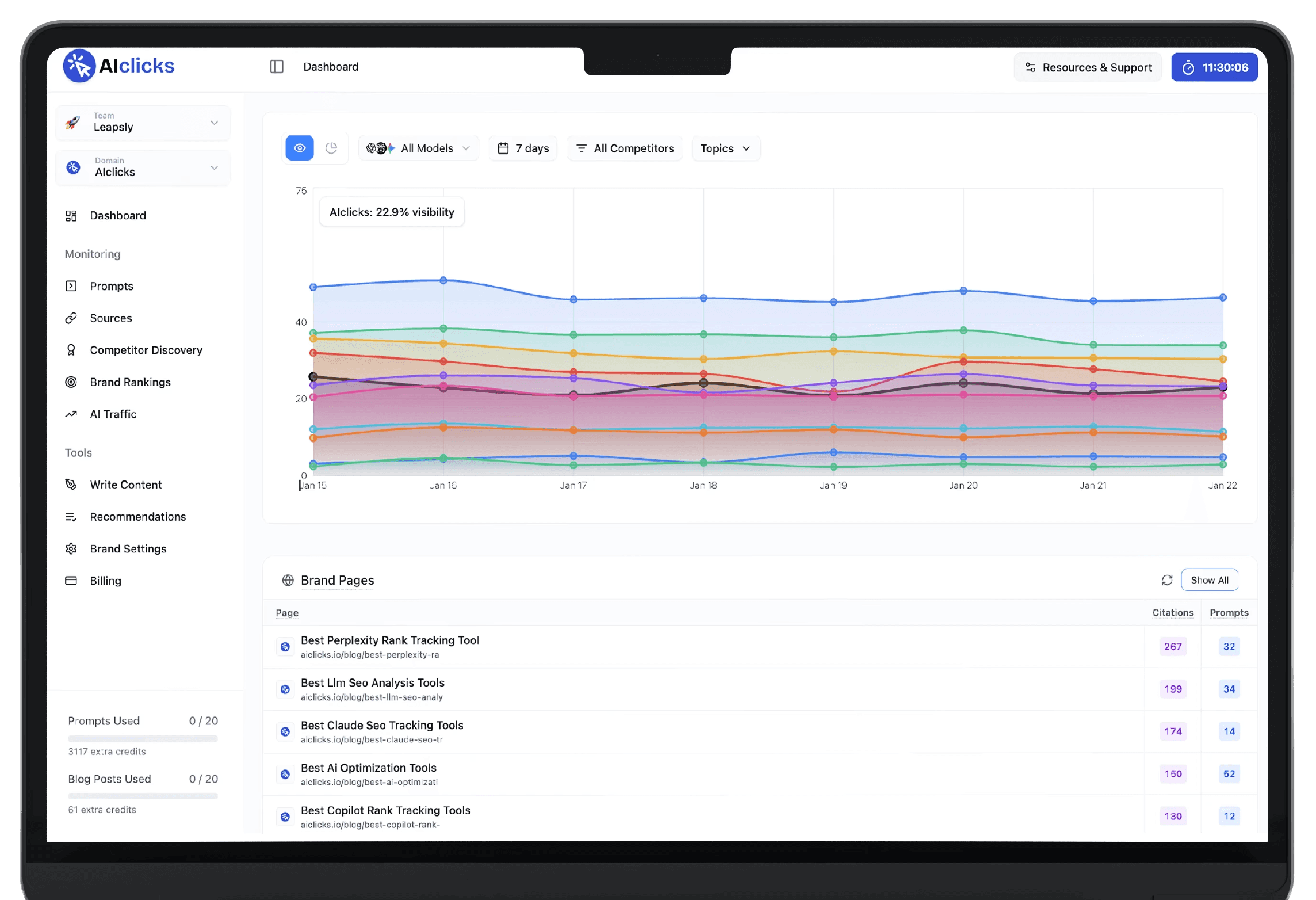
The Dashboard Your Dedicated AI Search Team Works In
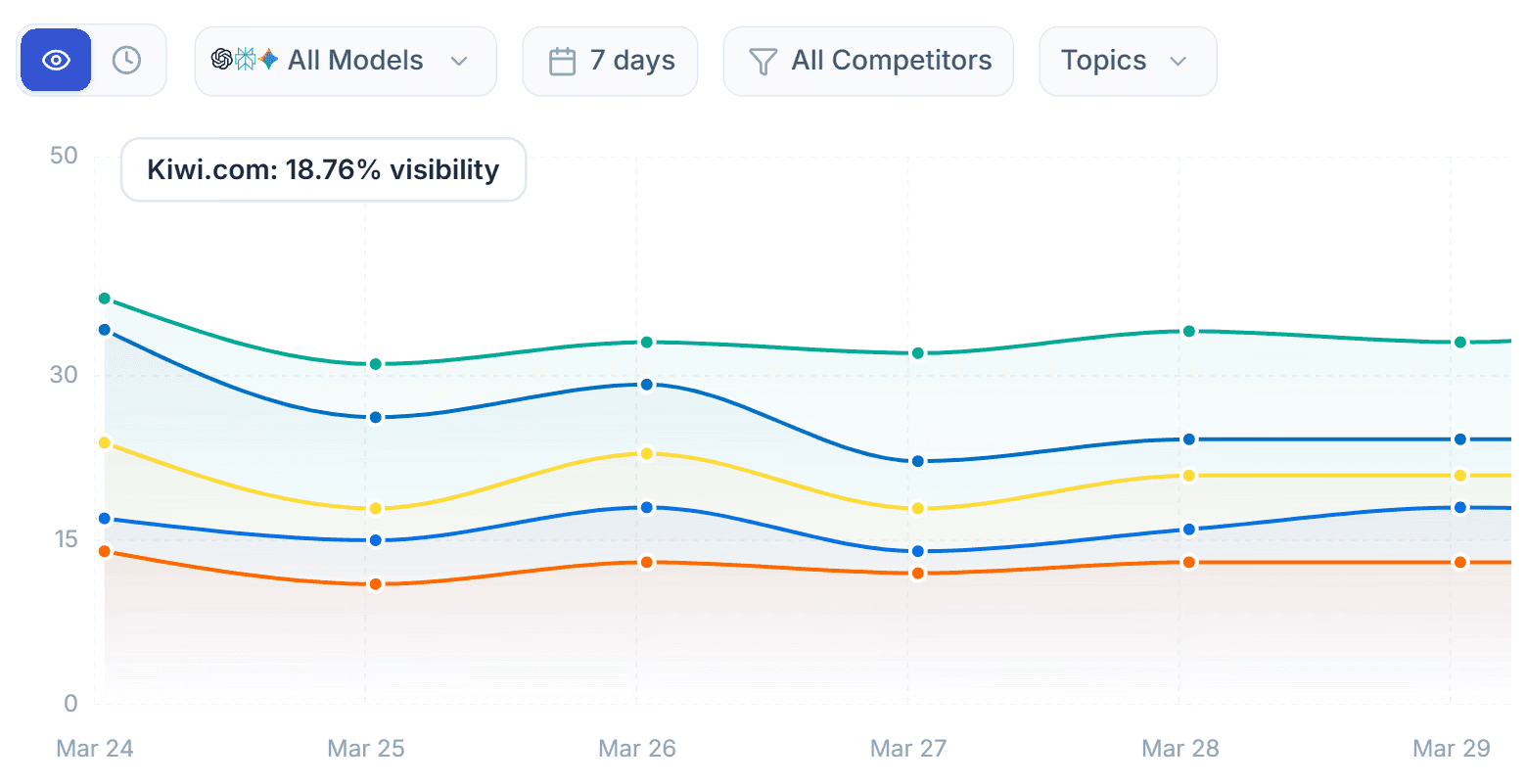
AIclicks gives you a live dashboard with daily ChatGPT mention rate, citation rate, sentiment, and share-of-voice across your tracked prompts, plus GA4 referral attribution for the traffic ChatGPT does send back.
Choose Your Plan
Flexible pricing that grows with your team. Upgrade or downgrade at any time.
Monthly
Yearly
-20%
Starter
Perfect for individuals & small teams
$49
/ month
Billed annually — you save $142
Choose 3 from:
Daily

" height="16px" id="fvSweaOBo" transform="translate(1 0)" width="14px"/></svg>)
" width="14px"><path d="M 13.864 5.629 L 13.3 5.629 L 13.3 5.6 L 7 5.6 L 7 8.4 L 10.956 8.4 C 10.379 10.03 8.828 11.2 7 11.2 C 4.681 11.2 2.8 9.319 2.8 7 C 2.8 4.681 4.681 2.8 7 2.8 C 8.071 2.8 9.045 3.204 9.786 3.864 L 11.766 1.884 C 10.516 0.719 8.844 0 7 0 C 3.134 0 0 3.134 0 7 C 0 10.866 3.134 14 7 14 C 10.866 14 14 10.866 14 7 C 14 6.531 13.952 6.073 13.864 5.629 Z" fill="rgb(255, 193, 7)" height="14px" id="H_YjfTNpn" width="14px"/><path d="M 0 3.742 L 2.3 5.429 C 2.922 3.888 4.429 2.8 6.193 2.8 C 7.264 2.8 8.238 3.204 8.979 3.864 L 10.959 1.884 C 9.709 0.719 8.037 0 6.193 0 C 3.504 0 1.172 1.518 0 3.742 Z" fill="rgb(255, 61, 0)" height="5.428500000000002px" id="PlkthQDhg" transform="translate(0.875 0)" width="10.959199999999996px"/><path d="M 6.232 5.581 C 8.04 5.581 9.683 4.889 10.925 3.764 L 8.758 1.931 C 8.032 2.483 7.144 2.782 6.232 2.781 C 4.411 2.781 2.865 1.62 2.283 0 L 0 1.759 C 1.159 4.026 3.511 5.581 6.232 5.581 Z" fill="rgb(76, 175, 80)" height="5.581099999999999px" id="WlnJ5gngE" transform="translate(0.7 8.4)" width="10.924899999999994px"/><path d="M 6.864 0.029 L 6.3 0.029 L 6.3 0 L 0 0 L 0 2.8 L 3.956 2.8 C 3.68 3.576 3.183 4.254 2.526 4.75 L 2.527 4.749 L 4.693 6.582 C 4.54 6.722 7 4.9 7 1.4 C 7 0.931 6.952 0.473 6.864 0.029 Z" fill="rgb(25, 118, 210)" height="6.589883930775992px" id="x_rSW275p" transform="translate(7 5.6)" width="7px"/></g></svg>)
" height="16px" id="hHS98fTxZ" width="16px"/></svg>)
 scale(1 1) translate(-1.861736945942159, -1.1170155383302638)" id="P20NzAvj0-699428820-radial-gradient" r="0.9935228066204626"><stop offset="0" stop-color="rgb(0, 174, 255)"/><stop offset="1" stop-color="rgb(7, 54, 196)"/></radialGradient><radialGradient cx="0.48250042504016705" cy="1.8366934653567062" gradient-transform="translate(0.48250042504016705, 1.8366934653567062) scale(1 1) translate(-0.48250042504016705, -1.8366934653567062)" id="UEWZqVjij-699428820-radial-gradient" r="0.9176890228114506"><stop offset="0" stop-color="rgb(255, 182, 87)"/><stop offset="1" stop-color="rgb(192, 43, 60)"/></radialGradient><linearGradient id="jyMN3TmKx-699428820-linear-gradient" x1="0.4594862532842614" x2="0.5405137467157386" y1="0" y2="1"><stop offset="0" stop-color="rgb(13, 145, 225)"/><stop offset="1" stop-color="rgb(255, 200, 0)"/></linearGradient><linearGradient id="xhMNwDFG0-699428820-linear-gradient" x1="0.4784828731548295" x2="0.5215171268451705" y1="5.551115123125783e-17" y2="1"><stop offset="0" stop-color="rgb(61, 203, 255)"/><stop offset="1" stop-color="rgba(5, 136, 247, 0)"/></linearGradient><radialGradient cx="1.4305090871482182" cy="0.34866158048251783" gradient-transform="translate(1.4305090871482182, 0.34866158048251783) scale(1 1) translate(-1.4305090871482182, -0.34866158048251783)" id="i79kAqaS4-699428820-radial-gradient" r="1.3362743412697924"><stop offset="0" stop-color="rgb(140, 72, 255)"/><stop offset="1" stop-color="rgb(255, 177, 82)"/></radialGradient><linearGradient id="mcxvno3tX-699428820-linear-gradient" x1="0.49844355920154226" x2="0.5015564407984577" y1="0" y2="1"><stop offset="0" stop-color="rgb(248, 173, 250)"/><stop offset="1" stop-color="rgba(168, 110, 221, 0)"/></linearGradient></defs><g d="M 11.605 1.219 C 11.397 0.499 10.739 0.002 9.989 0 L 9.498 0 C 8.682 0.002 7.985 0.588 7.842 1.391 L 7 6.016 L 7.209 5.296 C 7.416 4.574 8.075 4.076 8.825 4.074 L 11.681 4.074 L 12.879 4.545 L 14.033 4.074 L 13.697 4.074 C 12.947 4.072 12.289 3.575 12.081 2.855 Z M 4.413 13.387 C 4.618 14.111 5.278 14.611 6.031 14.613 L 7.075 14.613 C 7.988 14.613 8.735 13.88 8.758 12.96 L 8.871 8.5 L 8.633 9.319 C 8.426 10.039 7.768 10.537 7.018 10.539 L 4.138 10.539 L 3.111 9.977 L 2 10.539 L 2.331 10.539 C 3.084 10.542 3.743 11.042 3.949 11.766 L 4.413 13.387 Z M 9.999 0 L 4.167 0 C 2.501 0 1.501 2.221 0.834 4.441 C 0.045 7.073 -0.989 10.591 2.001 10.591 L 4.519 10.591 C 5.273 10.591 5.933 10.089 6.139 9.36 C 6.577 7.815 7.345 5.121 7.948 3.069 C 8.255 2.027 8.509 1.132 8.901 0.575 C 9.148 0.212 9.56 -0.004 9.999 0 M 9.999 0 L 4.167 0 C 2.501 0 1.501 2.221 0.834 4.441 C 0.045 7.073 -0.989 10.591 2.001 10.591 L 4.519 10.591 C 5.273 10.591 5.933 10.089 6.139 9.36 C 6.577 7.815 7.345 5.121 7.948 3.069 C 8.255 2.027 8.509 1.132 8.901 0.575 C 9.148 0.212 9.56 -0.004 9.999 0 M 6 14.593 L 11.833 14.593 C 13.499 14.593 14.499 12.372 15.166 10.151 C 15.955 7.519 16.989 4 13.999 4 L 11.48 4 C 10.725 4.002 10.063 4.505 9.86 5.232 C 9.266 7.332 8.663 9.429 8.051 11.523 C 7.745 12.566 7.49 13.461 7.098 14.019 C 6.851 14.382 6.439 14.597 6 14.593 M 6 14.593 L 11.833 14.593 C 13.499 14.593 14.499 12.372 15.166 10.151 C 15.955 7.519 16.989 4 13.999 4 L 11.48 4 C 10.725 4.002 10.063 4.505 9.86 5.232 C 9.266 7.332 8.663 9.429 8.051 11.523 C 7.745 12.566 7.49 13.461 7.098 14.019 C 6.851 14.382 6.439 14.597 6 14.593" fill="transparent" height="14.613333333333333px" id="QzkBy4Ibc" transform="translate(0 1)" width="16.00011071294081px"><path d="M 4.605 1.219 C 4.397 0.499 3.739 0.002 2.989 0 L 2.498 0 C 1.682 0.002 0.985 0.588 0.842 1.391 L 0 6.016 L 0.209 5.296 C 0.416 4.574 1.075 4.076 1.825 4.074 L 4.681 4.074 L 5.879 4.545 L 7.033 4.074 L 6.697 4.074 C 5.947 4.072 5.289 3.575 5.081 2.855 Z" fill="url(%23P20NzAvj0-699428820-radial-gradient)" height="6.016px" id="P20NzAvj0" transform="translate(7 0)" width="7.0333333333333385px"/><path d="M 2.413 4.887 C 2.618 5.611 3.278 6.111 4.031 6.113 L 5.075 6.113 C 5.988 6.113 6.735 5.38 6.758 4.46 L 6.871 0 L 6.633 0.819 C 6.426 1.539 5.768 2.037 5.018 2.039 L 2.138 2.039 L 1.111 1.477 L 0 2.039 L 0.331 2.039 C 1.084 2.042 1.743 2.542 1.949 3.266 L 2.413 4.887 Z" fill="url(%23UEWZqVjij-699428820-radial-gradient)" height="6.113333333333333px" id="UEWZqVjij" transform="translate(2 8.5)" width="6.871333333333332px"/><path d="M 9.999 0 L 4.167 0 C 2.501 0 1.501 2.221 0.834 4.441 C 0.045 7.073 -0.989 10.591 2.001 10.591 L 4.519 10.591 C 5.273 10.591 5.933 10.089 6.139 9.36 C 6.577 7.815 7.345 5.121 7.948 3.069 C 8.255 2.027 8.509 1.132 8.901 0.575 C 9.148 0.212 9.56 -0.004 9.999 0" fill="url(%23jyMN3TmKx-699428820-linear-gradient)" height="10.591388755215167px" id="jyMN3TmKx" width="9.999444046274142px"/><path d="M 9.999 0 L 4.167 0 C 2.501 0 1.501 2.221 0.834 4.441 C 0.045 7.073 -0.989 10.591 2.001 10.591 L 4.519 10.591 C 5.273 10.591 5.933 10.089 6.139 9.36 C 6.577 7.815 7.345 5.121 7.948 3.069 C 8.255 2.027 8.509 1.132 8.901 0.575 C 9.148 0.212 9.56 -0.004 9.999 0" fill="url(%23xhMNwDFG0-699428820-linear-gradient)" height="10.591388755215167px" id="xhMNwDFG0" width="9.999444046274142px"/><path d="M 0 10.593 L 5.833 10.593 C 7.499 10.593 8.499 8.372 9.166 6.151 C 9.955 3.519 10.989 0 7.999 0 L 5.48 0 C 4.725 0.002 4.063 0.505 3.86 1.232 C 3.266 3.332 2.663 5.429 2.051 7.523 C 1.745 8.566 1.49 9.461 1.098 10.019 C 0.851 10.382 0.439 10.597 0 10.593" fill="url(%23i79kAqaS4-699428820-radial-gradient)" height="10.593388755215164px" id="i79kAqaS4" transform="translate(6 4)" width="10.000110712940803px"/><path d="M 0 10.593 L 5.833 10.593 C 7.499 10.593 8.499 8.372 9.166 6.151 C 9.955 3.519 10.989 0 7.999 0 L 5.48 0 C 4.725 0.002 4.063 0.505 3.86 1.232 C 3.266 3.332 2.663 5.429 2.051 7.523 C 1.745 8.566 1.49 9.461 1.098 10.019 C 0.851 10.382 0.439 10.597 0 10.593" fill="url(%23mcxvno3tX-699428820-linear-gradient)" height="10.593388755215164px" id="mcxvno3tX" transform="translate(6 4)" width="10.000110712940803px"/></g></svg>)
" height="15.360666565427872px" id="HZPvvPBv7" transform="translate(0 0.5)" width="16px"/></svg>)
Tracked prompts
30
Websites you can add
3
LLMs you can track
3
Countries per project
1
LLM responses / mo
4,650
AI-optimized articles per month
10
Integrations
-
Support
Pro
For growing teams for more power
$140
/ month
Billed annually — you save $454
Choose 4 from:
Daily
Tracked prompts
150
Websites you can add
Unlimited
LLMs you can track
4
Countries per project
Unlimited
LLM responses / mo
18,600
AI-optimized articles per month
20
Integrations
Google Analytics
Support
BUSINESS
Best for medium-sized organizations
$357
/ month
Billed annually — you save $1198
Choose 6 from:
Daily
Tracked prompts
300
Websites you can add
Unlimited
LLMs you can track
6
Countries per project
Unlimited
LLM responses / mo
55,800
AI-optimized articles per month
30
Integrations
Google Analytics, API
Support
Dedicated account specialist
Become the #1 Answer in AI
Succeed in GEO yourself, or let us do all the work.
Do it yourself
Use AIclicks to see exactly where you appear across 10+ AI platforms, spot the gaps competitors are filling, and act on clear weekly recommendations.
From $59/month · Cancel anytime
Done for you
We Do All the Work for You
Our team manages your complete search presence: traditional SEO and GEO strategy, content, implementation, and reporting. You focus on collectors.
Custom pricing · Minimum 3-month engagement
The AI SEO agency trusted by 1,000+ brands worldwide
From solo founders to multi-client agencies, AIclicks runs the full AI SEO agency program for organizations of every shape and size that want to be cited across every AI surface.
4.9/5 stars on G2







FAQ
How long does SEO take to work for artists?
Individual artwork and long-tail subject pages can rank in 3 to 6 months, because almost nobody competes for them. Broad medium terms like abstract painting take 12 to 18 months, and some never come. The compounding is the point: artists who stopped uploading to print-on-demand platforms years ago still earn from listings they optimised once. Watch Search Console impressions on subject terms first; they move well before sales do.
Should I optimise for Google or for AI search?
Both, and artists are the worst placed of any trade for the second. Ahrefs analysed 863,000 keywords and found only 38% of pages cited in AI Overviews also ranked in the top 10, down from 76% a year earlier. Ranking no longer carries you into the answer. Language models read text, and an art site is mostly pixels, so a page with no written description simply cannot be quoted.
How is artist SEO different from normal local SEO?
In 3 ways. Your inventory is one of a kind, so every page is unique but also disappears when it sells, which no other local business deals with. Your best traffic source is Google Images, not the map pack, so image markup outweighs citations. And your keywords often show zero search volume in every tool, because the words buyers use for art are descriptive rather than commercial. Generic local advice covers none of that.
What should an artist budget for SEO?
Freelance help for a solo art business typically runs $500 to $1,500 a month, and a small agency $2,000 to $4,000. Compare that against what platforms already take: 35% at Saatchi Art, 50% at a physical gallery, and Etsy fees stacked on top. Clearing a retainer usually takes 2 or 3 extra direct sales a month. If the budget is zero, artwork pages and image naming cost only your time.
How does SEO fit with the ads I already run?
They cover different halves of the year. Most artists spend on Etsy or Instagram ads around a show or a holiday season, which buys attention for a week or two and then stops. Search keeps working when you are in the studio and not promoting anything. Use the ad data to pick content: whichever subjects and sizes actually converted are the collection pages worth building. Never let paid promotion substitute for having an indexable page.
Which pages should an artist build first?
Start with individual pages for the 10 pieces you would most like to sell again, written with medium, size and story. Then a commissions page with real pricing, because that is the highest-value enquiry you get. Then collection pages by subject and size. Then the about page, which is what AI assistants quote when someone asks who you are. The blog comes last, and only if you enjoy it.
How do I know if any of this is working?
Count enquiries and direct sales from organic search, not rankings. Tag your contact form by landing page so you can see which artwork page produced the message. In Search Console, split the Images tab from Web, because for most artists image impressions grow first. Watch Google Business Profile for direction requests, which is how studio visits show up. Then check whether AI assistants name you when asked about artists in your medium.
Should I do this myself or hire someone?
Do the writing yourself. Nobody else can describe a piece the way you can, and outsourced artwork descriptions read like catalogue filler that neither collectors nor language models find worth quoting. Hire out the parts that are genuinely technical: schema, migrating a lightbox gallery to real product pages, image compression, and site speed. Be careful with anyone selling art SEO packages built on generic directory submissions; the art directories that matter are all free.
Further Reading
Go deeper on GEO, AI search, and visibility tracking.