SEO for Architecture Firms:
A homeowner planning an addition spends months looking before they contact anyone: Houzz saves, Instagram screenshots, 3 firm websites open at once, and now a question typed into ChatGPT about who does this kind of work in their area. Referrals reach one of those moments.









Why Architecture Firms Need SEO
Clients research an architect for months before they call one. With more than 70,000 US architecture firms competing, being shortlisted now depends on whether Google and AI assistants can find you at all.
Most firm sites present every project inside one scrolling grid with a lightbox, so 40 completed buildings share one indexable address. Nothing about the adaptive reuse, the passive house or the hillside addition can rank on its own. The work that would win the enquiry is invisible to search.
Type residential architect near me anywhere in the US and Houzz answers first with a ranked list of 1,400 local professionals, no individual practice in sight. Yelp and the Better Business Bureau follow. Houzz Pro then charges your competitors for the sponsored slot inside that very listing.
Firms report paying about $3,000 monthly for a bundle of strategy, SEO and Instagram, and close 5% to 10% of what it produces. Industry benchmarks put marketing near 6% of revenue. Stop paying and the enquiries stop, because the retainer bought activity rather than pages that keep ranking.
How SEO Works for Architecture Firms
Search Engine Optimization projects are long-term investments for architects, where each task supplements the others and creates compound results over time.
01
Keywords, page structure, and the signals Google reads directly
On-page work is unusually hard for architecture firms because the thing being sold is visual and the medium Google reads is text. A studio will publish 30 photographs of a completed house and 11 words of caption, then wonder why a competitor with worse work ranks above it. The problem compounds when the site was designed as a portfolio object rather than a website: project titles set as image overlays, descriptions in a hover state, no headings at all. The pages that actually earn enquiries are individual project case studies, service pages split by building type, and a plainly written fees page.
Project case studies age extremely well. A page documenting a whole-house renovation, with the zoning constraint, the structural move, the schedule and the actual construction budget, keeps pulling enquiries for a decade because the next client with that problem is searching for exactly it. What churns is everything the profession loves to publish: award announcements, a new associate, conference recaps, the studio’s move to a new floor. Those hold value for about 2 weeks. Most firms invert this deliberately, treating the journal as the live part of the site and leaving project pages untouched since the photographer delivered the files.
1
Break the portfolio grid into one indexable URL per project, with a written brief, site constraint and building type in the copy.
2
Audit projects that never completed or that you would not show again; 301 them into the current building-type service page rather than deleting.
3
Mark every portfolio photograph as ImageObject with a real caption and photographer credit, and the licensed principal as Person with hasCredential.
4
Publish a fees page explaining percentage-of-construction, fixed-fee and hourly models, plus a page per design phase from schematic design through construction administration.
02
Map Pack visibility, citations, and proximity signals
Almost all residential and small commercial work is won within driving distance of the office, because the architect has to visit the site, know the building department, and sit in planning hearings. That is why searches for architects resolve into a 3-result map pack sitting over the organic results, Houzz included. A one-person studio can outrank a national platform there, which is true almost nowhere else on the page.
Make Architect the primary category, then add Architectural Designer, Home Builder or Landscape Architect only where you genuinely hold the license. List each building type you take as a separate service. Upload finished photography rather than renderings, and include the office itself so the listing reads as a real place. Answer the questions clients actually open with in the Q&A: what a first meeting costs, whether you take projects under $500,000, and how long permitting runs.
Architecture has a citation layer general local SEO never mentions. Houzz, Architizer, ArchDaily and Dezeen carry weight because editors vet what appears on them. The AIA firm directory and your state board of architecture register matter more still, because both verify licensure, and Google leans on verification. Add the USGBC directory if you hold LEED credentials and the PHIUS listing if you do passive house work. Every one needs the same firm name, suite and phone.
1
Set Architect as the primary category, list every building type as its own service entry, and upload photographs of completed work rather than renders.
2
Every registered office needs a separate profile plus a studio page naming the architects who actually sit there, since licensure runs state by state.
3
Run BrightLocal or Whitespark across Houzz, Architizer, the AIA firm directory and your state board listing, correcting every firm-name and suite variant.
4
Post one profile update a week from a live site: a framing photo, a permit approval, a room handed over.
03
Topic authority, inbound links, and content that earns traffic
Before anyone contacts an architect they are working out 3 things: whether they need one at all, what it will cost, and how long it adds to the schedule. Those exact questions sit in the People Also Ask box on every architect search, and almost no firm answers them. A page explaining when a draftsman is enough and when a licensed architect is required will out-earn any amount of design philosophy.
The client who has accepted they need an architect is now comparing studios, and what they want is evidence of similar work at similar scale. Show a project of their building type, on a site like theirs, with the budget and the timeline stated. Name the principal who will run it. Say what the first phase costs. Firms lose these enquiries at the moment a prospect cannot tell whether a $400,000 renovation is too small to bother you.
Links in architecture are earned by publication rather than outreach. ArchDaily, Dezeen, Architizer and Dwell accept project submissions, and each one links back. Award programs from the AIA chapters to the Architizer A+Awards publish winner pages with a link. Beyond that, the people you already work with will link if asked: the structural engineer, the photographer whose portfolio credits you, the contractor, the millworker, the university that lists you as an adjunct critic.
1
Publish an annual build-cost guide by building type, giving real dollar-per-square-foot ranges for new construction, renovation and additions, refreshed every year.
2
Give every building type in every area served its own page, such as accessory dwelling unit architect, covering that jurisdiction’s setback and height limits.
3
Build one fees hub answering percentage-of-construction pricing, hourly rates, feasibility study costs, and what a permit set adds to the bill.
4
Create one page per certification or system you genuinely practice in: Passive House, LEED, mass timber, historic tax credit rehabilitation.
04
Site speed, crawlability, Core Web Vitals, and mobile health
The failure specific to this profession is the portfolio built as a single-page application. Squarespace, Cargo, Webflow and Format templates load every project into one URL through JavaScript, so Search Console reports 6 indexed pages for a studio with 15 years of work. Add an intro animation, an enter-site splash and text baked into image files, and Google has almost nothing to read. The site looks immaculate and ranks for nothing but the studio’s own name.
Architectural photography is the heaviest media on the open web, and most firms upload it straight from the photographer’s delivery folder: 5,000 pixels wide, 8 megabytes, 20 to a project page. On a phone over cellular that page can take 10 seconds to paint. The client comparing 3 studios on a lunch break does not wait, and the irony is exact, because the images that lost them are the reason to hire you.
1
Crawl the site in Screaming Frog with JavaScript rendering on; if project pages do not appear as separate URLs, the portfolio is invisible.
2
Test the longest project page in PageSpeed Insights, the one carrying 30 images, and drive Largest Contentful Paint below 2.5 seconds.
3
Export photography and renderings to AVIF or WebP at display width, use srcset for retina, and lazy-load everything below the first project image.
4
Keep project and service URLs in a sitemap separate from the journal, and add an image sitemap so photography can be indexed independently.
05
Star ratings, review volume, and response strategy that builds trust
Reviews carry unusual weight here because the client is committing to an 18-month relationship and a fee in the tens of thousands with nothing built yet. They are also close to impossible to accumulate. A residential architect might finish 6 projects a year, so a decade of practice yields fewer reviews than a coffee shop collects in a month. Meanwhile Houzz and Google both rank on volume, and one dispute over a change order can sit at the top for years.
Ask at substantial completion, when the client is walking their finished building and has not yet received the final invoice. Not at project closeout, and certainly not 6 months later once the punch list has soured everything. Ask twice more across the life of a project, once after the permit is approved and once at the end of design development, because those are real milestones and the client feels them at the time.
1
Fire the review request from Monograph or BQE CORE when a phase is marked complete, signed by the project architect rather than the firm.
2
Reply inside 48 hours to scope and budget complaints by restating what the contract covered, and never blame the contractor.
3
Place the client’s words on the case study for the building they hired you to design, not in one testimonials page nobody visits.
4
Ask the contractors and engineers you work with to review the firm, since builders describe coordination and drawing quality better than homeowners.
Google is No Longer the Only Place Your clients are Searching
Clients are using AI to find answers, and they trust what it tells them. Invest in GEO to get recommended in those answers.
1 Billion
Questions ChatGPT receives every single day
38%
Your #1 top ranking page on Google would be cited by AI
14%
of architects optimise for GEO. The rest are invisible in AI answers


You can rank #1 for “architect near me” and still not exist in ChatGPT’s answer. Run a free GEO audit to see where your brand actually stands.
GEO vs SEO: Same Goal, Different Methods
GEO is wider than SEO. AI recommends the brands that show up across the sources it reads, so your presence in forums, social platforms and architectural blogs decides your odds. AIclicks measures the three metrics below so you know which to work on first.
AI Assistant
Which architect should I hire for a home addition?
Your Studio
Citation Rate
Shows how many AI answers about architecture firms name your brand, out of every 100. Models pull from the same trusted pages over and over, so citations compound: once you are in, staying in gets easier. Find the competitor pages AI cites most, then publish your own version of each.
Your Studio
82% positive
Competitor A
54% positive
Competitor B
38% positive
Brand Sentiment
Shows how AI describes you when your brand comes up: positive, neutral or negative. Tone is what separates being mentioned from being recommended, and models repeat whatever framing they find. Track the negative mentions back to the reviews and threads behind them, then publish content that answers those directly.
Others 52%
You 24%
— 24%
Your Studio
AI mention share of voice — architectural category
Competitors
Not Cited
Share of Voice in AI
Shows how much of the architectural conversation belongs to you rather than your competitors. This is the metric that matters most, the GEO version of a Google ranking. With only 1–5 brands named per answer, the market is winner-takes-more and every point is taken from someone.
The Dashboard Your Dedicated AI Search Team Works In
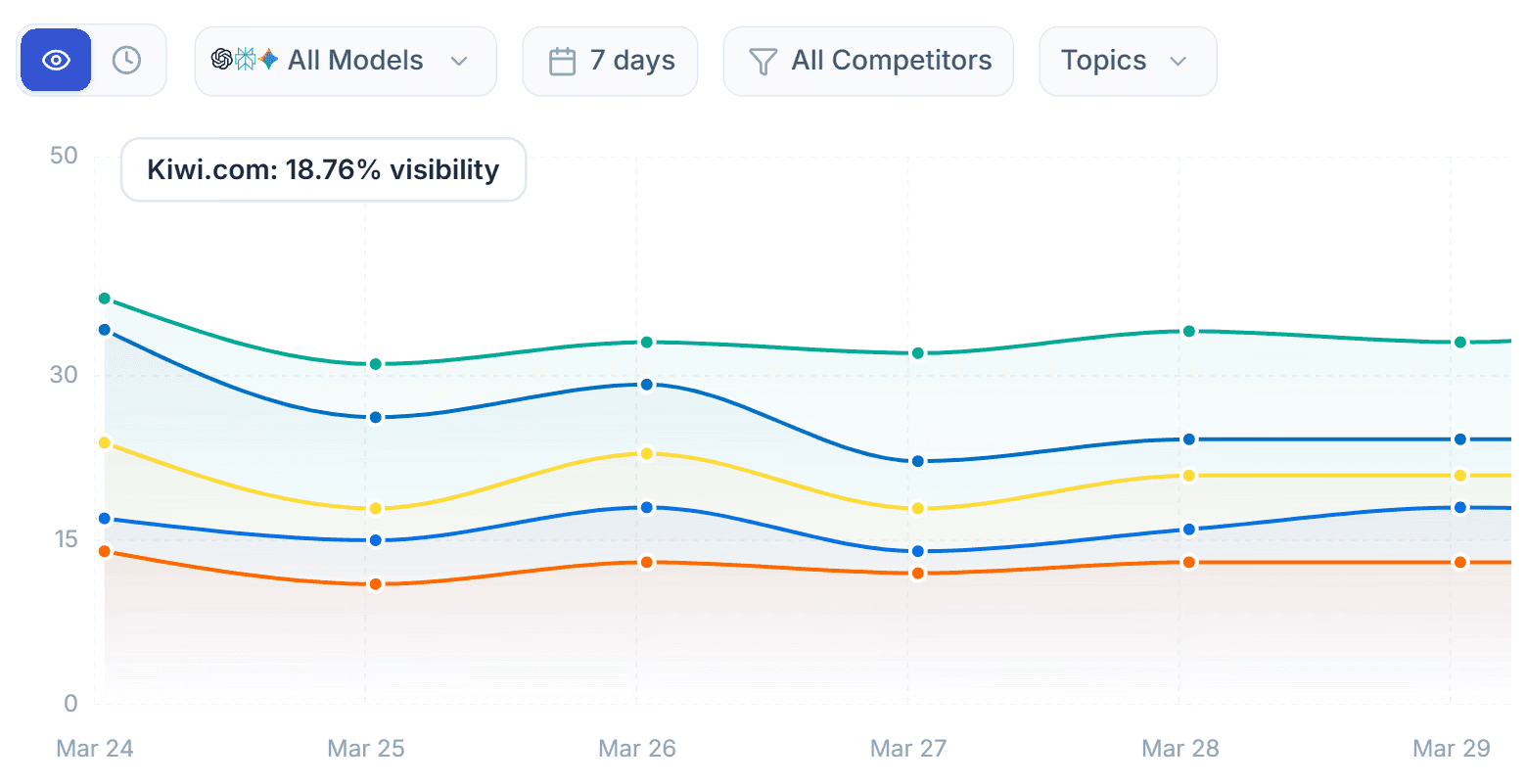
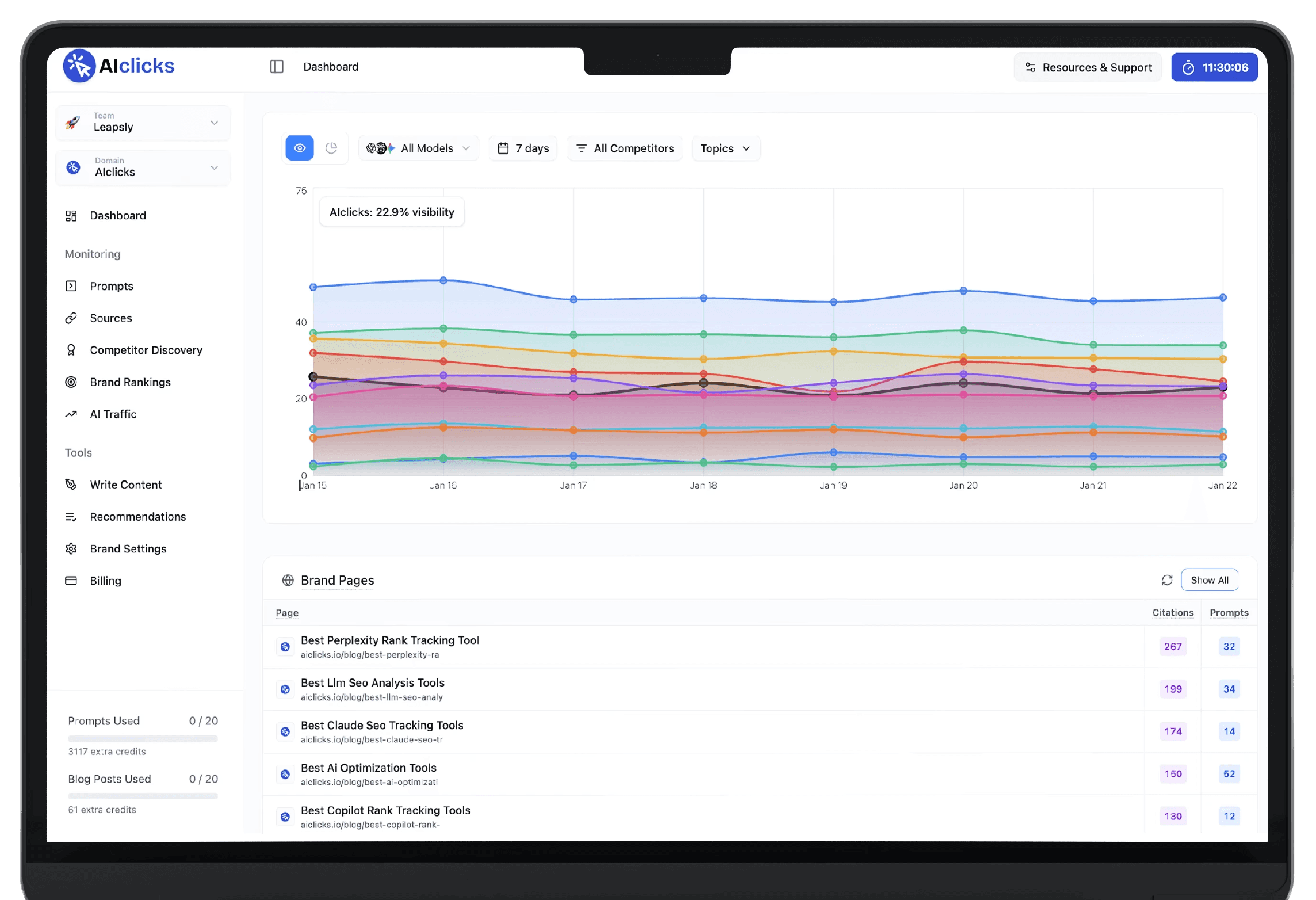
AIclicks gives you a live dashboard with daily ChatGPT mention rate, citation rate, sentiment, and share-of-voice across your tracked prompts, plus GA4 referral attribution for the traffic ChatGPT does send back.
Choose Your Plan
Flexible pricing that grows with your team. Upgrade or downgrade at any time.
Monthly
Yearly
-20%
Starter
Perfect for individuals & small teams
$49
/ month
Billed annually — you save $142
Choose 3 from:
Daily

" height="16px" id="fvSweaOBo" transform="translate(1 0)" width="14px"/></svg>)
" width="14px"><path d="M 13.864 5.629 L 13.3 5.629 L 13.3 5.6 L 7 5.6 L 7 8.4 L 10.956 8.4 C 10.379 10.03 8.828 11.2 7 11.2 C 4.681 11.2 2.8 9.319 2.8 7 C 2.8 4.681 4.681 2.8 7 2.8 C 8.071 2.8 9.045 3.204 9.786 3.864 L 11.766 1.884 C 10.516 0.719 8.844 0 7 0 C 3.134 0 0 3.134 0 7 C 0 10.866 3.134 14 7 14 C 10.866 14 14 10.866 14 7 C 14 6.531 13.952 6.073 13.864 5.629 Z" fill="rgb(255, 193, 7)" height="14px" id="H_YjfTNpn" width="14px"/><path d="M 0 3.742 L 2.3 5.429 C 2.922 3.888 4.429 2.8 6.193 2.8 C 7.264 2.8 8.238 3.204 8.979 3.864 L 10.959 1.884 C 9.709 0.719 8.037 0 6.193 0 C 3.504 0 1.172 1.518 0 3.742 Z" fill="rgb(255, 61, 0)" height="5.428500000000002px" id="PlkthQDhg" transform="translate(0.875 0)" width="10.959199999999996px"/><path d="M 6.232 5.581 C 8.04 5.581 9.683 4.889 10.925 3.764 L 8.758 1.931 C 8.032 2.483 7.144 2.782 6.232 2.781 C 4.411 2.781 2.865 1.62 2.283 0 L 0 1.759 C 1.159 4.026 3.511 5.581 6.232 5.581 Z" fill="rgb(76, 175, 80)" height="5.581099999999999px" id="WlnJ5gngE" transform="translate(0.7 8.4)" width="10.924899999999994px"/><path d="M 6.864 0.029 L 6.3 0.029 L 6.3 0 L 0 0 L 0 2.8 L 3.956 2.8 C 3.68 3.576 3.183 4.254 2.526 4.75 L 2.527 4.749 L 4.693 6.582 C 4.54 6.722 7 4.9 7 1.4 C 7 0.931 6.952 0.473 6.864 0.029 Z" fill="rgb(25, 118, 210)" height="6.589883930775992px" id="x_rSW275p" transform="translate(7 5.6)" width="7px"/></g></svg>)
" height="16px" id="hHS98fTxZ" width="16px"/></svg>)
 scale(1 1) translate(-1.861736945942159, -1.1170155383302638)" id="P20NzAvj0-699428820-radial-gradient" r="0.9935228066204626"><stop offset="0" stop-color="rgb(0, 174, 255)"/><stop offset="1" stop-color="rgb(7, 54, 196)"/></radialGradient><radialGradient cx="0.48250042504016705" cy="1.8366934653567062" gradient-transform="translate(0.48250042504016705, 1.8366934653567062) scale(1 1) translate(-0.48250042504016705, -1.8366934653567062)" id="UEWZqVjij-699428820-radial-gradient" r="0.9176890228114506"><stop offset="0" stop-color="rgb(255, 182, 87)"/><stop offset="1" stop-color="rgb(192, 43, 60)"/></radialGradient><linearGradient id="jyMN3TmKx-699428820-linear-gradient" x1="0.4594862532842614" x2="0.5405137467157386" y1="0" y2="1"><stop offset="0" stop-color="rgb(13, 145, 225)"/><stop offset="1" stop-color="rgb(255, 200, 0)"/></linearGradient><linearGradient id="xhMNwDFG0-699428820-linear-gradient" x1="0.4784828731548295" x2="0.5215171268451705" y1="5.551115123125783e-17" y2="1"><stop offset="0" stop-color="rgb(61, 203, 255)"/><stop offset="1" stop-color="rgba(5, 136, 247, 0)"/></linearGradient><radialGradient cx="1.4305090871482182" cy="0.34866158048251783" gradient-transform="translate(1.4305090871482182, 0.34866158048251783) scale(1 1) translate(-1.4305090871482182, -0.34866158048251783)" id="i79kAqaS4-699428820-radial-gradient" r="1.3362743412697924"><stop offset="0" stop-color="rgb(140, 72, 255)"/><stop offset="1" stop-color="rgb(255, 177, 82)"/></radialGradient><linearGradient id="mcxvno3tX-699428820-linear-gradient" x1="0.49844355920154226" x2="0.5015564407984577" y1="0" y2="1"><stop offset="0" stop-color="rgb(248, 173, 250)"/><stop offset="1" stop-color="rgba(168, 110, 221, 0)"/></linearGradient></defs><g d="M 11.605 1.219 C 11.397 0.499 10.739 0.002 9.989 0 L 9.498 0 C 8.682 0.002 7.985 0.588 7.842 1.391 L 7 6.016 L 7.209 5.296 C 7.416 4.574 8.075 4.076 8.825 4.074 L 11.681 4.074 L 12.879 4.545 L 14.033 4.074 L 13.697 4.074 C 12.947 4.072 12.289 3.575 12.081 2.855 Z M 4.413 13.387 C 4.618 14.111 5.278 14.611 6.031 14.613 L 7.075 14.613 C 7.988 14.613 8.735 13.88 8.758 12.96 L 8.871 8.5 L 8.633 9.319 C 8.426 10.039 7.768 10.537 7.018 10.539 L 4.138 10.539 L 3.111 9.977 L 2 10.539 L 2.331 10.539 C 3.084 10.542 3.743 11.042 3.949 11.766 L 4.413 13.387 Z M 9.999 0 L 4.167 0 C 2.501 0 1.501 2.221 0.834 4.441 C 0.045 7.073 -0.989 10.591 2.001 10.591 L 4.519 10.591 C 5.273 10.591 5.933 10.089 6.139 9.36 C 6.577 7.815 7.345 5.121 7.948 3.069 C 8.255 2.027 8.509 1.132 8.901 0.575 C 9.148 0.212 9.56 -0.004 9.999 0 M 9.999 0 L 4.167 0 C 2.501 0 1.501 2.221 0.834 4.441 C 0.045 7.073 -0.989 10.591 2.001 10.591 L 4.519 10.591 C 5.273 10.591 5.933 10.089 6.139 9.36 C 6.577 7.815 7.345 5.121 7.948 3.069 C 8.255 2.027 8.509 1.132 8.901 0.575 C 9.148 0.212 9.56 -0.004 9.999 0 M 6 14.593 L 11.833 14.593 C 13.499 14.593 14.499 12.372 15.166 10.151 C 15.955 7.519 16.989 4 13.999 4 L 11.48 4 C 10.725 4.002 10.063 4.505 9.86 5.232 C 9.266 7.332 8.663 9.429 8.051 11.523 C 7.745 12.566 7.49 13.461 7.098 14.019 C 6.851 14.382 6.439 14.597 6 14.593 M 6 14.593 L 11.833 14.593 C 13.499 14.593 14.499 12.372 15.166 10.151 C 15.955 7.519 16.989 4 13.999 4 L 11.48 4 C 10.725 4.002 10.063 4.505 9.86 5.232 C 9.266 7.332 8.663 9.429 8.051 11.523 C 7.745 12.566 7.49 13.461 7.098 14.019 C 6.851 14.382 6.439 14.597 6 14.593" fill="transparent" height="14.613333333333333px" id="QzkBy4Ibc" transform="translate(0 1)" width="16.00011071294081px"><path d="M 4.605 1.219 C 4.397 0.499 3.739 0.002 2.989 0 L 2.498 0 C 1.682 0.002 0.985 0.588 0.842 1.391 L 0 6.016 L 0.209 5.296 C 0.416 4.574 1.075 4.076 1.825 4.074 L 4.681 4.074 L 5.879 4.545 L 7.033 4.074 L 6.697 4.074 C 5.947 4.072 5.289 3.575 5.081 2.855 Z" fill="url(%23P20NzAvj0-699428820-radial-gradient)" height="6.016px" id="P20NzAvj0" transform="translate(7 0)" width="7.0333333333333385px"/><path d="M 2.413 4.887 C 2.618 5.611 3.278 6.111 4.031 6.113 L 5.075 6.113 C 5.988 6.113 6.735 5.38 6.758 4.46 L 6.871 0 L 6.633 0.819 C 6.426 1.539 5.768 2.037 5.018 2.039 L 2.138 2.039 L 1.111 1.477 L 0 2.039 L 0.331 2.039 C 1.084 2.042 1.743 2.542 1.949 3.266 L 2.413 4.887 Z" fill="url(%23UEWZqVjij-699428820-radial-gradient)" height="6.113333333333333px" id="UEWZqVjij" transform="translate(2 8.5)" width="6.871333333333332px"/><path d="M 9.999 0 L 4.167 0 C 2.501 0 1.501 2.221 0.834 4.441 C 0.045 7.073 -0.989 10.591 2.001 10.591 L 4.519 10.591 C 5.273 10.591 5.933 10.089 6.139 9.36 C 6.577 7.815 7.345 5.121 7.948 3.069 C 8.255 2.027 8.509 1.132 8.901 0.575 C 9.148 0.212 9.56 -0.004 9.999 0" fill="url(%23jyMN3TmKx-699428820-linear-gradient)" height="10.591388755215167px" id="jyMN3TmKx" width="9.999444046274142px"/><path d="M 9.999 0 L 4.167 0 C 2.501 0 1.501 2.221 0.834 4.441 C 0.045 7.073 -0.989 10.591 2.001 10.591 L 4.519 10.591 C 5.273 10.591 5.933 10.089 6.139 9.36 C 6.577 7.815 7.345 5.121 7.948 3.069 C 8.255 2.027 8.509 1.132 8.901 0.575 C 9.148 0.212 9.56 -0.004 9.999 0" fill="url(%23xhMNwDFG0-699428820-linear-gradient)" height="10.591388755215167px" id="xhMNwDFG0" width="9.999444046274142px"/><path d="M 0 10.593 L 5.833 10.593 C 7.499 10.593 8.499 8.372 9.166 6.151 C 9.955 3.519 10.989 0 7.999 0 L 5.48 0 C 4.725 0.002 4.063 0.505 3.86 1.232 C 3.266 3.332 2.663 5.429 2.051 7.523 C 1.745 8.566 1.49 9.461 1.098 10.019 C 0.851 10.382 0.439 10.597 0 10.593" fill="url(%23i79kAqaS4-699428820-radial-gradient)" height="10.593388755215164px" id="i79kAqaS4" transform="translate(6 4)" width="10.000110712940803px"/><path d="M 0 10.593 L 5.833 10.593 C 7.499 10.593 8.499 8.372 9.166 6.151 C 9.955 3.519 10.989 0 7.999 0 L 5.48 0 C 4.725 0.002 4.063 0.505 3.86 1.232 C 3.266 3.332 2.663 5.429 2.051 7.523 C 1.745 8.566 1.49 9.461 1.098 10.019 C 0.851 10.382 0.439 10.597 0 10.593" fill="url(%23mcxvno3tX-699428820-linear-gradient)" height="10.593388755215164px" id="mcxvno3tX" transform="translate(6 4)" width="10.000110712940803px"/></g></svg>)
" height="15.360666565427872px" id="HZPvvPBv7" transform="translate(0 0.5)" width="16px"/></svg>)
Tracked prompts
30
Websites you can add
3
LLMs you can track
3
Countries per project
1
LLM responses / mo
4,650
AI-optimized articles per month
10
Integrations
-
Support
Pro
For growing teams for more power
$140
/ month
Billed annually — you save $454
Choose 4 from:
Daily
Tracked prompts
150
Websites you can add
Unlimited
LLMs you can track
4
Countries per project
Unlimited
LLM responses / mo
18,600
AI-optimized articles per month
20
Integrations
Google Analytics
Support
BUSINESS
Best for medium-sized organizations
$357
/ month
Billed annually — you save $1198
Choose 6 from:
Daily
Tracked prompts
300
Websites you can add
Unlimited
LLMs you can track
6
Countries per project
Unlimited
LLM responses / mo
55,800
AI-optimized articles per month
30
Integrations
Google Analytics, API
Support
Dedicated account specialist
Become the #1 Answer in AI
Succeed in GEO yourself, or let us do all the work.
Do it yourself
Use AIclicks to see exactly where you appear across 10+ AI platforms, spot the gaps competitors are filling, and act on clear weekly recommendations.
From $59/month · Cancel anytime
Done for you
We Do All the Work for You
Our team manages your complete search presence: traditional SEO and GEO strategy, content, implementation, and reporting. You focus on clients.
Custom pricing · Minimum 3-month engagement
The AI SEO agency trusted by 1,000+ brands worldwide
From solo founders to multi-client agencies, AIclicks runs the full AI SEO agency program for organizations of every shape and size that want to be cited across every AI surface.
4.9/5 stars on G2







FAQ
How soon will an architecture firm see results?
Map pack and profile movement usually shows in 2 to 4 months; organic rankings for building-type and city terms land around 6 to 12. Agencies consistently quote 3 to 6 months as the point where results become visible, and that matches what happens when a firm finally gets project pages indexed. Long sales cycles stretch it further: a client who finds you in March may not sign until fall.
Do we need to worry about ChatGPT as well as Google?
Yes, and for architecture the gap is wider than most trades. Ahrefs examined 863,000 keywords and found only 38% of pages cited in AI Overviews also ranked in the top 10, down from 76% a year earlier. A top-10 position no longer buys you a place in the answer. Worse, your differentiation lives in photographs, and no model can read an image. Whatever is not written down cannot be quoted.
Why is architecture SEO different from other trades?
Three things. Your product is visual, so the assets that win the job are the assets search engines cannot read, and the fix is written case studies rather than bigger galleries. Your sales cycle runs months to years, so lead attribution has to survive that gap. And you are licensed, which means directories that verify registration, the state board and the AIA among them, carry weight that a Yelp listing never will.
What should a small architecture firm spend on SEO?
Published rates for the profession sit around $1,500 to $5,000 a month for managed work, and firms on Reddit report roughly $3,000 monthly for a bundle of SEO, strategy and Instagram. Benchmarks put total marketing near 6% of revenue, with local search taking about 30% of the digital half. Judge it against fee income: one additional residential commission usually covers a year of it.
Is Google Ads worth it alongside SEO for architects?
Usually less than you would expect. Architecture has low search volume and long consideration, so paid clicks arrive from people who are still 8 months from signing anything. Most firms get more from Houzz Pro placement and remarketing than from broad search ads. Where ads do earn their keep is testing: run them briefly on a building type you want more of, and let the conversion data decide which page to write next.
Which pages should an architecture firm build first?
The Google Business Profile comes before anything else; it costs nothing and outranks the whole page. Then split the portfolio so your 10 strongest projects each have their own URL and 300 words of real description. Then a fees page, which is the single most searched thing about your profession and the one almost nobody publishes. Then building-type service pages. Leave the journal until last, and write it only where clients keep asking the same question.
How do we know the SEO work is paying off?
Count enquiries that turn into paid feasibility work, not rankings. Architecture leads arrive by contact form and phone months apart, so tag every form by landing page and add call tracking, or the phone enquiries vanish entirely. Watch Search Console impressions on building-type terms, which move before positions do. Reconcile the total against your practice management system: proposals sent and projects opened are the only honest numbers.
Should we handle this ourselves or hire someone?
Split it by who holds the knowledge. Nobody outside the studio can write a project case study properly, because the interesting part is the constraint you solved, and that only exists in the project architect’s head. Keep the writing, the photography briefs and the review asks internal. Outsource the crawl fixes, schema, image pipeline and directory cleanup. If you hire out, ask the agency to show you an architecture site they made indexable.
Further Reading
Go deeper on GEO, AI search, and visibility tracking.