SEO for Accounting Firms:
A business owner looking for a new accountant does it once, usually in January, and usually under pressure. They compare 3 firms, read reviews, then ask ChatGPT which one handles S-corps. Whoever appears in that window keeps the client for years.









Why Accounting Firms Need SEO
Google now answers a growing share of accounting questions itself, and answers about money get hedged, sourced and filtered harder than almost any other category before a firm ever gets named.
Firms organise their sites the way they organise their org chart: Tax, Assurance, Advisory, Bookkeeping. Nobody types that. They type QuickBooks cleanup, S-corp election, late 1099 penalty, or first year LLC taxes. Each is a page you never wrote, and a competitor already owns the answer.
In a US city, the query cpa near me returns the Better Business Bureau, Yelp and your state CPA society’s find-a-CPA page above most individual firms. Xero and Intuit rank their own advisor directories too. You appear inside somebody else’s listing, ranked by criteria you do not control.
Firms bid against national tax brands for terms like cpa near me, where clicks routinely run $15 to $50 in filing season, then buy lead-gen placements on top. Website vendors bundle SEO at $200 to $500 a month and syndicate the same tax articles to every client. Nothing you own gets built.
How SEO Works for Accounting Firms
Search Engine Optimization projects are long-term investments for accountants, where each task supplements the others and creates compound results over time.
01
Keywords, page structure, and the signals Google reads directly
Accounting sites fail on-page for a reason most industries do not share. Google classes tax and financial guidance as YMYL, Your Money or Your Life, and holds it to a stricter standard before ranking anything. A page with no named author, no licence detail and no review date reads as unaccountable, and unaccountable financial advice does not rank. The pages carrying the weight are your individual service pages, one per problem a client actually has, plus team bios showing credentials, state licence numbers and the years each person has been practising. The blog is not where the money is.
What holds value is content built around a situation instead of a tax year. An explainer on when an LLC should elect S-corp treatment, or what actually happens during an IRS correspondence audit, still pulls enquiries 4 years from now, because the mechanics move slowly. What churns is anything with a year in the title: deadline round-ups, contribution limit tables, credit explainers written the week a bill passed. Most firms publish a fresh set every January and never retire the last one, so the archive grows faster than the useful content and quietly competes with it.
1
Break the services page apart into one page per client situation: S-corp election, QuickBooks cleanup, late payroll filings, first-year LLC returns.
2
Each January, 301 last year’s deadline and limit pages into a single evergreen page you update, rather than publishing a fresh set.
3
Mark the firm up with AccountingService schema, each CPA bio with Person including their licence, and question blocks with FAQPage.
4
Build a page per entity type and per client industry, such as S-corp, partnership, restaurant bookkeeping or contractor payroll, since demand runs year-round.
02
Map Pack visibility, citations, and proximity signals
Almost nobody hires an accountant they found nationally. Even fully remote firms win on proximity signals, because clients search cpa near me and Google answers with a map. The 3-result pack sits above the Better Business Bureau, above Yelp, above every state society directory, and it is the only place a two-partner firm outranks all of them. Proximity you cannot change; completeness and reviews you can.
Make Certified Public Accountant the primary category if you hold the licence, or Tax Preparation Service if you do not, then add bookkeeping, payroll and business consultant as secondaries. List every service separately with its own description. Publish real filing-season hours, including Saturdays, and change them back in May. Answer up front the questions that decide the call: whether you take individual returns, minimum fees, which software you work in, and whether you handle multi-state.
Accounting has a credential layer general local SEO never mentions. The IRS Directory of Federal Tax Return Preparers lists every PTIN holder with credentials, CPAverify carries your licence status from the state boards, and your state society’s find-a-CPA page is a genuine referral channel. Add the QuickBooks ProAdvisor and Xero advisor directories, the Better Business Bureau, and your chamber. All of them verify something, which is why one mismatched suite number across them costs more here than elsewhere.
1
Pick Certified Public Accountant for the primary category, list every service as its own entry with a description, and load genuine filing-season hours.
2
Set up a separate profile and a separate page per location, naming the partners actually based there, and never list a virtual mailbox.
3
Check your entry on CPAverify, the IRS preparer directory, your state society listing and Find-a-ProAdvisor, then correct any name, suite or phone mismatch.
4
Publish a profile update every week anchored to the next filing or payment deadline, so the listing reads as actively worked rather than abandoned.
03
Topic authority, inbound links, and content that earns traffic
Someone weighing up an accountant is working through 2 questions before they book anything: whether their situation genuinely needs a professional, and roughly what it will cost. Content that answers those honestly beats anything written for rankings. A plain page on when a bookkeeper stops being enough, or what an S-corp election actually saves at different profit levels, does more work than 20 posts about tax planning tips.
A prospect who has already decided to change firms is now comparing, and switching is the friction. They want to know who will actually handle the file rather than the partner on the homepage, what onboarding looks like mid-year, whether you pull records from the previous preparer, and what a return like theirs costs. Publish the fee ranges. Most firms lose this prospect precisely because no number appears anywhere on the site.
Links in accounting come from the referral network you already have. The attorneys, financial advisers and insurance brokers you trade referrals with all publish trusted-adviser pages. Software vendors list certified partners and run partner spotlights. State societies and the AICPA link speakers, committee members and continuing-education instructors. Small business development centres and chambers publish workshop pages naming whoever taught the session. Teaching one free class a quarter earns more links than any outreach campaign.
1
Publish a yearly comparison of doing it yourself, using tax software, and hiring a firm, with the real fee ranges for each.
2
Create one landing page per client niche you genuinely serve, such as dental practice bookkeeping or e-commerce sales tax, with numbers from real engagements.
3
Answer the pricing question directly on one page: hourly rates, fixed-fee packages, monthly retainers, and what a typical return costs by complexity.
4
Give each platform you hold certification in its own page, including QuickBooks Online, Xero, Gusto and NetSuite, because clients search software names first.
04
Site speed, crawlability, Core Web Vitals, and mobile health
The failure specific to accounting sites is the tax-year archive. Every January a new set of deadline, limit and credit pages goes up, and the previous set stays indexed. After 6 years the site has 6 near-identical pages on standard deduction amounts, and Google picks one, usually the oldest because it has the most links. Prospects land on numbers that were wrong 2 filing seasons ago, and nobody inside the firm ever sees it.
The moment that matters is a small business owner on a phone at 11 at night in April, 4 days from a deadline, working through a list of firms. They want a number and a sentence confirming you take new clients this late. If a client-portal login widget loads before the contact details, or the phone number sits inside a header image, they are gone. Filing-season traffic is impatient in a way January traffic is not.
1
Filter Screaming Frog output for URLs containing a year, then consolidate every duplicated deadline or contribution-limit page into one page you update.
2
Test the pages carrying your client portal login in PageSpeed Insights, since that embedded script is usually the slowest thing loading.
3
Stop serving tax organisers and checklists as 8 megabyte scanned PDFs; publish them as HTML pages that rank and compress the downloads.
4
Split the XML sitemap so service and niche pages sit apart from dated tax posts, and resubmit it the day new-season figures go live.
05
Star ratings, review volume, and response strategy that builds trust
Reviews decide accounting searches because the buyer cannot evaluate the work. They will never know whether the return was optimal, only whether you were reachable, clear and on time, and a star rating is all the evidence they get. Collecting them is awkward for 2 reasons: money conversations rarely end in delight, and the client who most wants to write something is usually the one who got a bill they did not expect.
Ask the day the return is accepted or the refund lands, not at year end when the relief has worn off. That is a status change in Drake, Lacerte or UltraTax, so the request can fire on it automatically, signed by the preparer who did the work rather than the firm. Keep it to a sentence and a link. Ask on every engagement, including the $300 individual returns, or the profile reads as curated.
1
Have TaxDome, Karbon or Canopy fire a review request when a return is marked accepted, sent from the preparer rather than the firm.
2
Answer inside a day, and never confirm the reviewer was a client, because Circular 230 and state board confidentiality rules bind you whatever they posted.
3
Place payroll reviews on the payroll page and audit-representation reviews on that page, so proof sits next to the service being considered.
4
Collect reviews after monthly bookkeeping closes and payroll runs too, not only after returns, so the profile gains stars in the quiet months.
Google is No Longer the Only Place Your clients are Searching
Clients are using AI to find answers, and they trust what it tells them. Invest in GEO to get recommended in those answers.
1 Billion
Questions ChatGPT receives every single day
38%
Your #1 top ranking page on Google would be cited by AI
14%
of accountants optimise for GEO. The rest are invisible in AI answers


You can rank #1 for “accountant near me” and still not exist in ChatGPT’s answer. Run a free GEO audit to see where your brand actually stands.
GEO vs SEO: Same Goal, Different Methods
GEO is wider than SEO. AI recommends the brands that show up across the sources it reads, so your presence in forums, social platforms and accounting blogs decides your odds. AIclicks measures the three metrics below so you know which to work on first.
AI Assistant
Which accountant should I use for my small business?
Your CPA Firm
Citation Rate
Shows how many AI answers about accounting firms name your brand, out of every 100. Models pull from the same trusted pages over and over, so citations compound: once you are in, staying in gets easier. Find the competitor pages AI cites most, then publish your own version of each.
Your CPA Firm
82% positive
Competitor A
54% positive
Competitor B
38% positive
Brand Sentiment
Shows how AI describes you when your brand comes up: positive, neutral or negative. Tone is what separates being mentioned from being recommended, and models repeat whatever framing they find. Track the negative mentions back to the reviews and threads behind them, then publish content that answers those directly.
Others 52%
You 24%
— 24%
Your CPA Firm
AI mention share of voice — accounting category
Competitors
Not Cited
Share of Voice in AI
Shows how much of the accounting conversation belongs to you rather than your competitors. This is the metric that matters most, the GEO version of a Google ranking. With only 1–5 brands named per answer, the market is winner-takes-more and every point is taken from someone.
The Dashboard Your Dedicated AI Search Team Works In
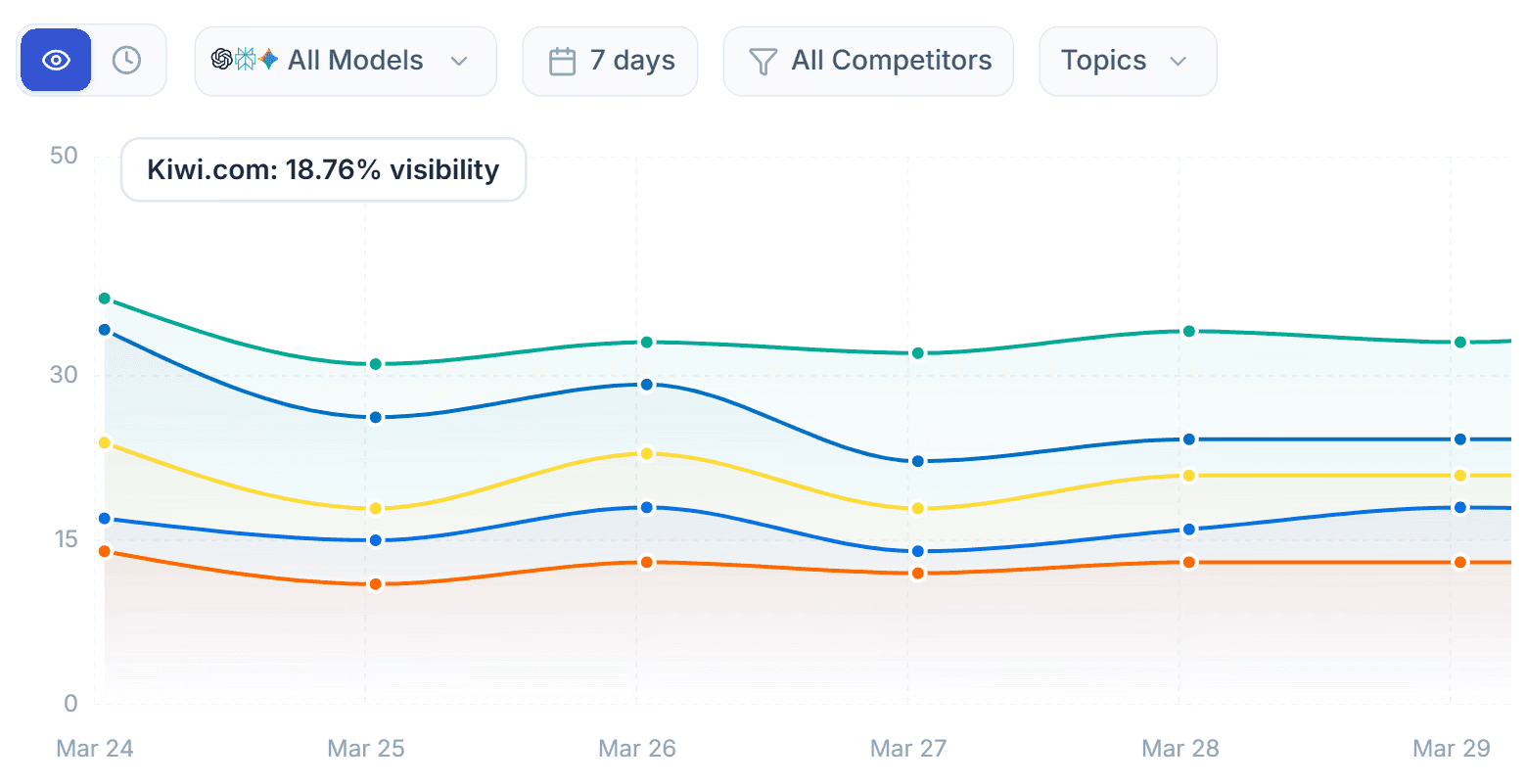
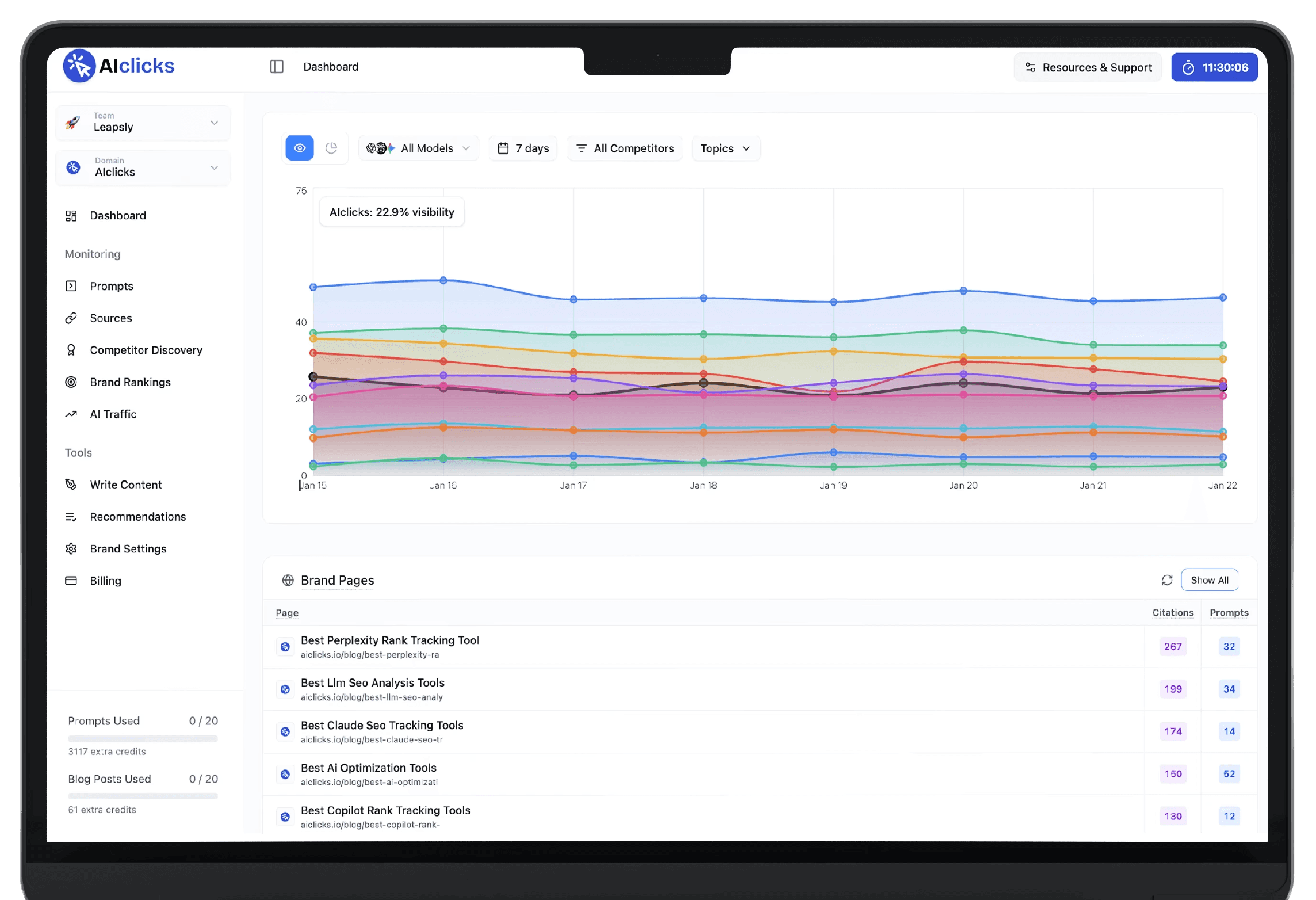
AIclicks gives you a live dashboard with daily ChatGPT mention rate, citation rate, sentiment, and share-of-voice across your tracked prompts, plus GA4 referral attribution for the traffic ChatGPT does send back.
Choose Your Plan
Flexible pricing that grows with your team. Upgrade or downgrade at any time.
Monthly
Yearly
-20%
Starter
Perfect for individuals & small teams
$49
/ month
Billed annually — you save $142
Choose 3 from:
Daily

" height="16px" id="fvSweaOBo" transform="translate(1 0)" width="14px"/></svg>)
" width="14px"><path d="M 13.864 5.629 L 13.3 5.629 L 13.3 5.6 L 7 5.6 L 7 8.4 L 10.956 8.4 C 10.379 10.03 8.828 11.2 7 11.2 C 4.681 11.2 2.8 9.319 2.8 7 C 2.8 4.681 4.681 2.8 7 2.8 C 8.071 2.8 9.045 3.204 9.786 3.864 L 11.766 1.884 C 10.516 0.719 8.844 0 7 0 C 3.134 0 0 3.134 0 7 C 0 10.866 3.134 14 7 14 C 10.866 14 14 10.866 14 7 C 14 6.531 13.952 6.073 13.864 5.629 Z" fill="rgb(255, 193, 7)" height="14px" id="H_YjfTNpn" width="14px"/><path d="M 0 3.742 L 2.3 5.429 C 2.922 3.888 4.429 2.8 6.193 2.8 C 7.264 2.8 8.238 3.204 8.979 3.864 L 10.959 1.884 C 9.709 0.719 8.037 0 6.193 0 C 3.504 0 1.172 1.518 0 3.742 Z" fill="rgb(255, 61, 0)" height="5.428500000000002px" id="PlkthQDhg" transform="translate(0.875 0)" width="10.959199999999996px"/><path d="M 6.232 5.581 C 8.04 5.581 9.683 4.889 10.925 3.764 L 8.758 1.931 C 8.032 2.483 7.144 2.782 6.232 2.781 C 4.411 2.781 2.865 1.62 2.283 0 L 0 1.759 C 1.159 4.026 3.511 5.581 6.232 5.581 Z" fill="rgb(76, 175, 80)" height="5.581099999999999px" id="WlnJ5gngE" transform="translate(0.7 8.4)" width="10.924899999999994px"/><path d="M 6.864 0.029 L 6.3 0.029 L 6.3 0 L 0 0 L 0 2.8 L 3.956 2.8 C 3.68 3.576 3.183 4.254 2.526 4.75 L 2.527 4.749 L 4.693 6.582 C 4.54 6.722 7 4.9 7 1.4 C 7 0.931 6.952 0.473 6.864 0.029 Z" fill="rgb(25, 118, 210)" height="6.589883930775992px" id="x_rSW275p" transform="translate(7 5.6)" width="7px"/></g></svg>)
" height="16px" id="hHS98fTxZ" width="16px"/></svg>)
 scale(1 1) translate(-1.861736945942159, -1.1170155383302638)" id="P20NzAvj0-699428820-radial-gradient" r="0.9935228066204626"><stop offset="0" stop-color="rgb(0, 174, 255)"/><stop offset="1" stop-color="rgb(7, 54, 196)"/></radialGradient><radialGradient cx="0.48250042504016705" cy="1.8366934653567062" gradient-transform="translate(0.48250042504016705, 1.8366934653567062) scale(1 1) translate(-0.48250042504016705, -1.8366934653567062)" id="UEWZqVjij-699428820-radial-gradient" r="0.9176890228114506"><stop offset="0" stop-color="rgb(255, 182, 87)"/><stop offset="1" stop-color="rgb(192, 43, 60)"/></radialGradient><linearGradient id="jyMN3TmKx-699428820-linear-gradient" x1="0.4594862532842614" x2="0.5405137467157386" y1="0" y2="1"><stop offset="0" stop-color="rgb(13, 145, 225)"/><stop offset="1" stop-color="rgb(255, 200, 0)"/></linearGradient><linearGradient id="xhMNwDFG0-699428820-linear-gradient" x1="0.4784828731548295" x2="0.5215171268451705" y1="5.551115123125783e-17" y2="1"><stop offset="0" stop-color="rgb(61, 203, 255)"/><stop offset="1" stop-color="rgba(5, 136, 247, 0)"/></linearGradient><radialGradient cx="1.4305090871482182" cy="0.34866158048251783" gradient-transform="translate(1.4305090871482182, 0.34866158048251783) scale(1 1) translate(-1.4305090871482182, -0.34866158048251783)" id="i79kAqaS4-699428820-radial-gradient" r="1.3362743412697924"><stop offset="0" stop-color="rgb(140, 72, 255)"/><stop offset="1" stop-color="rgb(255, 177, 82)"/></radialGradient><linearGradient id="mcxvno3tX-699428820-linear-gradient" x1="0.49844355920154226" x2="0.5015564407984577" y1="0" y2="1"><stop offset="0" stop-color="rgb(248, 173, 250)"/><stop offset="1" stop-color="rgba(168, 110, 221, 0)"/></linearGradient></defs><g d="M 11.605 1.219 C 11.397 0.499 10.739 0.002 9.989 0 L 9.498 0 C 8.682 0.002 7.985 0.588 7.842 1.391 L 7 6.016 L 7.209 5.296 C 7.416 4.574 8.075 4.076 8.825 4.074 L 11.681 4.074 L 12.879 4.545 L 14.033 4.074 L 13.697 4.074 C 12.947 4.072 12.289 3.575 12.081 2.855 Z M 4.413 13.387 C 4.618 14.111 5.278 14.611 6.031 14.613 L 7.075 14.613 C 7.988 14.613 8.735 13.88 8.758 12.96 L 8.871 8.5 L 8.633 9.319 C 8.426 10.039 7.768 10.537 7.018 10.539 L 4.138 10.539 L 3.111 9.977 L 2 10.539 L 2.331 10.539 C 3.084 10.542 3.743 11.042 3.949 11.766 L 4.413 13.387 Z M 9.999 0 L 4.167 0 C 2.501 0 1.501 2.221 0.834 4.441 C 0.045 7.073 -0.989 10.591 2.001 10.591 L 4.519 10.591 C 5.273 10.591 5.933 10.089 6.139 9.36 C 6.577 7.815 7.345 5.121 7.948 3.069 C 8.255 2.027 8.509 1.132 8.901 0.575 C 9.148 0.212 9.56 -0.004 9.999 0 M 9.999 0 L 4.167 0 C 2.501 0 1.501 2.221 0.834 4.441 C 0.045 7.073 -0.989 10.591 2.001 10.591 L 4.519 10.591 C 5.273 10.591 5.933 10.089 6.139 9.36 C 6.577 7.815 7.345 5.121 7.948 3.069 C 8.255 2.027 8.509 1.132 8.901 0.575 C 9.148 0.212 9.56 -0.004 9.999 0 M 6 14.593 L 11.833 14.593 C 13.499 14.593 14.499 12.372 15.166 10.151 C 15.955 7.519 16.989 4 13.999 4 L 11.48 4 C 10.725 4.002 10.063 4.505 9.86 5.232 C 9.266 7.332 8.663 9.429 8.051 11.523 C 7.745 12.566 7.49 13.461 7.098 14.019 C 6.851 14.382 6.439 14.597 6 14.593 M 6 14.593 L 11.833 14.593 C 13.499 14.593 14.499 12.372 15.166 10.151 C 15.955 7.519 16.989 4 13.999 4 L 11.48 4 C 10.725 4.002 10.063 4.505 9.86 5.232 C 9.266 7.332 8.663 9.429 8.051 11.523 C 7.745 12.566 7.49 13.461 7.098 14.019 C 6.851 14.382 6.439 14.597 6 14.593" fill="transparent" height="14.613333333333333px" id="QzkBy4Ibc" transform="translate(0 1)" width="16.00011071294081px"><path d="M 4.605 1.219 C 4.397 0.499 3.739 0.002 2.989 0 L 2.498 0 C 1.682 0.002 0.985 0.588 0.842 1.391 L 0 6.016 L 0.209 5.296 C 0.416 4.574 1.075 4.076 1.825 4.074 L 4.681 4.074 L 5.879 4.545 L 7.033 4.074 L 6.697 4.074 C 5.947 4.072 5.289 3.575 5.081 2.855 Z" fill="url(%23P20NzAvj0-699428820-radial-gradient)" height="6.016px" id="P20NzAvj0" transform="translate(7 0)" width="7.0333333333333385px"/><path d="M 2.413 4.887 C 2.618 5.611 3.278 6.111 4.031 6.113 L 5.075 6.113 C 5.988 6.113 6.735 5.38 6.758 4.46 L 6.871 0 L 6.633 0.819 C 6.426 1.539 5.768 2.037 5.018 2.039 L 2.138 2.039 L 1.111 1.477 L 0 2.039 L 0.331 2.039 C 1.084 2.042 1.743 2.542 1.949 3.266 L 2.413 4.887 Z" fill="url(%23UEWZqVjij-699428820-radial-gradient)" height="6.113333333333333px" id="UEWZqVjij" transform="translate(2 8.5)" width="6.871333333333332px"/><path d="M 9.999 0 L 4.167 0 C 2.501 0 1.501 2.221 0.834 4.441 C 0.045 7.073 -0.989 10.591 2.001 10.591 L 4.519 10.591 C 5.273 10.591 5.933 10.089 6.139 9.36 C 6.577 7.815 7.345 5.121 7.948 3.069 C 8.255 2.027 8.509 1.132 8.901 0.575 C 9.148 0.212 9.56 -0.004 9.999 0" fill="url(%23jyMN3TmKx-699428820-linear-gradient)" height="10.591388755215167px" id="jyMN3TmKx" width="9.999444046274142px"/><path d="M 9.999 0 L 4.167 0 C 2.501 0 1.501 2.221 0.834 4.441 C 0.045 7.073 -0.989 10.591 2.001 10.591 L 4.519 10.591 C 5.273 10.591 5.933 10.089 6.139 9.36 C 6.577 7.815 7.345 5.121 7.948 3.069 C 8.255 2.027 8.509 1.132 8.901 0.575 C 9.148 0.212 9.56 -0.004 9.999 0" fill="url(%23xhMNwDFG0-699428820-linear-gradient)" height="10.591388755215167px" id="xhMNwDFG0" width="9.999444046274142px"/><path d="M 0 10.593 L 5.833 10.593 C 7.499 10.593 8.499 8.372 9.166 6.151 C 9.955 3.519 10.989 0 7.999 0 L 5.48 0 C 4.725 0.002 4.063 0.505 3.86 1.232 C 3.266 3.332 2.663 5.429 2.051 7.523 C 1.745 8.566 1.49 9.461 1.098 10.019 C 0.851 10.382 0.439 10.597 0 10.593" fill="url(%23i79kAqaS4-699428820-radial-gradient)" height="10.593388755215164px" id="i79kAqaS4" transform="translate(6 4)" width="10.000110712940803px"/><path d="M 0 10.593 L 5.833 10.593 C 7.499 10.593 8.499 8.372 9.166 6.151 C 9.955 3.519 10.989 0 7.999 0 L 5.48 0 C 4.725 0.002 4.063 0.505 3.86 1.232 C 3.266 3.332 2.663 5.429 2.051 7.523 C 1.745 8.566 1.49 9.461 1.098 10.019 C 0.851 10.382 0.439 10.597 0 10.593" fill="url(%23mcxvno3tX-699428820-linear-gradient)" height="10.593388755215164px" id="mcxvno3tX" transform="translate(6 4)" width="10.000110712940803px"/></g></svg>)
" height="15.360666565427872px" id="HZPvvPBv7" transform="translate(0 0.5)" width="16px"/></svg>)
Tracked prompts
30
Websites you can add
3
LLMs you can track
3
Countries per project
1
LLM responses / mo
4,650
AI-optimized articles per month
10
Integrations
-
Support
Pro
For growing teams for more power
$140
/ month
Billed annually — you save $454
Choose 4 from:
Daily
Tracked prompts
150
Websites you can add
Unlimited
LLMs you can track
4
Countries per project
Unlimited
LLM responses / mo
18,600
AI-optimized articles per month
20
Integrations
Google Analytics
Support
BUSINESS
Best for medium-sized organizations
$357
/ month
Billed annually — you save $1198
Choose 6 from:
Daily
Tracked prompts
300
Websites you can add
Unlimited
LLMs you can track
6
Countries per project
Unlimited
LLM responses / mo
55,800
AI-optimized articles per month
30
Integrations
Google Analytics, API
Support
Dedicated account specialist
Become the #1 Answer in AI
Succeed in GEO yourself, or let us do all the work.
Do it yourself
Use AIclicks to see exactly where you appear across 10+ AI platforms, spot the gaps competitors are filling, and act on clear weekly recommendations.
From $59/month · Cancel anytime
Done for you
We Do All the Work for You
Our team manages your complete search presence: traditional SEO and GEO strategy, content, implementation, and reporting. You focus on clients.
Custom pricing · Minimum 3-month engagement
The AI SEO agency trusted by 1,000+ brands worldwide
From solo founders to multi-client agencies, AIclicks runs the full AI SEO agency program for organizations of every shape and size that want to be cited across every AI surface.
4.9/5 stars on G2







FAQ
When will SEO actually bring my firm new clients?
Local movement usually shows in 2 to 4 months, and steady enquiries around 6 to 9. The complication is the calendar. Rankings that arrive in June are worth a fraction of the same rankings in January, so work started after the New Year mostly pays off the following season. Firms in smaller markets move faster. Watch map pack impressions first; they rise months before booked engagements do.
Do we need to worry about ChatGPT as well as Google?
Both, and accounting is a harder case than most. Ahrefs analysed 863,000 keywords and found only 38% of pages cited in AI Overviews also ranked in the top 10, down from 76% a year earlier. On money questions the models hedge and lean on institutions, so your route into an answer runs through licence directories, society listings and clearly dated pages with a named CPA attached. Only 14% of firms track any of this.
What makes accounting SEO different from regular local SEO?
Three things. Google treats tax and financial advice as YMYL and will not rank unattributed pages, so credentials have to be visible. Demand is violently seasonal, which means content has to be in place before the season rather than during it. And your citation layer is credential-based: CPAverify, the IRS preparer directory and your state society listing carry weight a general directory does not. None of that appears in a standard local SEO checklist.
How much should we spend on SEO each year?
Website vendors bundle basic SEO at roughly $200 to $500 a month; independent agencies that do real work start nearer $1,500 and run to $5,000 in a competitive metro. Judge it against what you already pay per acquired client. When filing-season clicks on cpa near me run $15 to $50 and a small business client is worth years of fees, the retainer that lowers cost per client wins on arithmetic.
Should we keep running ads during filing season?
Yes, but treat them as different jobs. Paid search is the right tool for a 10-week window when everyone is searching at once and you have capacity to fill. Organic is what makes next season cheaper, because a page ranking for S-corp election help works in July as well as March. Most firms overspend on generic tax terms and underspend on the niche pages that convert. Use the ad data to pick which pages to build.
What should we build first if we only do one thing?
Claim the Google Business Profile first. It costs nothing and outranks your homepage on local queries anyway. After that, one page for your most profitable service, written in client language rather than engagement-letter language. Then partner and preparer bios carrying licence numbers. Then a published fee page. Then niche pages for the client types you actually want. Leave the blog until those exist.
What should we be measuring to prove this works?
Count signed engagement letters attributable to organic, and ignore ranking screenshots. Add call tracking, because the first contact is almost always a phone call that analytics never attributes. Google Business Profile insights move earliest, so watch calls and direction requests there. Impressions on your service and niche terms in Search Console rise before positions do. Everything else reconciles back to what got signed.
Can we do this ourselves or do we hire someone?
Both, split by who holds the knowledge. Anything requiring your judgement stays inside: profile updates, review asks, and writing plain answers to the questions clients keep raising. Hand out the technical layer, schema, and link acquisition. Watch the website vendor who builds the site and then sells SEO on top of the syndicated tax content every other firm publishes, because that duplication started on their template, not yours.
Further Reading
Go deeper on GEO, AI search, and visibility tracking.