" width="14px"><path d="M 13.864 5.629 L 13.3 5.629 L 13.3 5.6 L 7 5.6 L 7 8.4 L 10.956 8.4 C 10.379 10.03 8.828 11.2 7 11.2 C 4.681 11.2 2.8 9.319 2.8 7 C 2.8 4.681 4.681 2.8 7 2.8 C 8.071 2.8 9.045 3.204 9.786 3.864 L 11.766 1.884 C 10.516 0.719 8.844 0 7 0 C 3.134 0 0 3.134 0 7 C 0 10.866 3.134 14 7 14 C 10.866 14 14 10.866 14 7 C 14 6.531 13.952 6.073 13.864 5.629 Z" fill="rgb(255, 193, 7)" height="14px" id="H_YjfTNpn" width="14px"/><path d="M 0 3.742 L 2.3 5.429 C 2.922 3.888 4.429 2.8 6.193 2.8 C 7.264 2.8 8.238 3.204 8.979 3.864 L 10.959 1.884 C 9.709 0.719 8.037 0 6.193 0 C 3.504 0 1.172 1.518 0 3.742 Z" fill="rgb(255, 61, 0)" height="5.428500000000002px" id="PlkthQDhg" transform="translate(0.875 0)" width="10.959199999999996px"/><path d="M 6.232 5.581 C 8.04 5.581 9.683 4.889 10.925 3.764 L 8.758 1.931 C 8.032 2.483 7.144 2.782 6.232 2.781 C 4.411 2.781 2.865 1.62 2.283 0 L 0 1.759 C 1.159 4.026 3.511 5.581 6.232 5.581 Z" fill="rgb(76, 175, 80)" height="5.581099999999999px" id="WlnJ5gngE" transform="translate(0.7 8.4)" width="10.924899999999994px"/><path d="M 6.864 0.029 L 6.3 0.029 L 6.3 0 L 0 0 L 0 2.8 L 3.956 2.8 C 3.68 3.576 3.183 4.254 2.526 4.75 L 2.527 4.749 L 4.693 6.582 C 4.54 6.722 7 4.9 7 1.4 C 7 0.931 6.952 0.473 6.864 0.029 Z" fill="rgb(25, 118, 210)" height="6.589883930775992px" id="x_rSW275p" transform="translate(7 5.6)" width="7px"/></g></svg>)



Reviewed by:
Matas Kibildis

Head of Growth @ AIclicks
Last updated:
Expert Verified

I'll be direct with you: the B2B marketing landscape has changed under our feet, and most teams are still playing catch-up.
Over the last year running AIclicks, an AI search visibility tool, I've watched B2B marketers pour resources into tools that promise "AI-powered" everything, only to realize they're still invisible where it matters most. Your buyers aren't just searching on Google anymore. They're asking ChatGPT for vendor recommendations. They're trusting Perplexity's research summaries. They're letting AI Overviews make their shortlists before they ever talk to sales.
The data backs this up: 96% of B2B marketers now use AI in some capacity, with nearly half ranking it as their top trend for 2026. But here's the problem: 74% still struggle to achieve real value from their AI investments. The gap isn't in adoption. It's in choosing the right tools and actually using them to drive pipeline.
I've tested dozens of AI marketing tools over the past 18 months, from content creation platforms to predictive analytics suites to AI-powered ABM systems. Some genuinely transformed how we work. Others? Complete waste of budget. This guide walks through the 16 AI tools for B2B marketing that actually move the needle, organized by what they do best and when you should use them.
Quick Answer: Which AI Marketing Tools Do You Actually Need?
The best AI tools for B2B marketing depend on your biggest bottleneck. Here's the short version:
For content creation and SEO: AIclicks (AI visibility tracking and optimization), Jasper (brand-consistent content at scale), Surfer SEO (data-driven content optimization)
For ABM and intent data: 6sense (predictive account identification), Demandbase (end-to-end ABM platform), Cognism (verified contact data)
For marketing automation: HubSpot with Breeze AI (all-in-one CRM + automation), Salesforce Pardot (deep sales alignment), Marketo (enterprise lead nurturing)
For conversational marketing: Drift (AI chatbots for engagement), Intercom (customer support + marketing)
For workflow automation: Zapier (connect 5,000+ apps), Make (visual automation builder)
For AI visibility and discovery: AIclicks (track and optimize brand presence across ChatGPT, Perplexity, Gemini, and other AI search engines)
The single biggest mistake I see? Teams stack multiple tools without a clear strategy. Start with your conversion bottleneck, pick the tool that solves it, then expand from there.
AI Tools for B2B Marketing: Comparison Table
Tool | Best For | Coverage | Key Features | Strengths | Limitations | Pricing |
|---|---|---|---|---|---|---|
AIclicks | AI search visibility & GEO optimization | ChatGPT, Perplexity, Gemini, Claude, AI Overviews, Copilot | Prompt-level tracking, citation intelligence, competitor benchmarking, content recommendations | Most accurate AI visibility data; turns insights into action; unlimited seats | Focused on AI search, not traditional SEO | From $59/mo |
Jasper | Scalable content creation | N/A | Brand voice training, campaign workflows, 50+ templates | Maintains brand consistency at scale; excellent for multi-channel campaigns | Can feel generic without proper brand training | From $49/mo |
6sense | Account-based marketing | N/A | Predictive account scoring, intent signals, buying stage identification | Best-in-class intent data; identifies in-market accounts before they contact you | Premium pricing; requires sales alignment | Custom pricing |
HubSpot (Breeze AI) | All-in-one marketing automation | N/A | Lead scoring, content generation, workflow automation, native CRM | Seamless integration across marketing + sales; easiest to implement | Can get expensive as you scale contacts | From $50/mo |
Demandbase | Enterprise ABM platform | N/A | AI account intelligence, B2B DSP, personalization engine | Integrated advertising + ABM; deep account insights | Complex setup; enterprise-focused | Custom pricing |
Surfer SEO | Content optimization | Google Search | Real-time content scoring, SERP analysis, keyword research | Data-driven recommendations; excellent for SEO teams | Doesn't track AI search visibility | From $79/mo |
Drift | Conversational marketing | Website, Email | AI chatbots, conversational landing pages, meeting booking | Strong for pipeline generation; integrates with CRM | Limited to conversation-based engagement | From $2,500/mo |
Cognism | B2B contact data | Global | Mobile-verified numbers, GDPR-compliant data, intent signals | Best contact data accuracy in Europe; direct dial numbers | Pricing scales quickly with users | Custom pricing |
Zapier | Workflow automation | 5,000+ apps | No-code automation, multi-step workflows, data sync | Connects everything; no technical skills required | Can get expensive with high task volumes | From $29.99/mo |
Salesforce Pardot | B2B marketing automation | Salesforce ecosystem | Lead nurturing, email automation, ROI reporting | Deep Salesforce integration; powerful for aligned teams | Requires Salesforce Sales Cloud; complex setup | From $1,250/mo |
Grammarly | Writing quality | N/A | Grammar checking, tone adjustment, clarity suggestions | Essential for content quality; works everywhere | Not a strategic marketing tool | From $12/mo |
ChatGPT Plus | Research & content assistance | N/A | Unlimited GPT-4o, web search, multimodal input | Most versatile AI assistant; constantly improving | Requires careful prompting; no brand memory | $20/mo |
AdCreative.ai | Ad creative generation | Multiple ad platforms | AI-generated ad variations, performance prediction | Fast creative testing; data-backed designs | Limited to display/social ads | From $29/mo |
Intercom | Customer engagement | Website, Email, Mobile | AI chatbots, help desk, product tours | Unified customer data; strong for product-led growth | Can be complex for simple use cases | From $74/mo |
Marketo | Enterprise marketing automation | Adobe ecosystem | Lead management, multi-touch attribution, ABM features | Powerful for complex buyer journeys; robust reporting | Steep learning curve; requires dedicated ops | Custom pricing |
Copy.ai | Quick copywriting | N/A | Templates for emails, social posts, landing pages | Fast output for common formats | Output quality varies; needs heavy editing | From $49/mo |
The AI Tools You Actually Need: Category-by-Category Breakdown
AI Search Visibility & Optimization
AIclicks – Track and Optimize Your Brand Across AI Search Engines
I'm biased here. This is our platform, but I built AIclicks because nothing else solved the problem we were seeing. B2B brands would rank #1 for their target keywords in Google, then realize they were completely invisible in ChatGPT, Perplexity, and Gemini.
AIclicks tracks prompt-level visibility across the major AI search engines, shows you which sources influence AI recommendations, and gives you concrete steps to improve. You see exactly where your brand appears, how you're described, and which competitors are winning the prompts you're losing.
The differentiator is citation intelligence. We don't just count mentions. AIclicks shows you which external domains get cited, what kind of content drives those citations (Reddit threads, listicles, directories), and how to replicate those signals for your own brand.
Key Features:
Tracking across ChatGPT, Perplexity, Gemini, Claude, AI Overviews, and Copilot
Prompt-level visibility reports with sentiment analysis
Citation mapping to understand which sources drive AI recommendations
Competitor benchmarking to see share of voice
Actionable content recommendations based on visibility gaps
Geo audit for multi-region, multi-language tracking
Strengths: Most accurate AI visibility data in the market. Built specifically for generative engine optimization (GEO), not retrofitted from legacy SEO tools. Unlimited team seats, even on starter plans. Turns visibility data into actual optimization tasks instead of just reporting.
Limitations: Focused on AI search and brand visibility. If you need traditional keyword ranking or backlink analysis, pair it with Google Search Console or Ahrefs.
Pricing: From $59/mo for Starter; scales to $189 Pro and $499 Business
Best for: B2B brands serious about appearing in AI-generated recommendations, agencies managing multiple clients, marketing teams tracking competitive AI positioning
Let me explain this tool in simple terms. When buyers are asking ChatGPT "best tools for [your category]," you need to know if you're in the answer. That's what AIclicks does.
Content Creation & SEO Optimization
Jasper – AI Content at Scale Without Losing Your Brand Voice
Jasper is what happens when you train an AI specifically on your brand's voice, style guides, and past content. Unlike generic AI writing tools, Jasper's Brand Voice feature lets you upload sample content and style documentation, then generates copy that actually sounds like your company.
The campaign workflow tool is where it shines for B2B marketers. Feed it a single campaign brief, and Jasper produces email sequences, ad variations, social posts, blog outlines, and landing page copy from one input. For teams running multi-channel campaigns with small creative teams, this is a force multiplier.
Key Features:
Brand Voice training for consistent tone across all content
Campaign workflows that generate multi-channel assets from one brief
50+ templates for emails, blogs, ads, social media
SEO mode for optimized content creation
Team collaboration features with role-based permissions
Strengths: Best brand consistency among AI writing tools. Excellent for teams that need volume without sacrificing voice. The template library covers most B2B use cases. Integrates with Surfer SEO for optimization.
Limitations: Output quality depends heavily on brand training quality. Still needs human editing for thought leadership and complex topics. Not built for AI search optimization—focuses on traditional content creation.
Pricing: From $49/mo for Creator; $125/mo for Teams
Best for: Content marketing teams scaling production, agencies managing multiple brand voices, companies running coordinated multi-channel campaigns
Surfer SEO – Data-Driven Content Optimization
Surfer analyzes the top-ranking pages for your target keyword, identifies patterns in structure, word count, headers, and entities, and then scores your content in real-time as you write.
The Content Editor is the core feature. Write or paste your draft, and Surfer shows you exactly what's missing: specific terms to include, optimal heading structure, ideal content length, image recommendations. It's like having an SEO analyst reviewing every piece before it publishes.
Key Features:
Real-time content scoring based on SERP analysis
Keyword research with search intent classification
Content audits for existing pages
SERP Analyzer showing 500+ ranking factors
Integrations with Google Docs, WordPress, Jasper
Strengths: Takes the guesswork out of on-page SEO. Clear, actionable recommendations. Excellent for content teams without dedicated SEO specialists. Updates scoring based on current SERP data, not outdated best practices.
Limitations: Doesn't track AI search visibility—focused purely on traditional Google rankings. Can encourage formulaic content if you follow recommendations too literally. No built-in content creation (though it integrates with Jasper and others).
Pricing: From $79/mo for Essential; $219/mo for Scale
Best for: Content teams optimizing for Google Search, SEO specialists managing multiple sites, agencies producing client content
Account-Based Marketing & Intent Data
6sense – Predictive Account Identification
6sense uses AI to identify which accounts are actively researching solutions in your category, then scores and segments them based on buying stage. The Revenue AI feature predicts when accounts are likely to convert, letting marketing and sales teams prioritize outreach timing instead of guessing.
The platform ingests behavioral data across the web, not just your site, to build intent profiles. You see which accounts are searching for your keywords, reading competitor content, and engaging with industry resources, even before they visit your website.
Key Features:
Predictive account scoring based on intent signals
Buying stage identification (awareness, consideration, decision)
Account engagement insights across multiple channels
Integration with CRM and marketing automation platforms
Orchestration tools for coordinated campaigns
Strengths: Best-in-class intent data accuracy. Identifies in-market accounts before they raise their hand. Strong for complex B2B sales with long cycles. Sales and marketing alignment features actually work.
Limitations: Premium pricing makes it enterprise-focused. Requires meaningful traffic volume to generate reliable signals. Implementation complexity, expect 2-3 months to full value.
Pricing: Custom pricing (typically $30,000+ annually for mid-market)
Best for: Enterprise B2B companies with complex sales cycles, ABM-focused marketing teams, and organizations with strong sales and marketing alignment
Demandbase – End-to-End ABM Platform
Demandbase combines account intelligence, personalization, and B2B advertising in one platform. Unlike tools focused solely on data or content, Demandbase provides a unified view of target accounts, orchestrates engagement across channels, and measures account-level impact.
The AI predictive scoring model ranks accounts based on likelihood to convert, using historical data and real-time signals. Marketing and sales teams get aligned recommendations on which accounts to prioritize and when to engage them.
Key Features:
AI-powered account identification and prioritization
Integrated B2B DSP for account-based advertising
Website personalization by account
Real-time account intelligence and alerts
Multi-touch attribution and ROI reporting
Strengths: Only platform that truly integrates ABM strategy, advertising execution, and measurement. Deep account insights beyond basic firmographics. Real-time engagement signals across the buying committee.
Limitations: Complex platform with steep learning curve. Requires a dedicated ABM strategy and resources. Custom pricing makes it inaccessible for smaller teams.
Pricing: Custom pricing (typically $40,000+ annually)
Best for: Enterprise go-to-market teams, companies with defined ABM programs, organizations investing heavily in account-based advertising
Cognism – Verified B2B Contact Data
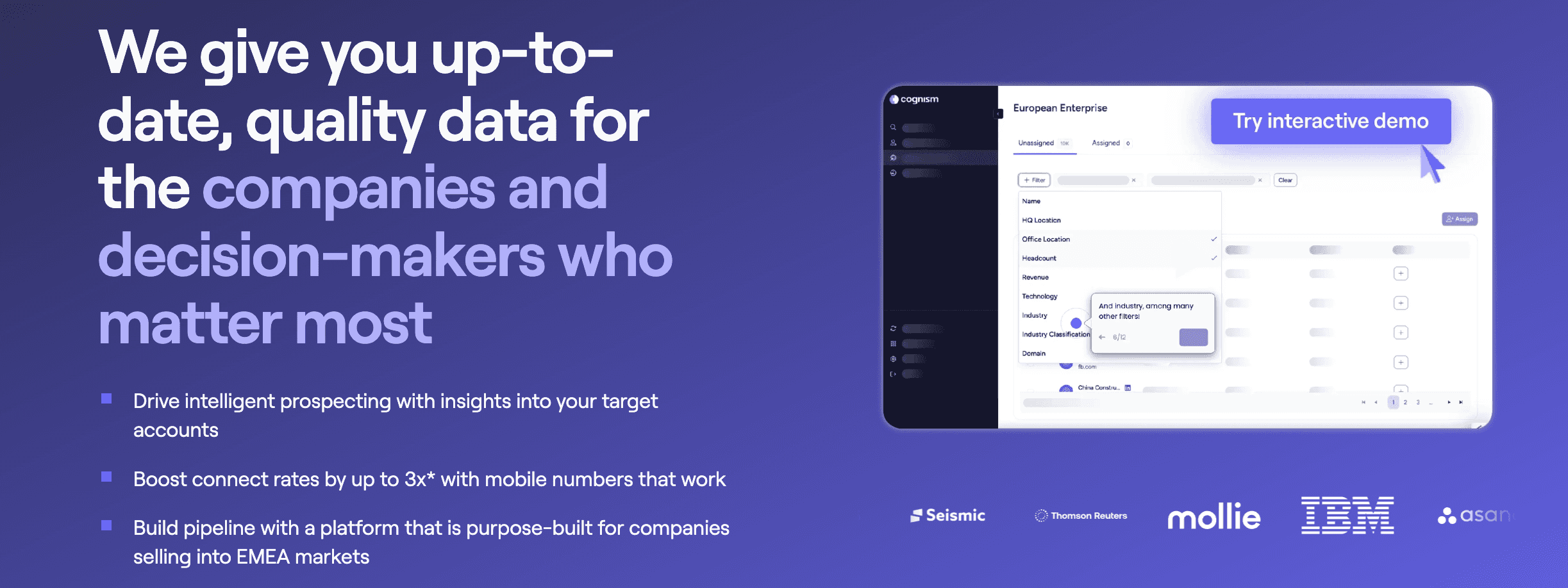
Cognism provides mobile-verified phone numbers, GDPR-compliant emails, and real-time data enrichment for B2B sales and marketing teams. The platform focuses on data accuracy, particularly in Europe, with Diamond Data offering the highest-quality verified contacts in the industry.
The intent data features help identify accounts showing buying signals, but the real value is contact quality. Direct dial numbers, mobile-verified emails, and compliance documentation that holds up under GDPR scrutiny.
Key Features:
Mobile-verified direct dial numbers
GDPR and CCPA-compliant contact data
Real-time data enrichment via API
Intent signals integration
Chrome extension for on-the-fly prospecting
Strengths: Best contact data accuracy, especially in Europe. Direct dial numbers actually work. Strong compliance documentation. Integrates with major CRMs and sales engagement platforms.
Limitations: Pricing scales quickly with seats and data access. No built-in email sequencing or campaign automation. Focused on data quality, not marketing execution.
Pricing: Custom pricing based on seats and data access
Best for: Outbound sales teams, account-based marketing programs needing verified contacts, European companies requiring GDPR compliance
Marketing Automation & CRM
HubSpot with Breeze AI – All-in-One Marketing Platform
HubSpot rolled out Breeze AI across 2024, embedding content generation, predictive lead scoring, and workflow automation directly into the CRM. It's not a bolt-on feature—Breeze runs across the Marketing Hub, Sales Hub, and Service Hub.
For B2B companies already on HubSpot, Breeze makes AI adoption frictionless. Email subject line optimization, automated workflow recommendations, content generation, and predictive analytics all live inside the platform you're already using daily.
Key Features:
AI-powered lead scoring and prioritization
Content generation for emails, social posts, blog drafts
Automated workflow suggestions based on performance data
Predictive analytics for deal likelihood
Native CRM integration across marketing and sales
Strengths: Easiest AI implementation for existing HubSpot users. All-in-one platform reduces tool sprawl. Strong free tier for getting started. Extensive training resources via HubSpot Academy.
Limitations: Pricing scales with contact count, which can get expensive. AI features are good but not best-in-class for any single function. Lock-in to HubSpot ecosystem.
Pricing: Free tier available; Marketing Hub Professional from $800/mo (includes Breeze AI)
Best for: B2B companies wanting a unified marketing and sales platform, teams without dedicated MarTech resources, organizations prioritizing ease of use over specialized features
Salesforce Marketing Cloud Account Engagement (Pardot) – Enterprise B2B Automation
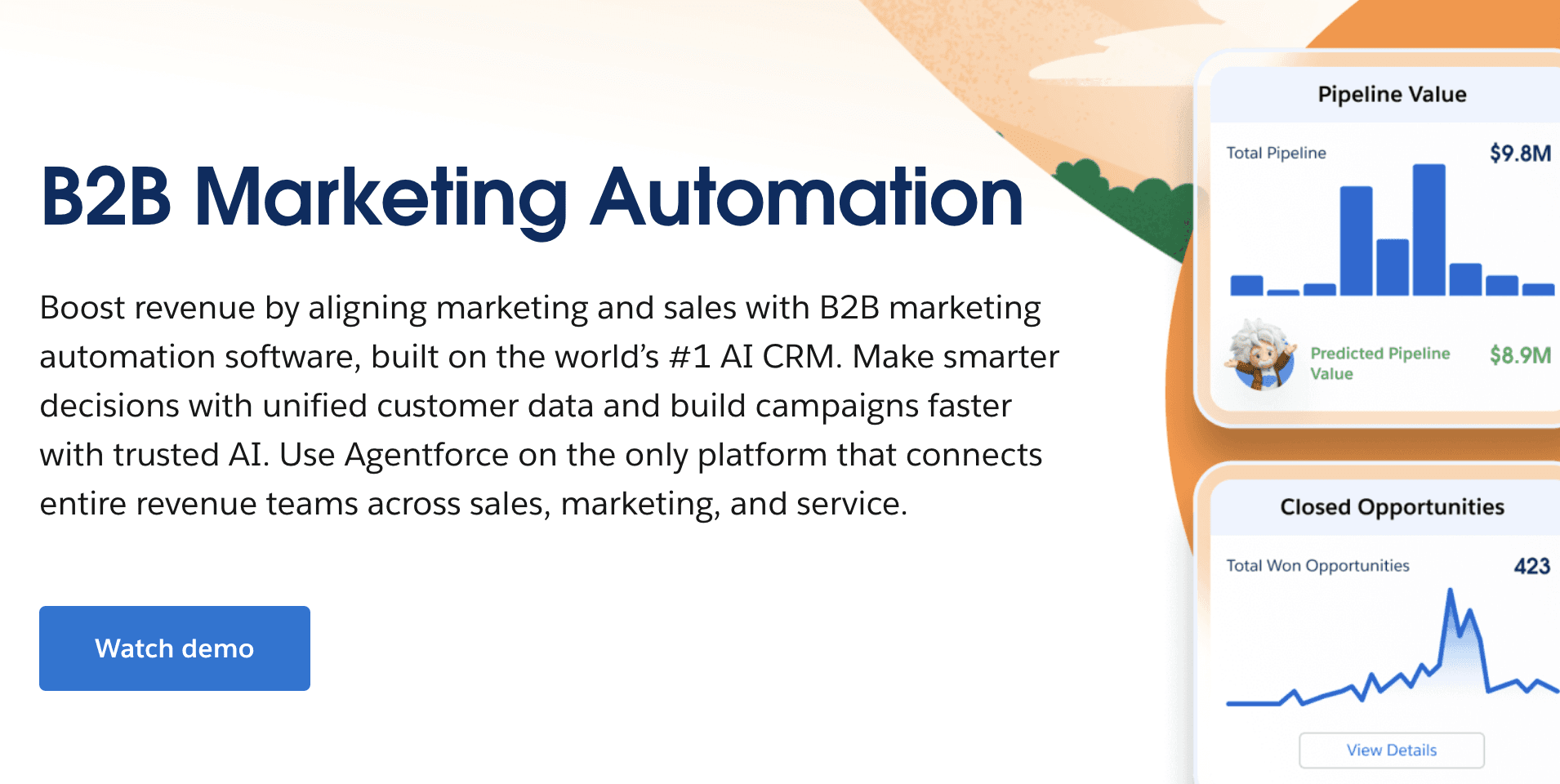
Pardot is built for B2B marketing automation with deep Salesforce integration. Lead nurturing, scoring, and attribution all sync directly with Sales Cloud, creating true alignment between marketing and sales teams.
The platform handles complex multi-touch attribution, sophisticated lead scoring models, and enterprise-grade campaign orchestration. If your sales team lives in Salesforce, Pardot eliminates the data silos that plague most organizations.
Key Features:
Advanced lead scoring with multiple scoring models
Multi-touch attribution across customer journey
Dynamic email content based on recipient data
Landing page and form builder with A/B testing
Salesforce native integration for seamless data sync
Strengths: Best marketing automation for Salesforce-centric organizations. Sophisticated attribution modeling. Strong for complex B2B buyer journeys. Eliminates marketing-sales data gaps.
Limitations: Requires Salesforce Sales Cloud subscription. Steep learning curve without dedicated admin. Can be overkill for simpler sales processes.
Pricing: From $1,250/mo for Growth; $2,500/mo for Plus; $4,000/mo for Advanced
Best for: Enterprise B2B companies on Salesforce, organizations with complex attribution needs, teams requiring tight sales and marketing alignment
Marketo – Enterprise Marketing Automation
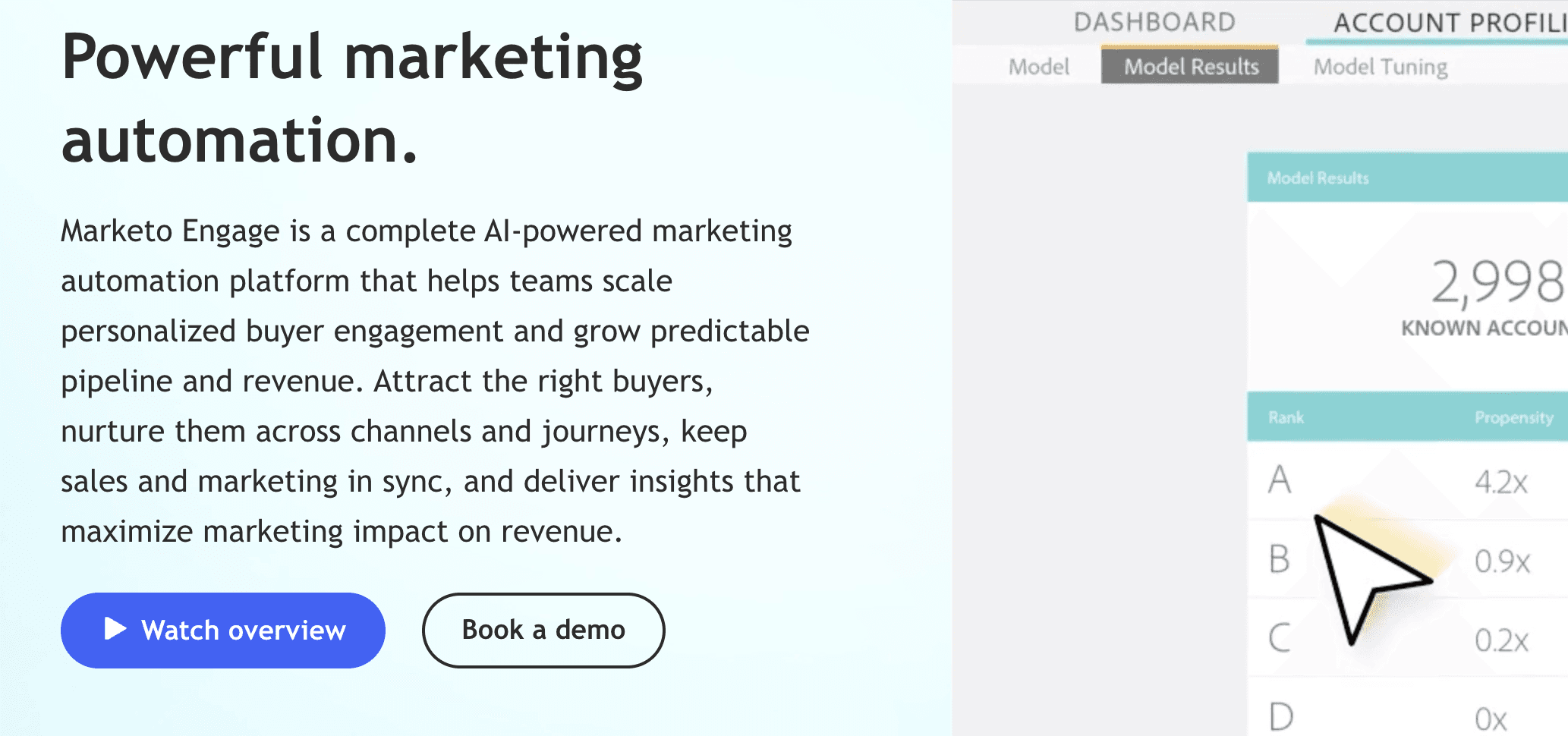
Marketo (now part of Adobe Experience Cloud) handles complex lead management, multi-touch attribution, and ABM features for enterprise B2B marketers. The platform excels at orchestrating sophisticated buyer journeys across multiple touchpoints and channels.
Where Marketo shines is attribution. The Revenue Cycle Analytics can track customer journeys through awareness, consideration, decision, and expansion, attributing revenue impact at each stage.
Key Features:
Lead lifecycle management with revenue attribution
Multi-touch attribution modeling
ABM features including account-based analytics
Dynamic content personalization
Extensive integration marketplace
Strengths: Most powerful for complex buyer journeys. Robust reporting and analytics. Strong ABM capabilities. Part of Adobe ecosystem for larger marketing operations.
Limitations: Steep learning curve—requires dedicated marketing ops. Premium pricing with complex licensing. Can feel like overkill for straightforward sales cycles.
Pricing: Custom pricing (typically $20,000+ annually for mid-market)
Best for: Enterprise B2B companies, organizations with dedicated marketing operations teams, companies running sophisticated ABM programs
Conversational Marketing & Engagement
Drift – Conversational Marketing Platform
Drift replaces traditional forms with conversational experiences. AI chatbots qualify leads, book meetings, and route conversations to the right sales reps based on account data and buying signals.
The conversational landing pages convert at 2-3x traditional form-based pages because they feel like actual conversations, not data collection. For B2B companies focused on pipeline generation, Drift's AI handles qualification at scale.
Key Features:
AI chatbots for website engagement
Conversational landing pages
Calendar integration for instant meeting booking
Account-based playbooks for target accounts
CRM integration for lead routing
Strengths: Significantly higher conversion rates than static forms. Excellent for pipeline generation. Strong account-based features. Integrates with major CRMs and marketing automation platforms.
Limitations: Premium pricing starting at $2,500/mo limits accessibility. Focused on conversation-based engagement—not a full marketing platform. Requires sales team alignment to maximize value.
Pricing: From $2,500/mo
Best for: B2B companies focused on demo-driven sales, organizations with high website traffic, teams wanting to replace form-based conversion
Intercom – Customer Engagement Platform
Intercom unifies customer messaging across marketing, sales, and support. The AI chatbots handle common questions, route complex issues to humans, and trigger campaigns based on user behavior and product usage.
For product-led B2B companies, Intercom's strength is the unified customer view. Marketing, sales, and support teams all work from the same conversation history and customer data.
Key Features:
AI-powered chatbots for support and sales
Automated onboarding messages and product tours
Behavioral targeting for campaigns
Unified inbox for all customer conversations
Integration with product analytics and CRM
Strengths: Best for product-led growth companies. Unified customer data across teams. Strong automation for onboarding and activation. Excellent mobile apps.
Limitations: Can be complex for simple use cases. Pricing scales with contacts. Focused on customer engagement, not full marketing automation.
Pricing: From $74/mo for small teams; custom pricing for enterprise
Best for: Product-led B2B SaaS companies, organizations prioritizing customer success, teams wanting unified support and marketing
Workflow Automation
Zapier – Connect Everything
Zapier automates workflows between 5,000+ apps without code. For B2B marketers, that means automatically syncing data between CRM, email platforms, project management tools, analytics, and everything else in your stack.
The value is eliminating manual data entry and ensuring consistency across systems. Lead fills out a form? Zapier adds them to your CRM, starts an email sequence, creates a task for sales, and logs the conversion in your analytics—all automatically.
Key Features:
5,000+ app integrations
Multi-step workflows (Zaps) with conditional logic
Data formatting and transformation
Scheduled automation triggers
Team collaboration features
Strengths: Connects virtually any tool in your stack. No-code automation accessible to non-technical teams. Extensive template library for common workflows. Reliable execution at scale.
Limitations: Costs scale with task volume. Complex workflows can get expensive. Some integrations are limited compared to native connections.
Pricing: Free tier available; Starter from $29.99/mo; Professional from $73.50/mo
Best for: Operations-focused marketers, teams using multiple disconnected tools, organizations wanting to eliminate manual data entry
Why AI Tools Matter for B2B Marketing in 2026
Let me share what I'm seeing in the data. When we launched AIclicks, our hypothesis was simple: search behavior is fundamentally shifting from keyword-based queries to conversational AI interactions. Eighteen months later, the numbers prove it.
Traditional SEO metrics tell one story. Your rankings might look fine. Traffic might be stable. But here's what's actually happening: 81% of B2B buyers now choose their preferred vendor before they ever talk to sales. And increasingly, that decision happens inside AI-generated answers, not on your landing pages.
The median B2B customer acquisition cost increased 14% year-over-year. Marketing teams are being asked to do more with less. This isn't a temporary squeeze, it's a structural shift in how B2B software gets discovered, evaluated, and purchased.
AI tools for B2B marketing aren't about automating your way to mediocrity. They're about redirecting human effort from repetitive tasks to strategic thinking. The best teams use AI to handle SERP research, competitive analysis, first-draft content, and data entry, then invest the time savings into positioning, market insight, and conversion optimization.
Companies using AI in marketing report a 42% reduction in customer acquisition cost compared to traditional methods. But that number hides a reality: success isn't about having AI tools. It's about choosing the right ones and integrating them into a coherent workflow.
Here's a video explaining the progress we achieved for one of our clients:
How to Choose the Right AI Marketing Tools for Your B2B Stack
After testing dozens of platforms, here's what actually matters:
Start with your biggest bottleneck. Don't buy tools because they're trendy. Identify where your marketing breaks down (lead quality, content production, visibility, attribution) and solve that first.
Look for workflow integration, not feature lists. The best tool isn't the one with the most features. It's the one that fits into your actual workflow and gets used daily.
Prioritize data quality over automation speed. AI agents and predictive analytics are only as good as the data they're trained on. Clean, structured, accessible data beats sophisticated AI working with garbage inputs.
Budget for implementation time. Most enterprise AI tools take 2-3 months to deliver value. Factor in setup, training, and iteration when planning timelines.
Track real outcomes, not vanity metrics. "AI visibility mentions" don't matter if they're not driving pipeline. "Content pieces published" don't matter if they're not converting. Tie every tool to revenue metrics.
For most B2B teams, the practical stack looks like:
AI visibility tracking (AIclicks) to ensure your brand appears in AI-generated recommendations
Content creation (Jasper or ChatGPT Plus) to scale production
Marketing automation (HubSpot or Pardot) to nurture leads
One specialized tool for your specific bottleneck (ABM, data, workflow automation)
Don't try to deploy everything at once. Add tools as you solve problems, not before.
The Future: AI Agents and Generative Engine Optimization
The landscape is shifting faster than most teams realize. By 2028, Gartner expects a substantial majority of B2B buying to be mediated by AI agents. That's not theoretical, it's already happening.
Your prospects are using ChatGPT to research vendors. They're trusting Perplexity's citations. They're letting AI Overviews build their shortlists. The brands winning in this environment are the ones treating AI search as a first-class channel, not an afterthought.
Traditional SEO and GEO (generative engine optimization) work together, not in opposition. SEO helps you rank and drive traffic. GEO makes your content AI-friendly for mentions and citations. Both matter.
The teams that win will:
Track their AI visibility as rigorously as they track Google rankings
Optimize content for AI-liftable formats (clear structure, answer-first sections, tables, FAQs)
Build authority signals that AI systems recognize (citations, external mentions, directory presence)
Monitor and iterate on AI search performance weekly, not quarterly
This isn't about replacing human marketers with AI. It's about redirecting human effort from repetitive tasks to strategic decisions that move revenue.
Start Tracking Your AI Visibility Today
The hard truth: if you're not measuring your brand's presence in AI search engines, you're flying blind. Your competitors are already optimizing for ChatGPT visibility. Buyers are already using AI to build their vendor shortlists.
Start with a baseline audit. See where you appear in AI-generated answers, which competitors are winning the prompts you're losing, and which content gaps are costing you visibility.
That's exactly what we built AIclicks to solve. Track your brand across ChatGPT, Perplexity, Gemini, Claude, and AI Overviews. Get citation intelligence showing which sources influence AI recommendations. Turn visibility data into concrete optimization tasks.
Ready to see where your brand stands in AI search? Start with AIclicks to track, analyze, and improve your visibility across the AI engines that now drive B2B discovery.
The brands that treat AI visibility as a strategic channel today will own the next decade of B2B marketing. Everyone else will be playing catch-up.
Frequently Asked Questions About AI Tools for B2B Marketing
What are AI tools for B2B marketing?
AI tools for B2B marketing are software platforms powered by large language models and machine learning that automate repetitive tasks, analyze data, and optimize marketing strategies. Not all AI tools are equal. The best AI marketing tools integrate seamlessly with your marketing channels and deliver actionable insights rather than raw data.
How much do AI marketing tools typically cost?
Pricing varies widely. Many platforms offer free plans—ChatGPT, Canva, and HubSpot, for example. Mid-tier AI tools for B2B run $50- $ 500/month. Enterprise platforms with comprehensive SEO tools and verified email addresses require custom pricing, starting at $1,000- $ 5,000/month. AIclicks starts at $59/mo.
Can AI tools help with lead generation and qualification?
Absolutely. AI-driven insights transform lead qualification by analyzing customer behavior and intent signals. The best AI tools identify high-intent website visitors, automate lead scoring across multiple channels, and engage prospects through AI-powered chatbots. Tools like 6sense use predictive analytics to score target accounts before they contact you.
How do AI tools improve content creation for B2B marketing?
Modern generative AI tools streamline the content creation process from strategy to distribution. They generate social media posts, marketing materials, landing pages, and long-form content while maintaining brand voice. The best platforms integrate content optimization and help with the video creation process for short-form videos.
What's the difference between marketing automation and AI marketing tools?
Marketing automation platforms handle workflow automation—scheduling emails, triggering campaigns, and managing contact data. AI integration adds intelligence: predictive lead scoring, dynamic personalization based on customer behavior, and AI agents making autonomous decisions. HubSpot with Breeze AI combines both, automating workflows while using machine learning to improve performance.
Are there free AI tools worth using for B2B marketing?
Yes. ChatGPT's free plan handles research and content creation. Canva's free tier works for social media posts and marketing materials. Google's Gemini provides free access to large language models. However, free plans lack comprehensive seo tools and the ability to analyze data at scale needed for serious B2B marketing strategies.
How do I choose which AI marketing tool is right for my business?
Start with your biggest bottleneck: invisible in AI search? Use AIclicks. Is content production slow? Try Jasper or ChatGPT Plus. Are leads getting lost? Use HubSpot or Drift. The best ai marketing tools integrate with your workflow, solve specific problems, and deliver measurable results with a strong user interface.



Any questions left?
Book a call here: