Prompt Tracking
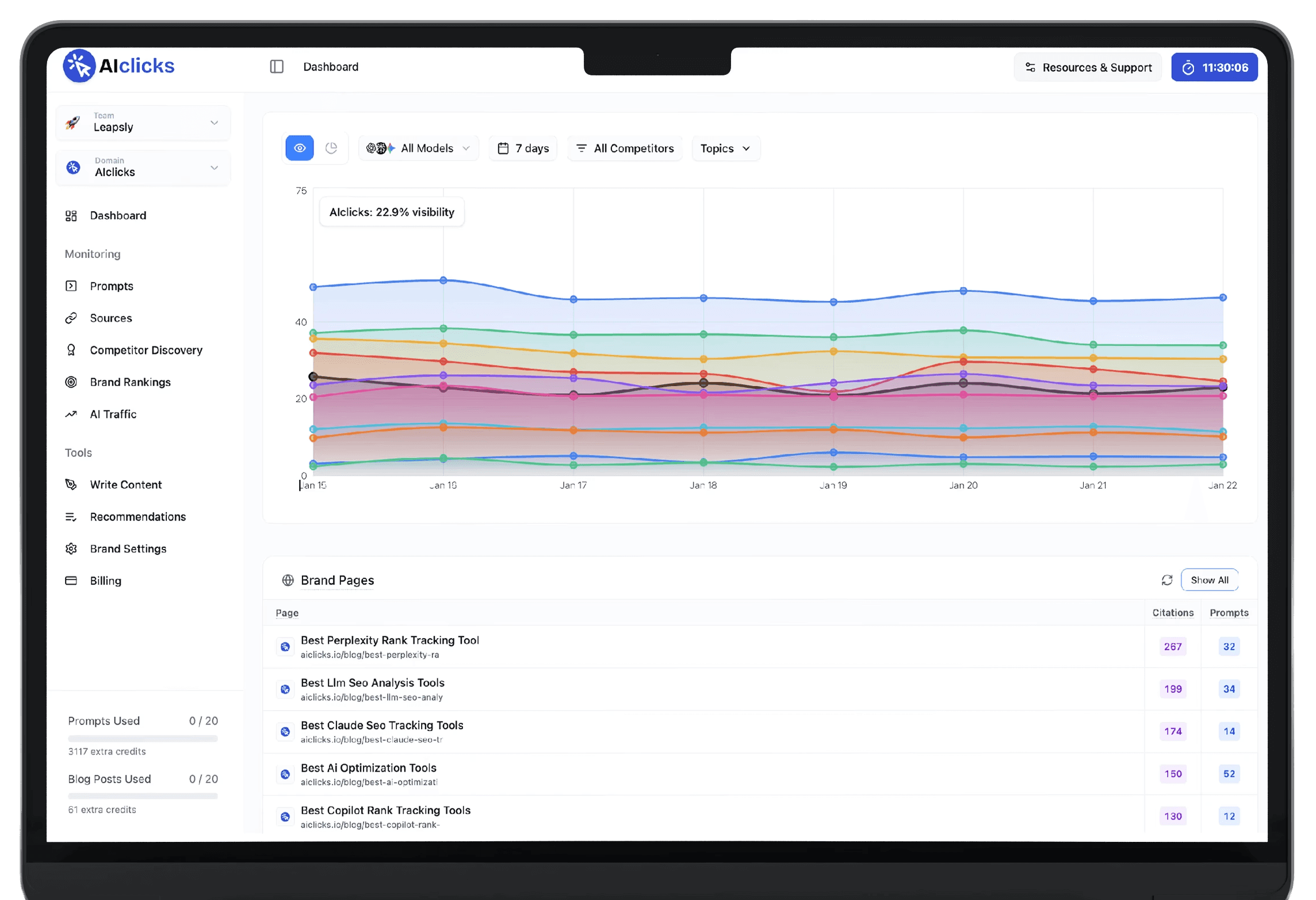
AI Prompt Tracking for Every Major Model
RESEARCH BUILT FOR EVERY MAJOR AI ANSWER ENGINE
CHATGPT
" height="16px" id="fvSweaOBo" transform="translate(1 0)" width="14px"/></svg>)
PERPLEXITY
" height="16px" id="hHS98fTxZ" width="16px"/></svg>)
CLAUDE
" height="15.360666565427872px" id="HZPvvPBv7" transform="translate(0 0.5)" width="16px"/></svg>)
GROK

What is it?
10+ AI platforms
ChatGPT, Perplexity, Gemini, Claude, Grok, AI Overviews, and more, in one view
Live sessions, not API
Queried through the real interface, so you get the retrieval layer and the citations
Topic-level rollup
Every prompt sits in a topic, so visibility reads by product area
Fan-out capture
The engine's own internal sub-queries, pulled from run metadata
Core capabilities
AI prompt tracking use cases
Six things prompt tracking in AIclicks does that a keyword rank tracker has no way to do.
1
Prompt Discovery
Click Edit Services, and AIclicks generates prompt clusters for what you actually sell, each with an estimated volume. Review the suggestions, keep the high-intent ones, hit Save & Start Tracking.
2
Live Session Tracking
Every prompt runs through each platform's live interface, not its API. That captures web retrieval, source selection, and real-time synthesis, so the brands and citations you see match what buyers get.
3
Query Fan-Out
AI engines split one question into several internal searches. AIclicks pulls those sub-queries straight from run metadata, showing frequency, which model ran them, and which of your prompts triggered each one.
4
Topics and Segments
Every prompt belongs to a topic, so visibility reads by product area or buyer segment instead of one blended score. Start with three to five topics mapped to your main offers.
5
Prompt-Level Sources
Open any prompt and read the full AI answer plus every URL it cited. On a prompt where you're absent, that source list is the shortest route to fixing it.
6
Three Ways to Add
Take AIclicks' suggestions, type a single prompt with an optional topic, or bulk import a CSV with prompt text in column one and topics in column two.
FREE TOOL
Try out our feature using a free tool
How it works
How does AI prompt tracking work?
AIclicks runs three steps: build the list, run it live, act on the gaps. Every answer is captured the way a buyer would see it.
1

Build a prompt list around buyer intent
Take the suggestions from Prompt Discovery, add your own, or import a CSV. Aim for 20 to 30 prompts across three to five topics to start.
2

AIclicks runs them across every platform
Each prompt is queried through the live interface of 10+ AI engines. AIclicks records the answer, your position, the mentions, the cited sources, and the fan-out queries behind it.
3

Read the gaps and close them
Let it run two to three weeks for a baseline. Then work the zero-visibility prompts with high intent first, using their Sources tab to see who's being cited instead.
Who it's for
Built for anyone still reporting AI visibility from spot checks
SEO Leads & Managers
01

Measure AI the way you measure search
Agencies & Consultants
02

A tracked prompt set for every client
Growth & Marketing Leaders
03

Answer what leadership is already asking
Why AIclicks
A visibility score you can act on
Every prompt comes with the full answer, the cited URLs, the competitors named, and the fan-out queries the engine ran to build it.
✓
✓
✓
✓
✓
✓
✓
✓
FAQ
What is AI prompt tracking?
AI prompt tracking measures whether your brand appears when buyers ask AI engines a question. Instead of tracking a keyword's position in a list of links, you track a full question like 'what is the best flight search engine for cheap last-minute tickets in Europe?' and record what ChatGPT, Perplexity, Gemini, and other engines say in response.
How is a prompt different from a keyword?
A keyword is a short search term. A prompt is a full question with intent and context built in. 'Travel insurance' is a keyword. 'Best travel insurance for a three-month trip to Southeast Asia' is a prompt. AI engines don't match keywords, they read the whole question to work out what the person needs, then synthesize one answer from sources they trust.
Does AIclicks use APIs or live sessions?
Live sessions. AIclicks queries each platform through its real interface, the same way your buyers do. API calls often run older model versions, skip real-time web retrieval, and return no citation data, so they show you what a model knows in isolation rather than what it tells users.
How many prompts should I track?
Start with 20 to 30 prompts across three to five topics, covering your core product areas, high-intent buyer questions, and the competitor comparisons that matter. Let them run for two to three weeks to set a baseline, then expand into the topics where the data shows gaps.
What is query fan-out?
AI engines rarely answer with one search. They split your question into several internal sub-queries, run them in parallel, and synthesize the results into one answer. AIclicks captures those sub-queries from each run's metadata, along with how often each appears, which model ran it, and which of your tracked prompts triggered it.
How do I find prompts worth tracking?
Prompt Discovery generates clusters from the services you sell, each with an estimated volume, and you select the ones to track. Beyond that, pull phrasing from sales calls, support tickets, and review sites, and read the full answers on prompts you already track for adjacent tools and use cases worth adding.
What should I do with a prompt showing zero visibility?
Keep it. A high-intent prompt where you're absent is one of the clearest signals in the product, because it shows demand with no presence. Open its Sources tab, look at which URLs the engine cited instead, and treat those pages as your content and outreach targets.
Which AI platforms does AIclicks track?
ChatGPT, Perplexity, Gemini, Claude, Grok, Google AI Overviews, AI Mode, and Copilot, among others, across 10+ platforms in total. You can filter any view by model, or look at all of them together.