

Revisado por:
Rokas Stankevicius

Founder @aiclicks.io
Última actualización:
Verificado por expertos


Auditoría de visibilidad de IA gratuita
Key Takeaways
AI writing tools now split into two groups: general content generators built for marketing and business writing, and specialists built for one job, fiction for Sudowrite, SEO content for Surfer AI and Frase.
Several tools in this space have repositioned recently from a standalone writing tool toward a broader "AI platform" or "AI agent" framing, so a team comparing older reviews should expect the product to have grown well beyond simple drafting.
Pricing structures vary widely: some tools charge per seat, others meter usage through word or generation credits, and a few keep their true entry price hidden behind an account signup rather than a public number.
A genuine permanent free tier is rare in this list; most of these tools offer a short free trial instead, and at least one dropped a previously advertised free plan entirely.
Brand voice and style consistency, not raw generation speed, is what separates the tools built for teams from the tools built for individual writers.
What Makes AI Writing Software Worth Using
It keeps a consistent brand voice across drafts instead of producing generic copy that needs a heavy rewrite before it can be published.
It fits into the workflow the content already goes through, publishing to a CMS or plugging into a content calendar, instead of leaving a team to copy and paste output into another tool.
Its pricing model matches how the team actually works, a flat seat price for steady daily use, or usage-based credits for occasional or highly variable output.
Quick Comparison
Tool | Category | Starting Price | Standout Feature |
AIclicks | AI visibility + content | $59/mo | Writer 2.0 drafts from a measured citation gap, not a blank prompt |
Surfer AI | SEO content generation | $59/mo | Analyzes 300,000+ words and 500+ signals per article before writing |
Jasper | Enterprise marketing AI | $69/mo per seat | 100+ specialized marketing agents governed by a shared brand-voice layer |
Copy.ai | GTM workflow automation | $29/mo | Workflows and Actions automating multi-step GTM processes, not just single drafts |
Anyword | Performance-scored copy | $49/mo | Predictive Performance Score rating a draft before it goes live |
Writer | Enterprise AI agents | Quote needed | Knowledge Graph grounding agent output in company-specific facts |
Sudowrite | Fiction and creative writing | $19/mo | Story Bible carrying characters, plot, and style across an entire novel |
Rytr | Budget AI writing | Free | Permanent free tier with 10,000 characters/month, no credit card |
Grammarly | Grammar + AI assist | Free | AI Humanizer and AI Detector agents layered onto its grammar checking |
Frase | SEO content + AI visibility | $49/mo | Content Guard auto-detects and drafts fixes for decaying pages |
1. AIclicks: Best for Content Built From a Measured Visibility Gap
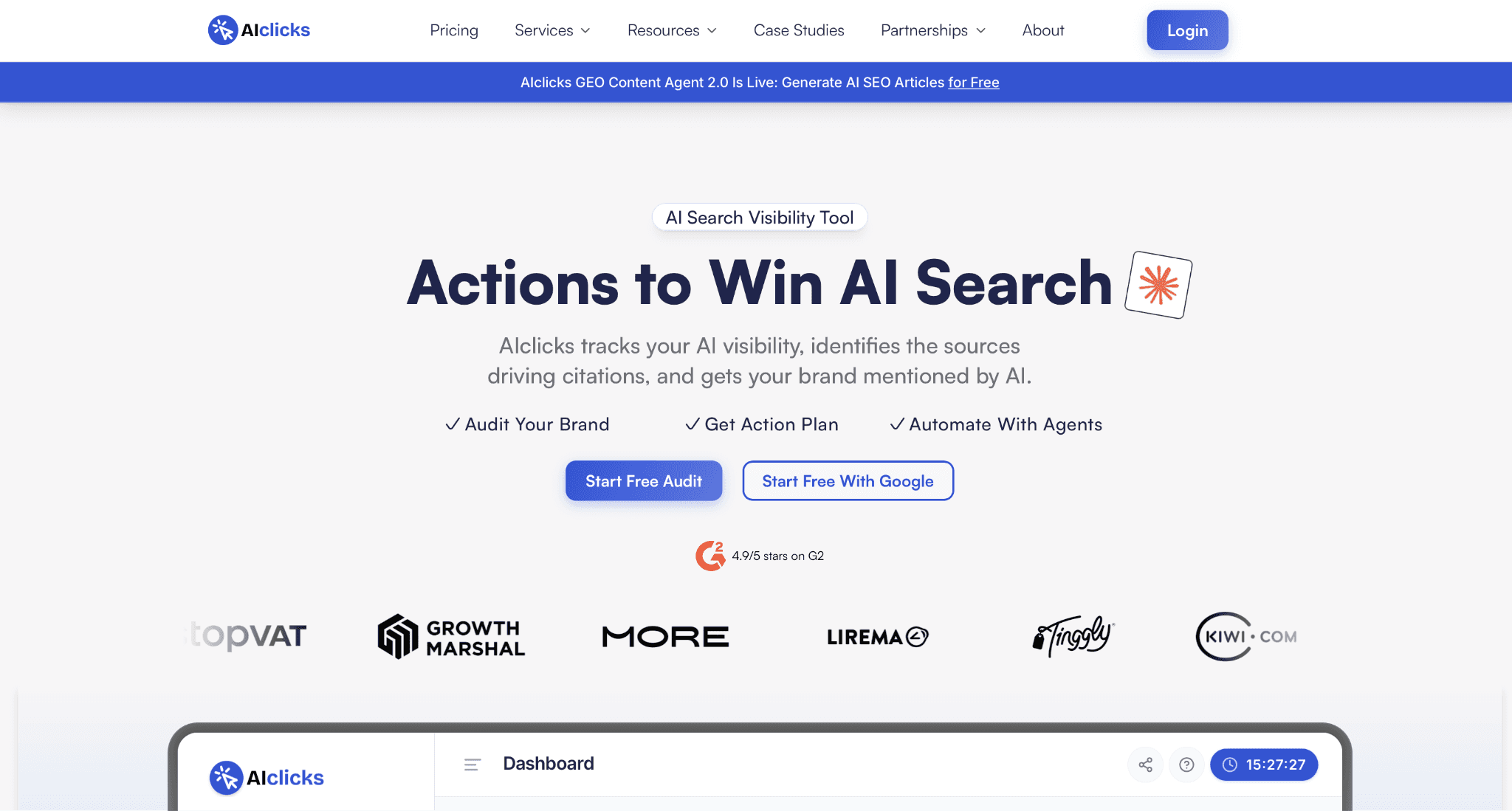
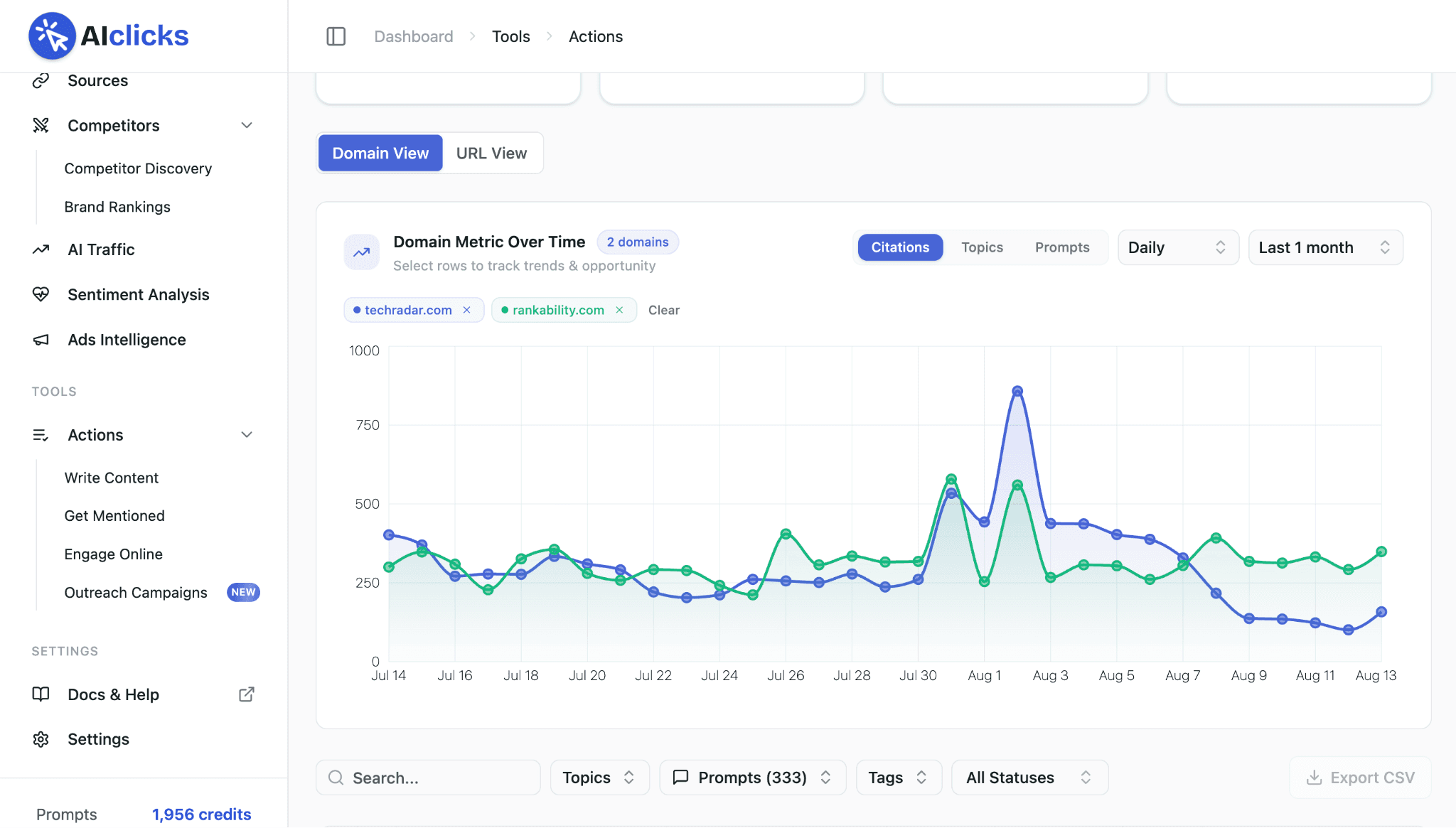
AIclicks is primarily an AI visibility tracking platform, following where and how often a brand gets cited across ChatGPT, Gemini, Perplexity, Google AI Overviews, and Copilot. Writer 2.0, one part of its Actions suite, turns that tracking data directly into content: instead of drafting from a blank prompt, it writes AI-optimized articles targeting the specific prompts and gaps the tracking has already surfaced, then publishes with one click to WordPress, Webflow, Shopify, or Framer.
Key features:
Writer 2.0 drafting AI-optimized articles from measured prompt-level visibility gaps rather than a standalone brief
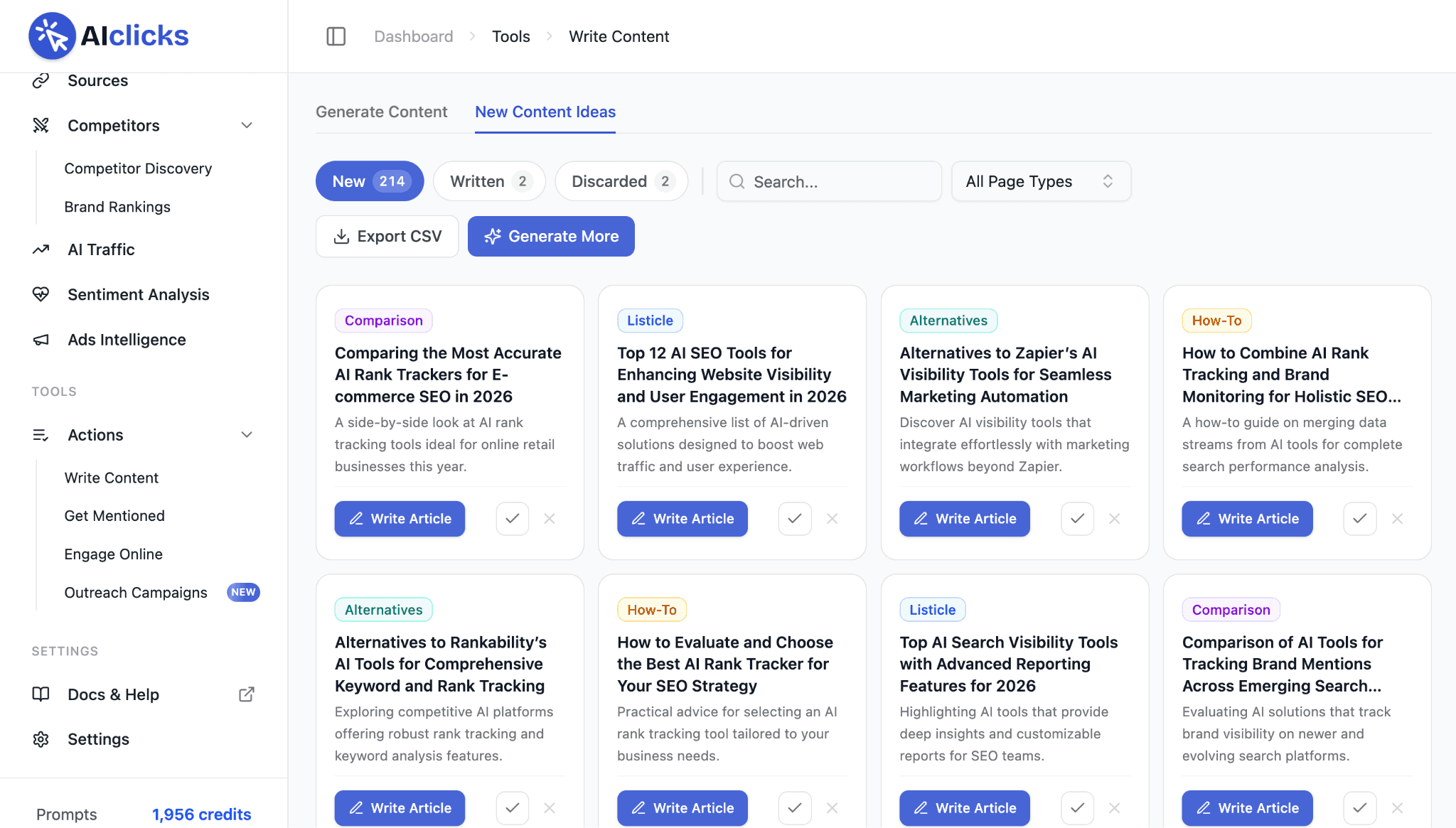
One-click publishing to WordPress, Webflow, Shopify, and Framer
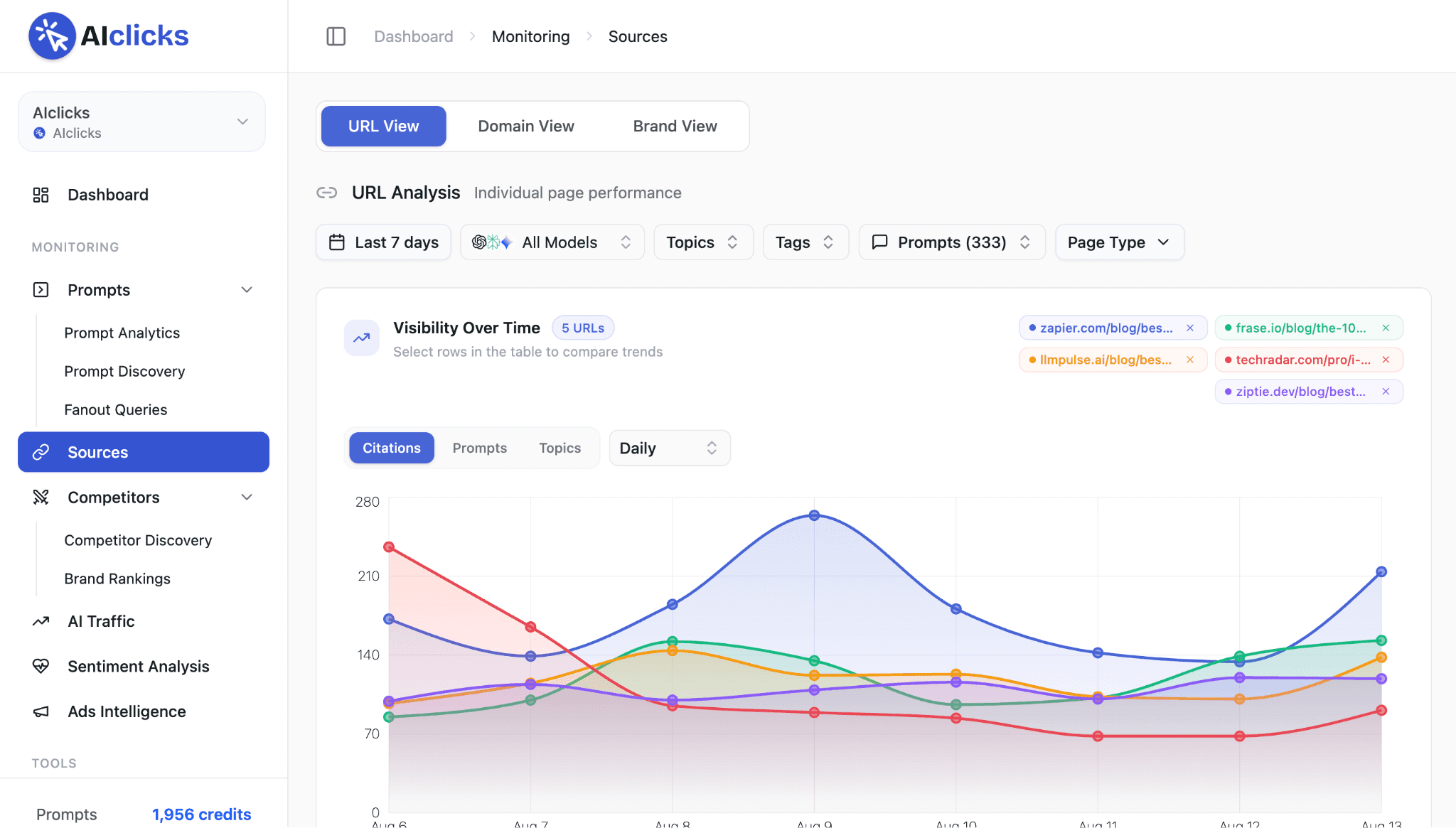
Sources shows which pages AI engines already cite for a topic, and Competitor Discovery shows which competitors get cited instead, so Writer 2.0 drafts toward the specific gap those two features surface
Get Mentioned and Engage Online extending the same Actions suite into outreach and social engagement, not just drafting
Pros:
Content targets a measured citation gap instead of a guess at what to write about
One subscription covers tracking, competitor benchmarking, and content generation together
3-day free trial with no credit card required on Starter and Pro
Cons:
Writer 2.0 isn't sold as a standalone writing tool, a team that only wants AI drafting without the tracking layer will be paying for capability it won't use
Starter plan's 5 articles/mo cap is light for a content team publishing frequently, Pro's 15/mo is a more realistic starting point
G2 rating: 4.9/5
Pricing: Starter $59/mo | Pro $189/mo | Business $499/mo | Enterprise custom | 3-day free trial
Verdict: For a team that wants its AI content tied to a measured visibility gap rather than a general keyword guess, AIclicks' Writer 2.0 makes sense bundled with the tracking it's built on top of, not as a standalone drafting tool.
Before you start, watch this quick tutorial:
2. Surfer AI: Best for SEO Content Backed by Data-Driven Analysis
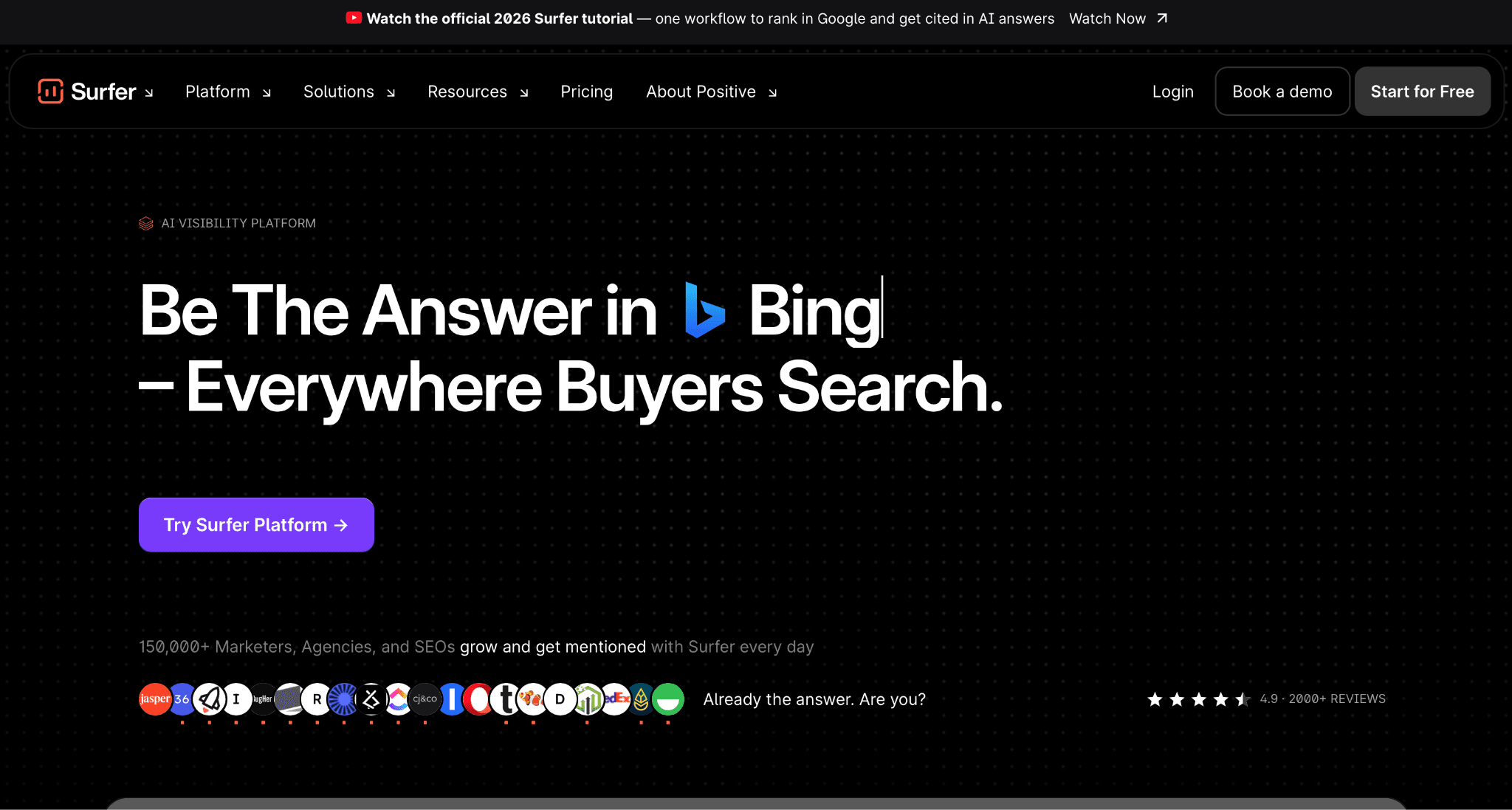
Surfer, now operating under parent company Positive Group as Positive Surfer following its acquisition, builds articles by analyzing over 300,000 words and 500+ web and AI signals for a given topic before writing. Its AI assistant, Surfy, and its Content Editor work alongside the AI writer, and the platform now includes its own AI visibility tracking on top of traditional SEO scoring.
Key features:
Article analysis drawing on 300,000+ words and 500+ web and AI signals per topic
Content Editor and Surfy assistant guiding edits alongside the AI draft
AI visibility tracking included from the Standard tier, 25 AI prompts/week
Custom Knowledge feature injecting brand facts and auto-generating FAQs from Google's People Also Ask
Pros:
Article generation time has dropped to roughly 3 minutes per Surfer's own product updates
Supports content generation in 11 languages
AI visibility tracking is bundled in rather than sold as a separate product
Cons:
Pricing is measured in documents rather than a clear per-article word allowance, harder to estimate exact output before signing up
Surfer's own pages cite conflicting customer counts (150,000+ customers in one place, 45,000 in another), worth confirming which figure applies specifically to the AI writing tool before repeating either number
G2 rating: 4.8/5
Pricing: Discovery $59/mo | Standard $119/mo | Pro $219/mo | Peace of Mind $359/mo | Enterprise custom, starting around $999/mo
Verdict: For a team that wants AI-written content backed by real competitive analysis rather than a generic draft, Surfer AI's document-based tiers scale from a solo blog up through an agency workload.
3. Jasper: Best for Marketing Teams Running Multiple Content Workflows
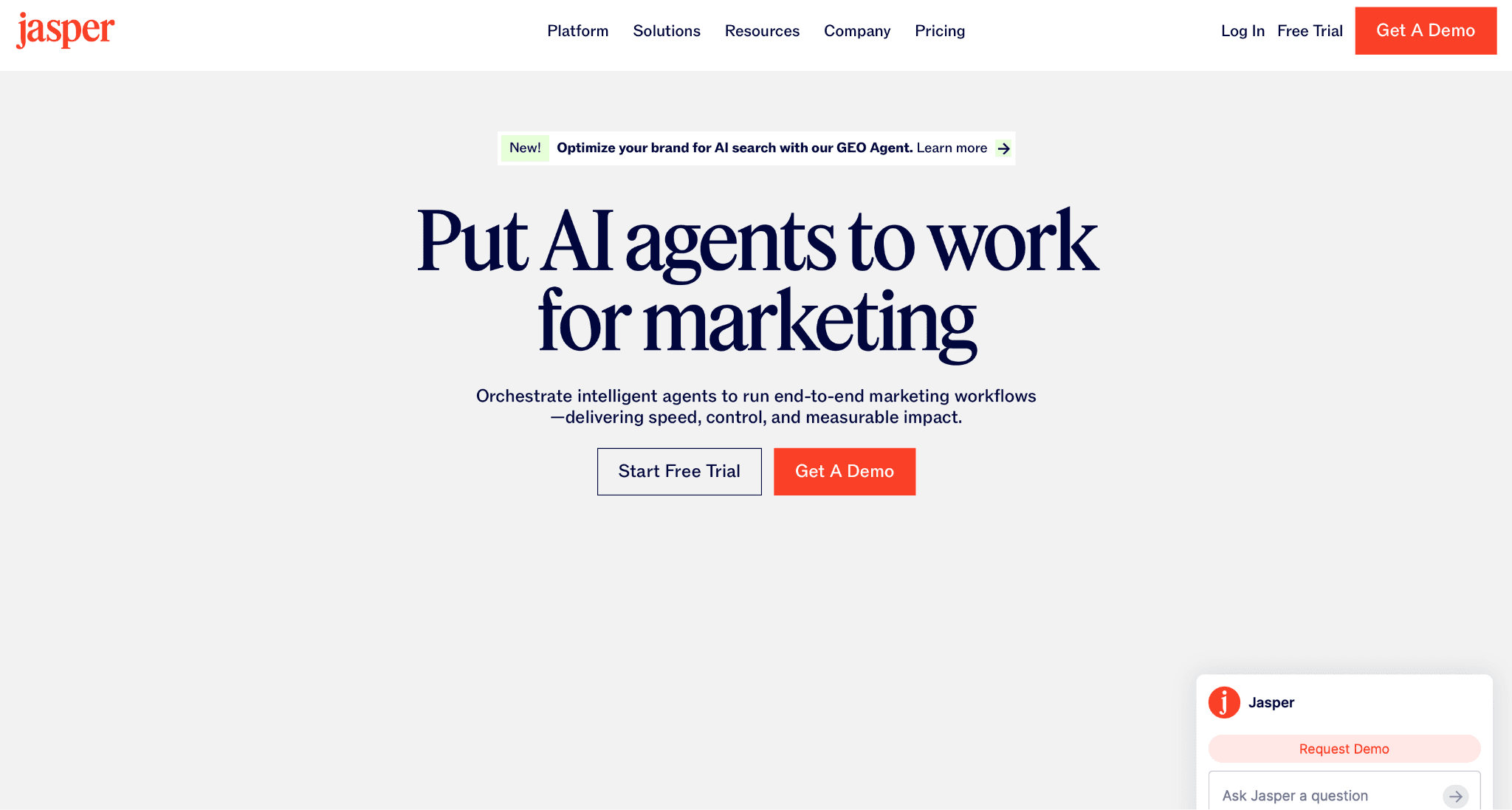
Jasper has repositioned from a standalone AI writer toward what it now calls an AI platform for marketing teams, orchestrating over 100 specialized agents across end-to-end marketing workflows rather than generating one piece of copy at a time. Jasper IQ governs every output against a shared brand voice, style guide, and knowledge base so a team of writers stays consistent.
Key features:
100+ specialized AI agents built for specific marketing tasks
Jasper IQ governance layer embedding brand voice and style guides into every output
GEO and AI Discovery monitoring citation rates in AI answer engines and flagging content gaps
Canvas workspace supporting core workflows, image generation, and a browser extension
Pros:
7-day free trial on the Pro plan
Brand voice and knowledge asset limits (2 Brand Voices, 5 Knowledge assets on Pro) keep smaller teams consistent without an enterprise contract
SOC2 compliance included even on the self-serve Pro tier
Cons:
Exact word or generation limits per plan aren't published on the pricing page, only referenced through a separate internal rate card, harder to budget usage precisely in advance
Business tier requires a 12-month minimum commitment, a real commitment for a team still evaluating fit
G2 rating: 4.7/5
Pricing: Pro $69/mo per seat | Business custom
Verdict: For a marketing team running several content workflows at once rather than one writer drafting solo, Jasper's agent-based structure and brand governance are worth the per-seat price.
4. Copy.ai: Best for Automating Go-to-Market Workflows, Not Just Drafting Copy
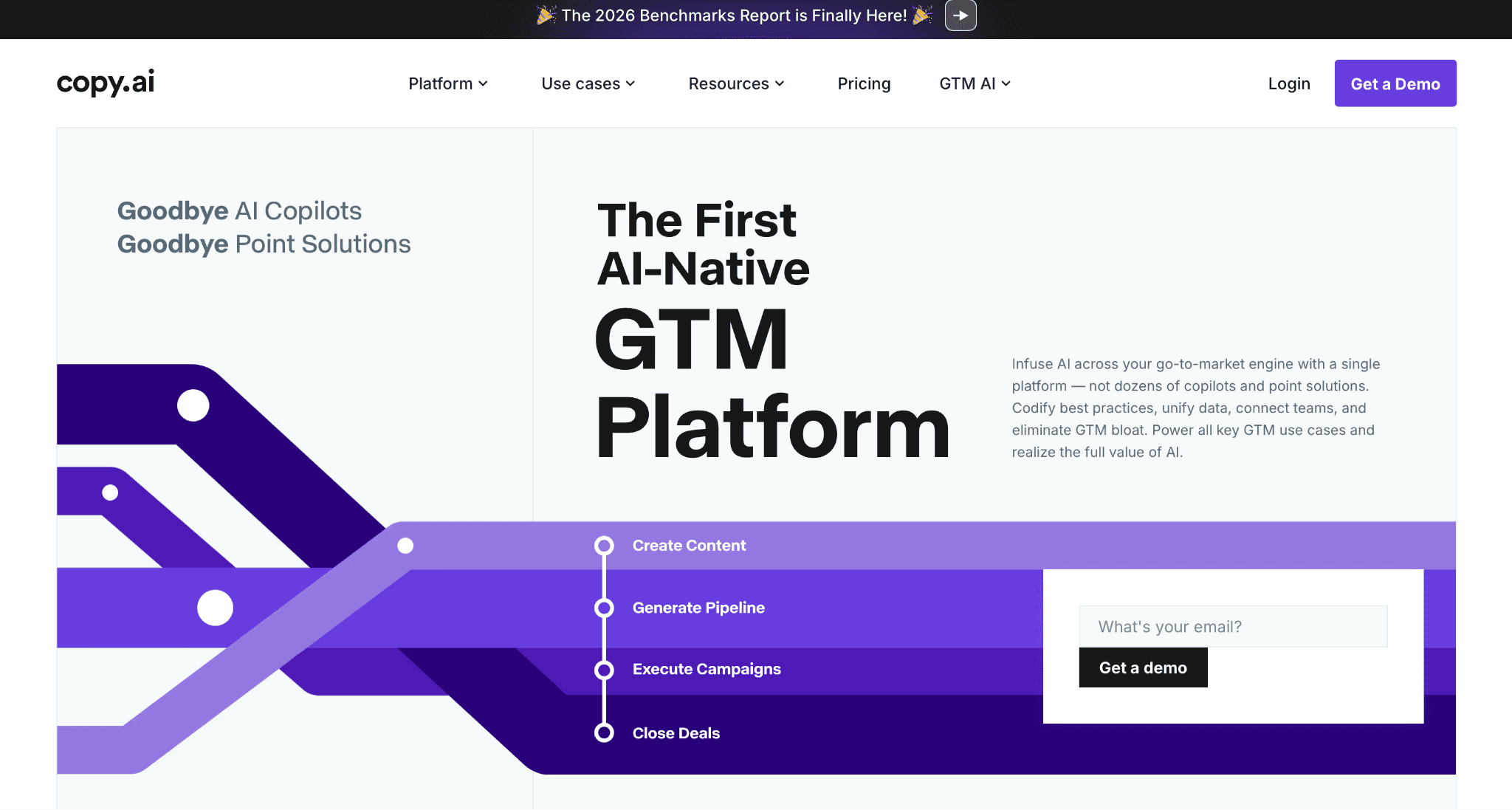
Copy.ai was acquired by Fullcast in October 2025 and now brands itself as an AI-native go-to-market platform built around Workflows, Actions, and Tables rather than a copywriting tool. Workflows codify a team's recurring processes into a repeatable AI-run sequence, and Tables consolidate data from multiple sources to power that automation, a different job than generating a single blog post or ad.
Key features:
Workflows codifying recurring marketing and sales processes into repeatable AI sequences
Actions serving as reusable building blocks a non-technical user can assemble into a workflow
Tables consolidating data from multiple sources into one queryable foundation
Multi-model support across OpenAI, Anthropic, Gemini, and Perplexity, plus 2,000+ integrations
Pros:
Chat plan includes 5 seats and unlimited words in chat at a relatively low entry price
Workflow credits scale predictably by tier, 20K on Growth up to 75K on Scale
Multi-model access means a team isn't locked into one underlying AI provider
Cons:
No free plan or trial currently exists on the live pricing page, despite an older Copy.ai blog post advertising 2,000 free words a month, worth confirming directly rather than expecting a free tier
G2 rating: Not listed on G2.
Pricing: Chat $29/mo | Enterprise custom
Verdict: For a team that wants to automate the process around content, not just generate the content itself, Copy.ai's Workflows are worth the jump once the entry Chat plan stops being enough, though the price gap between Chat and Growth is steep.
5. Anyword: Best for Copy That's Scored Before It Goes Live
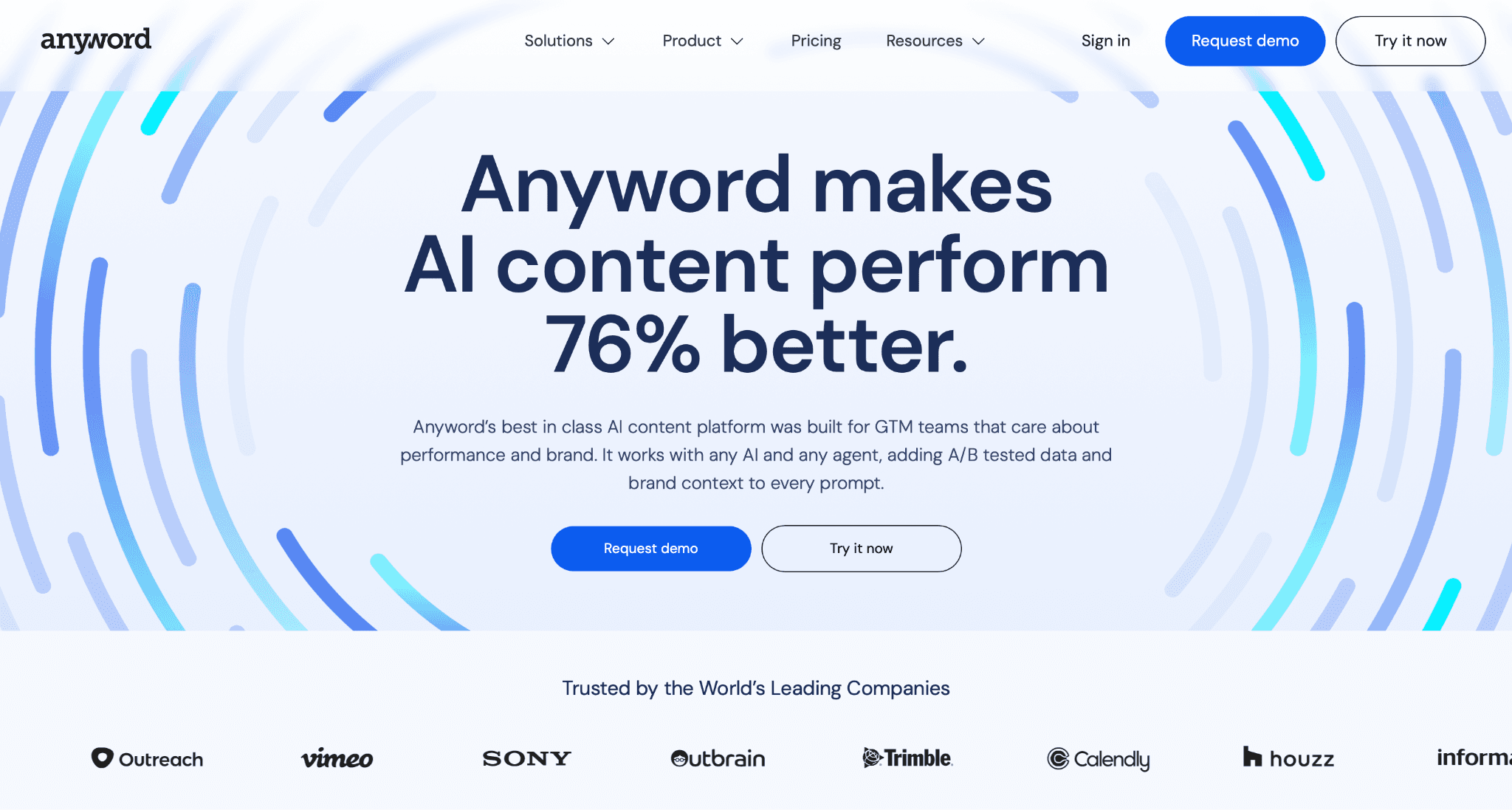
Anyword builds a predictive performance score into every piece of copy it generates, rating a draft's likely performance before it's published rather than leaving that judgment entirely to a writer's instinct. Its own stated accuracy is 82% at predicting which content variation performs better, against 52% for the same prompt run through a generic model without that scoring layer.
Key features:
Predictive Performance Score rating copy before it goes live
Data-Driven Editor showing real-time performance predictions as edits are made
Content Intelligence platform analyzing existing content for what's already working
Unlimited copy generation on every tier, with performance predictions metered separately by plan
Pros:
7-day or 2,500-credit free trial, whichever comes first, no credit card required
Unlimited word generation on every tier, including the entry Starter plan
Business and Enterprise tiers add custom-built AI models trained on a brand's own performance data
Cons:
Performance predictions are capped by plan (50/mo on Starter, 100/mo on Data-Driven), a team generating a high volume of variations will hit that limit before running out of generation capacity itself
Unlimited word generation only applies to the copy itself, not to how many of those drafts can get a performance score, worth keeping in mind when estimating real usage
G2 rating: 4.8/5
Pricing: Starter $49/mo | Data-Driven $99/mo | Business custom | Enterprise custom
Verdict: For a team that wants to know how a piece of copy will likely perform before spending budget behind it, Anyword's scoring layer is the reason to pick it over a tool that only generates text.
6. Writer: Best for Enterprise Teams Delegating Work to AI Agents
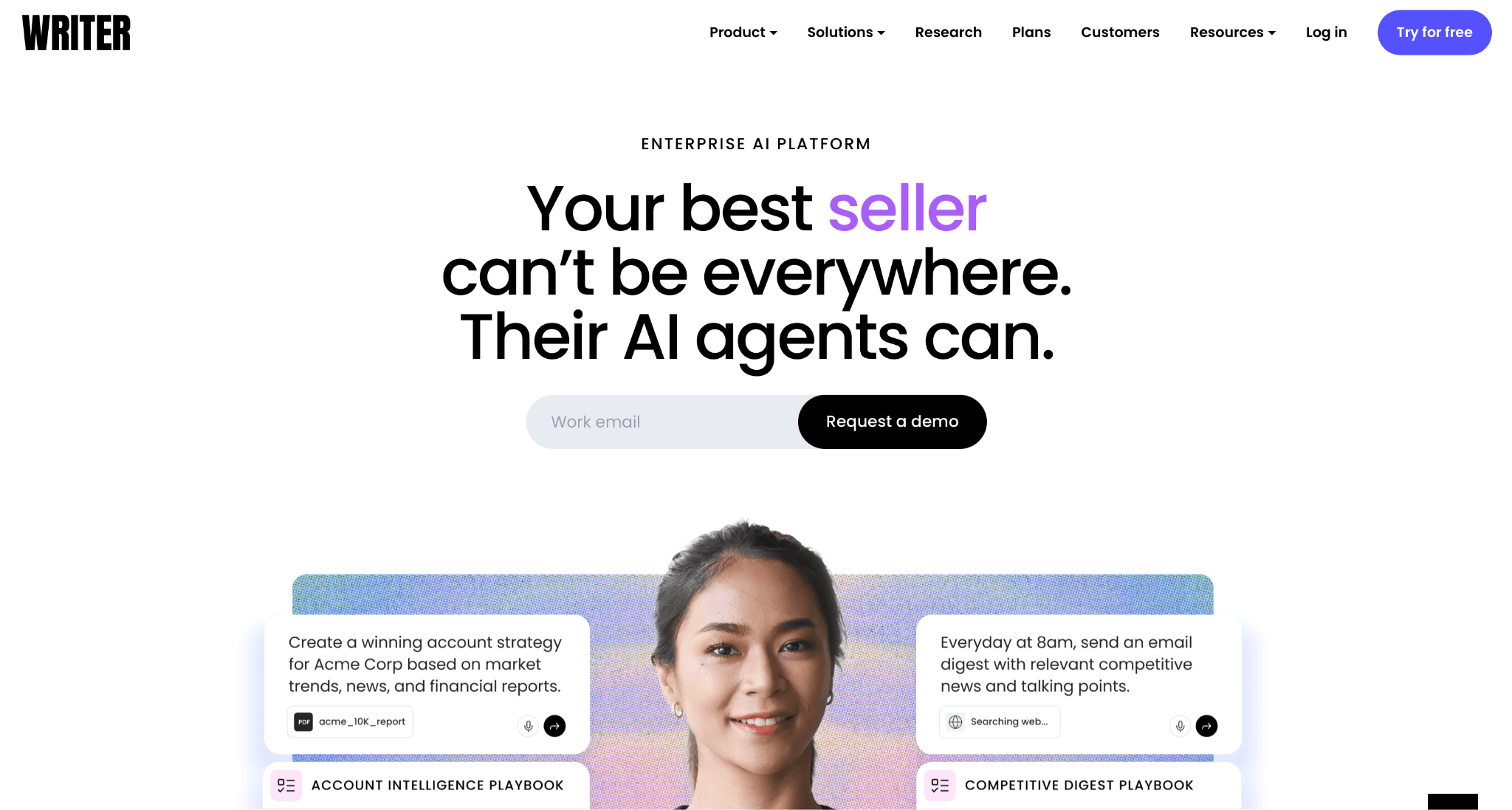
Writer has moved well beyond its original AI writing assistant positioning, now describing itself as an enterprise AI platform built for agentic work, delegating tasks to agents rather than prompting a single draft at a time. Its Knowledge Graph grounds agent output in a company's own facts and connectors, and enterprise governance features integrate with a company's existing identity and security systems.
Key features:
Agents completing tasks "start to finish" using company-specific context, not generic prompting
Knowledge Graph with connector support, capped at 50 GB on the Starter tier
Playbooks defining repeatable routines and workflows for a team
Enterprise governance including SAML SSO, SCIM, MFA, and SOC 2 Type II, with HIPAA/BAA available
Pros:
14-day free trial with no credit card required on Starter
Starter plan supports up to 5 users with agent access and basic connectors, enough to test real usage before scaling
Deep enterprise security options (SOC 2 Type II, HIPAA/BAA) available even outside a full custom Enterprise deal
Cons:
The Starter plan's actual monthly price isn't published anywhere on the site, it's only revealed after creating an account, hard to budget without signing up first
Only two tiers exist, Starter and Enterprise, leaving a real gap for a mid-size team that has outgrown Starter's 5-user cap but isn't ready for a full enterprise contract
G2 rating: 4.4/5
Pricing: Quote needed
Verdict: For an enterprise team ready to delegate real work to AI agents rather than just draft text, Writer's Knowledge Graph and governance features justify the jump once Starter's caps are outgrown, though the pricing gap to Enterprise is wide.
7. Sudowrite: Best for Novelists and Long-Form Fiction
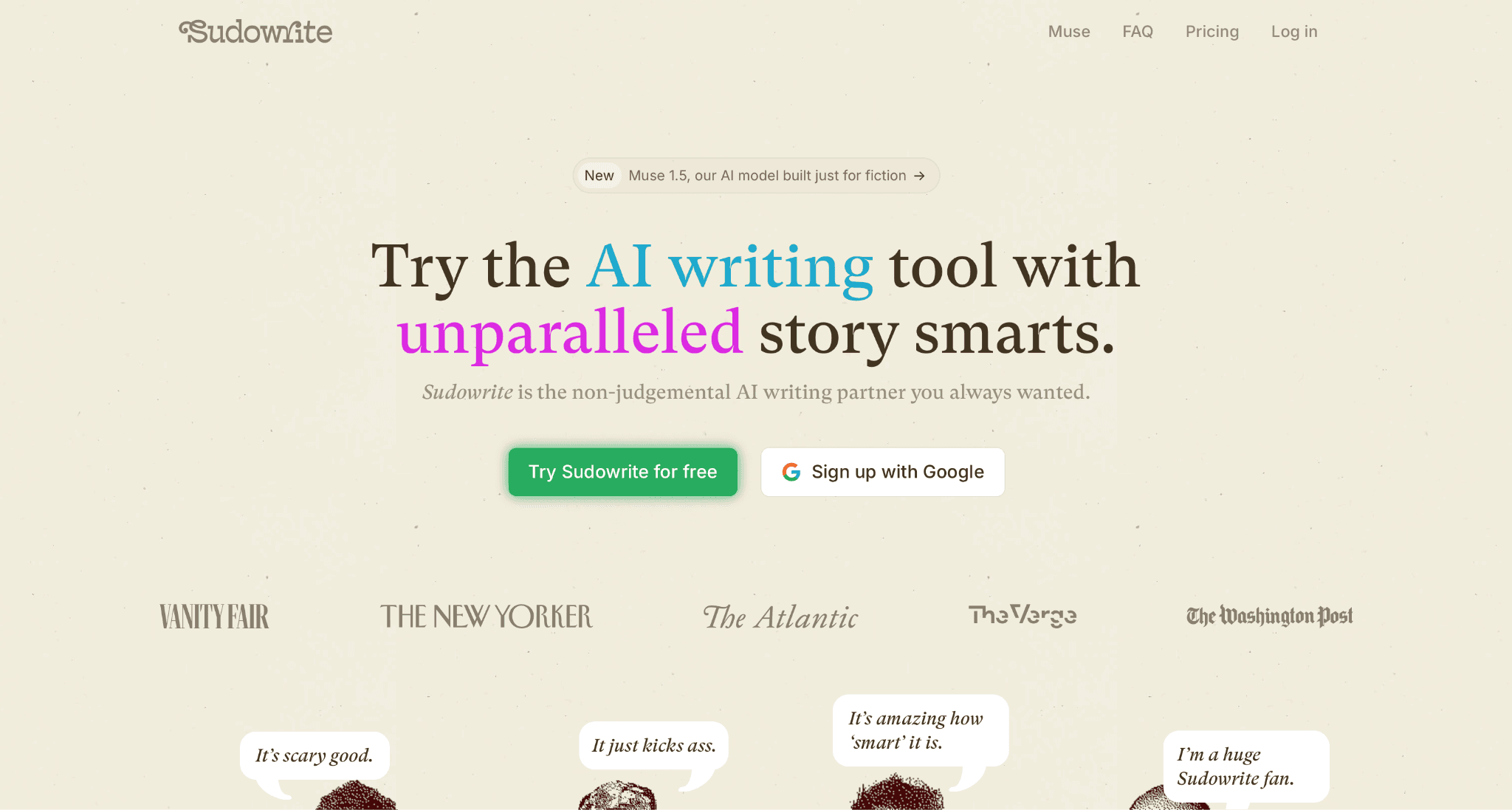
Sudowrite is built specifically for fiction, not general business or marketing writing, with its Story Bible feature guiding a writer from concept and outline through chapter beats to full prose in their own style. Muse, its custom AI model built for fiction, and Canvas, a brainstorming workspace for plot and character arcs, both support long-form creative work rather than short-form copy.
Key features:
Story Bible guiding a project from concept through outline, chapter beats, and full prose
Muse, a custom AI model trained specifically for fiction rather than general writing
Canvas workspace for brainstorming plot points, character arcs, and themes
Write feature generating roughly 300-word continuations based on characters, tone, and plot already established
Pros:
All tiers include full feature access, plans differ only by credit volume and rollover, not by locked features
Max tier's unused credits roll over for 12 months, useful for a writer whose output varies month to month
No credit card required to start, with an EZ Cancel Guarantee
Cons:
The Professional tier's credit allotment is shown inconsistently between the pricing page and Sudowrite's own docs (450,000 credits in one place, 1,000,000 in another), worth confirming directly before assuming either figure
Built specifically for fiction, a team needing marketing or business copy would be better served by a general-purpose writing tool
G2 rating: Not enough ratings.
Pricing: Hobby & Student $19/mo | Professional $29/mo | Max $59/mo
Verdict: For a novelist or screenwriter who needs a tool built around a whole manuscript rather than short-form copy, Sudowrite's Story Bible and fiction-specific model are worth the switch from a general-purpose AI writer.
8. Rytr: Best Budget AI Writing Tool With a Genuine Free Tier
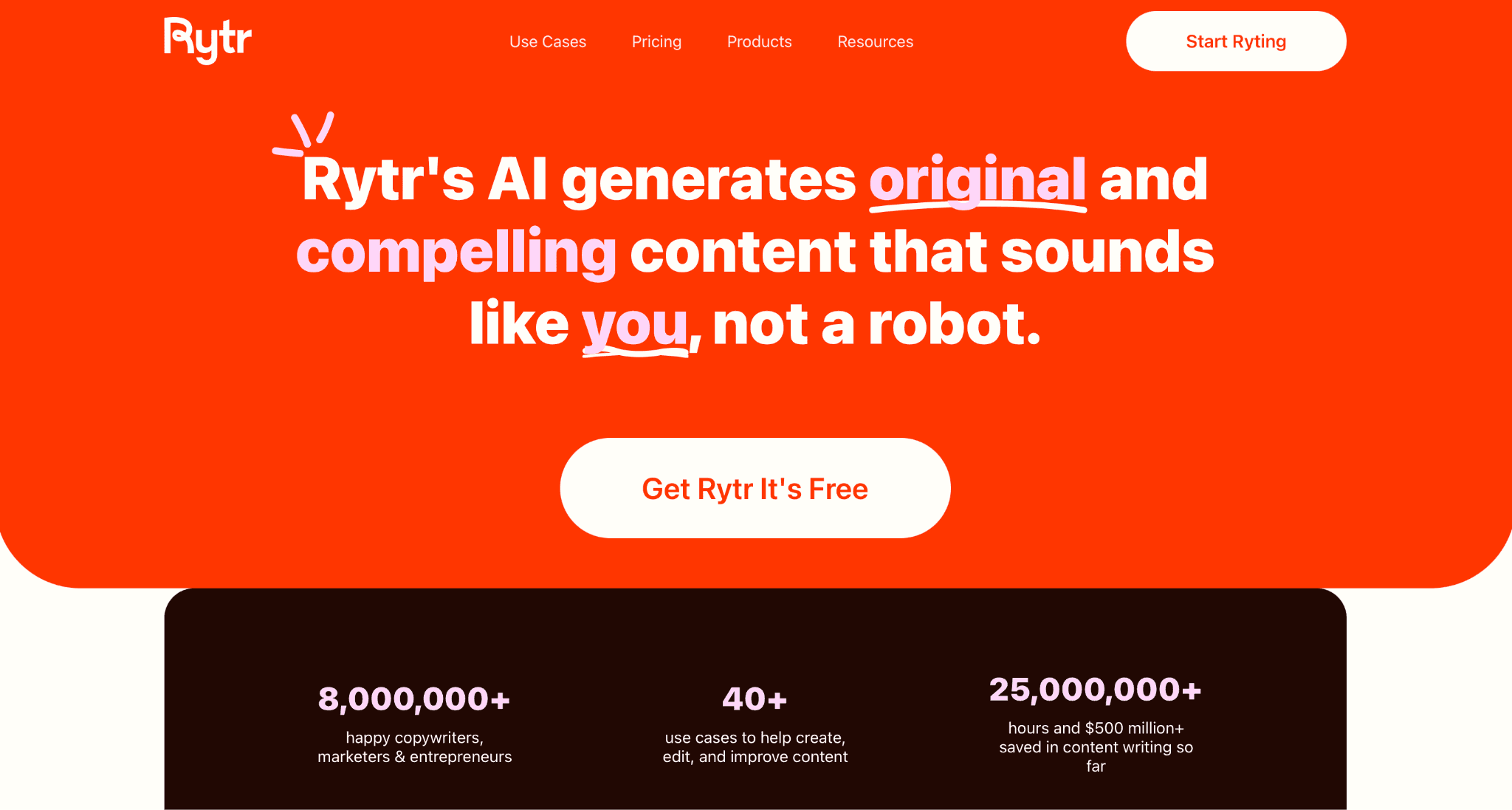
Rytr positions itself around affordability, with a permanent free tier and paid plans priced well below most of the other tools on this list. Its "My Voice" feature mirrors an individual's writing style across more than 20 pre-programmed tones, and its content library spans 40+ use cases and templates.
Key features:
40+ content use cases and templates, from blog sections to ad copy
"My Voice" feature mirroring an individual writer's style across 20+ tones
Built-in plagiarism checking on paid tiers
Chrome extension for writing directly in other apps and platforms
Pros:
Free forever tier with no credit card required, not a time-limited trial
Unlimited tier starts at $9/mo, among the least expensive paid AI writing plans available
Community access and priority support included on the Premium tier
Cons:
Rytr's own pages disagree on how many languages Premium supports, 35+ on the pricing table versus 40+ on the homepage, worth confirming directly before citing either figure
Free tier's 10,000 characters a month covers only light, occasional use rather than a real content workflow
G2 rating: 4.7/5
Pricing: Free $0 | Unlimited $9/mo | Premium $29/mo
Verdict: For an individual or small team that wants real AI writing capability without a real budget, Rytr's free tier and low-cost paid plans cover more than most budget tools in this space.
9. Grammarly: Best for Teams Already Using It for Editing Who Want AI Drafting Too
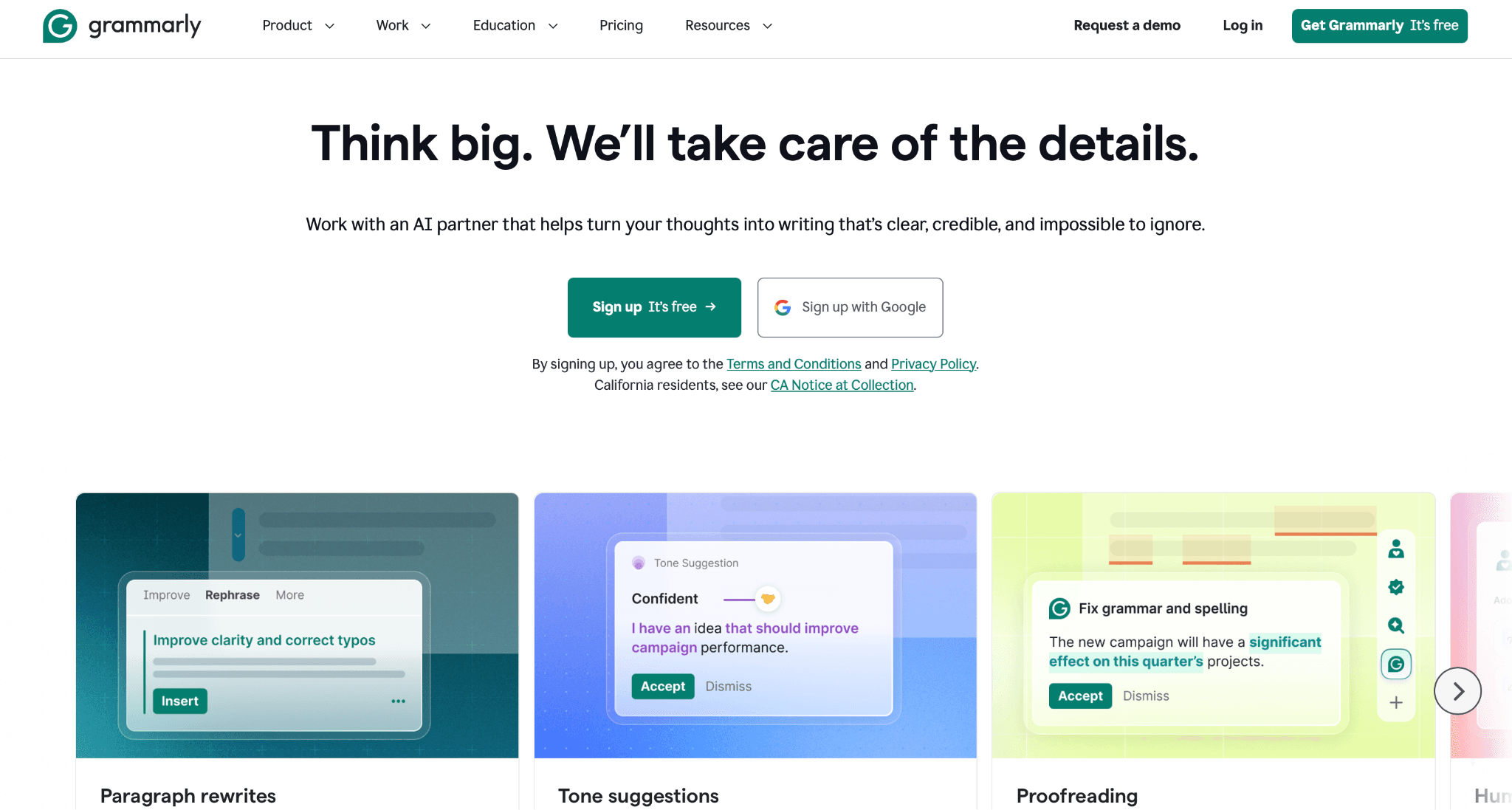
Grammarly's parent company rebranded to Superhuman in 2026, uniting Grammarly, Coda, and Superhuman Mail under one umbrella, though Grammarly itself keeps its existing name and product for current users. Its generative capability is built into the product as "AI prompts" rather than sold as a separate AI-writing product, alongside newer additions like an AI Humanizer agent and an AI Detector agent.
Key features:
AI prompts for paragraph rewrites, tone adjustment, and sentence-level fluency
AI Humanizer agent adding personality and natural variation to AI-assisted writing
AI Detector agent identifying AI-generated text
Tiered generative allowance, 100 AI prompts/month on Free, 2,000/month on Pro, unlimited on Enterprise
Pros:
Free tier includes 100 AI prompts a month alongside its core grammar and tone checking, not just correction
7-day free trial on Pro
Existing Grammarly users get AI drafting without switching to a separate product
Cons:
Whether the newer Superhuman Go AI agent is bundled into Pro or priced separately isn't specified anywhere on the site
Free tier's 100 AI prompts a month is modest for someone drafting original content regularly rather than mostly editing existing text
G2 rating: 4.7/5
Pricing: Free $0/mo | Pro $12/mo per member | Enterprise custom
Verdict: For a team already relying on Grammarly for editing, its built-in AI prompts are a reasonable way to add drafting without adopting a second tool, though a team writing from scratch regularly may want more generation capacity than the Pro tier includes.
10. Frase: Best for AI Content Paired With Ongoing Decay Detection
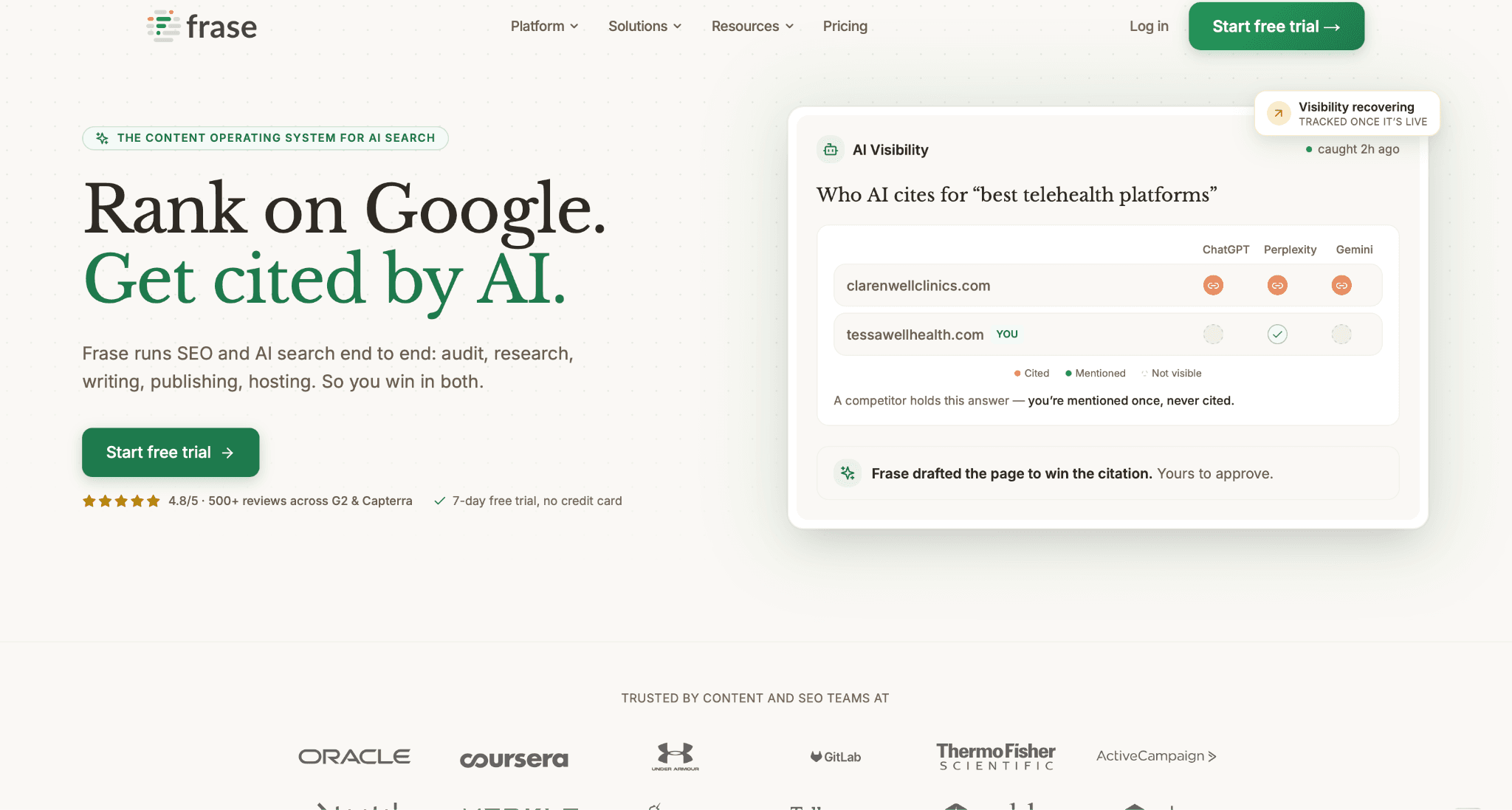
Frase has grown from an AI writing and SEO brief tool into what it calls a content operating system, pairing AI drafting with site audits, AI visibility monitoring across ChatGPT, Perplexity, Claude, and Gemini, and a Content Guard feature that detects when a published page starts losing rankings or traffic and drafts a fix.
Key features:
Site audits scoring pages for both SEO and AI readiness before content gets written
AI visibility monitoring across ChatGPT, Perplexity, Claude, and Gemini, updated daily
Content Guard detecting ranking or traffic decay and drafting fixes, with human approval by default
Direct publishing to WordPress, Webflow, Sanity, Wix, and Frase's own FraseCMS
Pros:
7-day free trial with no credit card required
Content Guard closes the loop on maintenance, not just initial drafting
Scale tier adds Claude and Gemini to AI visibility monitoring on top of the other tracked engines
Cons:
Entry Starter plan covers only 1 seat and 1 site, a small agency managing several client sites will need Professional or higher
Exact overage pricing beyond the included article and audit volume isn't published, worth confirming directly before assuming what happens past the monthly cap
G2 rating: 4.8/5
Pricing: Starter $49/mo | Professional $129/mo | Scale $299/mo | Enterprise custom
Verdict: For a team that wants AI content generation paired with ongoing monitoring of whether that content keeps performing, Frase's Content Guard is the reason to pick it over a tool that stops at the first draft.
How to Choose AI Writing Software
Match the tool to the job it's actually built for, general marketing copy, enterprise agent workflows, fiction, or SEO-driven content, rather than picking the most well-known name and forcing it to fit.
Check whether the tool's pricing is truly self-serve and published, or gated behind an account signup or sales call, before assuming a number applies to a real budget.
Weigh a permanent free tier or genuine trial against a tool's real capability, a generous free plan on a limited tool is worth less than a short trial on the tool that actually fits the job.
Frequently Asked Questions
Is there a genuinely free AI writing tool?
Rytr has a permanent free tier with no credit card required, capped at 10,000 characters a month. Grammarly's free tier includes 100 AI prompts a month alongside its grammar checking. Most other tools on this list offer only a short free trial rather than an ongoing free plan.
What's the difference between a general AI writing tool and one built for SEO?
A general tool like Jasper or Copy.ai focuses on marketing copy and workflow automation without necessarily analyzing what's already ranking. Surfer AI and Frase both analyze existing top-performing content and AI-engine citations before drafting, aiming the output at a specific ranking or citation gap rather than a general prompt.
Do any of these tools check whether AI engines like ChatGPT or Gemini are citing the content afterward?
Yes. AIclicks, Surfer AI, and Frase all include AI visibility or citation tracking alongside their writing capability, so a team can see whether a published piece is actually getting cited rather than assuming it worked.
Which of these tools is best for a solo writer versus a team?
Rytr and Sudowrite work well for a single writer on a tight budget. Jasper, Writer, and Copy.ai are built around multiple seats, shared brand voice, and workflow governance, better suited to a team than an individual.
Should a startup pick the cheapest AI writing tool or the one with the most features?
Neither by default. The cheapest tool is only a good deal if it actually covers the job, and the most feature-rich tool is wasted if half its capability goes unused. Matching the tool to the specific writing job, marketing copy, technical documentation, fiction, or SEO content, matters more than price or feature count alone.




¿Te queda alguna duda?
Reserva una llamada aquí: