

Revisado por:
Rokas Stankevicius

Founder @aiclicks.io
Última actualización:
Verificado por expertos

Auditoría de visibilidad de IA gratuita
Key Takeaways
Perplexity builds its answers from a handful of cited sources rather than a ranked list of links, so agencies frame the work around fresh information, clear direct answers, and recognized expertise rather than traditional keyword-ranking signals.
Perplexity's own crawler (PerplexityBot) and its Focus Modes (Academic, Writing, Reddit, YouTube, Social) create technical surface area that's different from generic AI-search work, worth asking an agency about directly rather than assuming "AI SEO" already covers it.
Content freshness runs on a specific cadence in at least one agency's approach here: a rolling 60-day refresh cycle tied to updating schema timestamps, since Perplexity favors recently updated sources when it cites.
The six entries here suit different profiles: established, broad-service agencies fit Coalition Technologies' and Techmagnate's scale, a UK or enterprise brand wanting Perplexity folded into an existing agency relationship fits Found, and a team that wants to run Perplexity visibility tracking itself fits AIclicks better than hiring any of the five service agencies.
Ask any agency to isolate Perplexity-specific results from a blended "AI" or "GEO" metric before hiring, since none of the named case studies across this list attribute a result to Perplexity citations specifically, they're general AI-search or AI Overview figures.
What Makes a Perplexity SEO Agency Worth Hiring
It explains how Perplexity actually selects sources, freshness, clarity, expertise, and crawler accessibility, rather than repeating generic "get cited in AI" language.
It backs claims with dated, named case studies rather than a vague promise with no track record behind it.
Its tracking separates Perplexity citation frequency and position from a blended, multi-platform "AI visibility" number.
Quick Comparison
Agency | Focus Area | Pricing | Standout Feature |
AIclicks | Self-serve AI visibility software | From $59/mo | Tracks and lets a team act on its own Perplexity visibility directly, without hiring an agency |
Victorious | Enterprise AEO, entity-first approach | Custom, consultation-based | Named, dated case studies (Delta Electronics, Porte Brown, SimplyFun), though not Perplexity-isolated |
Coalition Technologies | Established full-service AI SEO | Custom, consultation-based | Six-step AI Visibility Framework backed by a 250+ person team across nine offices |
Techmagnate | Dedicated Perplexity SEO service, established international agency | Custom, consultation-based | Structured Q&A content built for Perplexity's conversational query pattern |
Found | UK enterprise AI SEO | Custom, consultation-based | llms.txt configuration and proprietary Luminr tracking applied to Perplexity reporting |
Doc Digital SEM | Small agency, broad answer-engine coverage | Custom, consultation-based | One retainer covering Perplexity, AI Overviews, ChatGPT Search, Copilot, and Claude |
1. AIclicks: Best for Running Perplexity Visibility Tracking In-House Instead of Hiring It Out
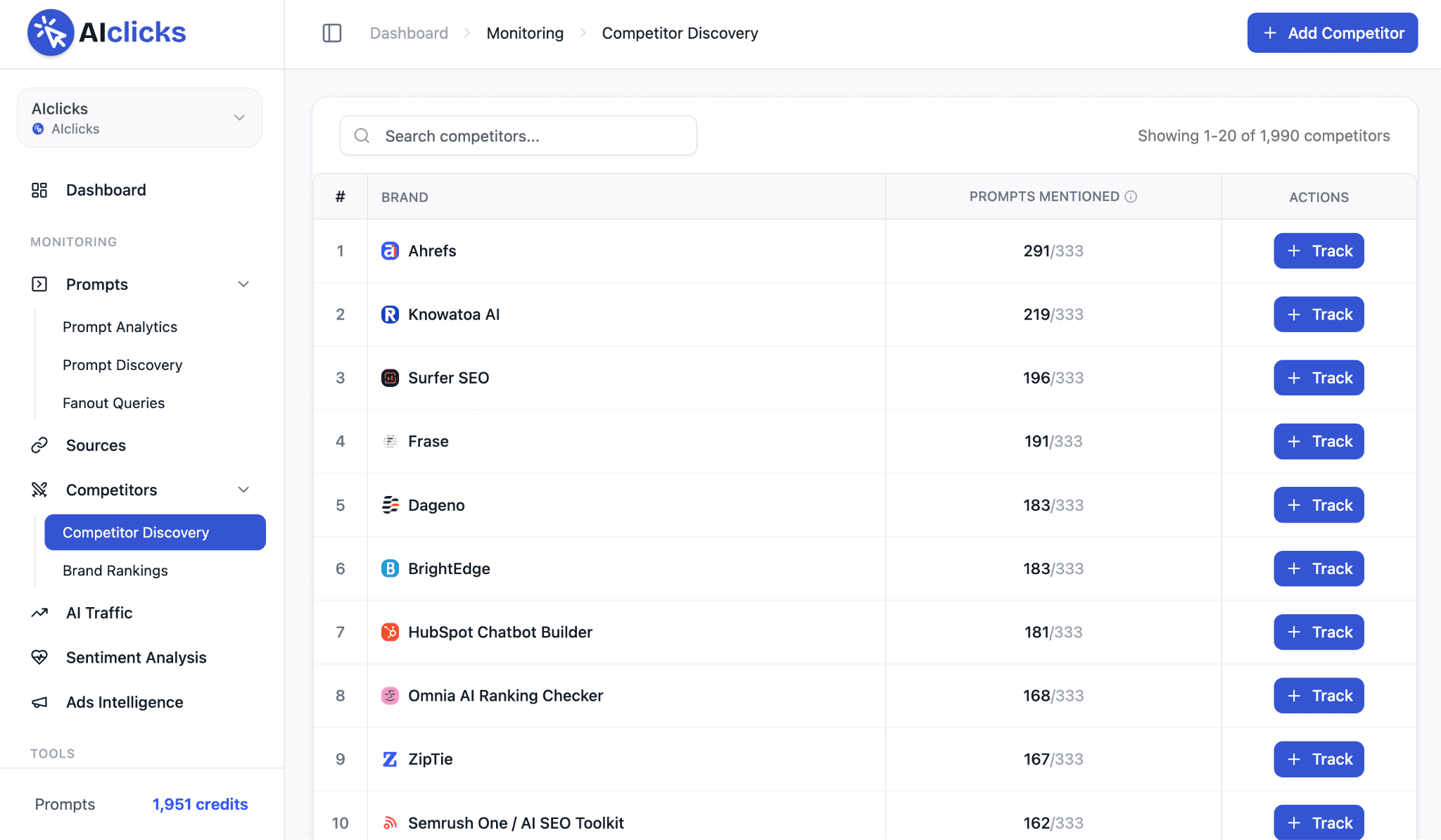
AIclicks is a self-serve AI visibility platform, not a service agency. It tracks how often and where a brand gets cited across 10+ AI platforms including Perplexity, ChatGPT, Gemini, Claude, Google AI Overviews, and Copilot, then gives a team the tools to close visibility gaps itself: Prompt Analytics for tracking, Sources and Competitor Discovery for citation intelligence, AI Traffic for GA4-connected referral tracking, and an Actions suite (Writer 2.0, Get Mentioned, Engage Online) for acting on what the tracking finds. A team gets much of the same visibility and execution capability the agencies below sell as a service, but runs it directly rather than handing it to outside consultants.
Key features:
Prompt Analytics tracking Perplexity visibility alongside ChatGPT, Gemini, Claude, AI Overviews, and Copilot in one dashboard
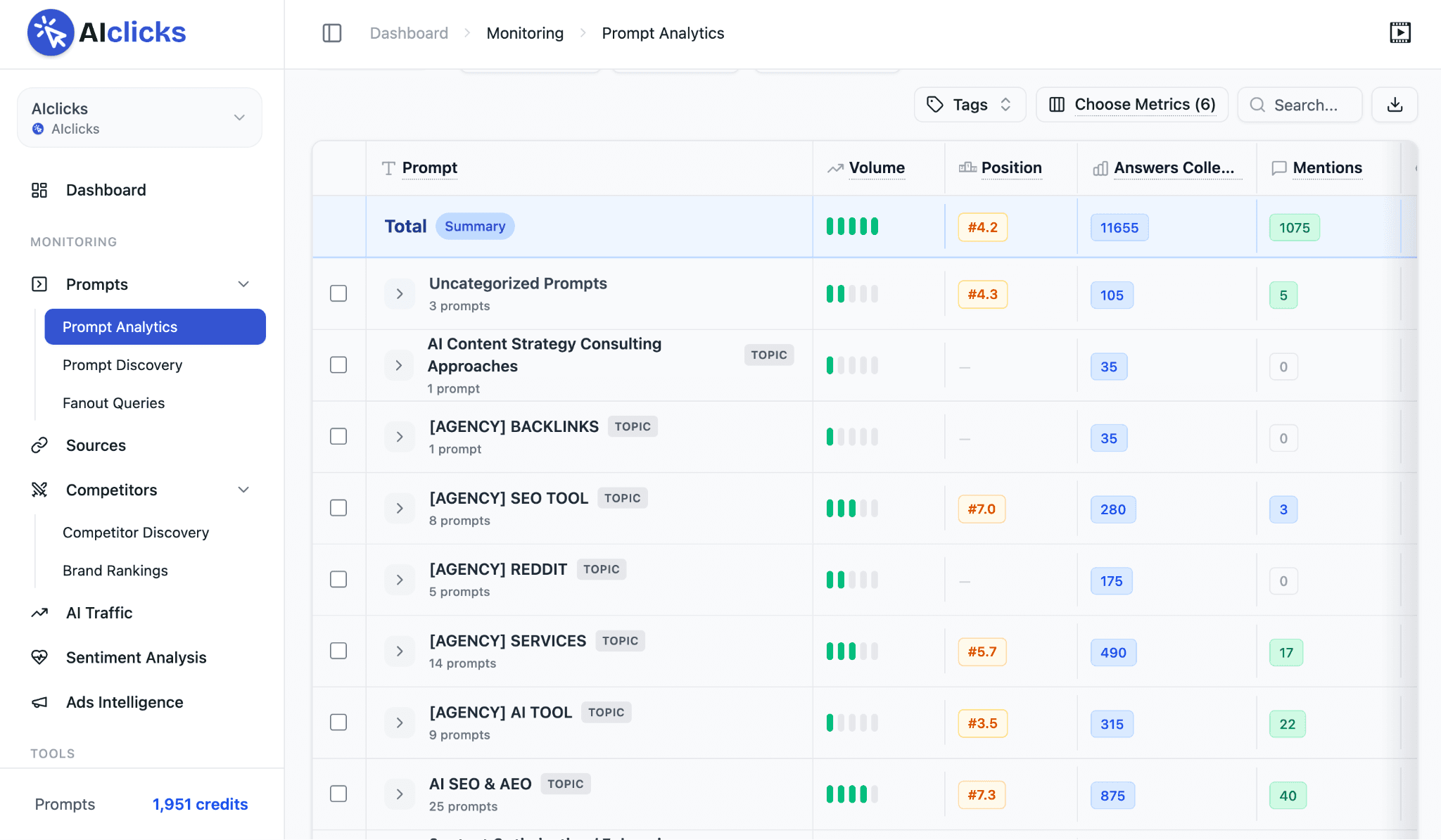
Sources and Competitor Discovery showing which pages get cited in Perplexity's answers and which competitors get cited instead
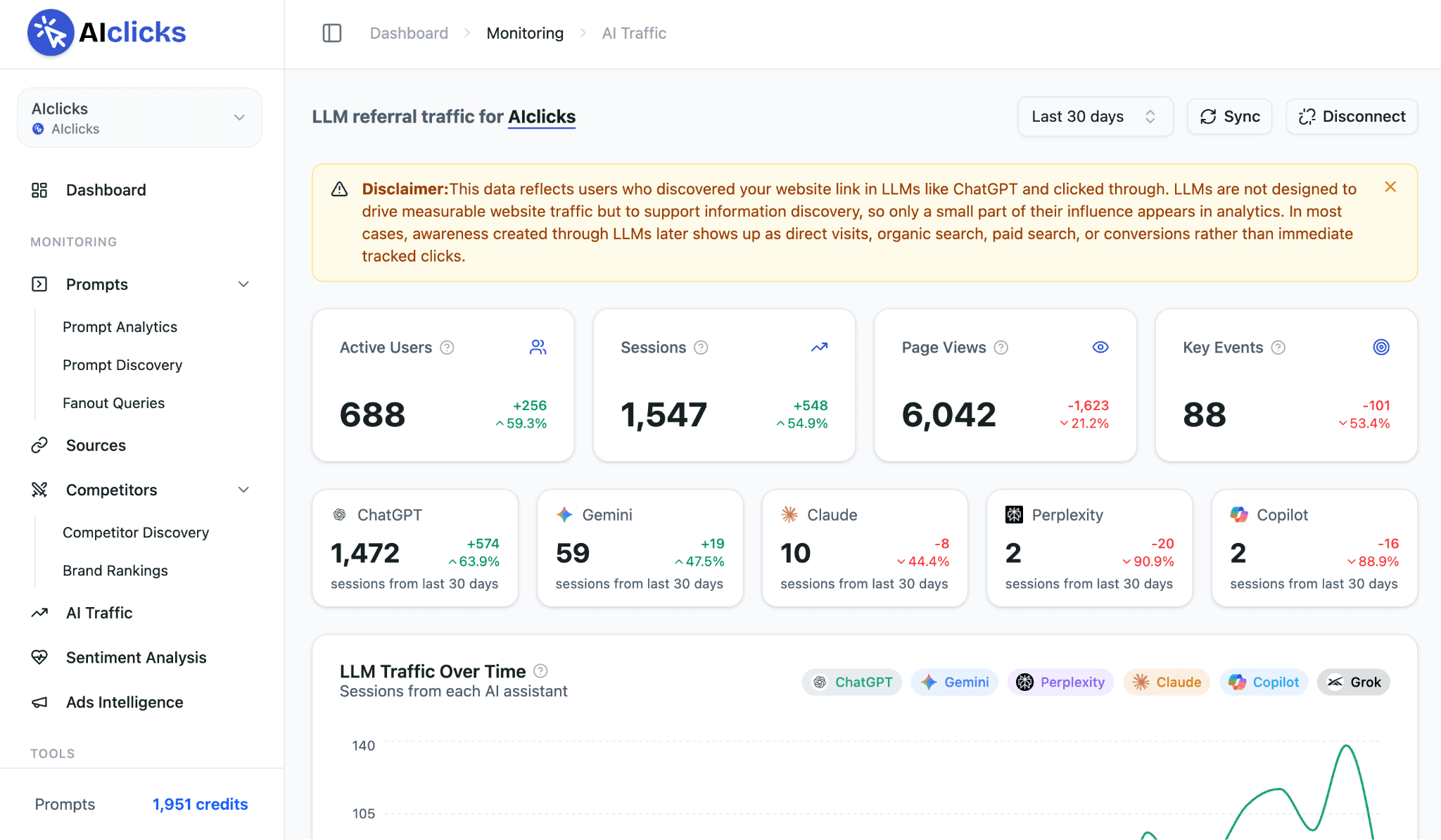
AI Traffic connecting to GA4 to measure actual referral traffic from Perplexity and other AI engines
Actions suite (Writer 2.0, Get Mentioned, Engage Online) turning tracked gaps into published content and outreach directly

Pros:
Published, self-serve pricing rather than a custom quote gated behind a sales call
A team can see and act on its own Perplexity visibility without waiting on an agency's reporting cycle
3-day free trial with no credit card required on Starter and Pro
Cons:
It's software rather than a full-service agency, a team without in-house capacity to act on what the tracking finds will still need to pair it with an agency or hire for content and outreach execution
Enterprise-scale multi-brand tracking sits behind a custom Enterprise plan rather than the published Business tier
Pricing: Starter $59/mo (30 prompts, 1 website, 3 LLMs, 4,650 monthly LLM responses, 5 articles/mo) | Pro $189/mo (150 prompts, unlimited websites, 4 LLMs, 18,600 monthly LLM responses, 15 articles/mo) | Business $499/mo (300 prompts, 6 LLMs, 55,800 monthly LLM responses, 30 articles/mo, dedicated account specialist) | Enterprise custom | 3-day free trial on Starter and Pro, no credit card required
Verdict: For a team that wants to see its own Perplexity visibility and act on it directly rather than hand the whole job to an outside team, AIclicks gives the tracking and execution tools to do that in-house, though it doesn't replace an agency's hands-on strategy and execution when that capacity doesn't exist internally.
If you’re not sure where to start your Perplexity journey, first check how to find your highest-impact GEO opportunities:
2. Victorious: Best for Enterprise AEO With an Entity-First Approach to Perplexity
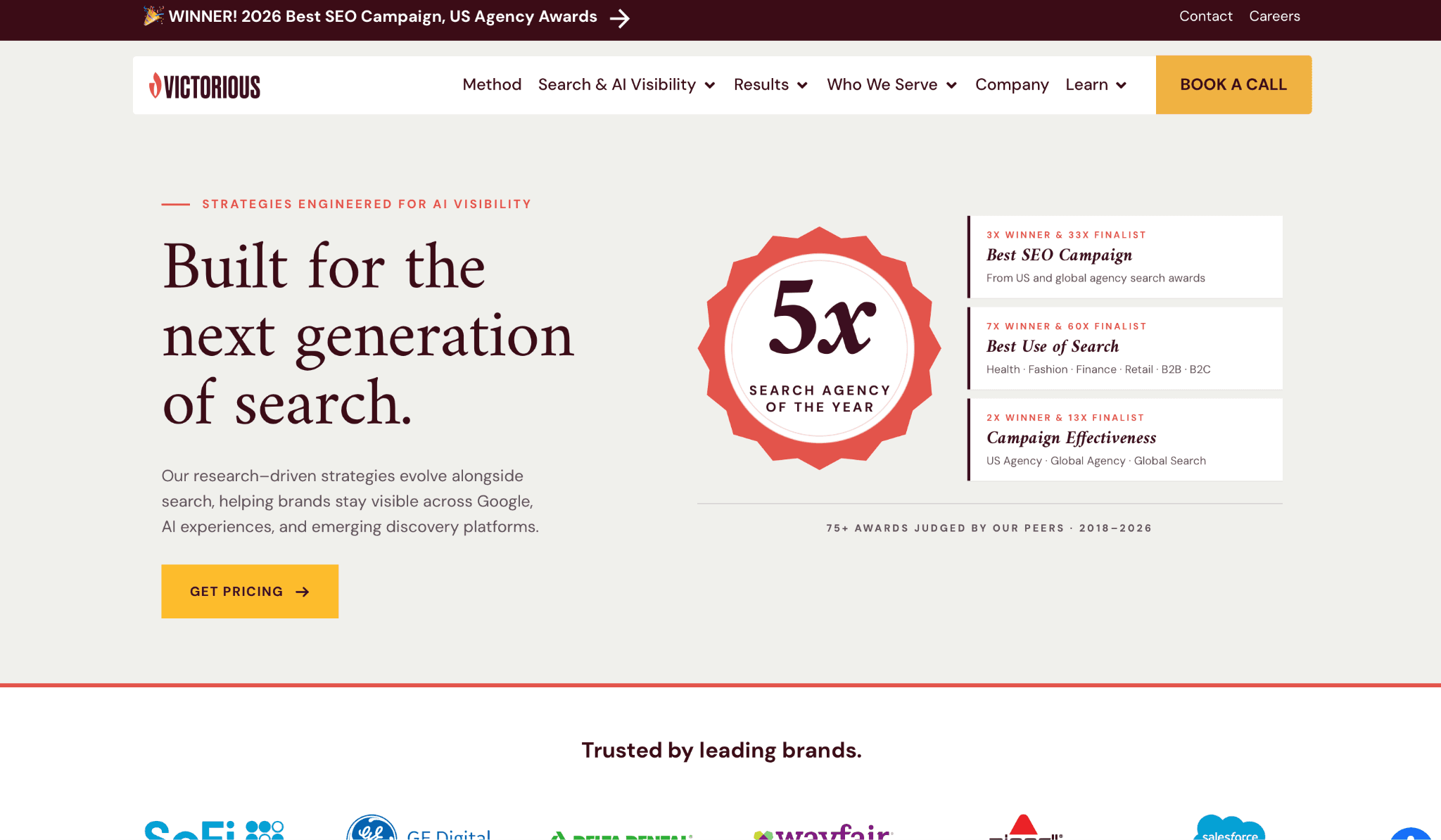
Victorious frames Perplexity as fundamentally different from a ranked results page: "Perplexity doesn't list links. It builds answers from a handful of cited sources." Its approach centers on an entity-first structure built on four pillars, entity foundations for inclusion, prompt and query research for targeting, content strategy for retrieval, and off-site presence for authority, aimed at the three factors it says help brands earn citations: fresh information, clear answers, and recognized expertise. Founded in 2013, the agency has picked up recognition including Global SEO Agency of the Year from Search Engine Land and Enterprise SEO Agency of the Year from Clutch.
Key features:
Entity-first approach built on four pillars: entity foundations, prompt and query research, content strategy, and off-site authority
Named factors it says drive Perplexity citations: fresh information, clear answers, and recognized expertise
Multiple industry awards, including Global SEO Agency of the Year (Search Engine Land) and Enterprise SEO Agency of the Year (Clutch)
Dedicated AEO sub-pages for several AI platforms rather than one generic AI-search page
Pros:
Long operating history and multiple independently awarded recognitions
Clear, specific framing of what actually drives a Perplexity citation rather than vague "AI visibility" language
Named, dated case studies exist for the broader AEO practice (Delta Electronics, Porte Brown, SimplyFun)
Cons:
The case studies shown on the Perplexity page are the same figures reused from its general AEO hub page; none of the metrics isolate a Perplexity-specific result
No pricing published anywhere on the site; every engagement routes to a consultation
Pricing: Custom, consultation-based
Verdict: For an enterprise brand that wants Perplexity work framed around a clear, specific point of view on what drives citations, Victorious's entity-first approach makes a reasonable case, though a prospect should ask for a Perplexity-isolated result before assuming the reused case studies apply directly.
3. Coalition Technologies: Best for Scale and a Named AI Visibility Framework
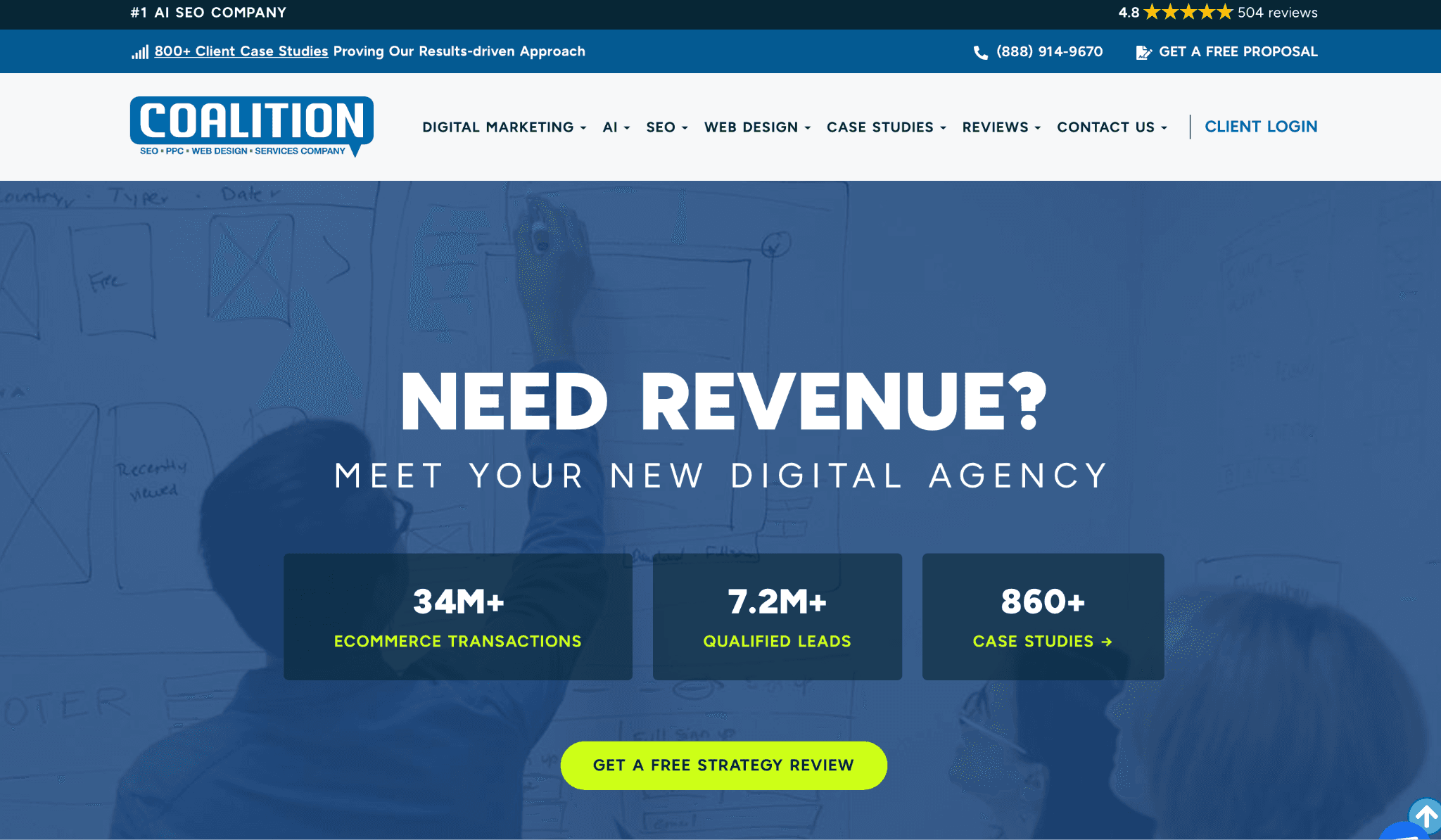
Coalition Technologies, founded in 2009 in Venice Beach and now running 250+ staff across nine offices, treats Perplexity as one part of a broader AI SEO practice built on a six-step AI Visibility Framework: entity clarity, technical accessibility, extractable answers, third-party validation, AI citation and perception tracking, and conversion paths. For Perplexity specifically, the work centers on scannability and citation-worthiness, optimizing content so Perplexity can find accurate information as quickly as possible.
Key features:
Six-step AI Visibility Framework: entity clarity, technical accessibility, extractable answers, third-party validation, AI citation and perception tracking, conversion paths
250+ staff across nine offices, one of the larger agencies covered in this list
Google Premier Partner and Shopify Premier Partner status, plus a Clutch "Top Generative Engine Optimization Company (2026)" badge
800+ client case studies referenced across its broader AI SEO practice
Pros:
Large, established agency with independently verifiable recognition (Clutch 4.8 stars, Google 4.8 stars, Forbes Business Council membership)
Named AI-search case studies with dated metrics: Omni Cheer (+7,620% AI search sessions), GK Elite (+5,087%), Sugatsune America (+261.6%)
Explicit statement that pricing is custom-built around each client rather than a fixed package, setting expectations clearly upfront
Cons:
No case study or metric anywhere on the site isolates a Perplexity-specific result; every named figure covers AI search or GEO broadly
No pricing range or starting figure published anywhere, including the Perplexity-specific page
Pricing: Custom, consultation-based
Verdict: For a brand that wants Perplexity work handled by a large, well-recognized agency with a named framework behind the work, Coalition Technologies' scale and track record stand out, though the Perplexity-specific proof is thinner than its broader AI SEO results.
4. Techmagnate: Best for Structured Content Built Around Perplexity's Conversational Query Pattern
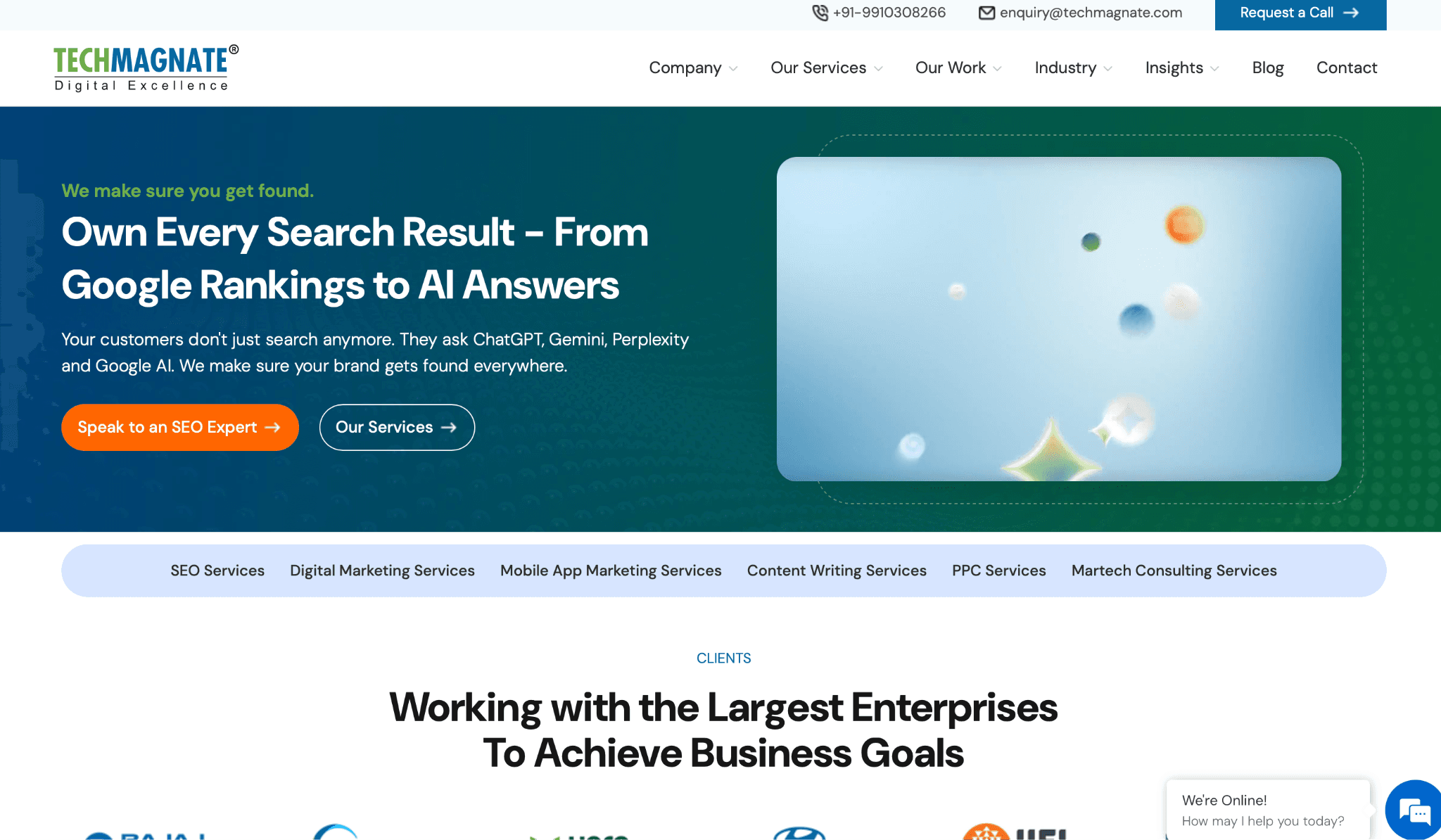
Techmagnate, founded in 2006 and running 300+ staff across five Indian offices, builds Perplexity work around structured, Q&A-style content matching how people actually phrase conversational queries. Its approach pairs LLM-specific optimization with traditional SEO, aiming for content that's summary-ready through schema, headings, and bullet points that support citation, and it draws a direct contrast between Perplexity-style optimization (citations, authority, structured content) and traditional keyword-based SEO.
Key features:
Structured Q&A-style content formatting matched to Perplexity's conversational query pattern
A direct comparison framework contrasting citation-and-authority optimization against traditional keyword SEO
Summary-ready content built with schema, headings, and bullet points to support citation
Combines LLM-specific optimization with a traditional SEO base rather than treating them separately
Pros:
Long operating history (founded 2006) with a large team and international offices across India
Client roster includes recognizable names like Bajaj Finserv, Airtel, Honda, and Mahindra, though not tied to Perplexity-specific results
Clear, direct explanation of how Perplexity-style content differs from traditional keyword SEO
Cons:
No pricing figures of any kind appear on the site; specific dollar ranges reported by third-party sources couldn't be confirmed on techmagnate.com itself
No dated case study or named client result ties specifically to Perplexity or GEO performance
Pricing: Custom, consultation-based
Verdict: For a brand that wants a clear explanation of how Perplexity content differs from traditional SEO from an established international agency, Techmagnate's structured approach is a reasonable starting point, though a prospect should ask directly for pricing and a Perplexity-specific reference.
5. Found: Best for UK Enterprise Brands Wanting Perplexity Folded Into an Existing Agency Relationship
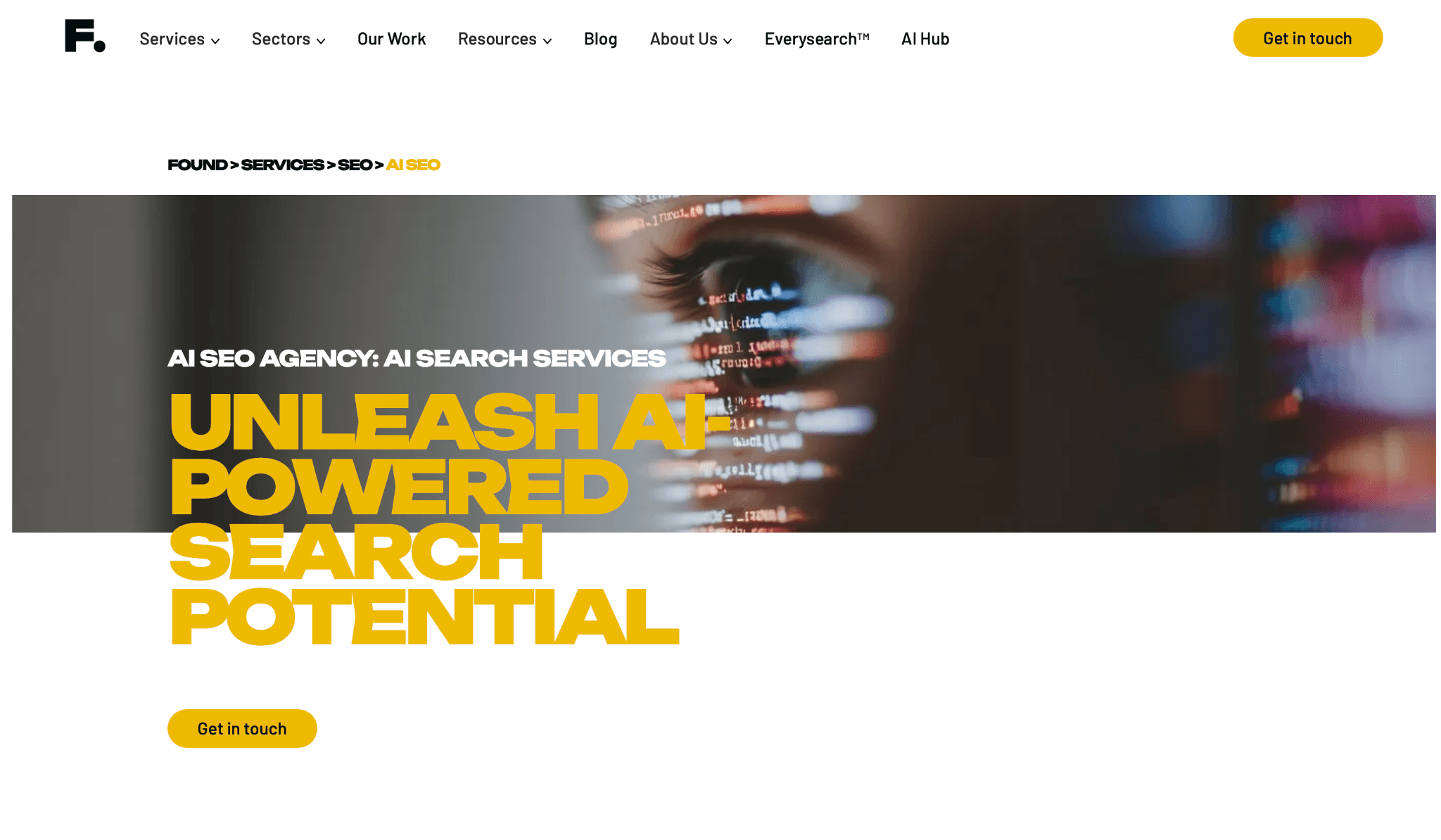
Found’s Perplexity work treats the platform as fundamentally different from a ranked results page, synthesizing information from across the web into direct, cited answers rather than serving up a list of links, and it explicitly names llms.txt configuration and structured data as part of the technical groundwork. Brand appearance inside Perplexity is tracked through Luminr, the same in-house tool Found uses across other AI platforms, alongside its broader Everysearch framework.
Key features:
Technical SEO for Perplexity explicitly naming llms.txt configuration and structured data
Digital PR and citation building framed around the credibility Perplexity requires before it cites a source
Luminr, an in-house tool tracking brand appearance inside Perplexity's answers
A stated ranking explanation: domain authority, content relevance and accuracy, and how well content is structured for AI retrieval
Pros:
Long operating history (founded 2005) and a large team relative to most agencies on this list
Sells directly to brands with a named account team, rather than working white-label through other agencies
Recognized industry credentials, including Google Premier Partner status and Great Place to Work recognition for five consecutive years
Cons:
No pricing published anywhere on the site, including the Perplexity-specific page
The only case study shown on the Perplexity page (Questback, +134% YoY organic traffic) measures a general site migration result, not a Perplexity-attributed citation metric
Pricing: Custom, consultation-based
Verdict: For a UK or enterprise brand that wants Perplexity visibility handled as one part of a larger, already-established agency relationship, Found's scale and in-house tracking tools make a reasonable case, though a prospect should ask for a Perplexity-isolated result rather than the general migration case study shown on the page.
6. Doc Digital SEM: Best for a Small Team Wanting Broad Answer-Engine Coverage in One Retainer
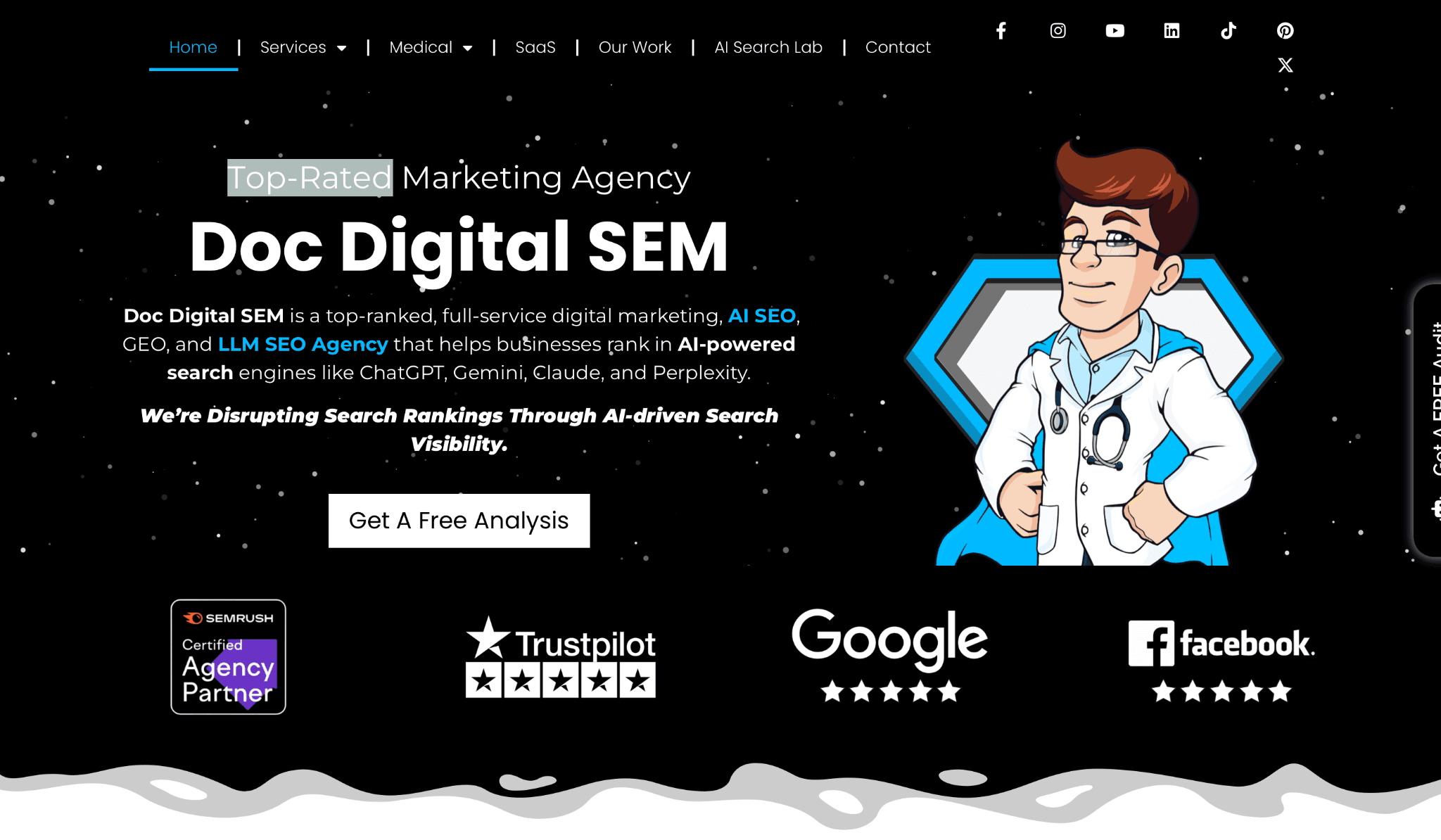
Doc Digital SEM is a small agency based in Fort Lauderdale, Florida, covering Perplexity alongside Google AI Overviews, ChatGPT Search, Microsoft Copilot, and Claude under one answer-engine optimization service rather than treating each platform separately. Its approach centers on citation-based visibility rather than traditional rankings, covering search optimization, AI-discovery web design, keyword and question research, on-site and off-site optimization, local SEO, content marketing, content distribution, and authority building.
Key features:
One retainer covering Perplexity alongside Google AI Overviews, ChatGPT Search, Microsoft Copilot, and Claude
Citation-based visibility framing rather than traditional keyword-rank tracking
Eight-part service list spanning technical optimization, content, and authority building
A free digital marketing analysis, valued at $1,500 on its own site, offered as an entry point
Pros:
Broad answer-engine coverage in a single service, useful for a small team that doesn't want to buy separate platform-specific engagements
Verifiable through Crunchbase and a Semrush Certified Agency Partner badge
Named testimonial clients (Florida VIP Party Bus, Sublime Pools & Spa) suggest a real, active small-business client base
Cons:
Small team (1-10 employees per Crunchbase), a different scale than the larger agencies on this list
No case study or client result anywhere on the site ties to Perplexity or AI-search work specifically; the two named case studies (Therapeutic Scuba, Freakin' Fitness) aren't attributed to answer-engine work
Pricing: Custom, consultation-based
Verdict: For a small business that wants one retainer covering Perplexity and several other AI platforms rather than five separate engagements, Doc Digital SEM's bundled approach fits, though its scale and lack of Perplexity-specific proof make it a bigger leap of faith than the larger names on this list.
How to Choose a Perplexity SEO Agency
Ask whether Perplexity-specific results are actually isolated in a case study, or blended into a general "AI search" or "GEO" figure; none of the named case studies across this list attribute a result to Perplexity citations specifically.
Decide whether the job needs a software platform a team runs itself or a full-service agency handling strategy and execution, since AIclicks and the five service agencies here solve different problems.
Ask directly about PerplexityBot crawler accessibility and content freshness cadence, since these are concrete, checkable technical factors rather than vague "AI visibility" promises.
Frequently Asked Questions
How is Perplexity different from ChatGPT or Google AI Overviews for SEO purposes?
Perplexity builds its answers from a handful of cited sources rather than a ranked list of links, and its own Focus Modes (Academic, Writing, Reddit, YouTube, Social) shape what it treats as a credible source for a given query, technical and content factors that don't map exactly onto ChatGPT or Google AI Overviews optimization.
Does Perplexity have its own crawler, and does that matter for SEO?
Yes. PerplexityBot needs explicit robots.txt access to crawl and index a site's content, so confirming crawler accessibility is a concrete first step before any content or citation-focused work begins.
How much does a Perplexity SEO or GEO engagement typically cost?
Almost none of the agencies on this list publish pricing; every one of them routes to a consultation or contact form. Treat any third-party-reported price range for these agencies as unconfirmed until verified directly with the agency.
Can a team track its own Perplexity visibility without hiring an agency?
Yes. A platform like AIclicks lets a team track its own Perplexity citations and competitor visibility directly and act on gaps it finds, a different path than handing the entire strategy to an outside agency.
How is success measured in Perplexity-specific SEO work?
Citation frequency, citation position, and content freshness are the metrics worth asking about specifically, since most published case studies across this list measure general AI-search or AI Overview results rather than isolating Perplexity.


¿Te queda alguna duda?
Reserva una llamada aquí: