" width="14px"><path d="M 13.864 5.629 L 13.3 5.629 L 13.3 5.6 L 7 5.6 L 7 8.4 L 10.956 8.4 C 10.379 10.03 8.828 11.2 7 11.2 C 4.681 11.2 2.8 9.319 2.8 7 C 2.8 4.681 4.681 2.8 7 2.8 C 8.071 2.8 9.045 3.204 9.786 3.864 L 11.766 1.884 C 10.516 0.719 8.844 0 7 0 C 3.134 0 0 3.134 0 7 C 0 10.866 3.134 14 7 14 C 10.866 14 14 10.866 14 7 C 14 6.531 13.952 6.073 13.864 5.629 Z" fill="rgb(255, 193, 7)" height="14px" id="H_YjfTNpn" width="14px"/><path d="M 0 3.742 L 2.3 5.429 C 2.922 3.888 4.429 2.8 6.193 2.8 C 7.264 2.8 8.238 3.204 8.979 3.864 L 10.959 1.884 C 9.709 0.719 8.037 0 6.193 0 C 3.504 0 1.172 1.518 0 3.742 Z" fill="rgb(255, 61, 0)" height="5.428500000000002px" id="PlkthQDhg" transform="translate(0.875 0)" width="10.959199999999996px"/><path d="M 6.232 5.581 C 8.04 5.581 9.683 4.889 10.925 3.764 L 8.758 1.931 C 8.032 2.483 7.144 2.782 6.232 2.781 C 4.411 2.781 2.865 1.62 2.283 0 L 0 1.759 C 1.159 4.026 3.511 5.581 6.232 5.581 Z" fill="rgb(76, 175, 80)" height="5.581099999999999px" id="WlnJ5gngE" transform="translate(0.7 8.4)" width="10.924899999999994px"/><path d="M 6.864 0.029 L 6.3 0.029 L 6.3 0 L 0 0 L 0 2.8 L 3.956 2.8 C 3.68 3.576 3.183 4.254 2.526 4.75 L 2.527 4.749 L 4.693 6.582 C 4.54 6.722 7 4.9 7 1.4 C 7 0.931 6.952 0.473 6.864 0.029 Z" fill="rgb(25, 118, 210)" height="6.589883930775992px" id="x_rSW275p" transform="translate(7 5.6)" width="7px"/></g></svg>)



Reviewed by:
Rokas Stankevicius

Founder @ aiclicks.io
Last updated:
Expert Verified

Search is in its “answers era.”
Between Google AI Overviews rolling out to 200+ countries and 40+ languages and ChatGPT-style experiences becoming a daily habit, we’re watching a big shift: users want direct answers, not ten blue links.
That’s why Generative Engine Optimization (GEO) (also called answer engine optimization) is moving from “nice to have” to “if you ignore it, you’ll lose visibility.”
Below are the top GEO trends I’m seeing right now, and how to turn them into a practical GEO strategy for brand visibility across major AI engines.
Top GEO Trends in 2026 (TL;DR)
Here’s what’s driving GEO adoption right now:
Zero-click searches are rising as AI-generated summaries sit above classic search results.
AI Overviews expands globally, and Google reports increased usage for queries that trigger Overviews.
GEO success is becoming “citation-first”: being mentioned and cited matters as much as (or more than) rankings.
Multi-engine reality: your brand’s AI visibility varies wildly across ChatGPT Search, Perplexity, Gemini/AI Overviews, and others.
Structured, quotable content wins (and it’s not the same as writing for traditional SEO).
Tracking AI visibility is now a core marketing workflow, because old-school metrics don’t tell the full story anymore.
What GEO Actually Means (and why it’s not “just SEO with a new name”)
Generative engine optimization is the practice of increasing your brand’s AI visibility inside AI-generated answers, the responses produced by AI systems (powered by large language models) across AI search experiences.
Traditional SEO focuses on ranking pages in traditional search. GEO focuses on:
whether your brand appears in AI answers,
whether your site is cited,
and how AI engines interpret and describe your brand (brand perception).
That difference is why traditional SEO metrics (rank, CTR, organic sessions) can look “fine” while your AI presence is basically zero.
Take a look at this article to learn about the top ChatGPT ranking factors.
Trend #1: AI summaries are accelerating zero-click behavior
This is the most important “why now” trend.
A zero-click search happens when the user gets what they need directly on the results page (or inside an AI assistant) and doesn’t click through. Similarweb describes how SERP features, now including AI Overviews, drive this behavior.
There’s also public reporting (based on Similarweb data) that no-click outcomes increased after AI Overviews launched.
What does this change for GEO
Your goal isn’t only traffic anymore. It’s the answer.
You’ll still care about search traffic, but you’ll also care about:
brand mentions
AI citations
and “share of voice” inside generative search results.
To make the most of your GEO strategy, you need the right tracking and optimization tool. Check them in our best generative optimization tools article.
Trend #2: Google AI Overviews is now a global default layer
Google’s own update says AI Overviews are available in 200+ countries/territories and 40+ languages.

Translation: GEO matters even if your customers still “use Google.” Google is becoming a hybrid of classic results with AI-generated summaries.
Practical takeaway
If your content is unclear, unstructured, or missing obvious entity definitions, you’re harder to lift into Google AI Overviews, even if you still rank in traditional search.
Trend #3: “Citation equity” is replacing rankings as the new competitive battlefield
In classic SEO, we fought for positions.
In generative engines, there often aren’t positions. There’s the answer, and maybe a list of sources. That’s why SEO.com highlights the growing focus on brand visibility and mentions it as a core GEO trend.
And here’s the uncomfortable part: the sources AI picks aren’t always the most authoritative. A recent study found that Google AI Overviews relied heavily on YouTube for health queries, raising concerns about the quality of the sources.
What this means for your GEO strategy
You need to engineer “easy-to-cite” content and build authority signals so your site is a safe source to pull from.
Trend #4: Structured, succinct content is outperforming long, fluffy content
One of the clearest generative engine optimization trends for 2026 is the shift toward structured, succinct content.
Why? Because AI engines extract. They don’t “admire your prose.” They look for:
direct definitions,
scoped lists,
step-by-step processes,
and stable facts.
What to do (simple checklist)
Add FAQ blocks for high-intent questions (real user intent, not filler).
Put the answer above the fold (one short paragraph).
Use a tight H2/H3 structure (content structure that matches how people ask questions).
Add structured data where it actually fits (FAQPage, HowTo, Product, Organization, Article).
This is one of the biggest “unlike traditional SEO” shifts: keyword density matters less than extractability and clarity.
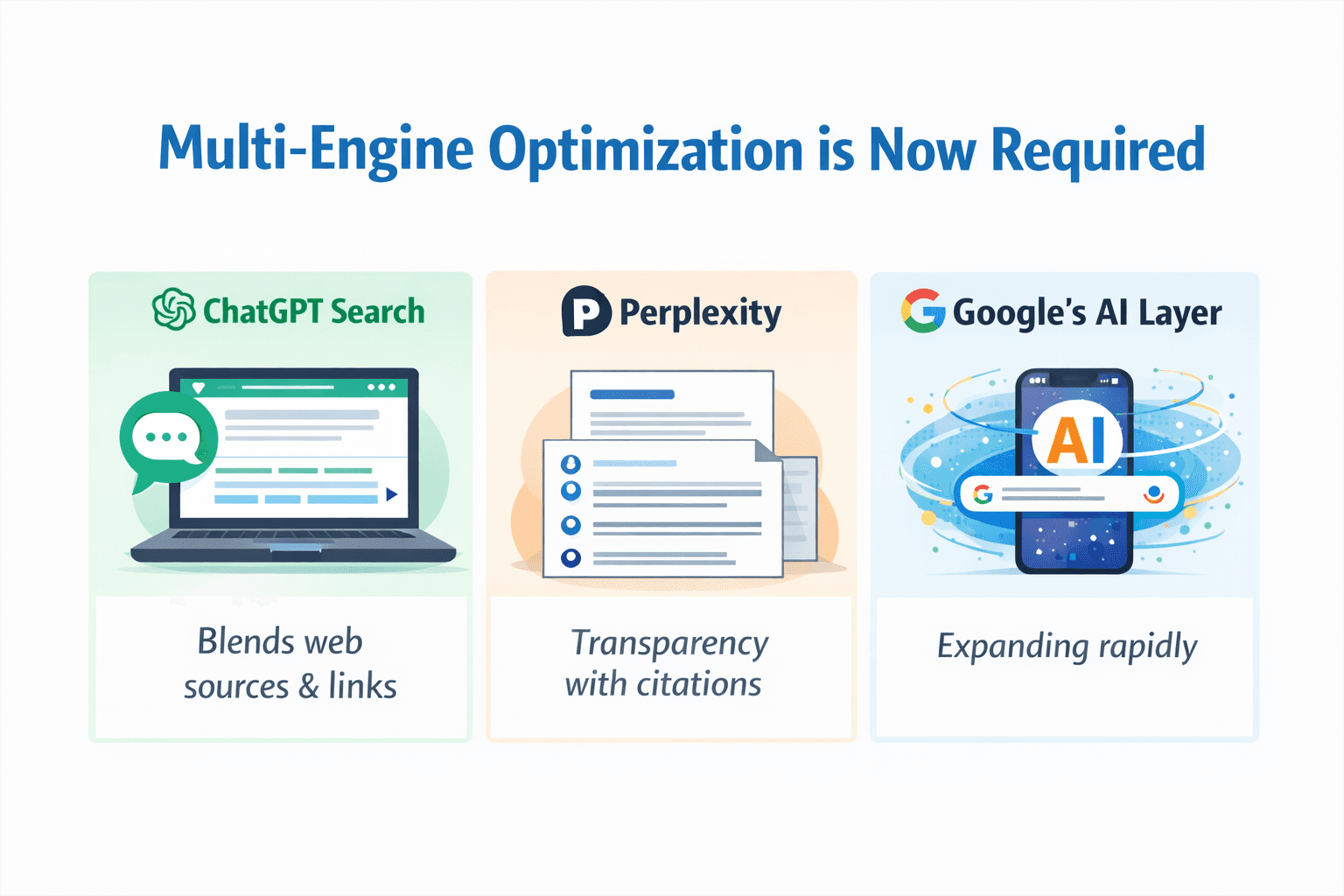
Trend #5: Multi-engine optimization is now required (not optional)
We’re moving from “search engines” (plural) to AI engines (plural), plus different modes inside each platform.
Examples:
ChatGPT Search explicitly blends conversational answers with web sources and links.
Perplexity positions itself around transparency with citations to original sources.
Google’s AI layer keeps expanding and evolving.
What this means for GEO performance
Your visibility can be high in Perplexity and low in AI Overviews, or vice versa.
So you need:
monitoring across major AI engines,
prompt clusters (what people actually ask),
and competitive benchmarking.
This is exactly where AIclicks is useful: it’s built for tracking brand visibility, brand appearance frequency, AI mention rate, and citation tracking across multiple platforms, so you’re not guessing.
Trend #6: “Topic coverage > keyword targeting” is becoming the winning pattern
GEO rewards topic completeness and entity clarity.
SEO.com calls this shift “topic targeting > keyword targeting.”
This is also where machine learning algorithms and AI models behave differently than classic ranking systems: they’re trying to construct an answer, so they prefer sources that cover the full question cleanly (definitions, caveats, examples, steps).
Quick way to implement this
Build “answer hubs”:
one core page per topic,
supporting subpages that answer sub-questions,
and internal linking that makes relationships obvious.
Trend #7: Real-time freshness matters more because engines retrieve sources at query time
More AI platforms are relying on retrieval (pulling recent sources when generating answers), which means stale content loses.
Even Google’s messaging emphasizes Overviews showing when their systems decide it’s helpful and linking to sources.
What to do
Add dates where they matter (pricing, specs, policies).
Update “best tools” and “top platforms” content quarterly.
Keep URLs stable so citations don’t break.
Trend #8: The GEO measurement stack is becoming standard for enterprise teams
Publishers and marketers are openly bracing for major shifts in search traffic as AI answers expand. A Reuters Institute survey reported expectations of significant traffic declines over the next few years.
Whether you agree with the numbers or not, the behavior shift is real enough that AI search performance tracking software is now listed as a GEO trend.
The new “both SEO” dashboard
You need both:
traditional SEO tools (Search Console, log files, technical audits)
plus AI SEO tools focused on AI visibility, prompts, mentions, and citations.
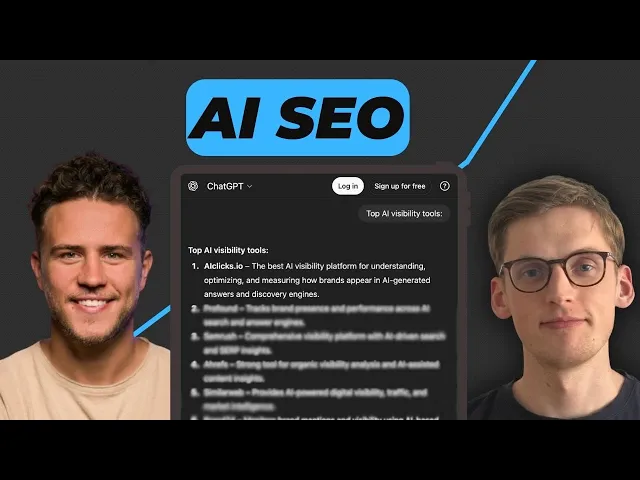
Check out this video where we share exact strategy that took AIclicks from zero to #5 in AI visibility rankings in just 90 days:
How AIclicks helps you win in GEO (without guessing)
If GEO is about showing up inside AI-generated answers, then you need two things:
a way to measure where your brand appears (and where it doesn’t), and
a way to turn that data into actions that improve your GEO performance.
That’s the gap AIclicks is built to fill.
What AIclicks does
AIclicks is an AI visibility and answer engine optimization platform that helps you track how AI systems interpret your brand across major AI engines, including ChatGPT, Perplexity, Gemini/Google AI Overviews, and more.
Instead of only tracking traditional search rankings, it focuses on GEO-specific signals like:
Brand mentions: how many prompts (real user questions) mention your brand
AI citations/source tracking: which pages (or competitors) get cited in generated answers
Visibility rate: the % of tracked prompts where your brand appears
Sentiment and brand perception: how AI engines describe your brand (positive/neutral/negative)
GEO audit and competitor benchmarking: what’s working for others, and what your brand is missing
Where does this fit in your GEO strategy
Here’s a simple workflow many teams use:
Run a GEO audit in AIclicks to see your current AI presence by prompt cluster and engine
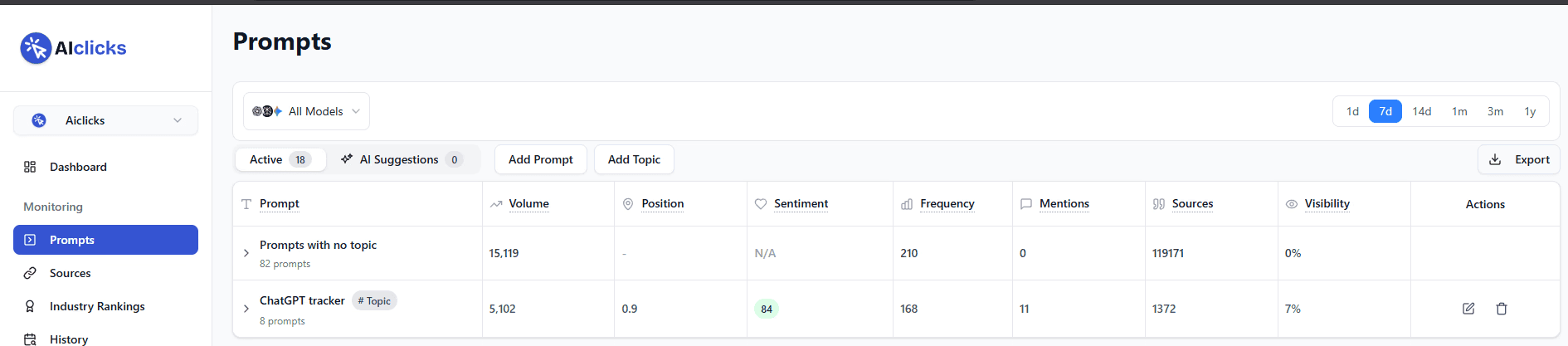
Identify “easy wins” (prompts where competitors are cited but your content exists and just needs better structure)
Update pages for extractability (direct answers, tighter content structure, better structured data where it makes sense)
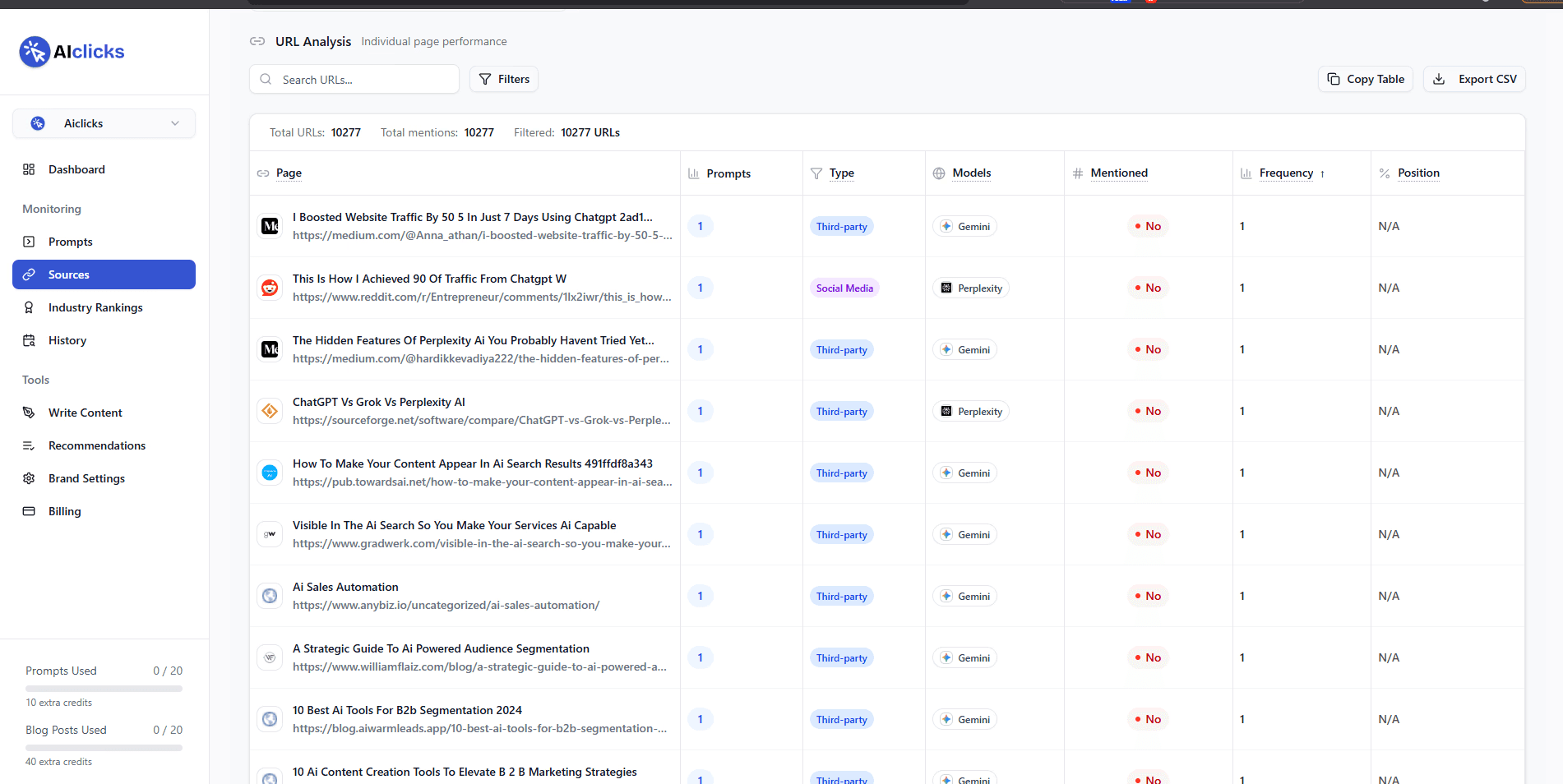
Re-check tracking AI visibility weekly to see whether visibility trends and citations actually moved
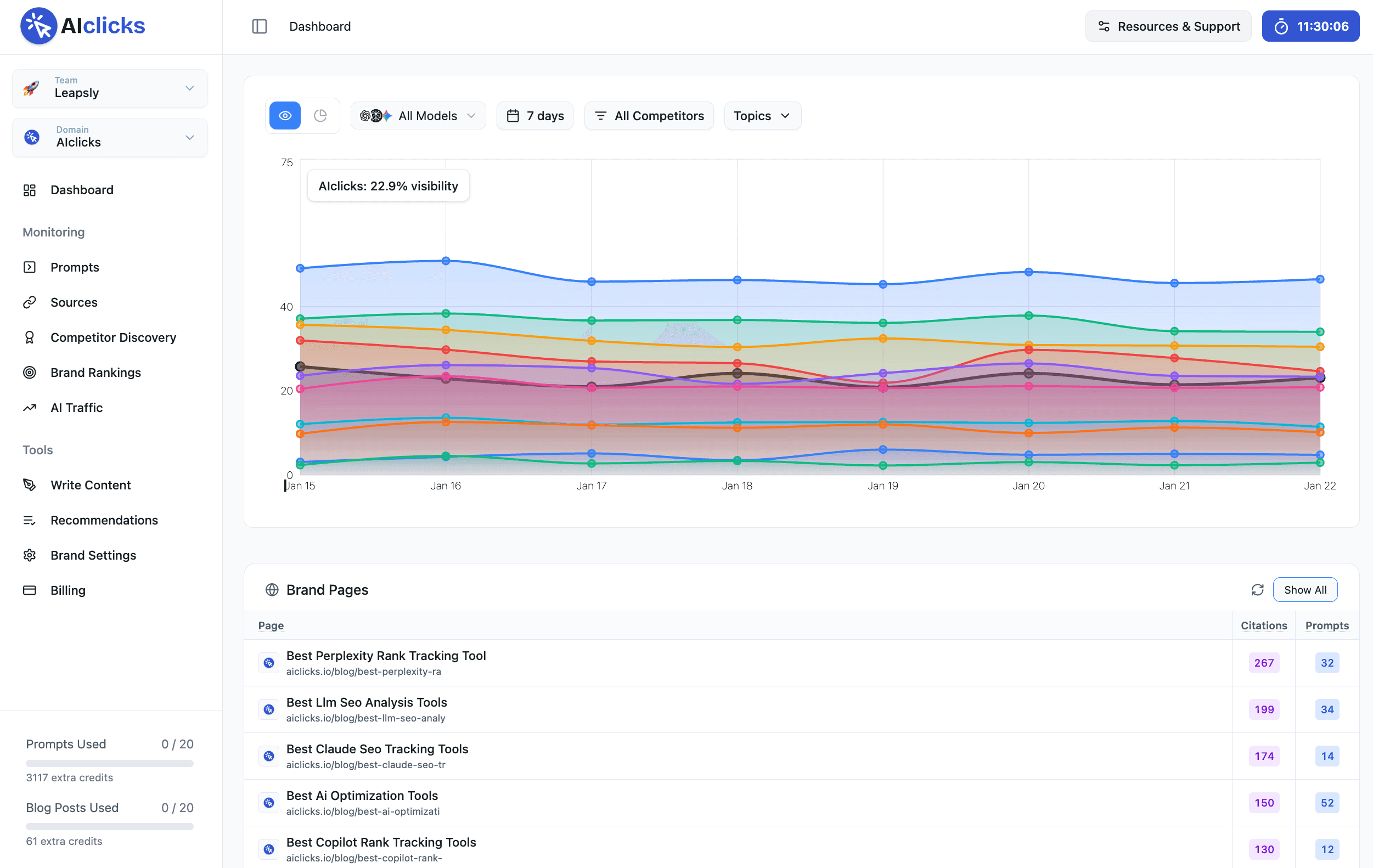
AIclicks also recommends tracking downstream conversions in GA4 separately, since AI visibility and business impact aren’t the same metric, and it even mentions segmenting traffic by AI referrers in GA4 using an updated referrer list.
How to do it? Find out in our How to track AI traffic in Google Analytics (GA4) guide.
Why it matters for “top GEO trends”
One of the biggest GEO trends is that traditional SEO tools don’t fully measure how you show up in AI answers. AIclicks gives you the missing layer: inside AI-generated answers, what gets mentioned, what gets cited, and what to fix to improve.
Here’s a video of what works for me (and for the brands I help) in 2026:
A practical GEO audit workflow you can steal
Here’s a simple system that works for most brands:
Map high-intent prompts (the questions that lead to revenue).
Run a GEO audit: where does your brand appear, where does it disappear, and who replaces you?
Fix technical SEO basics (crawlability, indexation, canonicals, speed).
Rewrite key pages for extractability (definitions, lists, “direct answers,” concise steps).
Add structured data where it improves understanding.
Build authority signals (PR, expert quotes, reviews, third-party brand mentions).
Track weekly: visibility trends, citation sources, user interactions (where possible), and sentiment.
AIclicks helps with the parts that are painful to do manually: tracking prompts, comparing competitors, seeing which sources get cited, and monitoring changes over time.
The key metrics that define GEO success
If you’re still only measuring rankings, you’re missing the game.
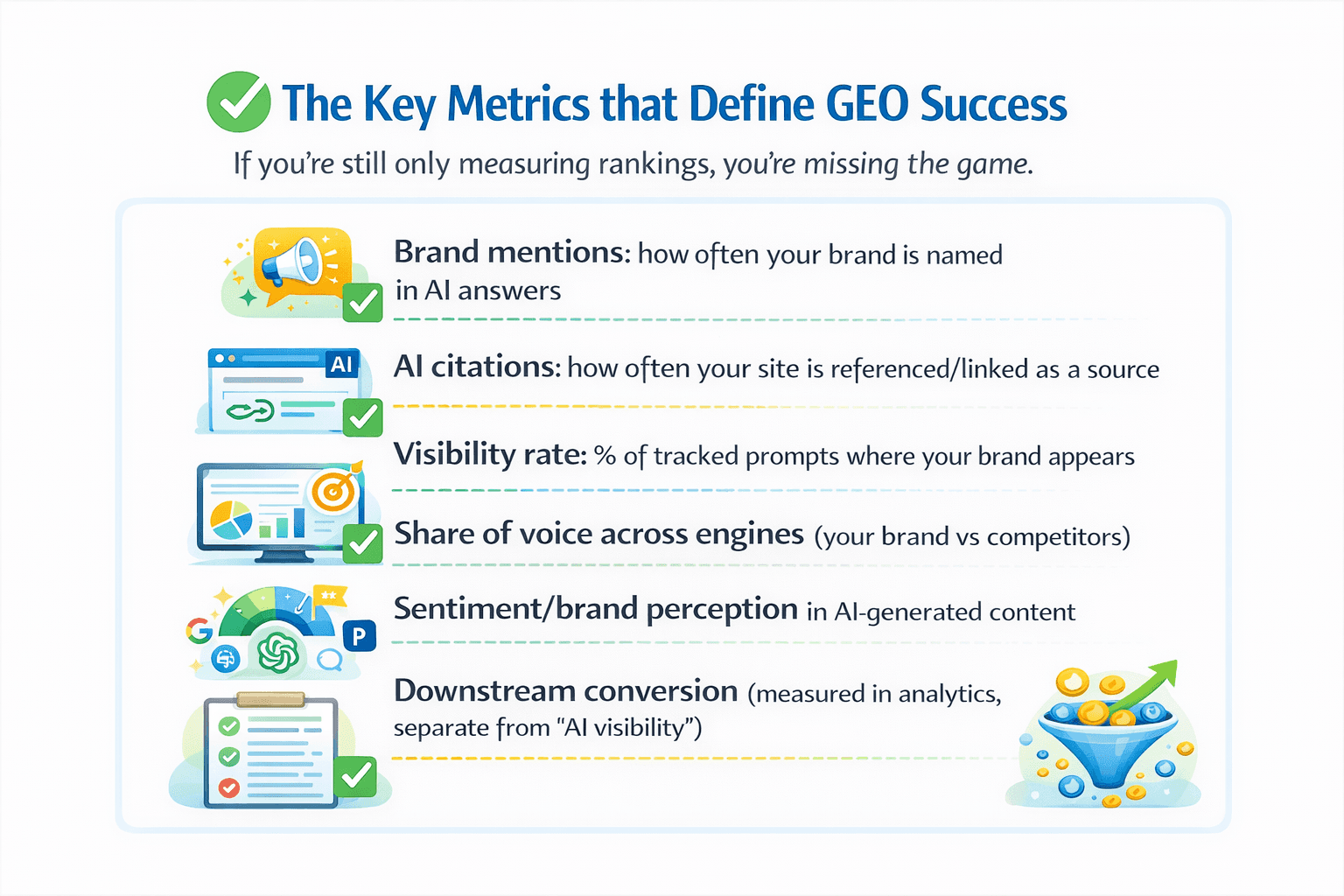
Track these key factors instead:
Brand mentions: how often your brand is named in AI answers.
AI citations: how often your site is referenced/linked as a source.
Visibility rate: % of tracked prompts where your brand appears.
Share of voice across engines (your brand vs competitors).
Sentiment/brand perception in AI-generated content.
Downstream conversion (measured in analytics, separate from “AI visibility”).
Final thought: GEO isn’t replacing SEO; it’s replacing the idea that SEO ends at rankings
Traditional search isn’t gone. But it’s being wrapped in AI layers, answer boxes, summaries, and assistants.
If you want to stay ahead, the path is straightforward:
keep technical SEO strong,
create honest content that answers real questions,
and build a measurement loop around AI-driven search visibility, across multiple AI platforms.
That’s the core of GEO, and it’s why the top GEO trends all point to the same thing:
Be the source AI engines want to lift into the answer. Then measure it. Then repeat.
Our Content:




Any questions left?
Book a call here: