

Reviewed by:
Rokas Stankevicius

Founder @ aiclicks.io
Last updated:
Expert Verified

Free AI visibility audit
Key Takeaways
The AI visibility category has split into three camps: analytics-led platforms (AIclicks, Peec AI, Scrunch AI, Profound AI), lightweight monitors (Otterly AI, Rankscale AI), and SEO-suite add-ons (Semrush, Ahrefs). Each solves a slightly different problem.
Monitoring is now the baseline, not the edge. Almost every tool can tell you where your brand stands in AI answers. The real differentiator in 2026 is what happens after: whether the tool helps you act, or just reports.
Price tags are deceptive. Many tools advertise a low entry price, then charge per engine, per seat, or per domain. Always calculate the real cost for the coverage you actually need.
Coverage varies more than you'd think. Some tools track 3-4 engines; others track 10 or more. If your buyers use Grok, DeepSeek, or Meta AI, your shortlist narrows fast.
Where AIclicks fits: broad real-interface tracking across 10+ platforms, plus a built-in recommendations engine. Built for teams that want action, not just analytics, without an enterprise price tag.
Writing a "best alternatives to ourselves" post is a slightly strange thing to do. The temptation is obvious: line up the competitors, praise each for something that doesn’t really matter, and funnel you back to a "but actually, just use us" conclusion.
You might have read those posts, right? Well, I believe they are of no help, and increasingly, AI engines are smart enough to see through them too.
This is not that post.
The honest reality is that AIclicks isn't the right tool for every team.
If you're an enterprise with a dedicated analyst who wants to drown in raw data, or you're already so deep in the Ahrefs ecosystem that adding anything else feels redundant, there are tools on this list that will serve you better than AIclicks will.
(And, we prefer to say that now than to win a customer who churns by month two.)
So, here are 8 strongest AIclicks alternatives in 2026, covering what each does well, where each falls short, and who should genuinely choose it.
I'll point out where I think AIclicks wins, because we built it and we believe in it. But I'll do it by showing you the actual differences, not by hiding them.
Let’s get started! 😉
Why Look for an AIclicks Alternative?
No tool is right for everyone. You'd reasonably look elsewhere if:
You need crawler infrastructure, not just tracking; a tool that rewrites your pages for AI bots (that's Scrunch's niche).
You want the deepest analytics and don't mind a learning curve to get them.
You're on a tight budget and want to test whether AI visibility matters before committing real spend.
You already live in Ahrefs or Semrush and would rather add a module than learn a new login.
Underneath all of it sits one fault line that divides this whole category: do you want a tool that measures your AI visibility, or one that also tells you what to do about it?
We built AIclicks firmly on the second side of that line. Not every team needs it that way, and every tool below makes a different call. Figuring out which one matches your situation is the whole game.
How I Evaluated These Alternatives
Every tool here was held to the same five questions:
Platform coverage: How many AI engines does it track, and are the ones your audience uses actually included?
Depth of insight: Does it stop at mention-counting, or does it show citations, sources, sentiment, and competitive position?
Action vs. analytics: Does it help you improve visibility, or just measure it?
Honest pricing: Is the entry price real, or does it balloon with add-ons?
Who it's truly for: Solo marketer, agency, enterprise? The wrong fit is the most expensive mistake in this category.
Details came straight from each vendor's site and pricing pages, cross-checked against independent reviews. Pricing in this space shifts constantly, so confirm on the vendor's page before you buy.
The 8 Best AIclicks Alternatives at a Glance
Tool Name | Best For | Starting Price | Engine Coverage | Standout Strength |
Peec AI | Marketing teams wanting clean analytics | ~€85/mo | 7 (3 included) | Unlimited seats on every plan |
Otterly AI | Agencies & SMBs wanting affordable monitoring | $29/mo | 6 engines | Affordable, multi-client workspaces |
Scrunch AI | Enterprises optimizing for AI agents | ~$250/mo | 7 engines | Serves AI-ready pages to crawlers (AXP) |
Profound AI | Large enterprises with analysts | $99/mo* | Up to 10 engines | Deepest enterprise data |
Rankscale AI | Solo operators wanting breadth on a budget | ~$20/mo | 17+ engines | Widest engine coverage, no upsell |
Athena HQ | Mid-market teams wanting workflows | $295/mo | 8+ engines | "Action Center" task workflows |
Semrush AI Toolkit | Teams already inside Semrush | $99/mo add-on | Major LLMs | AI data beside real SEO data |
Ahrefs Brand Radar | Competitive research, zero setup | $199/mo add-on | 6-7 engines | 400M+ search-backed prompts |
1. Peec AI
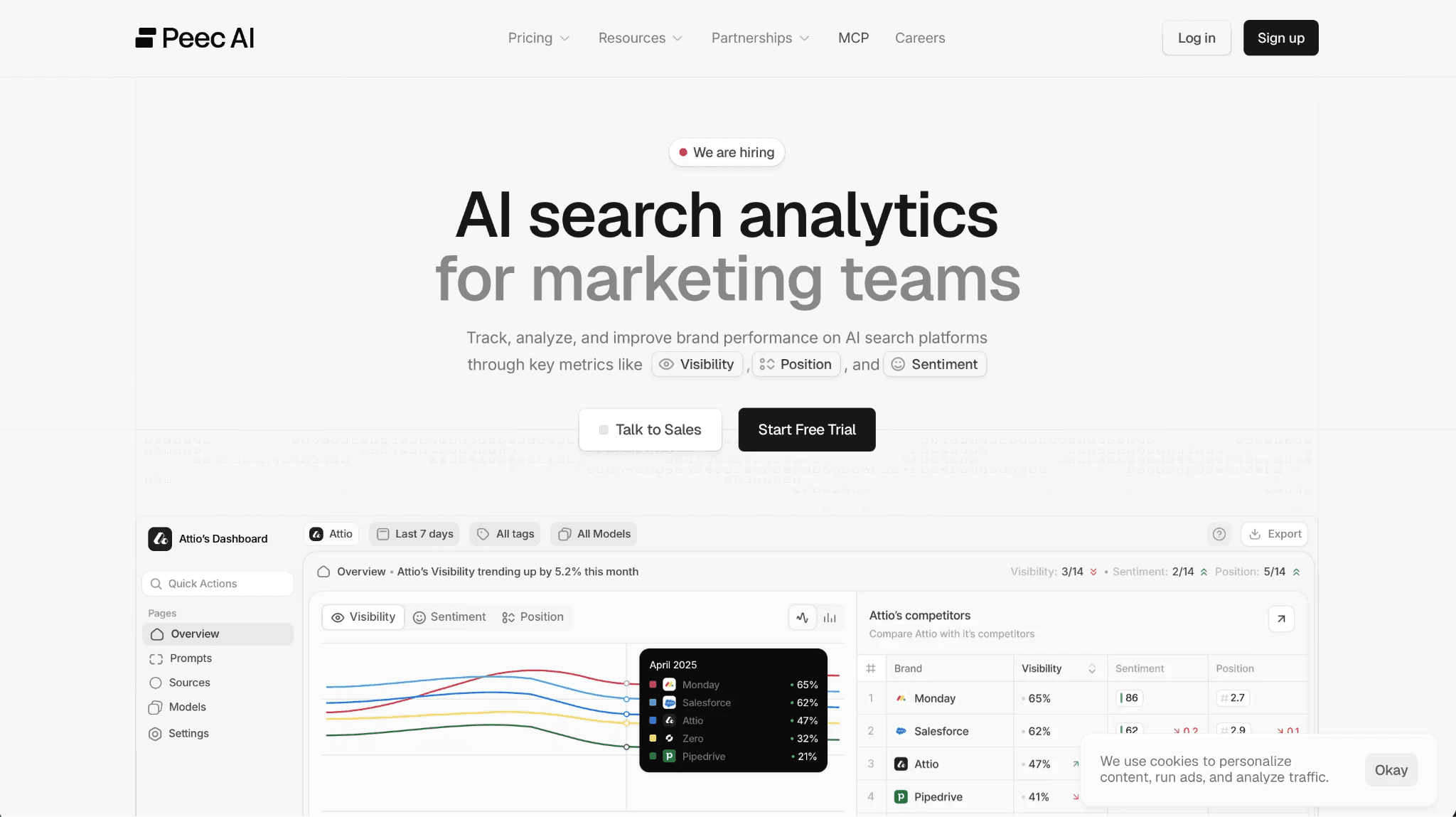
Peec AI is an AI search analytics for marketing teams, and it's built on a clear principle: restraint. Where many tools bury you in features, Peec AI strips the dashboard down to three numbers worth acting on: Visibility, Position, and Sentiment, and stops there.
SEO leaders like Lily Ray have publicly praised it for skipping the clutter, and a recent Series A means that simplicity isn't a sign of a thin product. It's the natural pick for marketing and content teams who want clean, daily analytics without a learning curve.
Key features:
Three core metrics: Visibility, Position, Sentiment, tracked daily across ChatGPT, Perplexity, Gemini, AI Overviews, AI Mode, Copilot, and Grok.
Unlimited user seats on every plan, a real win for larger teams and agencies.
Source citation tracking that separates "used" from "cited."
AI-suggested prompts with search volume, plus a Looker Studio connector and live MCP integration.
Pros & cons:
Pros:
Clean, focused UI, no feature bloat
Unlimited seats on every plan
Strong, well-funded roadmap
Cons:
Only 3 engines included per plan
Adding more engines costs extra
Analytics-led, light on execution
Pricing: Starter ~€85/mo (50 prompts, 3 engines), Pro ~€205/mo, Advanced ~€425/mo; unlimited users on all. 7-day free trial.
Verdict: Peec AI is excellent at what it sets out to do: clean, fast, no-clutter AI analytics. If pure measurement is your goal, it's among the best built. The distinction worth understanding is philosophical. Peec AI shows you where you stand with real clarity, but turning that into action is on you.
AIclicks takes the opposite stance, pairing tracking with a recommendations engine that hands you a ranked to-do list. If you want analytics, choose Peec AI. If you want analytics plus an actionable plan, that's where I'd point you to AIclicks.
Also read: Peec AI alternatives to try in 2026.
2. Otterly AI
Otterly AI is the affordable AI search monitoring platform built around automated simplicity. You build a prompt library of the questions your buyers actually ask, and Otterly AI runs them across the major engines on a schedule, surfacing share of voice, brand position, and sentiment.
The tool leans hard into two audiences: budget-conscious SMBs, and agencies running GEO for multiple clients, who get unlimited per-client workspaces with no per-client fees. A strong library of free GEO tools makes it as much a learning resource as a tracker.
Explore more Otterly AI alternatives that you can try out.
Key features:
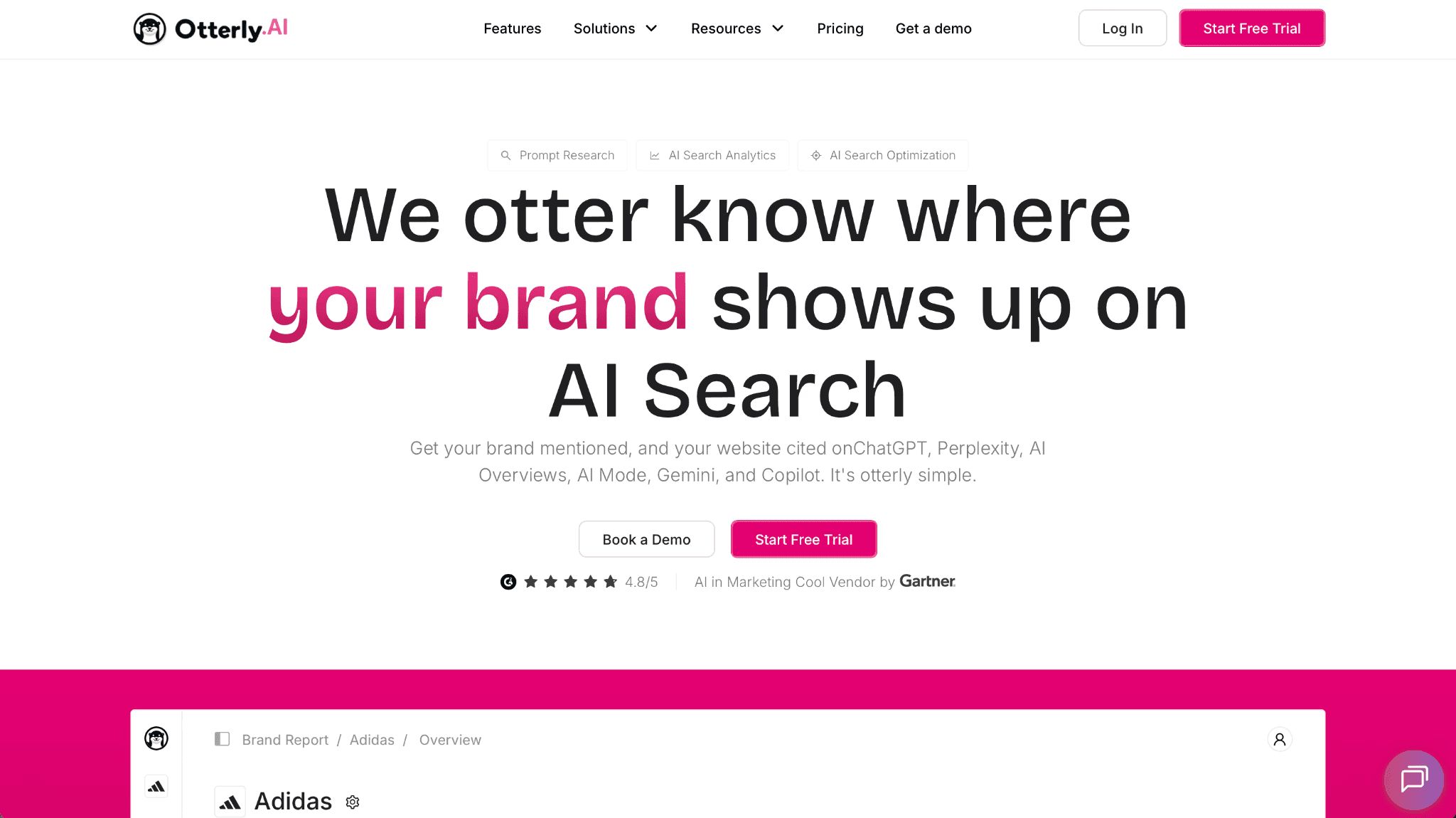
Six-engine coverage across ChatGPT, Perplexity, Google AI Overviews, AI Mode, Gemini, and Copilot, filterable by engine, country, and prompt tag.
AI Prompt Research to uncover the prompts driving AI answers in your category.
Content Audit with predictive scoring that estimates whether AI will cite a page before you publish.
GEO recommendations, sentiment tracking, and a public API.
Pros & cons:
Pros:
Fast setup, genuinely simple
Neutral, unbiased data
Predictive scoring before publishing
Cons:
Only six engines, no Claude or Grok
Monitoring-led, light on automation
Prompt limits multiply across engines
Pricing: From $29/month; 14-day free trial, no card required.
Verdict: Otterly AI is the easiest on-ramp into AI visibility, and for a small team that just wants reliable monitoring, it's a smart, affordable start. The ceiling shows up as you scale: six engines leaves Claude and Grok untracked, and because it's monitoring-led, you're still the one translating insight into action.
That's the core difference I'd flag versus AIclicks, which tracks 10+ platforms and ships the action layer built in. For first steps, Otterly is great. Once you're ready to act at scale, AIclicks covers more ground.
3. Scrunch AI
Scrunch AI takes AI visibility further than most. It doesn't just monitor your presence, it tries to fix the technical side of it.
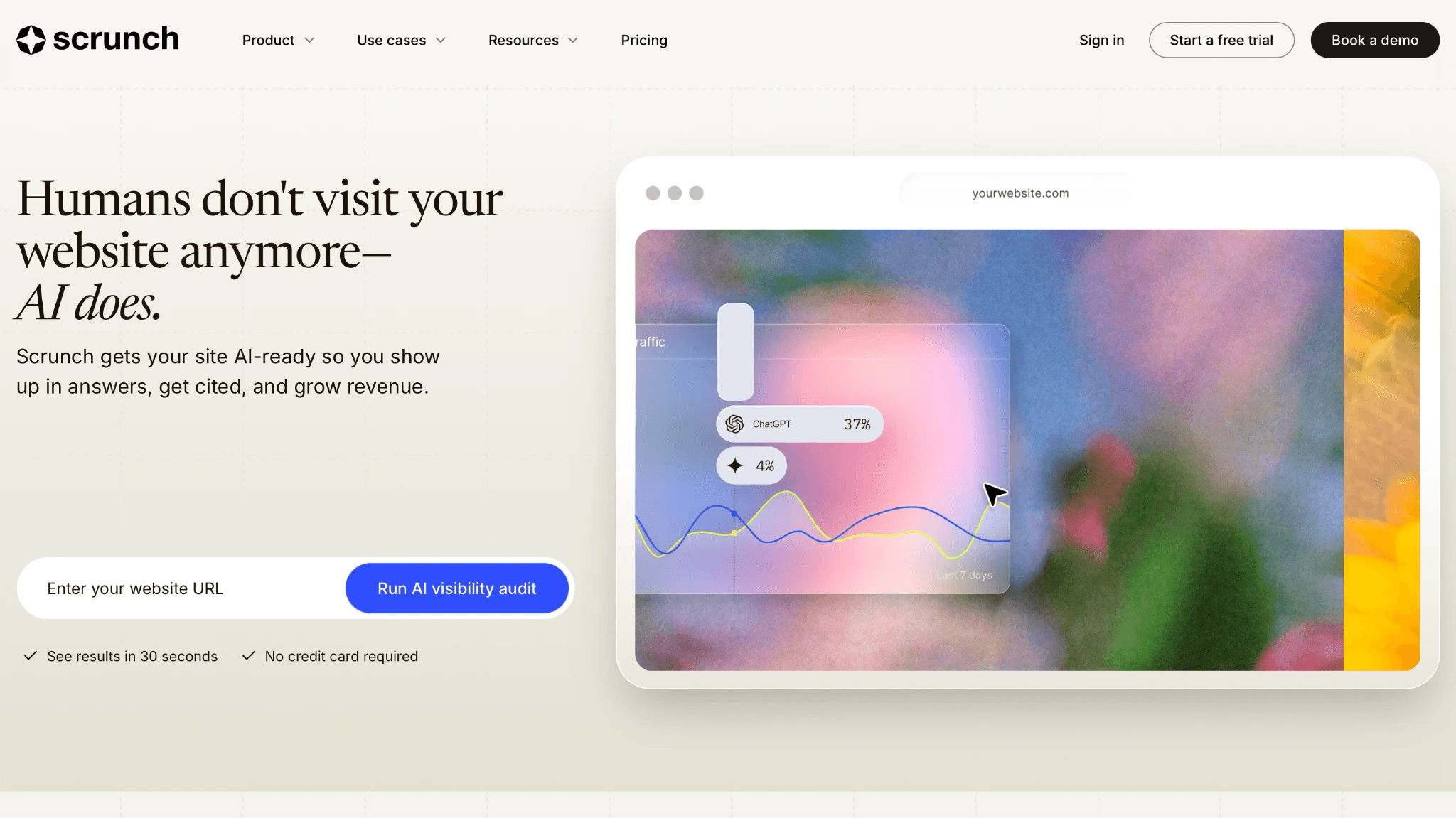
Alongside standard tracking across the major LLMs, its Agent Experience Platform (AXP) serves a parallel, machine-readable version of your site built specifically for AI crawlers, so agents can parse your content without choking on JavaScript or page bloat.
It's enterprise-grade software with SOC 2 Type II compliance and the pricing to match, built for teams treating AI crawlability as an infrastructure problem.
Key features:
Monitoring across ChatGPT, Claude, Gemini, Perplexity, AI Mode, AI Overviews, and Meta.
Agent Experience Platform (AXP) that serves structured, compressed pages for LLM crawlers.
Citation analysis, crawl-error detection, and real-time AI bot traffic monitoring.
Competitive benchmarking by competitor, persona, topic, and geo.
Pros & cons:
Pros:
AXP is a genuinely unique feature
Strong enterprise security (SOC 2)
Persona and geo benchmarking
Cons:
Expensive, ~$250/mo entry, billed annually
Page audits capped low on entry tier
Overkill for small teams
Pricing: Core/Starter ~$250/mo (annual); Growth higher; Enterprise custom. 7-day free trial.
Verdict: Scrunch AI is a serious enterprise platform, and AXP solves a real technical problem nobody else touches. If AI crawlability is a genuine bottleneck and you have the budget, it's a strong, specialized choice. For most teams, though, it's more machinery than they need, and the entry price reflects an enterprise buyer.
The honest dividing line: if "AI agents can't parse my site" keeps you up at night, choose Scrunch AI. If "I don't know what AI is saying about me or what to do about it" is the real problem, that's AIclicks territory, at a fraction of the cost.
Explore a few more Scrunch AI alternatives.
4. Profound AI
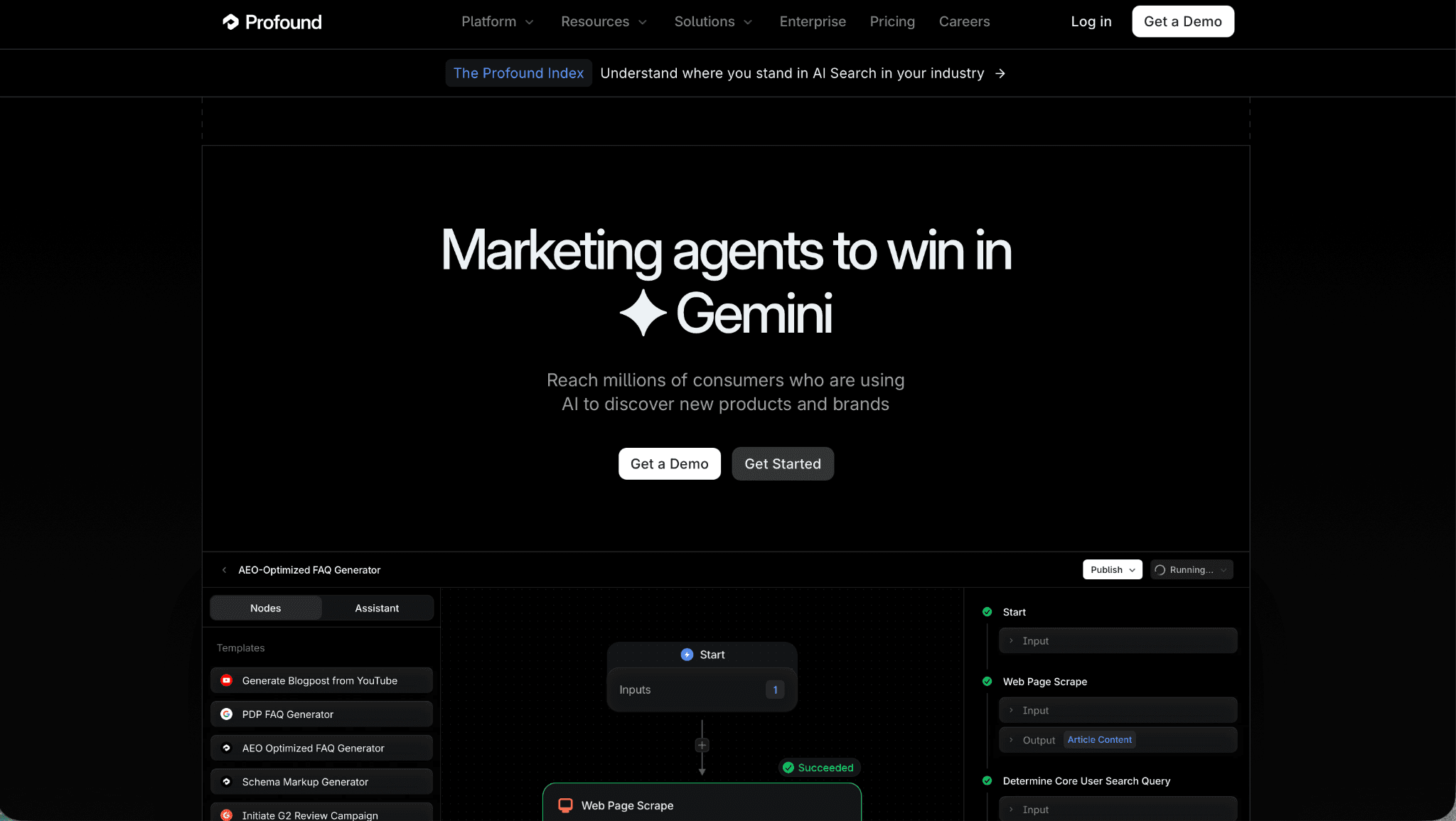
Profound is the most-funded, most-talked-about name in the AI visibility market, and it earned that position by being early and genuinely capable. It's an enterprise-grade platform offering deep brand visibility tracking, agent analytics, and proprietary prompt-volume data.
If you're a large brand with a dedicated team and the appetite for dense, analyst-grade dashboards, Profound delivers depth few can match. It is, unambiguously, built for the enterprise.
Key features:
Tracks up to 10 AI engines on the Enterprise tier.
Conversation and prompt-volume analytics at scale.
Agent analytics and AI crawler monitoring.
Competitor benchmarking and content recommendations.
Pros & cons:
Pros:
Deep, enterprise-grade data
Broad engine coverage at the top tier
Strong agent analytics
Cons:
$99 entry tracks ChatGPT only
Real coverage starts at $399/mo
Steep learning curve
Pricing: Starter $99/mo (ChatGPT only); Growth $399/mo (3 engines); Enterprise custom.
Verdict: Profound is the category's enterprise benchmark, and for large scale teams with analysts in team, it's a legitimate choice. But its strengths are also its constraints: the depth demands a learning curve, the real coverage demands $399/month, and like most analytics platforms, it surfaces gaps without closing them.
The crowd Profound prices out, startups, lean marketing teams, agencies, is precisely who AIclicks built for: broad coverage and an action plan from $59/month, no analyst required.
5. Rankscale AI
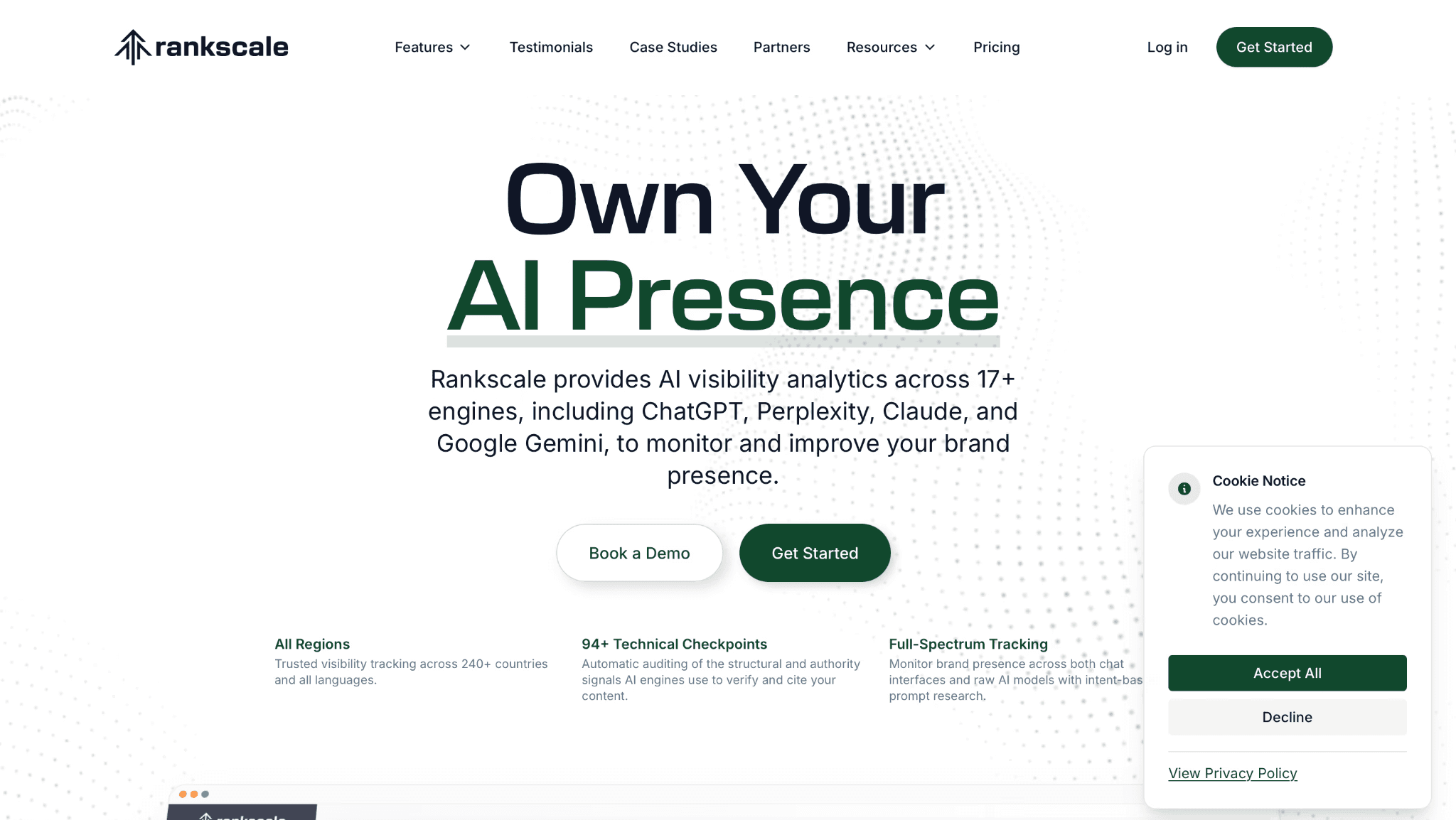
Rankscale AI wins on raw coverage and price. It's an AI visibility analytics platform that tracks an unusually wide spread of engines and then goes deep on the why behind every result.
Its calling card is breadth without the upsell, 17+ AI engines on every plan with no model gating, paired with a flexible, credit-based model that lets you start small. Founded in late 2024, it ships features at a fast clip and has become a favorite among data-comfortable solo operators and agencies.
Key features:
17+ AI engines on every plan, the widest coverage on this list.
AI Rank Tracker with visibility scoring, share of voice, and historical trends.
Page Audits across 200+ AI-readiness factors.
Prompt Research with search-volume estimation; tracking across 240+ regions.
Pros & cons:
Pros:
Widest engine coverage, 17+ AI engines
Deep, granular query data
Flexible credits suit variable volumes
Cons:
Credit math has a learning curve
Dense UI for newcomers
Monitoring-first, light on execution
Pricing: Credit-based, from ~$20/month; scales with usage. Free trial available.
Verdict: For sheer engine coverage at a low entry price, Rankscale is hard to beat, and its depth genuinely rewards analytical users. The trade-offs are operational: credit budgeting takes getting used to, and the interface favors data-fluent teams over beginners. And, like most analytics-led tools, it shows you the gaps but leaves the fixing to you.
AIclicks makes the opposite trade, accepting a shorter engine list in exchange for a more guided experience, with broad-enough coverage plus a ranked action plan and a gentler learning curve. Choose Rankscale for maximum breadth. Choose AIclicks to be told what to do next.
6. Athena HQ
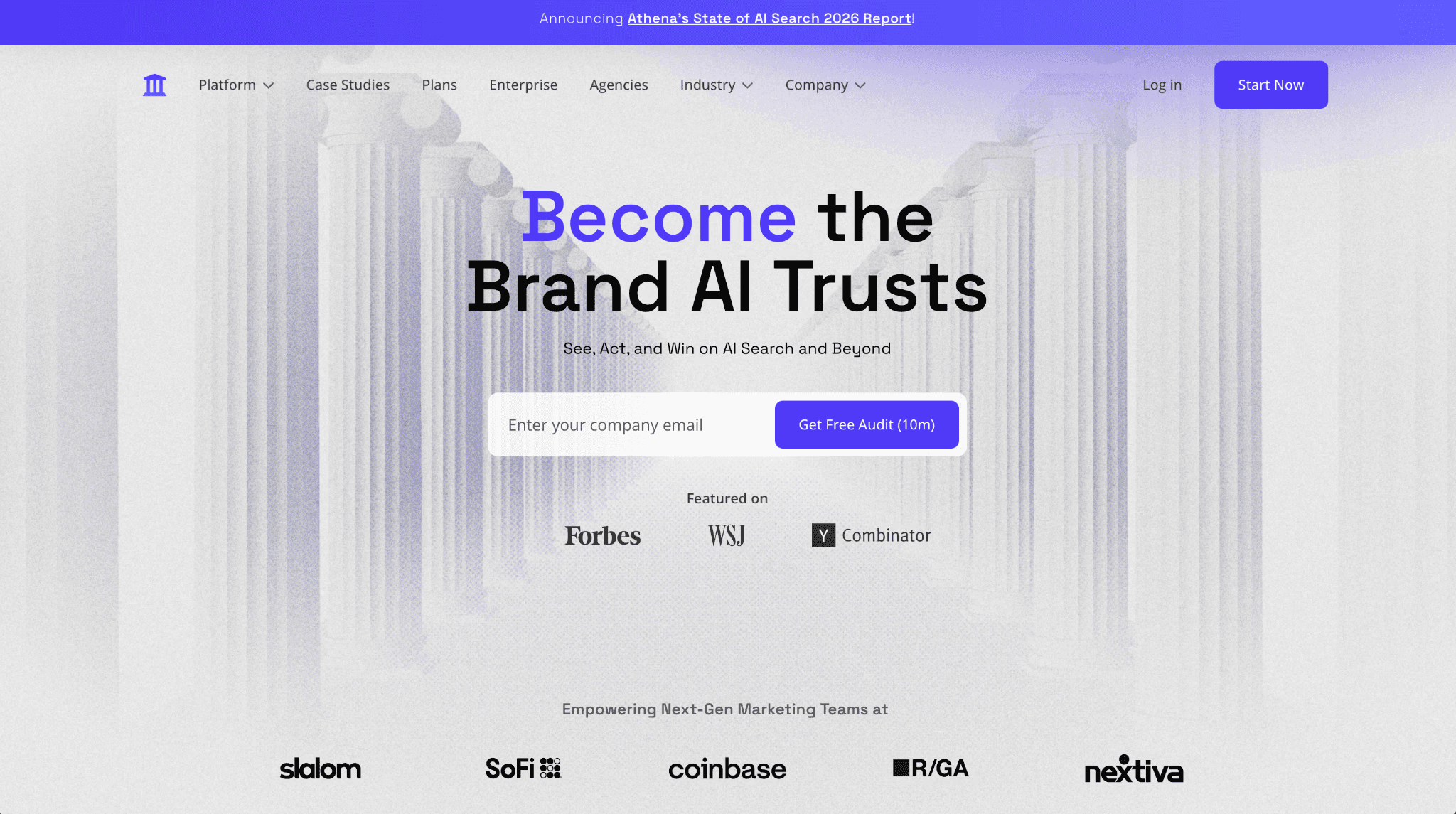
Athena HQ, founded by former Google Search and DeepMind leaders, is one of the most action-oriented platforms in the category. Its tagline is literally "Action on AI Search." Where most tools leave you to interpret the data, Athena's Action Center converts insights into structured, assignable GEO tasks.
It tracks eight AI engines, layers in an AI copilot you can question in plain English, and connects visibility to revenue. For mid-market teams that want their tool to produce a to-do list, it's a compelling option, and the closest one to AIclicks on this list.
Key features:
Eight-engine coverage on all plans, including ChatGPT, Perplexity, AI Overviews, AI Mode, Gemini, Claude, Copilot, and Grok.
Action Center that turns visibility gaps into trackable workflows.
"Ask Athena" AI copilot for conversational data access.
Revenue attribution via GA4 and Shopify; prompt-volume tracking.
Pros & cons:
Pros:
Action Center bridges insight to execution
8 engines on every plan
Revenue attribution built in
Cons:
Credit-based billing is unpredictable
Self-Serve limited to one country
No free trial
Pricing: Self-Serve from $295/month (3,600 credits); Growth and Enterprise above. No free trial.
Verdict: Athena and AIclicks agree on the big idea, that a visibility tool should hand you actions rather than just charts, which makes this the fairest head-to-head on the list. Athena deserves real credit for it.
Where they diverge is access: Athena's credit-based model starts at $295/month and burns credits with every analysis, so costs scale with usage and predictability suffers.
AIclicks delivers the same action-first philosophy on flat, transparent pricing from $59/month, with a free trial to test it first. If the workflow approach appeals, both are worth a look. Just run Athena's credit math against your volume before committing.
7. Semrush AI Visibility Toolkit
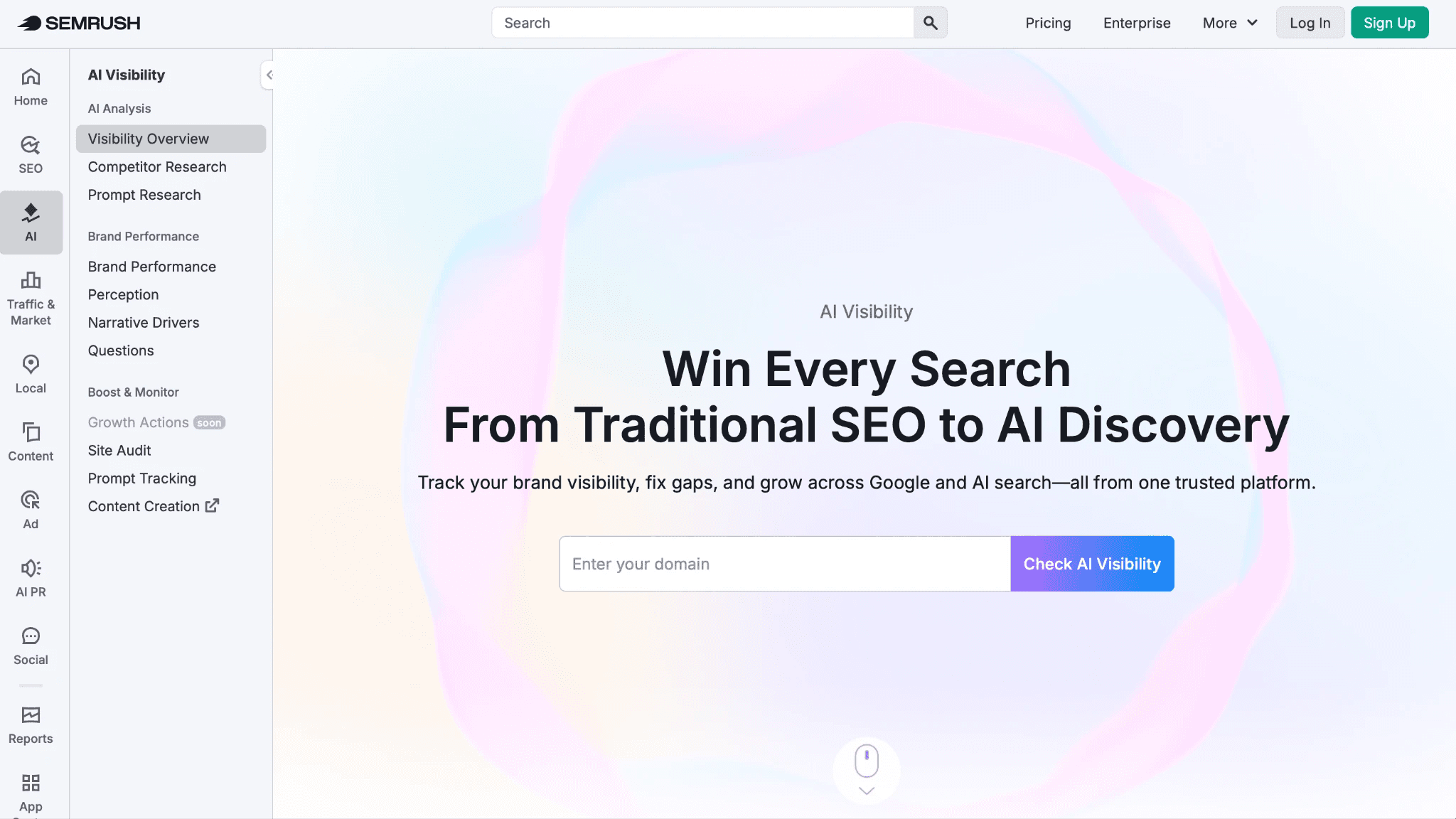
The Semrush AI Visibility Toolkit is Semrush's answer to AI search: a module that tracks how often LLMs mention your brand and how you compare to competitors, all inside the SEO platform millions of marketers already use.
The entire pitch is "no new tool to learn," with AI visibility data sitting beside your keyword rankings and site audits, in one login. For teams already living in Semrush, that integration is the whole appeal.
Key features:
Citations and mentions tracking across ChatGPT, Google AI Overviews, Gemini, Perplexity, and more.
Competitor comparison against up to nine rivals.
AI search site audit flagging citation blockers.
Prompt research and brand performance, deeply integrated with Semrush's SEO dataset.
Pros & cons:
Pros:
Zero learning curve for Semrush users
AI data beside real SEO data
Backed by a mature dataset
Cons:
Each extra domain costs $99/mo
Each extra seat costs $99/mo
Weak standalone value
Pricing: $99/month per domain add-on; or Semrush One from $199/month. Extra prompts $60/mo per 50.
Verdict: If Semrush is already your home base, the AI Toolkit is the low-friction choice, and keeping AI and SEO data under one roof has genuine value. But the economics punish scale: every extra domain and seat is another $99/month, which adds up fast for agencies, and reviewers agree it's hard to justify standalone.
AIclicks is purpose-built for AI visibility, with broader real-interface coverage and a built-in action plan from $59/month. Choose the Semrush toolkit for convenience inside an existing subscription. Choose AIclicks if AI visibility is a priority in its own right.
8. Ahrefs Brand Radar
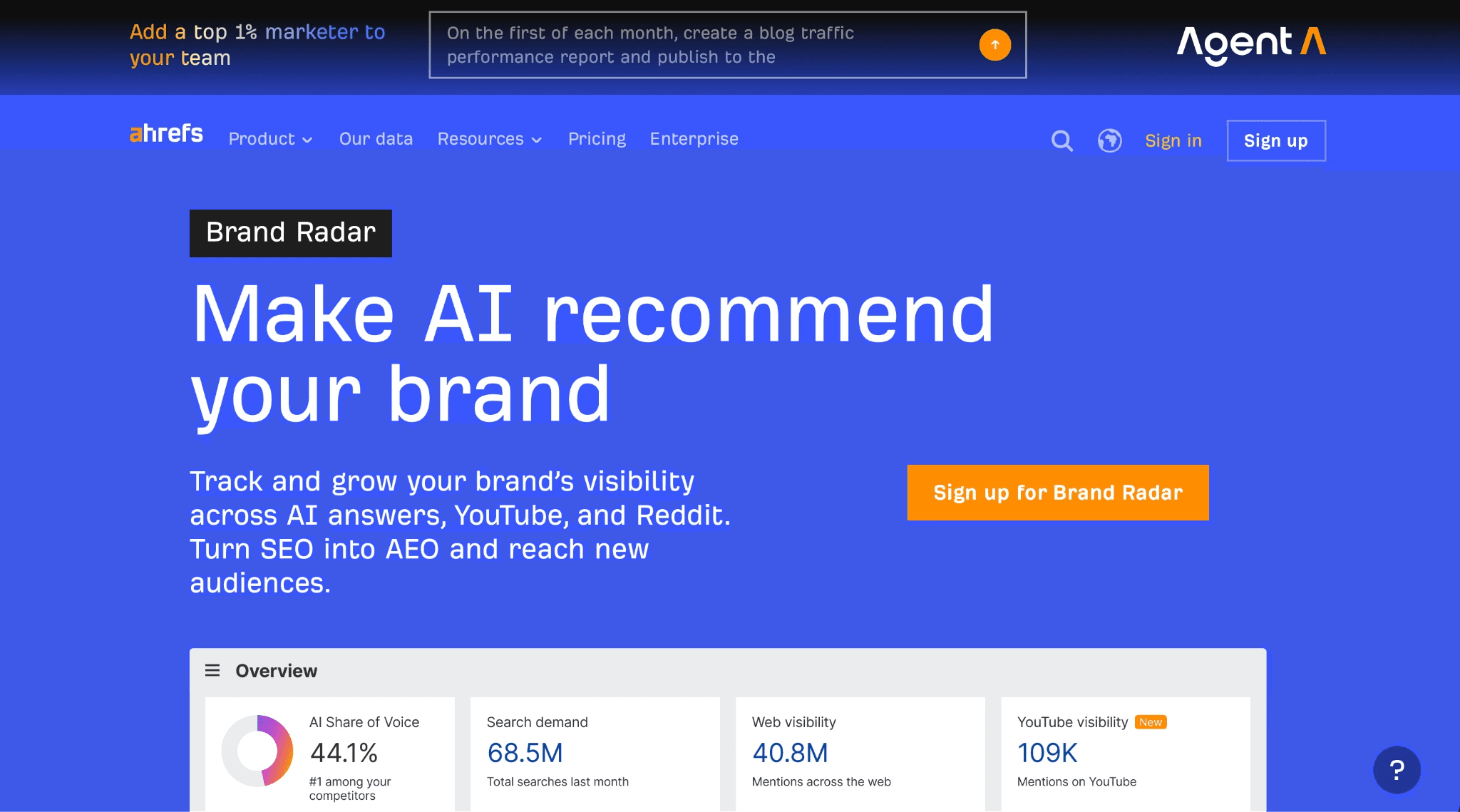
Ahrefs Brand Radar approaches AI visibility from an angle no other tool here matches. Instead of defining prompts and waiting for data to accumulate, Brand Radar runs on Ahrefs' enormous index of 400M+ monthly prompts, mostly search-backed rather than synthetic, so you can research any brand's AI visibility instantly, with zero setup.
Type in a domain and see its AI footprint immediately. It's less a "set up and monitor" tool and more an on-demand research engine for the whole of AI search.
Key features:
A search-backed prompt database across AI Overviews, AI Mode, ChatGPT, Copilot, Gemini, Perplexity, and Grok.
Research any domain instantly, with no setup and unlimited projects.
AI Sources tracking into YouTube, TikTok, and Reddit.
Custom Prompts add-on, plus the full Ahrefs SEO toolset.
Pros & cons:
Pros:
Instant data, zero setup
Research any brand, not just yours
Massive search-backed database
Cons:
Pricey: ~$828/mo all-in for full coverage
No Claude or Meta AI tracking
Research-led, light on action guidance
Pricing: Add-on to a base Ahrefs plan (Lite from $129/mo). AI indexes are $199/mo per platform, or $699/mo for the all-platform bundle; custom prompts are an extra $50/mo for 2,500 checks. Full coverage runs ~$828/mo all-in.
Verdict: Brand Radar is the standout for competitive intelligence. The no-setup, query-any-brand model is genuinely unique and invaluable for sizing up competitors or a category. Its strength, though, is measuring the market, not handing you a task list, and it's an add-on rather than a focused buy. AIclicks does the opposite job: it tracks your own presence across 10+ platforms and turns it into a ranked plan of action. The two can even complement each other, with Brand Radar for market research and AIclicks for executing on your own visibility. For instant broad research, Brand Radar wins. For action on your brand, AIclicks does.
Verdict: Brand Radar's instant, query-any-brand model is genuinely one of a kind, and for competitive and market research it's hard to beat. The catch is the bill. Full coverage runs roughly $828/month once the all-platform bundle stacks on top of a base Ahrefs plan, it still skips Claude and Meta AI, and its whole design points at measuring the market rather than telling you what to do next. That's a lot to pay for a rear-view mirror. It makes sense for an Ahrefs power user with a budget to spare who mainly wants intelligence on competitors.
For teams that want to track their own presence and get a ranked plan to act on it, AIclicks does that job directly and for far less. The two can even pair well: Brand Radar for the market view, AIclicks for the execution.
So Where Does AIclicks Actually Fit?
Here's the gap every tool on this list circles but few actually close: knowing where you stand in AI search is easy now. Knowing what to do about it is still hard.
AIclicks is built for that second problem, and it's the rare tool that treats tracking as the starting line rather than the finish.
It tracks 10+ AI platforms, the widest practical coverage of any tool at its price, including ChatGPT, Perplexity, Gemini, AI Overviews, AI Mode, Claude, Grok, DeepSeek, Meta AI, and Copilot. It does it by querying the real user interfaces rather than APIs, because what an actual person sees and what an API returns are often different answers, and tracking the wrong one quietly corrupts everything downstream.
Then the part most platforms skip entirely: a recommendations engine that turns all of it into a ranked, do-this-next list, including the content to publish, the sources to earn mentions on, and the conversations to join. All from $59/month, which is why 400+ agencies run client work on it.
The honest framing is this. If you need the absolute deepest enterprise data, Profound goes further. If you want to track every fringe engine in existence, Rankscale lists more. If you live inside an SEO suite, Semrush and Ahrefs bolt on neatly.
But for the large majority of teams, the goal isn't "more raw data" or "one more engine." It's the shortest path from where do I stand to here's exactly what I'm doing about it, without an enterprise contract or a full-time analyst to operate it. That's the lane AIclicks owns.
How To Choose the Right Tool
Skip the feature-list comparison and answer three questions about your own situation.
1. Do you need measurement or execution?
If you have a team that just needs accurate data, a monitor like Otterly AI, Peec AI, or Rankscale AI does the job. If your real problem is "I see the gaps but don't know what to do," you want an action-oriented platform like AIclicks or Athena HQ. The most common regret in this category is buying a dashboard that changes nothing.
2. What's your real budget, with the add-ons?
Headline prices are often fiction. Add up the base plan plus every engine, seat, and domain you actually need, then compare. Flat-rate and unlimited-seat tools usually win at scale over per-prompt or per-domain models.
3. Where should it live? Already on Semrush or Ahrefs?
Their add-ons keep everything in one login. Starting fresh, or treating AI visibility as a core channel? A dedicated platform gives you more depth for the money.
And whatever your shortlist, use the free trials. A week of hands-on testing tells you more than any comparison table, this one included.
The Real Differentiator Isn’t Data. It’s What You Do With It.
The AI visibility market in 2026 is crowded, and that's good news for buyers, because there's a genuinely strong tool for almost every situation.
Peec AI for clean analytics. Otterly AIfor an easy start. Scrunch AI and Profound AI for enterprise depth. Rankscale AI for breadth on a budget. Semrush and Ahrefs for teams already working inside them. AthenaHQ for a workflow-first approach.
The thread connecting the best of them is simple, and it's the line worth ending on: the tools that win aren't the ones with the prettiest charts. They're the ones that help you act.
That's the principle AIclicks is built on, and for teams whose priority is turning AI visibility data into real moves without an enterprise price tag, it's the strongest option on this list.
But no single article should settle it. Demo a couple of these tools, run them against your own brand, and pick the one that fits the way your team actually works.
Want to track your brand across 10+ AI platforms and get your action plan in minutes?
Start your free AIclicks trial
Frequently Asked Questions
1. What is AIclicks?
AIclicks is an AI search visibility platform that tracks how often your brand appears across 10+ AI engines, including ChatGPT, Perplexity, Gemini, and Google AI Overviews, by querying their real user interfaces, then converts that data into a prioritized action plan. It's used by 1,000+ brands and 400+ agencies, starting at $59/month.
2. What's the cheapest AIclicks alternative?
Rankscale AI is the lowest entry point at around $20/month (credit-based), followed by Otterly AI at $29/month. Each is monitoring-led, so factor in what you'll spend acting on the data separately.
3. Which AIclicks alternative is best for enterprises?
Profound and Scrunch AI are the strongest enterprise options: Profound for the deepest data, Scrunch for AI crawler infrastructure via its Agent Experience Platform. Both carry enterprise pricing and learning curves to match.
4. Do I need a dedicated AI visibility tool if I use Semrush or Ahrefs?
Not necessarily. Both offer AI visibility modules (Semrush's AI Toolkit, Ahrefs' Brand Radar) that integrate with their core platforms. If you already work inside one, the add-on is convenient. If AI visibility is becoming a core channel, a dedicated platform usually offers more depth and better action guidance.
5. What's the difference between a monitoring tool and an action-oriented tool?
Monitoring tools tell you what's happening: where you appear, who outranks you, which sources get cited. Action-oriented tools go further and tell you what to do, with prioritized content, citation, and outreach steps. Otterly AI, Peec AI, and Rankscale AI lean toward monitoring; AIclicks and Athena HQ lean toward action.
6. How many AI engines should a visibility tool track?
Match coverage to where your audience researches. Some tools track 3-4 engines; others track 10 or more. If your buyers use Grok, DeepSeek, or Meta AI, prioritize broader coverage. AIclicks tracks 10+, and Rankscale advertises 17+.
Any questions left?
Book a call here: