" width="14px"><path d="M 13.864 5.629 L 13.3 5.629 L 13.3 5.6 L 7 5.6 L 7 8.4 L 10.956 8.4 C 10.379 10.03 8.828 11.2 7 11.2 C 4.681 11.2 2.8 9.319 2.8 7 C 2.8 4.681 4.681 2.8 7 2.8 C 8.071 2.8 9.045 3.204 9.786 3.864 L 11.766 1.884 C 10.516 0.719 8.844 0 7 0 C 3.134 0 0 3.134 0 7 C 0 10.866 3.134 14 7 14 C 10.866 14 14 10.866 14 7 C 14 6.531 13.952 6.073 13.864 5.629 Z" fill="rgb(255, 193, 7)" height="14px" id="H_YjfTNpn" width="14px"/><path d="M 0 3.742 L 2.3 5.429 C 2.922 3.888 4.429 2.8 6.193 2.8 C 7.264 2.8 8.238 3.204 8.979 3.864 L 10.959 1.884 C 9.709 0.719 8.037 0 6.193 0 C 3.504 0 1.172 1.518 0 3.742 Z" fill="rgb(255, 61, 0)" height="5.428500000000002px" id="PlkthQDhg" transform="translate(0.875 0)" width="10.959199999999996px"/><path d="M 6.232 5.581 C 8.04 5.581 9.683 4.889 10.925 3.764 L 8.758 1.931 C 8.032 2.483 7.144 2.782 6.232 2.781 C 4.411 2.781 2.865 1.62 2.283 0 L 0 1.759 C 1.159 4.026 3.511 5.581 6.232 5.581 Z" fill="rgb(76, 175, 80)" height="5.581099999999999px" id="WlnJ5gngE" transform="translate(0.7 8.4)" width="10.924899999999994px"/><path d="M 6.864 0.029 L 6.3 0.029 L 6.3 0 L 0 0 L 0 2.8 L 3.956 2.8 C 3.68 3.576 3.183 4.254 2.526 4.75 L 2.527 4.749 L 4.693 6.582 C 4.54 6.722 7 4.9 7 1.4 C 7 0.931 6.952 0.473 6.864 0.029 Z" fill="rgb(25, 118, 210)" height="6.589883930775992px" id="x_rSW275p" transform="translate(7 5.6)" width="7px"/></g></svg>)



Reviewed by:
Rokas Stankevicius

Founder @ AIclicks
Last updated:
Expert Verified

If you’re still thinking of search engine optimization as “rank blue links → get organic traffic,” 2026 is going to feel a little strange for you.
We’re now in the AI search era: Google is shipping AI overviews and AI mode, and users are increasingly getting AI-generated answers (and leaving without clicking). Meanwhile, AI platforms like ChatGPT and Perplexity are sending some referral traffic, but it behaves differently than traditional search.
In this article, I pulled together AI SEO statistics, plus practical takeaways you can use to update your SEO strategy.
TL;DR: key AI SEO statistics highlight
Here are the numbers I keep coming back to when planning AI search optimization:
Google AI Overviews scale is massive. Alphabet reports AI Overviews have 2B+ monthly users across 200+ countries/territories and 40+ languages.
AI Overviews are showing up on a meaningful share of queries. Semrush / Search Engine Land coverage points to AI Overviews appearing on ~13% of searches in their dataset, and mostly on informational search queries.
Clicks drop when an AI summary appears. Pew Research found Google users were less likely to click when an AI summary appears in results.
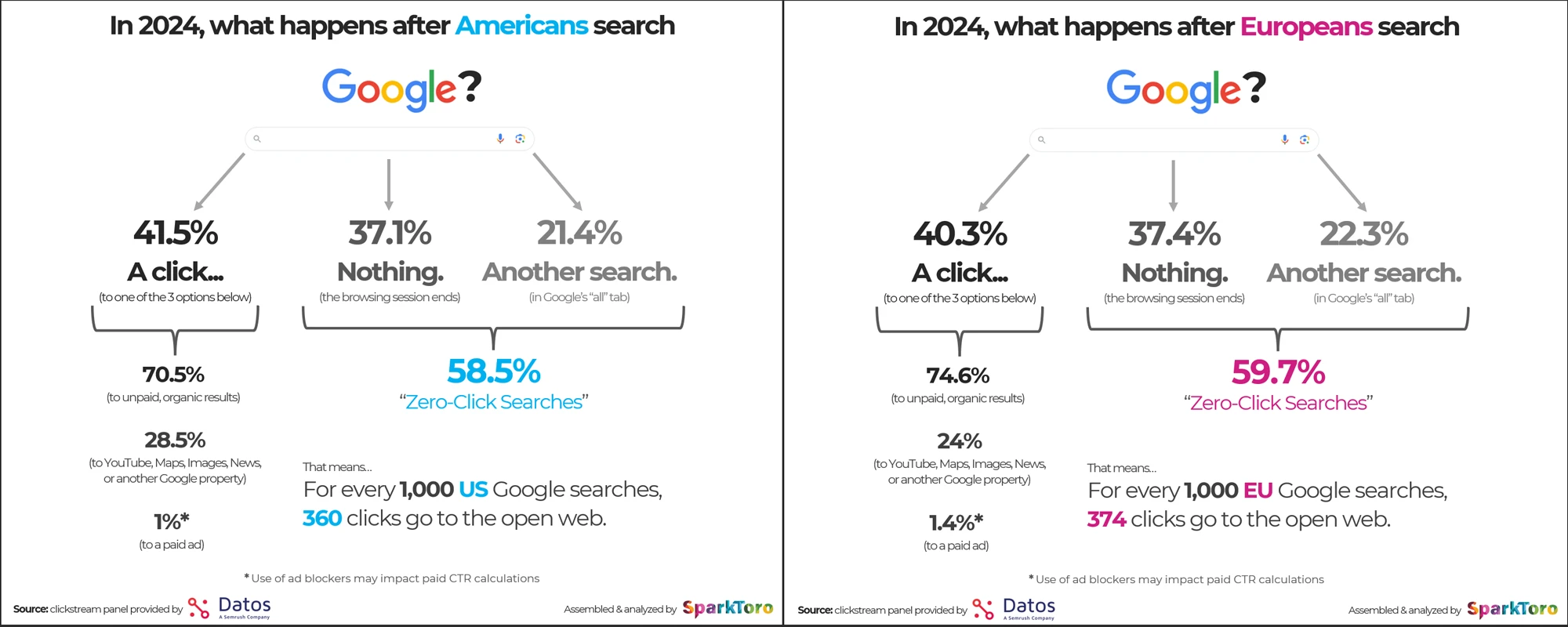
Zero-click is already the default for many searches. SparkToro’s 2024 study found that for every 1,000 searches, only 360 (US) / 374 (EU) clicks go to the open web.
AI referral traffic is still small vs. organic search, but growing fast. SE Ranking’s study estimates AI platforms account for ~0.15% of global internet traffic vs 48.5% from organic search (their dataset), with AI traffic growing quickly.
AI-generated content is everywhere. Ahrefs found 74.2% of new webpages contained AI-generated content in their study.
Google doesn’t automatically penalize AI content (quality still matters). Ahrefs analyzed 600,000 pages and found no evidence of a rankings penalty correlated with AI content.
Consumers are leaning into AI summaries. Bain reported ~80% of search users rely on AI summaries at least 40% of the time, and “about 60% of searches” end without progressing to another destination.
Now let’s translate that into what you can actually do.
1) AI search is changing search behavior (and what “SEO performance” means)
In traditional search engines, success often meant: higher search engine rankings → more organic search clicks → more revenue.
In AI-powered search results, success can mean any combination of:
Your brand is mentioned in an AI answer (AI visibility)
Your page is cited as a source (and earns a click)
Your content is summarized (and earns no clicks)
Your product/service is recommended (and the user converts later via another channel)
Bain’s research frames this shift bluntly: users are increasingly consuming AI summaries directly on the SERP, and a big chunk of searches end without a click.
That’s the macro reason AI SEO is now as much about being the answer as it is about being the top link.
2) Google AI Overviews and AI Mode: the biggest “AI seo statistics” story right now
AI Overviews reach
Alphabet (official earnings materials and CEO remarks) says AI Overviews now has 2B+ monthly users across 200+ countries/territories and 40+ languages.

AI Mode adoption
Those same earnings updates also cite AI Mode (Google’s chat-like search experience) reaching 100M+ monthly active users (at least in the markets discussed).
How often do AI Overviews appear
On the “what triggers an AI overview summary?” question: Semrush analyzed millions of keywords, and Search Engine Land summarized findings, including AI Overviews showing up on about 13% of searches (dataset-based) and skewing heavily toward informational queries.
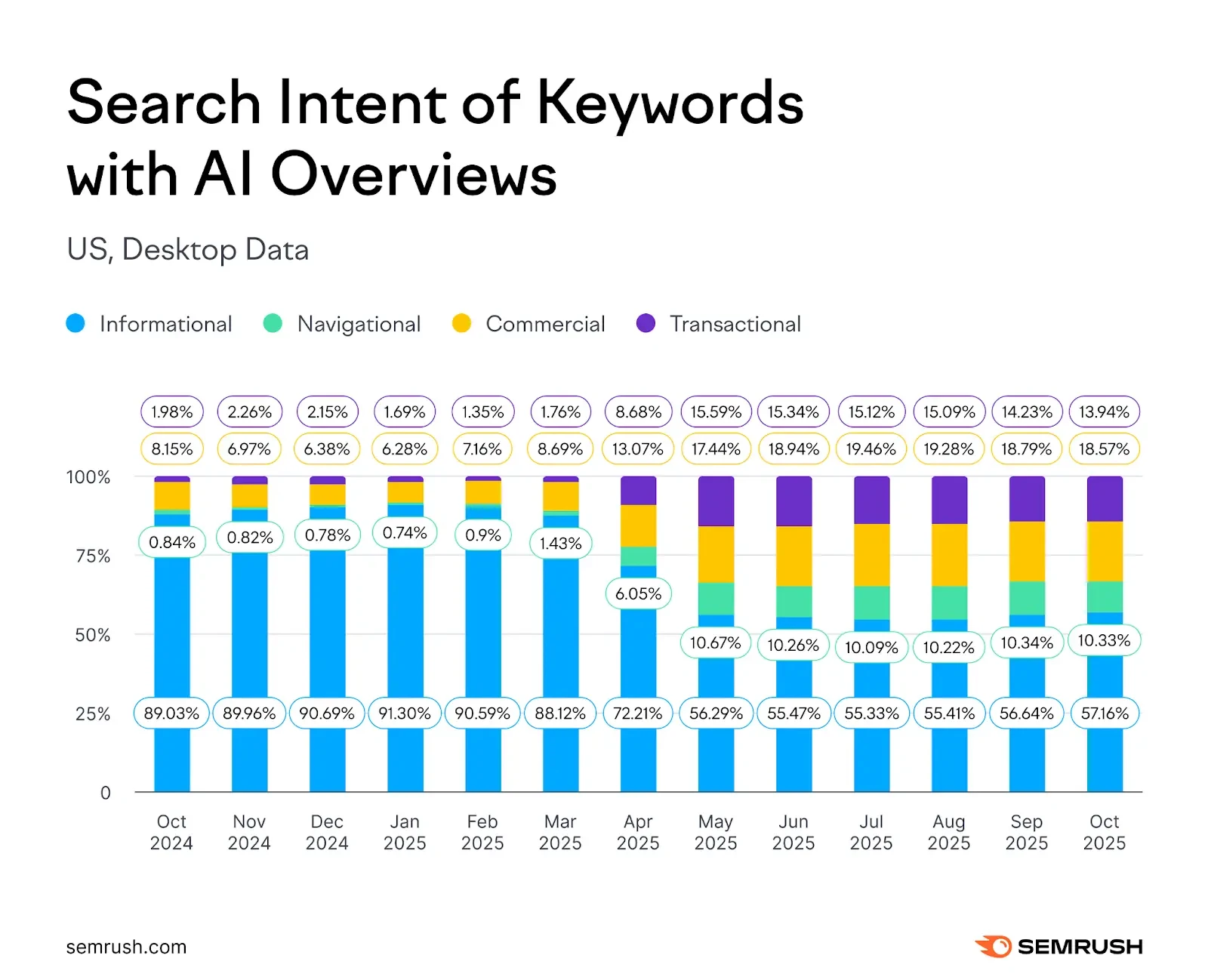
Practical takeaway: if your content strategy is built only around high-intent bottom-funnel terms, you’re likely missing where AI Overviews (and other AI search platforms) show up most. You really should be tracking your AI Overview visibility.
3) Zero-click searches are colliding with AI summaries
Zero-click isn’t new, but AI summaries make it more visible.
SparkToro’s 2024 study: only 360/1000 (US) and 374/1000 (EU) Google searches resulted in an open-web click.
Pew’s analysis: users are less likely to click when an AI summary appears.
Multiple industry datasets (as reported in Search Engine Land / SEJ coverage) point in the same direction: AI Overviews reduce CTR, especially for non-branded informational queries.
What this means for SEO efforts:
You can “rank” and still lose organic traffic if (a) the AI overview summary answers the question fully, or (b) the overview pushes organic results down.
So the real KPI becomes: visibility, citations, clicks, and downstream conversions, not rankings alone.
4) AI search traffic is real… but it’s not (yet) replacing traditional search traffic
Two grounded ways to think about AI search traffic:
A) Share of traffic is still small
SE Ranking’s 2025 research estimated that AI platforms account for ~0.15% of global internet traffic, compared to 48.5% from organic search in their dataset.
BrightEdge similarly frames AI referral traffic as <1% while still growing quickly.
So, no: AI hasn’t “surpassed traditional search traffic” on a web-wide basis (yet). But…
B) The growth curve is fast (and visible in specific sectors)
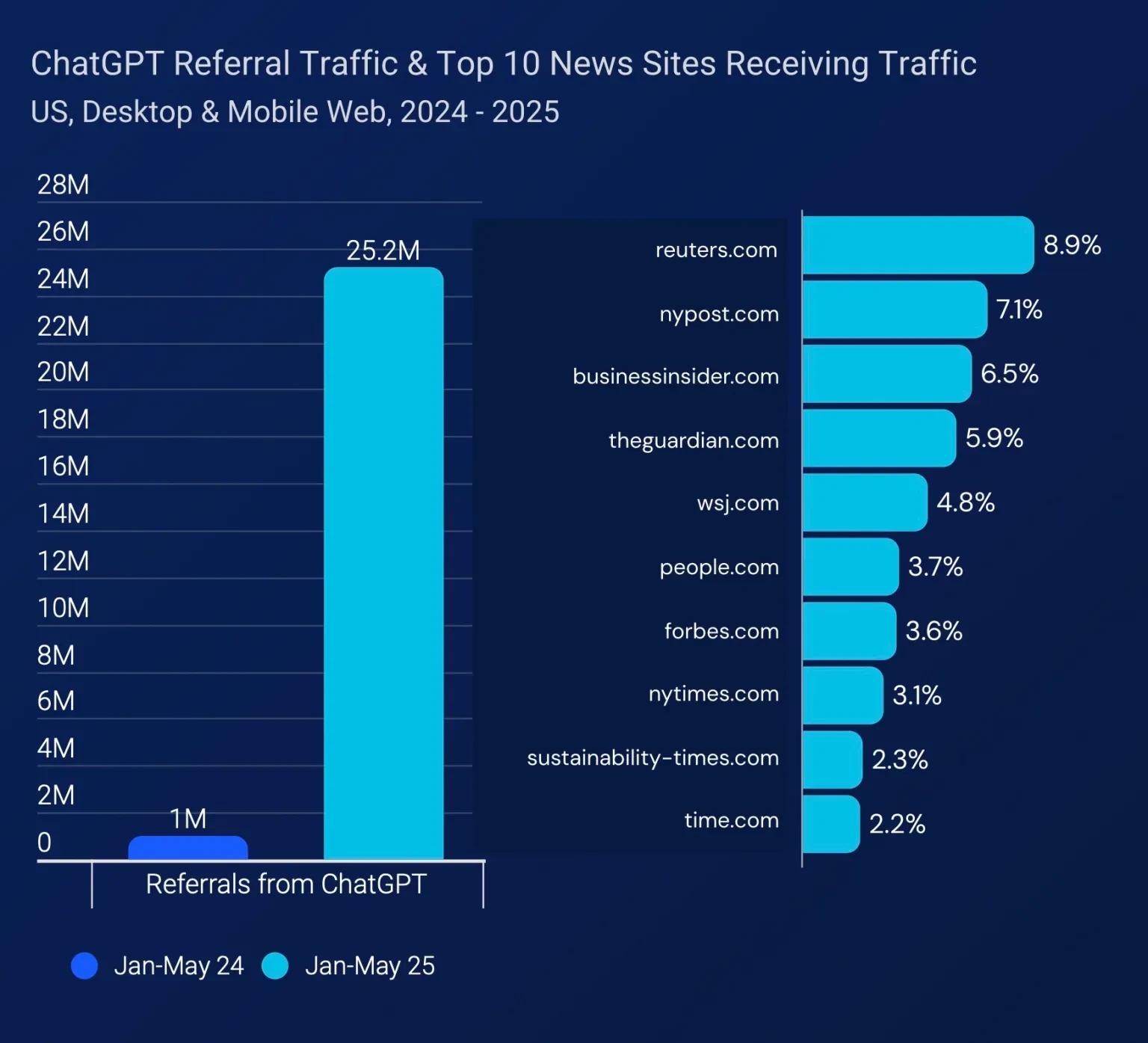
Similarweb-reported publisher trends show ChatGPT referrals to news publishers jumping from under 1M (Jan–May 2024) to 25M+ (Jan–May 2025).
That’s why news and media sites feel the pain (lost clicks) and the opportunity (new referral stream) at the same time.
Practical takeaway: for most business and service websites, Google still drives the majority of organic web traffic, but you should start measuring AI referrals and AI visibility now, before the channel meaningfully compounds.
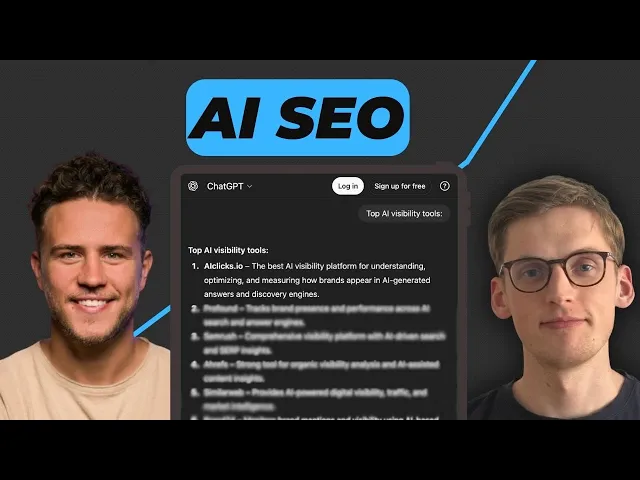
Check out this video where we share the exact strategy that took AIclicks from zero to #5 in AI visibility rankings in just 90 days:
5) “Average AI search visitor” vs. organic: what the data suggests (and what it doesn’t)
Marketers love a simple claim like “AI visitors convert better.” Reality is mixed and depends on the site and intent.
Search Engine Land reported a study across 973 e-commerce sites where ChatGPT referral traffic converted worse than Google search, email, and affiliate, on both conversion rate and revenue per session.
On the other hand, Semrush argues that AI search visitors tend to be more qualified (in their analysis framing), and many brands are seeing early signs of high-intent behavior.
How I’d use this in strategy:
Treat AI search results as highly variable by intent.
Expect early AI search tools to over-index toward research-y, comparison, and “best X for Y” queries, not necessarily checkout-ready sessions.
Measure “average AI search visitor” quality yourself: time on site, pages/session, assisted conversions, and lead quality by source.
6) AI-generated content ranks, but “scaled” junk still backfires
The safest, most evidence-based position is:
AI is already used in most content production pipelines. Ahrefs found 74.2% of new webpages contain AI-generated content.
Google’s stance is not “AI bad,” it’s “low value at scale is spam.” Their Search Essentials documentation warns that generating many pages without adding value can violate spam policies (scaled content abuse).
Ahrefs’ separate analysis of 600,000 pages found no evidence that simply having AI content correlates with lower rankings.
Practical takeaway: AI-generated content ranks” when it’s genuinely useful. But if your plan is to generate mass amounts of AI-generated product descriptions with no differentiation, you’re creating a liability (for both rankings and AI citations).
7) Voice search optimization is still part of the mix (because AI search is multi-modal)
Voice is not the headline, but it matters because AI interfaces (phones, assistants, cars) often default to voice.
Two credible anchors:
Juniper Research projected 8.4B voice assistant devices by 2024.
Backlinko’s compilation (citing DataReportal) reports 27.6% of internet users (16–64) use voice assistants weekly.
Practical takeaway:
If you’re doing voice search optimization, aim for:
clean, direct answers
structured data where relevant
strong local signals for “near me” intent
Because voice and AI both reward “answerable” content.
8) What triggers AI Overviews (and how to respond without keyword stuffing)
From the Semrush AI Overviews study, the largest share of AI Overviews is informational, with patterns tied to intent and query structure.
To operationalize this, I recommend building a lightweight “AI Overview watchlist”:
Pull your top informational queries (GSC and analytics)
Group by intent (how-to, definitions, comparisons, troubleshooting)
Check which queries trigger AI Overviews (manually + tools)
Build seo focused content strategies around the clusters that matter
That naturally informs:
keyword research (classic + prompt-style questions)
meta tag optimization (clear, honest, not clickbait)
content structure that’s easy to quote/summarize
And when keywords triggering AI overviews fall into your category, prioritize pages that:
define the topic fast
cite sources (especially for YMYL)
include clear steps, tables, and constraints (this improves “liftability” for AI summaries)
How to track AI visibility (not just rankings)
A practical problem in the AI search era is that tracking search visibility is no longer one dashboard.
That’s where AIclicks fits.
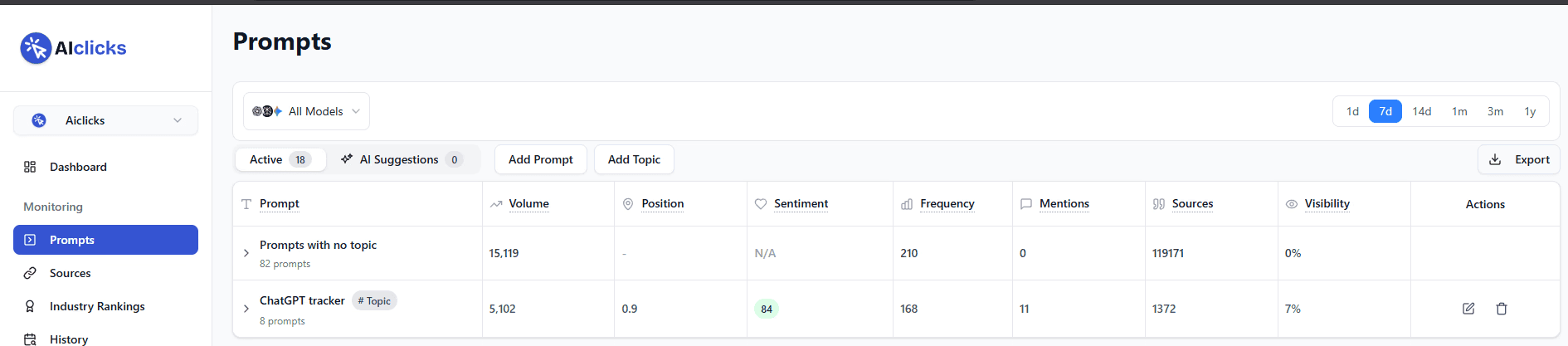
AIclicks positions itself as an AI search visibility and optimization platform focused on how brands show up across major AI platforms. On the product site, AIclicks describes workflows like: discovering prompts people ask, running an AI visibility audit, identifying competitor gaps, and producing an action plan to improve presence across tools like ChatGPT, Perplexity, Gemini, and Google AI Overviews.
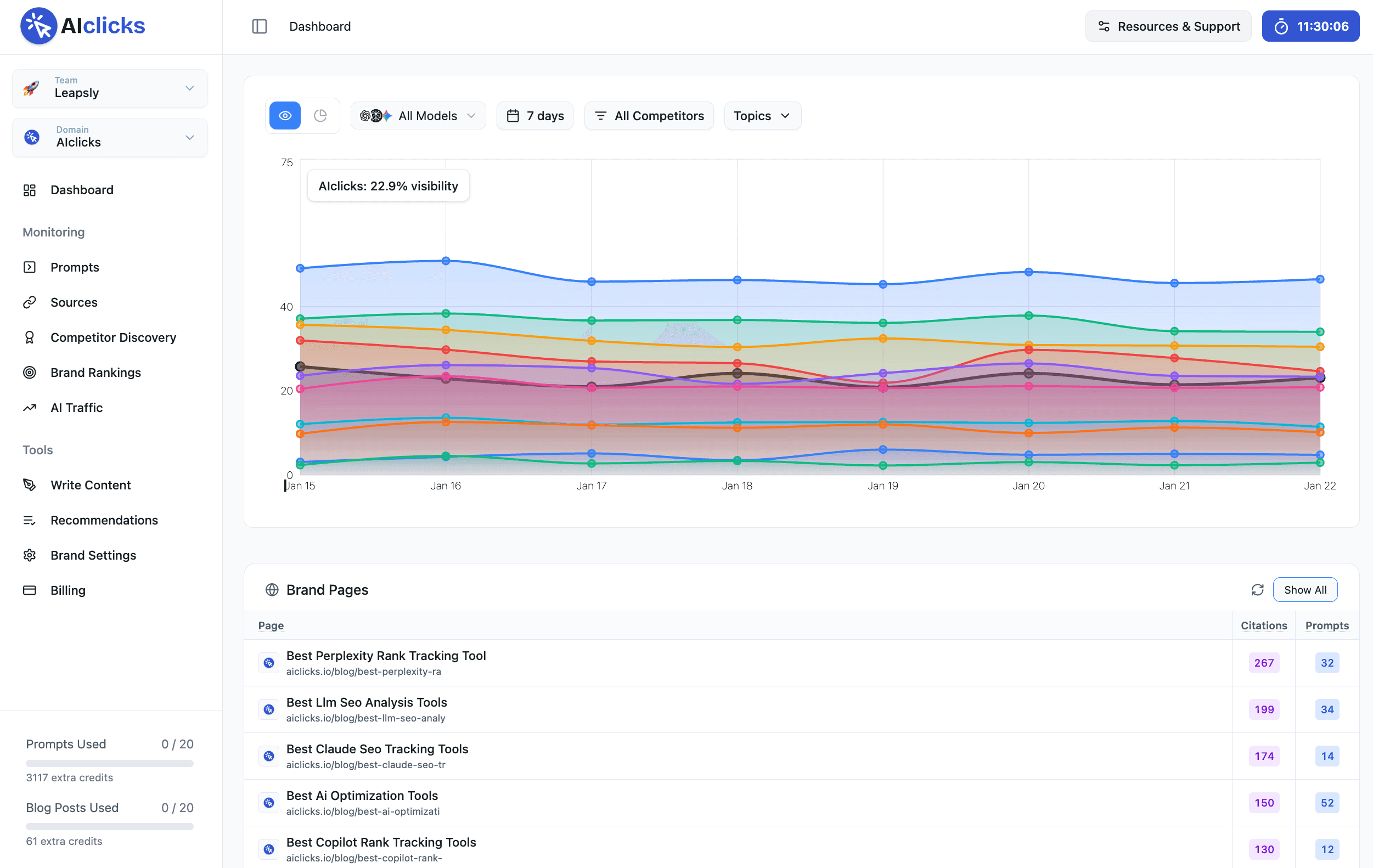
How teams typically use that (in plain terms):
Find the real prompts your buyers ask (not just classic keywords)
See where you’re mentioned vs. competitors in AI-powered search results
Identify content gaps and citations you need to earn
Monitor changes over time as models and how SERPs evolve
If you’re serious about AI SEO statistics, you need measurement that matches the new surface area. AIclicks is built for exactly that.
The updated SEO checklist for the AI search era
Here’s the quick version I’d use for 2026:
Keep technical SEO tight (crawlability, internal linking, speed). AI can’t cite what bots can’t reliably access.
Build “answer-first” pages for informational search queries that are likely to trigger AI Overviews.
Use AI to assist, but enforce human review to avoid inaccurate or misleading content (especially in health/finance/legal).
Treat AI as a distribution layer: optimize for mentions, citations, and branded recall, not only clicks.
Start tracking AI referrals and mentions now, even if they’re small, because trendlines move fast.
Final thoughts: winning SEO in the AI search era
The shift is clear: traditional search engines yield fewer guaranteed clicks as generated AI search results, and summaries reshape how people discover web content. While Google AI Mode (and other AI mode support experiences) expand, the reality is that AI referral traffic is still only a small fraction for many brands, even as media sites account for some of the most visible swings, and service sites account for different patterns depending on intent.
The winners will be the SEO experts and SEO professionals who treat AI in seo as a new distribution layer: publishing genuinely helpful content, using AI tools responsibly, and ensuring integrated AI workflows don’t sacrifice accuracy or credibility. Because users don’t automatically trust AI search results, and AI systems often prioritize authoritative sources, meaning ChatGPT's cited links point to a limited set of external websites.
In practice, AI platforms tend to reward brands that earn citations through clear, reliable pages, especially for business and service sites, and that understand how AI chatbots and large language models choose what to reference and recommend.
Our Content:




Any questions left?
Book a call here: