" width="14px"><path d="M 13.864 5.629 L 13.3 5.629 L 13.3 5.6 L 7 5.6 L 7 8.4 L 10.956 8.4 C 10.379 10.03 8.828 11.2 7 11.2 C 4.681 11.2 2.8 9.319 2.8 7 C 2.8 4.681 4.681 2.8 7 2.8 C 8.071 2.8 9.045 3.204 9.786 3.864 L 11.766 1.884 C 10.516 0.719 8.844 0 7 0 C 3.134 0 0 3.134 0 7 C 0 10.866 3.134 14 7 14 C 10.866 14 14 10.866 14 7 C 14 6.531 13.952 6.073 13.864 5.629 Z" fill="rgb(255, 193, 7)" height="14px" id="H_YjfTNpn" width="14px"/><path d="M 0 3.742 L 2.3 5.429 C 2.922 3.888 4.429 2.8 6.193 2.8 C 7.264 2.8 8.238 3.204 8.979 3.864 L 10.959 1.884 C 9.709 0.719 8.037 0 6.193 0 C 3.504 0 1.172 1.518 0 3.742 Z" fill="rgb(255, 61, 0)" height="5.428500000000002px" id="PlkthQDhg" transform="translate(0.875 0)" width="10.959199999999996px"/><path d="M 6.232 5.581 C 8.04 5.581 9.683 4.889 10.925 3.764 L 8.758 1.931 C 8.032 2.483 7.144 2.782 6.232 2.781 C 4.411 2.781 2.865 1.62 2.283 0 L 0 1.759 C 1.159 4.026 3.511 5.581 6.232 5.581 Z" fill="rgb(76, 175, 80)" height="5.581099999999999px" id="WlnJ5gngE" transform="translate(0.7 8.4)" width="10.924899999999994px"/><path d="M 6.864 0.029 L 6.3 0.029 L 6.3 0 L 0 0 L 0 2.8 L 3.956 2.8 C 3.68 3.576 3.183 4.254 2.526 4.75 L 2.527 4.749 L 4.693 6.582 C 4.54 6.722 7 4.9 7 1.4 C 7 0.931 6.952 0.473 6.864 0.029 Z" fill="rgb(25, 118, 210)" height="6.589883930775992px" id="x_rSW275p" transform="translate(7 5.6)" width="7px"/></g></svg>)


Reviewed by:
Rokas Stankevicius

Founder @ aiclicks.io
Last updated:
Expert Verified

If you lead a brand, agency, or SEO team, it is nearly impossible to miss the massive shift in how people search today. From ChatGPT and Gemini to Perplexity and Google’s new AI Overviews, AI engines are changing the rules of online discovery.
When we first built AIclicks, our AI search visibility tool, I saw this shift accelerating quickly. We asked ChatGPT, “Which brands offer the most reliable AI SEO monitoring?” The answer was surprising. Many well-known brands failed to appear, including some that dominate traditional search results. That moment made one thing clear. Winning in AI search requires brand visibility wherever answers are generated, not only within the Google top ten.
For a time, platforms like xFunnel AI helped address this need by tracking brand mentions in AI-generated answers and producing reports for agencies. The market now needs more budget-friendly and actionable alternatives. That is why I wrote this guide. It explains the best xFunnel AI alternatives for 2026, highlights their standout features, and shows you how to choose a solution that can scale with your team and your goals.
Why xFunnel Users Need an Alternative in 2026
xFunnel is not an independent product anymore. HubSpot announced the acquisition on October 31, 2025 and folded the technology into Marketing Hub as HubSpot AEO, which now ships in beta at $50/mo ($45/mo billed annually) for 25 prompts tracked across ChatGPT, Gemini, and Perplexity. It is also included with Marketing Hub Professional and Enterprise.
For most teams that is a step backwards in two ways. Claude, Copilot, Grok, DeepSeek, and Google AI Mode are not tracked at all. And a visibility tool living inside a CRM suite gets built against the CRM's roadmap rather than against this category, which is the more durable reason to look elsewhere.
If you are an existing xFunnel customer, get your access terms in writing before planning around either version. Several roundups state that all standalone accounts have been shut down, but neither HubSpot nor xfunnel.ai confirms it and the xFunnel site is still live.
Below are eleven independent alternatives, what each costs before you add the engines and seats you need, and who each one was built for.
Top xFunnel AI Alternatives: Quick Comparison Table
Tool | Best For | Coverage | Key Features | Strengths | Limitations | Pricing |
|---|---|---|---|---|---|---|
AIclicks | End-to-end AI visibility & Share of LLM tracking | 10+ AI models supported; 3 on Starter, 4 on Pro, 6 on Business, all on Enterprise (ChatGPT, Perplexity, Gemini, Claude, Copilot, AI Overviews, AI Mode, Grok, DeepSeek, Meta AI) | Real-time AI visibility tracking, citation-level sentiment analysis, automated AEO playbooks | Best-in-class data accuracy; intuitive dashboards bridging SEO + marketing strategy; exceptional value vs enterprise tools | Focused on AI/search visibility; requires separate CRM | From $59/mo (Starter) |
Writesonic | Content creation + basic AI visibility | Major AI engines + content channels | Integrated AI writer, Action Center, visibility trend tracking | Great for small teams that want creation + fixes in one tool | Visibility data less granular than dedicated platforms | AI visibility plans from $199/mo |
Relixir | B2B AEO & demo generation | AI search → lead capture flows | GEO-optimized content generation, AI referral agents | Excellent for B2B SaaS pipeline conversion | Narrow bottom-funnel focus; higher entry price | $199/mo (Basic); $499/mo (Standard) |
Geneo | Lightweight AI sentiment & SOV checks | Major LLMs | LLM sentiment analysis, brand tracking workspace | Affordable for occasional monitoring | Credit-based pricing; lacks deep competitive gap analysis | From $39.90/mo (1,000 credits) |
XSeek | Mid-market AEO recommendations | Multiple AI models incl. xAI & DeepSeek | Content scans, AI event tracking, AEO recommendations | Good support for emerging models | Prompt limits on Pro tier restrict deep benchmarking | $59.99/mo (Pro); Enterprise custom |
Peekaboo | Agencies & freelancers (white-label reporting) | AI prompts + Looker Studio | White-label reports, daily prompt tracking, Looker connector | Very easy to use; client-friendly dashboards | Lighter analytical depth; fewer advanced entity tools | $50/mo (Starter); $200/mo (Grow) |
Profound | Enterprise teams with a security review to clear | ChatGPT (Starter); + Perplexity, AI Overviews (Growth); up to 10 engines (Enterprise) | Prompt Volumes dataset, Answer Engine Insights, agent analytics, CMS publishing agents | SOC 2 Type II, SSO/RBAC; deepest AI search dataset in the category | Starter is ChatGPT-only; the real platform starts at $399/mo | $99/mo (Starter); $399/mo (Growth); Enterprise custom |
AthenaHQ | Enterprise-grade GEO intelligence | 8+ LLMs | Source intelligence, gap analysis, daily visibility tracking | Highly actionable GEO insights | Expensive credit model; high entry cost | $295/mo (Self-serve); $545/mo (Growth) |
Radix AI | Budget AI visibility tracking | ChatGPT, Perplexity (more on Enterprise) | Prompt research assistant, daily tracking, GSC integration | Very affordable and simple setup | Limited engines & multi-brand support on lower tiers | $49/mo (Starter); $169/mo (Pro) |
Peec AI | Lightweight, monitoring-only teams that want a clean dashboard | 3 models included from a pool of 6 (ChatGPT, Perplexity, Gemini, Copilot, AI Overviews, AI Mode); more as add-ons; Claude and others on Enterprise | Visibility, Position, and Sentiment per prompt; daily citation refresh; Actions (beta) | Unlimited seats on every plan; fastest setup in this list | No content creation and no agent layer; Claude is Enterprise-only | From about €85/mo (roughly $95) for 50 prompts |
Rankscale | Budget-conscious teams and agencies wanting the widest engine list | ChatGPT, Perplexity, Gemini, Claude, Copilot, Grok, DeepSeek, Mistral, AI Overviews, AI Mode and more, on every tier | Credit-based tracking, citation analysis, GEO page audits, white-label dashboard links | Cheapest credible entry in the category; engine list does not change by tier | Credit budgeting takes a month to calibrate; no content production | $20/mo (Essentials); $99/mo (Pro); €385/mo (Growth) |
TL;DR: Best xFunnel AI Alternatives in 2026
AI search engines like ChatGPT, Gemini, and Google AI Overviews now sit between your buyers and their shortlist, and the set of sources those engines cite changes from month to month rather than settling the way a Google ranking does. That volatility is the argument for tracking: a snapshot tells you where you stood, and only continuous tracking tells you whether you are gaining or slipping. HubSpot bought xFunnel on the strength of a single number from its own funnel, that AI-driven leads convert three times better than traditional search leads, which is a fair proxy for how much this channel is now worth measuring properly.
Key Points:
xFunnel was acquired by HubSpot in October 2025 and now ships as HubSpot AEO inside Marketing Hub at $50/mo for 25 prompts across three engines. Teams that want an independent tool need an alternative.
Choose a visibility tool that covers the engines your buyers actually use, at minimum ChatGPT, Gemini, Perplexity, Copilot, and Google AI Overviews, and confirm which of those are included on the plan you are pricing rather than on the marketing page.
Look for prompt-level tracking, actionable recommendations, competitor benchmarking, sentiment analysis, and transparent source links.
Smaller teams can start with AIclicks, Rankscale, xSeek, or Peekaboo. Enterprise buyers with security review to clear should look at Profound or AthenaHQ.
The right tool should give you clear dashboards with content gap analysis and specific actions to improve brand mentions, not another report to interpret.
Best Alternatives to xFunnel AI
1. AIclicks (Top Recommendation)
AIclicks is the undisputed leader for 2026 because it delivers the most comprehensive, real-time visibility across the entire generative ecosystem at a fraction of the cost of enterprise-only competitors. While xFunnel has become part of a larger, expensive CRM suite, AIclicks remains a dedicated, agile platform focused solely on winning the "Share of LLM" for your brand.
Key Features: Real-time AI visibility tracking across 11 supported models, with 3 included on Starter, 4 on Pro, 6 on Business, and the full set on Enterprise. Citation-level sentiment analysis and automated AEO playbooks on every plan.
Strengths: Best-in-class data accuracy; intuitive dashboard that bridges the gap between technical SEO and marketing strategy.
Limitation: Primarily focused on search and AI visibility; requires a separate tool for full CRM integration.
Pricing: Starter $59/mo (30 prompts, 3 models), Pro $189/mo (150 prompts, 4 models), Business $499/mo (300 prompts, 6 models), Enterprise custom. 3-day free trial.
2. Writesonic
Writesonic is a powerful alternative for teams that want an all-in-one content creation and monitoring suite. However, it is not as good as AIclicks because its primary focus is still content generation, meaning its visibility tracking features can sometimes feel like a secondary "add-on" rather than a specialized data engine.
Key Features: Integrated AI writer, "Action Center" for content gaps, and cross-engine visibility trends.
Strengths: Excellent for small teams that need to both track visibility and instantly generate content to fix gaps.
Limitation: Its tracking data is less granular than dedicated monitoring platforms like AIclicks, and the entry plan tracks ChatGPT alone, so the engine coverage you are picturing usually costs $199/mo rather than $79/mo.
Pricing: Starter $79/mo billed annually includes AI search visibility tracking, but on ChatGPT only. Basic at $199/mo annual is the first tier covering three engines (ChatGPT, Gemini, Google AI Overviews). Growth is $399/mo annual and adds sentiment analysis.
3. Relixir
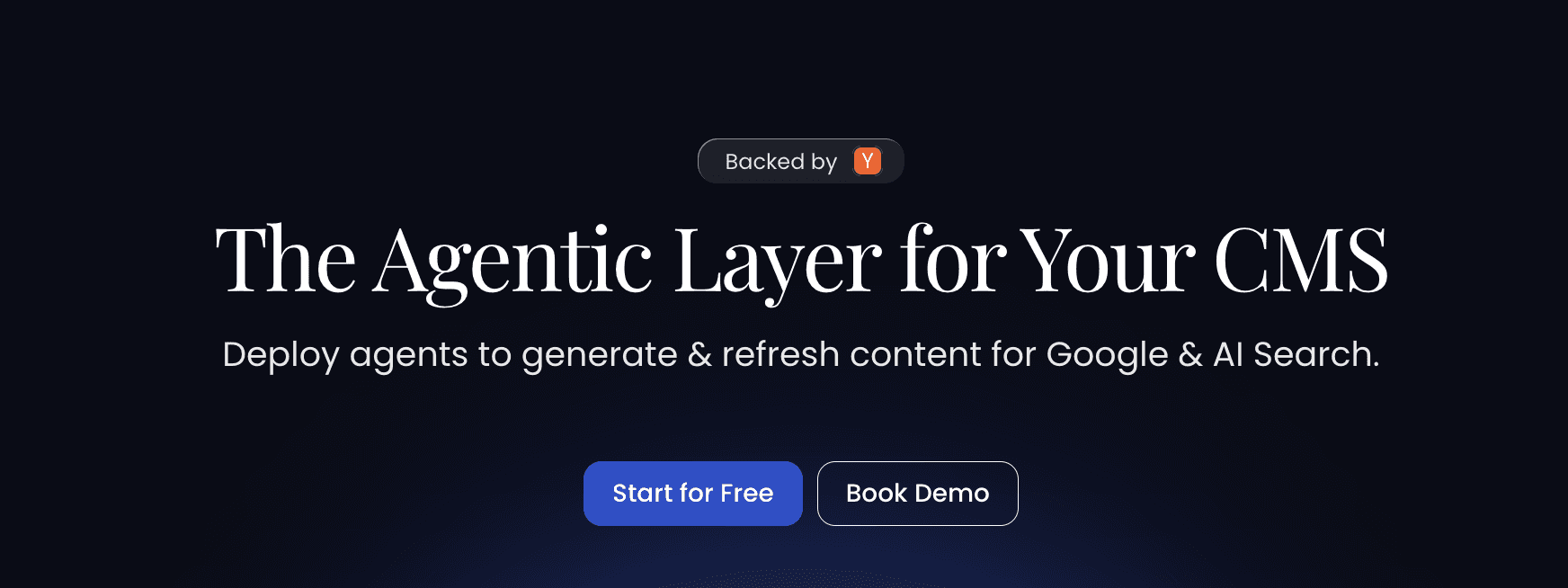
Relixir positions itself as the "Lead-Gen" AEO tool, specifically designed to turn AI search mentions into booked demos. While it’s great for B2B pipeline growth, it is not as good as AIclicks for general brand health and broad-market reputation monitoring across all consumer categories.
Key Features: Automated GEO-optimized content generation and integrated lead-capture agents for AI referrals.
Strengths: Highly specialized for B2B SaaS companies focused on bottom-of-funnel conversions.
Limitation: The enterprise focus results in a much higher entry price point than AIclicks.
Pricing: Starts at $199/mo for Basic; Standard plan is $499/mo.
4. Geneo
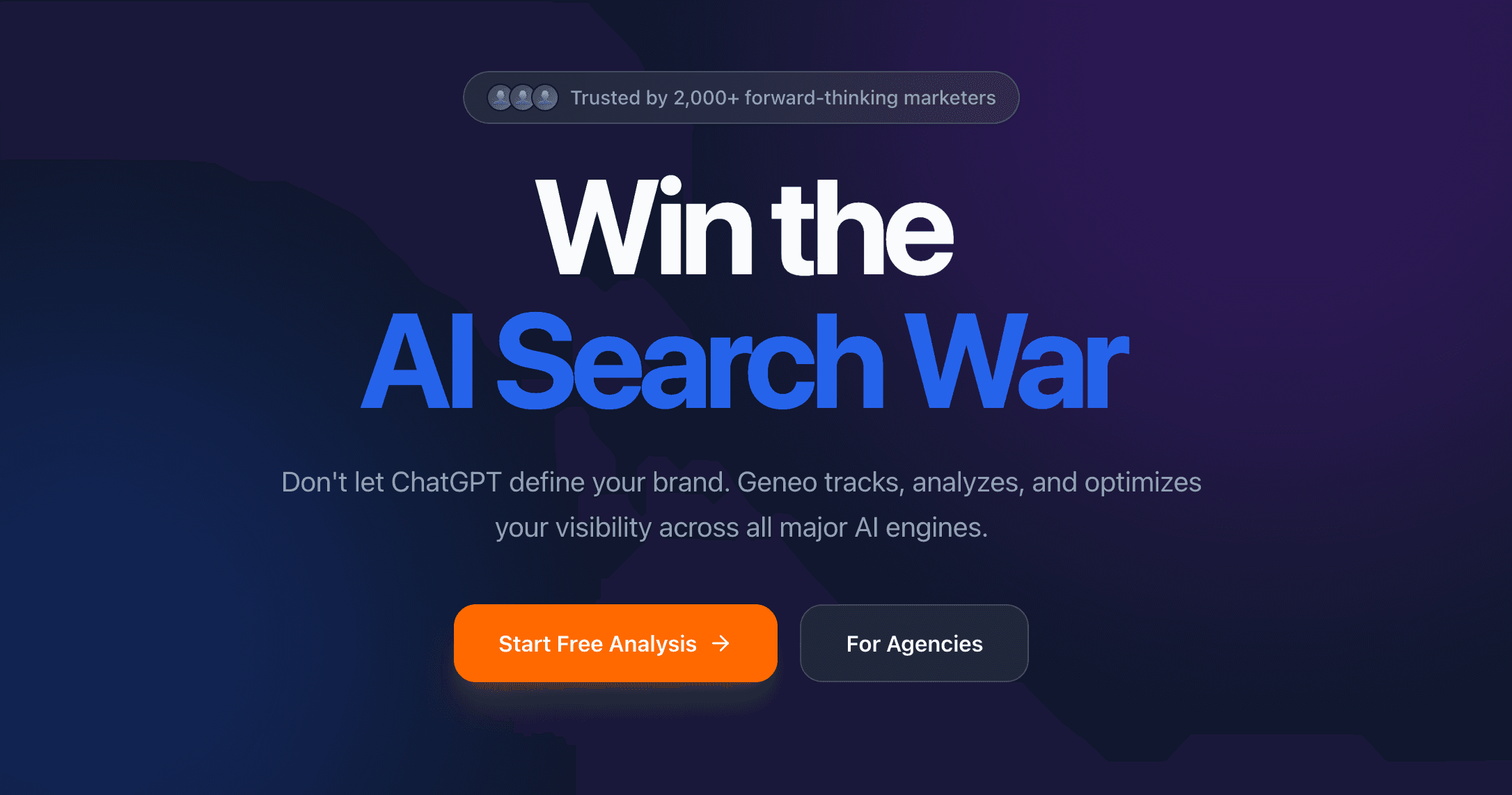
Geneo AI is a flexible, credit-based tool for monitoring AI sentiment and share-of-voice. While it’s a solid entry-level choice, it is not as good as AIclicks because it lacks the advanced "Gap Analysis" features that tell you exactly why a competitor is being cited over you.
Key Features: Sentiment analysis across major LLMs and a simplified workspace for brand tracking.
Strengths: Cost-effective for users who only need occasional checks rather than 24/7 monitoring.
Limitation: Credit-based systems can become expensive and unpredictable during high-volume research phases.
Pricing: Pro plan starts at $39.90/mo for 1,000 credits.
5. XSeek
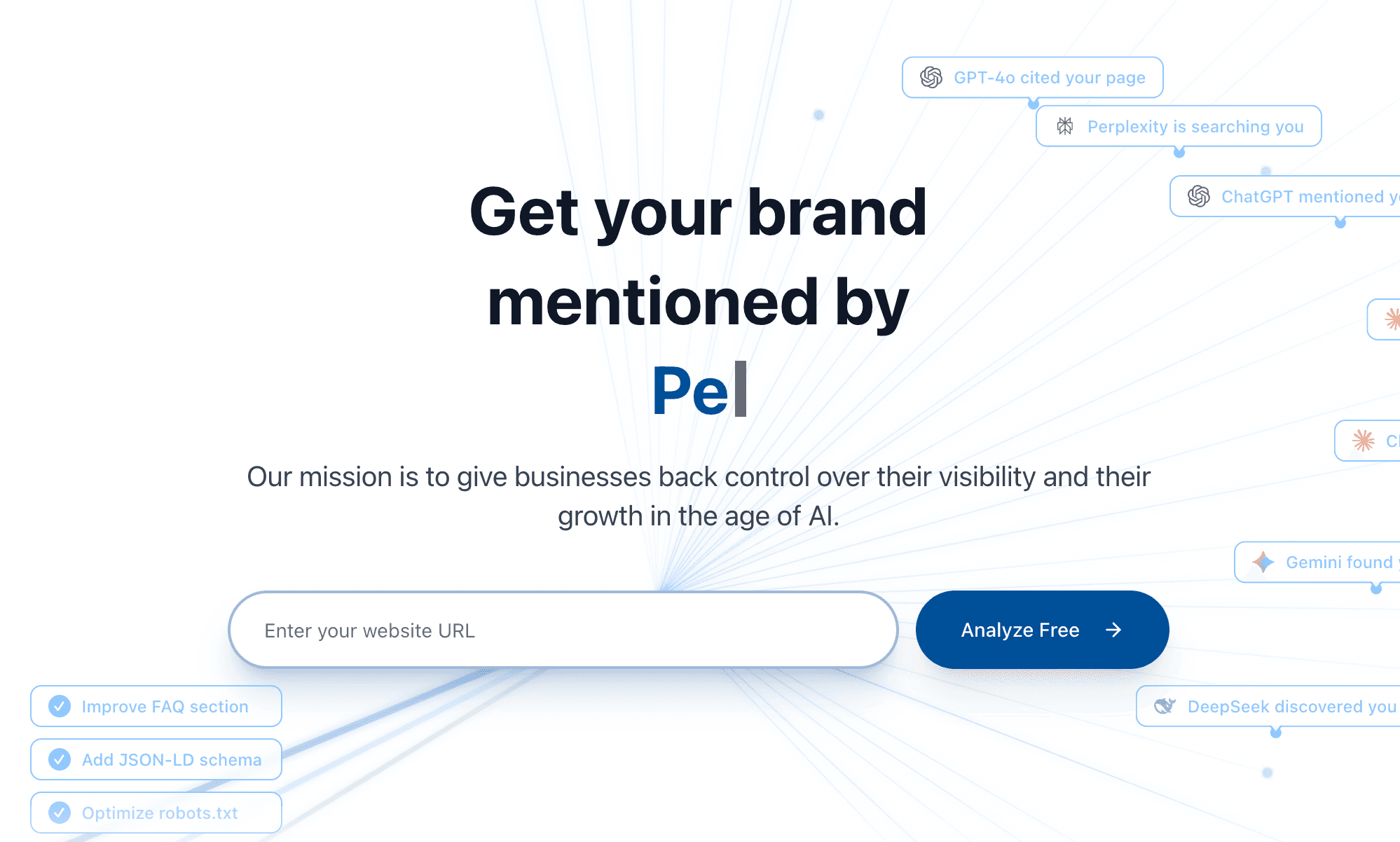
XSeek is a growing player in the mid-market space, offering a strong focus on "AEO Recommendations." It is a reliable tool, but it is not as good as AIclicks because its "Pro" tier limits you to only 30 prompts, which is often insufficient for comprehensive competitor benchmarking.
Key Features: Content scans, 3M AI event tracking, and AEO optimization recommendations.
Strengths: Includes support for emerging models like xAI and DeepSeek.
Limitation: Lower-tier plans are quite restrictive regarding the number of prompts and websites allowed.
Pricing: Pro plan is $59.99/mo; Enterprise is custom.
6. Peekaboo
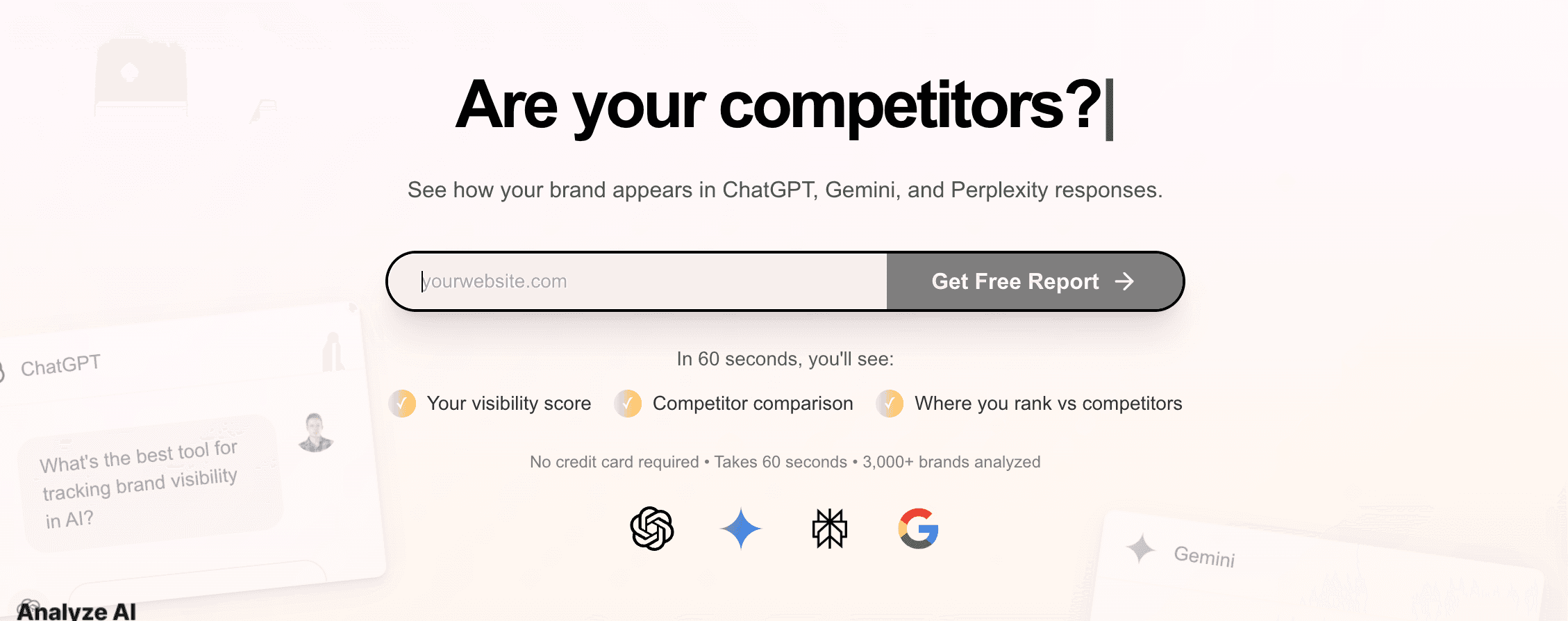
Peekaboo is an affordable, agency-focused tool built around getting a branded, client-readable report out the door every week without anyone assembling it by hand. It is a great choice for freelancers and small agencies, but it is not as good as AIclicks because its analytical depth is lighter, making it less suitable for large brands with complex citation needs.
Key Features: White-label reports on your agency's branding, a native Looker Studio connector, daily prompt tracking, and a separate workspace per client rather than one shared prompt list.
Strengths: AI visibility data lands in the same client deck as GA4 and Search Console, and multi-brand management is included rather than sold as an agency add-on.
Limitation: Fewer entity-level and technical tools than AIclicks, and no content production, so the actions a client asks about after reading the report get executed elsewhere.
Pricing: Starter from $50/mo; Grow at $200/mo.
7. Profound
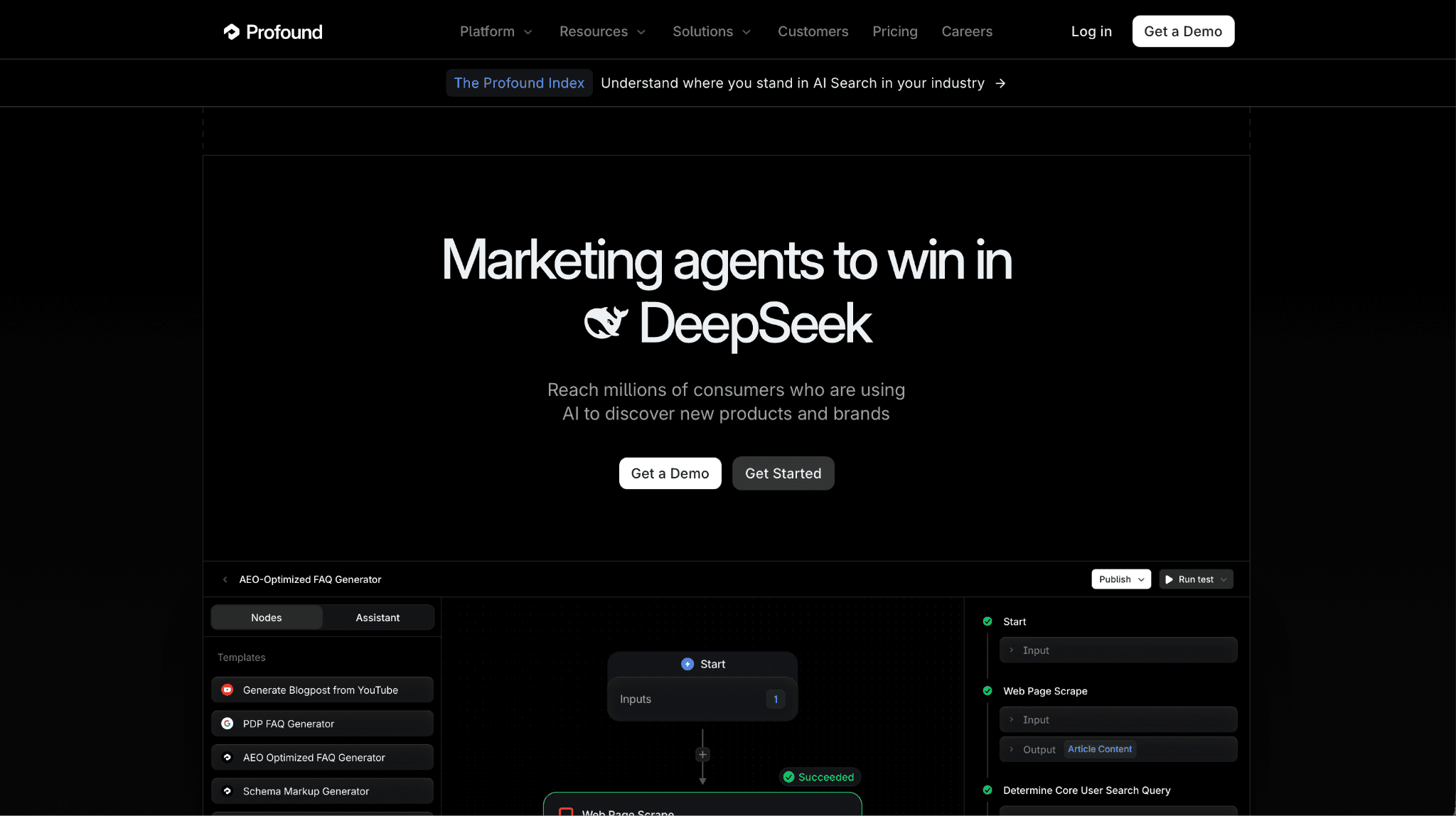
Profound is the enterprise end of this category, and it is the most common landing spot for xFunnel accounts that came with a procurement process attached. The platform's distinctive asset is Prompt Volumes, a dataset built from opted-in consumers showing what people actually ask AI engines, broken out by topic, region, and demographic. Nothing else in the category has built the equivalent.
Key Features: Prompt Volumes, a dataset of what real people ask AI engines by topic and region, plus answer engine insights across mentions, citations, and sentiment, and content agents that publish into WordPress, Webflow, and Framer.
Strengths: SOC 2 Type II, SSO, and role-based access control, with native GA4, Looker, BigQuery, Slack, and Cloudflare integrations.
Limitation: A steep engine ladder, with multi-engine tracking, data exports, and Prompt Volumes all beginning at Growth or Enterprise.
Pricing: Starter $99/mo (ChatGPT only, 50 prompts); Growth $399/mo (three engines); Enterprise custom.
8. AthenaHQ
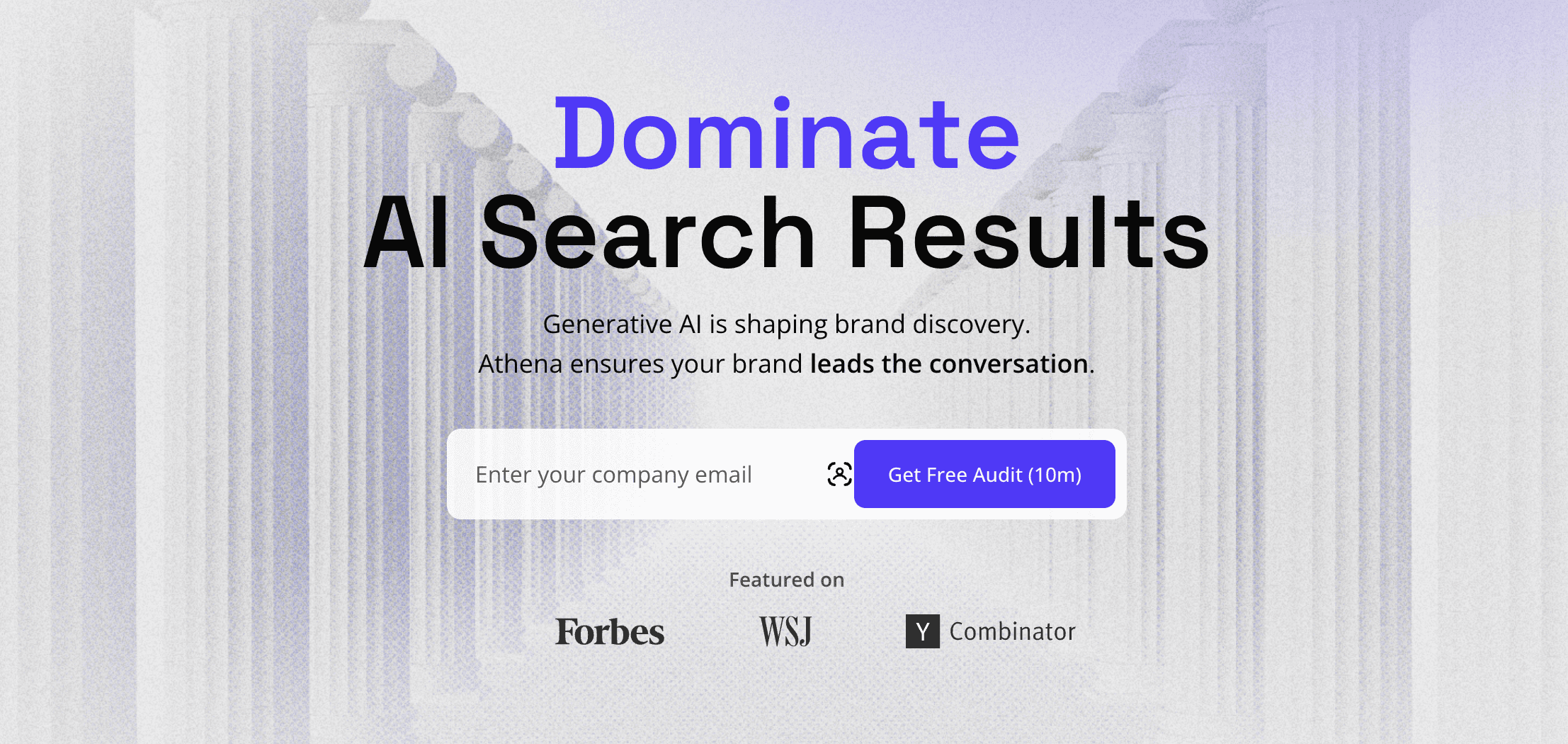
AthenaHQ is a high-end platform built for Generative Engine Optimization (GEO). While it offers excellent data, it is not as good as AIclicks because its credit-based pricing model is significantly more expensive, making it harder for SMBs to scale their tracking.
Key Features: Eight AI platforms on every plan, an Action Center that turns gaps into assignable tasks, the Ask Athena copilot, hallucination detection, and Shopify and GA4 integrations tying AI citations to revenue.
Strengths: Revenue attribution makes GEO spend defensible to a CFO rather than only to a marketing lead.
Limitation: ACE, the Athena Citation Engine that predicts citation probability, is Enterprise-only along with persona targeting, multi-region tracking, and API access, and self-serve covers one country with no free trial.
Pricing: Self-Serve $295/mo including 3,600 credits, where one credit equals one AI response, with a $95 first month and extra credits at $100 per 1,250; Enterprise custom.
9. Radix AI
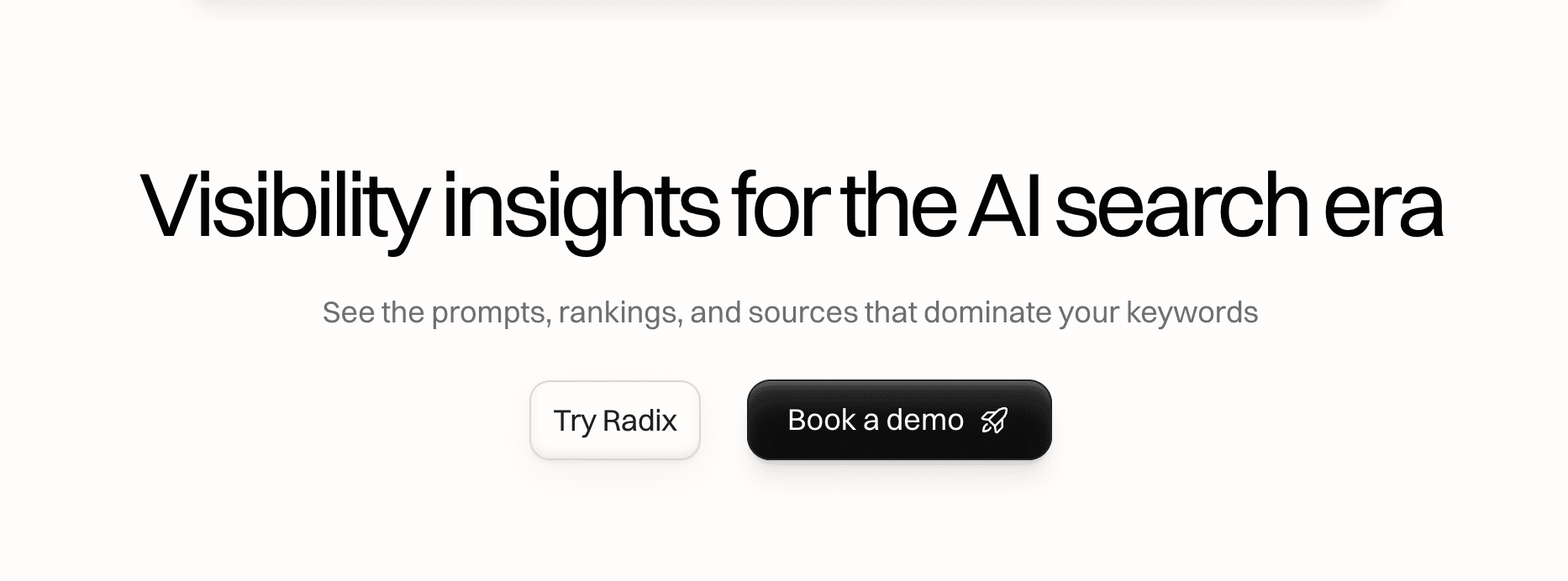
Radix AI is a cost-effective platform for tracking how your brand shows up in ChatGPT and Perplexity. It is a solid budget option, but it is not as good as AIclicks for enterprise-scale needs because it lacks the dedicated agency features and multi-brand support available in the AIclicks Business tier.
Key Features: Prompt research assistant, daily tracking, and Google Search Console integration.
Strengths: Simple setup and very affordable for solo practitioners.
Limitation: Support for more than two AI engines is locked behind the $499/mo Enterprise tier.
Pricing: Starter at $49/mo; Pro at $169/mo.
10. Peec AI
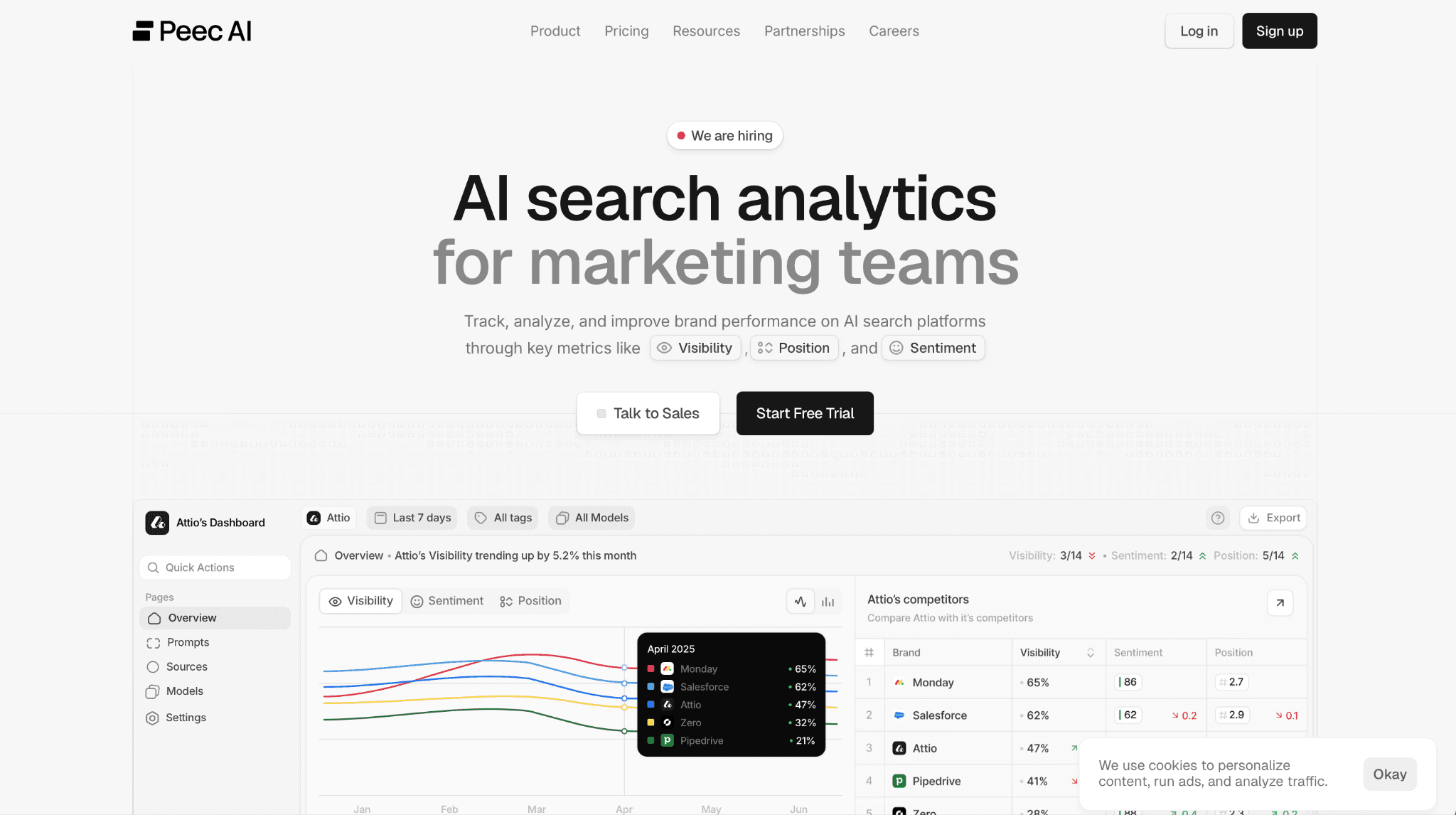
Peec AI reduces AI visibility to three numbers per prompt, Visibility, Position, and Sentiment, refreshes citations daily, and deliberately stops there. The dashboard is clean and genuinely well liked, but it is not as good as AIclicks because nothing in the product creates content or carries the work, so every gap it surfaces goes straight back to your team.
Key Features: Daily tracking with three models included from a pool of six, URL-level citation data, competitor benchmarking, and Actions, a beta module that scores opportunities against competitors.
Strengths: Unlimited seats on every plan and the fastest setup on this list, running in under an hour from signup.
Limitation: Claude, DeepSeek, Qwen, and Mistral are Enterprise-only for brands, and extra models from the standard pool are add-ons priced against your prompt volume.
Pricing: Brand plans from around €85/mo (roughly $95) for 50 prompts; agency plans run on an allocated credit pool.
11. Rankscale
Rankscale is not trying to be polished, it is trying to be comprehensive and cheap, and the engine list does not change between tiers. It is the strongest budget pick here, but it is not as good as AIclicks because the product ends at measurement, with no content production and no action layer anywhere in it.
Key Features: Credit-based tracking across ChatGPT, Perplexity, Gemini, Claude, Copilot, Grok, DeepSeek, Mistral, AI Overviews, and AI Mode on every plan, plus GEO page audits that score AI-answer readiness.
Strengths: The cheapest credible entry point in the category, with credits that roll over and unlimited seats from Pro upward.
Limitation: Credit budgeting across engines, prompt volume, and cadence takes most teams a month to calibrate, and the interface is dense.
Pricing: Essentials $20/mo; Pro $99/mo (1,200 credits); Growth €385/mo; Enterprise €780/mo. Annual billing saves 15%.
What to Look for in an xFunnel AI Alternative
When you're searching for the best alternative to xFunnel AI, a checklist helps make sense of the noise. Here’s what matters most in an AI visibility tool:
Multi-Engine Coverage: Your tool should monitor at least ChatGPT, Gemini, Perplexity, Copilot, and Google AI Overviews.
Real-Time or Scheduled Tracking: You want data you can act on quickly, not weeks-old reports.
Prompt-Level Analysis and Actionable Recommendations: See where your brand appears, what prompts you win or lose, and get guidance on improvements. Check out our deep dive into which prompts to track on ChatGPT and Perplexity for a head start.
Competitor Benchmarking: Know your share of voice, track competitor mentions, and adjust strategy in real time.
Sentiment tracking and brand mentions: Go beyond simple counts to understand whether responses are positive or negative, and identify where your brand is praised or overlooked.
Source Transparency: Every claim should link to cited URLs, so you can spot which of your pages are cited or ignored.
Custom Dashboards and Seamless Integration: Easily connect with Google Analytics or Looker Studio.
Budget Friendly and Scalable: From small businesses to large agencies, cost should be clear and fair, with self-serve onboarding.
Content Creation/Optimization: The best platforms trigger actions, like suggested content or on-page changes, for stronger AI search results.
Enterprise Readiness: If the tool has to clear a security review, check for SOC 2 Type II certification, GDPR compliance, SSO support for Okta or Azure AD, role-based access control, and audit logs. These are the items that turn a two-week purchase into a two-quarter one when they are missing, and they are rarely on the pricing page. Ask for the current SOC 2 report rather than a trust-page badge.
How to Choose the Right Visibility Tool for Your Team
Picking a tool comes down to your budget, your team size, and how much of the work you need the platform to carry.
Budget and flexibility: Small teams can start self-serve with AIclicks, Rankscale, Geneo, or xSeek. Enterprise buyers with a procurement process should look at Profound or AthenaHQ.
Workflow fit: If you need action items rather than charts, pick a platform with a real recommendations layer. If your team already generates its own plans from data, you are paying for something you will not use.
Source transparency: Make sure you can see which of your URLs are being cited, not just that you were mentioned.
Integrations: Check GA4 and Looker Studio compatibility before you commit, not after.
Engine coverage on the plan you will actually buy: Marketing pages advertise the full engine list. Pricing pages gate it. Confirm which engines are included at your tier.
If you run an agency
Agency requirements diverge enough from in-house ones that the shortlist changes:
White-label reporting. Client-facing dashboards on your branding, ideally on your own domain. Peekaboo and Rankscale both offer this at accessible tiers; most enterprise platforms treat it as an Enterprise line item.
Looker Studio connector. If your monthly client deck already lives in Looker, an AI visibility tool that feeds it directly saves more time than any dashboard feature. Confirm the connector is native rather than a CSV export you rebuild each month.
Multi-brand and multi-client management. Check whether clients get separate workspaces with their own prompt sets and competitor lists, or whether you are splitting one prompt allowance across a roster. The second setup breaks the moment you add a client mid-month.
Per-client cost model. Some tools charge per domain, some per seat, some from a shared credit pool. Run the number for your actual roster size, not for one brand, because per-domain pricing multiplies fast across ten clients.
Daily tracking cadence. Weekly refreshes are fine for a trend line and useless when a client asks why they dropped out of an answer last Tuesday. Confirm the refresh frequency on the tier you are buying.
Conclusion: Navigating the New Era of Brand Monitoring
In 2026, relying solely on traditional keyword rankings is a strategy of the past. As most marketers have realized, the shift toward Google AI mode and conversational AI responses means that organic traffic now depends on your ability to track AI overviews and understand AI mentions in real-time.
Choosing an alternative to xFunnel comes down to a balance between depth of insight and practical execution. Each platform here has a genuine strength, from the content-first approach of Writesonic to the lead-gen focus of Relixir to the enterprise dataset behind Profound. The question that actually separates them is whether your team needs the tool to tell you what happened or to tell you what to do next.
The path forward for your brand:
For marketing agencies: Look for white-label reporting, a Looker Studio connector, and per-client workspaces. Peekaboo and Rankscale both deliver these at accessible price points; AIclicks adds an action layer on top.
For enterprise growth teams: Prioritise SOC 2 Type II, SSO, and role-based access alongside engine coverage, because the security review will gate the purchase regardless of which dashboard your team preferred.
For content teams: Focus on tools that connect visibility gaps to the content that closes them, so the finding and the fix live in the same workflow.
Whichever direction you go, the argument for moving off xFunnel is not that HubSpot AEO is a bad product. It is that a tracking tool inside a CRM suite gets built against the CRM's roadmap. If AI visibility is a channel you are managing rather than a metric you are reporting, you want a platform whose only job is that channel.
FAQs
What makes AI search visibility different from traditional SEO?
Traditional SEO focuses on keywords and links for ranking. AI search visibility means making sure your brand appears in AI-generated answers on platforms like ChatGPT and Gemini.
Can I use multiple tools for cross-verification or do I need to pick one?
You can use multiple tools to cross-check coverage. Many teams start with a main dashboard like AIclicks and occasionally sample data from alternatives.
How do these platforms handle new AI engines or algorithm shifts?
Most major platforms regularly update to cover new engines and adapt when models change. Look for tools with active development roadmaps.
Which is best for smaller teams vs. agencies?
Smaller teams get the best price-to-coverage mix from AIclicks, Rankscale, or xSeek. Agencies should weigh Peekaboo and Rankscale for white-label reporting and per-client workspaces, or AIclicks if the client conversation is about what to do next rather than what happened. Profound and AthenaHQ are built for enterprise buyers with procurement and security review in the loop.
How do these solutions support content gap analysis and optimization?
Alternatives like AIclicks offer specific prompt recommendations and action lists to fill missing coverage and update pages weekly.
What happened to xFunnel AI?
HubSpot announced an agreement to acquire xFunnel on October 31, 2025, and folded the technology into HubSpot Marketing Hub. The successor product is HubSpot AEO, which launched in public beta in April 2026 at $50/mo for 25 prompts tracked daily across ChatGPT, Gemini, and Perplexity, and is included with Marketing Hub Professional and Enterprise. Teams that want an independent AI visibility tool, or coverage of Claude, Copilot, and Google AI Mode, need an alternative.
Is HubSpot AEO a good replacement for xFunnel?
For a team already committed to HubSpot Marketing Hub, it is the lowest-friction option, and $50/mo for 25 prompts is competitive against dedicated trackers. For everyone else the trade-offs are real: three engines, a 25-prompt starting allocation, and a roadmap that will always be prioritised against the rest of the CRM. If AI visibility is a primary channel rather than a reporting metric, a dedicated platform gives more coverage and a clearer execution layer at a comparable price.



Any questions left?
Book a call here: