" width="14px"><path d="M 13.864 5.629 L 13.3 5.629 L 13.3 5.6 L 7 5.6 L 7 8.4 L 10.956 8.4 C 10.379 10.03 8.828 11.2 7 11.2 C 4.681 11.2 2.8 9.319 2.8 7 C 2.8 4.681 4.681 2.8 7 2.8 C 8.071 2.8 9.045 3.204 9.786 3.864 L 11.766 1.884 C 10.516 0.719 8.844 0 7 0 C 3.134 0 0 3.134 0 7 C 0 10.866 3.134 14 7 14 C 10.866 14 14 10.866 14 7 C 14 6.531 13.952 6.073 13.864 5.629 Z" fill="rgb(255, 193, 7)" height="14px" id="H_YjfTNpn" width="14px"/><path d="M 0 3.742 L 2.3 5.429 C 2.922 3.888 4.429 2.8 6.193 2.8 C 7.264 2.8 8.238 3.204 8.979 3.864 L 10.959 1.884 C 9.709 0.719 8.037 0 6.193 0 C 3.504 0 1.172 1.518 0 3.742 Z" fill="rgb(255, 61, 0)" height="5.428500000000002px" id="PlkthQDhg" transform="translate(0.875 0)" width="10.959199999999996px"/><path d="M 6.232 5.581 C 8.04 5.581 9.683 4.889 10.925 3.764 L 8.758 1.931 C 8.032 2.483 7.144 2.782 6.232 2.781 C 4.411 2.781 2.865 1.62 2.283 0 L 0 1.759 C 1.159 4.026 3.511 5.581 6.232 5.581 Z" fill="rgb(76, 175, 80)" height="5.581099999999999px" id="WlnJ5gngE" transform="translate(0.7 8.4)" width="10.924899999999994px"/><path d="M 6.864 0.029 L 6.3 0.029 L 6.3 0 L 0 0 L 0 2.8 L 3.956 2.8 C 3.68 3.576 3.183 4.254 2.526 4.75 L 2.527 4.749 L 4.693 6.582 C 4.54 6.722 7 4.9 7 1.4 C 7 0.931 6.952 0.473 6.864 0.029 Z" fill="rgb(25, 118, 210)" height="6.589883930775992px" id="x_rSW275p" transform="translate(7 5.6)" width="7px"/></g></svg>)


Reviewed by:
Rokas Stankevicius

Founder @ aiclicks.io
Last updated:
Expert Verified

The right SEO ranking reporting software isn’t just a “nice to have” anymore. It serves as a main control panel for search engine optimization work, whether you’re a solo marketer, part of a marketing agency, or an SEO strategist at a business with multiple sites. If you can’t see how you rank everywhere your audience asks questions, including AI chatbots, you miss traffic, lose clients, and waste budget.
I’m the founder of AIclicks.io, an AI search visibility tool, and I’ve seen first-hand how reporting needs have changed. In the past, ranking tools simply showed your position for a keyword in Google. Now, we need to know how our pages appear in regular search, local packs, featured snippets, and even in LLMs like ChatGPT or Perplexity (check out this article where I explain how to rank in AI search results). As AI-driven search explodes, tracking all these touchpoints is essential.
In this article, I’ll share the most reliable, feature-rich, and forward-thinking SEO ranking reporting tools for agencies and SEO professionals in 2026, along with guidance on how to decide what fits your workflow.
SEO Ranking Reporting Tools Comparison Table
Tool | Best For | Coverage | Key Features | Strengths | Limitations | Pricing |
|---|---|---|---|---|---|---|
AIclicks | Surfacing AI / LLM search visibility | 6 major LLMs (ChatGPT, Perplexity, Claude, Grok, AI Overviews, Gemini) | Real-time AI visibility tracking, LLM sentiment analysis, competitor AI benchmarking, AI-assisted content recommendations | Unmatched accuracy for AI-native search, deep citation & sentiment insights, purpose-built for post-Google SEO | Highly focused on AI search (less emphasis on legacy-only workflows) | Starts at $59/mo (Starter) |
Semrush | All-in-one SEO for large teams & agencies | Google Search, PPC platforms, limited AI via add-on | Keyword Magic Tool, Position Tracking, Site Audit | Massive keyword & PPC database, broad marketing suite | AI tracking is a costly add-on, cluttered UI, legacy-first design | From $139.95/mo + $99+/mo AI add-on |
Atomic AGI | Teams & agencies wanting AI search, SEO, and automation unified. | 11 LLMs (ChatGPT, Gemini, Claude, Grok + more) incl. Google AI Overviews & AI Mode. | AI Search Tracking, SEO & Conversion Attribution, Technical & LLM Audits, Content Intelligence, AI Agents & Automations | Tracks 10+ generative engines, ties AI visibility to revenue, AI agents that automate SEO tasks end-to-end | More analytics-focused than optimization-focused, some advanced features still rolling out | Free tier available; from $10/mo |
SE Ranking | Growing agencies needing balance & value | Google Search, Google AI Overviews | Keyword rank tracking, competitor analysis, automated reporting | User-friendly, flexible pricing, good value | Shallow AI insights, no deep LLM (ChatGPT/Claude) coverage, limited actionability | From $65/mo |
AccuRanker | Fast, real-time rank updates | Google & Bing SERPs, limited AI (AccuLLM) | On-demand ranking updates, Share of Voice, API access | Fastest rank refresh speeds available | Expensive for its scope, primarily SERP-focused, limited AI ecosystem view | From $129/mo |
Whatagraph | Agencies reporting SEO + paid + analytics in one client report | 60+ channels including Google Search Console, GA4, Ahrefs, Semrush | Cross-channel data blending, AI report building and styling, automated report delivery, MCP | Combines SEO and all other channel data in one governed report; scales to hundreds of clients without adding reporting headcount | Not a focused SEO tool - more suitable for reporting | Forever-free plan available, paid plans start from $200/month |
Nightwatch | Advanced local & segmented tracking | Google Search, local SEO, limited AI add-on | Local tracking, white-label reporting, multi-engine support | Excellent visualization, granular local tracking | AI tracking is a paid add-on and lacks depth vs AI-native tools | From $39/mo (+$99/mo AI add-on) |
Mangools (SERPWatcher) | Freelancers & solo users | Google Search | Performance Index, daily updates, visual reports | Very intuitive, clean and beginner-friendly | Very limited scale, no serious AI/LLM monitoring | From $29/mo |
RankTracker | High-volume keywords & local SEO | Global & local search engines, early AI features | Global/local tracking, backlink checker, SEO audit | Affordable entry point, wide toolset | Buggy UI, immature AI features, shallow insights | From $29/mo |
SEO PowerSuite | Desktop users needing unlimited keywords | Google Search (desktop-based) | Rank Tracker, Website Auditor, SEO SpyGlass | Unlimited keywords, one-time annual pricing | Desktop-only, slow, outdated for real-time AI search | From $299/year |
Ahrefs | Backlink and deep rank analysis | Google Search, limited AI via Brand Radar | Site Explorer, Keywords Explorer, Rank Tracker | Industry-leading backlink index, strong technical SEO data | No free trial, AI tracking behind very expensive paywall, credit-based limits | From $129/mo (AI features $199–$699/mo extra) |
Google Search Console & Google Analytics | Free SEO diagnostics | Google Search & website traffic | Search performance, indexing, user behavior | First-party Google data, completely free | No AI engine data, no competitor insights, historical-only | Free |
Looker Studio | Data visualization & reporting | Depends on connected data sources | Custom dashboards, multiple data connectors | Extremely flexible, strong visualization, free | Not an SEO tool, no native tracking, requires technical setup | Free (Enterprise versions available) |
TL;DR: Best SEO Ranking Reporting Software Tools
SEO ranking reporting tools are now essential for tracking website and brand visibility across traditional search engines and AI-driven platforms like ChatGPT. In 2026, the best tools blend classic rank monitoring with automated, real-time insights and reporting, helping agencies and professionals spot problems, prove value, and adapt quickly.
Key Points:
Modern SEO reporting tools track rankings not just on Google and Bing, but also across AI platforms where brand visibility matters more than ever.
Look for features like accurate rank tracking, automated and customizable reports, easy integration with analytics tools, and practical insights, not just data.
Automation has replaced manual data gathering; software should save time and deliver client-ready reports without extra work.
Choose your tool based on business size, number of tracked locations/keywords, needed integrations, ease of use, and level of support.
Tools like AIclicks offer unique tracking for brand appearance in AI answers, while classic options like Semrush and Ahrefs excel in all-in-one SEO management.
The Best SEO Ranking Reporting Software Tools for 2026
I’ve tested all the popular and up-and-coming SEO reporting software, along with my team. Here’s the current leaderboard:
1. AIclicks – Best for Surfacing AI/LLM Search Visibility
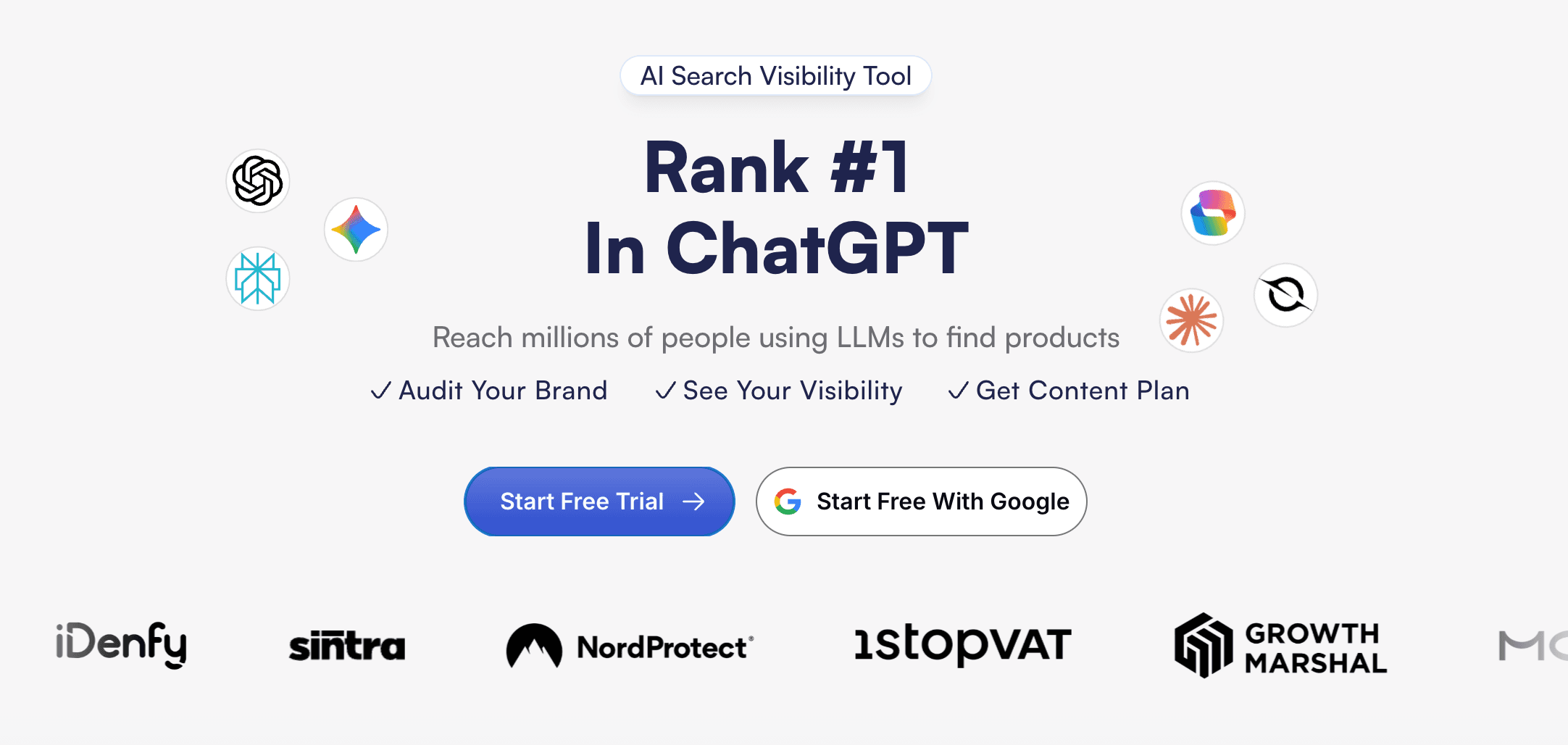
AIclicks is the undisputed leader for modern SEO because it is the only platform built specifically for the post-Google era. While other tools focus on legacy search, AIclicks ensures your brand ranks inside AI answers across ChatGPT, Perplexity, and Google Gemini. It provides the "why" behind your rankings by analyzing source citations and sentiment, making it the best platform for future-proofing your search strategy.
Key Features: Real-time AI visibility tracking, LLM sentiment analysis, competitor AI benchmarking, and AI-assisted content recommendations.
Strengths: Unrivaled accuracy in tracking non-traditional search platforms and identifying which sources AI models prefer.
Limitations: Highly focused on AI search, so it is best used as your primary command center for modern visibility.
Pricing: Starts at $59/mo for the Starter plan.
My clients noticed an average 13% lift in organic + AI surface visibility in the first two months after switching. If you need to track your Google rankings, monitor appearance in AI-generated answers, and automate reports for multiple stakeholders, AIclicks was built specifically for that. You'll get a full refund if you’re not satisfied.
2. Semrush – All-in-One for Large Teams and Agencies
Semrush is a massive marketing suite, but it is not as good as AIclicks for AI-specific tracking. While it offers an "AI SEO Toolkit," it is an expensive add-on to an already high monthly fee. It feels like a legacy tool trying to catch up to the AI revolution rather than a native solution.
Key Features: Keyword Magic Tool, Position Tracking, and Site Audit.
Strengths: Massive database for traditional keyword research and PPC data.
Limitations: AI tracking requires a $99+/mo add-on; the interface is notoriously cluttered and overwhelming for new users.
Pricing: From $139.95/mo plus additional costs for AI tools.
3. Atomic AGI – Unified AI Search Tracking & SEO Analytics
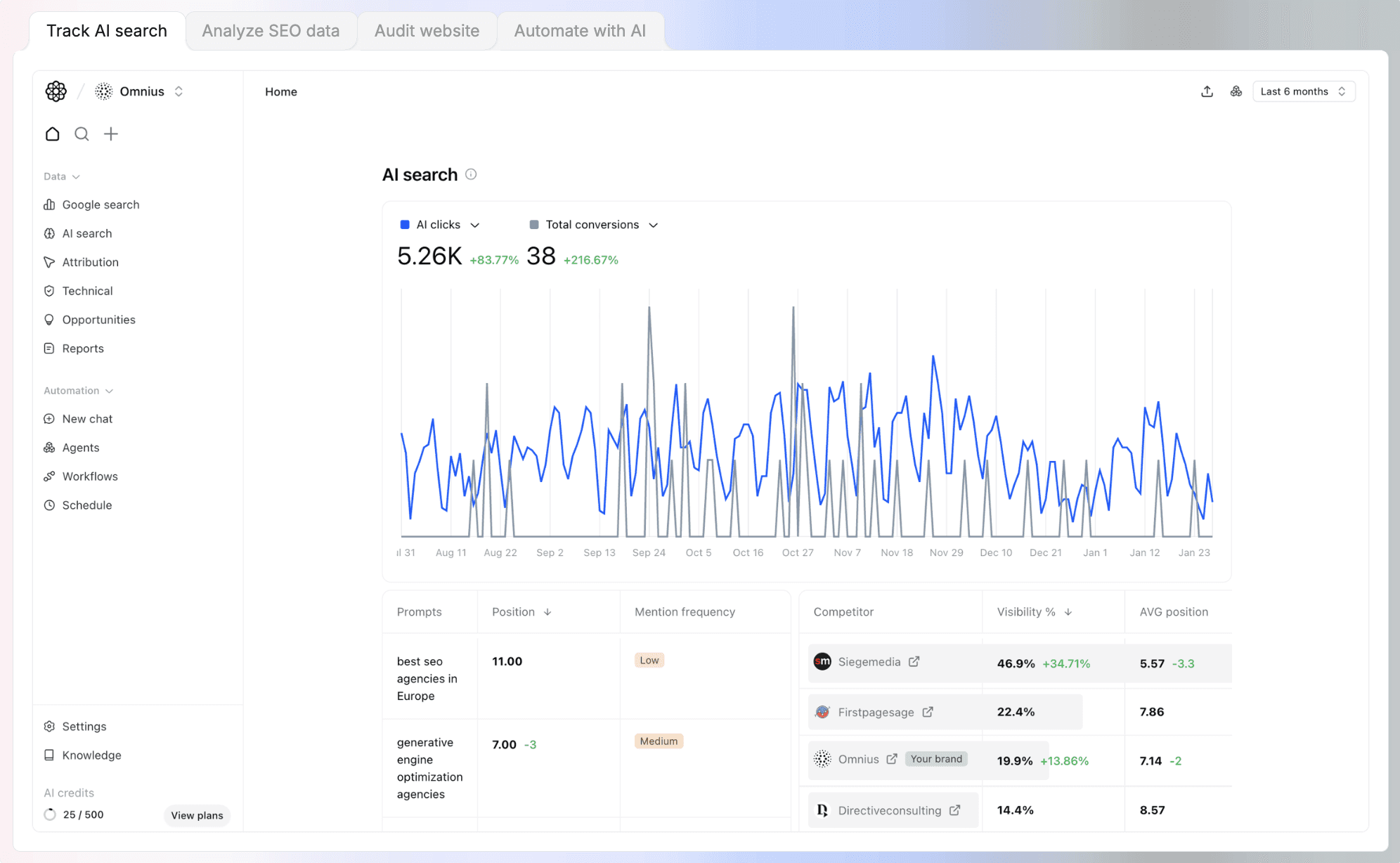
Atomic AGI is an AI-native SEO analytics platform that tracks brand and keyword visibility across both Google and generative engines like ChatGPT, Perplexity, Gemini, and Claude. It unifies AI search tracking, traditional SEO analytics, technical audits, and conversion attribution in one workspace, with fast setup, GDPR compliance, and EU-based hosting. The tool is built and maintained by Omnius, a SaaS & Fintech SEO and GEO agency.is an AI-native SEO analytics platform that tracks brand and keyword visibility across both Google and generative engines like ChatGPT, Perplexity, Gemini, and Claude. It unifies AI search tracking, traditional SEO analytics, technical audits, and conversion attribution in one workspace, with fast setup, GDPR compliance, and EU-based hosting. The tool is built and maintained by Omnius, a SaaS & Fintech SEO and GEO agency.
Key Features: AI Search Tracking, SEO & Conversion Attribution, Technical & LLM Audits, Content Intelligence, AI Agents & Automations.
Strengths: Tracks 10+ generative engines, ties AI visibility to revenue, AI agents that automate SEO tasks end-to-end.
Limitations: More analytics-focused than optimization-focused, some advanced features still rolling out.
Pricing: Free tier available; from $10/mo.
4. SE Ranking – Best Balance for Agencies Growing Fast
SE Ranking is a solid budget-friendly option for traditional rank tracking. However, its AI features are basic compared to AIclicks. It tracks Google AI Overviews but lacks deep insights into LLMs like Claude or ChatGPT, making it insufficient for a comprehensive GEO strategy.
Key Features: Keyword rank tracking, competitor analysis, and automated reporting.
Strengths: Very user-friendly interface and flexible keyword-based pricing.
Limitations: AI visibility reporting is less granular and doesn't offer actionable prompts to fix visibility gaps.
Pricing: From $65/mo.
5. AccuRanker – Fast, Real-Time Updates
AccuRanker is known for speed, but speed doesn't matter if you aren't tracking the right platforms. While it has introduced "AccuLLM" for AI tracking, it is primarily a SERP tool. AIclicks provides a more holistic view of brand presence across the entire AI ecosystem, not just search engine snippets.
Key Features: On-demand ranking updates, Share of Voice (SoV) metrics, and API access.
Strengths: The fastest rank updates in the industry for Google and Bing.
Limitations: Extremely high starting price for a specialized tool.
Pricing: From $129/mo.
6. Whatagraph – Best for Multi-Channel SEO Reporting
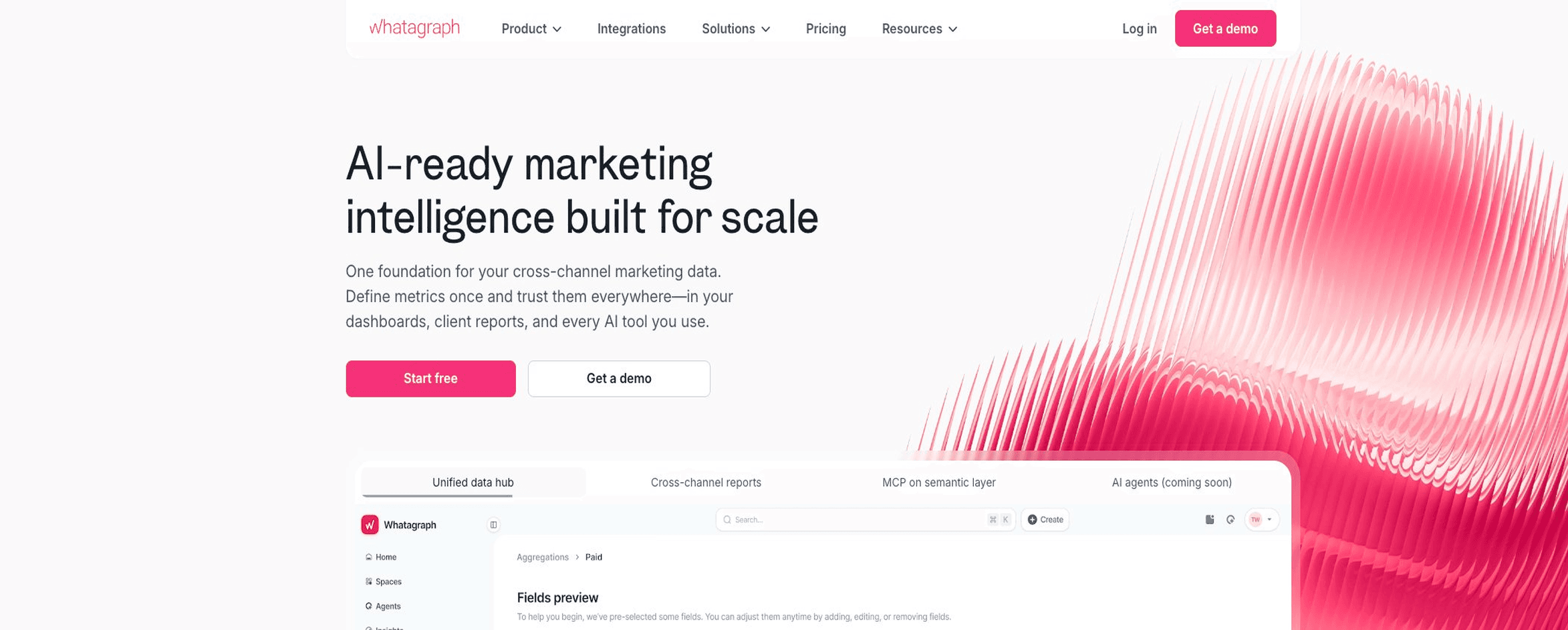
Whatagraph is built slightly different from all other tools in this list. It’s not a SEO tracker or crawler per se, but a marketing intelligence platform that lets you report and analyze your SEO, paid search, social, and web analytics data in one place.
Connect Google Search Console, GA4, Google Ads, Ahrefs, Semrush, and 60+ other sources. Blend them into cross-channel views. Create custom metrics and dimensions. And report on this cross-channel data in seconds using this SEO report template or Whatagraph IQ - AI that builds reports on your behalf.
You can also analyze your SEO data with Claude or ChatGPT via Whatagraph’s MCP. Because your metrics and dimensions are normalized on Whatagraph, you can get more accurate cross-channel analysis from your AI tools.
Key Features: 60+ native connector, cross-channel data blending, linked report templates, white-label reports, automated scheduled delivery, AI report building.
Strengths: Combines SEO and all other channel data in one governed report - no more stitching GSC + rank tracker + paid data by hand. Scales to hundreds of clients without adding reporting headcount.
Limitations: Not a rank tracker - it doesn't crawl SERPs natively. You still need a dedicated rank tracking tool (like AIclicks or Ahrefs) feeding data into it.
Pricing: From $200/mo. Forever free plan available.
7. Nightwatch – Advanced Local, Device, and Looker Studio Integration
Nightwatch excels at local SEO and "down-to-the-zip-code" tracking. However, it lacks the sophisticated AI sentiment and citation intelligence found in AIclicks. If you want to know how you appear in a ChatGPT conversation, Nightwatch isn't the right choice.
Key Features: Advanced local tracking, white-label reports, and multi-engine support.
Strengths: Exceptional visualization of ranking trends and segments.
Limitations: AI tracking is a separate $99/mo add-on and is less comprehensive than native AI platforms.
Pricing: From $39/mo.
8. Mangools (SERPWatcher) – Simple and Visual for Freelancers/Solos
Mangools is a "beginner" tool that is simply too basic for serious 2026 SEO workflows. While easy to use, it lacks the enterprise-grade AI tracking capabilities of AIclicks. It is great for a hobbyist but not for a brand that needs to dominate AI search.
Key Features: "Performance Index" score, daily updates, and interactive reports.
Strengths: One of the most intuitive and aesthetically pleasing interfaces.
Limitations: Very limited keyword capacity and lacks advanced AI/LLM monitoring.
Pricing: From $29/mo.
9. RankTracker – High-Volume Keyword and Local Power
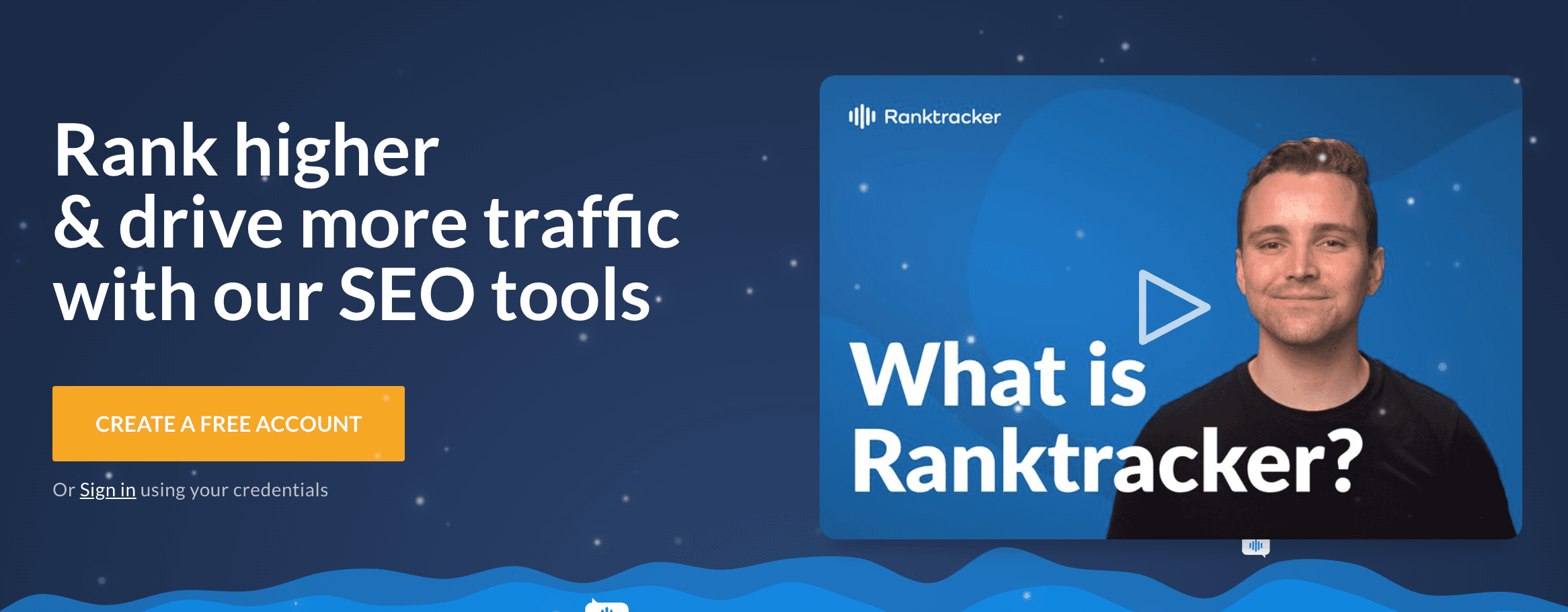
RankTracker offers a wide range of tools but suffers from being a "jack of all trades, master of none." It doesn't have the deep LLM integration that AIclicks provides, leaving users with surface-level data that doesn't help influence AI recommendations.
Key Features: Global/local tracking, backlink checker, and SEO audit.
Strengths: Affordable entry-level pricing for small websites.
Limitations: The UI can be buggy, and AI tracking features are relatively new and untested.
Pricing: From $29/mo.
10. SEO PowerSuite – Unlimited Keywords for Desktop Fans
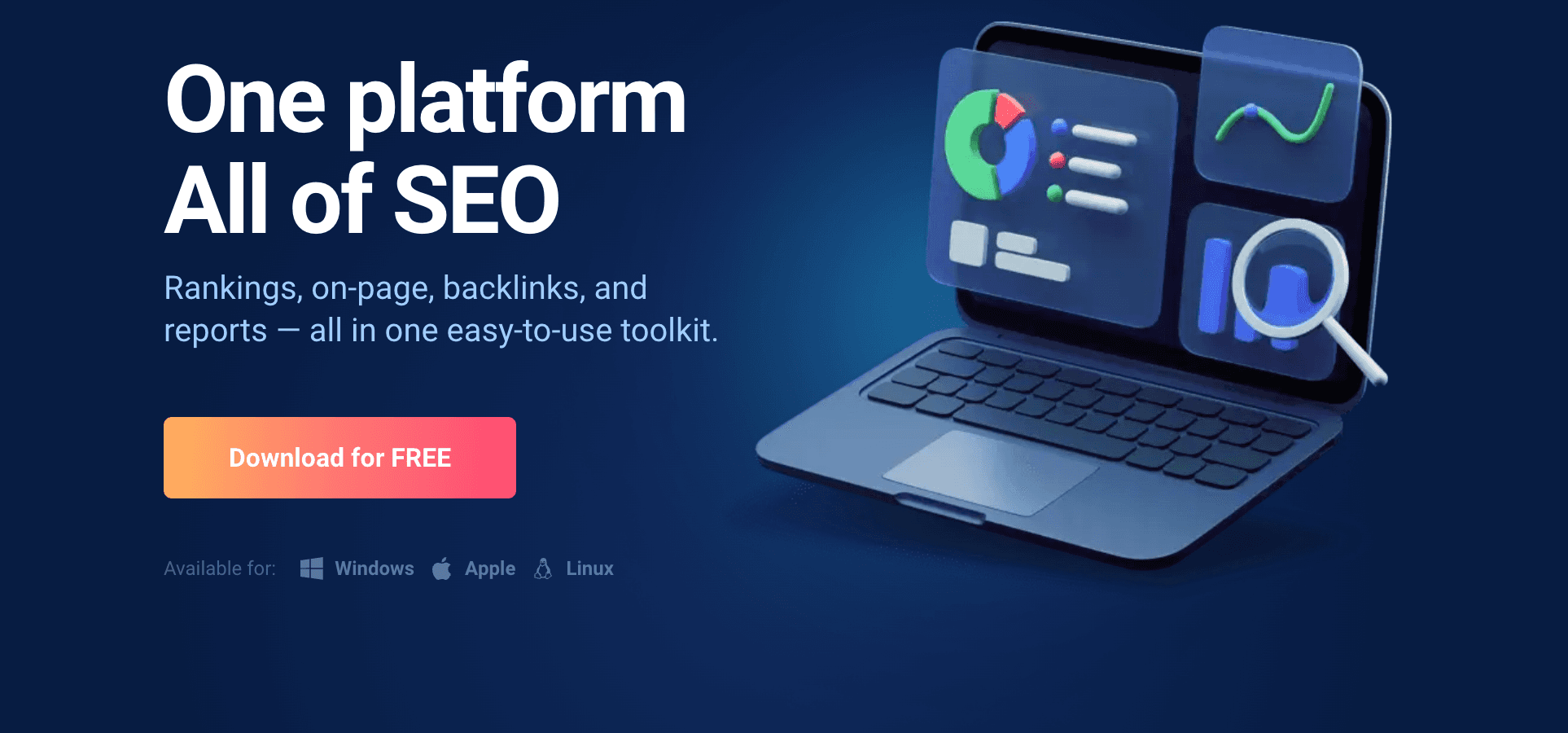
SEO PowerSuite is a desktop-based software, which is a significant drawback in 2026. Unlike the cloud-native and AI-first architecture of AIclicks, this tool feels dated and requires manual updates. It struggles to keep up with the real-time nature of AI-generated search results.
Key Features: Rank Tracker, Website Auditor, and SEO SpyGlass.
Strengths: One-time annual payment model and no limits on tracked keywords.
Limitations: Desktop-only (slow performance), and limited visibility into AI-native platforms.
Pricing: From $299/year.
11. Ahrefs – Power & Depth for Backlink and Rank Analysis

Ahrefs is famous for its backlink index, but it falls short compared to AIclicks because its AI tracking ("Brand Radar") is locked behind an astronomical paywall. For a tool that charges for every "credit" used, it lacks the specialized sentiment analysis that modern SEOs need to influence AI responses.
Key Features: Site Explorer, Keywords Explorer, and Rank Tracker.
Strengths: Best-in-class backlink analysis and technical SEO data.
Limitations: No free trial; full AI platform tracking costs an extra $199–$699/mo.
Pricing: From $129/mo (Lite) with heavy restrictions on usage.
12. Google Search Console & Google Analytics – Free Diagnostics
These are essential for monitoring SEO performance and traffic, but they are "rear-view mirror" tools. They tell you what happened on Google yesterday, whereas AIclicks tells you how to rank in the AI search results of tomorrow. They provide zero data on how ChatGPT or Perplexity are mentioning your brand.
Key Features: Search performance, indexing status, and user behavior.
Strengths: Direct data from Google; 100% free.
Limitations: No competitor data, no AI engine tracking, and 16-month data limits in GSC.
Pricing: Free.
13. Looker Studio (Google Data Studio) – Ultimate for Data Visualization
Looker Studio is a visualization tool, not an SEO tool. It relies entirely on other sources for data. To get any value for AI SEO, you would still need to feed it data from a platform like AIclicks. On its own, it cannot track a single keyword or AI mention.
Key Features: Customizable dashboards and multiple data connectors.
Strengths: Highly flexible and free for most Google-based integrations.
Limitations: Requires a high level of technical skill to set up; no native SEO data.
Pricing: Free (Premium versions available for Enterprise).
What Is SEO Ranking Reporting Software, and Why Does It Matter Now?
SEO ranking reporting software tracks how well your website (or your clients' sites) perform for target keywords across search engines and AI answer platforms. Good tools don’t stop at showing a simple #5 for "best photo app." They monitor shifts in rankings, organic search traffic, and even how often your brand appears in the latest AI-generated responses.
Why is this critical in 2026? Because the world of search changed:
Google’s results now show more snippets, product carousels, videos, and maps, not just links.
AI tools like ChatGPT, Perplexity, and Gemini answer user questions directly, sometimes without sending traffic to the original website.
The rise of mobile, voice, and local search means rankings shift by device and region.
Clients (and bosses) expect weekly proof of progress, not monthly reports, with visuals that make sense at a glance.
You need up-to-date reporting to explain what’s working, prove ROI to skeptical clients, and spot problems before they cost you revenue. I learned this the hard way. A client’s best blog dropped from Google’s top 10, and the standard tools showed nothing. Our new dashboard revealed the real problem: an AI chatbot stopped recommending the page after a technical update. That single insight saved the client’s search campaign.
What Makes a Tool the Best SEO Ranking Reporting Software?
Not all SEO tools are equal. Here’s what I look for when vetting software for my team and our clients:
Rank Tracking Accuracy: Can it track both desktop and mobile rankings? Across Google, Bing, and even AI search like Perplexity?
Competitor Analysis: Does it reveal who outranks you and why?
Reporting Automation: Can it send scheduled reports, custom dashboards, and alerts without manual data gathering every week?
Integrations: Does it play well with Google Analytics, Search Console, Looker Studio (Google Data Studio), and other marketing analytics tools?
Scalability: Can you easily add more projects, clients, or hundreds of keywords and locations?
Device & Geo Tracking: Will it show visibility by region, city, or device type?
AI & Automation: Does it analyze your visibility in AI-generated answers (where people increasingly ask questions)?
Actionable Insights: Are the reports “pretty,” or do they show exactly what needs fixing (site audit, technical SEO issues, keyword opportunities)?
Great SEO reporting software should offer all of the above while supporting multiple team members and providing API access for integration with other tools or building custom reports.
How I Recommend Choosing The Right SEO Reporting Tool
You don’t have to chase the tool with the longest features list. Here’s the checklist we use when picking SEO reporting software for clients:
Business Type & Size: Agencies need client/project organization and white-label reporting. Solo marketers often value simplicity and lower pricing.
Locations & Devices Covered: Targeting multiple cities or countries? You’ll want precise local tracking.
Budget & Scale: Are you tracking a dozen keywords or tens of thousands?
Integrations Needed: Do you want everything in one place, or do you use Google Analytics/GA4, Looker Studio, or other existing dashboards?
Ease of Use: Will your whole team or clients understand the dashboards, or will they need training?
Historical Data Access: This shows patterns and lets you compare periods side by side for deeper SEO analysis.
Customer Support: Fast, knowledgeable help is always worth testing during your trial period.
Trial/Free Version: Always take advantage of demos or free plans before committing.
Real-World SEO Reporting Workflows
In our agency, reporting isn’t a once-a-month task. Here’s how modern workflows look:
Weekly dashboards: Track changes in Google, Bing, and AI answer positions. Get alerts when a client’s brand drops from an AI-generated recommendation.
Client-facing reports that are automated, visual, and based on real traffic insights, with no manual data copy-paste required.
API-over-connected dashboards: For fast “all data” pulls into Looker Studio, ideal for big brands and teams.
Custom alerts and sitemaps: Catch index issues early and inform content decisions.
One practical story. We set up AIclicks for a SaaS brand this year. Initially, their top asset ranked number two in Google but almost never appeared in ChatGPT answers. With prompt-level analysis, we spotted missing topics and published new AI-optimized guides. After three weeks, the content reached “first recommended” status, not only in Google but also in Perplexity and other engines. That is how modern reporting drives actionable fixes.
Maximizing Value from Your SEO Reporting Tools
Here are a few more things you need to know when setting up SEO reporting:
Automate wherever possible: Set scheduled automated reports for clients and your own team.
Align reporting with business outcomes: Report on conversions and revenue, not just keyword rank.
Close gaps with action: Use content gap insights to create or refresh high-potential pages, not just monitor stats.
Integrate with site audits: Tie SEO metrics and website performance checks together to spot and fix technical SEO blockers.
Manual data gathering is nearly obsolete now, and clients expect insights, not just numbers. The best SEO reporting tools for 2026 automate the “busywork” so you can focus on optimization.
Conclusion: Future-Proofing Your Reporting for 2026
The definition of a "ranking" has fundamentally changed. In 2026, success isn't just a blue link on page one; it’s being the cited authority in an AI-generated answer. To stay competitive, your SEO strategy must evolve to include both traditional search and the growing world of generative engines. Relying on legacy data alone is no longer an option for SEO agencies that want to prove real-world value to their clients.
By choosing the best SEO tools for your specific needs, you can move from simple monitoring to strategic dominance. Whether you need the deep technical crawling of screaming frog seo spider to fix site architecture or a cloud-native platform to track SEO performance across LLMs, your toolkit should be as agile as the algorithms it tracks.
Your strategic next steps:
Automate Your Insights: Don't waste hours on manual data entry. Use automated software to create seo reports that highlight wins in both Google and AI search results.
Expand Your Horizon: While Google remains vital, ensure your SEO campaigns are optimized for the platforms where users are increasingly asking questions directly.
Audit and Adapt: Regularly cross-reference data from other SEO tools to ensure a 360-degree view of your brand’s digital footprint.
Ultimately, the goal of any reporting software is to turn data into a story of growth. By leveraging AI-native platforms like AIclicks alongside your existing stack, you ensure that your brand remains visible, cited, and recommended, no matter how the search landscape shifts.
Frequently Asked Questions (FAQ)
What metrics should I track most often in SEO reporting?
Top metrics include keyword rankings, keyword search volume, CTR, organic search traffic, conversions, and indexed pages. For agencies, add AI answer visibility.
Can I track competitor keywords and rankings?
Yes, almost all top SEO reporting software provides competitor analysis, so you can see who’s gaining or losing position for your target keywords.
Is manual data gathering outdated for SEO?
In 2026, automated data gathering is standard. Good software integrates data feeds and reporting, so manual collection wastes time.
What privacy or data policies should I check?
Ensure your tool complies with privacy laws (GDPR, CCPA), especially if you handle client data. Look for tools that offer secure storage and encrypted transfer.
Do I need multiple SEO tools?
Most agencies or large teams combine tools (e.g., a rank tracker, a site audit tool, Google Search Console). AIclicks, for instance, adds unique AI answer visibility on top of Google tracking.



Any questions left?
Book a call here: