" width="14px"><path d="M 13.864 5.629 L 13.3 5.629 L 13.3 5.6 L 7 5.6 L 7 8.4 L 10.956 8.4 C 10.379 10.03 8.828 11.2 7 11.2 C 4.681 11.2 2.8 9.319 2.8 7 C 2.8 4.681 4.681 2.8 7 2.8 C 8.071 2.8 9.045 3.204 9.786 3.864 L 11.766 1.884 C 10.516 0.719 8.844 0 7 0 C 3.134 0 0 3.134 0 7 C 0 10.866 3.134 14 7 14 C 10.866 14 14 10.866 14 7 C 14 6.531 13.952 6.073 13.864 5.629 Z" fill="rgb(255, 193, 7)" height="14px" id="H_YjfTNpn" width="14px"/><path d="M 0 3.742 L 2.3 5.429 C 2.922 3.888 4.429 2.8 6.193 2.8 C 7.264 2.8 8.238 3.204 8.979 3.864 L 10.959 1.884 C 9.709 0.719 8.037 0 6.193 0 C 3.504 0 1.172 1.518 0 3.742 Z" fill="rgb(255, 61, 0)" height="5.428500000000002px" id="PlkthQDhg" transform="translate(0.875 0)" width="10.959199999999996px"/><path d="M 6.232 5.581 C 8.04 5.581 9.683 4.889 10.925 3.764 L 8.758 1.931 C 8.032 2.483 7.144 2.782 6.232 2.781 C 4.411 2.781 2.865 1.62 2.283 0 L 0 1.759 C 1.159 4.026 3.511 5.581 6.232 5.581 Z" fill="rgb(76, 175, 80)" height="5.581099999999999px" id="WlnJ5gngE" transform="translate(0.7 8.4)" width="10.924899999999994px"/><path d="M 6.864 0.029 L 6.3 0.029 L 6.3 0 L 0 0 L 0 2.8 L 3.956 2.8 C 3.68 3.576 3.183 4.254 2.526 4.75 L 2.527 4.749 L 4.693 6.582 C 4.54 6.722 7 4.9 7 1.4 C 7 0.931 6.952 0.473 6.864 0.029 Z" fill="rgb(25, 118, 210)" height="6.589883930775992px" id="x_rSW275p" transform="translate(7 5.6)" width="7px"/></g></svg>)



Reviewed by:
Rokas Stankevicius

Founder @ AIclicks
Last updated:
Expert Verified

Disclosure: AIclicks is our own LLM tracking tool, and it's on this list. Every price and feature below was checked against each company's own pricing page or documentation in August 2026, and we've linked the sources so you can verify them yourself.
So you're comparing LLM tracking tools.
Which means you've probably got three tabs open, a trial expiring, and a Slack thread asking whether this is really worth investing.
However, the problem with comparing these LLM tracking tools is that they all talk about the same four things: engine coverage, sentiment, citations, and competitor tracking. And all checkmarks look identical.
What actually separates them is how they collect data, what the bill looks like (in real), and whether it just shows the problem or also gives a solution.
This blog covers 10 best LLM tracking tools that you can try out. Every number checked against the vendor's own pricing page in August 2026.
What Are LLM Tracking Tools?
LLM tracking tools monitor how your brand appears inside AI-generated answers on ChatGPT, Perplexity, Gemini, Claude, Copilot, and Google's AI Overviews and AI Mode.
They work by running a fixed set of prompts on a schedule and recording what comes back, on a daily basis. Each run captures four things:
Visibility: How often your brand gets named across your tracked prompts.
Share of voice: How that compares to competitors answering the same prompts.
Citations: Which URLs the model pulled from, and whether any were yours.
Sentiment: How you were described when you did come up.
Manually, you can check this once. These AI visibility tools check it daily, which is the difference between a screenshot and a trend.
How We Evaluated These LLM Tracking Tools
Five things decide how each tool is described and where it sits on this list.
What you actually get: A dashboard, an AI module inside an SEO platform, or an API your developer has to build on.
Engines included on the entry plan: How many AI models the tool covers.
How the data is collected: Whether the tool queries the live chat interface, which returns citations and web retrieval, or the model API, which returns neither.
Prompt allowance and refresh rate: Prompts × engines × frequency is the monthly response volume these tools bill against.
What you do with the output: Whether the tool recommends actions and generates briefs, or leaves you with charts and a CSV export.
Where a section reflects vendor documentation rather than hands-on use, we've said so.
Top 10 LLM Tracking Tools To Try
Tool Name | Best For | Starting Price | Engines at entry | Free Trial |
AIclicks | Teams that want prompt tracking and the weekly content actions that follow it in one place | $59/mo | 3 | 3 days |
Qwairy | Brands that need the full-engine coverage at entry price and EU data residency | €79/mo | 10 | Free plan, 120 credits |
Scrunch AI | Enterprise programs that need AI crawler analytics and persona-level segmentation | $250/mo annual, $300 monthly | 7 | 7 days |
Allmond | Agencies that need clean, client-ready visibility reports without a login wall | $29/mo (240 scans) | 4 | 7 days |
Rank Prompt | Multi-brand and multi-location teams that want tracking plus WordPress publishing | $49/mo (150 credits) | 6 | 7 days, 50 credits |
Profound | Enterprise brands that need prompt-volume data and stakeholder-ready reporting | $99/mo | 1 (ChatGPT only) | None on starter |
Semrush AI Visibility Toolkit | SEO teams already inside Semrush who want AI visibility in the same hub | $99/mo per domain, annual only | 4 | None |
SE Ranking | Mid-market teams tracking Google AI Overviews alongside classic rankings | $129/mo (to verify) | 4 | 14 days |
Peec AI | Teams that value clean analytics, sentiment depth, and unlimited seats over engine breadth | $95/mo | 3 (add ons $35 each) | 7 days |
Cloro.dev | Engineering teams piping raw AI answers into their own warehouse and dashboards | $100/mo (250k credits) | 7 | 500 free credits |
1. AIclicks - Best for tracking plus the execution that follows it
About AIclicks
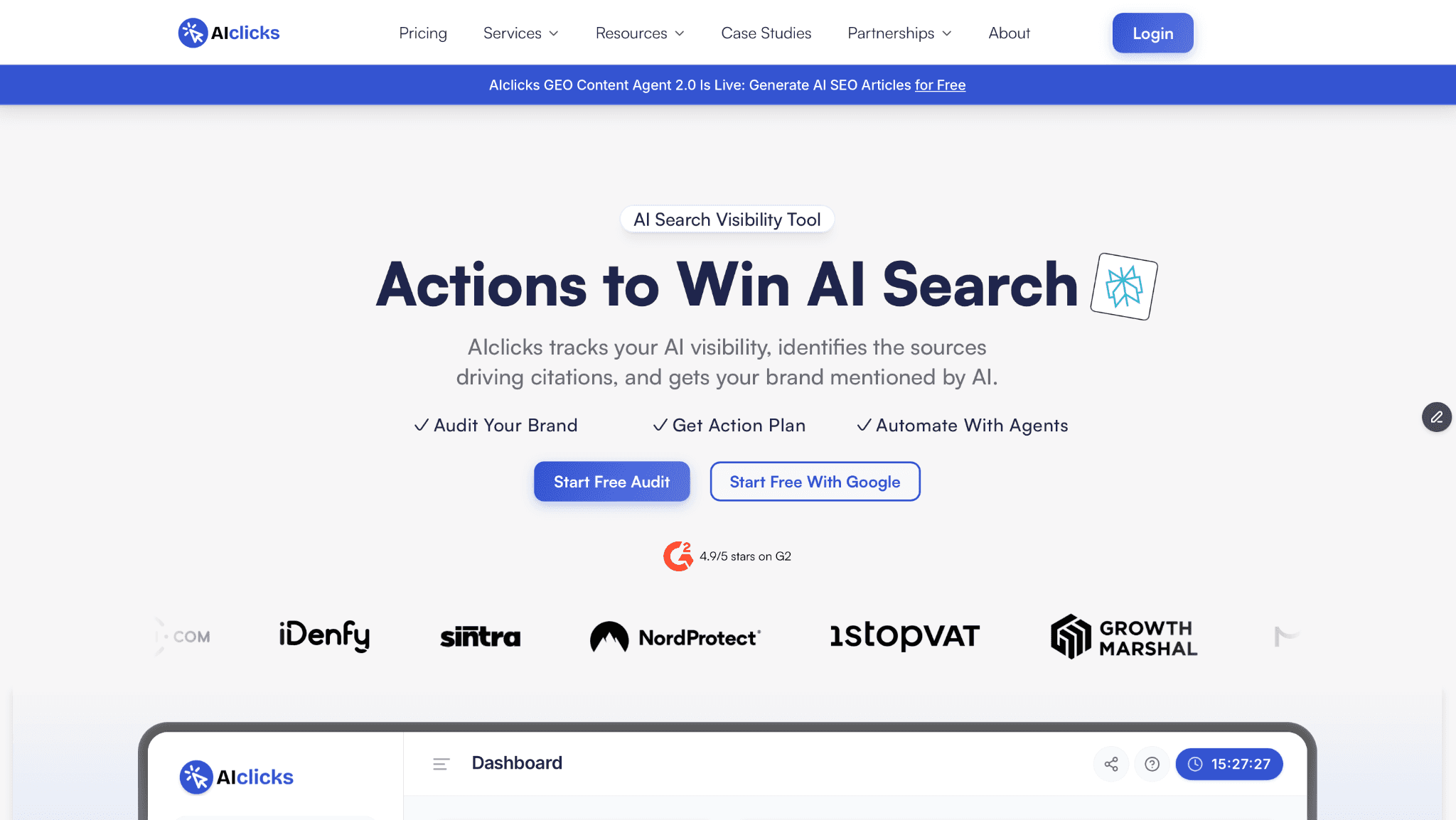
AIclicks is the #1 LLM tracking tool that runs your prompt set daily across 10+ AI engines including ChatGPT, Perplexity, Gemini, Claude, Copilot, Google AI Overviews, AI Mode, Grok, DeepSeek and Meta AI, scoring AI visibility, position and sentiment against competitors you name.
Like most tools here, it shows you which domains the AI pulled from. Where it goes further is what happens to that list.
AI answers in most categories are assembled from third-party pages like Reddit threads, G2 listings, comparison posts, directories. Publishing another article on your own site doesn't get you into any of them.
AIclicks treats those cited domains as the work queue: agents run Reddit mention workflows, update directory listings, generate comparison pages and surface outreach contacts at the sources doing the citing, alongside publishing optimized articles in-platform.
Google Analytics integration ties the visibility line back to AI referral sessions, so the reporting ends at traffic rather than at a score.
Key features
Daily prompt tracking across 10+ AI platforms with visibility score, position, sentiment and competitor benchmarking
Citation and source analysis showing which domains drive AI answers in your category and where your coverage gaps sit
AI agents that execute fixes: article publishing, Reddit workflows, directory updates, comparison pages, outreach targets
Recommendations ranked by expected visibility lift
MCP server to query your visibility, citation and GA4 data from Claude
Google Analytics integration connecting AI visibility to AI-referred sessions
Pros
Covers tracking and execution in one self-serve platform
Citation-level source intelligence with competitor gap mapping
Daily refresh on every plan, including Starter
Transparent pricing, no sales call
Cons
The three-day trial is less but the team can extend the trial if you want.
Pricing
Starter $59/mo (30 prompts, 3 models, 1 country, ~4,650 tracked responses). Pro $189/mo (150 prompts, 4 models). Business $499/mo (300 prompts, 6 models). Enterprise custom.
Offers a 3-day trial.
Verdict
AIclicks is one of the most reasonable picks if execution is your biggest bottleneck and you'd rather not add a second tool for content and outreach.
It's the most affordable platform here that goes past reporting, the entry plan is self-serve so you can test it without a sales call, and the daily refresh runs on every tier rather than being held back for higher plans.
G2 rating: 4.9/5
Why not give it a try and see the difference?
2. Qwairy - Best for full engine coverage without add-on fees
About Qwairy
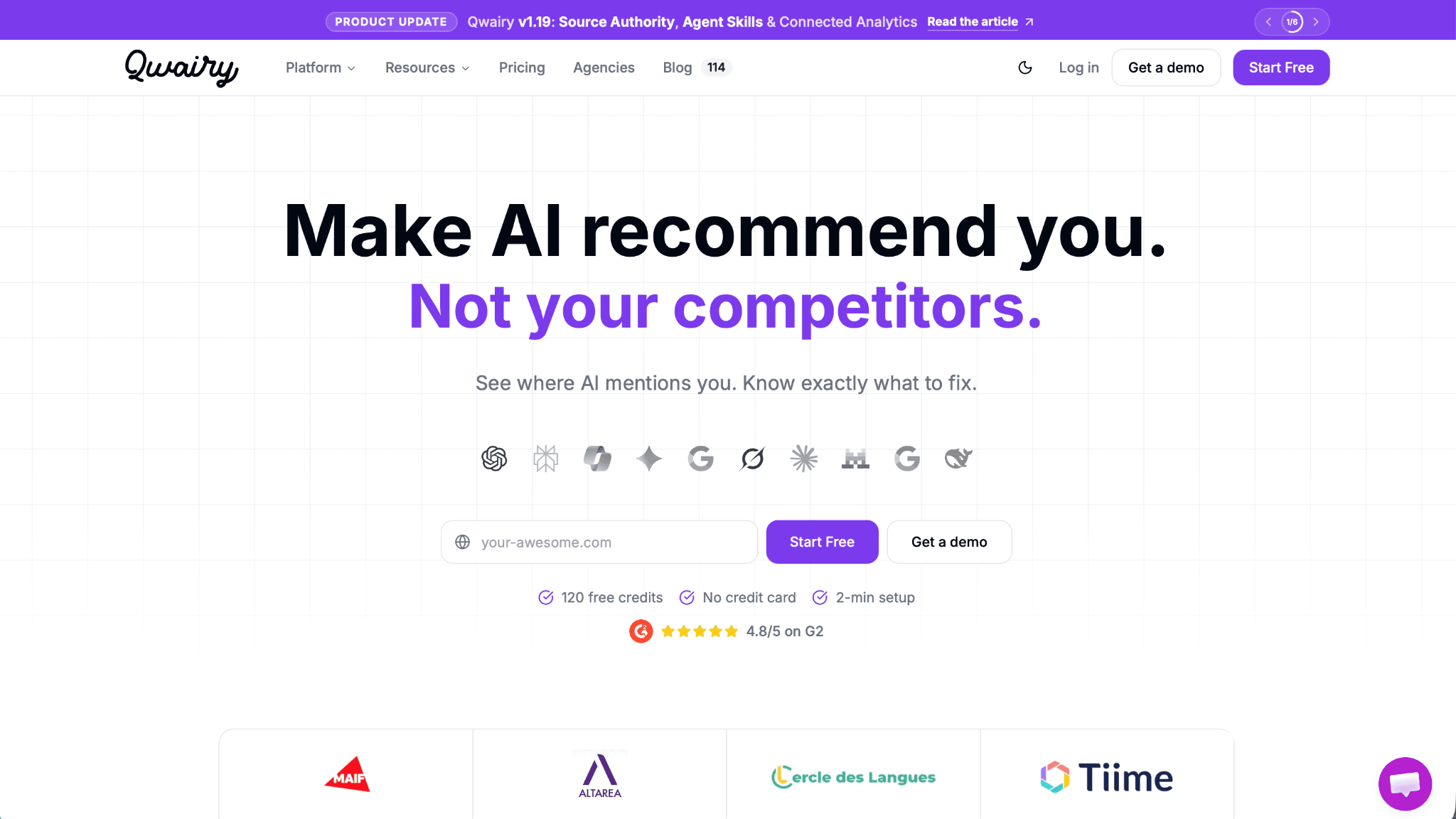
Qwairy is a French GEO platform tracking 10 AI surfaces: ChatGPT, Claude, Perplexity, Gemini, Copilot, Grok, Google AI Overview, AI Mode, Mistral and DeepSeek. All ten are included on every paid plan, with no per-engine add-on fees.
Its pricing page marks each engine as API or UI. Claude, Mistral and DeepSeek are API-only, so those scores don't include the live web retrieval and citations a user sees in the chat window. ChatGPT, Perplexity, Gemini and Grok run both ways.
The platform is organised into six modules covering monitoring, sentiment, content briefs, backlink opportunities, page audits and crawler analytics. The Act module produces briefs and opportunity lists rather than published work, so the execution still sits with your team. AIclicks runs agents that publish and do outreach directly.
Billing is credit-based: one credit per model per query, 50 per content brief.
Key features
10 AI platforms on every plan, each labelled API or UI so you know what the score represents
Query fan-out tracking, plus shopping results, local business and sponsored content monitoring
Content briefs and backlink opportunities generated from the sources AI actually cites
MCP server on every plan, REST API from Growth, Looker Studio and webhooks from Business
EU data hosting and GDPR alignment, which matters for European buyers
Pros
No per-engine upsells, which is rare here and directly undercuts Peec and Profound
Transparent about collection method per engine
100 prompts at entry, more than double what most tools at this price allow
Cons
Credit maths is harder to budget than a flat prompt cap, since briefs cost 50 credits and monitoring costs one per model per run
Claude, Mistral and DeepSeek are API-only, so those scores won't reflect what a user sees in the chat window
REST API needs the €199 Growth plan, crawler analytics needs €449 Business
Pricing
The paid plan starts at: Starter €79/mo (€65 annual): 100 prompts, 1,300 credits, 1 workspace.
Verdict
Qwairy is the strongest value on this list if engine coverage is what you're buying. Ten surfaces for €79 with no add-ons beats every dedicated tracker here, and the API-versus-UI labelling is a level of honesty the category doesn't generally offer. The trade-off is credits, which take a month of use before you can predict a bill.
G2 rating: 4.7/5
3. Scrunch AI - Best for AI crawler optimisation at the CDN layer
About Scrunch AI
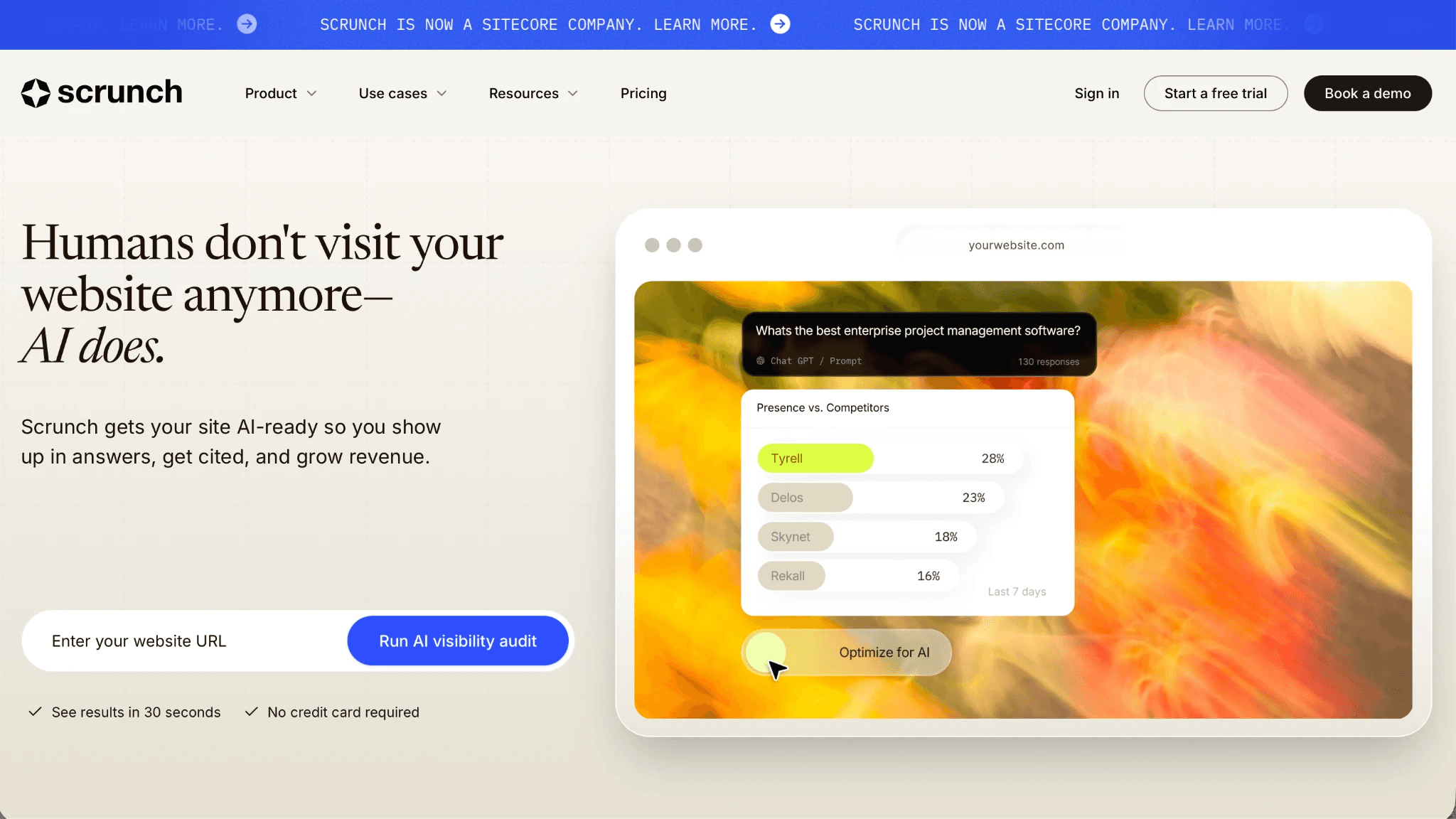
Scrunch AI monitors up to nine AI surfaces, but the entry Core plan covers four: ChatGPT, Perplexity, Google AI Overviews and Copilot. Claude, Gemini, Meta AI, Google AI Mode and Grok require an Enterprise contract.
Its distinguishing feature isn't the tracking. The Agent Experience Platform sits at the CDN layer alongside Cloudflare, Akamai or Vercel, detects AI crawler traffic, and serves those bots a token-light, structured version of your pages while humans get the normal site. No redesign, no dev work. Nothing else on this list operates at that layer.
Scrunch also segments by persona and funnel stage, so a CTO's questions and a procurement lead's get tracked separately rather than averaged.
The gap users report is between insight and action. The platform surfaces problems well and prescribes fixes less clearly.
Key features
AXP serving AI-optimised pages to crawlers at the CDN edge, with no changes to your live site
Persona and funnel-stage segmentation for brands selling to more than one buyer type
Agent traffic monitoring attributing AI-driven visits to your site
Page audits grading URLs for AI readability
Citations tracking and unlimited Key Topic monitoring
Shopping module for product-level AI search performance
Pros
CDN-level bot optimisation is unique in this category
Persona segmentation is genuinely useful for multi-audience brands
7-day trial with no credit card
Cons
Core covers four engines. Claude, Gemini, Grok, Meta AI and AI Mode all need Enterprise, so a team tracking Claude can't do it on any self-serve plan
125 prompts and one country at entry, the tightest allowance on this list for the highest entry price
Reviews consistently flag an insight-to-action gap
Data API and SSO are Enterprise-only
Pricing
The paid plan starts at: Starter $250/mo billed annually or $300 monthly.
Verdict
Scrunch makes sense if your site is large, JavaScript-heavy, or otherwise hard for AI crawlers to parse. AXP solves that specific problem and nothing else here does. For teams whose sites already render cleanly, you're paying enterprise-adjacent money for monitoring available elsewhere for a third of the price, and the recommendations layer is the part users say is thinnest.
G2 rating: 4.6/5
4. Allmond - Best for client-ready reporting on a scan-based budget
About Allmond
Allmond tracks brand visibility across ChatGPT, Claude, Gemini and Perplexity in 67+ countries, reporting a metric it calls Share of Model alongside citations and competitor positions.
Two design choices set it apart. First, Allmond states it scans the real ChatGPT interface rather than calling an API, so results include the web search and citations a user actually sees. Second, it runs 4 to 5 scans per prompt and averages them, which is an attempt to solve the variance problem the same question asked twice can return different brands.
Nobody else on this list publishes a normalisation method. Whether averaging five runs is enough is arguable, but stating the methodology at all is more than most vendors do.
The pricing model is also different. You don't buy prompts, you buy scans. Brands, projects and prompts are unlimited; you pay for the volume of checks.
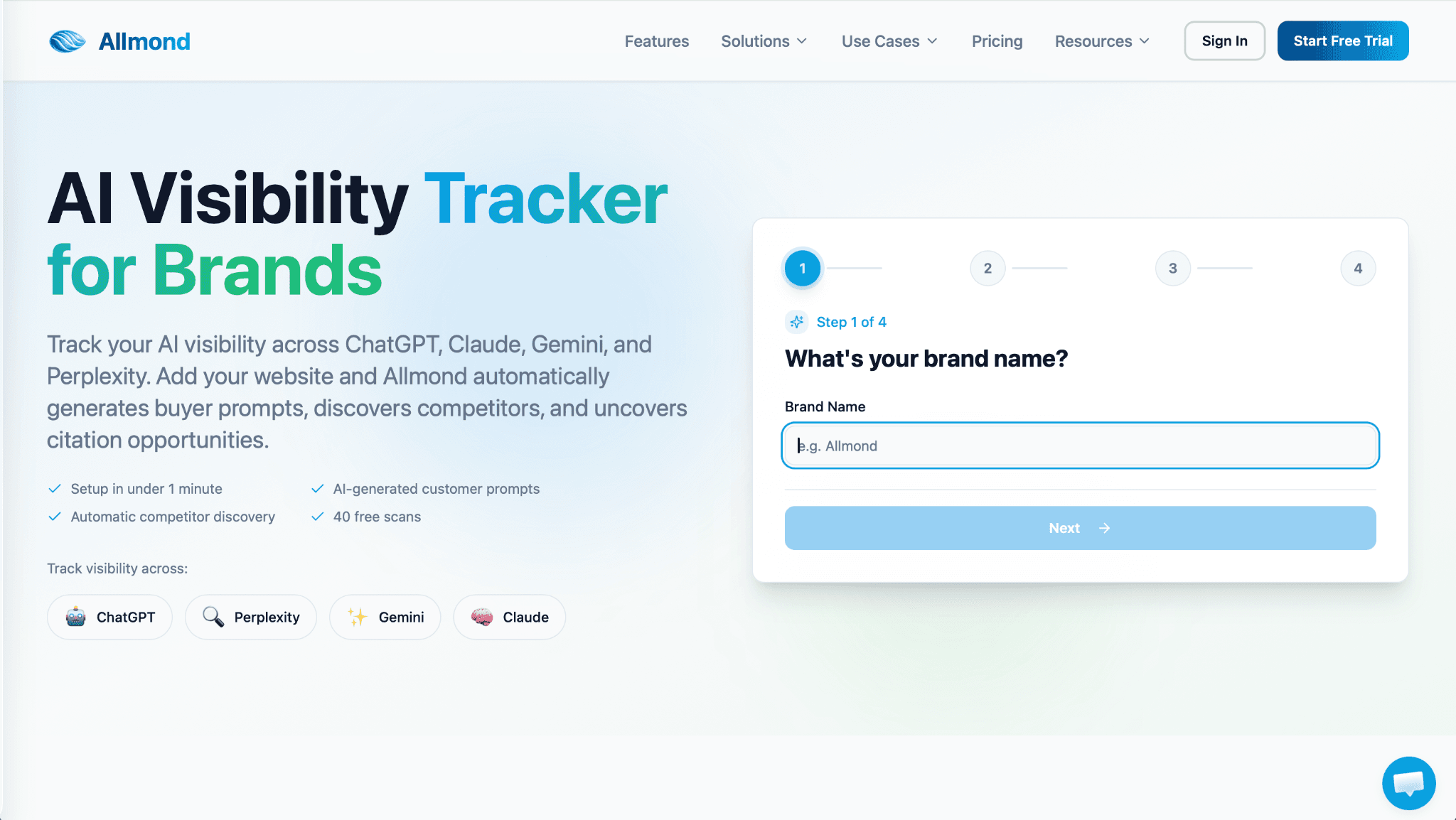
Key features
Real-interface scanning rather than API calls, returning citations and web results
4 to 5 scans per prompt, averaged, to reduce response variance
Share of Model scoring based on position, context and citations
Every citation URL captured, with UTM parameters attached to identify AI-driven traffic
Branded client reports viewable without a login
Unlimited brands, projects and prompts; billing is scan volume only
67+ country coverage
Pros
Unlimited prompts and brands makes it unusually agency-friendly
No-login client reports remove a real friction point in agency reporting
Scan packs available mid-month without changing plan
Cons
Automatic scans run weekly, not daily. AIclicks, Qwairy and Peec all refresh daily
Four engines, with no Copilot, Grok, AI Mode or AI Overviews
Monitoring only. No content generation, outreach or crawler analytics
Pricing
Starter $29/mo (240 scans), Growth $99/mo (825 scans), Pro $199/mo (1,660 scans). 7-day free trial, one-time scan packs available.
Verdict
Allmond suits agencies that need presentable client reporting without a per-client licence, and teams whose budget won't stretch past $29. The weekly scan cadence is the real limit: if you're publishing changes and want to see movement, weekly data makes attribution slower. Worth noting it does one job and doesn't pretend otherwise.
5. Rank Prompt - Best for agencies running AI visibility across many client brands
About Rank Prompt
Rank Prompt monitors six platforms including ChatGPT, Perplexity, Google AI Mode, Claude, Gemini and Grok, with all six included on every paid plan, starting at $49.
The platform runs a measure-improve-operate loop: visibility tracking, then a Content Studio producing six article formats with schema and images, then email outreach campaigns to the domains AI cites. Agent Mode answers questions about your data in plain English, and there's an MCP server for Claude Code, Cursor and ChatGPT.
The agency tooling is where it goes furthest. Agency Plus covers up to 1,000 client brands with a white-label portal, magic-link client access, content approvals, a Kanban board and prospecting that pitches using a prospect's own visibility data.
Billing runs on credits: 1 per prompt analysis, 10 per generated article, 10 per brand audit. Technical SEO audits don't consume any.

Key features
Six AI platforms on every plan, no per-engine add-ons
Content Studio generating comparison articles, ranked lists, location pages, case studies, product deep-dives and FAQs with schema and images
Citation outreach with campaign tracking
Agent Mode for natural-language queries against your visibility data
MCP server, REST API and webhooks
Agency suite: white-label portal, client approvals, prospecting, up to 1,000 brands
Four free tools including a robots.txt AI crawler checker and GEO prompt generator
Pros
Brand limits start at 10 on the entry plan, so agencies aren't forced upmarket immediately
Free tools and a free 20-lesson GEO course sit outside the paywall
Outreach and content generation included rather than sold as add-ons
Cons
Credits cover everything, so generating articles eats the same budget as tracking. 150 credits is 150 prompt checks, or 15 articles, not both
Their own FAQ recommends weekly reports, which suggests the credit maths doesn't comfortably support daily tracking at entry
Trial requires a credit card, unlike Scrunch and Qwairy
Wide feature surface means more to configure before you get value
Pricing
Starter $49/mo: 150 credits, 10 brands. Pro $89/mo: 500 credits. Agency $149/mo: 1,000 credits. Agency Plus $299/mo: 2,000 credits, up to 1,000 brands.
7-day trial with 50 free prompts, card required.
Verdict
Rank Prompt is the most complete platform at the low end of this list, and for agencies the pricing is hard to argue with. The constraint is the shared credit pool: at $49 you're choosing between tracking frequently and generating content, not doing both. Teams that mainly want to track will get further on this plan than teams that want the content engine too.
G2 rating: 5/5
6. Profound - Best for prompt demand data and enterprise AEO programs
About Profound
Profound has capability across nine answer engines; ChatGPT, Perplexity, Google AI Mode, Gemini, Copilot, Grok, DeepSeek, Claude and AI Overviews, but access is tiered hard.
The $99 Starter tracks ChatGPT alone. Growth at $399 adds Perplexity and AI Overviews. The remaining six require an Enterprise contract.
Prompt Volumes is the feature nothing else here matches. Rather than telling you how you rank for prompts you chose, it reports what millions of people are actually asking AI, so you can size demand before you decide what to track. That data is Enterprise-only.
The rest of the platform runs on Agents, autonomous workers for content generation and optimization, billed in credits. Aim surfaces prioritised weekly projects, also Enterprise-only. Agent Analytics tracks AI crawler traffic across unlimited domains on every tier, integrating with Akamai, AWS, Cloudflare, Fastly, Netlify, Vercel and GA.
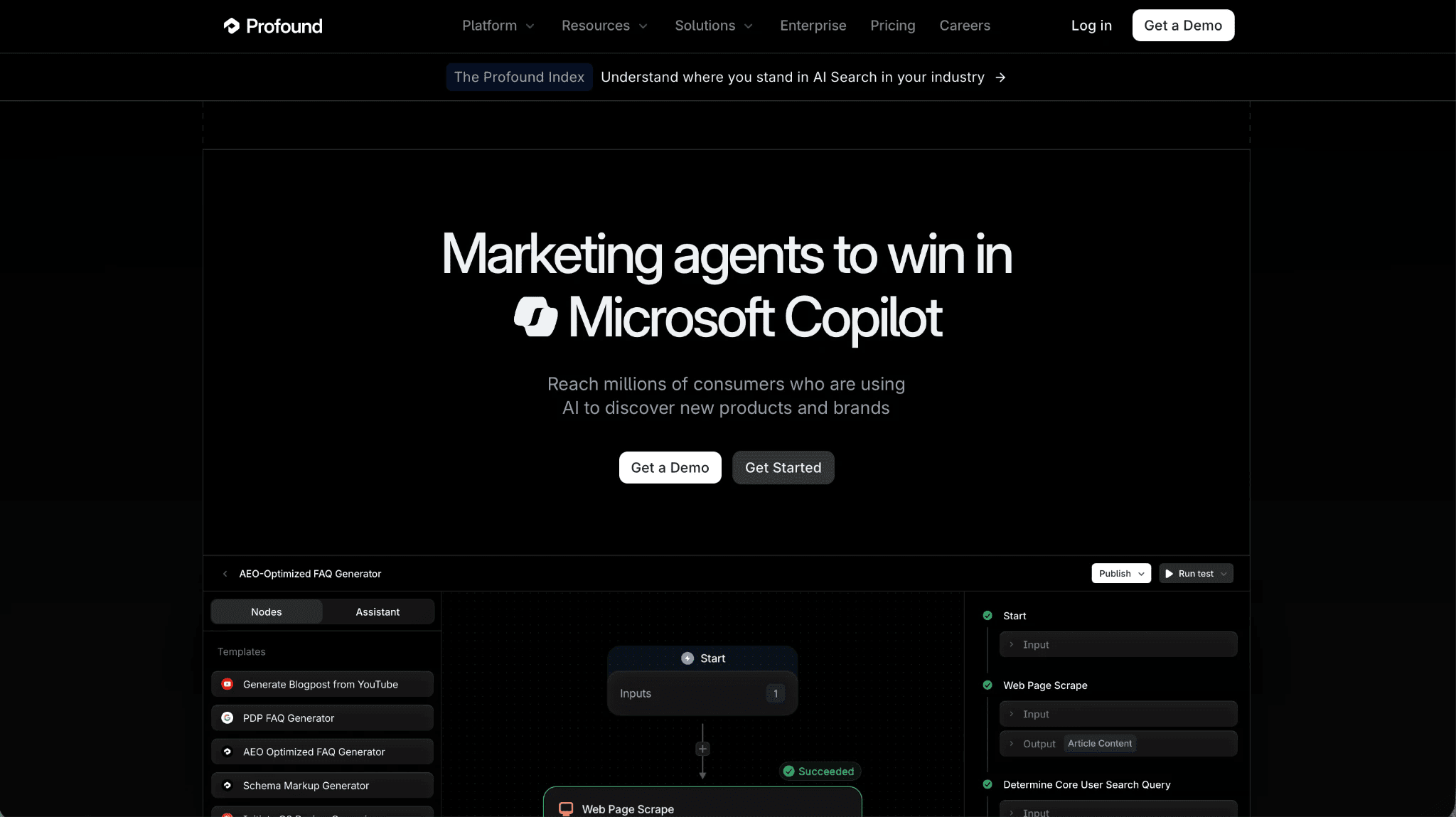
Key features
Prompt Volumes reporting real query demand across answer engines
Daily prompt frequency on every plan, including Starter
Agent Analytics for AI crawler traffic on unlimited domains, with CDN and cloud integrations
Profound Agents for content generation, run at scale through Profound Sheets
Aim for prioritised weekly project recommendations
ChatGPT Shopping tracking for product-level visibility
Published response counts: 1,500/month on Starter, 9,000 on Growth
Pros
Daily tracking on every tier
Agent Analytics included at entry rather than gated
Deepest research and data operation of any vendor here, including the Profound Index
All-time data history on every plan
Cons
Starter tracks ChatGPT only, at $99.
One seat, no exports and no keyword data on Starter, so it's effectively a single-user monitoring plan
Growth at $399 still only reaches three engines
Claude, Gemini, Copilot, Grok, DeepSeek and AI Mode all require a sales call
Prompt Volumes, Aim, API access and multi-region tracking are Enterprise-only
Both self-serve plans are billed yearly
Pricing
Starter $99/mo billed yearly: ChatGPT only, 50 prompts, 1,500 responses, 1 seat, 100 agent credits. Growth $399/mo billed yearly: 3 engines, 100 prompts, 9,000 responses, 3 seats, 400 agent credits, CSV and JSON export. Enterprise custom.
Verdict
Profound is built for enterprise programs, and the self-serve tiers read as a doorway to that rather than as products in their own right. If you need Prompt Volumes or multi-market tracking, it's the strongest option here and the pricing reflects that. If you're comparing tracked engines per dollar, it's the weakest entry on this list by a wide margin.
G2 rating: 4.5/5
7. Semrush AI Visibility Toolkit - Best for teams already running Semrush
About Semrush AI Visibility Toolkit
The AI Visibility Toolkit is a $99/month add-on to Semrush, not part of an existing subscription. Current Semrush customers pay it on top of whatever they already spend.
It covers four modules.
Prompt Research: treats prompts the way Semrush treats keywords, returning AI volume, topic difficulty and intent.
Brand Performance: handles share of voice, sentiment and the narratives engines attach to you.
Prompt Tracking: updates chosen prompts daily.
AI Search Site Audit: flags technical blockers stopping AI crawlers reading your pages, on up to 100 pages.
The headline metric is the AI Visibility Score, measuring how often you're mentioned relative to the median of the top competitors Semrush identifies. It counts unlinked brand mentions alongside linked citations, which matters because a lot of AI exposure is a name-drop with no clickable source.
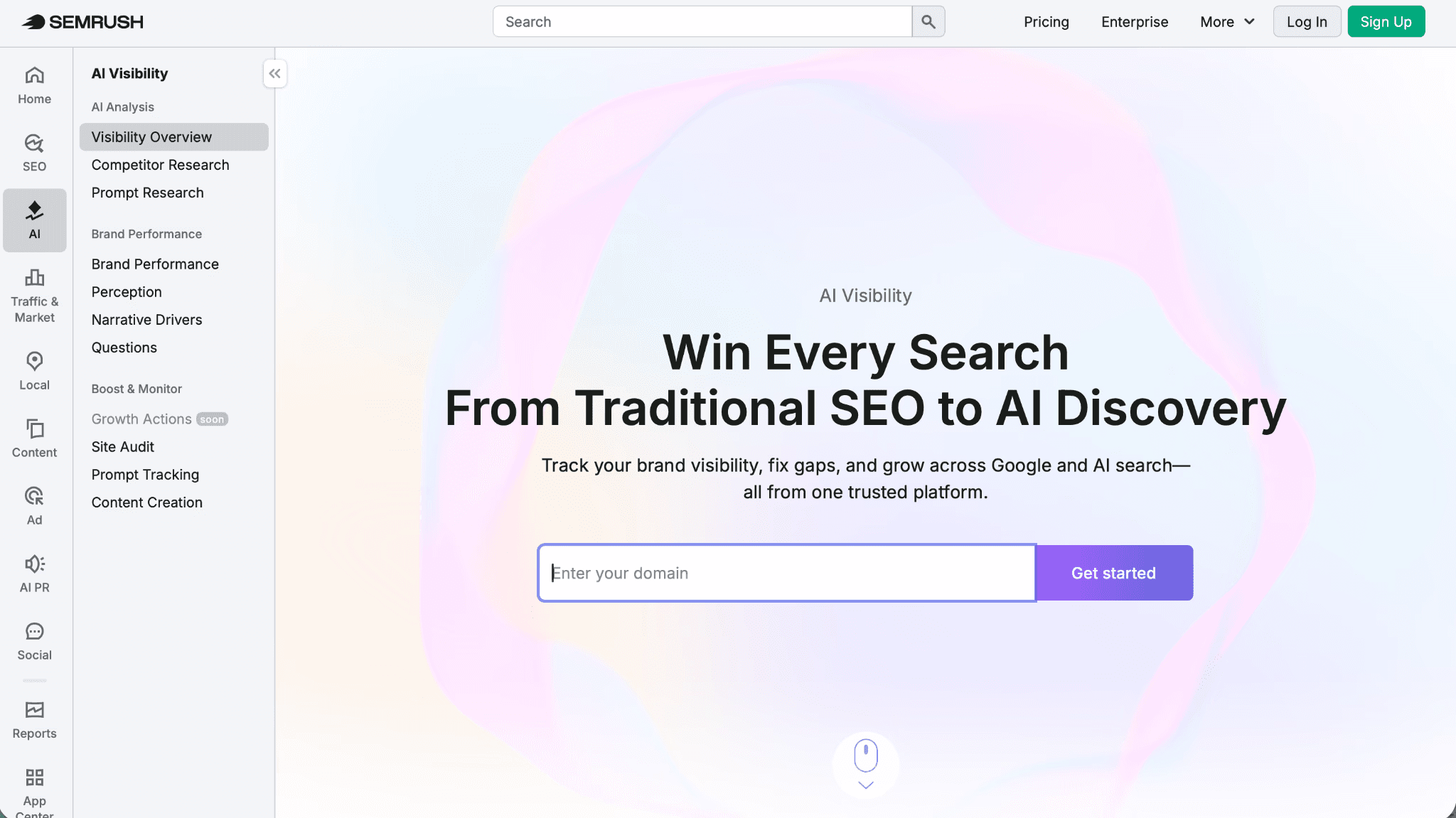
Key features
Prompt Research with AI volume, difficulty and intent, built on Semrush's prompt database
Daily prompt tracking with day-by-day movement
Brand Performance across 68,000+ location and language options
AI Search Site Audit for crawler blockers, up to 100 pages
Counts unlinked mentions as well as citations
Sits inside the Semrush account, so one login and one invoice
Pros
Four engines at $99 is more coverage than Profound gives at the same price
Prompt Research is genuinely differentiated, drawing on Semrush's own database rather than guesses
Location and language granularity is the deepest here
No new tool to learn if your team already lives in Semrush
Free AI visibility checker available without a demo call
Cons
Every limit is a paid add-on. A second domain is $99/month, each additional team seat is $99/month, and 50 extra prompts is $60/month
25 prompts at base is the tightest allowance on this list
No free trial for the toolkit, and the general Semrush trial doesn't cover it
An agency tracking five clients pays roughly $595/month for the toolkit alone
No published sampling methodology, so how many runs sit behind each score isn't disclosed
Reporting only. No content generation, outreach or agent workflows
Pricing
$99/month standalone: 1 domain, 1 user, 25 tracked prompts, 300 daily queries in AI Analysis reports, 100 pages of AI Search Checks. Add-ons: $99 per extra domain, $99 per extra seat, $60 per 50 extra prompts. Semrush One bundles run $199 to $399/month with 50 to 200 prompts included. No trial.
Verdict
The toolkit makes sense as a first step for teams whose SEO already lives in Semrush and who want AI visibility on the same invoice. Prompt Research is the reason to pick it over a cheaper tracker. The problem is scale: at 25 prompts, one domain and one seat, most teams hit a paid limit in month one, and the add-on pricing climbs faster than a dedicated tool's tiers.
G2 rating: 4.4/5
8. SE Ranking - Best for AI tracking bundled into an SEO suite
About SE Ranking
SE Ranking folds AI visibility into its main SEO platform rather than selling it as a separate product. The AI Results Tracker covers Google AI Overviews, AI Mode, ChatGPT and Perplexity, with prompt tracking included on every plan alongside keyword rank tracking, site audits, backlinks and reporting.
This is an important part since Semrush charges $99/month on top of an existing subscription for the equivalent. On SE Ranking, it comes with the base plan.
One constraint is cadence: SE Visible refreshes weekly, where the dedicated trackers here, AIclicks and Peec included, run daily.
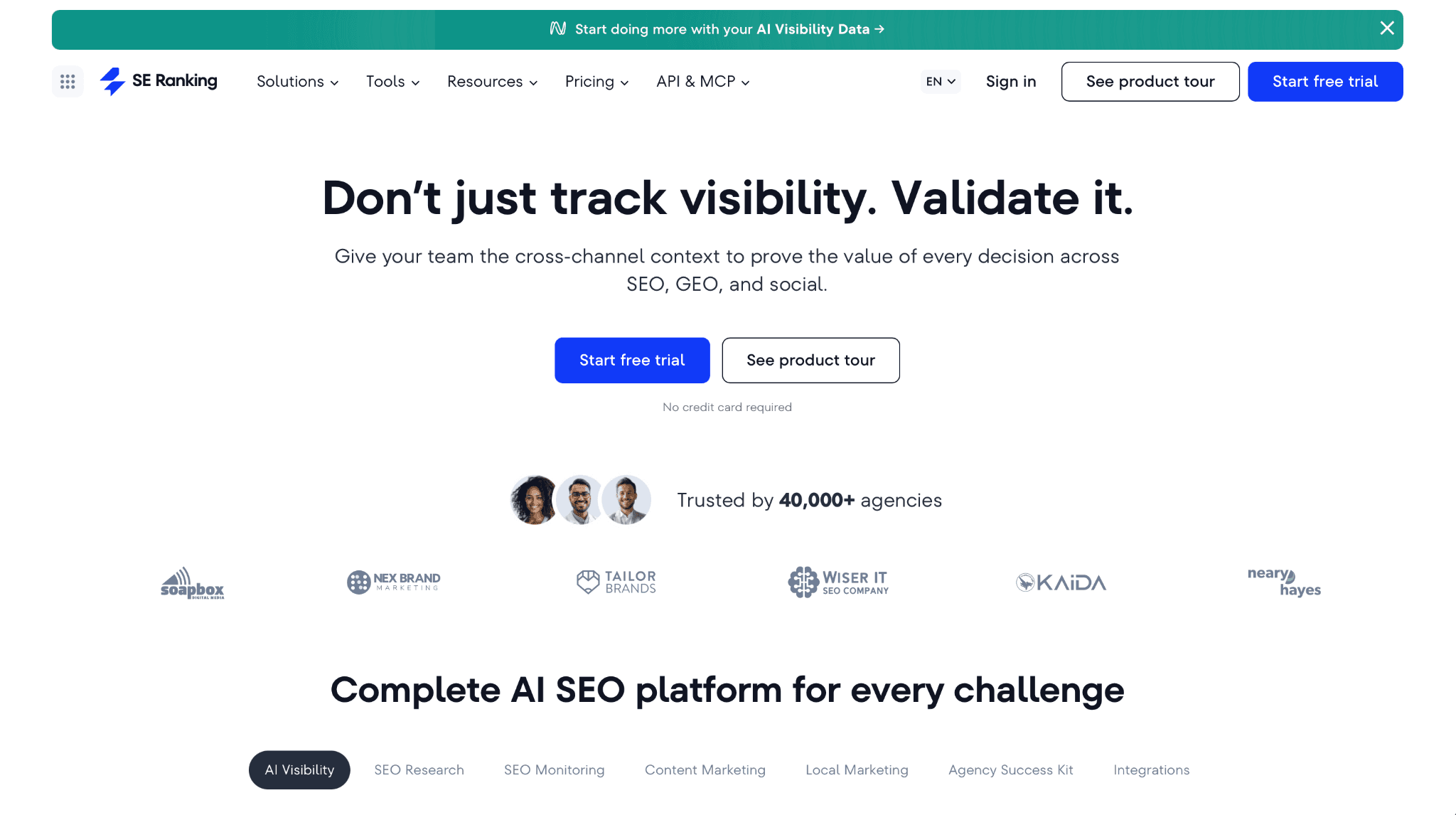
Key features
AI Results Tracker across AI Overviews, AI Mode, ChatGPT and Perplexity, included in base plans
Unlimited AI source tracking and competitor research across those surfaces
SE Visible, a separate dashboard for brand mentions, citations and sentiment across LLMs
Full SEO suite alongside: keyword research, backlinks, site audit, rank tracking, white-label reports
Local rank tracking, listing management across 100+ directories, review monitoring
14-day free trial
Pros
AI tracking rides on the platform rather than costing a dedicated-tool premium
The only tool here that replaces an SEO suite as well as an AI tracker
White-label reporting suits agencies already handling client SEO
Broadest non-AI feature set on this list by a distance
Cons
A check is one prompt on one engine, so allowances shrink fast across multiple platforms
SE Visible refreshes weekly, and the standalone version is limited to fewer engines than the bundled tracker
Prompt limits are presented as daily on the pricing page and monthly in the add-on docs
Dashboard updates can lag the crawl by hours or days
No prompt rollover
AI features are a module inside an SEO product rather than the product itself
Pricing
The paid plan starts at $129/mo. Higher tiers and Enterprise available. 14-day trial.
Verdict
SE Ranking fits teams that need an SEO platform and want AI visibility included rather than invoiced separately, particularly agencies already running client SEO through it. If AI visibility is your primary KPI, the weekly refresh on SE Visible and the per-engine check maths make it a slower, narrower instrument than the dedicated trackers here.
G2 rating: 4.7/5
9. Peec AI - Best for clean analytics with unlimited seats
About Peec AI
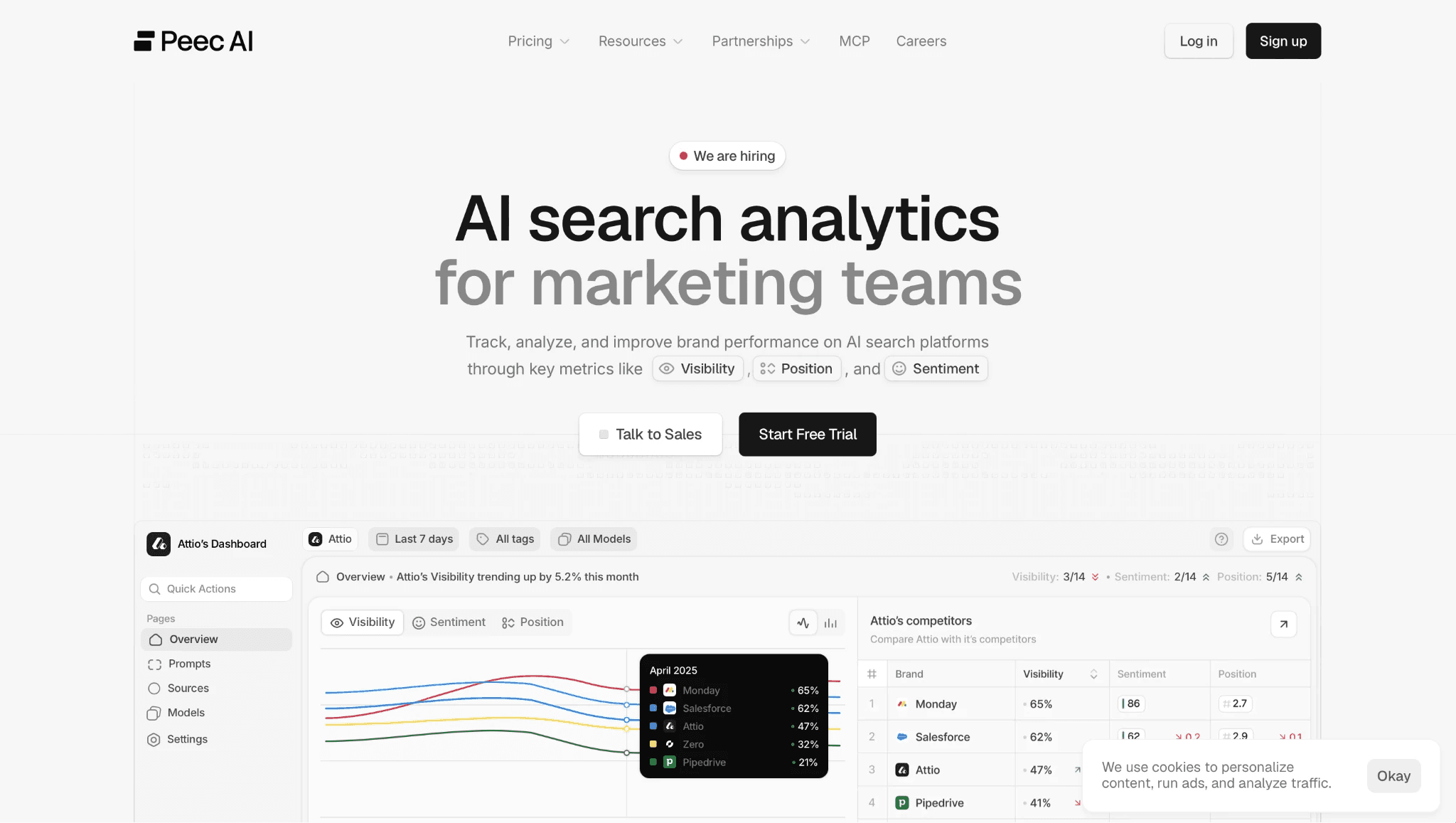
Peec AI is a Berlin-built AI search analytics platform tracking visibility, average position, citation share and sentiment against named competitors. It scrapes the assistants' own web interfaces rather than calling model APIs, so logged responses stay close to what a real user sees.
The structural detail is worth knowing: every self-serve plan covers three models, and that number never moves. Starter, Pro and Advanced all let you pick three from the pool. Extra engines are add-ons at $35/month on Starter, $85 on Pro and $165 on Advanced, per model. A team paying $495 chooses from the same list as a team paying $95.
The platform measures and benchmarks. It doesn't audit your site, produce a fix list, or attribute AI mentions to traffic and leads.
Key features
Visibility, position, citation share and sentiment with competitor benchmarking
Daily tracking on every plan
Automatic prompt suggestions generated from your site content
Native MCP server for Claude, Cursor and n8n workflows
AI Shopping Analytics tracking product-level recommendations, added June 2026
Agent Analytics with a crawlability checker and server-log AI crawler tracking
CSV exports on all plans, Looker Studio connector and API on higher tiers
Pros
Unlimited user seats on every paid tier, which is a real procurement advantage
Clean interface with a short setup, widely praised in reviews
Multi-country and multi-language tracking
Early and mature MCP implementation
Cons
Three models on every self-serve plan, including the $495 tier. Broad coverage means stacking add-ons
Google AI Overviews, Claude, Copilot and Grok sit outside the standard brand plans
Measurement only, with no site audit, fix list or lead attribution
API and SSO are Enterprise-only
$95 for 50 prompts is mid-to-high on cost per prompt here
Pricing
Brand plans: Starter $95/month (50 prompts, 3 models, 1 project), Pro $245/month (150 prompts, multi-country), Advanced $495/month (350 prompts, Looker Studio). Enterprise custom with all models, API and SSO. Agency plans run $245 to $795. Extra models $35 to $165/month each.
Verdict
Peec fits teams that already own content production and want trustworthy monitoring without a learning curve, particularly larger teams, since unlimited seats removes the per-head maths every other tool here charges. The constraint is engine coverage, which stays at three no matter how much you spend, so price out the add-ons before comparing the headline figure to anything else on this list.
G2 rating: 4.8/5
10. Cloro.dev - Best for teams building their own tracking
About Cloro.dev
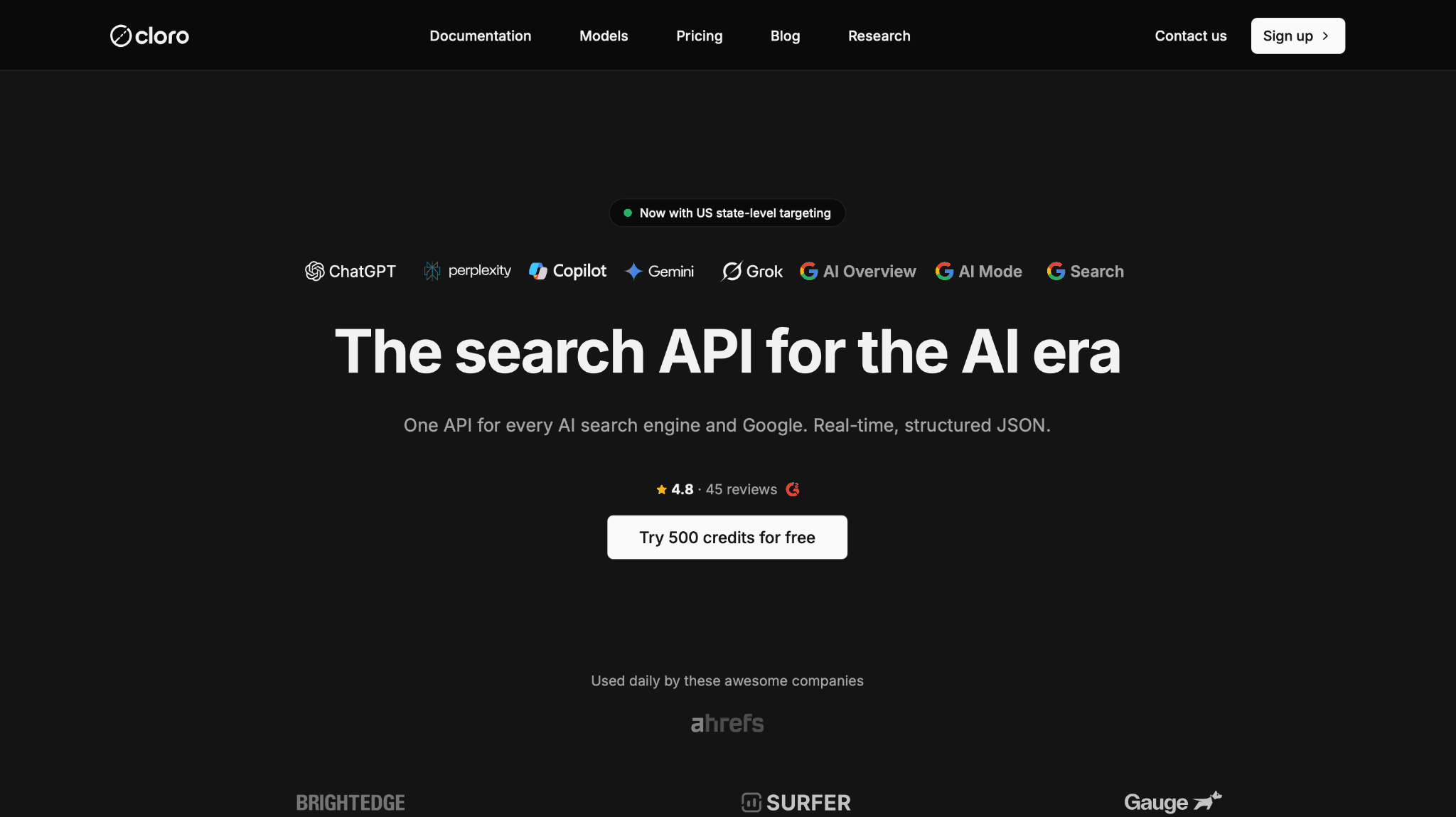
Cloro has no dashboard, no visibility score and no alerts. It's a search API that returns AI answers as structured JSON across ChatGPT, Perplexity, Copilot, Gemini, Google AI Mode, AI Overview, Google Search, Grok and Google News.
Each request returns the parsed response as markdown, text or raw HTML, plus sources with position and URL, query fan-out and shopping cards. Targeting covers every country, with US state-level routing on ChatGPT, Copilot, Perplexity and Gemini.
Cloro scrapes the chat interfaces rather than calling model APIs, which is why sources and citations come back at all. Provider APIs don't return them.
Key features
One API across eight AI and search surfaces with consistent structure
Parsed sources and citations, query fan-out and shopping blocks in every response
Country plus US state-level targeting via regional proxies
Async endpoint with webhooks for high-volume jobs
Integrations for Python, JavaScript, n8n, Zapier, LangChain and an MCP server
Free weekly AI Visibility Leaderboard covering 12 software categories, with no signup
99.99% uptime, automatic retries up to 10 attempts
Pros
Cheapest way to run high-volume tracking, at $0.31 to $0.80 per 1,000 credits
Unlimited seats on every paid plan
500 free credits monthly with no card
Credits only deducted on successful extraction
Publishes its data methodology openly through the leaderboard
Cons
No dashboard, scoring, alerting or reporting. You're buying raw data
Needs engineering time to become useful, which is a cost the price doesn't show
Credits expire monthly with no rollover
No Claude coverage
Concurrency is capped by tier, so scale means upgrading
Pricing
Free: 500 credits/month. Lite $30 (37,500 credits). Hobby $100 (250,000). Starter $250 (650,000). Growth $500 (1,350,000). Business $1,000 (2,800,000). Enterprise tiers from $2,000 to $5,000+. Per-1,000-credit rates fall from $0.80 to $0.31 as volume rises. Unlimited seats on all paid plans.
Verdict
Cloro belongs on this list because it's what several tools here are built on top of. If you have engineering capacity and want tracking shaped to your own reporting, buying the data directly is dramatically cheaper than buying a platform. If you don't, you're buying a JSON endpoint and a build ticket, and every other tool here will get you a number faster.
G2 rating: 4.8/5
How to Pick the Best LLM Tracking Tool
There's no single best tool here, which is why the list is grouped by job rather than ranked. What you should buy comes down to four things.
1. Engines: Check the entry plan, not the homepage. Six of these tools give you everything at their lowest price. Four don't. If your buyers live in ChatGPT and Perplexity, paying for ten surfaces is spend without a return.
2. Billing unit: Some bill prompts, some scans, some credits. SE Ranking counts one prompt on one platform as one check, so 200 checks is 40 prompts across five engines. Multiply prompts × engines × refresh rate before comparing any two prices.
3. Refresh rate: Most run daily. Allmond's automatic scans and SE Visible run weekly, which stretches your feedback loop from days to a month.
4. Reporting or execution: This is the one most teams get wrong. Semrush, SE Ranking, Peec, Allmond and Scrunch report and stop. Qwairy adds briefs, Rank Prompt and Profound generate content, and AIclicks covers monitoring plus the publishing and outreach that closes the gaps it finds. If you have writers and a PR function, buy the cleanest reporting you can afford. If you don't, a dashboard alone leaves you with a list nobody works.
Bottom Line
The ten tools here don't compete with each other as directly.
If you need engine breadth on a small budget, Qwairy and Rank Prompt cover more surfaces at entry than anything else. If your site is large and hard for crawlers to parse, Scrunch solves a problem nobody else addresses. If your SEO already lives in Semrush or SE Ranking, adding a second login is a harder sell than paying for the module. And if you have engineers and a warehouse, Cloro's raw data costs a fraction of any platform.
The one thing every tool on this list will do is tell you where you stand. Fewer will help you change it.
That's the gap AIclicks was built for. Daily tracking across 10+ AI platforms, citation analysis showing which domains produce answers in your category, and agents that work those domains: publishing, outreach, directory updates, Reddit workflows. All of it self-serve from $59, no sales call.
Start your free AIclicks trial and see where your brand actually sits across ChatGPT, Perplexity, Gemini and the rest.
FAQs
1. What is an LLM tracking tool?
An LLM tracking tool runs a fixed set of prompts across AI assistants like ChatGPT, Perplexity, Gemini and Claude on a schedule, then records whether your brand was mentioned, how it ranked against competitors, which sources the model cited, and how it was described.
2. How much do LLM tracking tools cost in 2026?
Entry plans on this list run from $29/month to $250/month. Most sit between $49 and $99. Price alone is misleading because tools bill on different units, so multiply prompts × engines × refresh rate before comparing.
3. Why do two tools show different visibility scores for the same brand?
AI answers change by session, country and whether the model ran a live web search. Tools also collect differently: some scrape the chat interface, others call model APIs, which return no citations and skip the web retrieval layer. Same brand, same day, different numbers.
4. Can I track AI visibility for free?
Partly. Qwairy has a free plan with 120 credits, and Cloro gives 500 free credits monthly, both without a card. AIclicks offers free tools including a GEO audit and AI citation tracker. For continuous tracking across engines, you'll need a paid plan.
5. How many prompts should I track?
Start with 25 to 50 covering how buyers actually phrase questions in your category, not keyword lists. Expand once you see which prompts your competitors own.
6. Do LLM tracking tools work for local businesses?
Some. Peec, Semrush and SE Ranking support location-level tracking, and Semrush covers 68,000+ location and language options. Check whether multi-country support sits on the entry plan or a higher tier.



Any questions left?
Book a call here: