" width="14px"><path d="M 13.864 5.629 L 13.3 5.629 L 13.3 5.6 L 7 5.6 L 7 8.4 L 10.956 8.4 C 10.379 10.03 8.828 11.2 7 11.2 C 4.681 11.2 2.8 9.319 2.8 7 C 2.8 4.681 4.681 2.8 7 2.8 C 8.071 2.8 9.045 3.204 9.786 3.864 L 11.766 1.884 C 10.516 0.719 8.844 0 7 0 C 3.134 0 0 3.134 0 7 C 0 10.866 3.134 14 7 14 C 10.866 14 14 10.866 14 7 C 14 6.531 13.952 6.073 13.864 5.629 Z" fill="rgb(255, 193, 7)" height="14px" id="H_YjfTNpn" width="14px"/><path d="M 0 3.742 L 2.3 5.429 C 2.922 3.888 4.429 2.8 6.193 2.8 C 7.264 2.8 8.238 3.204 8.979 3.864 L 10.959 1.884 C 9.709 0.719 8.037 0 6.193 0 C 3.504 0 1.172 1.518 0 3.742 Z" fill="rgb(255, 61, 0)" height="5.428500000000002px" id="PlkthQDhg" transform="translate(0.875 0)" width="10.959199999999996px"/><path d="M 6.232 5.581 C 8.04 5.581 9.683 4.889 10.925 3.764 L 8.758 1.931 C 8.032 2.483 7.144 2.782 6.232 2.781 C 4.411 2.781 2.865 1.62 2.283 0 L 0 1.759 C 1.159 4.026 3.511 5.581 6.232 5.581 Z" fill="rgb(76, 175, 80)" height="5.581099999999999px" id="WlnJ5gngE" transform="translate(0.7 8.4)" width="10.924899999999994px"/><path d="M 6.864 0.029 L 6.3 0.029 L 6.3 0 L 0 0 L 0 2.8 L 3.956 2.8 C 3.68 3.576 3.183 4.254 2.526 4.75 L 2.527 4.749 L 4.693 6.582 C 4.54 6.722 7 4.9 7 1.4 C 7 0.931 6.952 0.473 6.864 0.029 Z" fill="rgb(25, 118, 210)" height="6.589883930775992px" id="x_rSW275p" transform="translate(7 5.6)" width="7px"/></g></svg>)



Reviewed by:
Matas Kibildis

Head of Growth @ aiclicks.io
Last updated:
Expert Verified

The way we measure, understand, and guide marketing performance has changed. In 2026, analytics is no longer a “nice-to-have.” It defines who wins across search, social media, and even the answers AI models deliver to real customers.
As the founder of AIclicks.io, an AI search visibility tool, I have witnessed brands struggle and succeed with digital analytics over the last decade. Those experiences shape how our team builds solutions and helps marketers make clear, confident decisions, one insight at a time.
Many marketers ask the same questions. With so many analytics tools available, which ones matter most? Which tools help you track marketing data, engage customers, and understand what is truly working across search, social, and email, while still delivering actionable insights for better strategy?
In this guide, I will share my perspective, compare fifteen of the best digital marketing analytics tools, and explain why AI-driven solutions like AIclicks have become essential for growth and visibility.
Quick Comparison Table of Digital Marketing Analytics Tools
Tool | Best For | Coverage | Key Features | Strengths | Limitations | Pricing |
|---|---|---|---|---|---|---|
AIclicks | Measuring visibility in AI-generated search & recommendations | 6 major LLMs (ChatGPT, Perplexity, Claude, Grok, AI Overviews, Gemini) | AI Search Visibility Dashboard, GEO/AI audits, prompt-level analysis, AI-optimized content creation | Only tool explaining why AI models cite sources; actionable AI Lift recommendations; AI-native analytics | Requires GA4 or similar for traditional session-based web analytics | Starts at $59/mo; refund guarantee |
Google Analytics 4 (GA4) | Core web & conversion analytics | Websites, apps, Google Ads, Google Search Console | Event-based tracking, predictive analytics, funnel analysis | Industry standard for conversion and funnel tracking; free for most businesses | No AI chatbot visibility, steep learning curve | Free; GA4 360 ~$12,500/mo |
SEMrush | All-in-one SEO & competitive research | Google Search, PPC, limited AI via add-ons | Keyword Magic Tool, site audits, competitive traffic intelligence | Huge SEO & PPC data sets; strong competitive benchmarking | AI tools are costly add-ons; complex for small teams | From $139.95/mo + $99+/mo AI tools |
HubSpot Marketing Hub | Unified CRM, marketing & revenue analytics | Email, ads, CRM, campaigns, websites | Marketing automation, CRM-linked analytics, multi-touch attribution | Best linkage between marketing performance and revenue | Expensive at scale; basic SEO & AI search insights | Starter $15/seat/mo; Pro $890/mo + $3,000 onboarding |
Tableau | Enterprise data visualization & BI | Any connected data source | Drag-and-drop visuals, data blending, Tableau Pulse insights | Best-in-class visualization for large datasets | No native data collection; requires analyst resources | $75/user/mo (Creator); $15/user/mo (Viewer) |
Mixpanel | Product & user behavior analytics | Web apps, mobile apps, SaaS products | Event tracking, cohort analysis, retention funnels | Fast, intuitive behavioral analytics | No SEO, traffic source, or AI visibility data | Free (≤1M events); Growth ~$28/mo |
Amplitude | Deep behavioral & retention analysis | Apps, SaaS platforms, digital products | Journey mapping, Compass correlation charts, predictive models | Best-in-class retention and engagement insights | Expensive at scale; not a marketing visibility tool | Free Starter; Plus from $49/mo |
Microsoft Power BI | Enterprise dashboards for Microsoft ecosystems | Excel, Azure, databases, marketing & sales data | Enterprise security, automated dashboards, Excel/Azure integration | Exceptional value for Microsoft-centric companies | Windows-only desktop; steep DAX learning curve | $9.99/user/mo (Pro); $20/user/mo (Premium) |
Google Looker Studio | Affordable reporting & dashboards | GA4, Google Ads, third-party connectors | Live data connections, shareable branded dashboards | Free and flexible; strong Google stack integration | Depends on connectors; third-party data can be unreliable | Free; Pro for enterprise |
Ahrefs | SEO performance & backlink analytics | Google Search, limited AI via paid add-on | Backlink tracking, Content Explorer, rank tracking | Most accurate backlink data available | No free trial; AI tracking is very expensive | From $129/mo + $199+/mo AI add-on |
Sprout Social | Social media analytics & management | Instagram, LinkedIn, X, Facebook | Social listening, sentiment analysis, reporting | Excellent UI and collaboration tools | No SEO or AI search insights; very high price | From $249/mo (annual billing) |
Improvado | Enterprise data aggregation & ETL | 200+ marketing & ad platforms | Automated ETL, data normalization | Eliminates manual data pipelines | Not a visualization tool; requires BI software | Custom (~$1,000–$5,000/mo) |
Kissmetrics | Revenue-focused marketing analytics | Websites, campaigns, customer lifecycle data | Revenue attribution, cohort analysis, lifecycle reporting | Strong linkage between behavior and revenue | Dated UI; less flexible than newer tools | From $299/mo (annual billing) |
Mailchimp | Email marketing analytics | Email campaigns, basic customer journeys | Open/click tracking, A/B testing, automation | Very easy for small businesses | Pricing scales quickly; limited customer depth | Free (limited); from $20/mo |
Klaviyo | E-commerce lifecycle analytics | Shopify, BigCommerce, email & SMS | Predictive CLV, deep e-commerce integrations | Best-in-class revenue attribution for e-commerce | Complex setup; expensive for large lists | Free (limited); from $20/mo |
TL;DR: 15 Best Digital Marketing Analytics Tools
In 2026, digital marketing success depends on using advanced analytics tools that track not only website and campaign performance but also your visibility in AI-powered search and conversational platforms. Marketers should choose tools that deliver real-time data, AI-driven insights, and fit smoothly into their existing workflows, ensuring they stay visible and effective across all digital channels.
Key Points:
Rely on analytics tools that collect data from multiple channels, give AI-based predictions, and show clear action steps, not just reports.
Tracking your brand’s reach in AI chatbots and new search engines is now as important as monitoring Google rankings.
Pair core analytics tools like Google Analytics 4 with specialized platforms (such as AIclicks for AI visibility or SEMrush for SEO) for a full view of marketing performance.
Choose tools that are easy to integrate, offer good support, and match your team's needs in both scale and technical skill.
Keep updating your strategies by measuring, acting on insights quickly, and checking your visibility in both traditional and AI-driven platforms.
Best Digital Marketing Analytics Tools for 2026
1. AIclicks
As search shifts from web page links to AI-generated answers, traditional web analytics are no longer enough. AIclicks is the best platform for this new era, helping brands measure their presence inside AI chatbots and LLM-driven recommendations, a territory where legacy tools are blind.
Key Features: AI Search Visibility Dashboard, Geo/AI Visibility Audits, Prompt-Level Analysis, and AI-Optimized Content Creation.
Strengths: Only tool that analyzes why AI models cite certain sources; provides actionable "AI Lift" recommendations.
Limitation: Highly specialized for AI search; requires integration with a tool like GA4 for legacy session-based metrics.
Best for: Marketing teams, agencies, and businesses that care about appearing in AI results, not just Google links.
Pricing: Starts at $59/mo for Starter; includes a full refund guarantee.
2. Google Analytics 4
Google Analytics has long been the foundation for web analytics, with GA4 offering machine learning-powered user tracking across websites, apps, and devices. It’s free for most businesses and offers advanced funnel analysis, predictive analytics, and connector support for Google Ads and Google Search Console.
However, it cannot tell you how your brand is perceived by a chatbot before a user ever clicks a link.
Key Features: Event-driven data model, predictive churn analytics, and seamless Google Ads integration.
Strengths: The gold standard for conversion tracking and funnel analysis.
Limitation: Steep learning curve; does not track brand mentions or citations within closed AI ecosystems like ChatGPT.
Best For: All businesses needing a trusted, cross-channel analytics platform. It remains the default for over 70% of marketers worldwide. For a step-by-step walkthrough on capturing AI-driven traffic in GA4, see our guide on how to track AI traffic in Google Analytics 4.
Pricing: Free for most businesses; GA4 360 starts at ~$12,500/mo.
3. SEMrush
SEMrush is an all-in-one marketing analytics platform that does keyword research, site audits, competitor benchmarking, and content marketing optimization. Its machine learning algorithms detect SEO opportunities and weaknesses you might miss.
While Semrush is a massive "all-in-one" suite, it is not as good as AIclicks for specialized AI tracking. Even though it offers an AI toolkit, it feels like an add-on to a legacy system rather than a native AI-first platform.
Key Features: Keyword Magic Tool, Site Audits, and Competitive Traffic Intelligence.
Strengths: Massive database for traditional SEO and PPC research.
Limitation: AI tracking tools are expensive add-ons; the platform can be overwhelming for small teams.
Best For: Content marketers, SEO teams, agencies wanting action-ready data.
Pricing: Starts at $139.95/mo; AI tracking tools add $99+/mo.
4. HubSpot Marketing Hub
If you want all your marketing analytics, CRM data, automation, and campaign performance reporting in one place, HubSpot’s Marketing Hub delivers. It’s a favorite for integrated customer relationship management and cross-channel reporting.
It excels at lead attribution but lacks the deep "Search Generative Experience" (SGE) insights that AIclicks provides.
Key Features: Marketing automation, CRM-integrated analytics, and multi-touch attribution.
Strengths: Best-in-class integration between marketing data and actual sales revenue.
Limitation: Extremely expensive as you scale contacts; SEO features are basic.
Best For: Mid-market to enterprise organizations that want integrated, actionable insights.
Pricing: Starter at $15/seat/mo; Professional starts at $890/mo (with $3,000 onboarding fee).
5. Tableau
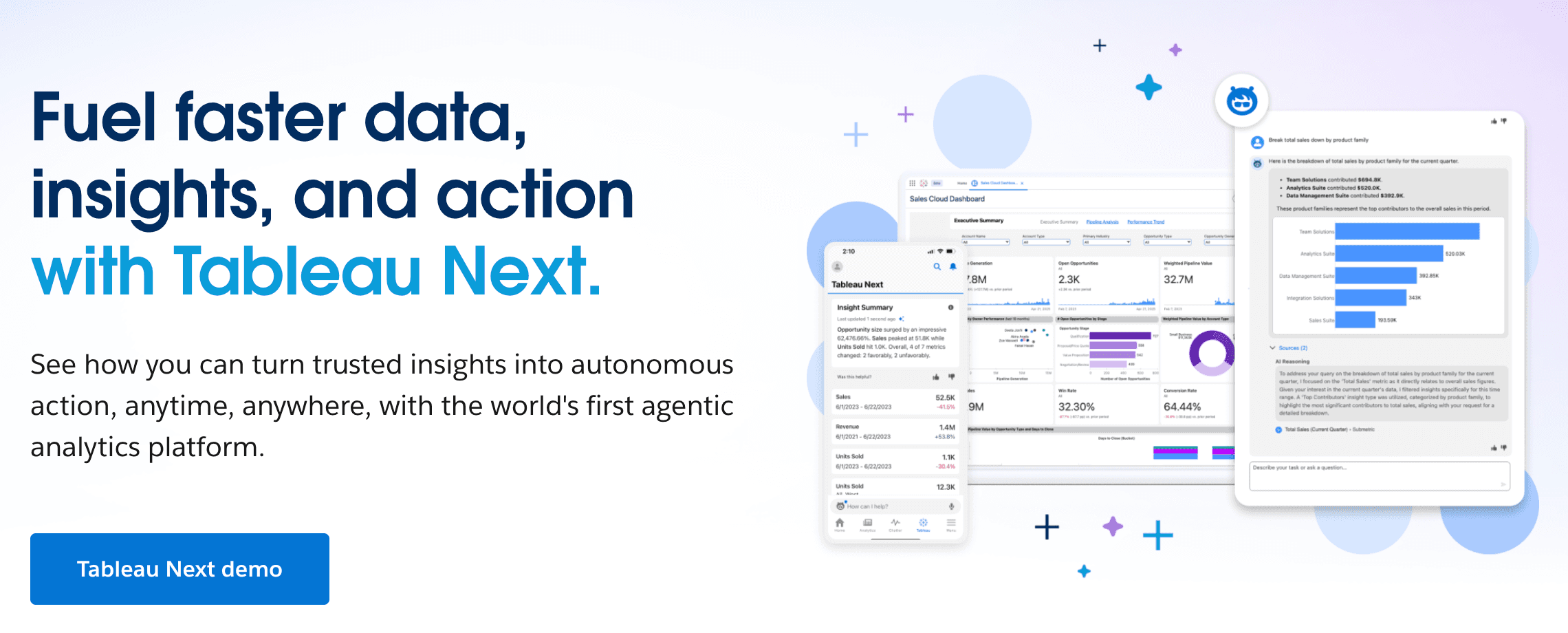
Tableau stands out for transforming raw marketing data into visual insights. It’s perfect for agencies and enterprises that need to analyze key metrics from multiple marketing channels and present findings in a visually compelling way.
Tableau is the "heavy lifter" for data visualization. It is a powerful business intelligence tool, but it doesn't generate data; it only visualizes it.
Key Features: Drag-and-drop visualization, complex data blending, and AI-powered "Tableau Pulse" insights.
Strengths: Unmatched ability to handle massive, disparate datasets.
Limitation: Requires a dedicated data analyst to set up; no native SEO or AI tracking.
Best For: Data teams, marketing agencies, and those who want the best business intelligence.
Pricing: $75/user/mo for Creators; Viewer licenses at $15/mo.
6. Mixpanel
Mixpanel makes product usage and customer journey tracking simple. Its easy setup and pricing make it a favorite for SaaS startups and growth teams.
Mixpanel is the go-to for SaaS companies focusing on product-led growth. It tracks what users do inside your app better than almost anyone.
Key Features: Event-based tracking, cohort analysis, and retention funnels.
Strengths: Exceptionally fast and easy to build complex user-behavior reports.
Limitation: Focused strictly on user actions; provides no data on external search or AI visibility.
Best For: Growth marketers focused on optimizing user flows and engagement.
Pricing: Free up to 1M events; Growth plan starts around $28/mo based on usage.
7. Amplitude
Amplitude goes deep into behavioral analytics and customer journey mapping. It blends data analysis, event tracking, and predictive analytics. The tool is designed for product teams who need to understand the "why" behind user retention.
Key Features: Customer journey mapping, "Compass" charts for correlation, and predictive modeling.
Strengths: Deepest behavioral insights for mobile apps and complex SaaS products.
Limitation: Very expensive for high-volume apps; not an SEO or marketing visibility tool.
Best For: Product and marketing teams wanting retention and engagement insights.
Pricing: Free Starter; Plus plan starts at $49/mo (billed annually).
8. Microsoft Power BI
Microsoft Power BI connects to existing Microsoft and Azure products, turning mountains of sales data and marketing metrics into detailed, custom dashboards. It’s a visualization powerhouse but lacks the specialized AI search intelligence of AIclicks.
Key Features: Integration with Azure and Excel, enterprise-grade security, and automated reporting.
Strengths: Incredible value for companies already using Office 365.
Limitation: The desktop version is Windows-only; high learning curve for DAX formulas.
Best For: Enterprises and advanced Power Users.
Pricing: $9.99/user/mo (Pro) or $20/user/mo (Premium).
9. Google Looker Studio
Looker Studio is a free reporting tool that connects to Google Analytics, Google Ads, social media platforms, and even other analytics software. Great for custom dashboards. However, it is a "shell" that requires data connectors to function.
Key Features: Live data connections, highly shareable reports, and custom branding.
Strengths: Free and integrates perfectly with the Google marketing stack.
Limitation: Third-party connectors (for social or AI data) can be buggy and expensive.
Best For: Small businesses or agencies needing affordable, flexible reporting.
Pricing: Free; Looker Studio Pro available for enterprises.
10. Ahrefs
Ahrefs is known for SEO analytics, including tracking backlinks, search traffic, and competitor content gaps. It is regularly cited among the best SEO analytics tools. However, its AI platform tracking is a paid add-on that is significantly more expensive than AIclicks.
Key Features: Backlink monitoring, Content Explorer, and Keyword Rank Tracker.
Strengths: The most accurate backlink database in the industry.
Limitation: No free trial; credit-based pricing can become very costly.
Best For: SEO teams and marketers focusing on organic growth.
Pricing: Starts at $129/mo; full AI tracking is a $199+/mo add-on.
11. Sprout Social
Sprout Social offers advanced analytics for social media management, empowering brands to optimize social media campaigns and measure social engagement. It helps you understand engagement on Instagram and LinkedIn but offers zero insight into search or AI engines.
If brand perception is the metric you care about most, I have also compared the best brand tracking tools in a separate guide.
Key Features: Sentiment analysis, social listening, and automated reporting.
Strengths: Excellent UI and centralized social inbox.
Limitation: Very high entry price; additional users cost the full plan price again.
Best For: Social media managers and agencies.
Pricing: Starts at $249/mo (billed annually).
12. Improvado
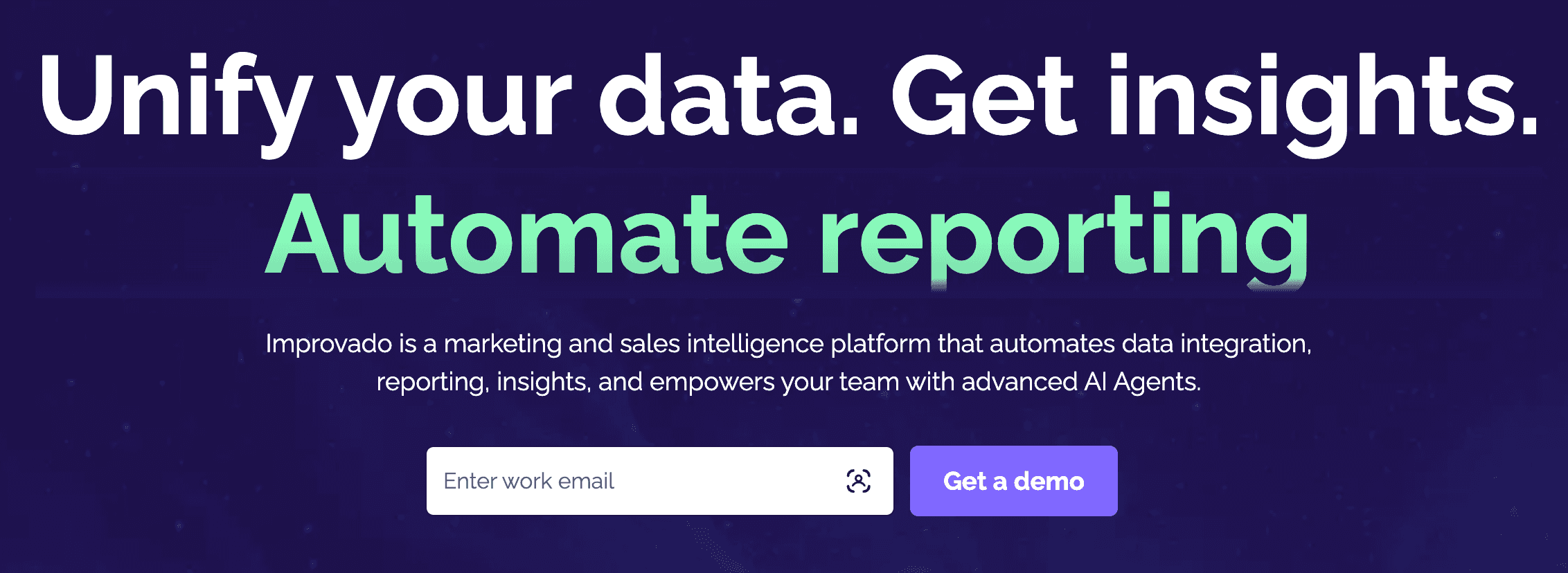
Improvado helps enterprises by aggregating and transforming marketing data from over 200 sources with AI-driven integration. It automates data collection and centralizes reporting, making large-scale marketing analytics easier.
Key Features: Automated ETL (Extract, Transform, Load) pipelines and data normalization.
Strengths: Eliminates manual CSV exports for large marketing teams.
Limitation: It is a data pipeline, not a dashboard; you still need a tool like Tableau to see the data.
Best For: Enterprises with multiple sources and large teams.
Pricing: Custom enterprise pricing (estimated $1,000–$5,000/mo).
13. Kissmetrics
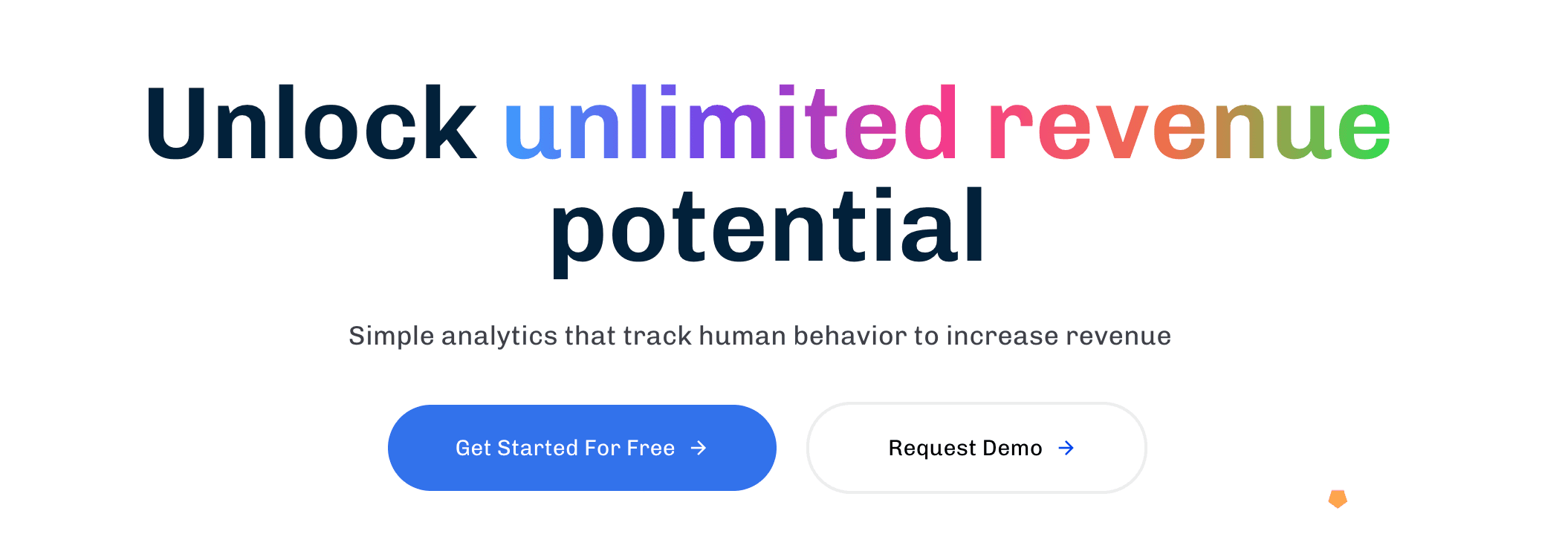
Kissmetrics tracks conversions, cohorts, and revenue. If you need campaign performance insights tied closely to sales and customer lifecycles, it’s a solid choice.
Key Features: Lifecycle reporting, revenue tracking, and cohort analysis.
Strengths: Connects behavioral data directly to revenue.
Limitation: The interface feels dated compared to Mixpanel or Amplitude.
Best For: Marketers who want to tie marketing strategies to revenue.
Pricing: Starts at $299/mo (billed annually).
14. Mailchimp
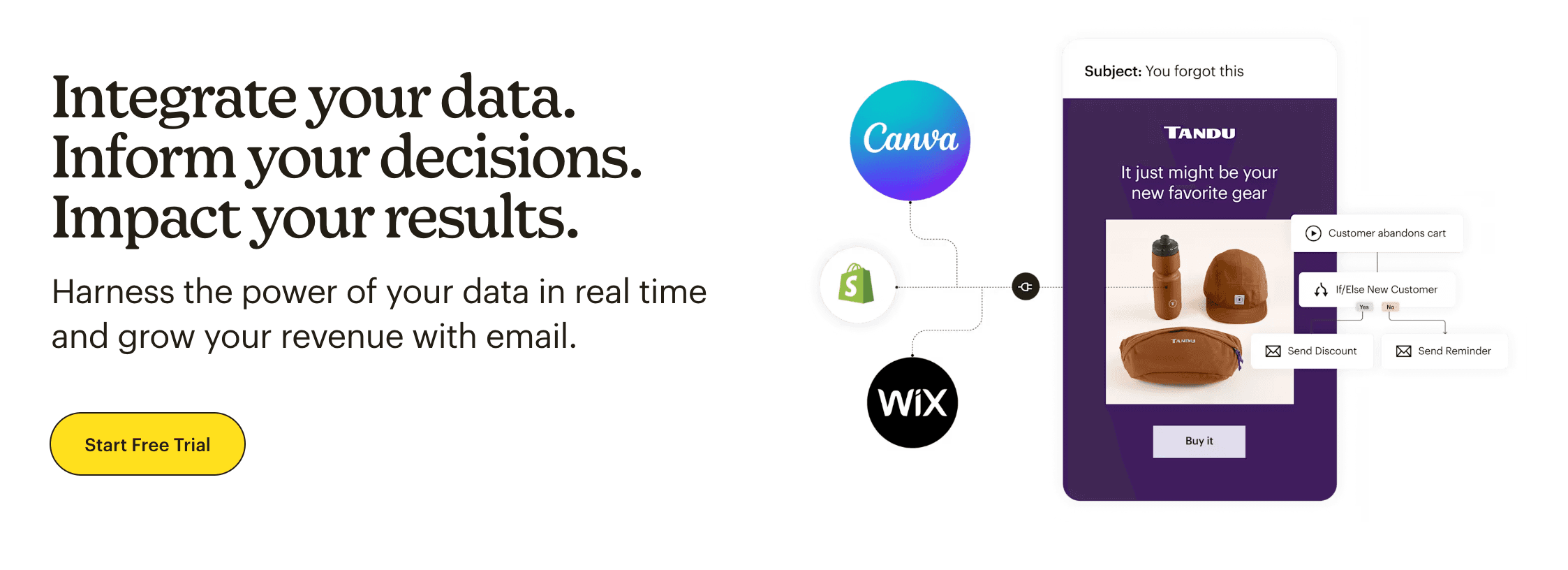
Mailchimp is a go-to solution for email marketing analytics and automation. Its reports cover open rates, click rates, and more, with real-time campaign performance.
Mailchimp is the standard for email analytics, but lacks the advanced "per-customer" depth found in Klaviyo or AI-search depth in AIclicks.
Key Features: Open/click tracking, A/B testing, and journey builders.
Strengths: Extremely easy to use for small businesses.
Limitation: Pricing increases sharply as your subscriber list grows.
Best For: Small businesses and e-commerce brands.
Pricing: Free (limited); Standard starts at $20/mo for 500 contacts.
15. Klaviyo
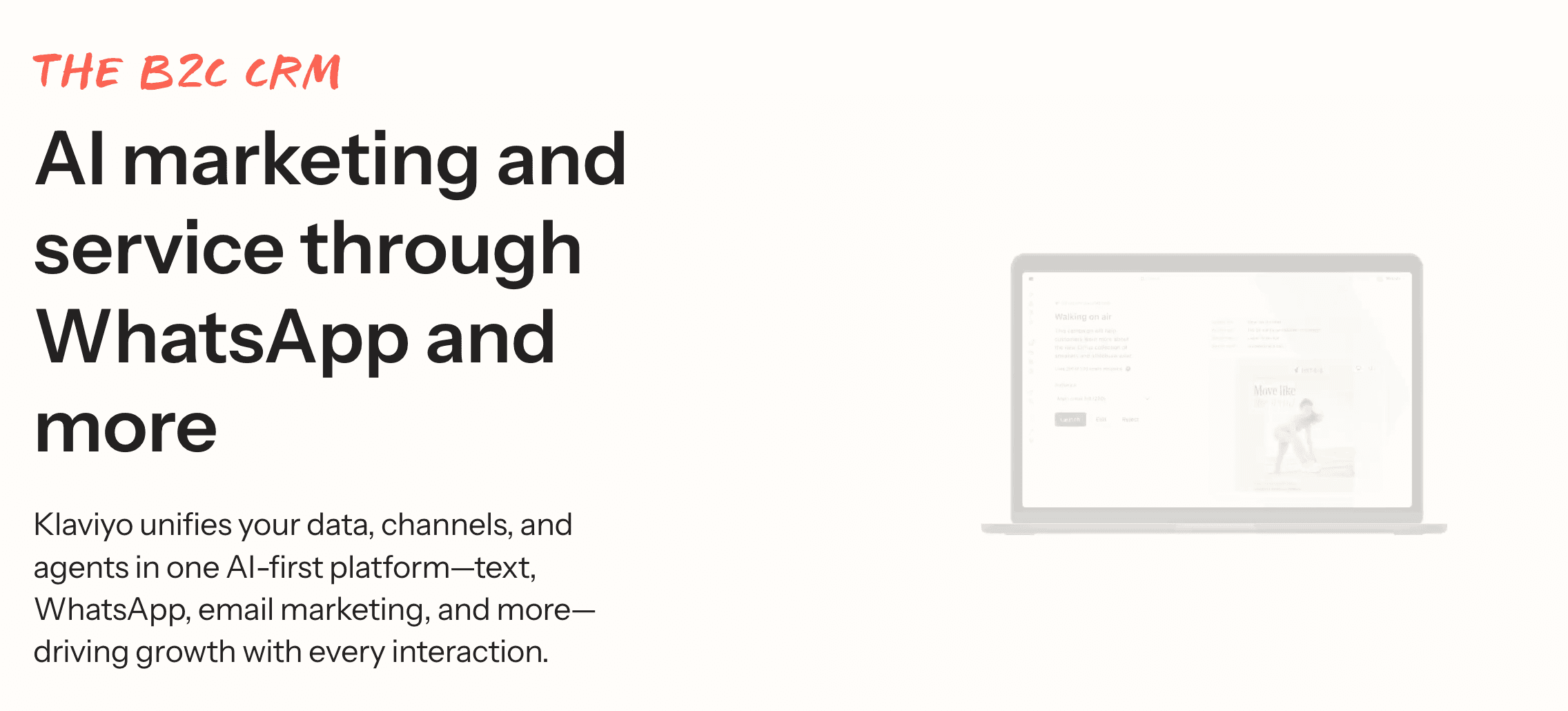
If you sell online, Klaviyo offers e-commerce-specific marketing analytics, tracking every email, SMS, and site visit down to customer-level detail.
Klaviyo is the "brain" for e-commerce brands, especially those on Shopify. It tracks every cent earned from an email or SMS.
Key Features: Deep Shopify/BigCommerce integration and predictive customer lifetime value.
Strengths: Highly personalized automation based on past purchase behavior.
Limitation: Can be complex to set up; expensive for large lists.
Best For: Shopify brands and online sellers.
Pricing: Free (limited); Email plans start at $20/mo for 500 contacts.
Why Analytics Tools Are Now Mission Critical
Digital marketing is more multi-channel and competitive than ever. User journeys span websites, social media networks, email, search engines, and chat-based AI assistants. Every click and conversion tells a story. Without the right analytics platform, you are essentially flying blind and guessing instead of knowing which campaigns drive results.
Gone are the days when Google Analytics was enough. Marketers now want deeper insights, predictive analytics, and tools that track both traditional web traffic and AI-driven search (think of users asking ChatGPT or Perplexity, “What’s the best tool for keyword research?”). Advanced analytics tools help you understand marketing performance, track user behavior, and fine-tune every campaign for more leads, sales, and loyal customers.
What matters most in 2026?
Accurate, real-time data from multiple sources (search, social, web, email).
AI-powered insights: Predict what will work, not just report what happened.
Ease of integration into your existing marketing stack.
Actionable insights: Clear next steps, not just pretty dashboards.
What to Consider When Choosing Analytics Tools
Choosing the best digital marketing analytics tools means looking beyond buzzwords and logos. Here’s what I recommend evaluating:
Features: Does the tool offer real-time data, predictive analytics, AI capabilities, and customizable dashboards?
Best Use Case: Small business, enterprise, social media, email marketing, or SEO? Each tool shines in specific areas.
Supported Data Sources: Can it pull data from all your important marketing channels?
AI/ML Capabilities: Does it help with things like LLM (large language model) answer tracking, or just historical reporting?
Integrations: Will it fit into your existing marketing stack with ease?
Pricing and Scale: Does the structure fit your team’s budget as you grow?
Support and Training: Are resources available when you need help?
For example, pairing Google Analytics with Tableau gives you both robust analytics and powerful reporting tools. If you care about AI answer visibility, you’ll want a solution like AIclicks that specializes in this new marketing data.
How AI Search and LLM Visibility Are Changing Digital Analytics
In 2026, it is no longer just about ranking on Google search results pages. Increasingly, people discover brands through AI-powered chat surfaces such as ChatGPT, Google’s conversational search, Perplexity, and Bing Copilot. These models answer questions like “What’s the best digital analytics tool?” directly, based on their preferred sources.
This is why we built AIclicks, to give brands the same level of visibility into conversational AI recommendation engines that they already have in Google Analytics for the web. For example, when we recently asked ChatGPT, “Where can I find the best tool for social media analytics?” the answer referenced brands with strong content assets, clear authority, and up-to-date AI-facing content. That outcome is intentional. Our platform enables clients to measure performance and win visibility in these emerging channels.
Winning in this new landscape means:
Monitoring prompt-level mentions and citations inside AI tools.
Mapping questions that lead to revenue (not just web traffic).
Building “liftable” answer-first pages, regularly refreshed.
Tracking competitor visibility inside AI answers.
If you don’t know your position in these hidden “AI rankings,” you might be invisible to a big chunk of your true market.
Integrating Analytics Tools into Your Marketing Stack
Most teams use more than one analytics tool. Best practice:
Combine Google Analytics 4 for core website data, Tableau or Power BI for dashboards, and SEMrush/Ahrefs for SEO.
Use Sprout Social or Kissmetrics for channel-specific insights (social, lifecycle).
Layer in AIclicks to track and improve your position inside answers surfaced by large language models.
Keep in mind, integration is key. If your data sits in silos, you’ll miss the bigger picture. Look for platforms, like Improvado or Looker Studio, that support data aggregation. Always set up customizable dashboards, so your team gets meaningful insights, not just raw numbers.
If organic rankings are a KPI you report on, dedicated SEO ranking software can feed position data into those same dashboards.
Conclusion: Mastering Your Marketing Stack for 2026
The era of "set it and forget it" reporting is over. In 2026, the most successful brands are those that move beyond basic analytics to embrace data-driven insights that span the entire user journey. Whether you are analyzing user behavior on a niche landing page or trying to optimize multi-channel campaigns for a global product launch, your choice of marketing analytics software will determine your ability to scale.
By integrating popular digital marketing tools, from a robust social media management platform to advanced search engine optimization suites, you can transform raw data into a competitive advantage. The goal is to move from simply seeing social media posts to understanding how those posts drive customer engagement and long-term loyalty.
Your strategic roadmap for growth:
Analyze Data Across Silos: Don't let your data live in isolation. Use multiple data sources and connectors like Google Data Studio to create a single source of truth for your marketing efforts.
Deepen Customer Understanding: Leverage top analytics tools to map customer behavior and identify the "why" behind every conversion.
Future-Proof Your Strategy: Incorporate comprehensive analytics that track your brand’s presence in AI-driven results, ensuring your marketing campaigns remain visible as search habits evolve.
Ultimately, the right software solutions are those that offer detailed insights while maintaining a pricing structure that fits your current needs, whether that's a starter tier or a full enterprise plan. By utilizing historical data for competitor analysis and staying agile with marketing cloud capabilities, you can ensure your ad campaigns deliver maximum impact.
Frequently Asked Questions
Which digital marketing analytics tool is best for small businesses?
Small businesses often start with Google Analytics 4 because it’s free and covers most needs. Looker Studio offers strong visualization, while Mailchimp handles email analytics. For future-proof AI visibility, AIclicks starts affordably.
How do you measure AI-search performance?
Traditional analytics track web traffic, while tools like AIclicks monitor mentions and citations in AI-generated answers and prompts, which is data you will not find in Google Analytics.
Can these tools track social media ROI?
Yes. Tools like Sprout Social, SEMrush, and HubSpot provide detailed analytics on social media campaigns, engagement, and ROI. AIclicks also measures your brand’s share in conversational recommendations.
Are all analytics tools easy to integrate with existing stacks?
Most top platforms (e.g., Google Analytics 4, Improvado, Looker Studio) offer robust integrations and APIs. Check for pre-built connectors and, ideally, trial integrations before long-term commitment.
Do advanced analytics platforms require technical knowledge?
Some, like Tableau and Power BI, benefit from data visualization backgrounds. Most tools now feature drag-and-drop dashboards and built-in help resources. Choose software based on your team’s skills and desired depth.



Any questions left?
Book a call here: